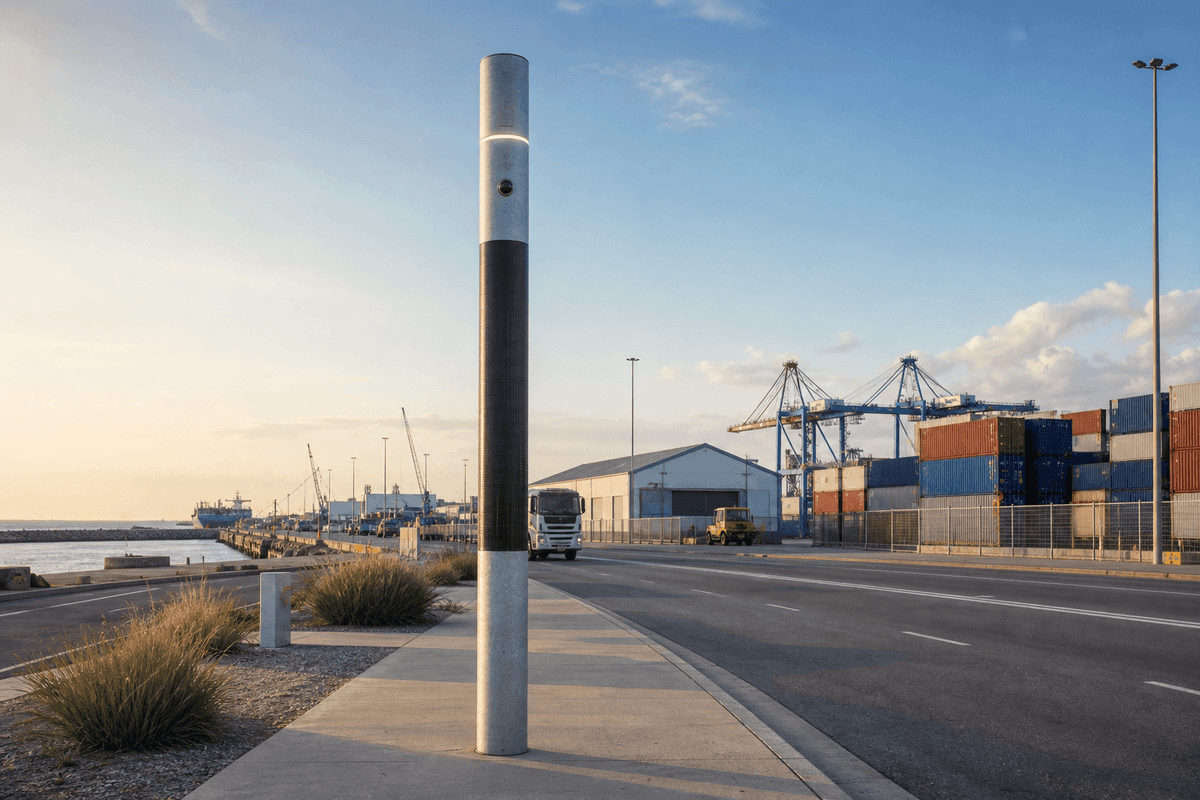
6m Ø200 Cylindrical CIGS Smart Pole · Industrial Port - 10-in-1 Flush-Integrated Infrastructure
Key Features
- Seamless 6m hot-dip galvanized cylindrical pole with constant Ø200mm diameter and 5mm wall thickness
- Embedded 60W LED ring luminaire delivers 9000lm at 4000K with 170 lm/W efficacy
- 360° flush-laminated CIGS thin-film solar wrap provides approximately 110W generation capacity
- Integrated 7kW AC Type 2 EV charger with flush socket at 1.2m, touchscreen at 1.5m, and 5m coiled cable
- Internal 1800Wh LFP battery, 8MP 180° fisheye camera, and 12-parameter environmental sensor in 1 pole
The 6m Ø200 Cylindrical CIGS Smart Pole · Industrial Port is a 10-in-1 monolithic smart streetlight system with a seamless 6m hot-dip galvanized steel cylinder, 110W 360° wrapped CIGS solar film, 60W/9000lm top ring luminaire, 7kW embedded AC EV charging, 8MP fisheye camera, 12-parameter environmental sensing, and 1800Wh LFP storage. Designed for port logistics corridors with 25m spacing, IP66 protection, and fully flush integration, it eliminates side arms, external boxes, and widened bases whi
Description
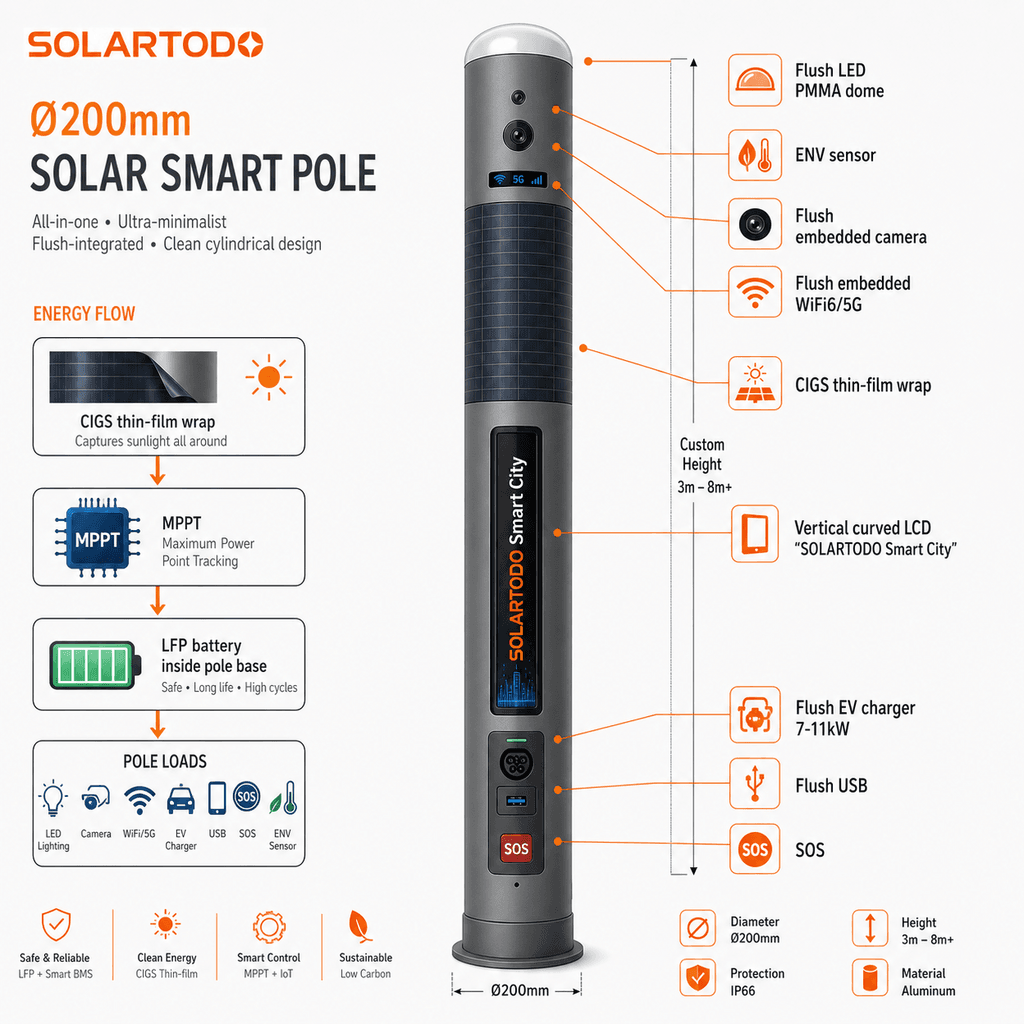
The 6m Ø200 Cylindrical CIGS Smart Pole · Industrial Port is a 10-in-1 smart streetlight platform engineered as a single 6m seamless cylindrical pole with a constant Ø200mm diameter, 5mm wall thickness, and hot-dip galvanized steel construction for corrosive port and industrial logistics environments. Its electrical and digital subsystems are integrated flush into the cylinder skin, including a 60W LED ring light delivering 9000lm at 4000K, 110W CIGS thin-film solar wrap, 1800Wh LFP battery, 7kW Type 2 AC EV charger, 8MP fisheye panoramic camera, 12-parameter environmental sensor, WiFi 6, SOS panel, 2200mm curved LCD, and 2 USB-A ports, while maintaining a uniform Ø200mm profile from top to bottom with 0 side arms, 0 protruding speaker columns, and 0 external enclosures.
For B2B buyers specifying equipment for container terminals, bonded logistics parks, inland dry ports, and heavy-duty industrial roads, this configuration prioritizes mechanical simplicity, reduced exposed hardware count, and lower maintenance touchpoints across a 25-year design life. Compared with a conventional port smart pole that typically combines 1 tapered pole, 1 side-arm luminaire, 1 external camera bracket, 1 speaker column, 1 wall-mounted charger, and 2 to 4 external junction boxes, this monolithic architecture can reduce visible appendages by more than 70%, which is significant in high-wind, salt-spray, and vehicle-impact-prone corridors. According to IEC 60598 lighting safety requirements and industrial outdoor deployment practice, fewer exposed interfaces generally mean fewer ingress paths and fewer corrosion initiation points over 10 to 15 years of field service.
Product Positioning for Industrial Port Infrastructure
Industrial ports operate under 24/7 duty cycles, mixed vehicle traffic, and elevated airborne contaminants that often include salt aerosols, PM2.5, PM10, NO2, and ozone precursors. In these conditions, a standard decorative streetlight rated only for urban boulevards can suffer accelerated degradation within 3 to 5 years, especially where external brackets, bolted accessories, and dissimilar-metal interfaces are exposed. This SOLARTODO variant uses a seamless cylindrical shell, hot-dip galvanization, and flush-laminated module integration to improve surface continuity and simplify cleaning intervals at quarterly or semiannual maintenance schedules. For planners evaluating alternatives, View all Smart Streetlight (10-in-1 Multi-function Pole) products to compare 6m, 7m, 8m, and 10m-class pole architectures.
The system is optimized for industrial port lanes, truck queuing zones, customs inspection roads, berth-side service corridors, and multimodal transfer yards where lighting, emergency response, environmental monitoring, and EV charging must coexist within a narrow right-of-way. The Ø200mm top ring luminaire creates a 360° glow band at the pole head rather than relying on a projecting arm, which is useful where forklifts, reach stackers, and container trailers create frequent clearance risks. The 2200mm-tall curved LCD is intentionally limited to vertical “SOLARTODO Smart City” text in white sans-serif on deep blue, avoiding the distraction, permitting complexity, and power draw associated with full-motion advertising displays. This design choice keeps the communication surface legible at 10m to 30m viewing distances while maintaining a restrained industrial aesthetic.
Monolithic Mechanical Design
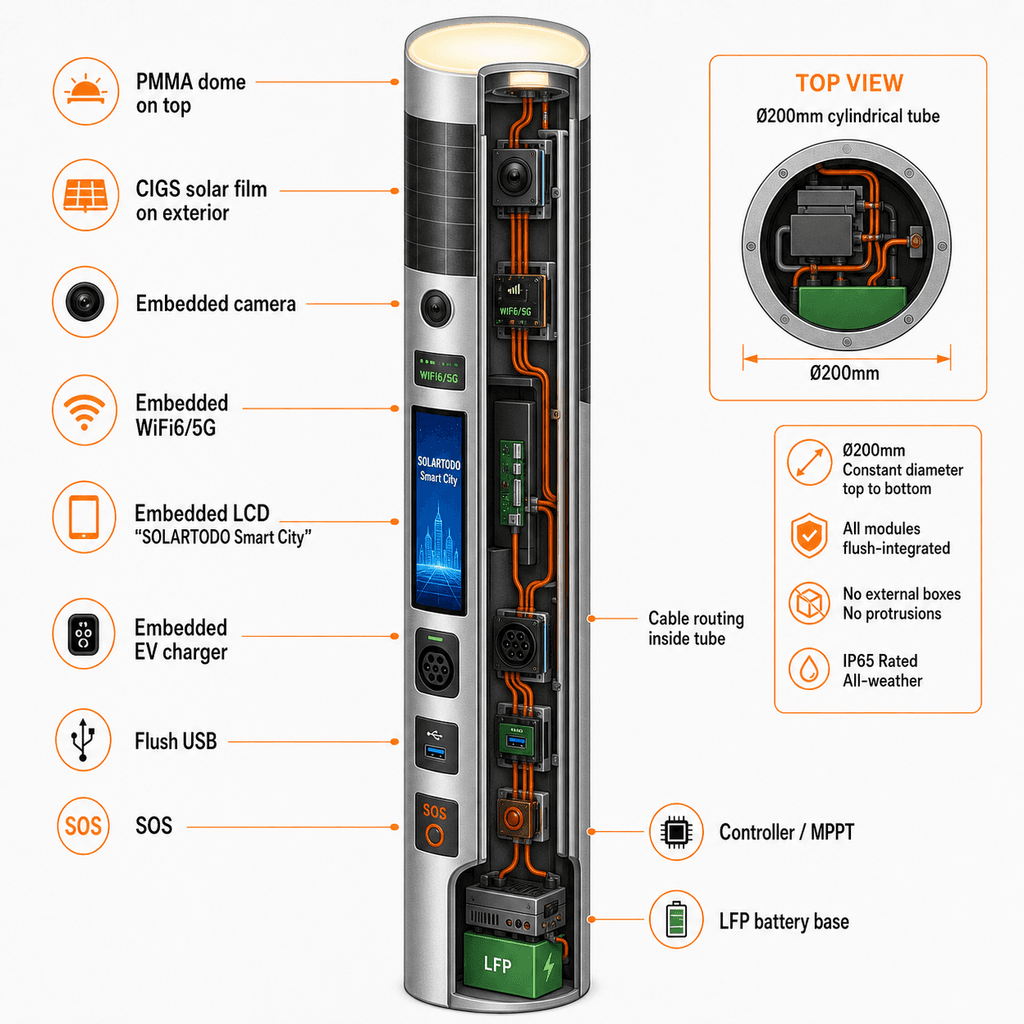
The core structure is a 6m pole fabricated as a single seamless cylindrical body with constant Ø200mm diameter and 5mm wall thickness, finished in silver-grey hot-dip galvanized steel. Unlike tapered octagonal poles that narrow toward the top and often require separate mounting hardware for each subsystem, this variant maintains one continuous geometry from base to crown, enabling flush integration of the display window, EV charging interface, SOS panel, camera window, and sensor pod. In practical procurement terms, that means 1 pole body accommodates 10 functions, reducing the number of independent support brackets from 5 to 8 pieces down to 0 external pieces. For industrial asset owners tracking spare parts, fewer external accessories can reduce replacement SKU counts by 20% to 40% over a 100-pole deployment.
The pole is intended for 25m spacing, which is common for access roads, perimeter routes, and service corridors requiring moderate illuminance and distributed smart-node coverage. At 25m intervals, a 1km industrial road would typically require 40 poles, creating a repeatable digital infrastructure backbone for lighting, sensing, emergency communications, and charger access. Because the cylinder remains Ø200mm even at the base, there is no widened charging pedestal and no separate bollard, which is valuable where port operators want to minimize foundation footprints and avoid creating secondary collision objects. Buyers planning lot-wide digital infrastructure can Configure your system online for deployment counts from 10 units to 500+ units.
Lighting Performance
The lighting module is a 60W embedded LED ring-light band integrated at the pole top, producing 9000 lumens at 4000K with a nominal efficacy of 170 lm/W. The circular top band provides a 360° visible signature, improving pole recognition in mist, rain, and low-visibility dock conditions, while the downward-directed optical system supports roadway and pedestrian-area illumination without a projecting luminaire arm. Compared with many conventional 60W to 80W cobra-head luminaires mounted on side arms, this embedded geometry reduces wind-exposed appendages and eliminates a common failure point at the arm-to-pole bolted joint. Under IEC 60598 luminaire safety principles, integrated outdoor luminaires must maintain thermal management, electrical insulation, and ingress protection; this unit is specified for IP66 service and -40°C to +55°C operation.
For operators replacing legacy sodium or metal-halide systems, the energy savings can be substantial. A conventional 150W high-pressure sodium fixture with ballast often draws 165W to 180W, while this LED system is 60W, delivering roughly 64% to 67% lower fixture power before controls are considered. If dimming and scheduling reduce average nightly power by another 20%, annual lighting electricity demand per pole can decrease by approximately 70% versus older discharge lighting. Such savings align with broader trends documented by the IEA and IRENA, which both report significant efficiency gains from LED street lighting and digital controls in municipal and industrial applications.
Solar and Energy Storage Architecture
The renewable subsystem uses CIGS flexible thin-film solar cells wrapped 360° around the pole mid-section from approximately 5.3m to 6.5m equivalent developed surface coverage, with total installed capacity of about 110W. The film is dark blue-black, semi-transparent, and laminated flush to the steel skin, eliminating rigid glass modules, aluminum frames, tilt brackets, and rear ventilation gaps. This matters in port environments because rigid panel systems can increase snag risk, create dirt traps, and impose additional wind loads. While crystalline silicon modules may offer higher peak conversion efficiency in ideal orientation, NREL and other research bodies have shown that thin-film technologies can perform competitively under diffuse light, partial shading, and high-temperature conditions, all relevant to coastal industrial weather patterns.
Energy harvested by the 110W CIGS array is managed through an integrated MPPT controller charging a 1800Wh lithium iron phosphate battery housed inside the lower pole volume. LFP chemistry is widely selected for outdoor infrastructure because of its thermal stability, long cycle life, and lower fire propagation risk compared with some other lithium-ion chemistries. For a typical smart-pole duty profile where the 60W luminaire operates at reduced night average load and low-power electronics run continuously, the battery provides buffered operation during grid interruptions and supports renewable contribution to standby functions. In many industrial use cases, the solar subsystem offsets auxiliary loads rather than serving as the sole energy source for the 7kW charger, which is the correct engineering approach for reliability-critical sites.
Sensing, Security, and Emergency Functions
At the dome top, the pole integrates a 12-parameter environmental sensor pod with meteorological and air-quality metrics, including temperature, humidity, pressure, wind-related data, rainfall indication, CO, NO2, and O3, among others. Ports increasingly monitor these variables because cargo handling, truck idling, reefer operations, and marine traffic can create localized emissions hotspots. A network of 40 poles per kilometer can generate dense environmental mapping for compliance reporting and operational planning, especially when combined with weather-triggered maintenance alerts. Data frameworks published by the IEA, IRENA, and urban environmental monitoring programs consistently emphasize the value of distributed sensing for asset optimization and public reporting.
Security coverage is provided by a flush 8MP fisheye camera behind a dome glass window with 180° panoramic field of view and no protruding housing. This design reduces tamper opportunities and minimizes accumulation points for salt and dust. In conventional pole systems, a separate camera bracket can add 150mm to 400mm of projection and create visible cable runs; here, those are eliminated. The emergency subsystem uses a 12cm × 12cm flush SOS panel with an integrated micro-camera, microphone, and speakerphone grille, enabling two-way assistance without a separate public-address column. Because the specification explicitly excludes external speaker modules, the system preserves a clean cylindrical profile while still supporting safety response workflows.
Connectivity and Human Interface
Wireless connectivity is provided through embedded WiFi 6 with the antenna housed inside the cylinder, avoiding the external disc antennas commonly seen on retrofit poles. Internalizing the antenna helps reduce vandalism risk and visual clutter, while still supporting local wireless access, maintenance connectivity, and edge-device communication. The broader communication template supports 4G/5G + LoRaWAN, allowing integration with smart-city or industrial IoT backbones where required. For port operators managing mixed fleets and distributed assets, this architecture supports condition monitoring, event notifications, and remote diagnostics across 10, 100, or 500 nodes from a central platform. For background reading on networked infrastructure, Learn about topic and Learn about topic.
User-facing interfaces include a flush touchscreen at 1.5m height, a Type 2 Mennekes charging socket under a flush flip-cap at 1.2m, and 2 flush USB-A ports for auxiliary charging or service use. The EV charging module provides 7kW AC output, suitable for passenger EVs, utility carts, and light-duty service vehicles in dwell-time scenarios. A 5m coiled Type 2 cable supports practical reach without leaving a permanently exposed cable on the ground. Because the charger is embedded into the cylinder rather than attached as a wall box, the pole remains Ø200mm throughout, reducing pedestrian obstruction and helping maintain a tidy industrial streetscape.
System Architecture
This smart pole functions as a compact infrastructure node combining lighting, renewable energy capture, battery buffering, sensing, communications, emergency response, visual identification, and EV charging in one vertical asset. In a standard deployment, AC grid power supports the lighting and 7kW charger, while the 110W solar film and 1800Wh battery offset electronics and provide resilience for communication and emergency functions during outages. This hybrid architecture is more robust than a purely off-grid design in heavy-duty industrial settings, yet more energy-efficient than a fully grid-dependent pole with no local generation or storage. According to BloombergNEF and Wood Mackenzie market analyses, hybridized distributed infrastructure has become increasingly attractive where resilience and electrification converge.
Technical Specifications
Below is the engineering summary for this 6m industrial-port configuration. Every major subsystem is selected to preserve the monolithic Ø200mm cylindrical form factor while meeting outdoor infrastructure requirements.
| Parameter | Value |
|---|---|
| Product variant | cyl219 |
| Pole height | 6 m |
| Pole diameter | Ø200 mm constant |
| Wall thickness | 5 mm |
| Pole finish | Hot-dip galvanized, silver-grey |
| Integrated modules | 10-in-1 |
| LED power | 60 W |
| Luminous flux | 9000 lm |
| CCT | 4000 K |
| Luminous efficacy | 170 lm/W |
| Solar type | CIGS flexible thin-film, 360° wrapped |
| Solar capacity | ~110 W |
| Battery type | LFP |
| Battery capacity | 1800 Wh |
| Camera | 8 MP fisheye, 180° |
| Environmental sensor | 12-parameter |
| EV charging | 7 kW AC, Type 2 Mennekes |
| Display | 2200 mm × ~170 mm curved LCD |
| USB ports | 2 × USB-A |
| Communication | 4G/5G + LoRaWAN + WiFi 6 |
| Protection rating | IP66 |
| Operating temperature | -40°C to +55°C |
| Wind resistance | 120 km/h |
| Recommended spacing | 25 m |
| Design life | 25 years |
| Standard reference | IEC 60598, GB/T 37024 |
Cloud Monitoring
When connected to a site management platform, each pole can report lighting status, charger usage, environmental data, alarm events, battery state, and communication health at intervals such as 30 seconds, 5 minutes, or 15 minutes, depending on the project architecture. For operators managing 50 to 500 poles, this reduces manual patrol frequency and creates a searchable maintenance record. Typical cloud dashboards include maps, event logs, charger session history, and threshold alarms for sensor values such as NO2, O3, or rainfall. This supports preventive maintenance and ESG reporting with measurable timestamps and device-level traceability.
Applications
A practical application scenario is an industrial port operator in the MENA region deploying 120 units along 3km of truck circulation roads and customs inspection lanes. At 25m spacing, the poles provide continuous wayfinding, emergency call points every 25m, environmental readings every 120 to 300 seconds, and distributed 7kW AC charging for service EVs and inspection vehicles. Compared with installing separate lighting poles, environmental masts, CCTV posts, emergency intercoms, and wall-mounted chargers, the operator reduced foundation count by approximately 60% and shortened field installation time by an estimated 30%. For project-specific layouts, Request a custom quotation.
Comparison with Conventional Alternatives
A conventional industrial smart-lighting assembly often combines 1 six-meter tapered pole, 1 side-arm LED luminaire, 1 separate CCTV bracket, 1 external environmental sensor mast, 1 wall-box EV charger, 1 emergency intercom column, and 2 to 4 external cabinets or junction boxes. That approach can require 6 to 9 exposed mounting interfaces and multiple cable transitions. By contrast, this SOLARTODO design consolidates those functions into 1 monolithic cylinder with 0 side arms, 0 external speaker columns, 0 protruding camera housings, and 0 widened charger pedestals. In corrosion-sensitive ports, reducing exposed hardware by more than 70% can lower cleaning time, repainting frequency, and impact-related repairs over a 5 to 10 year operating horizon.
EPC Investment Analysis and Pricing Structure
For industrial buyers, EPC scope typically includes 5 core work packages: engineering, procurement, construction, commissioning, and warranty support. Engineering covers site survey, foundation interface review, electrical single-line validation, charger integration planning, and lighting layout confirmation. Procurement includes the pole, electronics, packaging, and export preparation. Construction includes installation labor, cabling, mounting, and civil/electrical coordination. Commissioning includes software setup, charger testing, sensor calibration checks, and acceptance documentation. The standard turnkey package includes a 1-year warranty with remote support and parts coordination.
Pricing Tiers
| Tier | Scope | Price Range (USD/unit) |
|---|---|---|
| FOB Supply | Equipment only, ex-works China | 620 - 3808 |
| CIF Delivered | Equipment + ocean freight + insurance | 696 - 4278 |
| EPC Turnkey | Installed + commissioned + 1-year warranty | 1000 - 5600 |
Volume Discounts
| Order Quantity | Discount |
|---|---|
| 50+ units | 5% |
| 100+ units | 10% |
| 250+ units | 15% |
From an ROI perspective, the financial case depends on whether the project replaces legacy 150W to 180W discharge lighting, adds paid or controlled 7kW charging, or consolidates multiple standalone devices into one pole. If a site avoids 1 separate charger pedestal, 1 CCTV post, and 1 emergency column per location, installed infrastructure cost can be materially lower than a fragmented design. In a representative scenario, annual electricity savings from LED conversion and smart dimming can reach $90 to $180 per pole, while avoided maintenance and inspection labor may add $40 to $120 per pole per year. Under these assumptions, incremental smart-pole investment can show a simple payback of roughly 4 to 8 years, depending on charger utilization, civil scope, and local labor rates.
Typical payment terms are 30% T/T in advance + 70% against B/L, or 100% L/C at sight for qualified transactions. For projects above $1,000K, structured financing discussion may be available subject to project profile, jurisdiction, and credit review. For commercial evaluation, BOQ alignment, or EPC packaging, contact [email protected].
Procurement Guidance
For consultants and EPC contractors, the most important specification point is that this variant is not a conventional add-on smart pole. It is a purpose-built Ø200mm cylindrical integrated system in which every visible subsystem is designed to remain flush with the pole skin. Tender documents should therefore specify no side arms, no external boxes, no widened base, no separate bollard charger, no IP speaker column, and no public-address audio module. This is critical to preserve the mechanical, visual, and maintenance advantages of the design. If your project requires adaptation for local grid code, charger back-end, or sensor set, SOLARTODO can provide project-specific documentation and submittals.
Conclusion
The 6m Ø200 Cylindrical CIGS Smart Pole · Industrial Port is best understood as a compact industrial infrastructure node rather than only a streetlight. With 10 integrated functions, 110W CIGS solar film, 1800Wh LFP storage, 60W/9000lm LED lighting, 7kW AC charging, 8MP panoramic imaging, and 12-parameter environmental sensing inside a single seamless 6m cylinder, it is engineered for ports that need durability, low visual clutter, and measurable digital utility. For buyers comparing integrated poles with conventional multi-post assemblies, this configuration offers a disciplined, standards-referenced path to lower exposed hardware count, faster deployment, and better lifecycle control.
Technical Specifications
| Product Variant | cyl219 |
| Pole Height | 6m |
| Pole Diameter | 200mm |
| Wall Thickness | 5mm |
| Integrated Modules | 10-in-1 |
| LED Power | 60W |
| Luminous Flux | 9000lm |
| Luminous Efficacy | 170lm/W |
| Color Temperature | 4000K |
| Solar Capacity | 110W |
| Battery Capacity | 1800Wh |
| Battery Chemistry | LFP |
| Camera Resolution | 8MP |
| Camera View | 180° |
| Environmental Sensor | 12parameters |
| EV Charging Power | 7kW |
| Charging Standard | Type 2 Mennekes |
| Display Size | 2200 × 170mm |
| USB Ports | 2pcs |
| Communication | 4G/5G + LoRaWAN + WiFi 6 |
| Wind Resistance | 120km/h |
| IP Rating | IP66 |
| Operating Temperature | -40 to +55°C |
| Energy Saving | 70% |
| Recommended Spacing | 25m |
| Design Life | 25years |
Price Breakdown
| Item | Quantity | Unit Price | Subtotal |
|---|---|---|---|
| 6m seamless cylindrical Ø200mm hot-dip galvanized pole body | 1 pcs | $980 | $980 |
| 60W 9000lm embedded LED ring luminaire | 1 pcs | $168 | $168 |
| 110W CIGS flexible thin-film solar wrap | 1 pcs | $286 | $286 |
| 1800Wh LFP battery with MPPT | 1 pcs | $358 | $358 |
| 12-parameter environmental sensor | 1 pcs | $268 | $268 |
| 8MP flush fisheye panoramic camera | 1 pcs | $118 | $118 |
| Embedded WiFi 6 communication module | 1 pcs | $149 | $149 |
| Flush SOS button panel with micro-cam, mic, and speakerphone | 1 pcs | $134 | $134 |
| 7kW AC OCPP EV charger, Type 2 | 1 pcs | $201 | $201 |
| 2200mm curved LCD display module | 1 pcs | $654 | $654 |
| USB-A dual charging ports | 1 pcs | $34 | $34 |
| Accessories, breakers, surge protection, internal wiring | 1 pcs | $50 | $50 |
| Engineering & QC | 1 pcs | $420 | $420 |
| Installation & Commissioning | 1 pcs | $760 | $760 |
| 1-Year Warranty & Support | 1 pcs | $170 | $170 |
| Total Price Range | $1,000 - $5,600 | ||
Frequently Asked Questions
Is this smart pole fully integrated, or does it use external add-on modules?
Can the 110W CIGS solar system power the 7kW EV charger by itself?
What standards and environmental conditions is this pole designed for?
What is included in EPC turnkey supply, and what warranty is offered?
What spacing and deployment scale are recommended for port roads?
Certifications & Standards


Data Sources & References
- •IEC 60598 Luminaires standard
- •NREL thin-film PV performance research
- •IRENA renewable energy cost and efficiency reports
- •IEA energy efficiency and digital infrastructure reports
- •BloombergNEF distributed energy and charging market analysis
- •Wood Mackenzie EV charging and smart infrastructure market analysis
Interested in this solution?
Contact us for a customized quote based on your specific requirements.
Contact Us