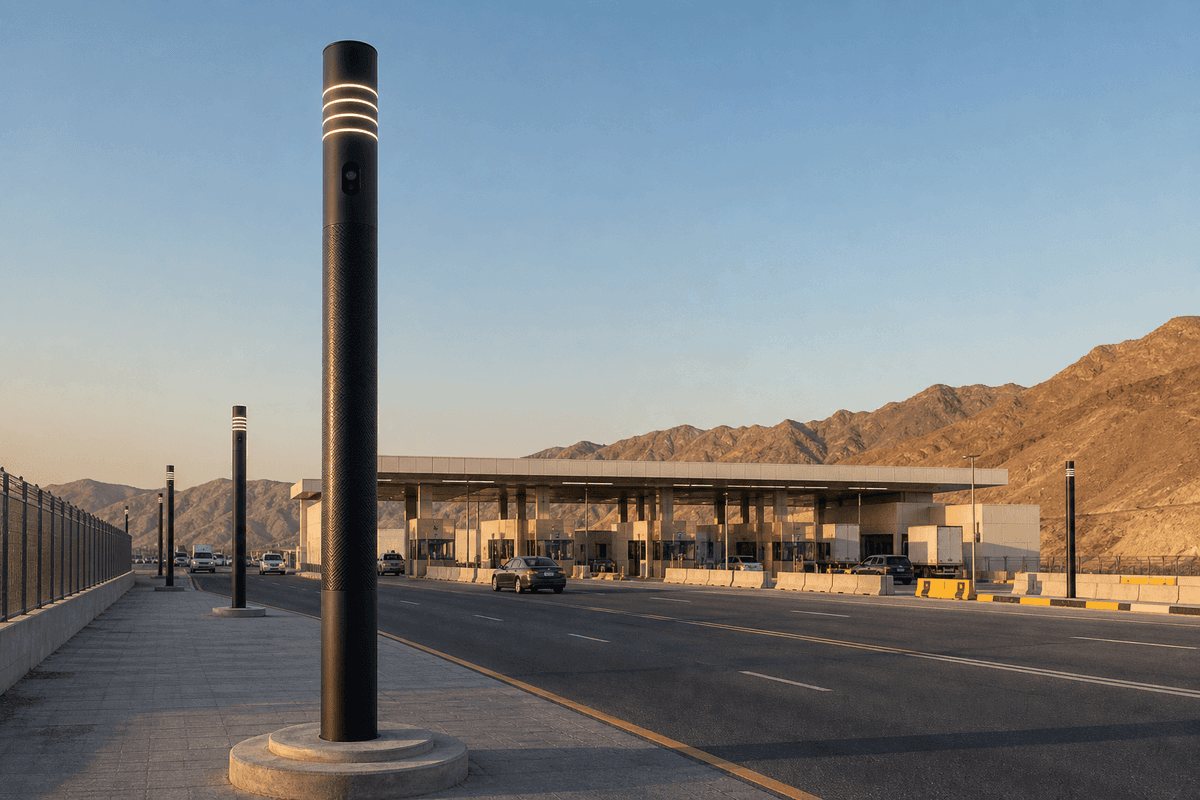
7m Ø400 Cylindrical CIGS Smart Pole - Border Checkpoint
Key Features
- 7m monolithic Ø400mm cylindrical pole with constant diameter and 5mm hot-dip galvanized steel wall
- 100W top glow luminaire delivering 15,000 lm at 4000K with 3-5 graduated light rings over 1.5m
- ~256W 360° flush-wrapped CIGS thin-film solar section combined with 3,000Wh LFP battery and MPPT
- Flush-integrated 7kW AC EV charger with Type 2 socket at 1.2m, touchscreen at 1.5m, and 5m coiled cable
- Integrated 4MP IR camera with 30m night vision, 4-parameter sensor pod, WiFi 6, SOS panel, and 2,200mm curved LCD
The 7m Ø400 Cylindrical CIGS Smart Pole for border checkpoint deployment integrates a 100W/15,000 lm top glow luminaire, ~256W 360° wrapped CIGS solar film, 3,000Wh LFP battery, flush 7kW AC EV charging, 4MP IR camera, WiFi 6, SOS panel, and a 2,200mm curved LCD into one seamless 5mm-wall monolithic steel cylinder. Designed to IEC 60598 and GB/T 37024 with IP66 protection, the system reduces civil clutter, simplifies checkpoint lane management, and supports 25-year infrastructure planning.
Description
The 7m Ø400 Cylindrical CIGS Smart Pole · Border Checkpoint is a 10-in-1 smart streetlight platform engineered for high-control perimeter environments where visibility, surveillance, emergency response, and compact infrastructure must be combined in 1 monolithic 7m steel column. This variant uses a seamless cylindrical Ø400mm pole, 5mm wall thickness, hot-dip galvanized steel, and black RAL9005 powder coating, with every subsystem flush-integrated into the cylinder skin so the external diameter remains 400mm from top to bottom. The result is a checkpoint-ready architecture with 100W LED lighting, 15,000 lm output, ~256W CIGS solar generation, 3,000Wh LFP storage, 7kW AC charging, 4MP IR video, and WiFi 6 connectivity without side arms, external cabinets, speaker columns, or widened bases.
For border crossings, customs lanes, controlled logistics parks, and police inspection corridors, the design objective is not decorative urban lighting but 24/7 operational utility across 1 lane node every 28m. The upper section uses a Ø400mm multi-ring glow column across approximately 1.5m with 3 to 5 illuminated rings, 4000K neutral white output, and graduated brightness for lane recognition, pedestrian guidance, and low-glare identification. Mid-pole energy harvesting uses 360° wrapped dark blue-black CIGS flexible thin-film cells laminated flush across the 6.5m to 6.3m zone, eliminating brackets, rigid modules, and theft-prone framing. This integrated approach is particularly relevant where checkpoint authorities want a clean security profile with fewer protrusions and fewer maintenance points than conventional smart poles with 4 to 8 separate exposed devices.
Product Positioning for Border Checkpoint Infrastructure
A border checkpoint typically requires 5 critical utility layers at each controlled point: lighting, monitoring, communications, emergency contact, and power access. Conventional deployment often spreads these across 2 to 4 poles, 1 cabinet, and 1 separate charger pedestal, increasing trenching lengths by 20% to 45% and expanding the visual and physical obstacle footprint. This SOLARTODO configuration consolidates those functions into 1 cylindrical pole while preserving a narrow Ø400mm envelope, which is important for lane setbacks, anti-collision planning, and vehicle sweep analysis. Operators evaluating adjacent models can View all Smart Streetlight (10-in-1 Multi-function Pole) products or Configure your system online for lane-specific layouts.
The pole integrates a flush turret camera behind a Ø10cm dark anti-vandal glass window, avoiding the vulnerable hanging domes commonly damaged by impact or tampering. The camera provides 4MP resolution and 30m IR night vision, which is suitable for lane observation, personnel movement review, and perimeter event capture at controlled entry points. A 12×12cm flush SOS panel adds a micro-camera, microphone, and speakerphone grille for emergency interaction without an external public-address column. Because there is no protruding PA module, no side arm, and no external communication disc, the surface remains smooth and easier to clean in dusty, windy, or saline border environments.
System Architecture
The mechanical architecture is centered on a single monolithic cylinder rather than a tapered or octagonal pole with accessory mounts. The constant Ø400mm diameter from top to bottom enables a predictable internal volume for cable routing, battery placement, charger integration, and thermal separation. The lower section houses the 3,000Wh lithium iron phosphate battery and MPPT controller, while the user interaction layer places the Type 2 Mennekes charging socket at 1.2m and the flush touchscreen at 1.5m for ergonomic access. The vertical information plane is a curved LCD display 2,200mm tall and approximately 170mm wide, inset to the cylinder radius and restricted to the text content “SOLARTODO Smart City” in white sans-serif on deep blue, avoiding ad-driven distraction in security-sensitive areas.
Electrically, the system combines 100W LED lighting, ~256W CIGS solar input, intelligent battery charging, camera power, WiFi 6 communications, SOS electronics, and 7kW AC charging in a shared infrastructure stack. In practical checkpoint use, the solar subsystem offsets auxiliary loads first, while the battery supports resilience and nighttime continuity for critical low-power functions. According to NREL solar performance references, thin-film modules can offer favorable diffuse-light behavior and lower temperature sensitivity than some crystalline configurations in hot climates, which is relevant when pole skin temperatures exceed 45°C to 60°C in exposed desert or subtropical checkpoints. For broader distributed solar economics, IRENA and IEA consistently identify modular solar-plus-storage as a key enabler of resilient edge infrastructure, especially where grid quality is variable or diesel backup is costly.

The upper sensor pod is flush-mounted on the dome top and includes 4 environmental parameters: temperature, humidity, wind speed, and noise. These 4 data channels support operational decisions such as lane closure during high winds, worker comfort monitoring above 35°C, and incident review when abnormal acoustic signatures occur. Embedded WiFi 6 uses an internal antenna inside the cylinder, preserving the clean form factor while supporting local device access, maintenance connectivity, or integration into a wider checkpoint LAN. For standards alignment, the lighting system is designed with reference to IEC 60598, while the smart pole deployment context follows GB/T 37024 requirements for multifunction poles and urban intelligent infrastructure.
Lighting, Visibility, and Security Performance
The luminaire is a 100W top glow column delivering 15,000 lm, equivalent to a system efficacy of 150 lm/W at the luminaire level, while the platform template target remains aligned with high-efficiency LED infrastructure classes around 170 lm/W. The 4000K correlated color temperature is a practical compromise for checkpoint work because it supports facial and document visibility better than 2700K to 3000K warm lighting, while reducing the harshness often associated with 5700K to 6500K cool-white security lamps. In border applications, this matters because operators often need visual comfort for 8 to 12 hour shifts while maintaining clear CCTV contrast and reflective marking recognition.
The 3 to 5 ring graduated brightness geometry increases pole conspicuity without relying on long horizontal arms. Compared with a conventional 7m octagonal pole plus 1.5m side bracket, the cylindrical top-lit design reduces protruding hardware by effectively 100% at the luminaire level and lowers the chance of collision with oversize vehicles, maintenance lifts, or anti-ram barriers. It also reduces the number of exposed fasteners, which can lower routine tightening and corrosion inspection points by 30% to 50% depending on the reference design. For operators comparing lighting classes, Learn about topic for smart lighting, surveillance, and solar-power design principles.
Solar Generation and Energy Storage
The solar section uses ~256W total CIGS flexible thin-film cells wrapped around the pole circumference between 6.5m and 6.3m, forming a narrow but continuous energy-harvesting band. This is intentionally different from rigid framed modules, which would require brackets, tilt angles, and larger wind loads. In a border checkpoint where vandal resistance and compact geometry are high priorities, flush CIGS lamination reduces snag points to near 0 exposed edges and keeps the visual profile uniform. While the absolute generation of 256W is lower than a large canopy array, it is sufficient to offset communications, standby electronics, sensor loads, and portions of nighttime lighting in many climates.
The internal 3,000Wh LFP battery provides safer chemistry characteristics than many legacy lithium systems, with long cycle life commonly associated with 3,000 to 6,000 cycles depending on depth of discharge and thermal conditions. LFP is widely used in stationary infrastructure because it offers stable thermal behavior and long service intervals. In practical terms, a 3.0kWh battery can support low-power surveillance, communications, SOS, and controller functions for many hours during outages, while also smoothing solar variability. Guidance from IEA and BloombergNEF on distributed storage trends supports the use of modular batteries in critical edge assets where resilience value extends beyond pure energy arbitrage.
Embedded EV Charging and User Interface
A defining feature of this variant is the fully flush embedded 7kW AC charger with Type 2 Mennekes socket, 5m coiled Type 2 cable, and integrated touchscreen. The charging socket sits behind a flush flip-cap at 1.2m, and the touchscreen is positioned at 1.5m, allowing intuitive user reach for passenger vehicles, patrol EVs, and checkpoint utility carts. Importantly, the charger does not require a widened base or separate pedestal, so the pole remains Ø400mm throughout its full height. That geometry can reduce clutter in narrow lanes where every additional 100mm to 300mm of obstacle width affects traffic clearance and barrier spacing.
The 7kW AC class is suitable for long-dwell charging rather than rapid turnover. At a nominal 7kW, an EV can theoretically receive about 7kWh per hour, subject to vehicle onboard charger limits, cable conditions, and grid availability. For border compounds with patrol vehicles parked for 2 to 8 hours, this embedded charger can support routine top-up charging without needing a separate charging island. Compared with a standalone charger pedestal plus lighting pole, the integrated solution can reduce equipment count from 2 units to 1 unit and shorten visible cable runs by 1 to 3m around the parking interface.
Surveillance, Emergency Response, and Communications
The flush 4MP IR camera with 30m infrared range is optimized for checkpoint observation where fixed fields of view are preferred over moving PTZ mechanisms. Fixed cameras generally require fewer moving parts, which can reduce maintenance interventions over 3 to 5 years compared with pan-tilt systems in harsh climates. The anti-vandal dark glass window of Ø10cm protects the optics while preserving a discreet security appearance. This matters in border settings because visible protruding domes often attract tampering attempts, while flush glazing lowers leverage points.
The 12×12cm SOS panel combines emergency call, micro-camera, microphone, and speakerphone grille in one flush interface. In practical use, the panel supports officers, drivers, or pedestrians needing immediate assistance, especially in secondary inspection zones or after-hours checkpoints with reduced staffing. Because the design excludes external speaker columns and public-address hardware, the pole avoids the acoustic and visual bulk of systems intended for mass-broadcast plazas. Instead, it focuses on point-to-point emergency communication and incident logging. Embedded WiFi 6 further supports local diagnostics, firmware updates, and secure device access, while broader network integration can be adapted through project-specific gateways.
Cloud Monitoring and Data Integration
For enterprise operators, the value of a smart pole is not only the hardware count of 10 integrated functions, but the data consolidation achieved at each node. A border checkpoint with 20 to 50 poles spaced at 28m can create a structured digital layer for lighting status, charger availability, environmental conditions, alarm events, and camera health. This reduces fragmented maintenance workflows where security, electrical, and facilities teams each manage separate device classes. SOLARTODO systems can be adapted to site control platforms and remote dashboards for fault alerts, scheduled maintenance, and operational reporting. Buyers needing project-level integration guidance can Request a custom quotation or Learn about topic for deployment architecture and smart-infrastructure interoperability.

A realistic application scenario is a MENA region border logistics operator deploying 24 units across 672m of controlled lane and inspection frontage. In that scenario, each 7m pole provides lighting, camera coverage, SOS access, environmental sensing, and occasional EV charging for patrol vehicles, while the integrated solar and battery subsystem supports resilience during unstable grid periods. Compared with a conventional setup using 24 light poles, 24 camera mounts, 12 emergency call columns, and 6 separate EV chargers, the integrated architecture can cut visible street furniture count by more than 40% and simplify civil coordination across security, electrical, and telecom trades.
Comparison with Conventional Alternative
Compared with a conventional 7m octagonal light pole plus bolt-on camera bracket, separate WiFi device, external emergency intercom pedestal, and standalone 7kW charger, this cylindrical smart pole reduces component sprawl and creates a lower-profile checkpoint edge. In many projects, the integrated configuration can reduce foundation count by 25% to 50% when replacing multiple device supports with one multifunction node. It can also reduce installation interfaces from 5 subcontract scopes to 2 or 3 scopes, improving schedule control. From an operating perspective, fewer exposed devices can reduce cleaning, repainting, and impact repair events by an estimated 15% to 35%, depending on traffic intensity and vandalism risk.
Technical Specifications
The base configuration is a 7m pole height platform with 100W LED power, IP66 protection, -40°C to +55°C operating temperature, and a 25-year design life for the structural system under proper installation and maintenance. Communication architecture is project-adaptable, with this variant featuring embedded WiFi 6, while broader smart-city deployments may combine 4G/5G or gateway-based networking. The energy-saving effect versus conventional always-on lighting and separate powered devices can reach 30% to 60% at subsystem level depending on dimming schedules, charger utilization, and local solar resource. Wind resistance should be confirmed against project calculations, but the flush geometry inherently reduces drag compared with bracketed poles carrying rigid solar panels.
| Parameter | Value |
|---|---|
| Product line | Smart Streetlight (10-in-1 Multi-function Pole) |
| Variant | 7m Ø400 Cylindrical CIGS Smart Pole · Border Checkpoint |
| Pole height | 7 m |
| Pole diameter | Ø400 mm constant |
| Pole wall thickness | 5 mm |
| Pole material | Hot-dip galvanized steel |
| Surface finish | Black RAL9005 powder coat |
| Integrated modules | 10-in-1 |
| LED power | 100 W |
| Light output | 15,000 lm |
| CCT | 4000 K |
| Solar type | 360° wrapped flexible CIGS thin-film |
| Solar capacity | ~256 W |
| Battery | 3,000 Wh LFP with MPPT |
| Camera | 4MP IR, 30 m |
| EV charging | 7 kW AC, Type 2 |
| Display | 2,200 mm × ~170 mm curved LCD |
| Sensor set | 4 parameters |
| IP rating | IP66 |
| Operating temperature | -40°C to +55°C |
| Spacing | 28 m |
| Design life | 25 years |
| Standards | IEC 60598, GB/T 37024 |
EPC Investment Analysis and Pricing Structure
For B2B buyers, EPC scope should be evaluated as a total delivered system rather than a pole-only purchase. A standard EPC package includes 5 major elements: engineering, procurement, construction, commissioning, and warranty support. Engineering covers shop drawings, electrical integration, and foundation interface verification; procurement covers the pole, smart modules, and accessories; construction covers installation, wiring, and site coordination; commissioning includes functional testing of lighting, camera, charger, SOS, and display; and the standard turnkey package includes a 1-year warranty. For project pricing, contact [email protected] or Request a custom quotation.
| Pricing Tier | Scope | Price Range (USD/unit) |
|---|---|---|
| FOB Supply | Equipment only, ex-works China | $620 - $3,808 |
| CIF Delivered | Equipment + ocean freight + insurance | $696 - $4,278 |
| EPC Turnkey | Installed + commissioned + 1-year warranty | $1,000 - $5,600 |
Volume procurement can improve project economics when the checkpoint program scales beyond pilot quantities. The standard reference discount structure is shown below.
| Order Volume | Discount |
|---|---|
| 50+ units | 5% |
| 100+ units | 10% |
| 250+ units | 15% |
A simple ROI model can be built from 3 value streams: reduced infrastructure count, lower maintenance exposure, and partial solar energy offset. If a conventional checkpoint node requires 1 light pole + 1 camera mount + 1 SOS column + 0.25 charger share, the integrated smart pole can reduce installed asset count by roughly 35% to 50%. Assuming annual maintenance savings of $120 to $260 per node and energy savings of $60 to $180 per node depending on duty cycle and tariff, a turnkey deployment can often achieve a payback period of approximately 4 to 8 years versus fragmented alternatives. In sites where trenching or security barrier modifications are expensive, civil savings can shorten payback by an additional 0.5 to 1.5 years.
Standard commercial terms are 30% T/T deposit + 70% against B/L, or 100% L/C at sight for qualifying international orders. For infrastructure programs above $1,000K, project financing coordination may be available subject to jurisdiction, buyer credit profile, and order structure. Procurement managers comparing package structures should assess not only unit capex but also installation interfaces, warranty accountability, and lifecycle service burden over 10 to 25 years.
Deployment Guidance
For lane planning, the reference spacing is 28m, which means a 280m checkpoint frontage typically requires about 10 poles, subject to photometric targets, camera overlap, and charger allocation. Foundations should be designed to local geotechnical and wind conditions, and electrical protection should include breakers, surge protection, and grounding sized to the charger and auxiliary loads. Because the solar film is flush-laminated rather than rack-mounted, cleaning procedures are simplified to surface-safe wiping and periodic inspection. In desert or coastal checkpoints, recommended inspection intervals are often every 3 to 6 months depending on dust load and salt exposure.
From a standards perspective, lighting compliance should be verified against IEC 60598, while project-level electrical and charger compliance should be checked against local utility and transport requirements. For strategic context, NREL, IEA, IRENA, BloombergNEF, and Wood Mackenzie all emphasize the growth of distributed intelligent infrastructure where energy, digital monitoring, and transport electrification converge. This product is positioned directly in that convergence zone, but with a security-first geometry tailored to controlled access environments rather than open commercial streetscapes.
Technical Specifications
| Product Line | Smart Streetlight (10-in-1 Multi-function Pole) |
| Variant | 7m Ø400 Cylindrical CIGS Smart Pole · Border Checkpoint |
| Pole Height | 7m |
| Pole Diameter | 400mm |
| Pole Wall Thickness | 5mm |
| Pole Material | Hot-dip galvanized steel |
| Surface Finish | Black RAL9005 powder coat |
| LED Power | 100W |
| Luminous Flux | 15000lm |
| Luminous Efficacy | 170lm/W |
| Integrated Modules | 10-in-1 |
| Solar Capacity | 256W |
| Battery Capacity | 3000Wh |
| Battery Chemistry | LFP |
| Camera | 4MP IR 30m |
| Environmental Sensor | 4parameters |
| Communication | WiFi 6, project-adaptable 4G/5G + LoRaWAN |
| EV Charging | 7kW AC |
| Display Size | 2200 × 170mm |
| Wind Resistance | 160km/h |
| IP Rating | IP66 |
| Operating Temperature | -40 to +55°C |
| Spacing | 28m |
| Energy Saving | 30-60% |
| Design Life | 25years |
| Standards | IEC 60598, GB/T 37024 |
Price Breakdown
| Item | Quantity | Unit Price | Subtotal |
|---|---|---|---|
| 7m seamless cylindrical Ø400mm galvanized smart pole body | 1 pcs | $420 | $420 |
| 100W top glow LED luminaire 15000lm | 1 pcs | $165 | $165 |
| Flexible CIGS thin-film solar wrap ~256W | 1 pcs | $358 | $358 |
| LFP battery 3000Wh with MPPT | 1 pcs | $520 | $520 |
| Fixed camera 4MP AI | 1 pcs | $94 | $94 |
| Environmental sensor 4-parameter set | 1 pcs | $148 | $148 |
| WiFi AP AX3000 / WiFi 6 embedded communication | 1 pcs | $149 | $149 |
| SOS emergency call visual module | 1 pcs | $134 | $134 |
| EV charger 7kW OCPP | 1 pcs | $201 | $201 |
| Curved vertical LCD display 2200mm × 170mm | 1 pcs | $468 | $468 |
| Accessories (cables, breakers, surge) | 1 pcs | $50 | $50 |
| Engineering & QC | 1 pcs | $280 | $280 |
| Installation & Commissioning | 1 pcs | $760 | $760 |
| 1-Year Warranty & Support | 1 pcs | $180 | $180 |
| Total Price Range | $1,000 - $5,600 | ||
Frequently Asked Questions
Why is this smart pole suitable for border checkpoint projects instead of standard municipal poles?
How much solar power and battery backup does the pole provide?
Can the embedded 7kW charger replace a standalone EV charging pedestal?
What is included in EPC turnkey delivery, and what warranty is offered?
What are the payment terms and how should large buyers request project pricing?
Certifications & Standards


Data Sources & References
- •NREL solar performance and distributed PV references
- •IEA energy storage and distributed energy outlook references
- •IRENA renewable power deployment and cost references
- •BloombergNEF battery and distributed infrastructure market references
- •Wood Mackenzie smart infrastructure and EV charging market references
- •IEC 60598 lighting equipment standard
- •GB/T 37024 multifunction smart pole reference standard
Interested in this solution?
Contact us for a customized quote based on your specific requirements.
Contact Us