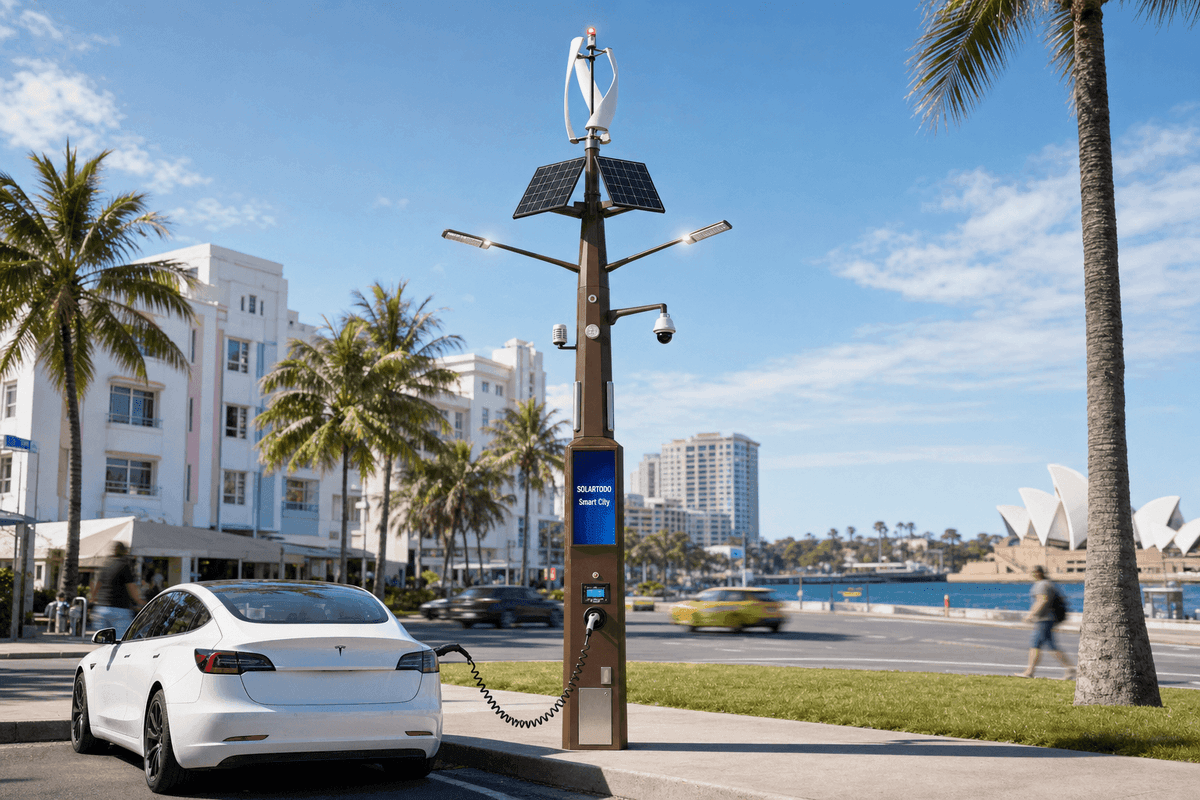
9m Wind-Solar Hybrid Smart Pole - Industrial Port 10-in-1 Infrastructure
Key Features
- 9m octagonal tapered steel pole with 45cm base diameter, 15cm top diameter, and 25-year design life
- 500W H-type Darrieus VAWT plus 2 x 100W monocrystalline PV modules and 5kWh LFP storage
- Twin 1.5m arms with 2 x 80W LED luminaires delivering about 24,000 lm at 150 lm/W
- Integrated 7kW Type 2 OCPP 1.6J AC charger built into the lower 2.2m pole body
- 1280 x 2560mm P5 LED display, 20x PTZ camera, 12-parameter sensor, 5G, WiFi 6, and LoRaWAN
The 9m Wind-Solar Hybrid Smart Pole integrates a 500W H-type VAWT, 200W monocrystalline PV, 5kWh LFP battery, twin 80W LED lighting, 7kW OCPP EV charging, 5G/WiFi 6, PTZ security, environmental sensing, public address, SOS intercom, and a P5 LED display in one industrial-port pole. It is specified for EPC deployment from $1,600 to $5,800 per installed unit with IEC 60598 lighting, IEC 62196-2 charging, IP66 outdoor protection, and 25-year structural design life.
Description
The 9m Wind-Solar Hybrid Smart Pole - Industrial Port is a 10-in-1 smart streetlight system for ports, logistics yards, bonded warehouses, petrochemical access roads, and 24-hour industrial campuses. Each 9m octagonal tapered steel pole combines a 500W Darrieus H-type vertical-axis wind turbine, 2 x 100W monocrystalline solar panels, a 5kWh LFP battery, 2 x 80W LED luminaires, a 7kW OCPP EV charger, a 1280 x 2560mm P5 LED display, 5G/WiFi 6 communications, PTZ video, environmental sensing, public address, and SOS emergency intercom in 1 integrated asset.
For B2B infrastructure teams, the design reduces the number of separate foundations, cabinets, poles, and network devices from approximately 6 assets to 1 coordinated system. Compared with a conventional port road package using a lighting pole, separate EV pedestal, CCTV pole, PA horn, LED sign, and sensor mast, the SOLARTODO hybrid pole can reduce civil interface points by about 50% to 70% on a 32m spacing layout, depending on trenching and grid-connection rules. View all Smart Streetlight (10-in-1 Multi-function Pole) products for adjacent heights and city-road variants.
Industrial-Port Configuration
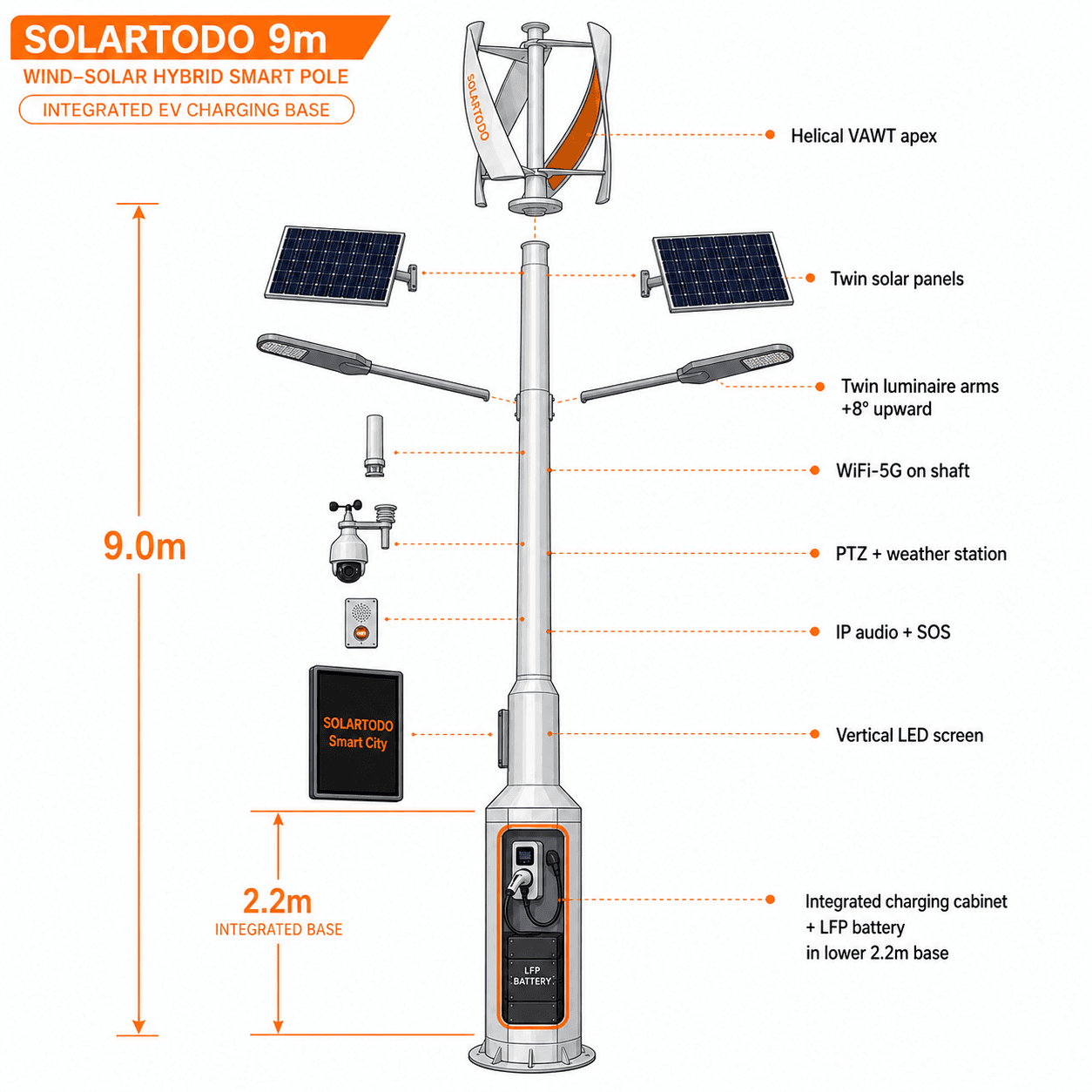
The structural body is a 9m antique-bronze RAL8011 octagonal tapered steel pole with a 45cm base diameter and 15cm top diameter. The lower 2.2m is not a separate EV pillar; it is the charger cabinet itself, welded as 1 continuous steel structure with the pole shell, access door, touchscreen, E-stop, cable holster, breaker space, and LFP battery compartment integrated into the same vertical envelope. This pole-as-charger arrangement is important for ports where vehicle lanes, bollards, cable trays, and container handling equipment leave less than 1.5m of usable sidewalk or island width.
The renewable package uses 1 Darrieus H-type VAWT with 3 straight vertical blades, an 80cm rotor diameter, a 110cm rotor height, and 500W rated output under suitable wind conditions. The wind turbine is positioned at the apex above the lighting arms, with 1 red aviation LED marker for visibility in industrial yards. Mid-pole solar generation uses 2 symmetric 100W deep-black monocrystalline modules on A-frame brackets at a 15 degree tilt, creating east-west collection without a broad single-sided sail area.
The battery system uses 1 embedded 5kWh lithium iron phosphate pack in the pole base with an MPPT charge controller and backup grid-tie interface. LFP chemistry is widely selected for stationary energy storage because it avoids cobalt and nickel, and IRENA has documented that battery and renewable integration are central to distributed power systems through 2030. The hybrid configuration can prioritize solar charging during daytime, wind charging during night or monsoon periods, and grid backup when the 5kWh reserve approaches the programmed depth-of-discharge threshold.
Lighting and Safety Functions
The lighting package uses twin symmetric 1.5m arms with an upward tilt of +8 degrees and 2 x 80W LED luminaires. At 150 lm/W, the total nominal luminous flux is about 24,000 lumens, suitable for 32m pole spacing in many port-road and parking-lane applications when the final photometric layout confirms uniformity, glare limits, and mounting geometry. The lighting system is aligned with IEC 60598 principles for luminaire safety and with common roadway-lighting engineering practice under IES and CIE methods.
For security, the pole includes 1 mini white PTZ dome camera with 360 degree pan, 20x optical zoom, and 100m infrared capability on a 40cm L-bracket. A 12-parameter environmental sensor measures meteorology, particulate air quality, rain, CO, NO2, and O3 for local operational visibility. The public-address system uses 2 symmetric IP audio columns, each 10cm in diameter, 50cm high, 30W rated, and 93dB nominal output, flush-mounted on opposite flat pole faces so the acoustic devices remain integrated rather than protruding as exposed horns.
Emergency features include 1 one-press SOS button, 2-way audio intercom, and 1 visual LED indicator for incident reporting in container yards, fuel areas, and controlled-access gates. The EV charger provides 7kW single-gun AC charging with Type 2 interface, OCPP 1.6J back-office compatibility, 5m coiled cable, touchscreen, E-stop, and maintenance door. The USB auxiliary package adds USB-C PD 30W plus USB-A output for field devices, handheld scanners, tablets, and maintenance phones.
System Architecture
The communications stack combines dual-mode WiFi 6, a 5G gateway, GbE uplink, and LoRaWAN integration in a flush color-matched housing at 8.7m. The housing is designed to sit on the flat pole face with continuous RAL8011 color across the device-pole boundary, reducing visual clutter and improving water-shedding compared with a bolted white enclosure. IEEE 802.11ax, commonly known as WiFi 6, supports higher-density wireless service than 802.11n-era access points, which matters when 100+ workers, handheld terminals, and security devices operate in the same port zone.
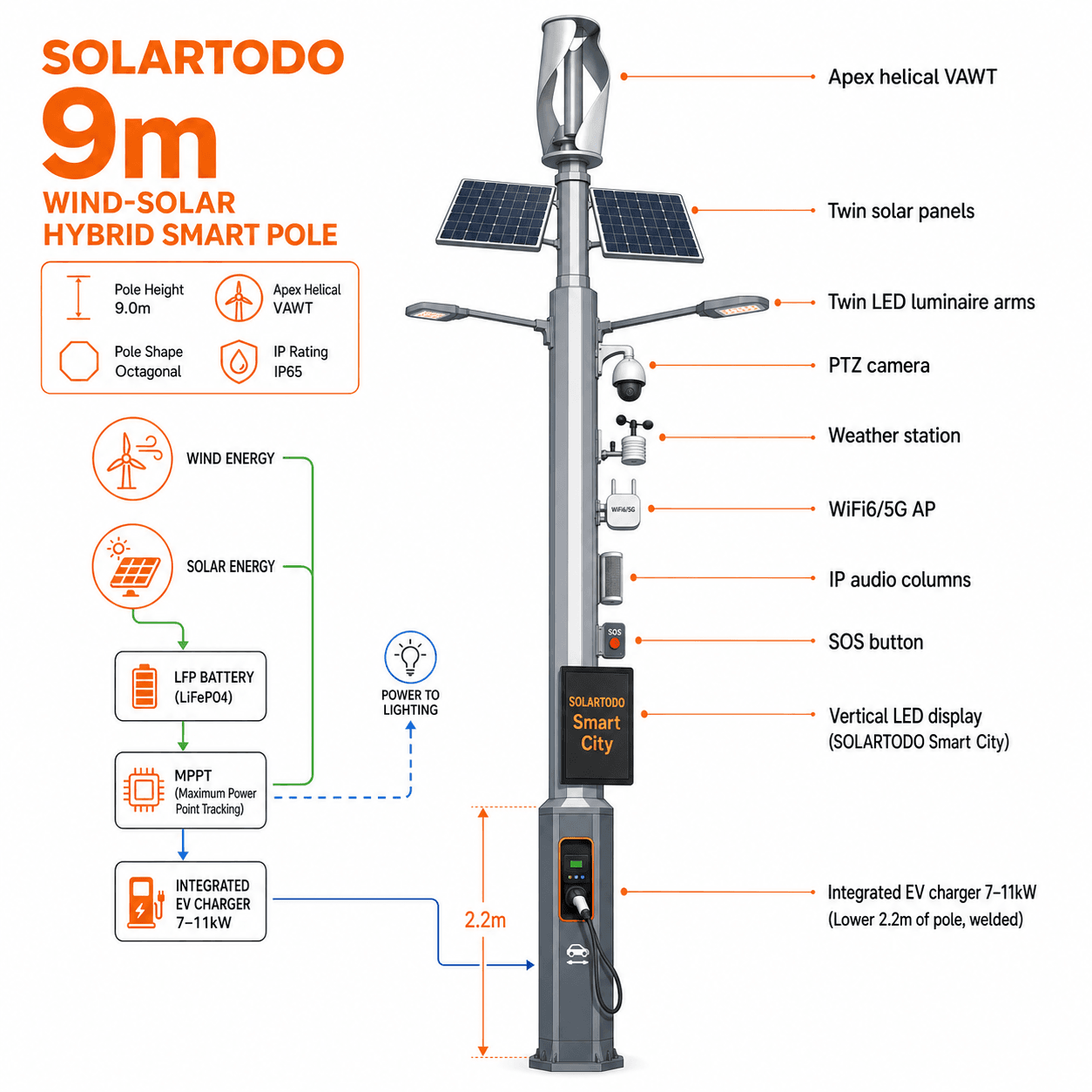
The energy chain starts with 2 renewable inputs: a 500W VAWT through a wind charge controller and 200W of monocrystalline PV through MPPT control. The DC bus charges the 5kWh LFP battery, which supplies LED lighting, communications, CCTV, sensors, display electronics, emergency equipment, and low-voltage accessories. EV charging at 7kW is normally connected through the grid-tie AC path because a 5kWh battery is sized for pole autonomy and resilience rather than full vehicle charging.
The information chain connects the PTZ camera, 12-parameter sensor, LED display, IP speakers, SOS intercom, charger status, battery telemetry, and luminaire controller to the cloud platform through 5G, GbE, WiFi 6, and LoRaWAN. Each device can be mapped as 1 logical node in a port operations dashboard, enabling alarm routing, dimming schedules, charger session data, display publishing, and speaker broadcasts. Configure your system online to adjust height, energy package, display size, camera type, and charging interface for 50-unit, 100-unit, or 250-unit procurement lots.
Technical Specifications
| Parameter | Industrial-port configuration |
|---|---|
| Pole height | 9m |
| Pole form | Octagonal tapered steel, 45cm base to 15cm top |
| Finish | RAL8011 antique bronze |
| Wind turbine | 500W H-type Darrieus VAWT, 80 x 110cm |
| Solar array | 2 x 100W monocrystalline, 15 degree tilt |
| Battery | 5kWh LFP with MPPT controller |
| LED lighting | 2 x 80W, 4000K, 150 lm/W |
| Camera | 360 degree PTZ, 20x zoom, 100m IR |
| EV charging | 7kW AC, Type 2, OCPP 1.6J |
| LED display | P5 portrait, 1280 x 2560mm, over 5000 cd/m2 |
| Communications | 5G, WiFi 6, GbE, LoRaWAN |
| Operating rating | IP66, -40 degrees C to +55 degrees C |
The LED advertising screen is a P5 portrait module measuring 1280 x 2560mm with brightness above 5000 cd/m2. Content is specified as SOLARTODO Smart City in white sans-serif text on a deep-blue background, with no third-party imagery. This controlled signage profile helps industrial buyers keep the display as an operational identity, safety, or wayfinding device rather than a general advertising surface that may require additional content permits.
Standards alignment includes IEC 60598 for luminaires, IEC 62196-2 for AC charging connectors, and GB/T 37024 for smart streetlight system considerations. NREL technical publications on distributed PV and storage note that component derating, battery temperature, and local irradiance have measurable effects on output, so SOLARTODO treats the 200W PV and 500W wind ratings as engineering inputs rather than guaranteed 24-hour generation. Learn about topic for additional technical notes on hybrid lighting, battery sizing, and smart-city connectivity.
Cloud Monitoring
The cloud platform can monitor at least 10 functional categories per pole: luminaire status, battery voltage, solar input, wind input, EV charger session, PTZ camera link, speaker status, SOS alarm, environmental data, and LED display content. Alarms can be configured for 5 common operational events: charger fault, camera offline, battery low, door open, and emergency call. IEA analysis of digitalized energy systems identifies monitoring and automation as key drivers for demand-side flexibility, especially when distributed devices scale from tens to thousands of endpoints.
For cybersecurity and system availability, procurement teams normally define 3 interface layers: device firmware, gateway communications, and cloud administration. IEEE 802.3 wired Ethernet, 5G cellular, and LoRaWAN can be combined so critical alarms do not depend on only 1 radio path. A port authority can also require role-based access, audit logs, and OCPP transaction records for the 7kW charger, especially when charging data must be reconciled with fleet, contractor, or tenant billing.
Application Scenario
A MENA-region container-terminal operator planning a 4km internal service road could deploy approximately 127 poles at 32m spacing, matching the reference configuration for this 9m variant. In this scenario, the operator receives roadway lighting, PTZ surveillance, air-quality monitoring, public address, emergency calling, EV support, and digital wayfinding from the same foundation line. Assuming each conventional asset would otherwise need 1 foundation or cabinet, the hybrid design can eliminate about 500+ separate mounting or enclosure points across the full road corridor.
Operational savings come from 3 areas: reduced trenching, lower maintenance visits, and energy offset from 200W PV plus 500W wind generation. Where a conventional 160W lighting load runs 12 hours per night, the annual lighting energy is about 701kWh per pole before dimming. With adaptive dimming and hybrid renewable contribution, many sites can reduce grid electricity for lighting and low-voltage smart functions by 40% to 70%, subject to wind regime, solar resource, battery temperature, and night-time security policy.
Compared with a grid-only lighting and CCTV layout, the 5kWh battery gives several hours of resilience for safety-critical modules during local outages. A simple emergency profile can reserve power for 2 x 80W lights at reduced output, the SOS intercom, PTZ camera, gateway, and red aviation LED while pausing non-critical display brightness. BloombergNEF and Wood Mackenzie have both tracked falling energy-storage costs through the 2020s, but project teams should still model replacement intervals, ambient temperature, and duty cycle for a 10-year operating plan.
EPC Investment Analysis and Pricing Structure
EPC delivery includes 5 work packages: engineering review, procurement, construction, commissioning, and 1-year warranty support. Engineering covers pole spacing, foundation load check, cable routing, photometric intent, charger interface, network plan, and display placement. Procurement covers the pole body, wind turbine, PV modules, battery, luminaires, camera, sensors, speakers, charger, display, gateway, electrical protection, and accessories. Construction covers foundation, lifting, fastening, wiring, grounding, and site acceptance. Commissioning covers lighting tests, charger OCPP registration, 5G/WiFi setup, sensor verification, camera view checks, PA broadcast testing, and SOS call routing.
| Pricing tier | Scope | Unit price range |
|---|---|---|
| FOB Supply | Equipment only, ex-works China | $992 - $3,944 |
| CIF Delivered | Equipment, ocean freight, and insurance | $1,114 - $4,431 |
| EPC Turnkey | Installed, commissioned, and 1-year warranty | $1,600 - $5,800 |
| Order volume | Discount guideline | Typical buyer profile |
|---|---|---|
| 50+ units | 5% | Industrial park phase 1 or port gate project |
| 100+ units | 10% | Multi-road logistics or bonded-zone rollout |
| 250+ units | 15% | City-scale port, free-zone, or national corridor program |
ROI depends on civil works, labor rates, grid-tie distance, network subscription, lighting schedule, and charger utilization. A conservative model may assign $120 to $260 per pole per year in avoided electricity and maintenance visits, plus 1 to 3 avoided standalone cabinets or poles per location. Against a conventional multi-asset layout costing $2,200 to $7,500 per location when separate foundations and devices are counted, a $1,600 to $5,800 EPC turnkey range can produce a simple payback of 3 to 7 years in projects with high trenching cost, strong wind resource, or 24-hour security staffing.
Payment terms are 30% T/T deposit plus 70% against B/L copy, or 100% irrevocable L/C at sight for qualified buyers. Project financing can be discussed for programs above $1,000K, especially for 250+ unit deployments with EPC scheduling, warranty spares, and phased commissioning. To validate specifications, bill of quantities, and delivery terms, Request a custom quotation or contact [email protected] with the target country, quantity, road length, grid voltage, and required certification package.
Procurement Notes
SOLARTODO supplies solar, energy storage, smart lighting, security, telecom, power-tower, and smart-agriculture infrastructure through https://solartodo.com, and this 9m industrial-port pole is positioned for buyers who need multiple systems delivered under 1 coordinated procurement file. The recommended tender package should include at least 12 documents: datasheet, foundation drawing, wind-load assumptions, single-line diagram, photometric plan, OCPP charger sheet, battery datasheet, gateway interface list, camera specification, coating standard, factory acceptance checklist, and warranty terms.
For compliance planning, buyers should confirm local equivalents to IEC 60598, IEC 62196-2, EMC rules, radio approvals, EV-metering rules, and aviation-marker requirements before mass production. The structural specification should also be checked against local wind map data, soil bearing capacity, corrosion category, and port safety rules for lifting equipment. A 127-unit deployment can be split into 3 batches for factory acceptance, shipping, and site installation so that early commissioning data informs the final 2 batches without changing the approved design baseline.
Technical Specifications
| Pole Height | 9m |
| LED Power | 160W |
| Luminous Efficacy | 150lm/W |
| Integrated Modules | 10-in-1 |
| Wind Resistance | 160km/h |
| IP Rating | IP66 |
| Operating Temperature | -40 to +55°C |
| Communication | 5G + WiFi 6 + GbE + LoRaWAN |
| Energy Saving | 40-70% |
| Design Life | 25years |
| Wind Turbine | 500W |
| Solar Array | 200W |
| Battery Capacity | 5kWh |
| EV Charger | 7kW |
| Pole Spacing | 32m |
Price Breakdown
| Item | Quantity | Unit Price | Subtotal |
|---|---|---|---|
| 9m octagonal tapered steel smart pole with integrated EV cabinet | 1 pcs | $587 | $587 |
| 500W Darrieus H-type VAWT with aviation LED | 1 pcs | $420 | $420 |
| 100W monocrystalline solar panel with bracket | 2 pcs | $85 | $170 |
| 5kWh LFP battery with MPPT controller | 1 pcs | $900 | $900 |
| 80W LED luminaire and 1.5m arm | 2 pcs | $120 | $240 |
| 20x PTZ camera with 100m IR and bracket | 1 pcs | $226 | $226 |
| 12-parameter environmental sensor | 1 pcs | $260 | $260 |
| 30W IP audio column speaker | 2 pcs | $92 | $184 |
| Visual SOS emergency call and intercom | 1 pcs | $134 | $134 |
| 7kW OCPP AC EV charger module | 1 pcs | $201 | $201 |
| P5 portrait LED display 1280 x 2560mm | 1 pcs | $980 | $980 |
| WiFi 6 and 5G gateway with LoRaWAN | 1 pcs | $260 | $260 |
| USB-C PD 30W and USB-A accessory module | 1 pcs | $34 | $34 |
| Cables, breakers, surge protection, and grounding accessories | 1 pcs | $50 | $50 |
| Engineering, drawings, factory QC, and documentation | 1 pcs | $240 | $240 |
| Installation, lifting, wiring, and commissioning | 1 pcs | $560 | $560 |
| 1-year warranty and remote support allowance | 1 pcs | $220 | $220 |
| Total Price Range | $1,600 - $5,800 | ||
Frequently Asked Questions
What makes the 9m industrial-port hybrid pole different from a conventional smart streetlight?
Does the 5kWh battery power the 7kW EV charger directly?
What is included in the EPC turnkey price and warranty?
Which standards are relevant for this product?
What deployment quantity is realistic for an industrial port road?
Certifications & Standards




Data Sources & References
- •IEC 60598 Luminaires safety standard
- •IEC 62196-2 Plugs, socket-outlets, vehicle connectors and vehicle inlets
- •GB/T 37024 Smart street lighting system technical reference
- •NREL distributed PV and storage technical publications
- •IRENA renewable power and storage integration reports
- •IEA digitalization and electricity system analysis
- •BloombergNEF and Wood Mackenzie energy-storage market analysis
Interested in this solution?
Contact us for a customized quote based on your specific requirements.
Contact Us