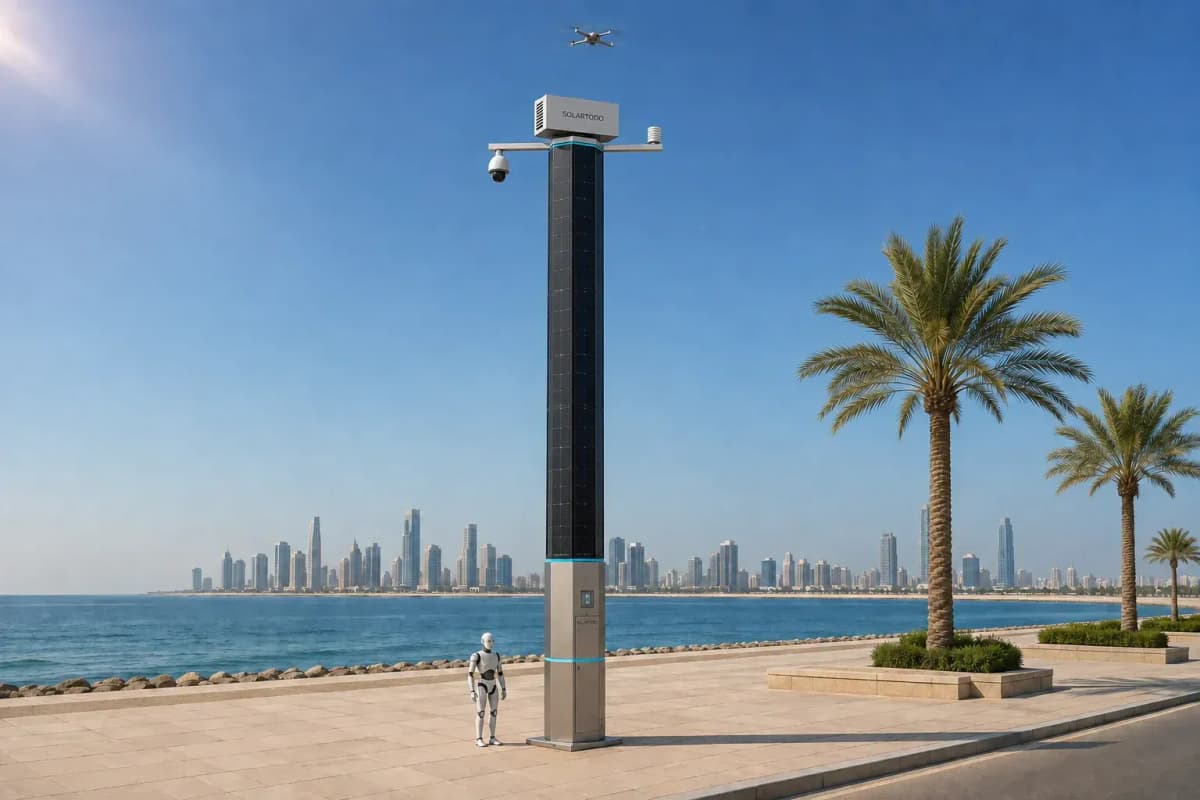
12m Smart Pole with Drone Dock (Sky Hub) - Coastal Seafront
Key Features
- 12 m pure smart pole with 0 W lighting equipment and 9-in-1 edge-node functions
- 2.8-3.2 kWp integrated monocrystalline PV replenishment with 1.0-1.3 kW DC clear-sky peak output
- 5-20 kWh battery storage class for drone service, edge compute, communications, and night operation
- 44-node reference layout at approximately 40 m spacing for about 1.76 km of coastal corridor coverage
- EPC turnkey price range of $6,500-$13,000 including installation, commissioning, and 1-year warranty
The 12 m SOLARTODO Sky Hub is a fully off-grid smart pole with drone docking, 5-20 kWh battery buffering, 2.8-3.2 kWp on-pole PV replenishment, IP66 field equipment, and local edge-AI processing for coastal seafront infrastructure.
Description
The 12m Smart Pole with Drone Dock (Sky Hub) - Coastal Seafront is a 12 m off-grid city edge node for drone operations, perimeter sensing, environmental monitoring, and field response coordination across coastal corridors, ports, seafront districts, and critical infrastructure zones. Each Sky Hub uses 2.8-3.2 kWp of integrated monocrystalline PV, 5-20 kWh-class storage, IP66-rated outdoor equipment, 4G/5G plus LoRaWAN communications, and local edge-AI processing so raw video and sensor streams remain on the pole.
SOLARTODO positions this product as a pure smart pole with 0 W lighting equipment, because its functional load is sensing, compute, energy buffering, drone service, robot coordination, and command workflow rather than illumination. A representative city package may use 44 Sky Hub poles at about 40 m spacing, creating roughly 1.76 km of distributed sensing and robotic-service coverage before site-specific line-of-sight, coastal wind, foundation, spectrum, and civil constraints are confirmed by engineering survey.
Product Definition
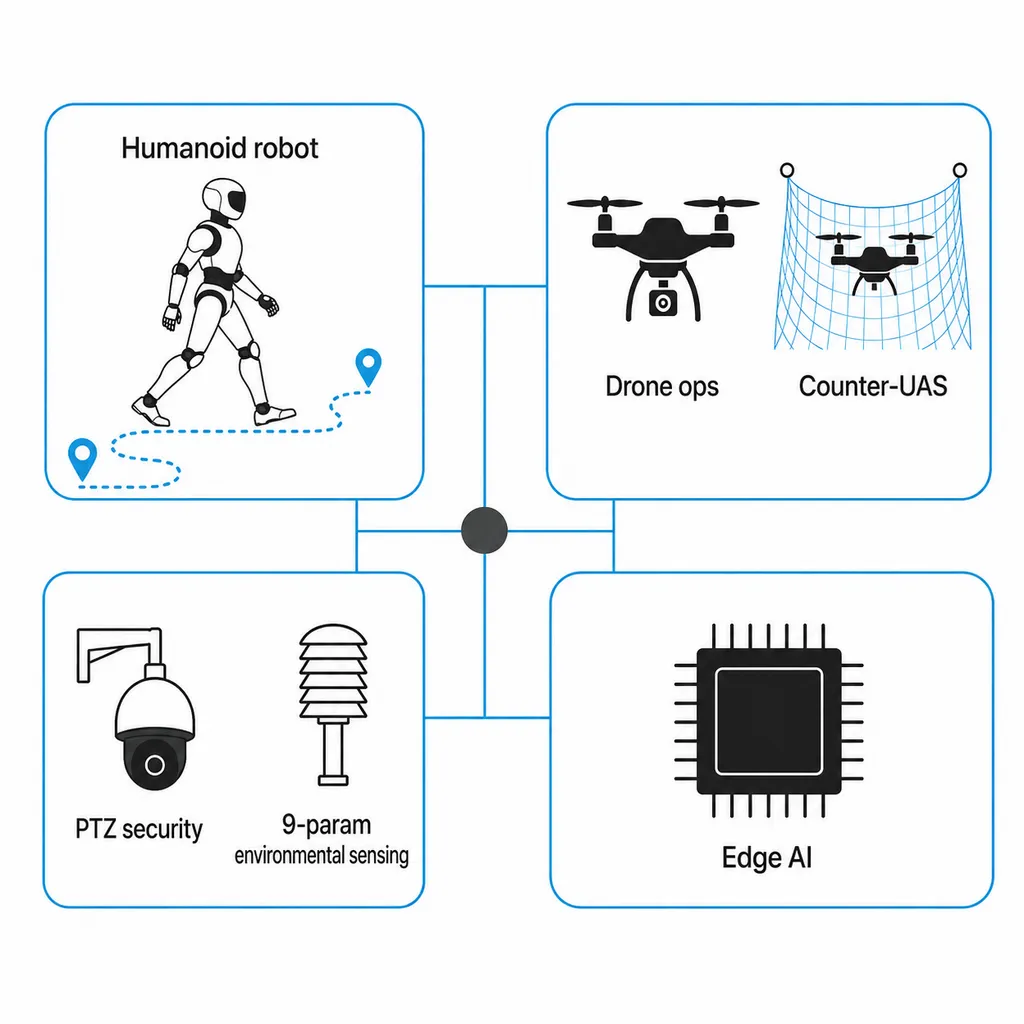
Sky Hub is a pole-form physical-AI node that combines 9 functional domains in 1 asset: structural pole, solar replenishment, battery storage, drone dock, drone battery exchange, local AI compute, security sensing, 9-parameter environmental monitoring, and human-authorized response coordination. The product belongs to SOLARTODO's smart infrastructure catalog; buyers comparing adjacent city-pole categories can View all Smart Streetlight (10-in-1 Multi-function Pole) products, while this specific Sky Hub configuration remains a non-lighting system with 0 luminaires.
The 12 m height supports wider sensor line-of-sight than 6-9 m roadside furniture and gives the drone dock a practical launch envelope above low obstacles in seafront service roads, quay areas, fenced perimeters, and public-realm edges. In procurement language, the unit is best treated as 1 off-grid micro-station with 3 operating layers: energy, compute, and robotic operations.
System Architecture
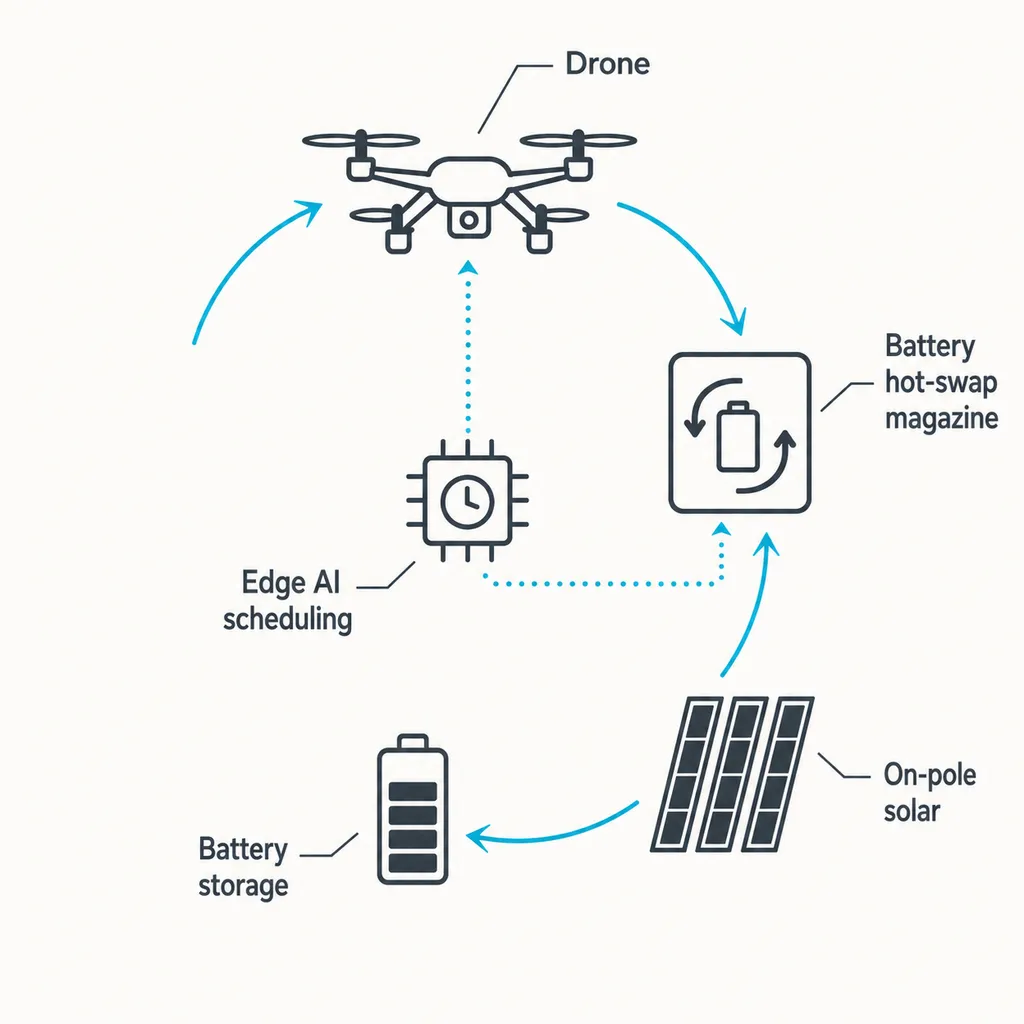
The Sky Hub architecture is organized around 4 subsystems: an off-grid power layer, a local compute layer, a sensor layer, and an operations layer. The power layer uses approximately 2.8-3.2 kWp of on-pole monocrystalline PV surfaces as replenishment, while the battery bank buffers 5-20 kWh so drone launch cycles, onboard compute, communication bursts, and robot charging are scheduled by duty cycle instead of being directly tied to instantaneous sunlight.
The compute layer uses Jetson-class edge processing to run inference, event classification, task scheduling, health checks, and mission logs locally on the pole. This design follows the edge-computing principle described in IEEE smart-city literature, where latency-sensitive applications benefit from processing near the sensor source rather than moving 24-hour raw streams to a remote data center (IEEE Internet of Things Journal, 2020).
The sensor layer supports anonymous vehicle counting, crowd-density estimation, intrusion detection, perimeter awareness, and 9-in-1 environmental data collection: wind speed, wind direction, temperature, humidity, atmospheric pressure, noise, PM10, PM2.5, and illuminance. It does not require face recognition or licence-plate recognition for its standard operating workflows, and only de-identified event or status metadata is transmitted outside the pole.
Off-Grid Energy Design
The integrated PV body is designed as a replenishment layer, not as a claim of unlimited solar-only runtime under every weather condition. Under a high-irradiance coastal or desert-adjacent region, the 8 vertical PV faces can deliver about 1.0-1.3 kW DC clear-sky operating peak and about 7-10 kWh/day, depending on season, horizon shading, soiling, albedo, and the number of sun-facing surfaces at a given hour.
NREL's PVWatts Version 8 documentation notes that production estimates depend on weather data, albedo, system losses, and modeling assumptions, which is directly relevant to any vertical or multi-face PV surface used on an off-grid pole (NREL PVWatts V8). For coastal seafront use, SOLARTODO therefore treats 5-20 kWh storage as the operating reserve that absorbs short weather deficits, high drone-service loads, and night operation.
Compared with a conventional grid-powered surveillance mast plus a separate drone service point, 1 Sky Hub can reduce trenching, feeder-cable routing, and distributed cabinet count by roughly 30-60% on brownfield coastal roads where civil works are more expensive than equipment integration. The exact percentage depends on 3 site variables: cable distance avoided, foundation reuse potential, and the required number of patrol intervals per 24-hour day.
Drone Dock and Robotic Operations
The drone subsystem supports launch, patrol, inspection, return, recharge state management, and automated battery exchange through a multi-bay service mechanism. In a 44-pole network, each node can maintain its own mission queue and status log while the command view coordinates route assignments, dock availability, battery state, and event priority across dozens of locations.
Automated drone service is most valuable where inspection points are separated by 100 m to 2 km, such as seawalls, solar-storage fence lines, port roads, desalination boundaries, industrial perimeters, and beach-front utility corridors. The dock enables repeated sorties without an operator standing at the pole, but the mission plan must still respect 1 local aviation rule set, 1 approved operating envelope, and human authorization for response workflows.
The ground-robot interface supports patrol return, wireless charging at the base, alarm response, and air-ground coordination. For a representative MENA solar farm scenario, 12 Sky Hub poles at 40 m spacing can cover about 480 m of perimeter frontage, while drones inspect fence anomalies from above and a service robot checks ground-level access points within the same common operating picture.
Counter-UAS Coordination
The counter-UAS workflow is strictly non-lethal and human-authorized. The pole can detect and track an unauthorized drone, combine the event with optional partner-sensor inputs such as radar, and coordinate a friendly drone for soft aerial net-capture or close-approach deterrence after authorization; it is not a jamming device, weapon, autonomous attack platform, or hard-kill system.
This distinction matters for procurement in at least 3 regulatory areas: aviation approval, spectrum management, and public-safety operating policy. Because radar is not part of the standard pole hardware, any radar-assisted configuration is treated as a partner-sensor integration with separate siting, power budget, and approval review.
Data Governance and Cyber-Physical Workflow
Sky Hub is designed for local processing and PDPL/LGPD-oriented data minimization, with raw video and raw sensor data staying on the pole. The outbound data model is limited to de-identified events, system status, environmental readings, drone mission logs, battery condition, and maintenance alerts, which reduces bandwidth and supports privacy-aware smart-city procurement.
The operations loop has 4 stages: sensing, authorized assessment or response, edge-compute scheduling, and field operations maintenance. In daily operation, a 24-hour command view can show environmental thresholds, perimeter alerts, drone availability, robot status, battery state, and maintenance tickets without transferring continuous raw surveillance footage away from the asset.
Technical Specifications
| Parameter | Specification |
|---|---|
| Pole height | 12 m |
| Lighting system | 0 W, none |
| Integrated capability set | 9-in-1 |
| PV replenishment | 2.8-3.2 kWp nameplate |
| Clear-sky operating PV output | 1.0-1.3 kW DC peak |
| Typical high-irradiance daily yield | 7-10 kWh/day |
| Battery storage class | 5-20 kWh |
| Outdoor enclosure target | IP66 |
| Operating temperature | -40 deg C to +55 deg C |
| Communications | 4G/5G + LoRaWAN |
| Design life | 25 years |
IEC 61215-1:2021 defines design qualification and type-approval requirements for terrestrial PV modules intended for long-term open-air operation, while IEC 61730-1:2023 and IEC 61730-2:2023 address PV module safety construction and testing (IEC 61215-1:2021, IEC 61730-1:2023). For this Sky Hub, those standards are used as engineering reference points for PV module selection and supplier documentation rather than as a blanket certification claim for every project configuration.
The IP66 target aligns with IEC 60529 enclosure terminology, where the first digit 6 indicates dust-tight protection and the second digit 6 indicates protection against powerful water jets (IEC 60529 overview by Intertek). Coastal projects should still require 1 corrosion plan, 1 grounding plan, and 1 maintenance schedule because salt spray, windborne sand, and humidity accelerate exposed hardware aging.
Cloud Monitoring
The cloud layer is used for event metadata, maintenance tickets, fleet status, firmware governance, and dashboard reporting rather than raw video transport. A 44-node deployment can report thousands of small telemetry records per day while avoiding the bandwidth load that would be created by 44 continuous high-resolution video uplinks.
IEEE 802.15.4-related low-rate networking principles support the use of low-power telemetry channels in IoT systems, while 4G/5G backhaul handles higher-priority event packets and command acknowledgements when permitted by the local carrier plan (IEEE 802.15.4 task information). SOLARTODO can help buyers Configure your system online before formal civil, energy, and network sizing is locked.
Applications
Coastal seafront applications include 6 common project types: port perimeter patrol, seawall inspection, marina security, public-space crowd-density monitoring, solar-storage site surveillance, and critical utility corridor checks. The 12 m configuration is usually selected where a lower 6 m or 8 m pole would be blocked by parked vehicles, fencing, containers, landscaping, or service buildings.
For a 1.76 km seafront corridor using 44 nodes at 40 m intervals, procurement teams should model at least 4 resource assumptions before purchase: daily drone sorties per pole, local solar yield, required autonomy hours after poor weather, and maintenance access time. SOLARTODO's knowledge center provides related guidance on solar-storage sizing, and buyers can Learn about topic when comparing edge-node architecture with conventional camera-pole networks.
EPC Investment Analysis and Pricing Structure
EPC turnkey delivery includes 5 major work packages: engineering, procurement, construction, commissioning, and a 1-year warranty. For this 12 m Sky Hub, EPC scope normally includes foundation interface review, pole supply, integrated PV subsystem, battery storage, drone dock installation, edge-compute commissioning, communications setup, acceptance testing, operator training, and project documentation.
| Pricing tier | Scope | Unit price range |
|---|---|---|
| FOB Supply | Equipment only, ex-works China | $4,030-$8,840 |
| CIF Delivered | Equipment, ocean freight, and insurance | $4,527-$9,931 |
| EPC Turnkey | Installed, commissioned, and 1-year warranty | $6,500-$13,000 |
| Order volume | Indicative discount | Example application |
|---|---|---|
| 50+ units | 5% | district or industrial-park phase 1 |
| 100+ units | 10% | coastal corridor or port perimeter |
| 250+ units | 15% | city-scale framework procurement |
ROI should be evaluated against 3 conventional alternatives: a grid-fed camera pole, a separate drone dock, and manual patrol labor. If 1 installed Sky Hub avoids $1,500-$3,000 of trenching and electrical-cabinet work, reduces 2 routine inspection visits per week, and offsets $800-$1,600/year in patrol and connectivity overhead, a $6,500-$13,000 EPC unit can support an indicative 3.5-7.0 year payback before taxes, financing cost, replacement batteries, and local permitting fees.
Payment terms are 30% T/T deposit plus 70% against bill of lading, or 100% irrevocable L/C at sight. Project financing can be reviewed for contracts above $1,000,000, and engineering-commercial requests should be sent to [email protected] with site coordinates, required pole count, target autonomy hours, drone duty cycle, and any coastal wind-speed requirement.
Procurement Notes
Each Sky Hub should be specified with 8 acceptance items: height, wind design basis, PV power class, storage capacity, communications carrier, drone operating envelope, privacy/data policy, and warranty scope. The most common procurement risk is treating the pole as a generic mast when its 5-20 kWh storage, drone service, and edge compute loads require a complete energy budget.
IEA's Renewables 2025 analysis projects 4,600 GW of renewable capacity additions from 2025 to 2030 and notes that solar PV represents nearly 80% of renewable capacity expansion, which supports the broader market logic for distributed PV-backed infrastructure (IEA Renewables 2025). IRENA also identifies battery storage as a key technology for integrating variable renewable electricity and supporting self-consumption and mini-grid use cases (IRENA Energy Storage).
To request a bankable bill of quantities, civil drawings, project-specific energy simulation, or delivery schedule, use Request a custom quotation. SOLARTODO will confirm 12 m pole loading, foundation assumptions, coastal wind rating, solar yield, battery sizing, and robotic duty cycle before final EPC pricing is released for purchase order approval.
Technical Specifications
| Pole Height | 12m |
| Lighting System Power | 0W |
| Integrated Modules | 9-in-1 |
| PV Replenishment Nameplate | 2.8-3.2kWp |
| Clear-Sky PV Operating Peak | 1.0-1.3kW DC |
| Typical Daily PV Yield | 7-10kWh/day |
| Battery Storage Class | 5-20kWh |
| Wind Resistance | 160km/h |
| IP Rating | IP66 |
| Operating Temperature | -40 to +55deg C |
| Communication | 4G/5G + LoRaWAN |
| Energy Saving vs Grid-Fed Separate Assets | 30-60% |
| Design Life | 25years |
Price Breakdown
| Item | Quantity | Unit Price | Subtotal |
|---|---|---|---|
| 12 m octagonal tapered steel pole | 1 pcs | $923 | $923 |
| Integrated monocrystalline PV body, 2.8-3.2 kWp class | 1 pcs | $1,600 | $1,600 |
| Battery storage system, 10 kWh configured allowance | 1 pcs | $1,200 | $1,200 |
| Automated drone dock and battery exchange module | 1 pcs | $1,800 | $1,800 |
| Jetson-class edge AI compute module | 1 pcs | $800 | $800 |
| PTZ camera for perimeter awareness | 1 pcs | $226 | $226 |
| Environmental sensor, 9-in-1 | 1 pcs | $218 | $218 |
| Smart cloud gateway and IoT hub | 1 pcs | $92 | $92 |
| 4G/5G + LoRaWAN communication package | 1 pcs | $450 | $450 |
| Accessories, breakers, surge protection, cabling | 1 pcs | $50 | $50 |
| Engineering, coastal design review, and QC documentation | 1 pcs | $650 | $650 |
| Installation and commissioning | 1 pcs | $850 | $850 |
| 1-year warranty and support | 1 pcs | $450 | $450 |
| Total Price Range | $6,500 - $13,000 | ||
Frequently Asked Questions
Does the 12 m Sky Hub include lighting equipment?
How much energy can the on-pole solar body realistically produce?
Can Sky Hub perform counter-UAS actions automatically?
What does EPC turnkey pricing include?
What data leaves the pole during normal operation?
Certifications & Standards

Data Sources & References
- •NREL PVWatts Version 8 documentation - https://developer.nrel.gov/docs/solar/pvwatts/
- •IEA Renewables 2025 - https://www.iea.org/reports/renewables-2025/renewable-electricity
- •IRENA Energy Storage - https://www.irena.org/Energy-Transition/Technology/Energy-Storage
- •IEC 61215-1:2021 - https://webstore.iec.ch/en/publication/61345
- •IEC 61730-1:2023 - https://webstore.iec.ch/en/publication/59803
- •IEEE Internet of Things Journal edge smart-city survey - https://ieeexplore.ieee.org/document/9063670/
Interested in this solution?
Contact us for a customized quote based on your specific requirements.
Contact Us