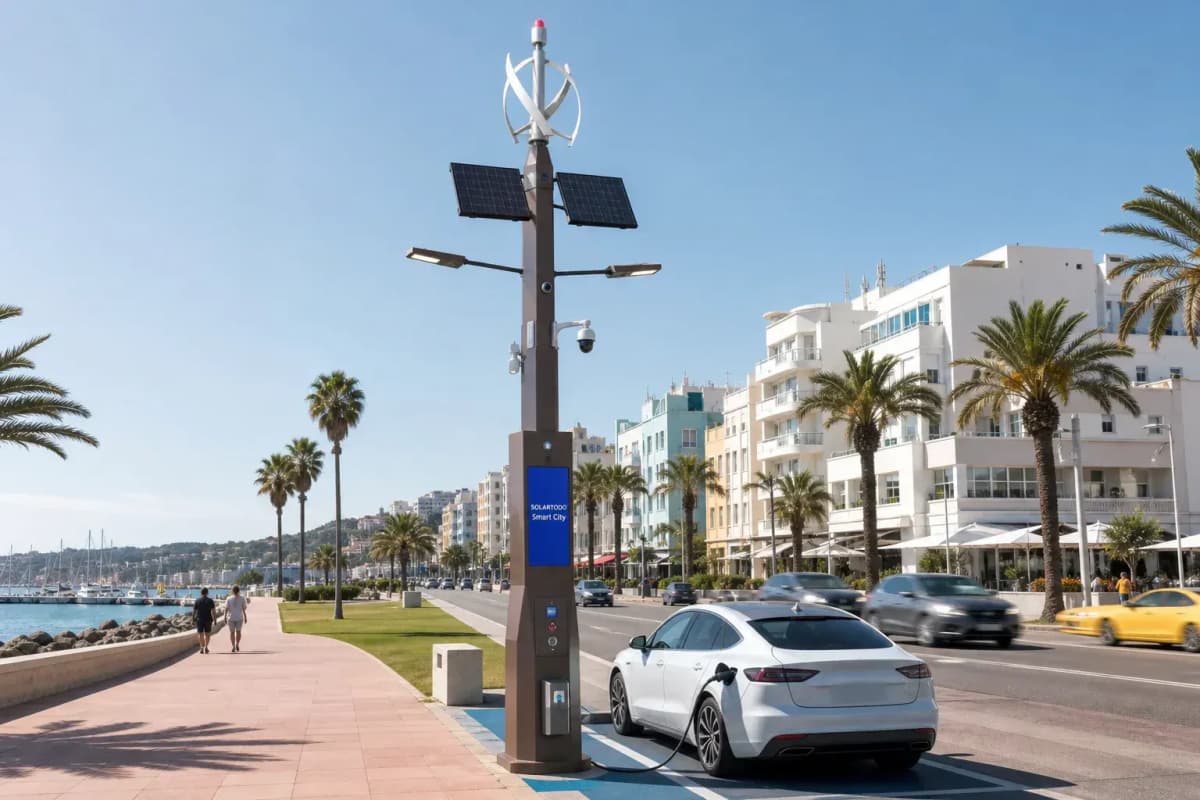
10m Wind-Solar Hybrid Smart Pole - Coastal Seafront
Key Features
- 10 m octagonal tapered steel pole with Ø45 cm base, Ø15 cm top, and antique bronze RAL8011 finish
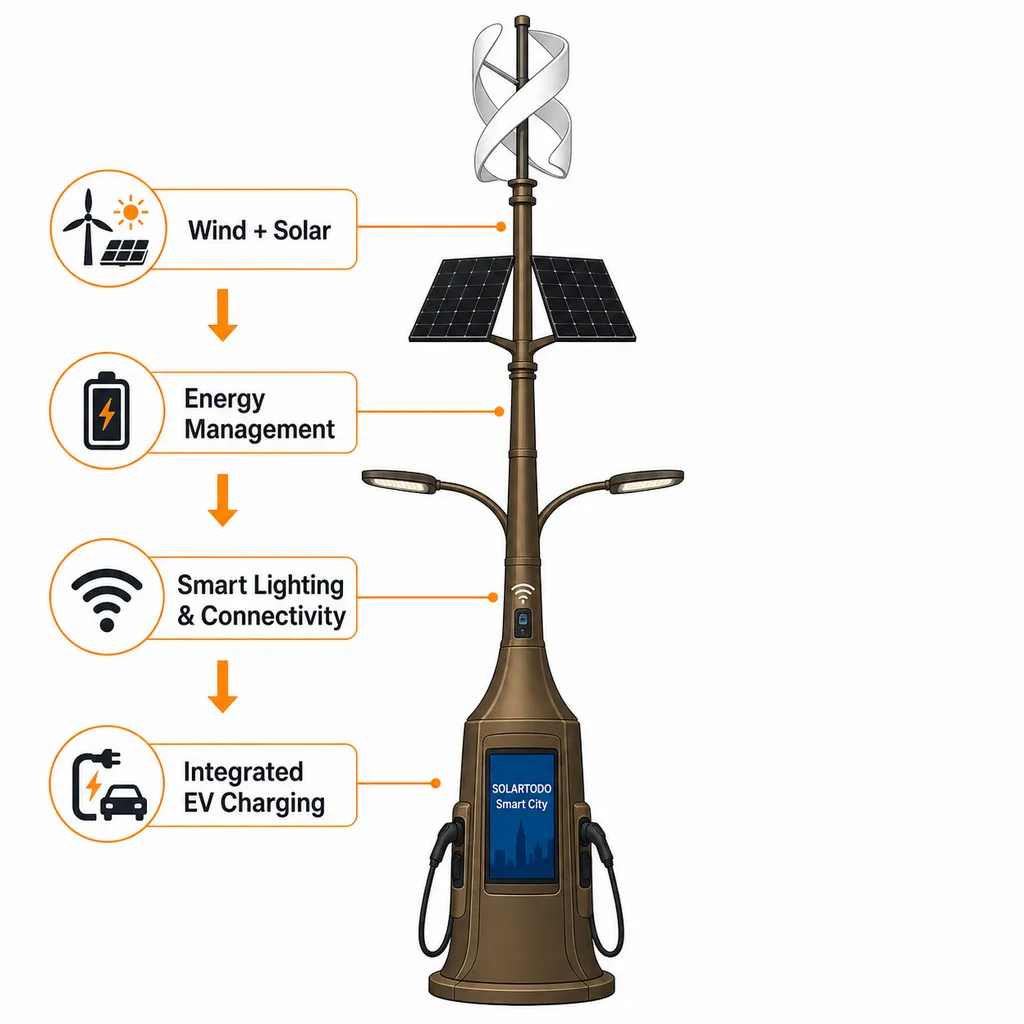
- Hybrid self-powered package with 500 W Darrieus VAWT, 2 x 100 W PV panels, 15 kWh LFP battery, and grid backup
- Integrated 7 kW dual-gun AC EV charger with 2 x Type 2 connectors, OCPP 1.6J, 5 m cables, touchscreen, and E-stop
- Twin 1.5 m arms support 2 x 80 W LEDs at 150 lm/W and 4000 K for a combined 160 W lighting load
- Smart-city modules include 4 MP camera, 8-parameter sensor, WiFi 6 for 256 devices, 2 x 30 W IP speakers, SOS, and P5 display
The 10m Wind-Solar Hybrid Smart Pole integrates a 500 W VAWT, 200 W PV array, 15 kWh LFP battery, 160 W LED lighting, 7 kW dual-gun EV charging, 4 MP video, WiFi 6, SOS, PA, sensors, and P5 display for coastal smart-city corridors.
Description
The 10m Wind-Solar Hybrid Smart Pole - Coastal Seafront is a 10-in-1 smart-streetlight node built around a 10 m octagonal tapered steel pole, a 500 W Darrieus H-type vertical-axis wind turbine, 2 x 100 W monocrystalline PV panels, a 15 kWh LFP battery, and a 7 kW dual-gun AC EV charger integrated into the lower 2.2 m of the pole body. Designed for 35 m coastal spacing and 82-pole seafront packages, it combines 160 W LED lighting, 4 MP security video, 8-parameter environmental sensing, WiFi 6 access, public address, SOS alarm, and a 1280 x 2560 mm P5 LED display in 1 continuous antique-bronze RAL8011 steel structure.
Product Definition
This SOLARTODO smart pole is engineered for coastal boulevards, seafront promenades, marina access roads, resort drives, and public parking edges where 1 foundation must support lighting, communications, emergency response, EV charging, and renewable generation. The pole body tapers from a 45 cm base diameter to a 15 cm top diameter, using an octagonal geometry that improves flat-face module integration and helps installers maintain consistent device orientation across 82 repeated units. The lower 2.2 m is not a separate charger cabinet; it is the welded pole-as-charger enclosure, which reduces the footprint from 2 street-side assets to 1 asset.
The coastal configuration uses 3 complementary energy inputs: a 500 W apex VAWT for wind-rich nights, 200 W of monocrystalline PV for daytime production, and a backup grid tie for service continuity during low-resource periods. NREL states that PVWatts estimates grid-connected PV energy production from weather and system inputs worldwide, so site-specific annual yield should be modeled with at least 12 monthly irradiance assumptions before procurement NREL PVWatts. IEA Renewables 2025 projects 4,600 GW of renewable capacity additions from 2025 to 2030, with solar PV contributing nearly 80% of expansion, which supports hybrid distributed assets in public infrastructure planning IEA Renewables 2025.
View all Smart Streetlight (10-in-1 Multi-function Pole) products to compare this 10 m coastal hybrid model with 6 m, 8 m, 9 m, and 12 m smart-pole options. For early engineering, Configure your system online with pole height, spacing, EV connector type, camera class, and display size before issuing a bill of quantities for 50, 100, or 250 units.
System Architecture
The mechanical architecture starts with a 10 m antique-bronze RAL8011 tapered steel shaft, twin 1.5 m luminaire arms with +8° upward tilt, a top-mounted 500 W Darrieus H-type VAWT with 3 straight blades measuring 80 x 110 cm, and 2 symmetrical 100 W deep-black PV panels mounted on A-frame brackets at 15° tilt. The vertical-axis turbine includes a red aviation LED at the apex, while the PV panels are arranged east-west to reduce directional dependence on corridors that may rotate 15° to 45° away from true south.
The lower 2.2 m pole-as-charger section contains a 15 kWh LFP battery, MPPT controller, 7 kW dual-gun AC charger, 2 Type 2 outlets with 5 m coiled cables, touchscreen interface, E-stop, surge protection, breakers, and a sealed maintenance door. IEC 62196-2 defines dimensional compatibility and interchangeability requirements for AC EV plugs, socket-outlets, vehicle connectors, and inlets up to 480 V AC and 63 A three-phase or 70 A single-phase, which is why Type 2 hardware is specified for this 7 kW AC configuration IEC 62196-2.
Integrated Modules
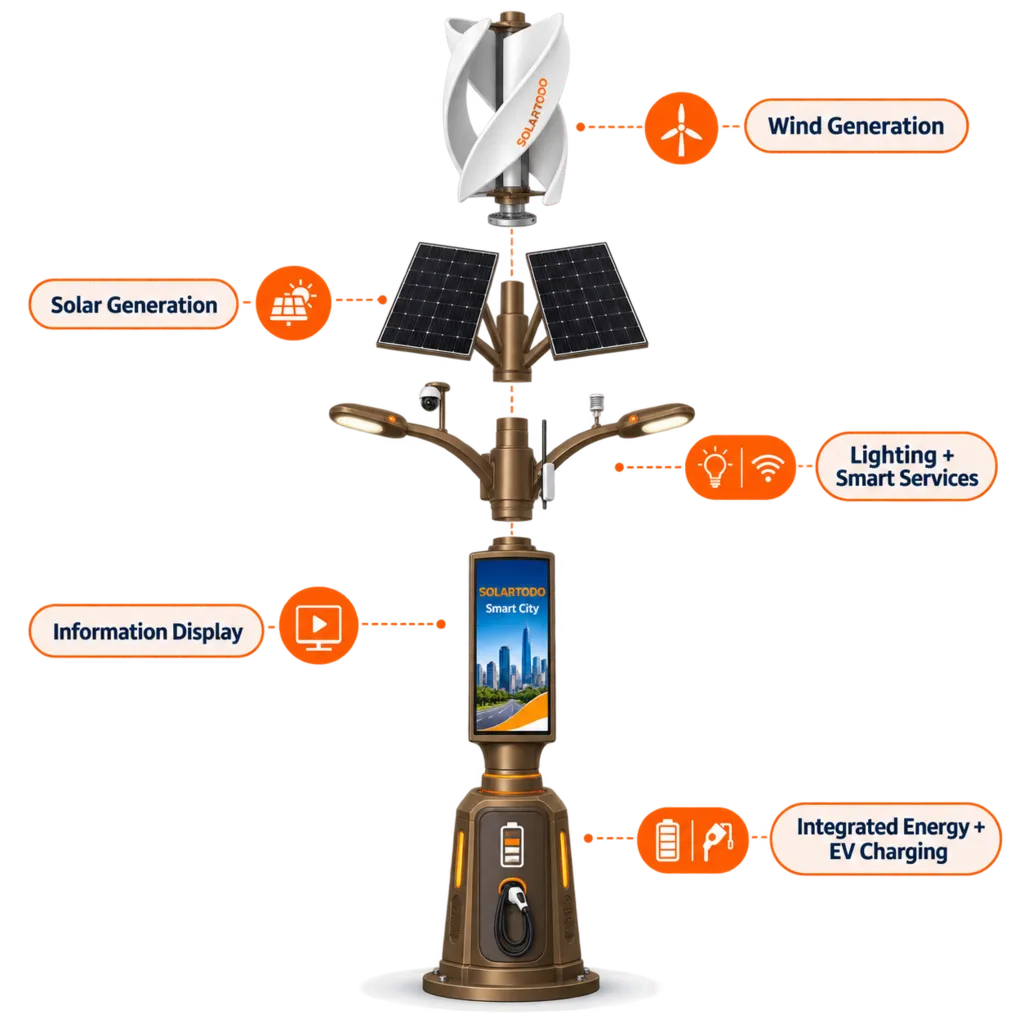
The lighting subsystem uses 2 x 80 W LED luminaires with 150 lm/W efficacy, 4000 K neutral-white color temperature, and symmetrical arms for 2-way coastal walkway or roadway coverage. IEC 60598-1:2024 specifies general safety requirements and tests for luminaires operating from supply voltages up to 1,000 V, making it the key baseline for luminaire construction, wiring protection, and dielectric safety in this 160 W assembly IEC 60598-1:2024.
The security and civic-safety package includes 1 x 4 MP bullet camera with 50 m IR, 1 x 30 cm short-arm bracket, 1 SOS panic interface, and camera-linked emergency broadcast activation. The public-address system uses 2 x 30 W IP audio columns rated 93 dB, each formed as a slim Ø10 x 50 cm perforated aluminum tube integrated flush against opposite flat pole faces, so the speaker module stays aligned with the octagonal pole profile instead of projecting as a separate box.
The information and connectivity package includes 1 x P5 portrait LED advertising display measuring 1280 x 2560 mm and rated above 5,000 cd/m², with content restricted to the words SOLARTODO Smart City in white sans-serif on a deep-blue background. The WiFi 6 AP is mounted flush at 8.7 m on a flat pole face, supports 802.11ax service for up to 256 devices, and provides up to 1.8 Gbps radio capacity when paired with a suitable backhaul and spectrum plan.
The environmental-monitoring package measures 8 parameters: temperature, humidity, wind, pressure, noise, PM2.5, PM10, and illuminance. IEC 61400-2 addresses safety philosophy, quality assurance, engineering integrity, installation, maintenance, and operation for small wind turbines, which is directly relevant to the 500 W VAWT mounted on a public 10 m structure IEC 61400-2. For grid-interactive projects, IEEE 1547-2018 is the reference framework for distributed energy resource interconnection and interoperability with electric power systems IEEE 1547-2018.
Cloud Monitoring
Each pole can report lamp status, battery state of charge, PV charge current, wind input, charger events, camera health, SOS alarms, speaker status, WiFi AP uptime, and 8 environmental values to a smart-city cloud gateway. The EV charger uses OCPP 1.6J, which the Open Charge Alliance identifies as a widely implemented protocol released in 2015 with JSON, SOAP, and smart-charging support, allowing operators to integrate billing, authorization, remote reset, firmware management, and transaction logs Open Charge Alliance OCPP.
Remote monitoring normally uses 4G/5G plus LoRaWAN, with local segmentation between high-bandwidth services such as 4 MP video and low-bandwidth telemetry such as PM2.5, PM10, battery voltage, and LED dimming commands. A practical commissioning plan assigns 1 gateway profile per 50 to 100 poles, validates charger meter values at 15-minute intervals, and tests the SOS-to-camera-to-broadcast sequence at 3 physical points: local button, cloud event, and audio output.
Technical Specifications
| Parameter | Coastal seafront configuration |
|---|---|
| Pole structure | 10 m octagonal tapered steel, Ø45 cm base to Ø15 cm top |
| Finish | Antique bronze RAL8011, coastal outdoor coating system |
| Wind generation | 500 W Darrieus H-type VAWT, 3 blades, Ø80 x 110 cm |
| Solar generation | 2 x 100 W monocrystalline panels, 15° A-frame tilt |
| Battery storage | 15 kWh LFP inside integrated pole base |
| LED lighting | 2 x 80 W, 150 lm/W, 4000 K, twin 1.5 m arms |
| EV charging | 7 kW dual-gun AC, 2 x Type 2, OCPP 1.6J, 5 m cables |
| Camera | 4 MP bullet camera, 50 m IR, 30 cm bracket |
| Display | P5 LED portrait screen, 1280 x 2560 mm, >5,000 cd/m² |
| Communications | WiFi 6, 4G/5G, LoRaWAN, TCP/IP audio, cloud gateway |
| Installation spacing | 35 m nominal center-to-center corridor spacing |
The energy system is sized for resilience rather than full EV-load autonomy, because a 7 kW charger can consume 7 kWh in 1 hour while the pole has 15 kWh of battery storage and 0.7 kW of rated renewable input before derating. IRENA reports that 2024 utility-scale battery storage installed cost declined 93% from 2010 to about USD 192/kWh, while solar PV global weighted-average LCOE reached about USD 0.043/kWh, showing why distributed PV, wind, and LFP storage are increasingly specified together IRENA Renewable Power Generation Costs 2024.
Representative MENA Solar Farm Scenario
For a representative MENA coastal solar-farm access-road scenario, 82 units spaced at 35 m cover approximately 2.87 km of perimeter or seafront roadway, while the combined lighting load is 13.12 kW at full 160 W output per pole. If adaptive dimming reduces the 160 W lamp load by 60% for 6 of 12 night hours, annual lighting consumption can fall by about 17,243 kWh compared with all-night 100% output, using the formula 82 x 160 W x 6 h x 365 d x 60%.
Compared with a conventional alternative using 1 passive 10 m streetlight, 1 separate 7 kW EV charger cabinet, 1 separate CCTV pole, 1 separate PA speaker pole, and 1 separate LED sign foundation, this 1-pole architecture can reduce visible street-side foundations from 5 to 1, a nominal 80% reduction in foundation count. The final savings depend on geotechnical class, trench route, local labor rate, and whether the project uses 1 shared communications backbone or 5 separate service drops.
EPC Investment Analysis and Pricing Structure
EPC pricing includes 5 work packages: engineering, procurement, construction, commissioning, and 1-year warranty support. Engineering covers layout, pole loading checks, foundation drawings, electrical single-line diagrams, EV-charger coordination, OCPP integration, IP addressing, and coastal coating specification. Procurement includes the 10 m pole, 500 W VAWT, 200 W PV array, 15 kWh LFP storage, 160 W LEDs, camera, 8-in-1 sensor, 2 speakers, SOS station, WiFi 6 AP, P5 display, charger, cables, breakers, and surge protection.
| Pricing tier | Scope | Unit price range |
|---|---|---|
| FOB Supply | Equipment only, ex-works China | USD 992 - 3,944 |
| CIF Delivered | FOB equipment plus ocean freight and insurance | USD 1,114 - 4,431 |
| EPC Turnkey | Fully installed, commissioned, and covered by 1-year warranty | USD 1,600 - 5,800 |
| Volume band | Discount basis | Indicative reduction |
|---|---|---|
| 50+ units | Repeated production and shared engineering | 5% |
| 100+ units | Batch procurement and container optimization | 10% |
| 250+ units | Project manufacturing slot and standardized commissioning | 15% |
ROI analysis should compare 3 cost pools: avoided grid-only lighting energy, avoided civil works for multiple separate cabinets, and reduced routine inspection trips through cloud monitoring. For an 82-pole corridor, replacing 5 separate public-space assets with 1 integrated structure can materially reduce trenching, concrete, conduit, and inspection scope, while adaptive dimming can cut the 13.12 kW lighting load by 40% to 70% depending on traffic policy. Use local tariff inputs in USD/kWh and 10-year O&M assumptions before setting a payback period.
A conservative buyer model can use a 4- to 8-year simple payback window for coastal smart-city corridors when EV charging revenue, avoided foundations, lighting energy savings, and reduced patrol labor are counted together. Payment terms are 30% T/T deposit plus 70% against B/L, or 100% L/C at sight, with project financing review available for projects above USD 1,000K. To validate assumptions, Request a custom quotation or email [email protected] with a 1-line diagram, 12-month tariff, wind class, and delivery port.
Standards, Compliance, and Procurement Notes
The specification references IEC 60598 for luminaire safety, IEC 61400-2 for small wind turbine engineering integrity, IEC 62196-2 for Type 2 AC charging interfaces, IEEE 1547 for DER interconnection, GB/T 37024 for smart lighting pole practices, and OCPP 1.6J for charger-to-platform communications. For public projects, procurement should require at least 3 factory documents: coating inspection record, electrical test report, and module-level serial list.
Coastal projects should specify corrosion category, anchor-bolt grade, foundation concrete class, drainage detail, cable gland rating, and lightning/surge coordination before price finalization. A 10 m pole with a 500 W rotor, 2 PV panels, 2 arms, a 1280 x 2560 mm display, and integrated 7 kW charger has different wind-load behavior than a bare lighting pole, so every 82-unit package should receive a project-specific structural check before civil works begin.
Applications
Typical applications include 2-lane seafront roads, marina parking lots, coastal resort access drives, port-adjacent pedestrian corridors, island microgrid streets, and renewable-energy demonstration zones. The 35 m spacing supports regular visual rhythm, while the 15 kWh battery and backup grid tie allow the pole to keep essential services available during low-solar or low-wind intervals without pretending that a single 200 W PV array can continuously power a 7 kW EV load.
For system education and buyer due diligence, SOLARTODO recommends 2 knowledge checks before procurement: Learn about topic for smart-lighting architecture and Learn about topic for hybrid solar-storage planning. These 2 references help engineers separate rated power, daily energy yield, storage autonomy, charging demand, and communication bandwidth before signing an EPC schedule.
Buyer Checklist
Before ordering 50, 100, or 250 units, confirm 10 inputs: wind design speed, soil bearing capacity, cable route length, grid voltage, EV connector preference, OCPP backend, camera VMS protocol, display content policy, telecom backhaul, and coastal coating requirement. SOLARTODO can align the 82-unit bill of materials with CIF port delivery, EPC crew scheduling, and 1-year warranty support after these 10 inputs are locked.
The 10m Wind-Solar Hybrid Smart Pole is best specified when a public or private owner needs 1 repeatable coastal infrastructure node instead of 5 separate systems competing for sidewalk space. Its practical value comes from the combination of 10 m mounting height, 500 W wind generation, 200 W PV, 15 kWh storage, 7 kW charging, 160 W lighting, 4 MP monitoring, and cloud-managed civic services in 1 integrated steel asset.
Technical Specifications
| Pole Height | 10m |
| Pole Geometry | Octagonal tapered steel, Ø45 cm base to Ø15 cm top |
| Integrated Modules | 10-in-1 |
| Wind Turbine | Darrieus H-type VAWT, 3 straight blades, 500W |
| Solar Array | 2 x 100 monocrystalline panels at 15° tiltW |
| Battery Storage | 15kWh |
| LED Power | 160W |
| Luminous Efficacy | 150lm/W |
| Color Temperature | 4000K |
| EV Charging | 7 kW dual-gun AC, 2 x Type 2, OCPP 1.6J |
| Camera | 4 MP bullet camera with 50 m IR |
| Environmental Sensor | 8 parameters: temperature, humidity, wind, pressure, noise, PM2.5, PM10, illuminance |
| LED Display | P5 portrait display, 1280 x 2560 mm, >5000 cd/m² |
| Communication | 4G/5G + LoRaWAN + WiFi 6 802.11ax |
| IP Rating | IP66 |
| Operating Temperature | -40 to +55°C |
| Wind Resistance | 160km/h |
| Energy Saving | 65% |
| Design Life | 25years |
| Nominal Spacing | 35m |
Price Breakdown
| Item | Quantity | Unit Price | Subtotal |
|---|---|---|---|
| 10m octagonal tapered steel smart pole with integrated charger cabinet | 1 pcs | $671 | $671 |
| 500W Darrieus H-type vertical-axis wind turbine with aviation LED | 1 pcs | $380 | $380 |
| 100W monocrystalline deep-black solar panel | 2 pcs | $44 | $88 |
| 15kWh LFP battery pack inside pole base | 1 pcs | $900 | $900 |
| MPPT controller for wind-solar hybrid charging | 1 pcs | $90 | $90 |
| 80W LED luminaire, 150 lm/W, 4000K | 2 pcs | $70 | $140 |
| 4MP fixed bullet camera with 50m IR | 1 pcs | $94 | $94 |
| 8-in-1 environmental sensor | 1 pcs | $201 | $201 |
| 30W IP speaker column, 93dB | 2 pcs | $92 | $184 |
| Visual SOS emergency call and panic alarm interface | 1 pcs | $134 | $134 |
| 7kW OCPP AC EV charger, dual-gun Type 2 | 1 pcs | $201 | $201 |
| P5 vertical LED display, 1280x2560mm | 1 pcs | $650 | $650 |
| WiFi 6 AX access point | 1 pcs | $149 | $149 |
| Smart cloud gateway and IoT hub | 1 pcs | $92 | $92 |
| Cables, breakers, surge protection and mounting accessories | 1 pcs | $50 | $50 |
| Engineering, structural check and QC documentation | 1 pcs | $320 | $320 |
| Installation and commissioning | 1 pcs | $430 | $430 |
| 1-year warranty and support | 1 pcs | $210 | $210 |
| Total Price Range | $1,600 - $5,800 | ||
Frequently Asked Questions
What makes the coastal seafront version different from a standard smart pole?
Does the 15 kWh battery fully power the 7 kW EV charger?
Which standards are relevant for engineering review?
What is included in the EPC turnkey price and warranty?
How many poles are needed for a typical seafront corridor?
Certifications & Standards


Data Sources & References
- •NREL PVWatts Calculator, https://pvwatts.nrel.gov/
- •IEA Renewables 2025, https://www.iea.org/reports/renewables-2025/renewable-electricity
- •IRENA Renewable Power Generation Costs in 2024, https://www.irena.org/Digital-Report/Renewable-Power-Generation-Costs-in-2024
- •IEC 60598-1:2024, https://webstore.iec.ch/en/publication/66620
- •IEC 61400-2:2013, https://webstore.iec.ch/en/publication/5433
- •IEC 62196-2, https://webstore.iec.ch/en/publication/24204
- •Open Charge Alliance OCPP, https://openchargealliance.org/protocols/open-charge-point-protocol/
Interested in this solution?
Contact us for a customized quote based on your specific requirements.
Contact Us