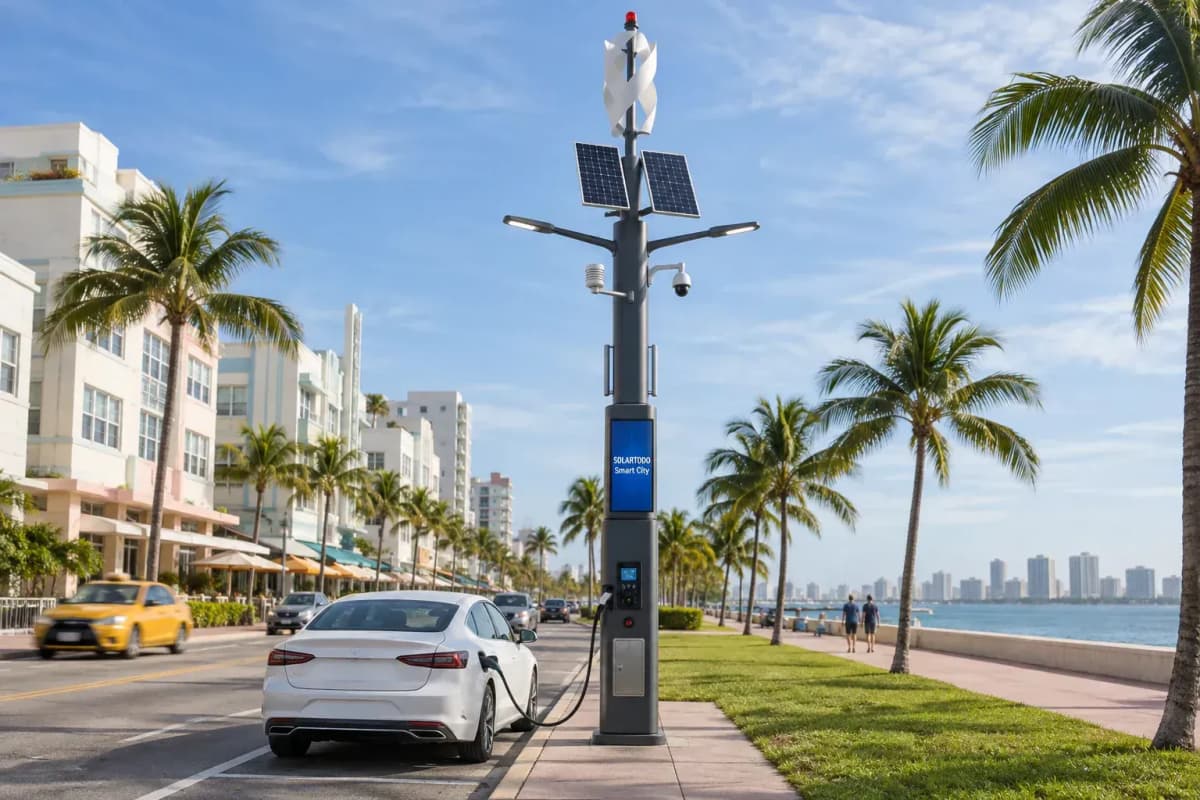
11m Wind-Solar Hybrid Smart Pole - Urban Arterial
Key Features
- 11m octagonal tapered steel pole with Ø45cm base, Ø15cm top, and RAL7024 powder coating
- Hybrid self-powered system with 500W Darrieus VAWT, 200W monocrystalline PV, and 15kWh LFP storage
- Twin 1.5m arms with 2 × 80W LED luminaires delivering 150lm/W at 4000K
- Integrated 7kW Type 2 AC EV charger with OCPP 1.6J, 5m coiled cable, touchscreen, and E-stop
- Smart-city module stack includes 25x PTZ camera, 12-parameter sensor, P4 LED display, WiFi 6, 5G, and LoRaWAN
The 11m Wind-Solar Hybrid Smart Pole combines a 500W Darrieus H-type VAWT, 200W monocrystalline PV, 15kWh LFP storage, twin 80W LED lighting, PTZ security, EV charging, public address, environmental sensing, and 5G/LoRaWAN connectivity in 1 integrated urban arterial pole. Its lower 2.2m steel section functions as the welded EV charging cabinet, reducing roadside equipment count while supporting IEC 60598 and IEC 62196-2 aligned infrastructure planning.
Description
The 11m Wind-Solar Hybrid Smart Pole · Urban Arterial is a 10-in-1 smart streetlight platform for 35m pole spacing, combining 176 units of 11m octagonal tapered steel poles with 500W vertical-axis wind generation, 200W monocrystalline PV, 15kWh LFP battery storage, 160W total LED lighting, 7kW AC EV charging, PTZ video, environmental sensing, public address, LED messaging, SOS, WiFi 6, 5G, and LoRaWAN. Designed for arterial roads, municipal corridors, campuses, industrial parks, transport nodes, and mixed-use smart-city streets, the pole integrates power, sensing, communication, safety, and charging into 1 continuous steel structure rather than multiple roadside cabinets.
Product Overview
This SOLARTODO smart-streetlight variant uses an 11m dark grey RAL7024 octagonal tapered steel pole with a base diameter of 45cm and a top diameter of 15cm, giving the structure the visual discipline needed for urban arterials with heavy traffic, sidewalks, medians, and public-realm equipment zones. The lower 2.2m section is not a separate charger pedestal; it is the EV charging cabinet itself, welded as 1 continuous steel body with a maintenance door, 7kW Type 2 AC charging interface, OCPP 1.6J communication, 5m coiled cable, E-stop, touchscreen, 2 USB-A ports rated 5V/2.4A, and internal LFP battery space.
The hybrid energy system combines 2 renewable inputs and 1 backup grid interface, which is important because lighting, surveillance, communications, and charging have different daily load curves across a 24-hour operating cycle. A 500W Darrieus H-type VAWT at the apex uses 3 straight vertical blades in an 80cm by 110cm swept envelope, while 2 deep-black 100W monocrystalline panels sit on symmetric east-west A-frame brackets at 15° tilt; an MPPT controller prioritizes local renewable production before grid backup is used.
System Architecture
At the top of the pole, the VAWT, red aviation LED, and 12-parameter environmental sensor create a compact 3-level crown for wind harvesting, safety marking, and data collection above typical roadside obstruction heights. The sensor package covers full meteorology plus air quality, rain, CO, NO2, and O3, enabling 1 pole to support illumination control, public-safety dashboards, low-emission-zone analysis, flood-prone intersection monitoring, and public-health datasets with hourly or sub-hourly sampling intervals.
The mid-pole zone is arranged for balanced loading and clean sightlines: twin symmetric 1.5m arms carry 2 × 80W LED luminaires at +8° upward tilt, producing 160W of total lighting output at 150lm/W and 4000K neutral-white color temperature. This configuration supports arterial road lighting where pole spacing is 35m, luminaire symmetry matters for 2-way carriageways, and lighting design should be checked against project photometrics, local road classification, glare limits, and IEC 60598 luminaire safety requirements.
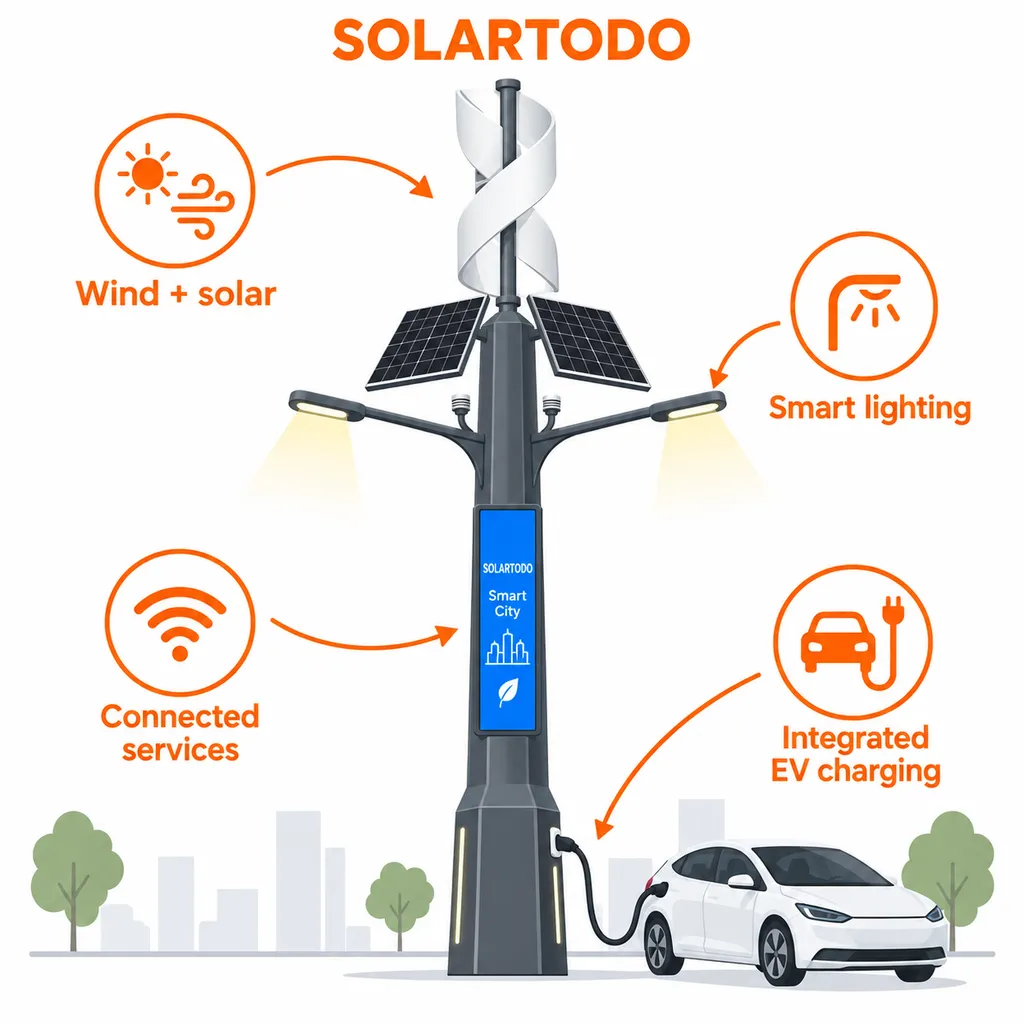
The security and communications layer uses a 22cm white PTZ dome camera on a 50cm L-bracket outrigger, providing 360° rotation, 25x optical zoom, and 150m IR range for intersections, bus stops, parking entrances, and arterial pedestrian crossings. A flush-mounted dual-mode WiFi 6 and 5G gateway at 8.7m provides GbE uplink and LoRaWAN integration, with the color-matched enclosure blended into the flat pole face so the device reads as part of 1 unibody infrastructure system rather than an externally strapped accessory.
Public communication is handled through 2 symmetric 30W IP audio column speakers, each a slim Ø10cm × 50cm perforated aluminum tube mounted flush against opposite pole faces and color-matched to RAL7024. The paired 93dB TCP/IP speakers support emergency announcements, scheduled public-address messages, and local authority notifications, while the one-press SOS button can trigger camera linkage and operator workflows within seconds when connected to a city command platform.
Technical Specifications
| Parameter | Specification |
|---|---|
| Pole height | 11m |
| Pole quantity reference | 176 units |
| Pole geometry | Octagonal tapered steel, Ø45cm base to Ø15cm top |
| Finish | Dark grey RAL7024 powder coat |
| Wind generation | 500W Darrieus H-type VAWT, 3 straight blades, Ø80cm × 110cm |
| Solar generation | 2 × 100W monocrystalline panels, 15° tilt |
| Battery | 15kWh LFP inside pole base |
| LED lighting | 2 × 80W, 150lm/W, 4000K |
| Camera | 22cm PTZ dome, 360° rotation, 25x zoom, 150m IR |
| EV charging | 7kW AC, Type 2, OCPP 1.6J, 5m cable |
| Display | P4 portrait LED screen, 960mm × 1920mm, >5500cd/m² |
| Communication | WiFi 6, 5G, GbE uplink, LoRaWAN |
The integrated display uses a P4 vertical LED screen measuring 960mm × 1920mm in portrait format with brightness above 5500cd/m², suitable for daylight-readable municipal notices, traffic advisories, and revenue-supported public information. For this variant, display content is specified as “SOLARTODO Smart City” in white sans-serif type on deep blue, with no additional imagery, so procurement teams can model screen power, brightness, and permitting requirements without ambiguous media assumptions.
The pole’s power architecture should be understood as a hybrid micro-infrastructure node rather than a fully isolated off-grid tower, because the design includes 500W wind, 200W PV, 15kWh LFP storage, and backup grid tie in 1 controlled system. NREL PVWatts Version 8 is commonly used to estimate PV energy from local irradiance and 2020 TMY-type weather inputs, so project engineers should model the 200W PV contribution by city, tilt, azimuth, shading, and loss assumptions before final autonomy sizing (NREL PVWatts).
Standards and Engineering Basis
The luminaire subsystem is aligned with IEC 60598 principles for classification, marking, mechanical construction, electrical construction, and photobiological safety of luminaires operating up to 1000V, which is relevant to the 2 × 80W LED heads and their pole-mounted wiring paths (IEC 60598-1). The EV charging subsystem references IEC 62196-2 for AC charging couplers, Type 2 interfaces, and plug/socket interoperability, while OCPP 1.6J gives operators a known protocol basis for charger monitoring and billing integration.
For structural and wind review, the 11m pole, 500W top VAWT, twin arms, PTZ bracket, display, PV A-frame, and flush gateway should be checked against local wind maps, foundation soil reports, corrosion class, and project-specific finite-element assumptions. The quoted wind resistance template value is 150km/h, but final anchor-bolt diameter, base plate thickness, rebar cage, and concrete grade should be engineered for each site because a 45cm base diameter pole with a rotating crown has different dynamic loading than a conventional 11m lighting-only pole.
IRENA’s 2025 cost analysis reported that renewable power capacity additions reached 582GW in 2024 and that utility-scale solar PV LCOE averaged USD 0.043/kWh, providing a macroeconomic basis for cities pairing distributed solar with batteries and efficient loads (IRENA Renewable Power Generation Costs 2024). IEA’s 2024 integration analysis also notes that solar PV and wind capacity more than doubled from 2018 to 2023, supporting the use of hybrid renewable inputs where grid resilience and urban decarbonization are both procurement goals (IEA Integrating Solar and Wind).
Cloud Monitoring
The cloud monitoring architecture links the pole controller, EV charger, WiFi 6/5G gateway, LoRaWAN interface, PTZ camera, IP speakers, SOS input, LED display, MPPT controller, and battery management system into 1 asset record per pole. Typical dashboards track 15kWh battery state of charge, 500W wind output, 200W PV output, 160W lighting load, 7kW charging events, camera status, speaker status, gateway uptime, environmental measurements, display schedules, and fault alarms by minute, hour, day, and month.
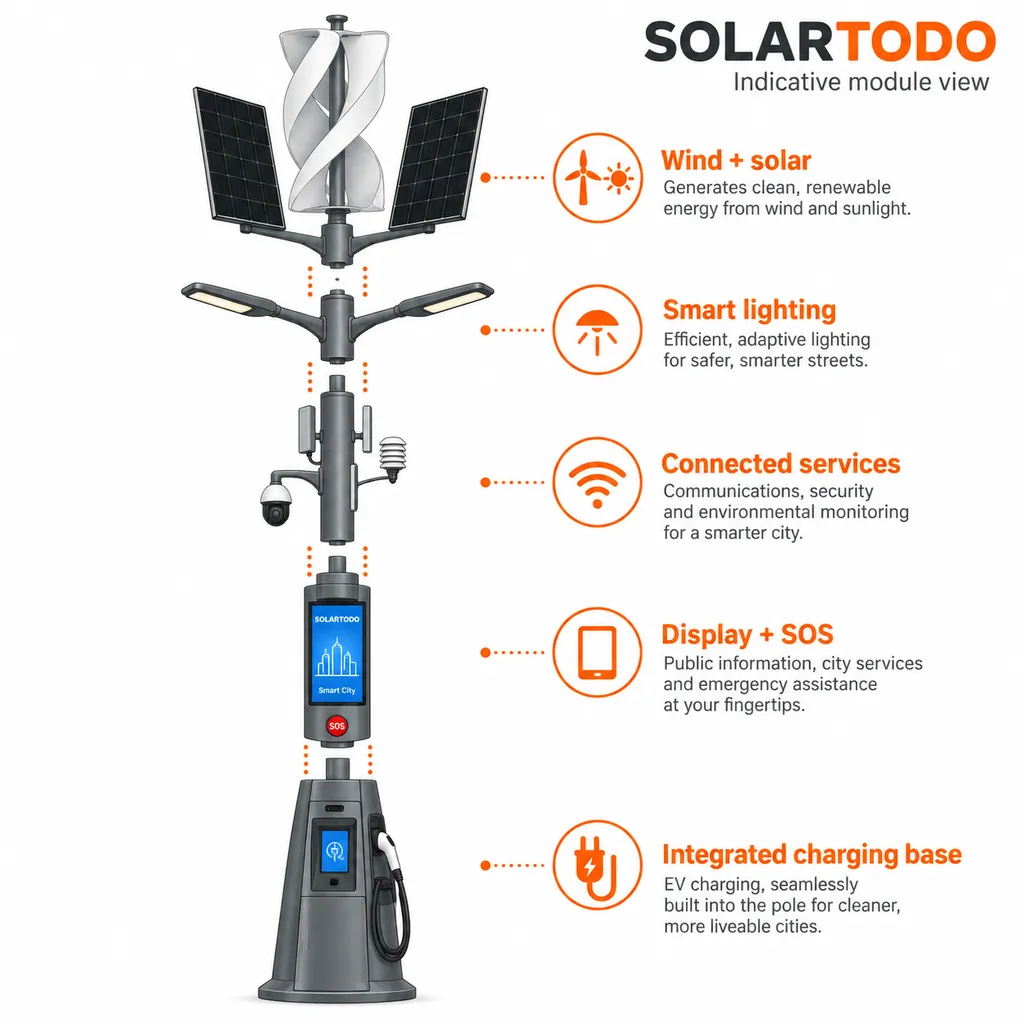
Remote management reduces inspection trips by consolidating at least 10 field functions into 1 connected pole asset: lighting, wind, solar, storage, EV charging, camera, SOS, display, audio, environmental sensing, and communications. Compared with a conventional deployment using 1 lighting pole, 1 charger pedestal, 1 camera pole, 1 display frame, 1 weather mast, and 1 communications cabinet, the integrated structure can reduce separate roadside equipment positions by about 60% to 80%, depending on whether the baseline includes 5 or 6 independent supports.
Representative Urban Arterial Scenario
For a representative MENA urban arterial scenario using 176 poles at 35m spacing, the corridor length is approximately 6.16km, calculated as 176 × 35m. The installed lighting capacity is 28.16kW from 176 × 160W LED luminaires, while distributed storage totals 2640kWh from 176 × 15kWh LFP packs, giving the road operator a large distributed buffer for night lighting, camera uptime, gateway continuity, public-address readiness, and limited charging support during grid instability.
Assuming 11 hours of nightly lighting, the LED load is about 309.8kWh per night for 176 units, before adaptive dimming, camera, communications, display, charger, and battery losses are added. Compared with a conventional 250W high-pressure sodium or metal-halide fixture at 176 locations, a 160W LED configuration reduces connected lighting power by 36%, and adaptive dimming can increase operational savings further when traffic volume, pedestrian presence, or curfew schedules allow lower output for 4 to 6 hours per night.
The 200W PV array and 500W VAWT are intentionally modest relative to the 7kW EV charger, because an urban pole cannot physically carry utility-scale generation. The engineering value is distributed resilience: solar output is strongest during high-irradiance daylight hours, vertical-axis wind can contribute during different time windows, the 15kWh LFP battery can stabilize low-voltage loads, and the backup grid tie prevents public-safety functions from depending on a single intermittent source.
EPC Investment Analysis and Pricing Structure
EPC turnkey delivery includes 5 work packages: engineering, procurement, construction, commissioning, and 1-year warranty support. Engineering covers site survey, pole layout, foundation drawings, single-line diagrams, photometric coordination, wind-load review, and communications topology; procurement covers the 11m pole body, wind turbine, PV panels, LFP battery, LEDs, camera, sensor, charger, display, audio, SOS, gateway, protection devices, cabling, and spare parts; construction covers excavation, foundation, lifting, wiring, earthing, and site reinstatement; commissioning covers functional testing, OCPP connection, camera alignment, lighting checks, and operator handover.
| Pricing tier | Scope | Unit price range |
|---|---|---|
| FOB Supply | Equipment only, ex-works China | USD 992-3,944 |
| CIF Delivered | Equipment plus ocean freight and insurance | USD 1,114-4,431 |
| EPC Turnkey | Installed, commissioned, and 1-year warranty | USD 1,600-5,800 |
| Volume | Discount from applicable tier | Procurement note |
|---|---|---|
| 50+ units | 5% | Suitable for pilot corridors of 1.75km at 35m spacing |
| 100+ units | 10% | Suitable for district packages of 3.5km at 35m spacing |
| 250+ units | 15% | Suitable for city programs above 8.75km at 35m spacing |
A practical ROI model should compare 3 cost centers: reduced lighting energy, reduced civil works from asset consolidation, and monetizable services such as EV charging, WiFi sponsorship, or display leasing. For 1 pole, replacing a 250W conventional lamp with 160W LED saves 90W of connected lighting load; over 11 hours per night and 365 days, that is about 361kWh/year before dimming. At USD 0.15/kWh, the direct lighting energy saving is about USD 54/year per pole, while maintenance and trenching savings may be larger when 5 standalone assets are consolidated into 1 foundation.
Payback depends on local tariffs, charger utilization, display policy, carbon value, and labor rates, so SOLARTODO recommends using 3 utilization cases during procurement: conservative at 1 EV session/day, base case at 3 EV sessions/day, and high-use arterial case at 6 EV sessions/day. Payment terms are 30% T/T deposit plus 70% against bill of lading, or 100% L/C at sight; financing can be reviewed for projects above USD 1,000K, and EPC or distributor inquiries can be sent to [email protected].
Applications
The 11m Wind-Solar Hybrid Smart Pole is best suited to arterial roads, bus rapid transit corridors, university campuses, hospitals, seaports, industrial parks, airport access roads, waterfront promenades, and mixed-use developments that need 24/7 lighting, video, communications, EV charging, and public messaging within a constrained right-of-way. Procurement teams can View all Smart Streetlight (10-in-1 Multi-function Pole) products, Configure your system online, or Request a custom quotation when corridor length, pole count, road class, and foundation data are available.
For knowledge planning, buyers should review 2 topic areas before specification freeze: smart pole energy modeling and urban EV charging integration. SOLARTODO’s knowledge center provides background material for system sizing at Learn about topic, while IEA’s city renewable-energy work highlights the municipal role in deploying distributed energy across local infrastructure and public assets (IEA Cities and Renewable Energy).
Procurement Notes
A complete bill of materials should confirm 14 major subsystems per pole: steel structure, foundation kit, VAWT, aviation LED, PV brackets, PV modules, MPPT, LFP battery, LED luminaires, PTZ camera, environmental sensor, IP speakers, SOS station, EV charger, LED display, and communications gateway. For 176 units, packing plans should separate long steel poles, battery packs, fragile electronics, LED displays, cameras, chargers, and brackets into documented crates with serial numbers, test records, and installation drawings.
Quality control should include 8 factory checks before shipment: coating thickness, dimensional inspection, weld inspection, electrical continuity, insulation resistance, functional lighting test, charger protocol check, and communications gateway test. Site acceptance should include 10 field checks after installation: foundation alignment, verticality, earthing resistance, luminaire aiming, camera coverage, WiFi/5G signal, LoRaWAN link, battery state, EV charging transaction, SOS linkage, speaker output, and display brightness under daytime conditions.
The expected design life is 25 years for the pole structure under appropriate corrosion control, while electronic subsystems such as batteries, cameras, gateways, displays, and chargers require lifecycle replacement planning at shorter intervals based on duty cycle and ambient temperature. Operating temperature is specified from -40°C to +55°C and ingress protection is specified as IP66 for outdoor modules, but enclosure sealing, drainage, and maintenance access should be reviewed after the first 6 to 12 months in coastal, desert, snow, or high-pollution environments.
Buyer Checklist
Before issuing a purchase order, engineering and procurement teams should provide at least 9 inputs: road cross-section, pole spacing target, design wind speed, soil bearing capacity, grid connection voltage, EV connector policy, telecom SIM requirements, camera retention policy, and display permitting constraints. For a 176-unit corridor, these inputs determine foundation size, cable routes, grid-tie protection, data plan cost, cloud architecture, installation sequence, and handover documentation.
The SOLARTODO configuration approach keeps the 11m hybrid pole as 1 engineered infrastructure node rather than a decorative lamp with add-ons, which matters when cities plan thousands of roadside assets over 10 to 25 years. By combining 500W wind, 200W PV, 15kWh storage, 160W LED lighting, 7kW charging, and connected sensing in 1 pole, the platform supports lower clutter, better asset records, faster maintenance dispatch, and more resilient public services for urban arterial environments.
Technical Specifications
| Pole Height | 11m |
| LED Power | 160W |
| Luminous Efficacy | 150lm/W |
| Integrated Modules | 10-in-1 |
| Wind Resistance | 150km/h |
| IP Rating | IP66 |
| Operating Temperature | -40 to +55°C |
| Communication | 4G/5G + LoRaWAN + WiFi 6 + GbE |
| Energy Saving | 36% |
| Design Life | 25years |
| Wind Turbine Power | 500W |
| Solar PV Power | 200W |
| Battery Capacity | 15kWh |
| EV Charger Output | 7kW |
| Recommended Spacing | 35m |
Price Breakdown
| Item | Quantity | Unit Price | Subtotal |
|---|---|---|---|
| 11m octagonal tapered steel smart pole with integrated EV cabinet | 1 pcs | $923 | $923 |
| 500W Darrieus H-type VAWT with red aviation LED | 1 pcs | $520 | $520 |
| 100W monocrystalline deep-black PV panel | 2 pcs | $65 | $130 |
| 15kWh LFP battery pack with MPPT controller | 1 pcs | $1,450 | $1,450 |
| Twin 80W LED luminaire assembly with symmetric arms | 1 pcs | $210 | $210 |
| 22cm PTZ dome camera, 25x zoom, 150m IR | 1 pcs | $226 | $226 |
| 12-parameter environmental sensor | 1 pcs | $260 | $260 |
| 30W IP audio column speaker | 2 pcs | $92 | $184 |
| Visual SOS emergency call button with camera linkage | 1 pcs | $134 | $134 |
| 7kW Type 2 OCPP AC EV charger module | 1 pcs | $201 | $201 |
| P4 portrait LED display, 960mm × 1920mm | 1 pcs | $760 | $760 |
| WiFi 6 + 5G + LoRaWAN smart gateway | 1 pcs | $180 | $180 |
| USB-A ports, protection devices, cabling, breakers, surge set | 1 pcs | $90 | $90 |
| Engineering, drawings, QC, and factory acceptance | 1 pcs | $180 | $180 |
| Installation and commissioning allowance | 1 pcs | $320 | $320 |
| 1-year warranty and support allowance | 1 pcs | $160 | $160 |
| Total Price Range | $1,600 - $5,800 | ||
Frequently Asked Questions
What makes this 11m pole different from a standard smart streetlight?
Can the 7kW EV charger run only from the wind and solar system?
What does EPC turnkey pricing include for this product?
Which standards are relevant for specification and inspection?
What information is needed before SOLARTODO can quote a corridor project?
Certifications & Standards



Data Sources & References
- •NREL PVWatts Calculator Version 8, https://pvwatts.nrel.gov/
- •IEC 60598-1:2020 Luminaires - General requirements and tests, https://webstore.iec.ch/en/publication/61414
- •IEA 2024 Integrating Solar and Wind, https://www.iea.org/reports/integrating-solar-and-wind
- •IRENA 2025 Renewable Power Generation Costs in 2024, https://www.irena.org/Digital-Report/Renewable-Power-Generation-Costs-in-2024
- •IEA Cities, Towns and Renewable Energy, https://www.iea.org/reports/cities-towns-and-renewable-energy-yes-in-my-front-yard
- •IEC 62196-2 EV charging coupler standard reference
Interested in this solution?
Contact us for a customized quote based on your specific requirements.
Contact Us