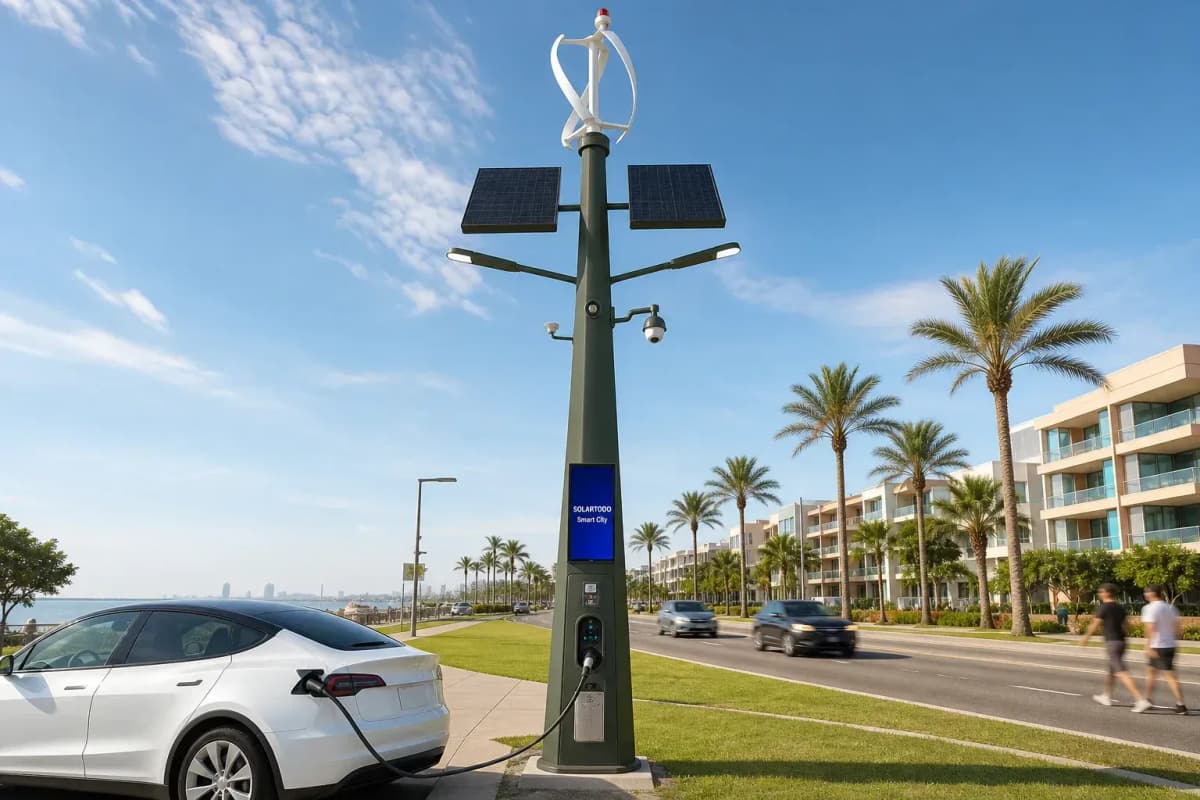
14m Wind-Solar Hybrid Smart Pole - Urban Arterial
Key Features
- 14m octagonal tapered steel pole with 45cm base diameter, 15cm top diameter, and 2.2m integrated EV charging cabinet
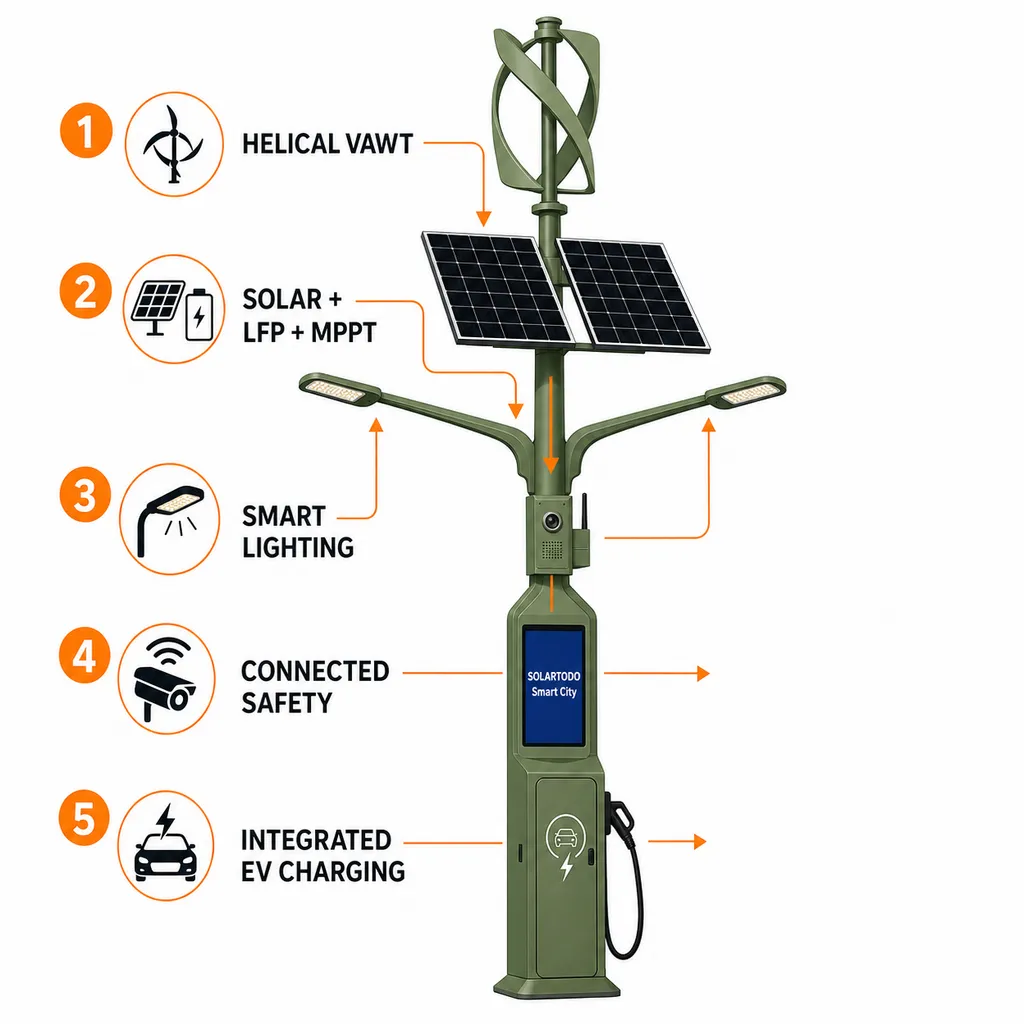
- Hybrid self-powered package with 400W Gorlov VAWT, 400W monocrystalline PV, 5kWh LFP battery, MPPT, and backup grid tie
- Twin 1.5m arms carry 2×80W LED luminaires at 150 lm/W and 4000K for about 24,000 lm total output
- Integrated 11kW Type 2 AC EV charger with OCPP 1.6J, 5m coiled cable, touchscreen, E-stop, and maintenance door
- Smart-city stack includes 25× PTZ camera, 12-parameter sensor, WiFi 6 for 256 devices, 30W IP speaker, SOS, USB, and P5 LED display
The 14m Wind-Solar Hybrid Smart Pole integrates a 400W Gorlov VAWT, 400W monocrystalline PV, 5kWh LFP storage, 2×80W LED lighting, 11kW Type 2 EV charging, PTZ security, WiFi 6, PA, SOS, air-quality sensing, and a P5 LED display in 1 continuous steel pole. It is designed for 30m arterial-road spacing, IP66 outdoor service, IEC 60598 lighting safety alignment, IEC 62196-2 EV connector compatibility, and OCPP 1.6J charger management.
Description
The 14m Wind-Solar Hybrid Smart Pole · Urban Arterial is a 10-in-1 smart streetlight engineered for 30m arterial-road spacing, combining a 14m octagonal tapered steel pole, a 400W Gorlov-type vertical-axis wind turbine, 400W of monocrystalline solar PV, a 5kWh LFP battery, 2×80W LED luminaires, an 11kW Type 2 AC EV charger, PTZ video, WiFi 6, public address, SOS, environmental sensing, and a P5 LED display in 1 integrated infrastructure asset. The lower 2.2m of the pole is the EV charging cabinet itself, welded as 1 continuous steel body rather than added as a separate pillar, which reduces roadside equipment count by up to 3 cabinets per pole location.
SOLARTODO positions this product for city arterials, bus corridors, public parking edges, campuses, industrial parks, logistics zones, and mixed-use boulevards where 1 pole must support lighting, charging, monitoring, connectivity, and digital communication within a compact 45cm base diameter. Buyers comparing smart lighting options can View all Smart Streetlight (10-in-1 Multi-function Pole) products or Configure your system online with height, power, sensor, charger, and communications options in 1 structured workflow.
System Architecture
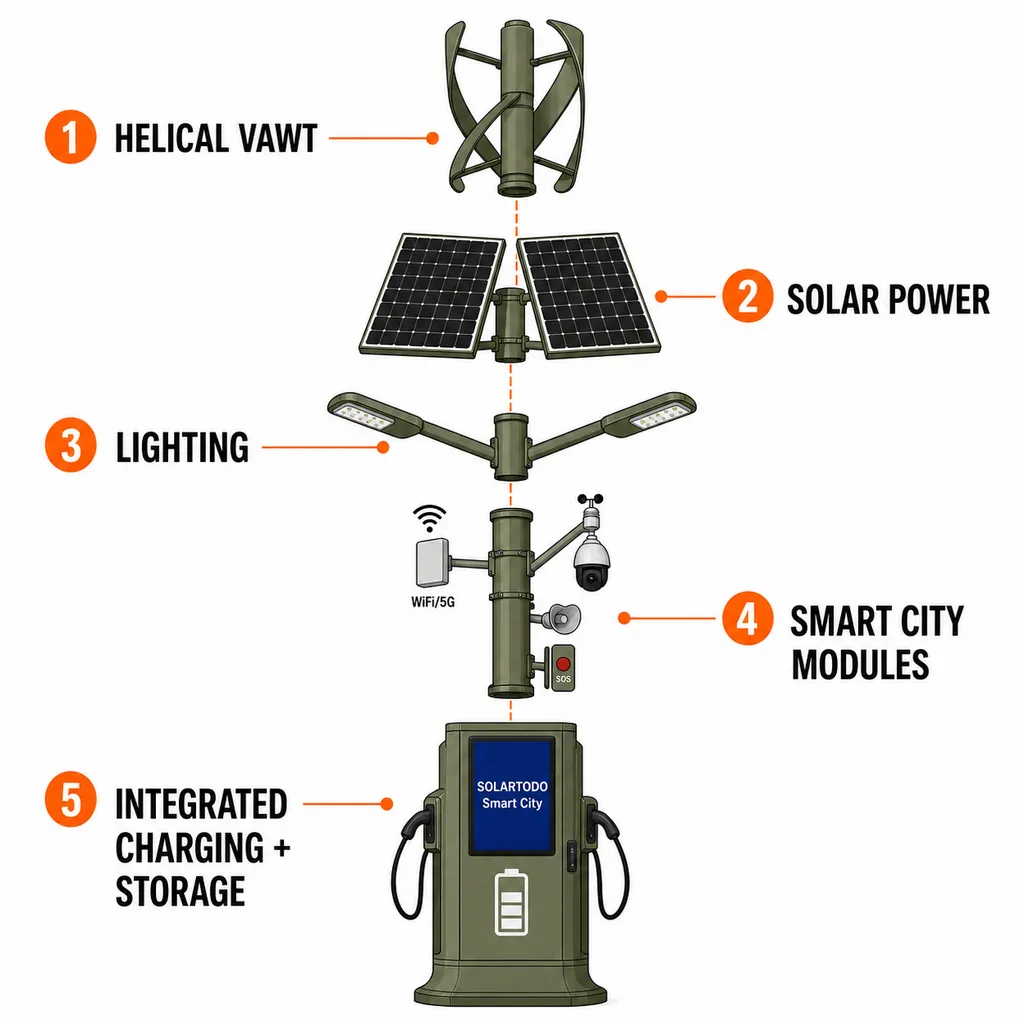
The mechanical platform uses a 14m octagonal tapered steel shaft with an approximate 45cm base diameter and 15cm top diameter, finished in military green RAL6014 powder coat for corrosion resistance and visual consistency across urban corridors. The pole carries a 70×100cm helical Gorlov-type VAWT at the apex, 2 deep-black 200W monocrystalline PV panels on symmetric east-west A-frame brackets at 15 degrees, twin 1.5m luminaire arms tilted +8 degrees, and a flush-mounted WiFi 6 AP at 8.7m.
The power architecture has 3 operating sources: wind generation from the 400W VAWT, solar generation from the 400W PV array, and a backup grid-tie input for periods with low irradiance or low wind speed. A 5kWh lithium iron phosphate battery inside the pole base is managed by an MPPT controller, and the 11kW AC charger is separated electrically from essential services so lighting, camera, SOS, and communications remain priority loads during constrained energy conditions.
Technical Specifications
The lighting package uses 2 symmetric 80W LED luminaires rated at 150 lm/W and 4000K neutral white, producing about 24,000 lumens before optical and thermal losses. For road-lighting designs, the fixture should be checked against local photometric requirements, glare limits, and pole spacing, while luminaire safety is aligned with IEC 60598-1 general requirements for classification, marking, mechanical construction, electrical construction, and testing.
The wind subsystem uses 3 twisted white aluminum blades in a Gorlov-style helical rotor, with a 70cm diameter, 100cm height, 400W rated output, and a red aviation LED mounted near the rotating assembly for aerial visibility. Vertical-axis wind turbines are selected here because they can accept turbulent multi-directional urban wind better than many small horizontal-axis turbines, although annual kWh output still depends on 12-month local wind-speed distribution rather than nameplate rating alone.
The solar subsystem uses 2×200W monocrystalline modules mounted in an east-west pair to spread generation across morning and afternoon hours instead of optimizing only 1 midday peak. NREL PVWatts Version 8 notes that PV energy estimates depend on long-term weather data and modeling assumptions, including module temperature, irradiance, inverter behavior, and losses, so the 400W PV field should be treated as a site-modeled contributor rather than a guaranteed daily kWh value.
The EV charging subsystem is an integrated 11kW single-gun AC charger with Type 2 connector geometry, 5m coiled cable, touchscreen, emergency stop, maintenance door, and OCPP 1.6J backend communication. IEC 62196-2 defines dimensional compatibility and interchangeability requirements for AC EV plugs, socket-outlets, vehicle connectors, and vehicle inlets up to specified current and voltage classes, while the Open Charge Alliance identifies OCPP 1.6 as a widely implemented protocol with JSON and SOAP profiles.
The sensing and safety stack includes a 22cm white PTZ dome camera with 360-degree rotation, 25× optical zoom, and 150m IR night visibility, plus a 12-parameter environmental sensor for meteorology, air quality, rain, CO, NO2, and O3. A one-press SOS button links emergency calls to camera context, and the 30W IP audio column is a slim 10×50cm perforated aluminum tube mounted flush against the flat pole face with TCP/IP network control and 93dB acoustic rating.
Integrated Pole-as-Charger Design
The defining feature is the 2.2m lower steel section that functions as the EV charging cabinet, cable station, service compartment, touchscreen interface, and access-controlled maintenance housing in 1 welded pole body. Compared with a conventional layout using 1 lighting pole, 1 charger pedestal, 1 telecom enclosure, and 1 display frame, this integrated configuration can reduce separate roadside foundations by approximately 50% to 75% depending on the final civil design.
This unibody approach improves urban-right-of-way management because cable penetrations, earthing, surge protection, charger servicing, and low-voltage distribution are concentrated inside 1 lockable steel envelope. Procurement teams also avoid coordinating 4 separate enclosure colors, 3 separate anchor groups, and 2 independent service trenches, which is useful on arterial corridors where traffic-control windows may be limited to 6 to 8 hours per night.
Lighting, Video, and Public Safety
The twin-arm luminaire layout gives bilateral roadway coverage from a 14m mounting height, with each 1.5m arm angled upward by +8 degrees to optimize the relationship between carriageway reach, pedestrian-zone visibility, and pole-top equipment clearance. The 160W total LED load is lower than many legacy 250W to 400W high-intensity discharge combinations, and LED dimming schedules can reduce annual lighting kWh by 40% to 70% when traffic and safety policies permit adaptive operation.
The PTZ camera and SOS button are designed as a linked public-safety pair, with the camera’s 25× zoom and 150m IR range supporting event verification before dispatch. The pole also supports real-time public address through a 30W IP column speaker, enabling 1 command center to broadcast evacuation, traffic, weather, or site-security audio across multiple poles without installing separate amplifier cabinets at every 30m interval.
Connectivity and Cloud Monitoring
The communications package uses WiFi 6 based on IEEE 802.11ax-class access technology, with a rated device capacity of 256 clients and up to 1.8Gbps radio throughput under configured conditions. The AP housing is color-matched and flush mounted at 8.7m, so the RAL6014 finish continues across the device-pole boundary and preserves the visual continuity expected in high-visibility city streets.
Cloud monitoring aggregates lighting status, charger sessions, PV and wind energy data, battery state of charge, PTZ camera health, WiFi AP uptime, SOS activity, environmental readings, and LED display playback logs into 1 operations interface. OCPP 1.6J enables charger session messaging and remote status visibility, while smart-pole telemetry can be integrated with municipal dashboards through 4G, 5G, LoRaWAN, Ethernet, or project-specific API bridges.
Display, Sensing, and City Data
The digital communication module is a P5 vertical LED display sized 1280×2560mm in portrait orientation, with brightness above 5000 cd/m² for daylight visibility. For this variant, content is strictly specified as SOLARTODO Smart City in white sans-serif text on a deep blue background, with no secondary imagery, because arterial installations often require predictable civic signage rather than advertising variability.
The 12-parameter top sensor expands the pole from lighting infrastructure into a distributed observation node, measuring weather, rain, pollutant, and gas indicators at a consistent 14m structural reference point. For city engineers, 41 poles across a representative corridor can create 41 repeatable data points at 30m spacing, allowing hyperlocal comparisons between intersections, bus stops, parking pockets, and vegetation zones.
Representative MENA Urban Arterial Scenario
For a representative MENA arterial-road scenario with 41 poles installed at 30m spacing, the illuminated and monitored corridor length is approximately 1.23km, excluding turning bays and intersection setbacks. If each pole operates the 160W LED package for 11 hours per night and adaptive dimming reduces average output to 60%, lighting consumption is about 1.06kWh per pole per night, or about 15,900kWh per year for 41 poles before auxiliary loads.
In the same 41-pole scenario, the combined renewable nameplate capacity is 32.8kW because each pole carries 400W PV and 400W wind. Actual generation must be modeled with local solar irradiance and wind-speed records, but the hybrid architecture reduces dependence on a single resource, and backup grid tie prevents the 5kWh battery from becoming the sole reliability mechanism during dust events, heat waves, or multi-day calm periods.
A conventional alternative using 41 separate lighting poles, 20 charger pedestals, 20 CCTV poles, 10 WiFi poles, and 10 display frames can require more than 100 visible streetscape assets for a similar functional brief. The SOLARTODO configuration consolidates the same order of functionality into 41 poles, which can reduce visible asset count by about 59% and lower civil coordination risk where right-of-way space is constrained.
EPC Investment Analysis and Pricing Structure
EPC delivery includes 5 work packages: engineering design, procurement, construction, commissioning, and a 1-year warranty. Engineering covers structural layout, power single-line review, charger interface planning, lighting layout inputs, and communications architecture; procurement covers pole fabrication, luminaires, VAWT, PV, LFP battery, charger, display, sensors, and accessories; construction covers foundations, lifting, cabling, earthing, network integration, and on-site QA; commissioning covers 1 acceptance checklist for lighting, EV charging, camera, WiFi, display, SOS, PA, energy telemetry, and cloud monitoring.
| Pricing tier | Scope | Unit price range |
|---|---|---|
| FOB Supply | Equipment only, ex-works China, 1 pole set | USD 992-3,944 |
| CIF Delivered | Equipment plus ocean freight and insurance, 1 pole set | USD 1,114-4,431 |
| EPC Turnkey | Installed, commissioned, and warranted for 1 year, 1 pole set | USD 1,600-5,800 |
| Volume band | Discount from qualifying equipment baseline | Typical procurement use |
|---|---|---|
| 50+ poles | 5% | Small urban district, campus, or 1 arterial package |
| 100+ poles | 10% | Multi-road municipal framework or utility-led rollout |
| 250+ poles | 15% | Citywide smart corridor or regional infrastructure program |
ROI analysis should compare at least 4 annual cash-flow categories: avoided grid lighting energy, avoided separate cabinet maintenance, EV charging margin, and digital-signage or municipal communication value. As a simplified illustration, 1 pole saving 350kWh to 700kWh of grid lighting energy per year at USD 0.12/kWh offsets USD 42 to USD 84 annually, while 1 EV charger averaging only 4 paid 11kWh sessions per week at a USD 0.08/kWh service margin adds about USD 183 annually; combined with lower separate-asset maintenance, a 1-pole payback can fall in a broad 6- to 12-year planning range depending on utilization, tariff, labor, and local civil costs.
Payment terms are normally 30% T/T deposit plus 70% against bill of lading, or 100% irrevocable L/C at sight for qualified buyers; project financing can be discussed for programs above USD 1,000,000. For engineered quotations, drawings, and corridor schedules, procurement teams can Request a custom quotation or contact [email protected] with pole count, road width, wind zone, grid voltage, charging policy, and installation country.
Standards and Compliance References
This variant is specified around IEC 60598 luminaire safety, GB/T 37024 smart-pole system practice, IEC 62196-2 Type 2 EV connector compatibility, OCPP 1.6J charger communication, IP66 ingress protection, and WiFi 6 IEEE 802.11ax-class connectivity. IEA Energy Efficiency 2025 frames efficiency as a system-level lever across buildings, transport, industry, and appliances, which supports treating smart poles as integrated energy, mobility, and digital infrastructure rather than single-purpose lighting assets.
IRENA’s 2025 renewable-cost analysis reports 2024 global weighted-average LCOE values of USD 0.043/kWh for utility-scale solar PV and USD 0.034/kWh for onshore wind, while also reporting battery storage cost declines of 93% from 2010 to 2024. These figures do not price a 400W pole-mounted VAWT or 5kWh cabinet battery directly, but they provide useful context for why hybrid renewable and storage components are now feasible in distributed urban equipment.
Applications
The 14m Wind-Solar Hybrid Smart Pole is suitable for 6-lane urban arterials, smart-parking boundaries, BRT corridors, waterfront promenades, airport approach roads, logistics parks, university campuses, and industrial park entrances where 2-way lighting, camera oversight, EV charging, and public data capture are required from 1 asset. For technical background on smart-pole planning, energy storage sizing, and sensor integration, buyers can Learn about topic before finalizing a 50-, 100-, or 250-pole bill of quantities.
Civil and electrical designers should verify 6 project inputs before release to manufacture: wind load, foundation design, grid voltage, charger authorization method, SIM or fiber network plan, and environmental sensor calibration interval. SOLARTODO can provide drawings, component datasheets, and project-specific submittals for tender packages, and buyers can Learn about topic for broader solar, storage, smart-lighting, and energy-infrastructure guidance.
Technical Specifications
| Pole Height | 14m |
| Pole Structure | Octagonal tapered steel, base 45cm to top 15cm |
| Integrated Modules | 10-in-1 |
| Wind Turbine | 400 Gorlov-type helical VAWT, 70x100cm rotorW |
| Solar Array | 2 x 200 monocrystalline panels at 15 degree tiltW |
| Battery Capacity | 5kWh |
| LED Power | 160W |
| Luminous Efficacy | 150lm/W |
| Color Temperature | 4000K |
| EV Charging Output | 11kW |
| EV Connector | Type 2, OCPP 1.6J, 5m cable |
| Camera | 360 degree PTZ, 25x zoom, 150m IR |
| Environmental Sensor | 12-parameter meteorology and air-quality package |
| LED Display | P5 portrait display, 1280 x 2560, >5000 brightnesscd/m² |
| Communication | 4G/5G + LoRaWAN + WiFi 6 |
| WiFi Capacity | 256 devices, up to 1.8Gbps |
| Spacing | 30m |
| Wind Resistance | 160km/h |
| IP Rating | IP66 |
| Operating Temperature | -40 to +55°C |
| Energy Saving | 60% |
| Design Life | 25years |
| Finish | RAL6014 military green powder coat |
Price Breakdown
| Item | Quantity | Unit Price | Subtotal |
|---|---|---|---|
| 14m octagonal tapered steel pole with integrated charger cabinet | 1 pcs | $1,050 | $1,050 |
| 400W Gorlov-type helical VAWT with aviation LED | 1 pcs | $280 | $280 |
| 200W monocrystalline solar panel | 2 pcs | $80 | $160 |
| 5kWh LFP battery inside pole base | 1 pcs | $600 | $600 |
| MPPT hybrid charge controller | 1 pcs | $60 | $60 |
| Twin 80W LED luminaire assembly | 1 pcs | $120 | $120 |
| 22cm PTZ dome camera, 25x zoom, 150m IR | 1 pcs | $226 | $226 |
| 12-parameter environmental sensor | 1 pcs | $260 | $260 |
| 30W IP audio column speaker | 1 pcs | $92 | $92 |
| Visual SOS emergency call module | 1 pcs | $134 | $134 |
| 11kW OCPP AC EV charger, Type 2 single gun | 1 pcs | $252 | $252 |
| P5 LED advertising display, 1280x2560mm | 1 pcs | $900 | $900 |
| WiFi 6 AX access point | 1 pcs | $149 | $149 |
| USB-C PD 30W plus USB-A outlet module | 1 pcs | $34 | $34 |
| Accessories, cables, breakers, and surge protection | 1 pcs | $50 | $50 |
| Engineering, drawings, and factory QC | 1 pcs | $260 | $260 |
| Installation and commissioning | 1 pcs | $580 | $580 |
| 1-year warranty and support | 1 pcs | $170 | $170 |
| Total Price Range | $1,600 - $5,800 | ||
Frequently Asked Questions
What makes the 14m Wind-Solar Hybrid Smart Pole different from a conventional streetlight?
How is the EV charger integrated into the pole structure?
What does EPC turnkey pricing include for this smart pole?
Can the wind and solar system power the pole without the grid?
Which standards are relevant for project submittals?
Certifications & Standards


Data Sources & References
- •IEC 60598-1:2020, Luminaires - Part 1: General requirements and tests, https://webstore.iec.ch/en/publication/61414
- •IEC 62196-2:2016 and IEC 62196-2:2025 lifecycle reference, EV conductive charging accessories, https://webstore.iec.ch/en/publication/24204
- •NREL PVWatts Calculator Version 8.5.2, released September 25, 2025, https://pvwatts.nrel.gov/version_8.php
- •IRENA Renewable Power Generation Costs in 2024, July 2025, https://www.irena.org/Publications/2025/Jun/Renewable-Power-Generation-Costs-in-2024
- •IEA Energy Efficiency 2025, published November 20, 2025, https://www.iea.org/reports/energy-efficiency-2025
- •Open Charge Alliance OCPP protocol overview and OCPP 1.6 downloads, https://openchargealliance.org/protocols/open-charge-point-protocol/
Interested in this solution?
Contact us for a customized quote based on your specific requirements.
Contact Us