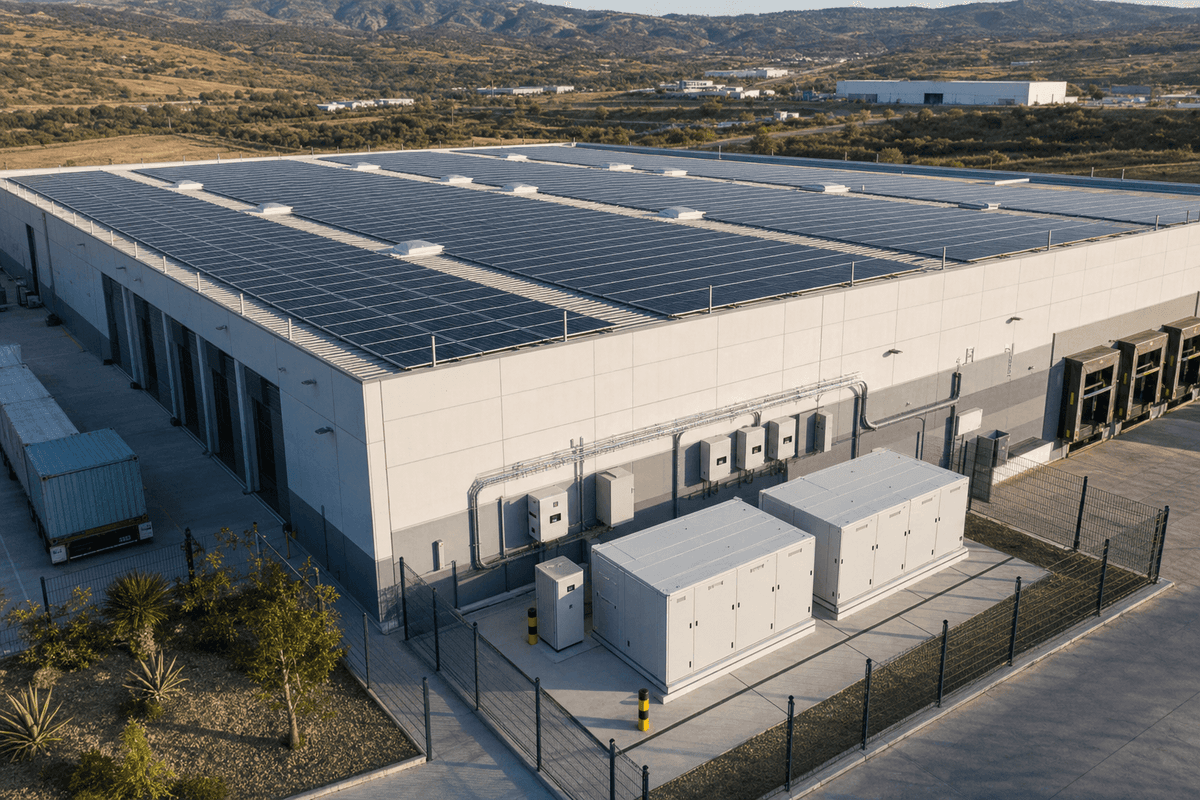
100kW TOPCon Solar + 200kWh LFP Storage — Commercial Hybrid System
Solar PV

100kW TOPCon Solar + 200kWh LFP Storage — Commercial Hybrid System

EPC Price Range
$180,000 - $240,000

Key Features

  • 100 kWp N-Type TOPCon bifacial array with 22.5–24.5% module efficiency and 10–20% bifacial albedo gain, generating 150–175 MWh/year
  • 200 kWh LFP battery storage (180 kWh usable) with >6,000 cycle life, ≥92% round-trip efficiency, and 4-hour backup at 45 kW load
  • First-year module degradation <1%, annual degradation <0.4%, and 30-year linear power warranty at 87.4% of nameplate capacity
  • Estimated payback period of 6.5–7.4 years with combined annual savings of $32,400–$55,500 from energy arbitrage and demand charge reduction
  • Full compliance with IEC 61215, IEC 61730, IEC 62116, IEC 62619, UL 1703, UL 9540A, and IEEE 1547-2018 for global bankability
  • Cloud-based monitoring platform with real-time string-level performance data, automated alerts, and remote O&M capability
  • CO₂ offset of 105–122 metric tons per year, equivalent to removing 22–26 passenger vehicles from the road annually

Description

SOLARTODO 100kW + 200kWh Solar+Storage Commercial System — Technical Product Description

Overview

The SOLARTODO 100kW + 200kWh Solar+Storage Commercial system is a fully integrated, utility-grade hybrid energy solution engineered for commercial and light-industrial facilities seeking energy independence, demand-charge reduction, and long-term operational cost savings. Combining a 100 kWp N-type TOPCon bifacial photovoltaic array with a 200 kWh lithium iron phosphate (LFP) battery energy storage system (BESS), this turnkey package delivers an estimated 150–175 MWh of clean electricity per year under average irradiance conditions (1,500–1,750 peak sun hours), while providing up to 4 hours of full-load backup power at the rated 50 kW discharge rate. The system is designed to comply with IEC 61215, IEC 61730, IEC 62116, UL 1703, and IEEE 1547 standards, ensuring bankability and grid-interconnection readiness across major markets.

The commercial hybrid configuration is particularly well-suited for warehouses, manufacturing plants, retail centers, hotels, and agricultural processing facilities with daytime load profiles of 80–150 kW and peak demand charges exceeding $10/kW/month. At the 2025–2026 benchmark Levelized Cost of Energy (LCOE) of approximately $0.04–$0.06/kWh for this system class, project payback periods typically range from 6 to 9 years, with a net present value (NPV) turning strongly positive beyond year 10 over a 25-year project life.


Solar PV Subsystem

Module Technology: N-Type TOPCon Bifacial

The photovoltaic array utilizes 143 units of 700 W-class N-type TOPCon (Tunnel Oxide Passivated Contact) bifacial modules, such as the Trina Solar Vertex N 700–725 W series, achieving a nameplate DC capacity of approximately 100.1 kWp. Each module is fabricated on a 210 mm large-format N-type monocrystalline silicon wafer, delivering a front-side conversion efficiency of 22.5–24.5% under Standard Test Conditions (STC: 1,000 W/m², 25°C, AM1.5G) per IEC 60904-3.

The passivated contact architecture suppresses surface recombination at both the emitter and back-surface field, yielding an open-circuit voltage (Voc) exceeding 40 V per module and a temperature coefficient of power (Pmax) of only −0.29%/°C — a 15–20% improvement over conventional PERC technology. The bifacial design captures an additional 10–20% albedo gain from reflected ground irradiance, depending on surface reflectivity (albedo factor 0.2–0.5), effectively boosting annual energy yield without increasing the array footprint.

Long-term reliability is guaranteed by a first-year degradation of less than 1% and a subsequent annual degradation rate of less than 0.4%, resulting in a minimum 30-year power output warranty at 87.4% of nameplate capacity. All modules carry IEC 61215 (design qualification), IEC 61730 (safety), and UL 1703 certifications, and are rated for wind loads up to 2,400 Pa and snow loads up to 5,400 Pa.

Array Configuration: Fixed-Tilt Mounting

The array is deployed in a fixed-tilt ground-mount or rooftop configuration using hot-dip galvanized steel and anodized aluminum racking. The optimal tilt angle is site-specific, typically set between 15° and 30° for mid-latitude commercial sites to maximize annual energy yield while minimizing soiling accumulation. The fixed-tilt design eliminates moving parts, reducing maintenance costs and achieving a structural design life exceeding 25 years with minimal intervention.

The total array footprint is approximately 600–700 m² (assuming 7–8 m² per module including row spacing for maintenance access and shading avoidance). The racking system is engineered to withstand wind speeds of up to 160 km/h and seismic Zone 4 loading per ASCE 7-22, making it suitable for deployment across diverse geographic and climatic conditions.

Inverter and Power Electronics

Power conversion is handled by commercial-grade string inverters with a combined AC output capacity of 100 kW at 0.98 power factor. The inverters comply with IEC 62116 (anti-islanding), IEEE 1547-2018 (grid interconnection), and IEC 62109-1/2 (safety of power converters). Maximum Power Point Tracking (MPPT) efficiency exceeds 99.5%, and the European weighted efficiency (EU-η) is rated at 98.2%, minimizing conversion losses across the full irradiance range.

Each string inverter supports a DC input voltage range of 200–1,000 V and is equipped with integrated DC arc-fault circuit interruption (AFCI) per UL 1699B, rapid shutdown capability per NEC 2020 Article 690.12, and remote firmware updates via the SOLARTODO cloud monitoring platform.


Battery Energy Storage Subsystem

LFP Cell Chemistry and Safety

The 200 kWh BESS employs lithium iron phosphate (LFP, LiFePO₄) prismatic cells arranged in modular rack-mounted battery cabinets. LFP chemistry is selected for its superior thermal stability (no thermal runaway below 270°C), cycle life exceeding 6,000 full cycles at 80% Depth of Discharge (DoD) to 80% State of Health (SoH), and compliance with UN 38.3, IEC 62619, and UL 9540A fire safety standards. The system carries a 10-year capacity warranty guaranteeing a minimum 80% usable capacity retention.

The usable energy capacity is 180 kWh (90% usable DoD), providing approximately 4 hours of backup at 45 kW continuous discharge or peak shaving at up to 100 kW for 1.8 hours. The round-trip AC-to-AC efficiency of the storage system is ≥92%, and the self-discharge rate is less than 3% per month at 25°C ambient temperature.

Battery Management and Grid Integration

Each battery cabinet integrates a multi-level Battery Management System (BMS) that monitors cell voltage (±1 mV resolution), temperature (±0.5°C resolution), and state of charge (SoC) with ±2% accuracy. The BMS communicates with the Energy Management System (EMS) via CAN bus and Modbus TCP/IP, enabling real-time optimization of charge/discharge scheduling based on time-of-use (TOU) tariff data, solar forecast, and load demand signals.

The hybrid inverter/PCS (Power Conversion System) supports four primary operating modes: self-consumption priority, peak shaving, backup/islanding, and grid export. In self-consumption mode, the system automatically routes solar generation to the load, charges the battery with surplus energy, and draws from the battery during evening peak hours — a strategy that can reduce grid electricity purchases by 60–80% in favorable locations.


System Performance and Economics

Annual Energy Generation

Based on NREL PVWatts v8 modeling with a performance ratio (PR) of 0.80 and a system loss factor of 14% (accounting for wiring, soiling, mismatch, and inverter losses), the 100 kWp array is projected to generate 150–175 MWh per year in locations with 1,500–1,750 peak sun hours annually. This is equivalent to offsetting approximately 105–122 metric tons of CO₂ per year, based on the U.S. EPA average grid emission factor of 0.386 kg CO₂/kWh (eGRID 2023) or regional equivalents.

The capacity factor for a fixed-tilt commercial system in a mid-latitude location (e.g., southern United States, Mediterranean Europe, or northern Australia) is approximately 17–20%, consistent with NREL's 2025 benchmark data for utility-scale and commercial PV.

Financial Analysis

At a blended commercial electricity tariff of $0.12–$0.18/kWh and a demand charge of $12–$20/kW/month, the system's annual electricity cost savings are estimated at $18,000–$31,500/year from energy arbitrage alone, with an additional $14,400–$24,000/year in demand charge reduction through peak shaving (assuming 100 kW peak demand reduction for 12 months). Combined annual savings of $32,400–$55,500/year yield a simple payback period of 6.5–7.4 years at the midpoint system price of $210,000, before applying applicable tax incentives such as the U.S. Investment Tax Credit (ITC, currently 30% under the Inflation Reduction Act) or equivalent regional incentives.

Over a 25-year project life, the net present value (NPV) at a 6% discount rate is estimated at $120,000–$220,000, with an internal rate of return (IRR) of 12–18% depending on local tariff escalation rates (assumed 2–3% annually). The LCOE of the solar generation component is approximately $0.04–$0.06/kWh, consistent with the 2025–2026 global benchmark of sub-$0.03/kWh in best-resource locations and sub-$0.06/kWh for rooftop commercial systems.


Monitoring, Commissioning, and Warranty

The SOLARTODO commercial system includes a cloud-based monitoring platform with a dedicated IoT gateway, providing real-time visibility into module-level performance (via string-level monitoring), battery SoC, grid import/export, and CO₂ savings. Data is accessible via web dashboard and mobile application, with automated alerts for performance deviations exceeding 5% from the predicted baseline.

Commissioning is performed by SOLARTODO-certified engineers following IEC 62446-1 (PV system documentation and testing) and includes thermographic inspection, I-V curve tracing, insulation resistance testing (>1 MΩ at 1,000 V DC), and grid-interconnection testing per IEEE 1547. The system is delivered with a 25-year linear power output warranty on modules, a 10-year product warranty on inverters and battery cabinets, and a 5-year workmanship warranty on installation.


Frequently Asked Questions

Q1: What is the minimum roof or ground area required for this system?

The 100 kWp array requires approximately 600–700 m² of unshaded, structurally adequate surface area, accounting for module footprint (~2.56 m² per 700 W module × 143 modules = ~366 m²) plus row-spacing clearance for maintenance access and inter-row shading avoidance at the design tilt angle. For flat commercial rooftops, a minimum clear area of 650 m² is recommended. Ground-mount installations may require additional land for perimeter fencing and access roads, typically 800–1,000 m² total.

Q2: How long does the 200 kWh battery provide backup power during a grid outage?

The usable capacity of the LFP BESS is 180 kWh (at 90% DoD). At a continuous load of 45 kW, this provides approximately 4 hours of full backup. If the solar array is generating simultaneously (e.g., during daytime outages), the effective backup duration extends significantly. The hybrid inverter supports seamless transfer to islanded mode within 20 milliseconds, meeting UPS-class continuity requirements for most commercial loads.

Q3: What is the expected degradation of the battery over its service life?

The LFP cells are rated for more than 6,000 full charge-discharge cycles at 80% DoD to 80% State of Health, equivalent to approximately 16–18 years of daily cycling. The 10-year capacity warranty guarantees a minimum 80% usable capacity retention. Annual capacity fade is typically 1.5–2.5% in the first five years, slowing to less than 1% per year thereafter. Operating the system within the recommended temperature range of 15–35°C and avoiding sustained 100% SoC significantly extends cycle life.

Q4: Is the system eligible for government incentives or tax credits?

In the United States, the system qualifies for the 30% Investment Tax Credit (ITC) under the Inflation Reduction Act (IRA) Section 48, applicable to both the solar and storage components when the battery is charged primarily from the co-located solar array (≥75% solar charging requirement). Additional incentives may be available through MACRS 5-year accelerated depreciation, state-level rebates, and utility demand-response programs. SOLARTODO provides documentation support for incentive applications; customers are advised to consult a qualified tax professional for jurisdiction-specific guidance.

Q5: What maintenance does the system require over its 25-year life?

Annual maintenance requirements are minimal and include: module cleaning (1–4 times per year depending on soiling conditions), visual inspection of mounting hardware and electrical connections, inverter filter cleaning or replacement (annually), and BMS firmware updates (remotely via cloud platform). SOLARTODO offers optional O&M (Operations & Maintenance) service contracts covering preventive maintenance, performance guarantees, and 24/7 remote monitoring with a guaranteed response time of 4 business hours for critical alarms. Estimated annual O&M cost is $2,500–$4,500/year, or approximately 1.2–2.1% of system capital cost.


References

Technical Specifications

System Capacity (DC)100kWp
Module TypeN-Type TOPCon Bifacial (210mm wafer)
Module Wattage700–725W
Module Quantity143pcs
Module Efficiency22.5–24.5%
Bifacial Gain10–20%
Array ConfigurationFixed-Tilt Ground/Roof Mount
Inverter TypeCommercial String Inverter
Inverter AC Output100kW
Inverter MPPT Efficiency>99.5%
Battery Storage Capacity (Nominal)200kWh
Battery Storage Capacity (Usable)180kWh
Battery ChemistryLFP (LiFePO₄) Prismatic
Battery Cycle Life>6,000 cycles @ 80% DoD to 80% SoH
Battery Round-Trip Efficiency≥92%
Backup Duration (45 kW load)~4hours
Est. Annual Generation150–175MWh/year
Capacity Factor17–20%
Performance Ratio0.80
System Area (array footprint)600–700
CO₂ Offset105–122tons/year
Payback Period6.5–7.4years
LCOE (solar component)0.04–0.06$/kWh
1st Year Degradation<1%
Annual Degradation (after yr 1)<0.4%
30-Year Power Warranty87.4% of nameplate
Module Warranty25years
Inverter Warranty10years
Battery Warranty10years
Workmanship Warranty5years
Operating Temperature Range−40 to +85°C (modules)
Wind Load Rating2,400Pa
Snow Load Rating5,400Pa

Price Breakdown

ItemQuantityUnit PriceSubtotal
N-Type TOPCon Bifacial Solar Modules (700W class)143 pcs$154$22,022
Commercial String Inverters (100kW total)4 pcs$1,250$5,000
Fixed-Tilt Mounting & Racking System1 lot$8,000$8,000
DC Cables, Combiner Boxes & Overcurrent Protection1 lot$2,000$2,000
AC Infrastructure (switchgear, metering, protection)1 lot$3,000$3,000
LFP Battery Energy Storage System (200 kWh, rack-mount cabinets)4 pcs$20,000$80,000
Battery Power Conversion System (PCS) & EMS1 set$15,000$15,000
Cloud Monitoring System & IoT Gateway1 set$500$500
Installation Labor1 lot$8,000$8,000
Grid Connection & Utility Interconnection1 lot$2,000$2,000
Engineering, Permitting & Commissioning1 lot$19,500$19,500
Total Price Range$180,000 - $240,000

Frequently Asked Questions

What is the minimum roof or ground area required for this system?
The 100 kWp array requires approximately 600–700 m² of unshaded, structurally adequate surface area. This accounts for the module footprint (~2.56 m² per 700 W module × 143 modules = ~366 m²) plus row-spacing clearance for maintenance access and inter-row shading avoidance at the design tilt angle. For flat commercial rooftops, a minimum clear area of 650 m² is recommended. Ground-mount installations typically require 800–1,000 m² total including perimeter fencing and access roads.
How long does the 200 kWh battery provide backup power during a grid outage?
The usable capacity of the LFP BESS is 180 kWh (at 90% DoD). At a continuous load of 45 kW, this provides approximately 4 hours of full backup. If the solar array is generating simultaneously during daytime outages, the effective backup duration extends significantly. The hybrid inverter supports seamless transfer to islanded mode within 20 milliseconds, meeting UPS-class continuity requirements for most commercial loads including HVAC, lighting, and critical process equipment.
What is the expected degradation of the battery over its service life?
The LFP cells are rated for more than 6,000 full charge-discharge cycles at 80% DoD to 80% State of Health, equivalent to approximately 16–18 years of daily cycling. The 10-year capacity warranty guarantees a minimum 80% usable capacity retention. Annual capacity fade is typically 1.5–2.5% in the first five years, slowing to less than 1% per year thereafter. Operating within the recommended temperature range of 15–35°C and avoiding sustained 100% SoC significantly extends cycle life.
Is the system eligible for government incentives or tax credits?
In the United States, the system qualifies for the 30% Investment Tax Credit (ITC) under the Inflation Reduction Act Section 48, applicable to both solar and storage components when the battery is charged primarily from the co-located solar array (≥75% solar charging requirement). Additional incentives may include MACRS 5-year accelerated depreciation, state-level rebates, and utility demand-response programs. SOLARTODO provides documentation support for incentive applications; customers should consult a qualified tax professional for jurisdiction-specific guidance.
What maintenance does the system require over its 25-year life?
Annual maintenance requirements are minimal: module cleaning (1–4 times per year depending on soiling conditions), visual inspection of mounting hardware and electrical connections, inverter filter cleaning or replacement (annually), and remote BMS firmware updates. SOLARTODO offers optional O&M service contracts covering preventive maintenance, performance guarantees, and 24/7 remote monitoring with a 4-business-hour critical alarm response time. Estimated annual O&M cost is $2,500–$4,500/year, approximately 1.2–2.1% of system capital cost.
What grid interconnection standards does the system comply with?
The system complies with IEEE 1547-2018 for distributed energy resource interconnection, IEC 62116 for anti-islanding protection, and IEC 62109-1/2 for power converter safety. The inverters support configurable voltage and frequency ride-through settings, reactive power control (Q(V) and Q(P) modes), and remote curtailment via DNP3 or Modbus TCP/IP protocols. Grid interconnection documentation per IEC 62446-1 is provided at commissioning, facilitating utility approval processes in most jurisdictions.

Certifications & Standards

IEC 61215 (Module Design Qualification)
IEC 61215
IEC 61730 (Module Safety)
IEC 61730
UL 1703
IEC 62116 (Anti-Islanding)
IEC 62116
IEC 62109-1/2 (Power Converter Safety)
IEC 62109-1/2
IEC 62619 (Battery Safety for Industrial Use)
IEC 62619
UL 9540A
IEEE 1547-2018 (Grid Interconnection)
IEEE 1547-2018
IEC 62446-1 (PV System Documentation)
IEC 62446-1
CE Marking
UN 38.3

Data Sources & References

  • NREL PVWatts Calculator v8, 2025 — https://pvwatts.nrel.gov/
  • NREL 2025 Annual Technology Baseline (ATB) — https://atb.nrel.gov/
  • U.S. EPA eGRID 2023 Emission Factors — https://www.epa.gov/egrid
  • Trina Solar Vertex N Series Datasheet 2025 — https://www.trinasolar.com/
  • IEC 61215:2021 Module Design Qualification Standard
  • IEC 62619:2022 Battery Safety Standard
  • IEEE 1547-2018 Grid Interconnection Standard
  • U.S. IRS IRA Section 48 ITC Guidance 2023 — https://www.irs.gov/
  • BloombergNEF 2025 Battery Price Survey
  • Wood Mackenzie Commercial Solar Market Outlook 2025–2026

Project Cases

100kW TOPCon Solar + 200kWh LFP Storage — Commercial Hybrid System - 1
100kW TOPCon Solar + 200kWh LFP Storage — Commercial Hybrid System - 2

Interested in this solution?

Contact us for a customized quote based on your specific requirements.

Contact Us
100kW TOPCon Solar + 200kWh LFP Storage — Commercial Hybrid System | SOLAR TODO | SOLARTODO