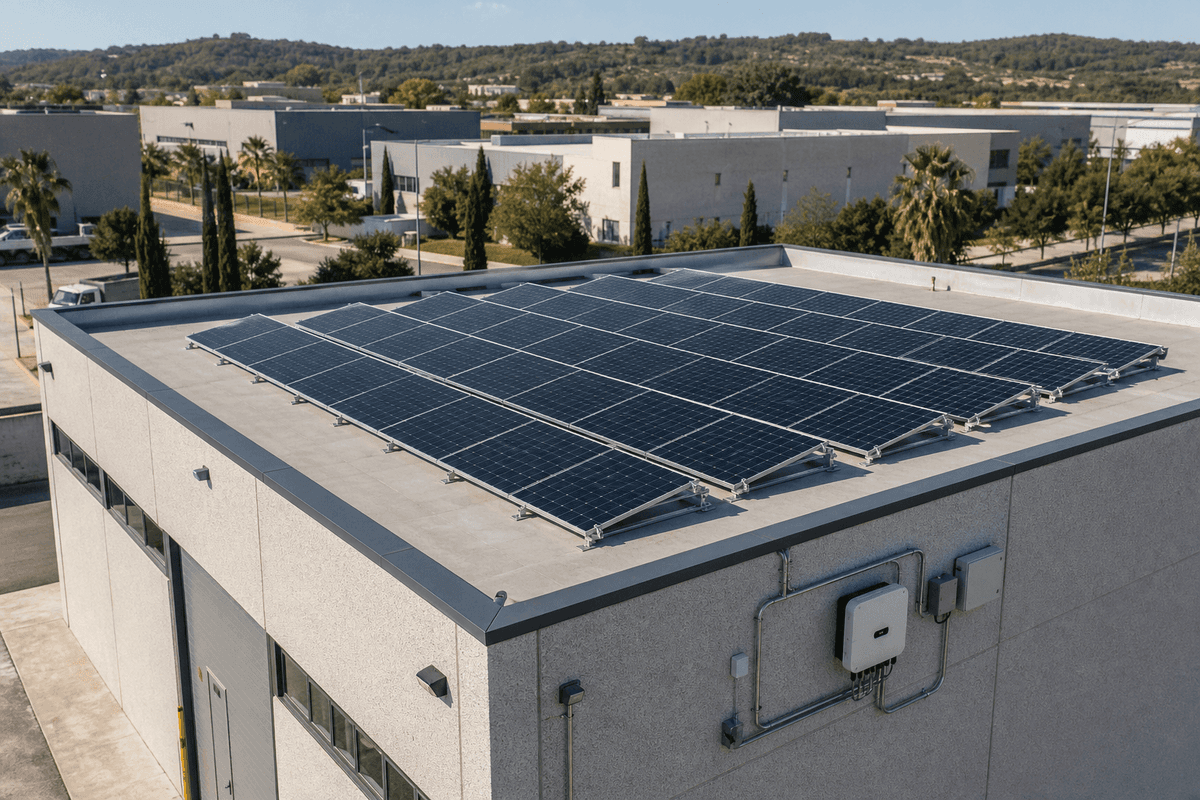
11kW Small Commercial Rooftop TOPCon Fixed - 15 Degree PV System
Key Features
- 11 kWp fixed rooftop PV system using 16 pcs 700 W class N-type TOPCon modules
- 24.4% module efficiency with estimated annual generation of 14.5 MWh
- 15 degree fixed tilt designed for low-profile small commercial roofs around 60 m2
- EPC turnkey price range of $6,390-$8,240 with 1-year workmanship support
- Estimated 3.2 year payback at $0.16/kWh avoided commercial electricity cost
11 kWp fixed-tilt rooftop PV system for small commercial buildings, using 24.4% N-type TOPCon modules at a 15 degree tilt. EPC turnkey pricing is $6,390-$8,240, with estimated annual generation of 14.5 MWh and a 3.2 year simple payback under $0.16/kWh avoided electricity cost.
Description
The 11kW Small Commercial Rooftop TOPCon Fixed system is an 11 kWp grid-tied solar PV package for workshops, warehouses, retail roofs, and light-industrial buildings using 24.4% efficient N-type TOPCon modules on a 15 degree fixed array. SOLARTODO specifies 700 W class mono TOPCon modules, a commercial string inverter, roof-rated mounting, monitoring, and EPC commissioning in a turnkey price band of $6,390-$8,240.
This product is designed for B2B buyers who need a compact, standards-aligned rooftop system that can generate about 14.5 MWh/year at a 15.0% capacity factor before site-specific shading correction. For adjacent capacities, procurement teams can View all Solar PV System products, and engineers can Configure your system online using roof size, grid voltage, and load profile data.
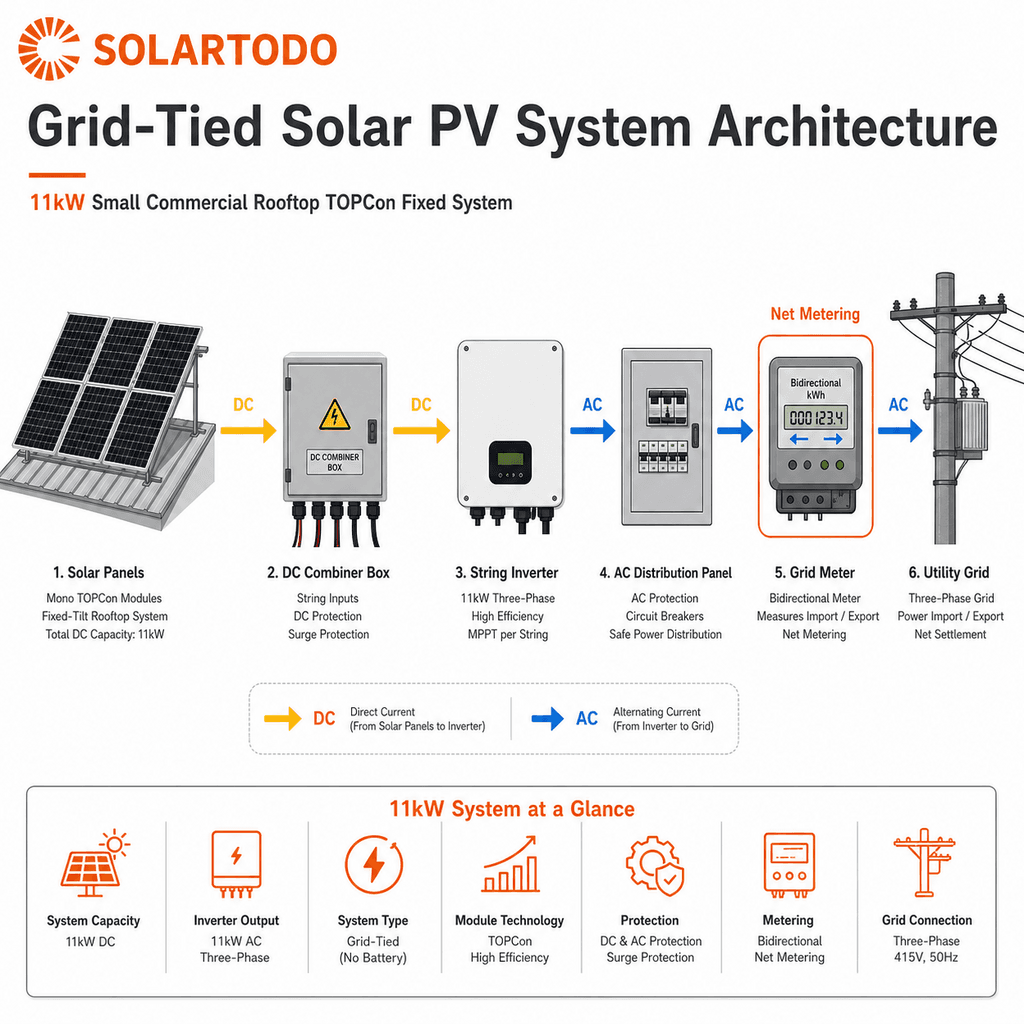
System Architecture for 11 kW PV
The base architecture uses 16 x 700 W N-type TOPCon modules, producing 11.2 kWp DC nominal array capacity and commonly paired with a 10-11 kW three-phase string inverter for small commercial AC service. A 15 degree roof tilt is used to reduce wind load, simplify drainage, and maintain a low-profile installation where parapet clearance and roof-access lanes are limited to about 1.0 m.
N-type TOPCon technology uses passivated contacts on a 210 mm wafer platform, with mass-production module efficiencies typically in the 22.5-24.5% range and 700 W+ modules now mainstream in 2025-2026 procurement. Compared with a conventional PERC rooftop array at about 21.0% module efficiency, this 24.4% TOPCon design can reduce active module area by roughly 14% for the same DC capacity, improving fit on small roofs below 80 m2.
The electrical topology uses 2 strings of 8 modules or an equivalent voltage-window layout depending on the selected inverter MPPT range, local ambient temperature, and module Voc. DC cabling, string fusing where required, surge protection, AC isolation, and grid interconnection are specified against IEC inverter and installation practice, with anti-islanding performance referenced to IEC 62116:2014.
Technical Specifications and Standards
The module layer is specified against IEC 61215 for crystalline silicon design qualification and IEC 61730 for photovoltaic module safety qualification, while UL 1703 or UL 61730 references may be used for North American-equivalent procurement. Inverter islanding behavior follows IEC 62116, and utility-interface design can reference IEEE 1547-2018 where local grid codes require voltage ride-through, frequency response, and interconnection documentation.
| Parameter | Value |
|---|---|
| Nominal DC capacity | 11 kWp |
| Module technology | N-type mono TOPCon |
| Module efficiency | 24.4% |
| Typical module count | 16 pcs at 700 W class |
| Array type | Fixed rooftop |
| Tilt angle | 15 degrees |
| Estimated annual generation | 14.5 MWh/year |
| Estimated usable roof area | 60 m2 including access space |
| EPC price range | $6,390-$8,240 |
TOPCon modules are selected because first-year degradation is normally below 1.0%, annual degradation is below 0.4%, and 30-year power warranties can retain about 87.4% of nameplate output. Over a 25-year financial model, those degradation numbers keep lifetime generation near 330-345 MWh for an 11 kWp rooftop in a moderate irradiation market.
NREL PVWatts modeling practice is commonly used for early-stage yield estimates, and SOLARTODO uses an 11 kWp system size, 15 degree tilt, fixed array assumption, and conservative 14.5 MWh/year baseline before project-specific weather file validation. IRENA cost reporting shows utility-scale solar LCOE has fallen sharply over the last decade, and small commercial rooftop systems can achieve about $0.025-$0.055/kWh where labor, interconnection, and self-consumption are favorable.
Cloud Monitoring for 16 Modules
The monitoring package includes inverter-level production data, daily kWh charts, alarm reporting, export status, and basic O&M event records for at least 1 site and 1 inverter. For small commercial users, cloud telemetry is most useful when compared against a 15-minute or 60-minute building load profile, because self-consumption above 70% materially improves payback in tariff markets with limited export compensation.
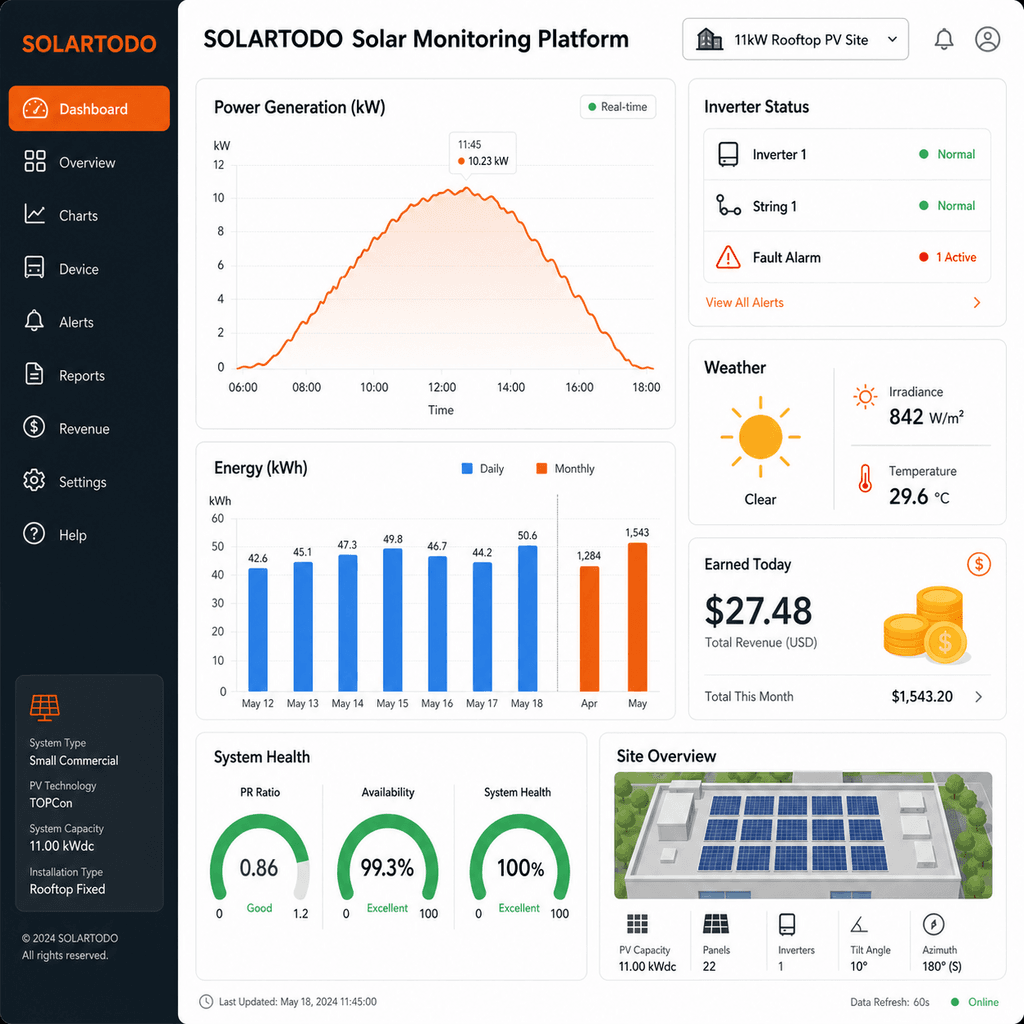
A facility manager can identify string underperformance when expected midday output is 8-10 kW but measured inverter output drops below 6 kW under similar irradiance. This data reduces troubleshooting time compared with manual monthly meter checks and supports warranty claims within the 10-year inverter and 25-year panel warranty periods.
Applications for Small Commercial Roofs
The 11 kW configuration fits small commercial loads such as daytime HVAC, refrigeration, lighting, pumps, office equipment, and light machinery with annual consumption above 18 MWh. A retail store using 40 kWh/day can offset roughly 99% of that daytime energy in sunny months if load timing is well matched, while a warehouse with higher evening demand may use the system mainly for peak daytime reduction.
Example scenario: a 480 m2 workshop in the MENA region installs an 11 kWp TOPCon rooftop system at a 15 degree tilt, producing about 16.0 MWh/year in high-irradiance conditions. At an avoided tariff of $0.14/kWh, annual savings can reach $2,240, and a mid-range EPC cost of $7,315 produces a simple payback of about 3.3 years before tax incentives or demand-charge benefits.
Compared with a diesel generator producing electricity at roughly $0.28-$0.40/kWh after fuel and maintenance, this fixed PV system can reduce daytime energy cost by 70-90% when solar output is consumed onsite. Compared with a single-axis tracker, the fixed rooftop structure also avoids tracker motors, controllers, and moving bearings, reducing mechanical maintenance points by 100% while sacrificing some yield on ground-mounted sites.
EPC Investment Analysis and Pricing Structure
SOLARTODO EPC scope includes 5 commercial work packages: engineering, procurement, construction, commissioning, and warranty support. The engineering package covers array layout, string sizing, roof interface review, single-line diagram, inverter selection, bill of materials, and grid-connection documentation for 1 small commercial site.
| Pricing tier | Scope | Price range, USD |
|---|---|---|
| FOB Supply | Equipment only, ex-works China | $3,962-$5,603 |
| CIF Delivered | Equipment plus ocean freight and insurance | $4,371-$6,182 |
| EPC Turnkey | Installed, commissioned, and 1-year EPC warranty | $6,390-$8,240 |
The EPC price covers modules, inverter, mounting, DC balance-of-system, AC infrastructure, monitoring, installation labor, commissioning, and 1 year of EPC workmanship support. The component pricing is separated from installation and warranty cost so procurement teams can compare FOB supply against full-site delivery without hiding markup inside the 16 module unit price.
| Order volume | Discount on eligible equipment |
|---|---|
| 50+ systems | 5% |
| 100+ systems | 10% |
| 250+ systems | 15% |
At a reference EPC midpoint of $7,315, estimated annual production of 14.5 MWh, and avoided electricity cost of $0.16/kWh, annual bill savings are about $2,313. That produces a simple payback of about 3.2 years, while a 25-year operating period can deliver more than $57,000 in undiscounted avoided energy cost before inverter replacement and local O&M adjustments.
The estimated LCOE is $0.025/kWh using a 25-year production model, low annual O&M, and TOPCon degradation below 0.4%/year after year 1. In markets where commercial grid electricity exceeds $0.12/kWh, the system can be cost-competitive without subsidies; in markets below $0.06/kWh, project developers should model demand-charge savings, tax credits, and export limits before approval.
Payment terms are 30% T/T + 70% against B/L, or 100% L/C at sight for bank-approved buyers. SOLARTODO can discuss financing structures for projects above $5,000K, and procurement teams can Request a custom quotation or contact [email protected] with roof drawings, grid voltage, annual load data, and target delivery date.
Procurement Notes for Engineers and Buyers
The 11 kW fixed rooftop format is intentionally conservative because it uses standard string inverter architecture, roof mounting without motors, and PV modules certified to IEC safety and performance standards. IEA solar market analysis reports PV as one of the fastest-growing electricity technologies, while BloombergNEF and Wood Mackenzie have tracked TOPCon gaining the majority share of new crystalline silicon module shipments during the 2025-2026 buying cycle.
For specification learning, buyers can Learn about topic covering PV module selection, inverter sizing, and rooftop project economics. A procurement checklist should include at least 8 documents: module datasheet, inverter datasheet, mounting load table, warranty statement, flash-test tolerance, IEC certificates, packing list, and commissioning report.
Roof suitability should be checked before purchase because a 60 m2 system area, roof live-load limits, wind zone, corrosion category, access path, and waterproofing warranty can change the final EPC design. When roof condition is uncertain, SOLARTODO recommends a structural review before issuing a final bill of materials for 11 kWp installation.
For a complete B2B workflow, use Configure your system online for a first-pass capacity estimate, then send drawings through Request a custom quotation. Buyers comparing PV, storage, smart lighting, telecom power towers, and smart agriculture infrastructure can also View all Solar PV System products and browse Learn about topic for procurement references.
Technical Specifications
| System Capacity | 11kWp |
| Module Type | mono_topcon |
| Module Efficiency | 24.4% |
| Array Configuration | fixed |
| Tilt Angle | 15degrees |
| Est. Annual Generation | 14.5MWh |
| Capacity Factor | 15.0% |
| System Area | 60m2 |
| CO2 Offset | 6.5tons/year |
| Payback Period | 3.2years |
| LCOE | 0.025$/kWh |
| Warranty | 25yr panels, 10yr inverter |
Price Breakdown
| Item | Quantity | Unit Price | Subtotal |
|---|---|---|---|
| 700W N-type TOPCon PV Modules | 16 pcs | $154 | $2,464 |
| Commercial String Inverter | 1 pcs | $880 | $880 |
| Fixed Rooftop Mounting System | 1 pcs | $880 | $880 |
| DC Cables and Combiner Box | 1 pcs | $220 | $220 |
| AC Infrastructure and Protection | 1 pcs | $330 | $330 |
| Cloud Monitoring System | 1 pcs | $500 | $500 |
| Installation and Commissioning | 1 pcs | $880 | $880 |
| Grid Connection Support | 1 pcs | $800 | $800 |
| Engineering and Quality Control | 1 pcs | $180 | $180 |
| 1-Year Warranty and EPC Support | 1 pcs | $186 | $186 |
| Total Price Range | $6,390 - $8,240 | ||
Frequently Asked Questions
What is included in the $6,390-$8,240 EPC turnkey price?
How much electricity can the 11 kW rooftop system generate each year?
Why use TOPCon modules instead of conventional PERC modules?
Which standards apply to this commercial rooftop PV system?
What roof area is required for the 11 kW TOPCon fixed system?
Certifications & Standards


Data Sources & References
- •NREL PVWatts 2025
- •IEC 61215 crystalline silicon PV module qualification
- •IEC 61730 photovoltaic module safety qualification
- •IRENA Renewable Power Generation Costs 2024
- •IEA Renewables 2025
- •BloombergNEF PV Market Outlook 2025
- •Wood Mackenzie Solar Module Technology Outlook 2025
Interested in this solution?
Contact us for a customized quote based on your specific requirements.
Contact Us