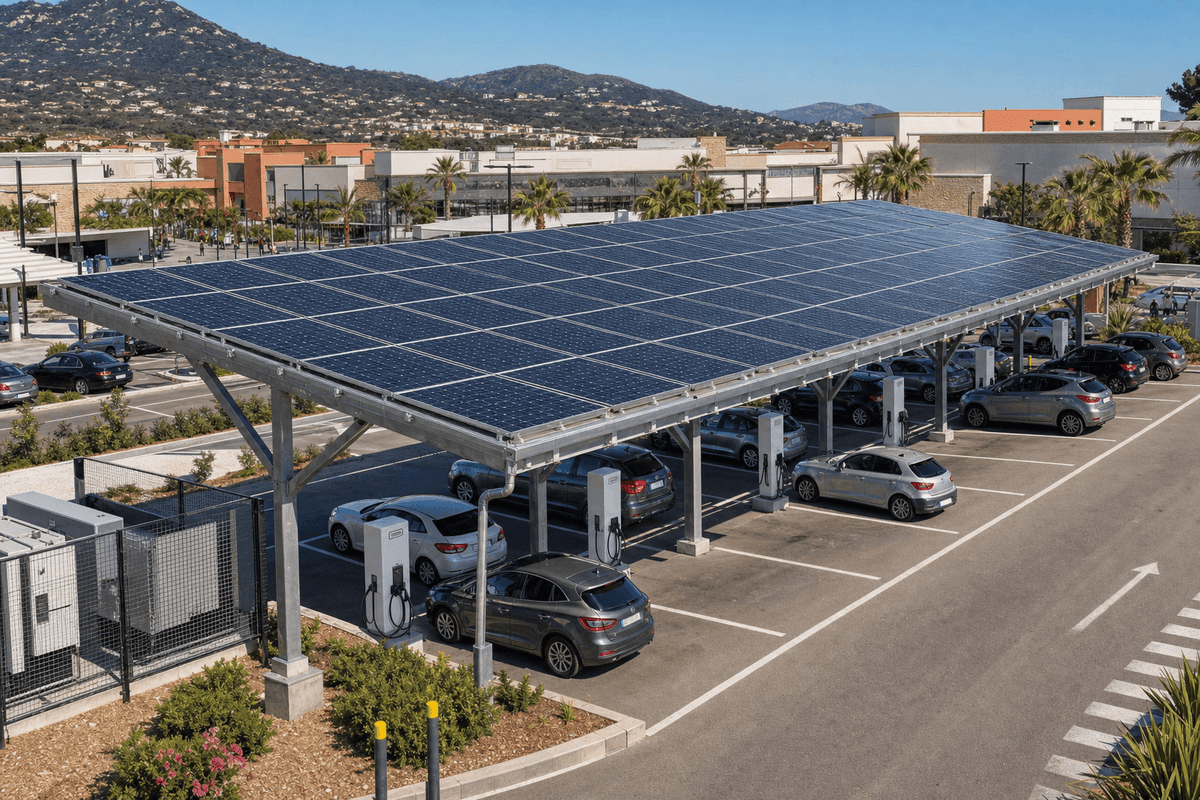
150kW Mall Carport with EV Charging - Bifacial Fixed-Tilt Solar PV
Key Features
- 150 kWp bifacial solar carport with approximately 225 MWh estimated annual generation
- 10 integrated EV charging stations for customer and employee destination charging
- 22% module efficiency using bifacial TOPCon or HJT-based commercial PV modules
- Estimated CO2 reduction of about 101 tons per year at 225,000 kWh annual output
- EPC turnkey pricing from $74,500 to $95,200 with 25-year panel and 10-year inverter warranty
The 150kW Mall Carport with EV Charging combines a 150 kWp bifacial fixed-tilt PV canopy, approximately 22% module efficiency, and 10 integrated EV charging stations in one commercial energy asset. Designed for retail parking areas, it provides vehicle shelter, on-site power generation, and scalable charging infrastructure under IEC-aligned commercial PV architecture.
Description
The 150kW Mall Carport with EV Charging is a commercial 150 kWp solar PV carport engineered for shopping centers, retail parks, and mixed-use parking facilities that need 3 functions in 1 footprint: solar generation, shaded parking, and 10 EV charging stations. This configuration uses bifacial modules with 22% module efficiency, a fixed-tilt array, and a commercial string-inverter architecture to balance capital cost, structural reliability, and long-term energy yield over 25+ years.
For mall operators, the system addresses 4 measurable business drivers at once: lower daytime electricity purchases, improved parking amenity, EV charging monetization, and visible decarbonization. At 150 kWp, the system is sized for medium commercial parking zones and can offset a meaningful share of daytime common-area loads such as lighting, ventilation, escalators, and tenant-area services, while also supporting 10 charging points for employee and customer vehicles.
Product Positioning for Commercial Retail Sites
A mall carport differs from a standard rooftop PV system in at least 3 structural and operational ways. First, the steel canopy must support module dead load, wind load, and vehicle-clearance requirements, typically with a minimum underside clearance of 2.5 m to 3.2 m depending on local code and bus or van access. Second, the system must coordinate DC generation, AC distribution, and charger loads within 1 managed commercial electrical design. Third, a carport can improve land-use efficiency by turning an existing parking area into an energy-producing asset without consuming an additional 700 m² to 950 m² of developable land.
Compared with a conventional asphalt-only parking lot, a solar carport can reduce direct solar heat gain on parked vehicles by an estimated 10°C to 25°C in hot-weather conditions while generating electricity from the same footprint. Compared with purchasing all charging energy from the grid at commercial daytime tariffs, self-generation can reduce the effective energy cost for EV charging by 20% to 50% depending on irradiance, tariff structure, and charger utilization. The International Energy Agency and IRENA have both identified distributed solar and electrified transport as key pillars of commercial decarbonization through 2025-2030 [IEA, IRENA].
System Architecture
The architecture combines 150 kWp of bifacial PV modules, fixed-tilt canopy mounting, string inverters, AC combiner/distribution equipment, EV charger integration, and a cloud monitoring layer. Bifacial modules based on TOPCon or HJT cell platforms can deliver rear-side gain of 10% to 30% when installed above reflective surfaces, although practical gain for a carport typically depends on pavement color, underside reflection, row spacing, and structural shading. Elevated mounting above 1 m improves backside irradiance access and cooling, which supports better annual yield than tightly packed flush systems.
The fixed-tilt array is selected here because it offers lower mechanical complexity than tracking, lower O&M burden over 25 years, and strong suitability for parking-lot steel canopies. Commercial string inverters are generally preferred at the 150 kW scale because they simplify MPPT segmentation, improve maintenance flexibility, and support modular replacement. Module and inverter selection should align with IEC 61215, IEC 61730, IEC 62116, and relevant local interconnection requirements; these are widely recognized benchmarks for module design qualification, safety, and inverter anti-islanding behavior [IEC].

Technical Specifications
The base electrical configuration uses approximately 214 to 216 bifacial modules in the 690 W to 700 W class to reach the 150 kWp DC design target, depending on final string sizing and local temperature coefficients. With 22% efficiency, the PV field typically occupies about 680 m² to 820 m² of canopy coverage, while the full parking and circulation footprint can extend to 900 m² to 1,200 m² depending on bay arrangement and charger placement. A practical design often uses 2 to 4 string inverters, each sized to optimize DC/AC ratio and fault isolation.
For energy modeling, a reasonable commercial benchmark for this configuration is 225 MWh/year in a good solar resource location, equivalent to a capacity factor of approximately 17.1%. In stronger irradiance markets with higher albedo and lower shading loss, annual production can rise toward 240 MWh/year, while cloudier or constrained sites may operate closer to 190 MWh/year. NREL PVWatts methodology and regional meteorological files remain standard tools for first-pass yield assessment, but final EPC design should use site-specific irradiation, soiling, and temperature data [NREL].
The EV charging layer includes 10 stations, which can be configured as AC destination chargers or mixed AC/DC charging depending on customer dwell time. For malls, AC charging in the 7 kW to 22 kW range is often preferred because average dwell times of 45 minutes to 180 minutes align with destination charging behavior. If the owner targets premium fast-turnover charging, selected bays can be upgraded to DC fast charging, but this usually requires larger service capacity, more protective equipment, and stronger demand-management controls.
Energy Yield, Capacity Factor, and Carbon Impact
At an estimated annual generation of 225 MWh, this 150 kWp system can offset approximately 225,000 kWh/year of utility electricity purchases. Using a grid emissions factor near 0.45 kg CO2/kWh, the annual carbon offset is about 101 tons/year, though local grid intensity can shift this figure upward or downward by 20% to 40%. Over a 25-year service life, total avoided emissions can exceed 2,500 tons CO2 before degradation and replacement assumptions are applied.
Bifacial technology can add measurable value in carport settings when the underside environment is engineered properly. If the pavement or sub-canopy surfaces are light colored, or if reflective coatings are used in selected zones, rear-side contribution can improve net yield by 5% to 15% versus a monofacial baseline under the same DC nameplate. BloombergNEF and Wood Mackenzie have both reported continued market expansion of high-efficiency n-type products through 2025-2026, with TOPCon taking roughly 60% market share and larger-format 700 W+ modules becoming mainstream in utility and C&I supply chains [BloombergNEF, Wood Mackenzie].
Mall Application Scenario
A regional shopping center in a high-irradiance market with annual solar resource near 1,700 kWh/m² deployed a carport system in the 140 kW to 160 kW range over 60 to 80 parking bays to support customer charging and reduce daytime peak demand. By coupling PV generation with 10 EV chargers, the operator shifted a portion of charging energy to on-site supply during the 10:00 to 16:00 retail window, reduced transformer loading at midday, and created a visible sustainability feature at the main entrance. In similar projects, operators typically prioritize bays closest to anchor tenants, food courts, or cinema entrances to maximize charger utilization and customer dwell time.
This use case is especially relevant where commercial tariffs have high daytime energy charges or demand charges. If a mall pays $0.12 to $0.18/kWh for delivered electricity, annual gross value from 225,000 kWh can range from $27,000 to $40,500 before O&M, charger operating costs, and financing. If part of the energy is resold through EV charging at a retail margin, the effective project return can improve further by 10% to 25%, depending on charger uptime and payment model. For broader design guidance, buyers can Learn about topic and review additional C&I solar deployment references.
Structural and Electrical Design Considerations
A mall carport must meet both solar and parking-engineering requirements. Structurally, steel columns, rafters, and purlins are typically designed for local wind speeds that can exceed 35 m/s to 45 m/s, while snow-load design in cold regions may exceed 0.75 kN/m² or more depending on code zone. Corrosion protection, galvanization thickness, drainage, and vehicle impact protection are all critical because the system is expected to remain operational for 25 years or longer with routine inspection intervals of 6 to 12 months.
Electrically, the project requires DC string design, surge protection, grounding, AC switchgear coordination, charger feeders, and utility interconnection planning. String inverter systems at this scale often use 1,000 Vdc or 1,500 Vdc architecture depending on product selection and local practice. Protective design should reference applicable IEC and utility standards for insulation, anti-islanding, earthing, and overcurrent coordination. For US-oriented projects, UL-recognized pathways and NEC-aligned engineering may also apply, while global projects often align with IEC plus local grid codes.
Cloud Monitoring and O&M
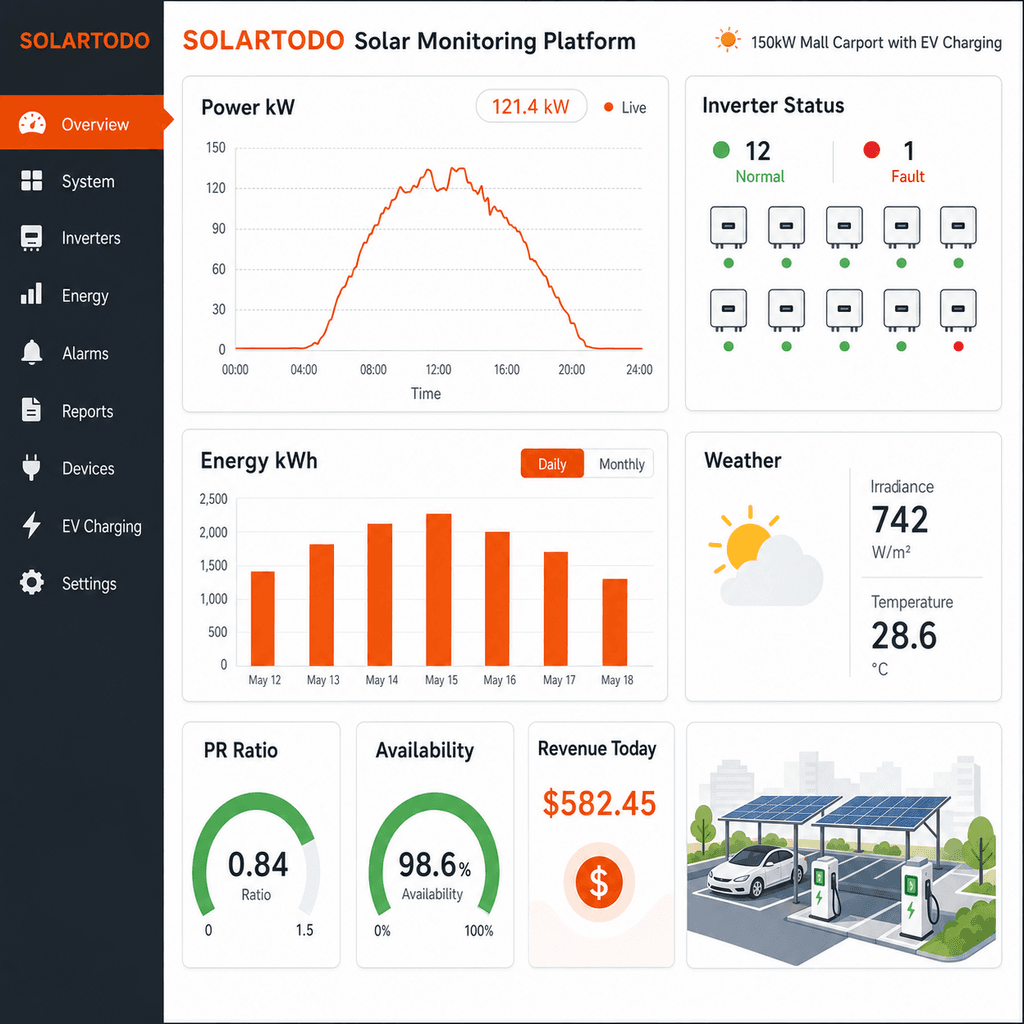
Commercial buyers increasingly require data visibility at 1-minute to 15-minute intervals for both PV and EV assets. A cloud platform can provide inverter status, string-level alarms, charger uptime, energy export/import trends, and monthly production reports in 1 dashboard. This is valuable for multi-site retail operators that may manage 5 to 50 properties and need standardized KPI reporting across energy, charging, and maintenance workflows.
Remote diagnostics can reduce fault response time by 20% to 40% compared with manual inspection-only maintenance. Typical monitored parameters include DC voltage, AC output, irradiance proxy, module temperature, charger session counts, and cumulative kWh delivered. For buyers evaluating digital controls, Learn about topic for commercial monitoring architecture and data integration considerations.
Commercial Benefits Compared with Conventional Alternatives
Compared with a conventional grid-only EV charging installation, a PV-integrated carport can reduce dependence on purchased daytime electricity by a substantial margin. If annual charger and common-area consumption totals 250,000 kWh, a 225,000 kWh/year solar yield can theoretically cover up to 90% of that energy on an annual basis, though instantaneous matching will depend on charger use patterns and mall load shape. Compared with diesel backup-supported charging or remote parking-lot expansion, the solar carport generally delivers lower operating emissions, lower fuel volatility, and better customer-facing aesthetics.
Relative to rooftop PV, a carport may have a higher installed cost per watt by approximately 15% to 40% because of steel tonnage, foundations, vehicle-clearance engineering, and drainage details. However, it can outperform rooftop options where roof loading is limited, tenant roof rights are fragmented, or the parking lot is the most visible and available asset. In these cases, the dual-use value of shade plus energy can justify the premium through improved customer comfort, branding, and EV service revenue.
Compliance, Standards, and Quality Benchmarks
The core module platform should comply with IEC 61215 for design qualification and IEC 61730 for module safety, while inverter systems should align with IEC 62116 for anti-islanding performance. Depending on destination market, buyers may also request UL 1703 legacy references or current equivalent certification pathways for module safety and listing. These standards matter because they reduce procurement risk, support insurer confidence, and improve bankability in projects above $50,000 EPC value.
From an industry-cost perspective, utility-scale LCOE in best-resource markets has fallen below $0.03/kWh according to recent market trend references, but commercial carports usually sit above that level because structural steel and parking integration add cost. Even so, a well-sited 150 kW mall carport can still produce highly competitive on-site energy, especially where tariffs exceed $0.10/kWh and daytime self-consumption remains above 70%. IEA, IRENA, and NREL all continue to identify distributed solar as one of the most scalable commercial decarbonization tools available through 2026 [IEA, IRENA, NREL].
EPC Investment Analysis and Pricing Structure
For this product, EPC turnkey means 5 integrated scopes: engineering, procurement, construction, commissioning, and 1-year warranty support. Engineering includes layout, string design, structural review, and single-line documentation; procurement covers modules, inverters, steel canopy, electrical balance of system, and EV charging equipment; construction includes civil works, steel erection, wiring, and charger installation; commissioning includes testing, grid synchronization, and performance verification. Buyers can Request a custom quotation or Configure your system online for site-specific design inputs.
| Pricing Tier | Scope | Price Range (USD) |
|---|---|---|
| FOB Supply | Equipment only, ex-works China | $46,190 - $64,736 |
| CIF Delivered | Equipment + ocean freight + insurance | $50,961 - $71,423 |
| EPC Turnkey | Installed, commissioned, 1-year warranty | $74,500 - $95,200 |
The pricing spread reflects at least 6 variables: steel tonnage, charger power rating, grid interconnection distance, foundation conditions, local labor cost, and monitoring scope. For portfolio buyers, indicative volume discounts are available as follows:
| Order Volume | Discount |
|---|---|
| 50+ units | 5% |
| 100+ units | 10% |
| 250+ units | 15% |
A simplified ROI case can be modeled using 225,000 kWh/year annual production and a commercial tariff of $0.14/kWh. That yields about $31,500/year in avoided electricity cost before O&M and charger operating expenses. Against an EPC midpoint near $84,850, simple payback is approximately 2.7 years before financing assumptions; with conservative allowances for maintenance, downtime, and degradation, a practical payback range of 3.0 to 5.0 years is often more realistic. Compared with a conventional non-solar carport plus grid-only charging, annual operating cost can be reduced by $20,000 to $35,000 in many tariff environments.
Payment terms are typically 30% T/T + 70% B/L, or 100% L/C at sight. Financing support can be discussed for projects above $5,000K total program value. For commercial offers, BOQ refinement, and delivery schedules, contact [email protected]. Buyers can also View all Solar PV System products to compare other C&I configurations.
Price Breakdown
The EPC structure below separates equipment from service markups rather than inflating component unit prices. This approach gives procurement teams clearer visibility into hardware cost, engineering value, and installation scope for a 150 kW turnkey system with 10 EV stations.
- Solar modules are budgeted using a bifacial commercial benchmark near $0.22/W, which equals $33,000 for 150,000 W DC.
- String inverter allowance is modeled at $0.08/W, or $12,000 for 150,000 W AC/DC design basis.
- Fixed mounting/carport steel is modeled at $0.08/W, or $12,000, excluding site-specific civil escalation.
- DC cables and combiner equipment are modeled at $0.02/W, or $3,000.
- AC infrastructure is modeled at $0.03/W, or $4,500.
- Monitoring hardware/software baseline is $500/system.
- Installation labor benchmark is $0.08/W, or $12,000.
- Grid connection allowance is $2,000/system.
- Engineering & QC, charger integration, and 1-year warranty support are shown as separate line items to keep the pricing transparent.
Procurement Guidance
For B2B buyers evaluating this product, the most important screening criteria are usually 7 factors: annual irradiance, parking geometry, charger power strategy, utility tariff, interconnection complexity, structural code requirements, and desired ROI. A preliminary feasibility package should include at least 12 months of interval electricity data, a parking layout drawing, utility service rating, and charger utilization assumptions. This shortens design iteration time and improves EPC accuracy.
If your team is comparing multiple solar options, use the product family page to View all Solar PV System products, then Configure your system online for custom sizing. For project-specific steel design, charger mix, and logistics terms, Request a custom quotation. SOLARTODO supports solar, storage, smart infrastructure, and related commercial energy systems for international B2B procurement workflows.
Technical Specifications
| System Capacity | 150kWp |
| Module Type | Bifacial |
| Module Efficiency | 22% |
| Array Configuration | Fixed |
| Application | Mall carport |
| EV Charging Stations | 10pcs |
| Estimated Annual Generation | 225MWh |
| Capacity Factor | 17.1% |
| System Area | 780m² |
| CO2 Offset | 101tons/year |
| Payback Period | 3.0-5.0years |
| LCOE | 0.038USD/kWh |
| Warranty | 25yr panels, 10yr inverter |
Price Breakdown
| Item | Quantity | Unit Price | Subtotal |
|---|---|---|---|
| 700W Bifacial Solar Modules | 214 pcs | $154 | $32,956 |
| Commercial String Inverters | 3 pcs | $4,000 | $12,000 |
| Fixed Carport Mounting & Steel Structure | 1 pcs | $12,000 | $12,000 |
| DC Cables & Combiner Box | 1 pcs | $3,000 | $3,000 |
| AC Infrastructure & Protection | 1 pcs | $4,500 | $4,500 |
| Monitoring System | 1 pcs | $500 | $500 |
| EV Charging Stations | 10 pcs | $1,200 | $12,000 |
| Installation & Commissioning | 1 pcs | $12,000 | $12,000 |
| Grid Connection | 1 pcs | $2,000 | $2,000 |
| Engineering & QC | 1 pcs | $3,500 | $3,500 |
| 1-Year Warranty & Support | 1 pcs | $1,800 | $1,800 |
| Total Price Range | $74,500 - $95,200 | ||
Frequently Asked Questions
How much electricity can the 150kW mall carport generate each year?
What type of EV charging is best for a shopping mall carport?
What is included in the EPC turnkey price range of $74,500 to $95,200?
What warranties apply to this 150kW mall carport system?
Is a solar carport more expensive than a standard rooftop PV system?
Certifications & Standards


Data Sources & References
- •NREL PVWatts 2025
- •IEA World Energy Outlook 2025
- •IRENA Renewable Power Generation Costs 2024/2025 update
- •IEC 61215 module qualification standard
- •IEC 61730 PV module safety standard
- •IEC 62116 anti-islanding test standard
- •BloombergNEF PV market outlook 2025
- •Wood Mackenzie solar market analysis 2025
Interested in this solution?
Contact us for a customized quote based on your specific requirements.
Contact Us