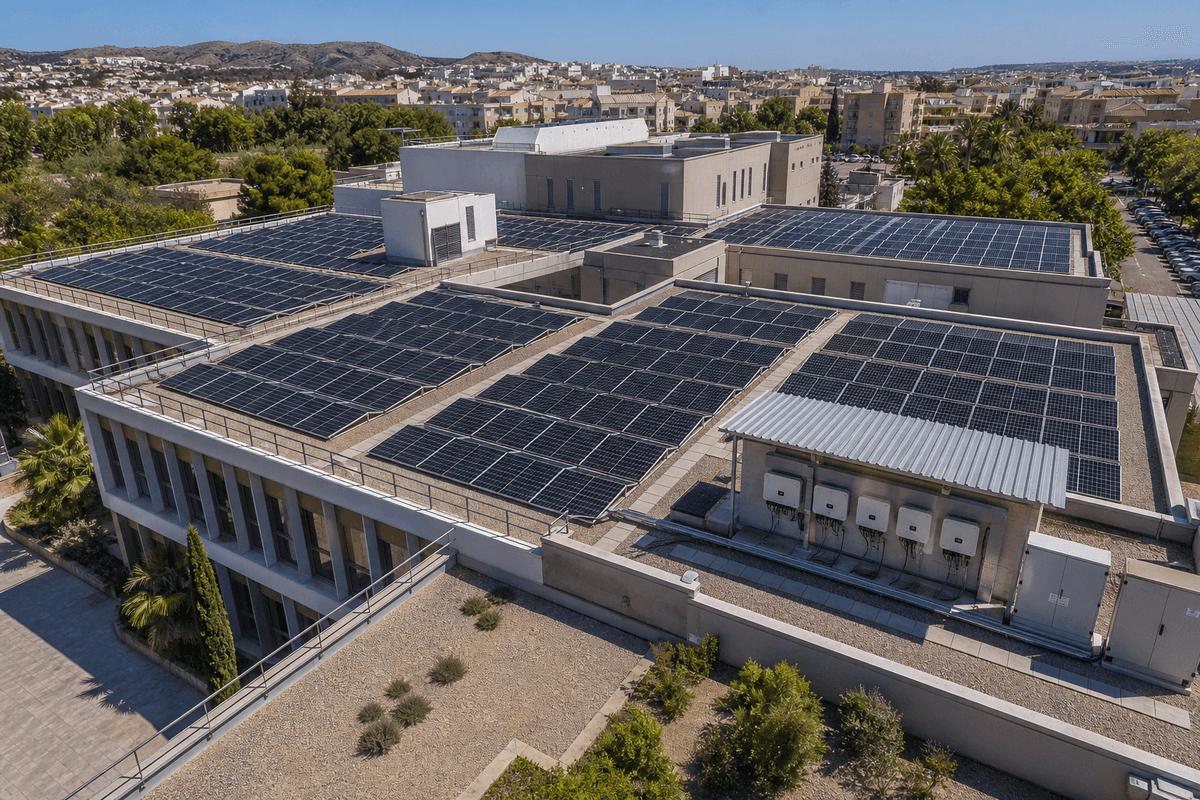
200kW School Hospital Rooftop Solar PV System - Mono TOPCon Fixed Array
Key Features
- 200.2 kWp DC system using approximately 286 pcs of 700W-class N-type mono TOPCon modules
- Estimated annual generation of 320-360 MWh with typical capacity factor of 18-21%
- Institutional rooftop footprint of about 900-1,100 m2 depending on layout and access lanes
- Low degradation profile: first year under 1.0%, then under 0.4% annually, with 30-year output to 87.4%
- EPC turnkey budget range of USD 86,400-110,400 with simple payback often 2.4-4.5 years
The 200kW School Hospital Rooftop Solar PV System is a fixed-tilt institutional rooftop solution using N-type mono TOPCon modules with 22.5-24.5% module efficiency, commercial string inverters, and an EPC turnkey price range of USD 86,400-110,400. Designed for schools, hospitals, and public buildings, it delivers about 320-360 MWh annually, supports 25+ years of operation, and complies with IEC 61215, IEC 61730, IEC 62116, and UL 1703 reference standards.
Description
The 200kW School Hospital Rooftop solar PV system is a commercial-scale 200 kWp institutional rooftop solution engineered for schools, hospitals, clinics, universities, and public service buildings that require predictable daytime electricity, low operating cost, and long asset life. Built around N-type mono TOPCon modules with 22.5-24.5% mass-production efficiency and fixed-tilt rooftop mounting, this configuration typically generates 320-360 MWh of electricity per year depending on irradiation, roof orientation, and local temperature conditions, while targeting a capacity factor of 18-21% and a design life exceeding 25 years.
For institutional buyers, the key value of a 200kW rooftop solar plant is the direct reduction of daytime utility purchases, especially where school and hospital demand peaks between 08:00 and 18:00 for HVAC, lighting, IT, refrigeration, water pumping, and medical equipment. Compared with conventional grid-only electricity procurement or diesel backup-supported daytime consumption, a properly designed rooftop PV system can reduce delivered energy cost by 30-70% over the project life in many markets, while avoiding approximately 210-260 tons of CO2 per year based on common grid emission factors published by the IEA and IRENA. Buyers can also View all Solar PV System products or Configure your system online for project-specific layouts.
System Overview
This configuration uses approximately 286 modules in the 700W class to achieve a nominal DC capacity of about 200.2 kWp, making it well suited to large flat roofs, reinforced concrete roofs, steel-structure roofs, and mixed institutional buildings with available installation area of roughly 900-1,100 m2. The array is configured as a fixed rooftop system because fixed-tilt structures offer the lowest lifecycle mechanical complexity, lower O&M burden, and proven durability over 25+ years, which is especially important for hospitals and schools where equipment uptime and safety are more important than extracting the final 3-8% of yield available from more complex tracking systems.
The module platform is based on 210 mm N-type wafers with passivated contact architecture, in line with the mainstream TOPCon technology trend that is expected to hold roughly 60% market share through 2025-2026 according to industry market analyses from BloombergNEF and Wood Mackenzie. For rooftop institutions, N-type TOPCon provides three practical advantages: lower first-year degradation of less than 1%, annual degradation of less than 0.4%, and a 30-year power warranty to approximately 87.4% retained output. Those numbers improve lifetime energy delivery and lower levelized cost of electricity compared with older P-type technologies that often degrade faster in high-temperature or high-irradiance climates.
Technical Specifications
At the system level, the recommended architecture combines 200.2 kWp DC of modules with approximately 160-200 kW AC of commercial string inverter capacity, depending on local grid export rules and desired DC/AC ratio. A design ratio between 1.05 and 1.25 is common for institutional rooftops because it improves morning and late-afternoon inverter loading without materially increasing clipping losses in most climates. Based on NREL PVWatts methodology and commercial rooftop benchmarks, annual production of 320-360 MWh is realistic in good solar regions, equivalent to about 1,600-1,800 kWh/kWp/year.
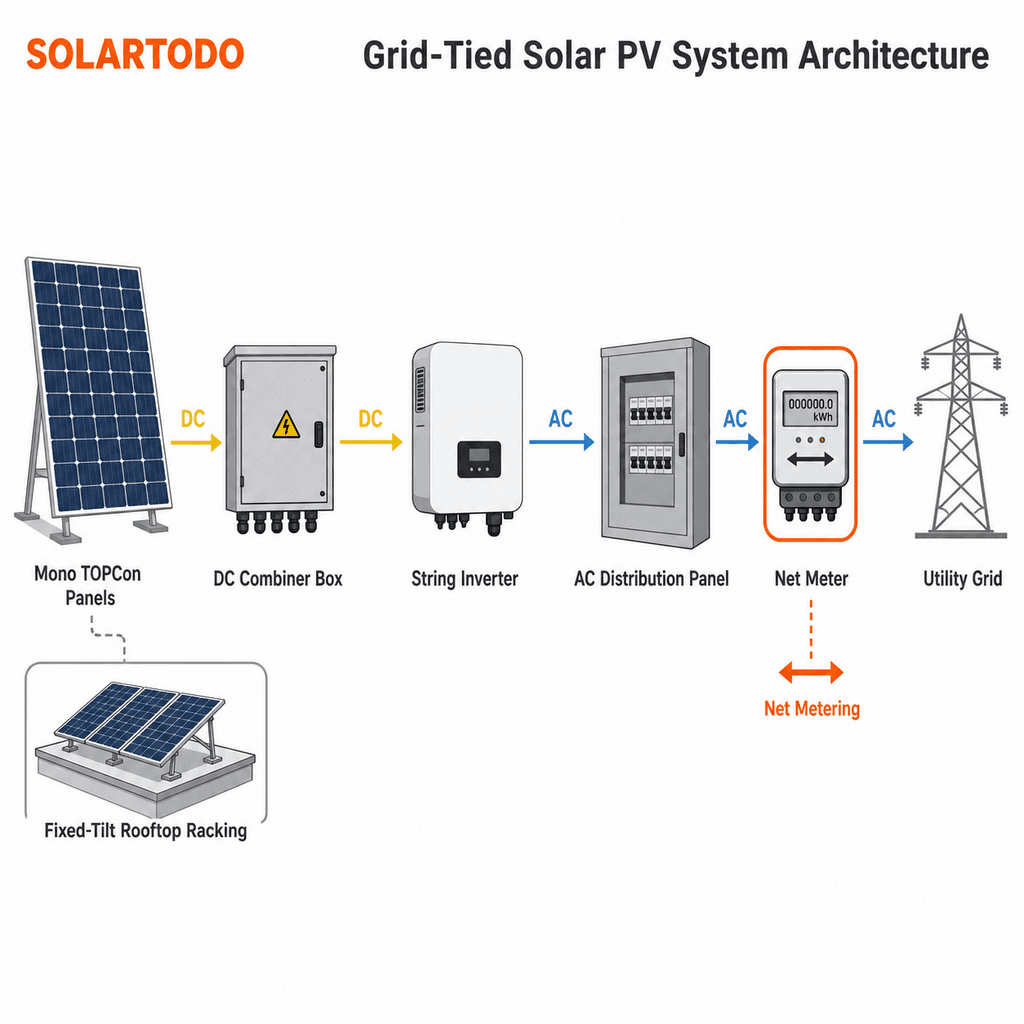
A typical technical profile for this 200kW rooftop plant includes module efficiency of 23.0-24.0%, bifacial gain potential of 10-20% where roof albedo and spacing support backside irradiance, and operating voltage windows aligned with modern three-phase string inverters. While rooftop bifacial gain is usually lower than in open-field plants, institutional roofs with white membrane surfaces or reflective coatings can still realize a measurable 2-6% uplift in annual energy. For buyers evaluating standards compliance, the module and inverter selection should reference IEC 61215, IEC 61730, IEC 62116, and UL 1703, with final country-specific certifications depending on destination market and utility interconnection requirements.
System Architecture
The recommended architecture starts with 286 x 700W+ mono TOPCon modules arranged in multiple strings feeding 4-6 commercial-grade string inverters in the 33-50 kW class. DC cabling, rooftop isolators, surge protection, grounding, and AC combiner or distribution panels are sized for institutional duty cycles and local code compliance. String inverter architecture is preferred at 200kW because it improves MPPT granularity across multiple roof faces, simplifies maintenance at the 1-inverter level rather than the whole plant, and typically lowers downtime risk compared with a single central inverter in this capacity band.
For schools and hospitals, rooftop engineering must account for dead load, wind uplift, roof penetrations, drainage pathways, emergency access lanes, and fire-setback requirements. A 200kW system normally adds approximately 15-25 kg/m2 depending on ballast or anchored mounting design, module size, and local wind zone. Structural review is therefore mandatory before procurement. SOLARTODO can support project teams with preliminary layout assumptions, but final engineering should verify roof reserve capacity, cable routing, lightning protection, and utility interconnection details before installation proceeds. For deeper background, buyers can Learn about topic to compare rooftop PV design options and compliance considerations.
Energy Yield and Performance Metrics
In a representative high-sun market with annual horizontal irradiation above 1,900 kWh/m2, this 200kW institutional rooftop system can produce around 340 MWh/year after standard system losses of 12-18% for temperature, inverter conversion, mismatch, soiling, wiring, and availability. In moderate climates with lower irradiance, output may be closer to 300-320 MWh/year. That range is sufficient to cover a meaningful share of daytime consumption for a school campus with 1,000-2,000 students or a medium hospital wing operating 24/7 with strong daytime load.
Performance ratio for a well-executed commercial rooftop project generally falls between 78% and 85%, depending on local ambient temperature, cable design, inverter loading, shading, and maintenance discipline. TOPCon modules provide an advantage in warm climates because lower temperature sensitivity and stronger low-light performance can improve annual harvest by 1-3% versus less advanced products under the same BOS conditions. According to NREL, module technology, orientation, and thermal environment can materially affect annual yield, so site-specific simulation remains essential before final investment approval.
Application Scenario: School and Hospital Use Case
A practical use case is a regional hospital or educational campus in the Middle East, Africa, Southeast Asia, or Latin America where daytime tariffs are elevated and cooling loads dominate from 10:00 to 17:00. In one typical deployment scenario, a 200kW rooftop array installed across 2-4 connected buildings offsets air-conditioning, lighting, computers, laboratory equipment, vaccine refrigeration, and water pumping. If annual production reaches 345 MWh and the displaced electricity tariff is USD 0.14/kWh, annual gross savings can reach about USD 48,300, excluding demand-charge effects and any export credits.
Compared with diesel-generated daytime electricity at USD 0.22-0.40/kWh in many off-grid or weak-grid regions, the rooftop PV system can reduce energy cost by roughly 36-70% while also cutting noise, local air pollution, and fuel logistics risk. For hospitals in particular, solar PV does not replace critical backup generation, but it can reduce generator runtime, lower maintenance intervals, and preserve fuel reserves for actual outages. According to IEA and IRENA data, solar PV remains one of the lowest-cost new-build power sources globally, with utility-scale LCOE in the best locations already below USD 0.03/kWh and commercial rooftop economics increasingly favorable where retail tariffs exceed USD 0.10/kWh.
Safety, Compliance, and Reliability
Institutional projects must prioritize electrical safety, arc-fault risk mitigation, surge protection, and emergency isolation. The system should be designed around certified modules meeting IEC 61215 and IEC 61730, with inverter anti-islanding behavior aligned to IEC 62116 and local utility standards. Hospitals often require stricter segregation of essential and non-essential loads, while schools may require enhanced cable protection in publicly accessible areas. In both cases, earthing continuity, overcurrent protection, and labeling should be documented at 100% of field circuits before energization.
Long-term reliability depends on component quality and maintenance discipline. TOPCon modules with first-year degradation below 1.0% and annual degradation below 0.4% can retain approximately 87.4% output after 30 years, which materially improves long-horizon financial performance. String inverters usually carry 5-10 year standard warranties, extendable to 10-15 years, while mounting structures are typically engineered for 25 years or more subject to corrosion category, wind design speed, and installation quality. These parameters align with common project-finance expectations for commercial rooftop assets.
Cloud Monitoring
A modern 200kW rooftop plant should include 1 cloud monitoring gateway or equivalent integrated inverter platform for real-time visibility into generation, inverter status, alarm history, and daily performance trends. Monitoring at 5-15 minute intervals allows maintenance teams to detect string underperformance, inverter trips, communication faults, and abnormal curtailment early. For schools and hospitals with limited technical staff, centralized dashboards simplify reporting to facility managers, finance teams, and sustainability officers.
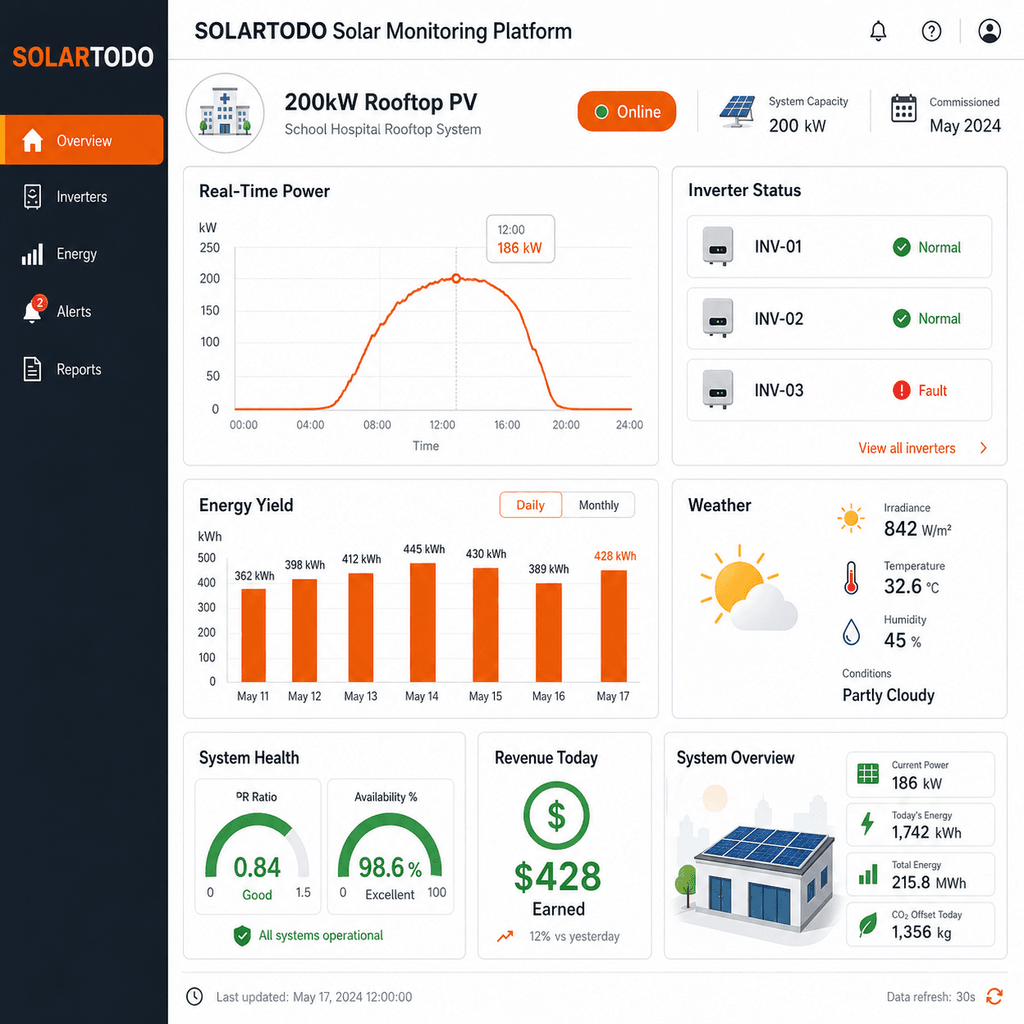
Cloud reporting also supports ESG and public-sector disclosure requirements by converting generation data into avoided emissions, cost savings, and system availability metrics. A 200kW plant producing 340 MWh/year can avoid approximately 238 tons of CO2/year using an emissions factor of 0.70 kg CO2/kWh, though local grid factors may vary by more than 50%. Buyers wanting design guidance, yield assumptions, or hybridization options with storage can Learn about topic or Request a custom quotation for a site-specific proposal.
EPC Investment Analysis and Pricing Structure
For institutional buyers, EPC scope typically includes 5 major work packages: engineering, procurement, construction, commissioning, and warranty support. Engineering covers site survey, structural review inputs, single-line diagrams, string design, protection coordination, and layout optimization. Procurement includes modules, inverters, mounting, cables, AC/DC balance of system, and monitoring hardware. Construction covers logistics, installation, electrical works, testing, and safety management. Commissioning includes insulation tests, polarity verification, inverter setup, utility synchronization, and performance handover. Standard turnkey scope here includes a 1-year workmanship and support warranty after commissioning.
The commercial pricing for this 200kW School Hospital Rooftop system is structured in 3 tiers depending on buyer scope and Incoterms:
| Pricing Tier | Scope | Price Range (USD) |
|---|---|---|
| FOB Supply | Equipment only, ex-works China | 53,568 - 75,072 |
| CIF Delivered | Equipment + ocean freight + insurance | 59,102 - 82,827 |
| EPC Turnkey | Fully installed, tested, commissioned | 86,400 - 110,400 |
For portfolio buyers, the following volume discount framework applies to equipment or standardized project packages where technical scope remains consistent across sites:
| Volume | Discount |
|---|---|
| 50+ units/projects | 5% |
| 100+ units/projects | 10% |
| 250+ units/projects | 15% |
A simple ROI illustration shows why 200kW rooftop PV is attractive for schools and hospitals. If EPC investment is USD 98,000, annual generation is 340,000 kWh, and displaced power cost is USD 0.12/kWh, annual electricity savings are about USD 40,800. Under those assumptions, simple payback is approximately 2.4 years before tax effects and maintenance reserves. At a lower tariff of USD 0.08/kWh, annual savings remain USD 27,200, giving a payback of roughly 3.6 years. Compared with diesel self-generation at USD 0.28/kWh, avoided cost can exceed USD 95,000/year, making rooftop PV economically compelling even without subsidies.
Standard payment terms are 30% T/T + 70% B/L, or 100% L/C at sight for qualified transactions. Financing support can be discussed for projects above USD 5,000K. For EPC quotations, layout review, and bankability documentation requests, contact [email protected]. Institutional buyers should also use the Configure your system online tool to compare roof area, annual yield, and budget scenarios before tendering.
Price Breakdown Reference
The EPC cost structure below separates equipment value from installation, engineering, and warranty support rather than inflating component prices. This is important for procurement teams that need transparent CAPEX benchmarking. Actual line items can vary by roof complexity, interconnection distance, crane access, local labor cost, and electrical code requirements, but the structure below reflects a realistic turnkey package inside the stated EPC range of USD 86,400-110,400.
Procurement and Design Considerations
Before final order placement, buyers should validate 6 project variables: roof structural capacity, available net installation area, utility interconnection policy, daytime load profile, lightning protection interface, and maintenance access. For hospitals, critical load segregation and backup generator coordination are especially important because PV output is variable and should be integrated into a broader resilience plan. For schools, annual holiday schedules and weekend load reductions may affect self-consumption ratios by 5-20%, influencing the preferred inverter sizing and export-control strategy.
From a lifecycle perspective, a 200kW rooftop PV system is generally lower risk than adding equivalent diesel generation for daytime energy offset. Diesel systems require ongoing fuel purchase, routine maintenance every 250-500 hours, and exposure to fuel price volatility that can swing more than 20% in a single year. By contrast, rooftop PV has no fuel cost, modest O&M, and predictable degradation under warranty-backed performance curves. That difference is why solar has become a core decarbonization pathway for public institutions, supported by datasets from IEA, IRENA, NREL, and market intelligence from BloombergNEF.
Why This Configuration Fits Institutional Rooftops
At 200kW, the system is large enough to deliver visible savings yet small enough to fit on many existing institutional roofs without the complexity of utility-scale plant controls. The use of fixed mounting, TOPCon modules, and string inverters balances energy yield, serviceability, and capex discipline. In practical terms, this means a school administrator or hospital facilities manager gets a system with 25-year panel warranty coverage, 10-year inverter coverage, clear monitoring, and straightforward maintenance planning, while procurement teams get transparent pricing and standards-aligned documentation. To discuss a live project, Request a custom quotation from SOLARTODO.
Technical Specifications
| System Capacity | 200kWp |
| Module Type | mono_topcon |
| Module Efficiency | 23.0% |
| Array Configuration | fixed |
| Application | institutional_rooftop |
| Est. Annual Generation | 340MWh |
| Capacity Factor | 19.4% |
| System Area | 1000m2 |
| CO2 Offset | 238tons/year |
| Payback Period | 2.4-4.5years |
| LCOE | 0.028-0.045USD/kWh |
| Warranty | 25yr panels, 10yr inverter |
Price Breakdown
| Item | Quantity | Unit Price | Subtotal |
|---|---|---|---|
| 700W N-type TOPCon solar modules | 286 pcs | $154 | $44,044 |
| 50kW commercial string inverter | 4 pcs | $4,000 | $16,000 |
| Fixed rooftop mounting system | 1 pcs | $16,000 | $16,000 |
| DC cables, connectors, combiner & protection | 1 pcs | $4,000 | $4,000 |
| AC distribution, breakers & grid connection package | 1 pcs | $6,000 | $6,000 |
| Monitoring system and data logger | 1 pcs | $500 | $500 |
| Engineering & QC | 1 pcs | $3,500 | $3,500 |
| Installation & Commissioning | 1 pcs | $12,000 | $12,000 |
| 1-Year Warranty & Support | 1 pcs | $1,800 | $1,800 |
| Total Price Range | $86,400 - $110,400 | ||
Frequently Asked Questions
How much electricity can a 200kW school or hospital rooftop solar system generate each year?
What is included in the EPC turnkey price for this 200kW rooftop PV system?
What warranties apply to the 200kW School Hospital Rooftop system?
Is a fixed-tilt rooftop system better than diesel generation for schools and hospitals?
Can this 200kW rooftop solar system be monitored remotely by facility managers?
Certifications & Standards


Data Sources & References
- •NREL PVWatts 2025
- •IEA World Energy Outlook 2025
- •IRENA Renewable Power Generation Costs 2024/2025
- •IEC 61215 Photovoltaic Module Standard
- •IEC 61730 Photovoltaic Safety Qualification
- •IEC 62116 Utility-Interconnected PV Inverter Anti-Islanding
- •BloombergNEF Solar Market Outlook 2025
- •Wood Mackenzie Global Solar PV Market Update 2025
Interested in this solution?
Contact us for a customized quote based on your specific requirements.
Contact Us