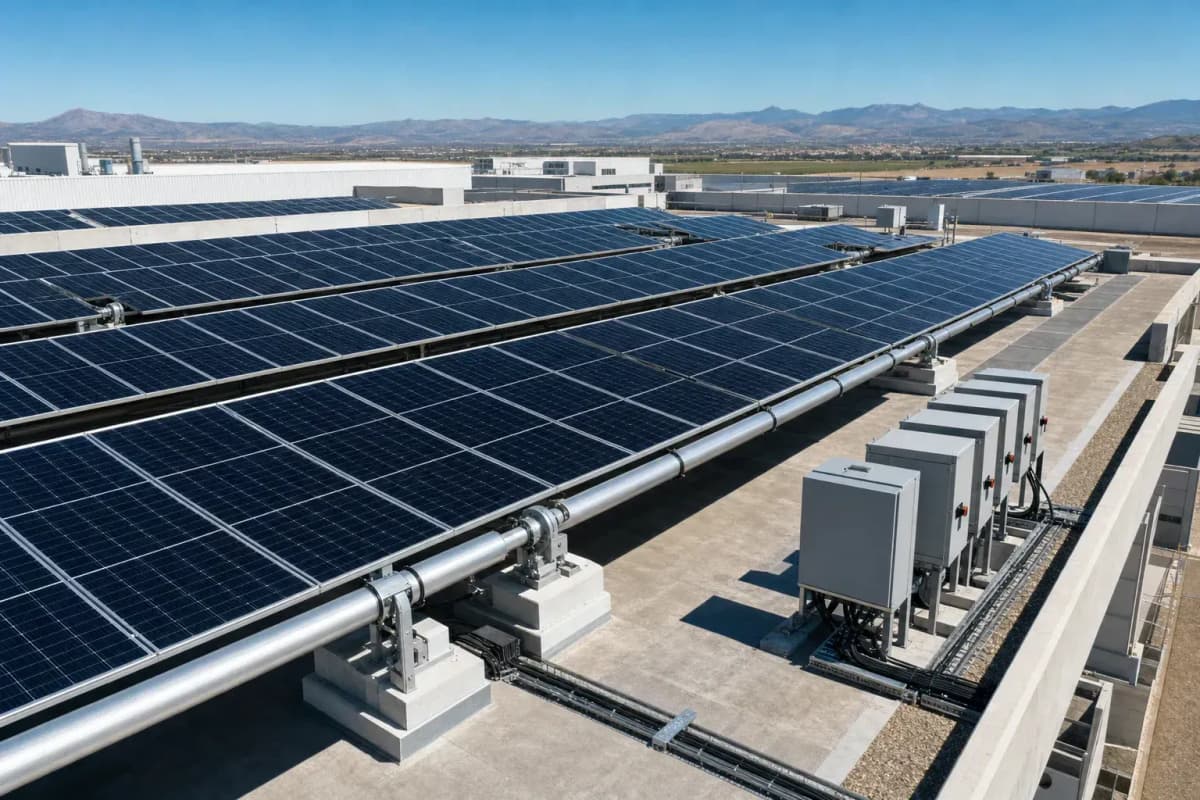
811kW Industrial Roof HJT 1-axis Tracker - High-Yield Commercial PV
Key Features
- 811 kWp industrial rooftop PV system with 25.7% HJT module efficiency and 1-axis tracking.
- Modeled annual generation of 1,563 MWh/year at a 22.0% capacity factor.
- Estimated CO2 offset of 703 tCO2/year using 0.45 tCO2/MWh grid displacement.
- EPC turnkey price range of USD 306,558-403,460, equal to about USD 0.38-0.50/W.
- HJT performance profile includes -0.24%/C temperature coefficient and about 0.4%/year degradation.
The 811kW Industrial Roof HJT 1-axis Tracker is a 25.7% efficient HJT rooftop PV system with 1-axis tracking, 1,563 MWh/year modeled output, and EPC turnkey pricing of USD 306,558-403,460.
Description
The 811kW Industrial Roof HJT 1-axis Tracker is a grid-connected solar PV system for large factory, logistics, cold-chain, and warehouse roofs, using 25.7% HJT module efficiency, horizontal 1-axis tracking, and an EPC turnkey budget of USD 306,558-403,460. The 811 kWp DC plant is specified for industrial roof applications where 1,563 MWh/year generation, about 22.0% capacity factor, and approximately 703 tCO2/year avoided emissions are more important than minimum first cost.
This SOLARTODO configuration combines 700 W-class HJT bifacial modules, 10 commercial string inverters or equivalent central-inverter blocks above 500 kW, tracker-capable roof structure design, DC/AC protection, cloud monitoring, commissioning, and 1 year of EPC support. The page is written for B2B buyers comparing a 811 kW industrial-roof PV asset against fixed-tilt TOPCon, diesel generation, or utility electricity contracts over a 25-year panel warranty horizon.
System Architecture
The electrical architecture starts with approximately 1,144 pieces of 700-710 W HJT bifacial modules, giving a practical nameplate near 811 kWp after stringing and inverter sizing tolerance. HJT cells use crystalline silicon wafers with passivated amorphous silicon layers, so the module family normally reaches 24-26% mass-production efficiency and a temperature coefficient near -0.24%/C, compared with many conventional PERC modules around -0.34%/C under hot-roof operating temperatures.
On a typical industrial roof, SOLARTODO divides the 811 kWp array into multiple MPPT zones with DC string protection, surge protection devices, isolators, and AC switchgear sized for the site voltage class. The single-axis tracker follows the daily east-west sun path within mechanical roof-load limits, targeting 15-25% more energy than a fixed-tilt array in suitable irradiance regions, while preserving maintenance lanes of about 0.8-1.2 m where roof geometry permits.
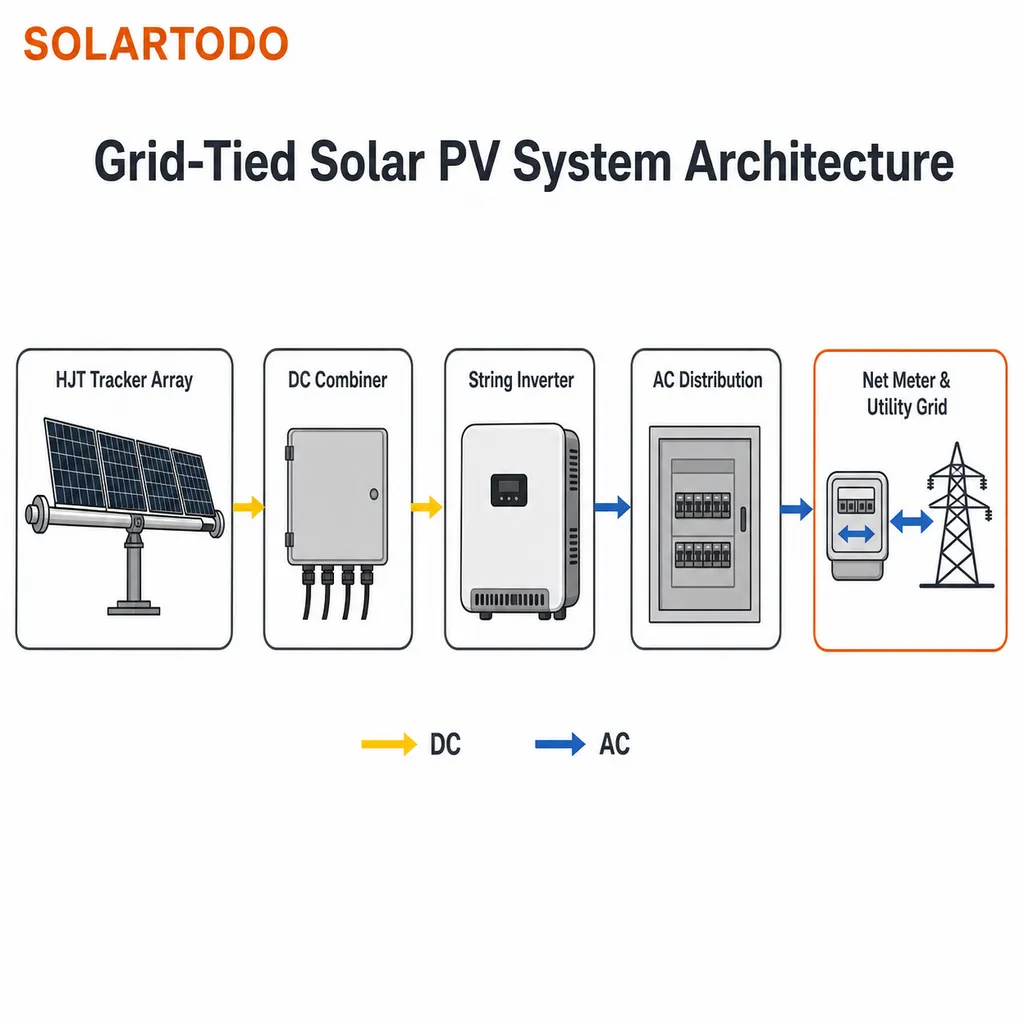
The system boundary includes modules, 1-axis tracker mounting, inverter conversion, AC collection, monitoring gateway, and grid interconnection equipment, but excludes customer-owned transformer upgrades unless stated in the quotation. For structural review, a roof area of about 4,600 m2 is reserved, based on 3,156 m2 of active module area plus tracker clearance, setbacks, wind zones, fire access, and service corridors.
Technical Specifications
The baseline design uses HJT modules because industrial roofs often operate 20-35 C above ambient temperature during summer production hours. With a -0.24%/C coefficient, a module running 30 C above STC loses about 7.2% of rated power, while a conventional -0.34%/C module loses about 10.2%, creating a roughly 3.0 percentage-point output advantage before bifacial and tracking effects are counted.
| Parameter | 811kW Industrial Roof HJT 1-axis Tracker value |
|---|---|
| DC capacity | 811 kWp |
| Module technology | HJT bifacial, 24-26% production class |
| Module efficiency used for sizing | 25.7% |
| Array configuration | 1-axis horizontal tracker |
| Estimated annual generation | 1,563 MWh/year |
| Capacity factor | 22.0% |
| Design roof area | 4,600 m2 |
| CO2 offset assumption | 703 tCO2/year at 0.45 tCO2/MWh |
Applicable module qualification references include IEC 61215 for design qualification and type approval, IEC 61730-1:2023 and IEC 61730-2 for PV module safety construction and testing, and UL 1703 where legacy North American module recognition is requested. Inverter anti-islanding and grid-interaction reviews can reference IEC 62116, IEEE 1547-2018, and local utility interconnection rules for voltage, frequency, ride-through, and disconnect behavior.
Energy Yield Model
The planning yield of 1,563 MWh/year is calculated from 811 kWp x 8,760 h/year x 22.0% capacity factor, before local soiling, shading, curtailment, and interconnection constraints are finalized. NREL PVWatts Version 8.5.2, released on 2025-09-25, is a suitable early-stage tool because it supports bifacial modules, updated thermal models, NSRDB PSM V3 weather data, and PVWatts V8 API assumptions for bankable pre-feasibility screening.
For a representative MENA industrial-roof scenario with 2,050 kWh/m2/year global horizontal irradiance, 3% annual soiling loss, 1.5% AC clipping loss, and 0.5% curtailment, the 811 kW HJT tracker can be modeled at about 1.50-1.65 GWh/year. This is a representative engineering scenario only, not a claim that any customer deployed, purchased, approved, or achieved those results at a named site.
Compared with a fixed-tilt industrial roof system of the same 811 kWp DC size and similar inverter loading ratio, the 1-axis tracker configuration is expected to reduce the effective cost per delivered kWh by roughly 10-18% in high-irradiance locations. The tracker adds mechanical CAPEX and roof engineering work, but the 15-25% yield uplift can offset those costs where electricity tariffs are above USD 0.08/kWh and roof structure margins are adequate.
HJT Module Performance
HJT is selected for this 811 kW variant because it combines high conversion efficiency, low degradation, and bifacial response in a format compatible with commercial string design. The cited technology range is 24-26% mass-production module efficiency, bifaciality up to 90-95%, first-year LID-free behavior, and approximately 0.4%/year linear degradation after initial stabilization.
Over a 25-year panel warranty model, a HJT output guarantee near 90% at year 25 gives procurement teams a clearer lifetime-energy profile than low-cost modules with higher temperature losses or faster annual degradation. For production plants with daytime loads of 600-1,200 kW, the 811 kWp system can offset a large share of daytime consumption without requiring battery storage in the base configuration.
Commercially available reference classes include Huasun Himalaya G12-132 modules above 700 W with certified efficiency around 24.16%, and Risen HJT modules reported around 745 W in 700 W-class product families. SOLARTODO treats the exact module brand, frame size, connector type, and fire rating as quotation variables, because a 811 kW rooftop project can require 2-4 approved module alternatives to satisfy delivery date, certification, and local content rules.
Tracker and Roof Integration
A horizontal 1-axis tracker on an industrial roof requires more engineering review than a fixed aluminum rail system because moving rows impose dynamic loads, row spacing, wind-stow logic, and maintenance access constraints. SOLARTODO sizes tracker zones against project wind speed, roof membrane type, parapet height, structural reserve, and ballast or anchoring method, with final approval normally requiring 1 roof survey, 1 structural calculation package, and 1 utility interconnection review.
In procurement terms, the tracker line is not a decorative accessory; it is an energy-yield component that can add about USD 0.06-0.12/W in equipment and integration cost depending on steel content, motor count, controller topology, and roof attachment method. The main engineering decision is whether the roof has enough structural capacity to accept the tracker while maintaining 25-year waterproofing integrity and code-compliant emergency access.
Inverters, Protection, and Grid Interface
For an 811 kW commercial rooftop, SOLARTODO normally uses high-power string inverters in 8-12 units, or central inverter architecture when the customer prefers fewer service points and the local grid accepts a larger block size. String inverters improve MPPT granularity across irregular roofs, while central inverters above 500 kW can reduce USD/W inverter cost when the roof plane is uniform.
The AC side includes low-voltage switchgear, metering, transformer interface coordination, power-quality review, and protection settings aligned with local grid code. A typical 811 kW interconnection package addresses anti-islanding under IEC 62116, distributed energy resource behavior under IEEE 1547-2018 where applicable, and site-specific limits for reactive power, power factor, export control, and rapid shutdown.
Cloud Monitoring
The monitoring layer collects inverter data, tracker position, string alarms, energy yield, fault codes, weather-station inputs, and export-meter readings at intervals such as 5 minutes or 15 minutes. A buyer can review daily generation in kWh, specific yield in kWh/kWp, performance ratio, inverter availability, and alarm response time against the EPC acceptance plan.
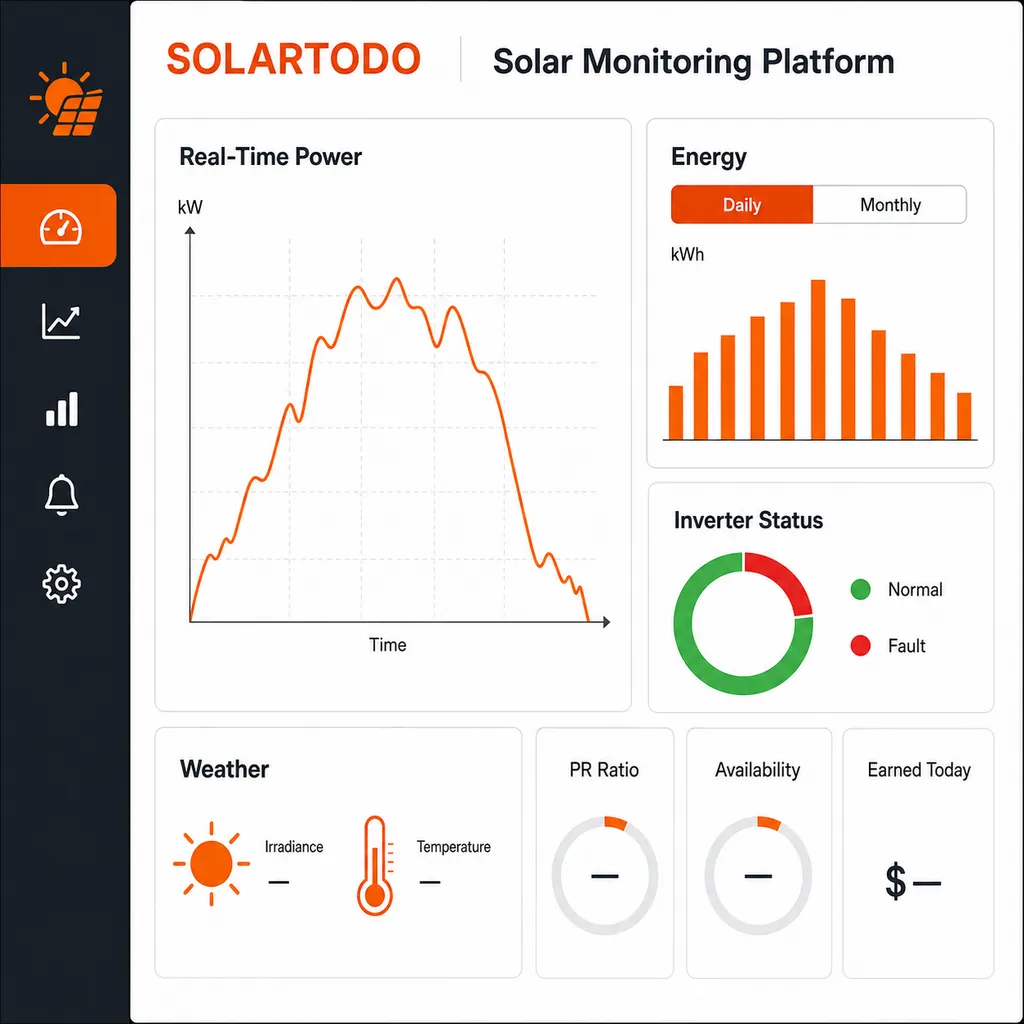
Cloud monitoring is especially important for a 811 kW roof because a 1% unnoticed performance loss can represent about 15.6 MWh/year of lost generation. At an electricity value of USD 0.12/kWh, that small deviation equals about USD 1,875/year, which is enough to justify routine alarm triage, thermal inspection, and annual O&M scheduling.
Applications
The best-fit applications are industrial rooftops with daytime processes, distribution warehouses with electric forklifts, cold-chain facilities, food processing plants, textile factories, electronics assembly sites, and corporate campuses with 500-1,500 kW day-load profiles. The 811 kW scale is large enough for professional EPC procurement but still small enough to fit many roof portfolios without utility-scale land acquisition.
Project developers can use this product page as a preliminary technical baseline, then refine yield, bills of material, and interconnection scope through Configure your system online. Buyers comparing other PV sizes can also View all Solar PV System products or review related design guidance at Learn about topic before requesting engineered drawings.
EPC Investment Analysis and Pricing Structure
The EPC turnkey scope includes 5 work packages: engineering, procurement, construction, commissioning, and warranty support. Engineering covers roof survey, layout, single-line diagram, structural calculations, and grid-interface design; procurement covers modules, inverters, tracker, DC/AC balance of system, monitoring, and shipping coordination; construction covers lifting, anchoring, wiring, testing, labeling, and safety documentation; commissioning covers insulation resistance, polarity, IV checks, inverter startup, tracker commissioning, and handover; warranty support covers 1 year of EPC service plus equipment warranties.
| Pricing tier | Commercial scope | Price range, USD |
|---|---|---|
| FOB Supply | Equipment only, ex-works China | 190,066-274,353 |
| CIF Delivered | Equipment, ocean freight, and insurance | 209,700-302,694 |
| EPC Turnkey | Fully installed, commissioned, and 1-year warranty | 306,558-403,460 |
| Volume threshold | Indicative discount | Procurement interpretation |
|---|---|---|
| 50+ systems | 5% | Best for multi-roof industrial portfolios above 40.55 MW total |
| 100+ systems | 10% | Best for developer frameworks above 81.10 MW total |
| 250+ systems | 15% | Best for national rollouts above 202.75 MW total |
At the EPC midpoint of about USD 355,009, the installed cost equals roughly USD 0.438/W for 811 kWp. With 1,563 MWh/year generation, USD 0.12/kWh electricity value, and approximately USD 5,677/year O&M using IRENA's 2024 utility PV O&M reference near USD 6.99/kW-year, annual net savings can be estimated near USD 181,883/year, giving a simple payback of about 1.95 years before tax, depreciation, demand-charge, or financing effects.
Against diesel generation at USD 0.18-0.35/kWh, the 811 kW HJT tracker can reduce energy cost by roughly 50-85% where grid interconnection and self-consumption are available. Against a no-tracker fixed roof at the same 811 kWp size, the tracker should be evaluated on incremental CAPEX, roof load, O&M complexity, and the added 234-391 MWh/year that may result from a 15-25% yield gain.
Standard payment terms are 30% T/T deposit plus 70% against bill of lading, or 100% L/C at sight for approved bank instruments. Financing discussion is available for projects above USD 5,000K, and buyers can Request a custom quotation or contact [email protected] with roof drawings, 12 months of electricity bills, target COD date, and grid-voltage data.
Standards, Market Context, and Procurement Notes
IRENA's 2024 cost database reported global utility-scale solar PV LCOE near USD 0.043/kWh, total installed cost near USD 691/kW, and global PV capacity factor around 17.4% for new utility-scale projects. This 811 kW industrial roof HJT tracker uses a lower quoted EPC band because it is a standardized B2B supply configuration with China-based equipment sourcing and project-specific installation scope.
IEA's Global Energy Review 2026 reported that solar PV additions surpassed 600 GW in 2025 and cumulative solar PV capacity reached around 2,800 GW, making solar the largest installed power technology by capacity. IEA Renewables 2025 also forecasts 4,600 GW of renewable additions from 2025 to 2030, with solar PV providing almost 80% of that growth, which supports long-term spare-part availability and supplier competition.
For procurement governance, buyers should request datasheets, flash-test tolerance, EL inspection policy, factory quality-control checkpoints, inverter certification, tracker wind-stow settings, roof waterproofing method, and commissioning records for 100% of inverter blocks. SOLARTODO can prepare an English bill of materials, warranty matrix, and preliminary yield model within 2-5 working days after receiving layout drawings and consumption data.
Related SOLARTODO Resources
For engineering education, procurement teams can use Learn about topic to compare HJT, TOPCon, bifacial gain, inverter loading ratio, and LCOE inputs across at least 5 technical themes. For commercial selection, the online configurator can compare capacity, module type, array type, system area, annual MWh, and EPC range across 3 pricing tiers before a formal quotation is issued.
The 811kW Industrial Roof HJT 1-axis Tracker is therefore best understood as a high-yield commercial PV asset, not only a list of panels. It combines 811 kWp capacity, 25.7% HJT module efficiency, 1-axis solar tracking, 1,563 MWh/year modeled production, USD 306,558-403,460 EPC pricing, and standards-led procurement for industrial buyers who need predictable electricity cost reduction over 25 years.
Technical Specifications
| System Capacity | 811kWp |
| Module Type | HJT bifacial |
| Module Efficiency | 25.7% |
| Array Configuration | 1-axis horizontal tracker |
| Estimated Annual Generation | 1563MWh/year |
| Capacity Factor | 22.0% |
| System Area | 4600m2 |
| CO2 Offset | 703tons/year |
| Payback Period | 1.95years |
| LCOE | 0.031USD/kWh |
| Warranty | 25yr panels, 10yr inverter, 1yr EPC support |
Price Breakdown
| Item | Quantity | Unit Price | Subtotal |
|---|---|---|---|
| 700W-class HJT bifacial modules | 1144 pcs | $128 | $146,432 |
| Industrial roof 1-axis tracker structure package | 1 pcs | $62,000 | $62,000 |
| Commercial string inverter set | 10 pcs | $4,100 | $41,000 |
| DC cables, combiner boxes, and protection | 1 pcs | $14,800 | $14,800 |
| AC switchgear and metering infrastructure | 1 pcs | $22,000 | $22,000 |
| Cloud monitoring gateway and weather inputs | 1 pcs | $2,500 | $2,500 |
| Roof structural interface and waterproofing allowance | 1 pcs | $24,000 | $24,000 |
| Installation and commissioning | 1 pcs | $52,000 | $52,000 |
| Engineering design and quality control | 1 pcs | $16,500 | $16,500 |
| Grid interconnection coordination | 1 pcs | $8,000 | $8,000 |
| 1-year warranty and support | 1 pcs | $9,000 | $9,000 |
| Total Price Range | $306,558 - $403,460 | ||
Frequently Asked Questions
What does the EPC turnkey price include for the 811kW system?
Why use HJT modules instead of standard TOPCon modules for this roof?
How much electricity can the 811kW 1-axis tracker generate?
Is a 1-axis tracker practical on every industrial roof?
What standards should procurement teams request before purchase?
Certifications & Standards


Data Sources & References
- •NREL PVWatts Version 8.5.2, https://pvwatts.nrel.gov/version_8.php
- •NREL PVWatts V8 API documentation, https://developer.nrel.gov/docs/solar/pvwatts/
- •IRENA Renewable Power Generation Costs in 2024, https://www.irena.org/Digital-Report/Renewable-Power-Generation-Costs-in-2024
- •IEA Global Energy Review 2026, https://www.iea.org/reports/global-energy-review-2026
- •IEA Renewables 2025, https://www.iea.org/reports/renewables-2025
- •IEC 61730-1:2023 PV module safety qualification, https://webstore.iec.ch/en/publication/59803
Interested in this solution?
Contact us for a customized quote based on your specific requirements.
Contact Us