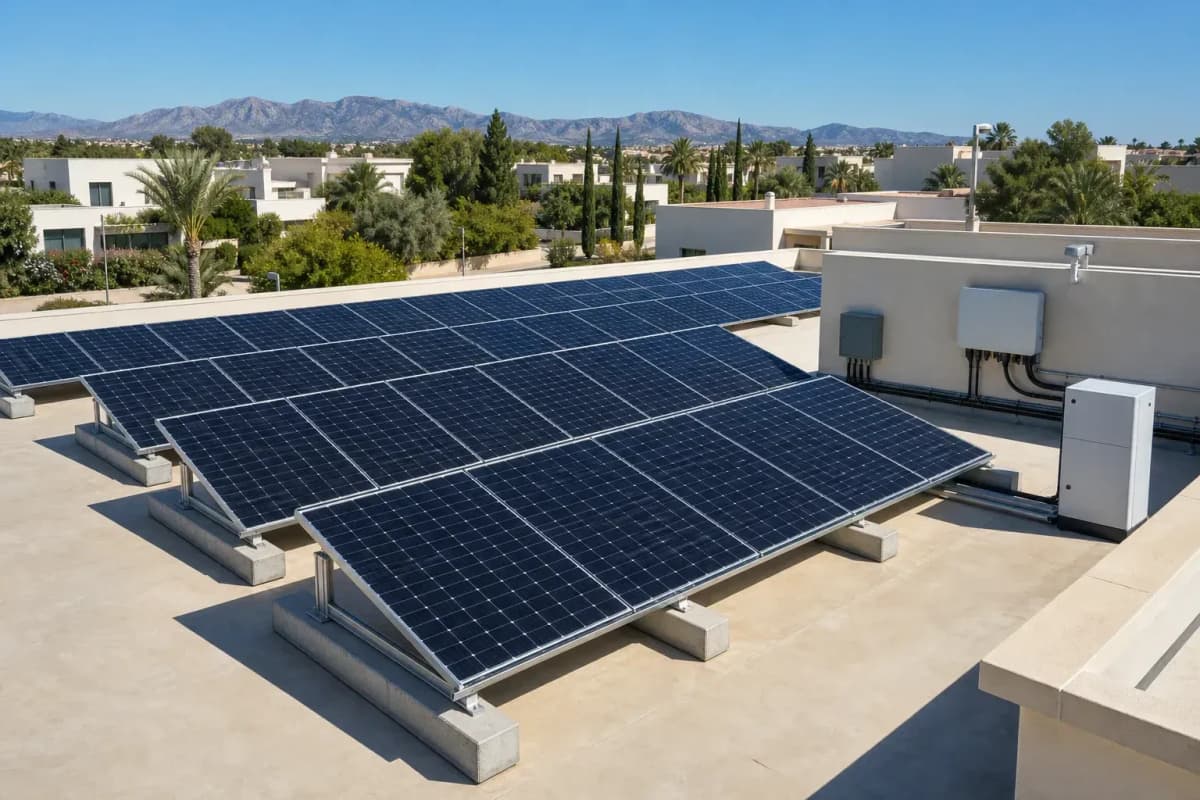
26kW Residential Solar+Storage Bifacial Fixed - 22% Hybrid PV System
Key Features
- 26 kWp residential hybrid PV system with 37 bifacial 700 W-class modules and 22% module efficiency.
- Fixed 10-degree roof or ground-mount array with approximately 125 m2 installed footprint.
- Estimated annual generation of 41.0 MWh and 18.0% capacity factor in a representative high-irradiance scenario.
- 10 kWh-class LFP storage supports about 4-6 hours of 1.5-2.5 kW critical residential loads.
- EPC turnkey range is USD 13,560-17,360 with FOB supply from USD 8,407.
The 26kW Residential Solar+Storage Bifacial Fixed system combines 22% efficient bifacial PV modules, a fixed 10-degree array, hybrid inverter architecture, and 10 kWh-class LFP storage for residential self-consumption and backup. EPC turnkey pricing is USD 13,560-17,360, with IEC 61215, IEC 61730, IEC 62116, UL 1703, and IEEE 1547-aligned design references.
Description
The 26kW Residential Solar+Storage Bifacial Fixed system is a 26 kWp hybrid PV package using 22% efficient bifacial modules, a fixed 10-degree mounting geometry, a residential hybrid inverter, and LFP battery storage for day-night load shifting. The reference design uses 37 bifacial 700 W-class modules, approximately 125 m2 of usable array area, and an estimated 41.0 MWh/year generation profile under a representative high-irradiance residential scenario.
This product page is written for engineers, procurement teams, and project developers comparing 1 residential hybrid PV system against grid-only supply, diesel backup, or a conventional monofacial rooftop array. For SOLARTODO portfolio navigation, buyers can View all Solar PV System products, Configure your system online, or Request a custom quotation for 1 address-specific bill of materials.
System Architecture
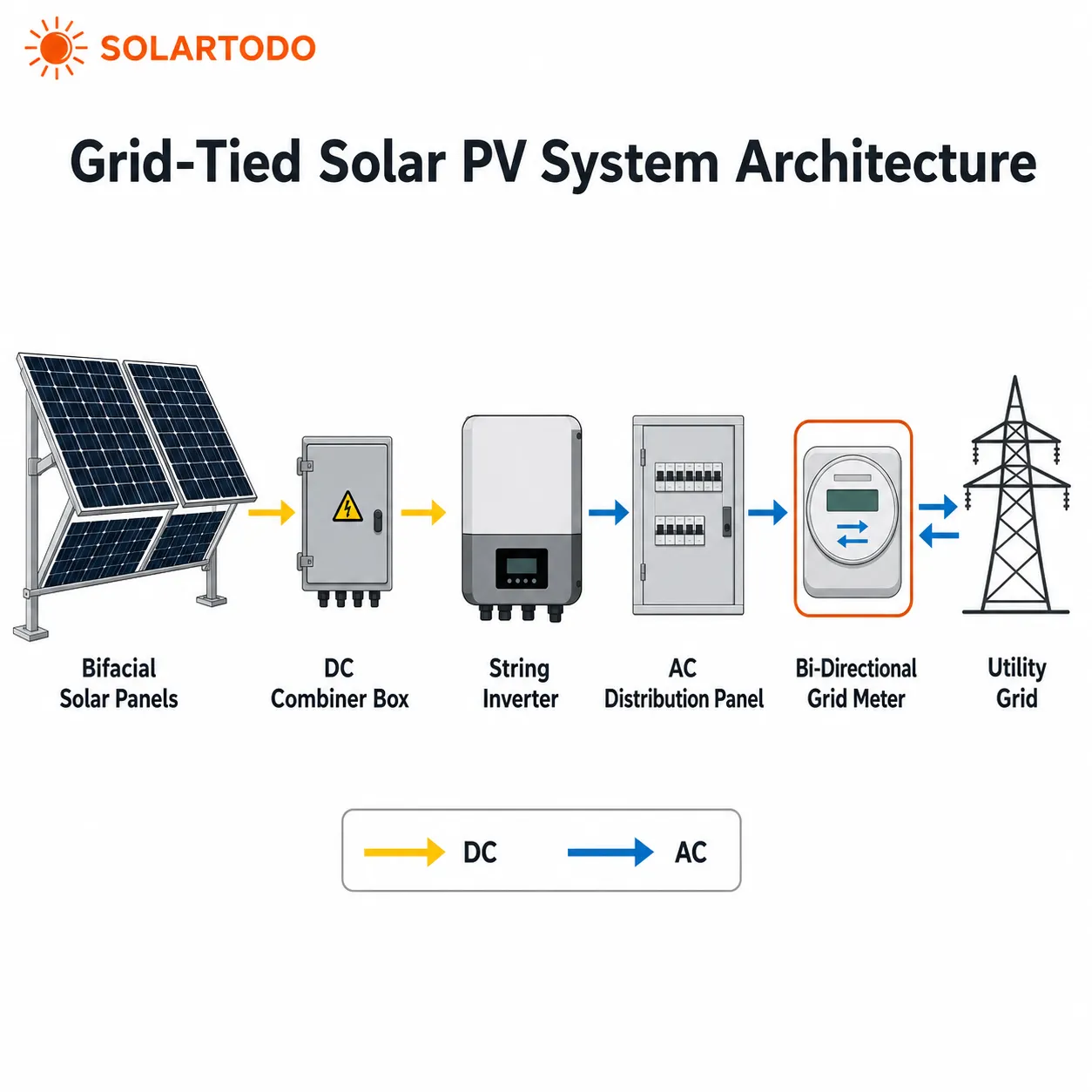
The 26 kWp architecture combines bifacial TOPCon or HJT-based modules, a fixed-tilt support structure, a hybrid inverter sized near 26 kW AC, DC protection, AC distribution, cloud monitoring, and 1 LFP storage cabinet in the 10 kWh class. The DC array is normally configured into 2-4 MPPT strings, with final string count determined by module Voc, local minimum temperature, inverter voltage window, and national electrical code limits.
Bifacial modules collect front-side irradiance plus rear-side reflected irradiance, which makes albedo a real design variable rather than a cosmetic site detail. NREL PVWatts Version 8 explicitly added bifacial module inputs and albedo modeling in its current calculator workflow, making rear-side gain more practical to estimate for 2025-2026 residential and commercial studies (NREL PVWatts V8).
The fixed 10-degree array configuration is selected for low structural cost, simple wind loading, easier maintenance access, and a 25-year mechanical design life when matched with corrosion-resistant rails, clamps, and grounding hardware. Compared with a single-axis tracker, the fixed system can reduce moving-part count by 100% and mounting CAPEX by roughly USD 0.04/W, while sacrificing part of the maximum bifacial yield potential.
Technical Specifications
The reference DC field uses 37 modules rated around 700 W each, giving 25.9 kW DC before commercial rounding to the 26 kW product class. Module efficiency is specified at 22%, so the active module surface is approximately 118 m2, while the installed footprint is estimated at 125 m2 after allowing 5-8% spacing for roof edges, service corridors, rail projection, and electrical clearances.
| Parameter | Reference value |
|---|---|
| Nominal DC capacity | 26 kWp |
| Module technology | Bifacial TOPCon or HJT |
| Module efficiency | 22% |
| Array type | Fixed roof or ground mount |
| Tilt angle | 10 degrees |
| Estimated annual generation | 41.0 MWh/year |
| Capacity factor | 18.0% |
| Estimated system area | 125 m2 |
| CO2 offset | 18.5 tons/year |
| Reference storage | 10 kWh LFP class |
| Reference LCOE | USD 0.019/kWh |
| Warranty basis | 25-year panels, 10-year inverter, 1-year EPC support |
The bifacial rear-side gain assumption is 10-18% in this residential fixed configuration, with 10% used for conservative concrete or light roof surfaces and 18% used for white gravel, pale membrane roofing, sand, or other high-albedo surroundings. The supplied technical knowledge range of 10-30% remains valid for elevated ground mounts above 1 m, but a 10-degree residential layout should be modeled against actual surface reflectance before final procurement.
Module certification should reference IEC 61215 for crystalline silicon PV design qualification and type approval, IEC 61730 for PV module safety qualification, and UL 1703 where legacy North American module listing language remains required in procurement documents. Inverter and grid-interface documents should reference IEC 62116 for islanding prevention and IEEE 1547-2018 for distributed energy resource interconnection behavior in applicable markets.
Representative MENA Residential Hybrid Scenario
For a representative MENA villa scenario with 5.8 kWh/m2/day plane-of-array resource, 10-degree tilt, 14% aggregate losses, and 12% bifacial rear-side gain, the 26 kWp system is estimated at about 41.0 MWh/year. At an electricity value of USD 0.18/kWh, that output corresponds to approximately USD 7,380/year of avoided grid purchases before local export tariffs, demand charges, or time-of-use credits are applied.
In the same scenario, a conventional 26 kW monofacial fixed array with similar inverter sizing may generate 8-12% less annual energy if roof reflectance and rear irradiance are favorable for bifacial modules. That means the bifacial system can add roughly 3.0-4.4 MWh/year, equivalent to USD 540-792/year at USD 0.18/kWh, without increasing the number of roof penetrations by 37 positions.
The 10 kWh-class LFP storage block is sized for short-duration residential backup, evening self-consumption, and PV clipping recovery rather than 24-hour off-grid autonomy. For a home with a 1.5-2.5 kW critical-load panel, 10 kWh can typically support 4-6 hours of essential circuits, subject to battery depth-of-discharge settings, HVAC lockout strategy, inverter surge rating, and local electrical code requirements.
EPC Investment Analysis and Pricing Structure
EPC turnkey scope includes 5 work packages: engineering, procurement, construction, commissioning, and 1-year site warranty support. Engineering covers string design, roof or ground-layout drawings, single-line diagrams, grounding concept, protection coordination, and interconnection documentation; procurement covers modules, inverter, battery, racking, DC/AC protection, cables, connectors, labels, monitoring, logistics, and quality-control inspection.
| Pricing tier | Scope | Price range |
|---|---|---|
| FOB Supply | Equipment only, ex-works China | USD 8,407-11,805 |
| CIF Delivered | Equipment plus ocean freight and insurance | USD 9,275-13,024 |
| EPC Turnkey | Installed, commissioned, and 1-year supported | USD 13,560-17,360 |
| Order volume | Discount from listed tier | Procurement note |
|---|---|---|
| 50+ systems | 5% | Best for 1 regional installer program |
| 100+ systems | 10% | Best for 1 developer framework order |
| 250+ systems | 15% | Best for 1 utility or national housing rollout |
The ROI model uses a midpoint EPC price of USD 15,460, annual production of 41.0 MWh, avoided retail electricity of USD 0.18/kWh, and annual O&M allowance of USD 260. Under those 4 assumptions, net annual savings are about USD 7,120 and the simple payback period is approximately 2.2 years before financing cost, tax treatment, export compensation, battery replacement, and local permitting fees.
Compared with a diesel backup alternative consuming 0.27 L/kWh and diesel priced at USD 1.10/L, 10,000 kWh of annual shifted or backup energy can avoid about USD 2,970/year in fuel expense and roughly 7.2 tons/year of direct CO2 emissions. The hybrid PV-battery system also avoids 100% of engine oil changes, fuel delivery risk, and acoustic nuisance associated with a small residential generator, although it still requires electrical inspection and battery thermal clearance.
Payment terms are structured for B2B procurement: 30% T/T deposit plus 70% against bill of lading, or 100% irrevocable L/C at sight for qualified buyers. Project financing can be reviewed for portfolios above USD 5,000K, and technical-commercial requests should be sent to [email protected] with 1 load profile, 12 months of bills, roof drawings, and target delivery country.
Performance, Standards, and Market Context
IEA reported that solar PV additions surpassed 600 GW in 2025 and accounted for more than 75% of new renewable capacity additions worldwide, which supports high supplier scale and rapid technology refresh cycles for residential PV packages (IEA Global Energy Review 2026). IEA also projects 4,600 GW of renewable capacity additions over 2025-2030, with solar PV representing nearly 80% of expansion in the main case (IEA Renewables 2025).
IRENA’s 2024 cost database reported a global weighted-average utility-scale solar PV LCOE of USD 0.043/kWh and a solar PV total installed cost of USD 691/kW, while noting that battery storage costs fell 93% from 2010 to 2024 (IRENA Renewable Power Generation Costs 2024). The 26 kW residential hybrid system is smaller than utility-scale projects, so its turnkey price per watt is higher, but its avoided retail electricity value can be 3-6 times higher than wholesale solar tariffs.
NREL modeling conventions are useful for preliminary yield estimation because PVWatts V8 uses 30 years of historical weather data ranges and includes updated weather, inverter, module, and bifacial inputs. SOLARTODO still recommends a bankable 8760-hour simulation for projects above 100 systems, especially when the procurement decision depends on 1-hour load matching, export caps, or battery dispatch strategy.
IEC and IEEE references should be included directly in procurement submittals because hybrid residential systems connect generation, storage, and grid-protection behavior in 1 electrical installation. Recommended compliance language includes IEC 61215 and IEC 61730 for modules, IEC 62116 for anti-islanding, IEEE 1547 for DER interconnection, and local electrical-code review for rapid shutdown, battery clearances, earthing, surge protection, and fire access.
Cloud Monitoring
The cloud-monitoring layer tracks at least 6 operating groups: PV generation, battery state of charge, inverter alarms, grid import/export, load consumption, and historical yield. For a 26 kW hybrid site, 15-minute telemetry creates 35,040 records/year per measured channel, enabling fault detection for string underperformance, abnormal inverter clipping, communication loss, battery cycling depth, and unexpected nighttime loads.
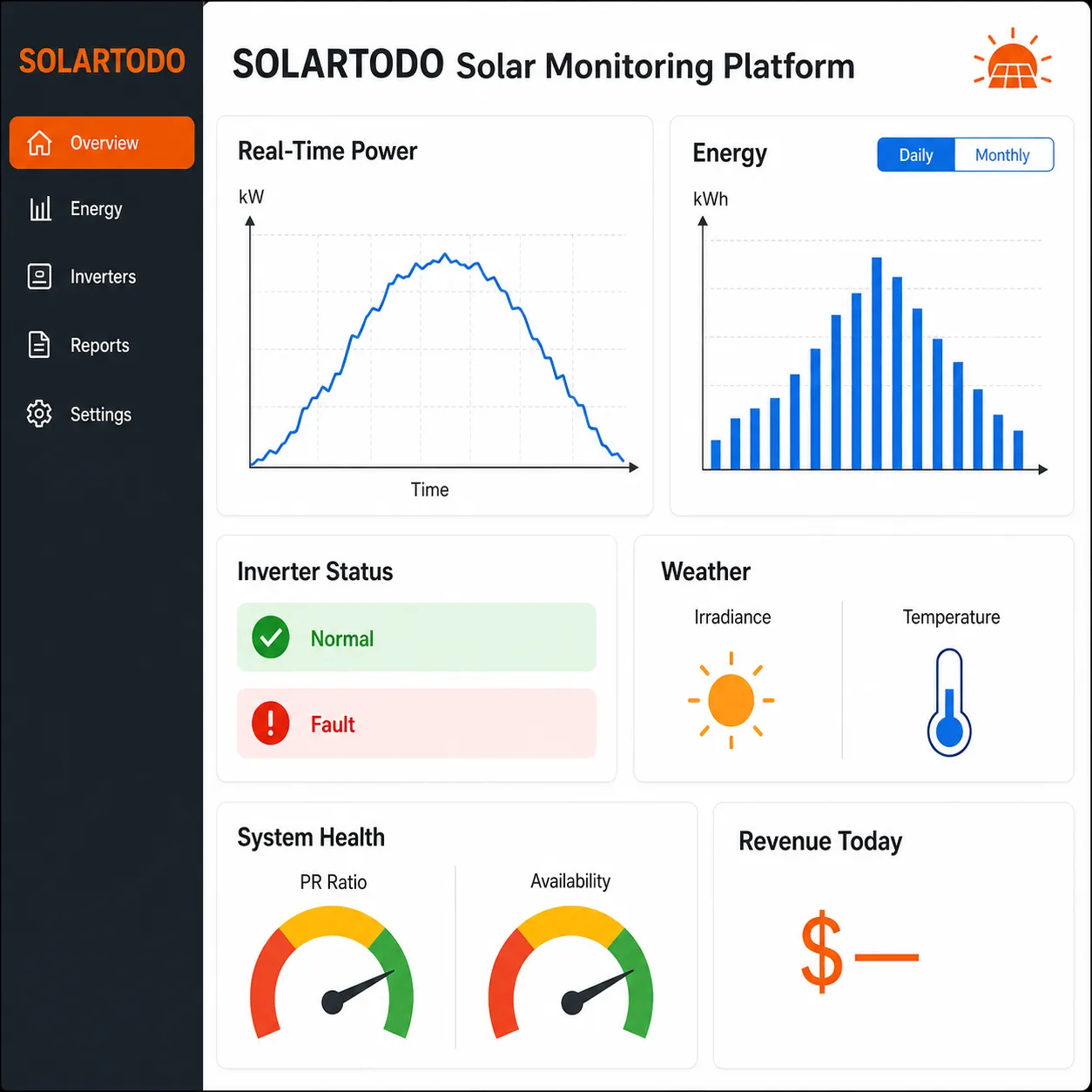
Monitoring is especially valuable for bifacial installations because rear-side gain is site-sensitive and can change after 1 roof coating, 1 gravel replacement, or seasonal soiling. A practical operations rule is to compare monthly specific yield in kWh/kWp against modeled values, flagging deviations above 8% for inspection of soiling, shading, string faults, inverter derating, or battery dispatch configuration.
Applications
This system is best suited to high-consumption homes, villas, residential compounds, farm residences, and small mixed-use properties with 30-80 MWh/year of electricity consumption. It is also suitable for buyers who need 1 hybrid package that reduces daytime grid imports, shifts solar output into evening loads, and maintains essential circuits during short outages.
Ground-mounted residential applications should prioritize white gravel, pale concrete, sand, or reflective membranes to increase rear-side irradiance for the 37 bifacial modules. Roof-mounted applications should verify roof waterproofing, parapet shading, ballast limits, wind uplift, and 10-degree row spacing before finalizing the bill of materials, because 1 shaded row can reduce string output across multiple modules.
Procurement teams can review related technical articles at Learn about topic and compare B2B system classes through the SOLARTODO knowledge base at Learn about topic. For the fastest commercial review, submit 1 target country, 1 installation type, 1 grid standard, 12 monthly consumption values, and the required storage autonomy in hours through Request a custom quotation.
Delivery, Commissioning, and Quality Control
Factory-side QC should include EL inspection, module flash-test sorting, inverter serial-number verification, battery capacity documentation, insulation checks, connector compatibility checks, and packaging inspection before CIF shipment. Site-side commissioning should include polarity verification, Voc and Isc checks for every string, torque-mark inspection on 100% of electrical terminations, insulation resistance testing, inverter grid-code setup, battery charge-discharge verification, and cloud-monitoring handover.
A complete handover file should contain at least 10 document groups: datasheets, certificates, layout drawings, single-line diagram, string schedule, warranty terms, commissioning checklist, monitoring login record, spare-parts list, and maintenance guidance. Annual maintenance normally includes 2 visual inspections, 1 thermal scan where available, 1 cleaning schedule review, and 1 performance-ratio assessment against the 41.0 MWh/year reference model.
Buyer Notes
The listed 26 kW EPC range is a planning price, not a site-specific construction contract, because roof structure, cable route length, battery location, grid-approval fees, labor rate, and import duties can change installed cost by more than 15%. SOLARTODO prepares final offers after 1 engineering review and can adjust storage capacity, inverter brand, module wattage, and mounting hardware for national code, snow load, wind zone, salt mist, or utility interconnection rules.
Technical Specifications
| System Capacity | 26kWp |
| Module Type | Bifacial TOPCon or HJT |
| Module Efficiency | 22% |
| Array Configuration | Fixed |
| Tilt Angle | 10degrees |
| Estimated Annual Generation | 41.0MWh/year |
| Capacity Factor | 18.0% |
| System Area | 125m2 |
| CO2 Offset | 18.5tons/year |
| Payback Period | 2.2years |
| LCOE | 0.019$/kWh |
| Reference Storage Capacity | 10kWh |
| Warranty | 25yr panels, 10yr inverter, 1yr EPC support |
Price Breakdown
| Item | Quantity | Unit Price | Subtotal |
|---|---|---|---|
| 700 W bifacial TOPCon/HJT PV module | 37 pcs | $154 | $5,698 |
| 26 kW residential hybrid inverter | 1 pcs | $1,300 | $1,300 |
| 10 kWh LFP battery cabinet | 1 pcs | $1,800 | $1,800 |
| Fixed mounting structure and clamps | 1 pcs | $1,200 | $1,200 |
| DC cables, connectors, and protection box | 1 pcs | $620 | $620 |
| AC distribution and grid connection hardware | 1 pcs | $680 | $680 |
| Cloud monitoring gateway and meter set | 1 pcs | $500 | $500 |
| Engineering, drawings, and QC documentation | 1 pcs | $850 | $850 |
| Installation and commissioning labor | 1 pcs | $2,080 | $2,080 |
| 1-Year warranty and technical support | 1 pcs | $700 | $700 |
| Total Price Range | $13,560 - $17,360 | ||
Frequently Asked Questions
What is included in the EPC turnkey price for the 26kW Residential Solar+Storage Bifacial Fixed system?
How much energy can a 26 kW bifacial fixed system generate each year?
Why use bifacial modules instead of conventional monofacial modules?
Is the 10-degree fixed tilt suitable for every residential site?
Which standards should procurement teams request for this hybrid PV system?
Certifications & Standards


Data Sources & References
- •NREL PVWatts Version 8, 2025 release notes and calculator documentation
- •IEA Global Energy Review 2026, Technology: Solar PV and Wind
- •IEA Renewables 2025, Renewable Electricity analysis
- •IRENA Renewable Power Generation Costs in 2024, published 2025
- •IEC 61215 photovoltaic module design qualification reference
- •IEC 61730 photovoltaic module safety qualification reference
- •IEEE 1547-2018 distributed energy resource interconnection standard
Interested in this solution?
Contact us for a customized quote based on your specific requirements.
Contact Us