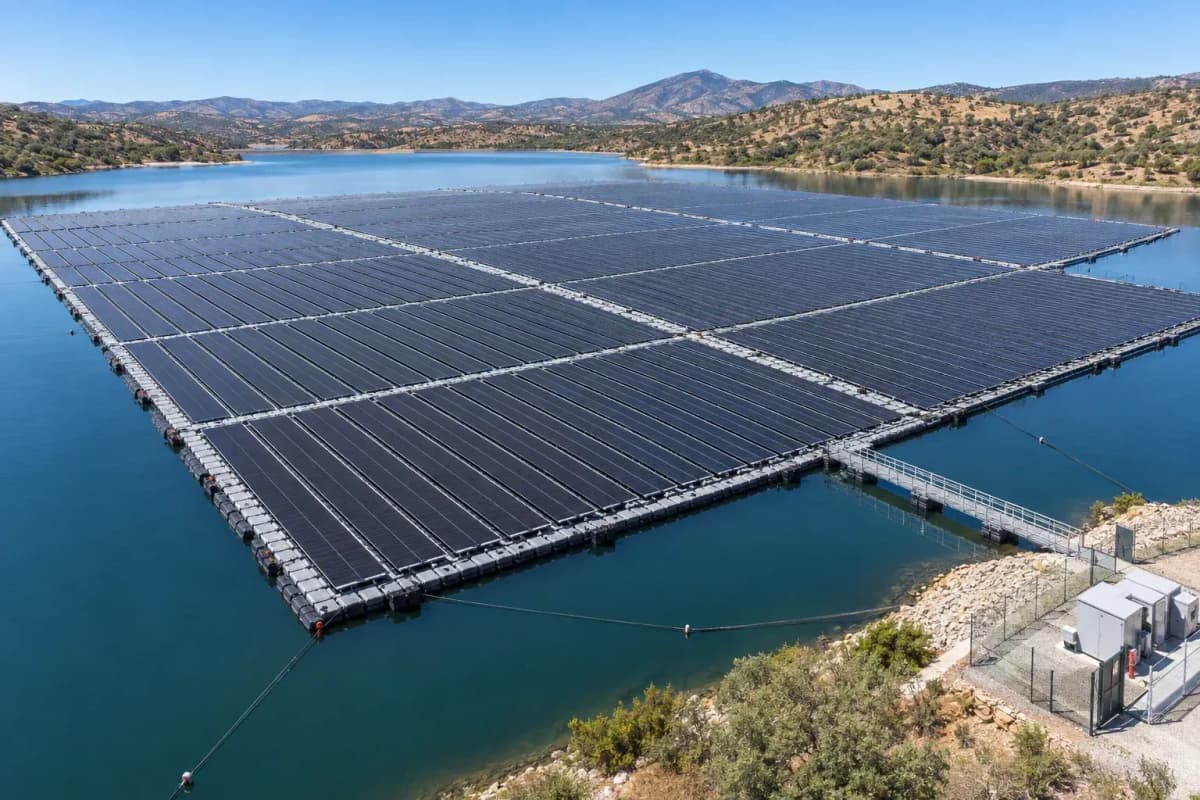
7.3MW Utility Scale Thin-Film CdTe Floating - High-Temperature FPV System
Key Features
- 7,346 kWp DC capacity using thin-film CdTe modules with 18.6% configured efficiency
- 13,833 MWh/year estimated generation at a 21.5% capacity factor
- 78,000 m² estimated floating array surface with near-zero ground-array land occupation
- USD 2,830,016-3,616,158 EPC turnkey range, equal to about USD 0.385-0.492/W
- 6,225 tons/year estimated CO2 offset using a 0.45 tCO2/MWh grid factor
A 7,346 kWp utility-scale floating PV system using thin-film CdTe modules, 18.6% configured efficiency, central inverters, and FPV mounting for reservoirs, industrial ponds, and water-constrained project sites. EPC turnkey pricing is USD 2,830,016-3,616,158, with estimated annual generation of 13,833 MWh at a 21.5% capacity factor.
Description
The 7.3MW Utility Scale Thin-Film CdTe Floating system is a 7,346 kWp floating photovoltaic plant configured with thin-film cadmium telluride modules, 18.6% design efficiency, central inverter blocks, and reservoir-grade FPV mounting. For B2B developers, utilities, and infrastructure owners, this SOLARTODO design targets 13,833 MWh/year generation, 21.5% capacity factor, and EPC turnkey pricing of USD 2,830,016-3,616,158.
This configuration belongs to the SOLARTODO Solar PV System line and is engineered for utility applications where land value, evaporation control, grid interconnection, and high-temperature performance must be evaluated as 4 separate procurement variables. Buyers can View all Solar PV System products, compare 3 pricing tiers, or Configure your system online before requesting a bankable bill of quantities.
Technical Specifications
| Parameter | Value |
|---|---|
| DC capacity | 7,346 kWp |
| Module technology | Thin-film CdTe, Series 7 class |
| Configured module efficiency | 18.6% |
| Array type | Floating PV on water body |
| Estimated annual generation | 13,833 MWh/year |
| Capacity factor | 21.5% |
| Estimated water-surface area | 78,000 m² |
| Estimated module active area | 39,494 m² |
| CO2 offset assumption | 6,225 tons/year at 0.45 tCO2/MWh |
| EPC turnkey range | USD 2.830M-3.616M |
| Warranty basis | 25-year panels, 10-year inverter, 1-year EPC support |
System Architecture
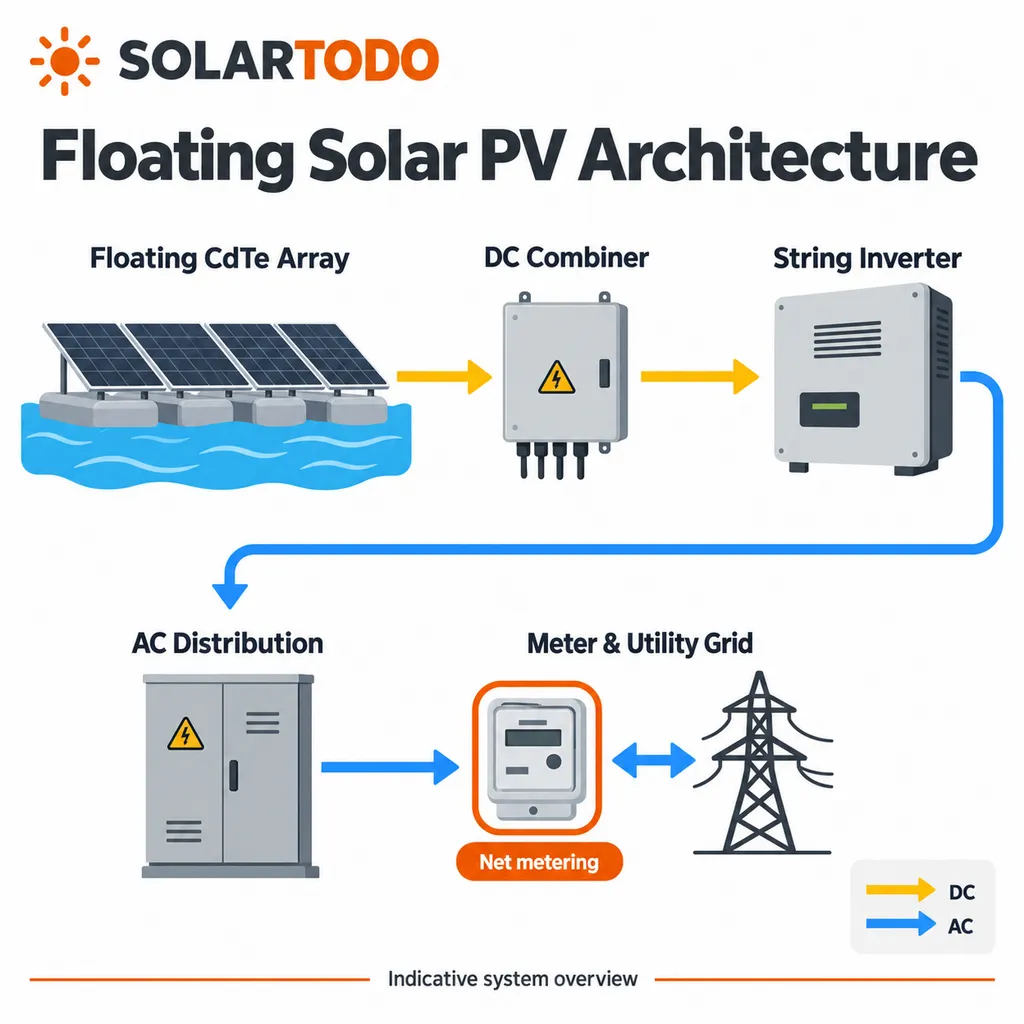
The 7,346 kWp DC array is organized around utility-scale inverter stations, medium-voltage transformation, DC combiner protection, and SCADA data acquisition at 1 central point of control. A representative 550 W CdTe module assumption requires approximately 13,356 modules, producing a nameplate DC capacity of 7,345.8 kWp before final string sizing, voltage-temperature checks, and water-body layout optimization.
CdTe thin-film modules are selected for hot, humid, and diffuse-light regions because the technology typically has a lower temperature coefficient than conventional crystalline silicon modules and no crystalline-cell cracking pathway. First Solar Series 7 public data lists up to 550 W and up to 19.7% efficiency, while this SOLARTODO configuration uses 18.6% as the conservative design value for energy-yield modeling and procurement normalization.
The floating substructure uses HDPE floats, stainless or coated fasteners, shore anchors, underwater mooring lines, and floating cable trays sized for wind, water-level variation, wave fetch, and maintenance access. Compared with a conventional ground-mounted 7.3 MW project, the FPV design can reduce direct land occupation by about 78,000 m² and can deliver a 5-10% cooling-related energy gain when water temperature and ventilation conditions are favorable.
The inverter architecture uses central inverter blocks because a project above 500 kW normally benefits from fewer conversion points, simpler MV collection, and lower USD/W inverter cost than distributed commercial string inverter layouts. IEC 62116 anti-islanding requirements, IEEE 1547 interconnection behavior, and local grid-code ride-through settings should be validated during the 2-stage engineering review before procurement is released.
Floating PV Engineering Context
Floating PV is not simply ground-mounted PV moved onto water; it is a coupled electrical, hydrological, and civil system with at least 6 design domains: solar yield, buoyancy, anchoring, corrosion, bathymetry, and grid access. NREL identified 24,419 suitable man-made U.S. water bodies in a national technical-potential study and found that FPV on suitable reservoirs could contribute nearly 10% of current U.S. electricity generation under conservative assumptions.
For a representative MENA solar farm scenario, SOLARTODO models this 7.346 MWp FPV plant on a 78,000 m² industrial reservoir with 2,150 kWh/m²/year global horizontal irradiation, 5.5 kWh/m²/day average resource, 21.5% AC-equivalent capacity factor, and USD 0.07/kWh avoided electricity value. Under those 4 assumptions, gross annual energy value is about USD 968,310 before O&M, curtailment, wheeling, or tax treatment.
The NREL AquaPV work published in 2024 emphasizes that reservoir FPV requires environmental and regulatory screening, including water depth, temperature, reservoir ownership, and permitting route. For this 7.3 MW class asset, early-stage feasibility should allocate 4-8 weeks for bathymetry review, 2-4 weeks for grid-impact screening, and 1 environmental checklist before EPC contract finalization.
Module Technology and Standards
IEC 61215 is the relevant design-qualification framework for terrestrial PV module durability, while IEC 61730 addresses PV module safety construction and testing across crystalline and thin-film technologies. The 2023 edition of IEC 61730-1 specifies construction requirements intended to reduce electric shock, fire, and mechanical-stress risk for long-term outdoor operation, including modules exposed to 70 °C 98th-percentile operating temperatures.
UL 1703 remains a widely referenced legacy safety standard in procurement documents, while many U.S. projects now evaluate module safety through UL 61730 harmonized requirements. For inverter and grid protection, IEC 62116 anti-islanding, IEEE 1547 interconnection, surge protection coordination, insulation monitoring, and DC disconnect labeling should be included in the 1-line diagram review.
The CdTe technology selection also has a bankability dimension because utility-scale procurement increasingly compares lifetime energy, degradation, temperature response, and recycling pathways rather than only USD/W. First Solar Series 7 public specifications cite 30-year linear performance warranty language and 0.3% warranted annual degradation, while this SOLARTODO page keeps the commercial warranty template at 25 years for panels and 10 years for inverters unless project-specific documents extend those terms.
EPC Investment Analysis and Pricing Structure
EPC turnkey delivery includes 5 work packages: engineering, procurement, construction, commissioning, and 1-year warranty support. For this 7,346 kWp system, engineering covers yield simulation, electrical single-line diagrams, floating-layout drawings, mooring assumptions, protection settings, and commissioning procedures; procurement covers modules, floats, anchors, inverters, transformers, combiner boxes, cables, monitoring, logistics, and factory quality control.
| Pricing tier | Scope | Price range |
|---|---|---|
| FOB Supply | Equipment only, ex-works China | USD 1,754,610-2,458,987 |
| CIF Delivered | Equipment plus ocean freight and insurance | USD 1,935,861-2,713,000 |
| EPC Turnkey | Installed, commissioned, and 1-year supported | USD 2,830,016-3,616,158 |
| Volume level | Discount | Commercial use case |
|---|---|---|
| 50+ units or equivalent blocks | 5% | Multi-site industrial water reservoirs |
| 100+ units or equivalent blocks | 10% | Regional procurement framework |
| 250+ units or equivalent blocks | 15% | Utility or government portfolio tender |
Using the EPC midpoint of USD 3,223,087, annual gross energy value of USD 968,310 at USD 0.07/kWh, and estimated O&M of USD 96,233/year based on USD 13.1/kW-year from IRENA 2024 cost reporting, simple payback is about 3.7 years before taxes and financing. Against a diesel generation alternative at USD 0.18/kWh, the same 13,833 MWh/year output represents about USD 2.49M/year in displaced fuel-linked generation value, but final ROI depends on tariff, curtailment, and grid charges.
Payment terms are 30% T/T deposit plus 70% against bill of lading, or 100% irrevocable L/C at sight for approved buyers. Project financing discussion is available for qualified projects above USD 5,000K, and buyers can Request a custom quotation or contact [email protected] with 3 documents: site coordinates, water-body boundary, and interconnection voltage.
Cloud Monitoring
The monitoring layer collects inverter output, string-level current where specified, irradiance, module temperature, float-zone alerts, wind speed, AC power quality, and revenue-grade meter data at 5-15 minute intervals. A utility owner can connect the SCADA gateway to SOLARTODO cloud dashboards, export CSV files for lender reports, and configure 3 alarm classes for production loss, insulation fault, and communication failure.
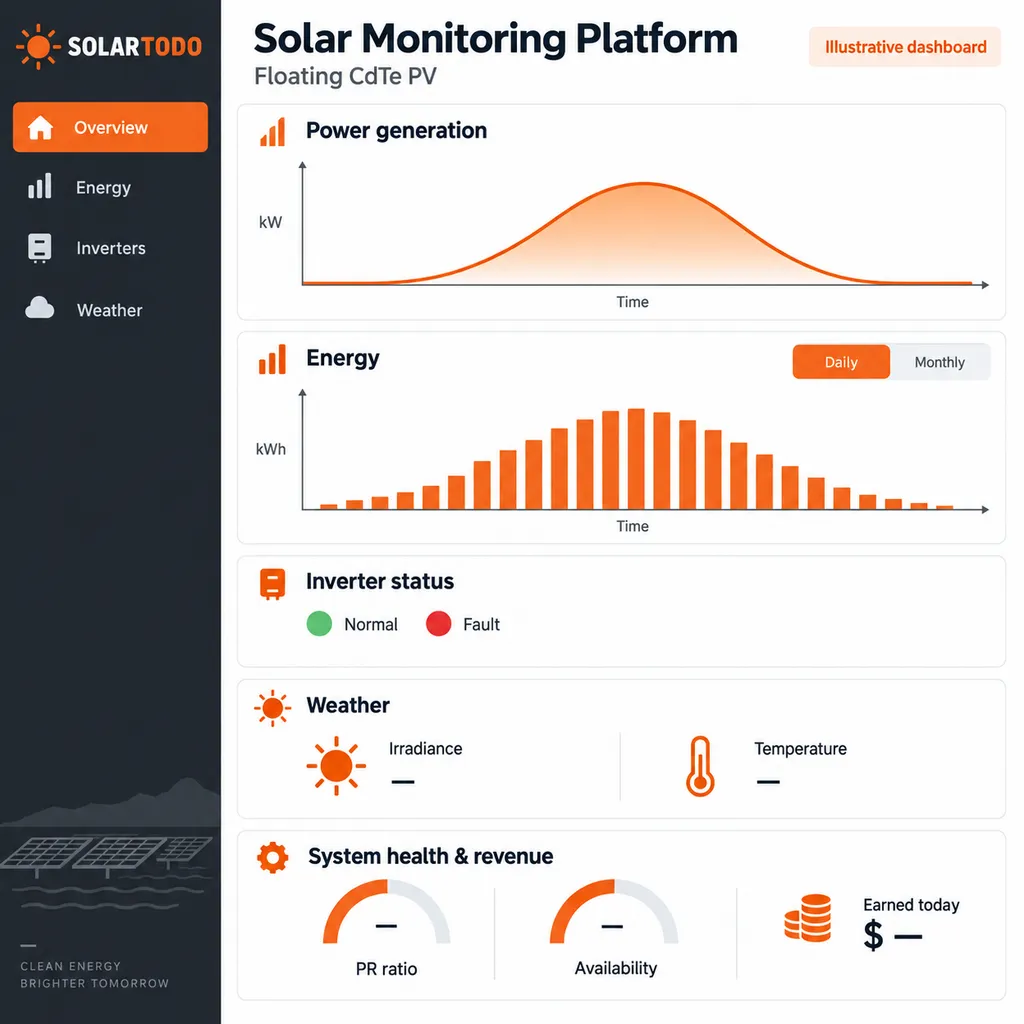
Cloud monitoring supports O&M decisions because a 1% annual availability loss on a 13,833 MWh/year asset equals about 138 MWh/year of missed generation. For technical reading on PV performance ratios, floating-array design, and solar project controls, buyers can Learn about topic and review the wider SOLARTODO knowledge base before preparing a lender-grade technical note.
Applications
This 7.3 MW CdTe floating PV system is best suited for reservoirs, quarry lakes, industrial cooling ponds, wastewater treatment lagoons, hydropower reservoirs, and agricultural water bodies where a 5-10% FPV cooling gain and land-preservation value can materially improve project economics. The design is especially relevant where land acquisition exceeds USD 15/m², reservoir evaporation is economically important, or grid access exists within 1-5 km.
Compared with a fixed-tilt ground-mounted crystalline silicon PV alternative, the FPV CdTe configuration reduces land conversion by approximately 100% at the array footprint and may improve hot-weather yield by 2-6% from CdTe temperature behavior plus 5-10% water-cooling effects. The tradeoff is higher civil complexity, mooring inspection, marine-grade cabling, and reservoir permitting, which typically increases EPC cost by 10-25% versus simple ground-mount designs.
IEA Renewables 2025 projects 4,600 GW of renewable electricity additions from 2025 to 2030, with solar PV representing nearly 80% of capacity expansion. IEA Global Energy Review 2026 reports that solar PV additions surpassed 600 GW in 2025, confirming that utility procurement is scaling around bankable PV technologies, standardized inverters, and grid-compatible monitoring.
IRENA Renewable Power Generation Costs in 2025 reports a global utility-scale solar PV LCOE of USD 44/MWh, while the 2024 digital report lists USD 0.043/kWh and 17.4% global weighted-average utility PV capacity factor. This 7.346 MWp FPV configuration uses a site-specific target LCOE of USD 0.034/kWh because the representative case assumes high irradiation, moderate EPC cost, and 21.5% capacity factor.
BloombergNEF and Wood Mackenzie market tracking through 2025 show that crystalline silicon TOPCon dominates mainstream module supply, while CdTe remains a strategically differentiated utility-scale option for heat, humidity, degradation, and supply-chain diversification. SOLARTODO positions this design for buyers who need a 7 MW class water-sited PV block rather than a commodity rooftop or land-only product.
Procurement Notes
Final project sizing should verify DC/AC ratio, water-level fluctuation, cable ampacity at 90 °C insulation assumptions, transformer impedance, earthing design, lightning risk, corrosion class, and O&M boat access before purchase order release. SOLARTODO normally requests 6 inputs for quotation accuracy: latitude-longitude, reservoir polygon, maximum water depth, grid voltage, target COD date, and preferred Incoterm.
For developers preparing tender documents, this product page can be converted into a 20-year energy model, a component-level BOQ, or an EPC scope split between local civil works and imported electrical equipment. To accelerate procurement, Configure your system online, compare products at View all Solar PV System products, and use Learn about topic for background on solar standards and project bankability.
Technical Specifications
| System Capacity | 7346kWp |
| Module Type | thin_film_cdte |
| Module Efficiency | 18.6% |
| Array Configuration | floating |
| Application | utility |
| Est. Annual Generation | 13833MWh |
| Capacity Factor | 21.5% |
| System Area | 78000m² |
| CO2 Offset | 6225tons/year |
| Payback Period | 3.7years |
| LCOE | 0.034USD/kWh |
| Warranty | 25yr panels, 10yr inverter |
Price Breakdown
| Item | Quantity | Unit Price | Subtotal |
|---|---|---|---|
| Thin-Film CdTe PV Modules, 550 W class | 13356 pcs | $99 | $1,322,244 |
| Floating HDPE Pontoons, Mooring, and Anchoring Hardware | 78000 pcs | $6 | $468,000 |
| Central Inverter Stations, 900-1000 kW class | 8 pcs | $45,000 | $360,000 |
| DC Cable Sets, Combiner Boxes, and String Protection Packs | 7346 pcs | $20 | $146,920 |
| Medium-Voltage Transformers, Switchgear, and AC Protection | 2 pcs | $95,000 | $190,000 |
| SCADA, Weather Station, Revenue Metering, and Data Gateway | 1 pcs | $28,000 | $28,000 |
| Ocean Freight, Marine Insurance, and Export Packing Allowance | 1 pcs | $181,251 | $181,251 |
| Engineering, Design Review, Factory QC, and Documentation | 1 pcs | $125,000 | $125,000 |
| Installation and Commissioning Labor Blocks | 7346 pcs | $80 | $587,680 |
| Grid Interconnection Testing and Protection Relay Coordination | 1 pcs | $65,000 | $65,000 |
| 1-Year Warranty, Remote Support, and Spare Parts Allowance | 1 pcs | $78,500 | $78,500 |
| Total Price Range | $2,830,016 - $3,616,158 | ||
Frequently Asked Questions
What does the EPC turnkey price include for the 7.3MW CdTe floating PV system?
Why use CdTe thin-film modules instead of conventional crystalline silicon modules?
How much water surface is required for this 7.346 MWp floating PV plant?
What annual generation and payback should a buyer expect?
Which standards are relevant for engineering and procurement approval?
Certifications & Standards


Data Sources & References
- •NREL Floating Photovoltaic Systems technical potential study, 2019, https://doi.org/10.1021/acs.est.8b04735
- •NREL AquaPV regulatory and environmental considerations for floating PV, 2024, https://www.nrel.gov/docs/fy24osti/90272.pdf
- •IEA Renewables 2025, https://www.iea.org/reports/renewables-2025
- •IEA Global Energy Review 2026, https://www.iea.org/reports/global-energy-review-2026/technology-solar-pv-and-wind
- •IRENA Renewable Power Generation Costs in 2025, https://www.irena.org/Publications/2026/Jul/Renewable-Power-Generation-Costs-in-2025
- •IEC 61730-1:2023 photovoltaic module safety qualification, https://webstore.iec.ch/en/publication/59803
- •First Solar Series 7 public product specifications, https://www.firstsolar.com/Products/Series-7
Interested in this solution?
Contact us for a customized quote based on your specific requirements.
Contact Us