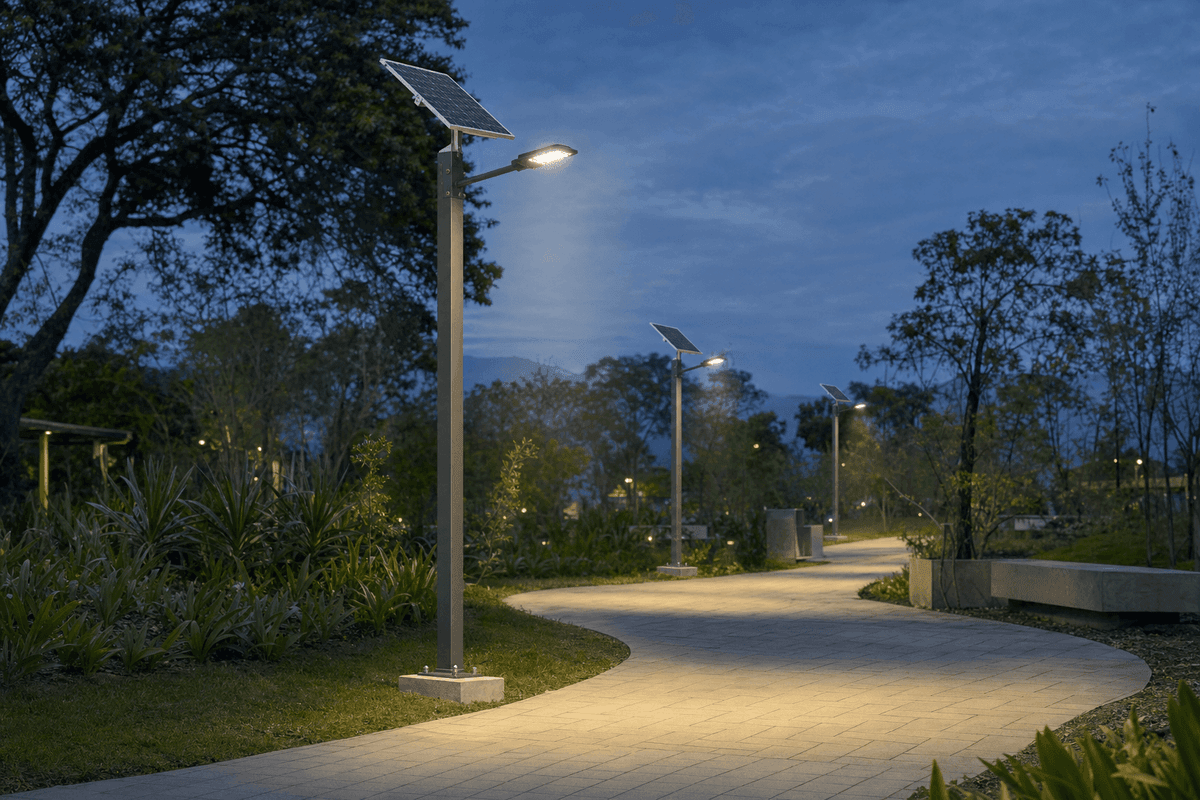
3.5m Park Pathway Garden Light 20W - LFP Solar Street Light
Key Features
- 3.5m aluminum-alloy pole with modern minimalist garden-light styling
- 20W LED engine delivers approximately 3,400 lm at >170 lm/W
- 40Wp TOPCon solar panel supports 12h dusk-to-dawn operation
- 150Wh LiFePO4 battery provides 4 rainy-day autonomy with smart dimming
- $130-$200 EPC turnkey range includes installation, commissioning, and 1-year support
The 3.5m Park Pathway Garden Light 20W combines a 40Wp TOPCon solar panel, 150Wh LiFePO4 battery, 3.5m aluminum-alloy pole, and 4000K LED output for 12-hour dusk-to-dawn park lighting with 4 rainy-day autonomy.
Description
The 3.5m Park Pathway Garden Light 20W is a temperate-climate solar streetlight for parks, gardens, resorts, campuses, and pedestrian routes, using a 40Wp monocrystalline TOPCon module, a 150Wh LiFePO4 battery, and a 20W LED engine rated at about 3,400 lm. SOLARTODO specifies this 3.5m modern minimalist fixture with a lightweight aluminum-alloy pole, 4000K neutral-white optics, 12h/night operation, and 4 rainy-day autonomy for B2B EPC buyers.
Product Overview
This garden-type solar streetlight is designed for low-speed pedestrian environments where 3.5m mounting height, 20W LED power, and 4000K color temperature typically provide a more comfortable visual field than 6m or 8m roadway luminaires. In a 50-unit pathway package, each light operates as an independent PV-battery-LED system, reducing trenching, copper cabling, and distribution-board work compared with a conventional grid-fed garden-light circuit.
The system belongs to SOLARTODO's View all Solar Street Light products category and uses separate, serviceable components instead of a sealed disposable lamp body. The 40Wp panel follows the design logic used in IEC 62124 standalone PV system verification, while the luminaire safety and ingress-protection approach aligns with IEC 60598 and IP66/IP67 design practices for outdoor luminaires.
Technical Specifications
| Parameter | Value |
|---|---|
| Pole height | 3.5 m |
| LED power | 20 W |
| Estimated luminous flux | 3,400 lm at >170 lm/W chips |
| Solar panel | 40 Wp monocrystalline TOPCon |
| Battery | 150 Wh LiFePO4 with BMS |
| Autonomy | 4 rainy days in temperate climates |
| Lighting schedule | 12 h/day dusk-to-dawn |
| Color temperature | 4000K neutral white |
| Pole material | Aluminum alloy |
| Wind resistance | 120 km/h project basis |
| Operating temperature | -20°C to +50°C |
| Warranty | 3 years system, 5 years pole |
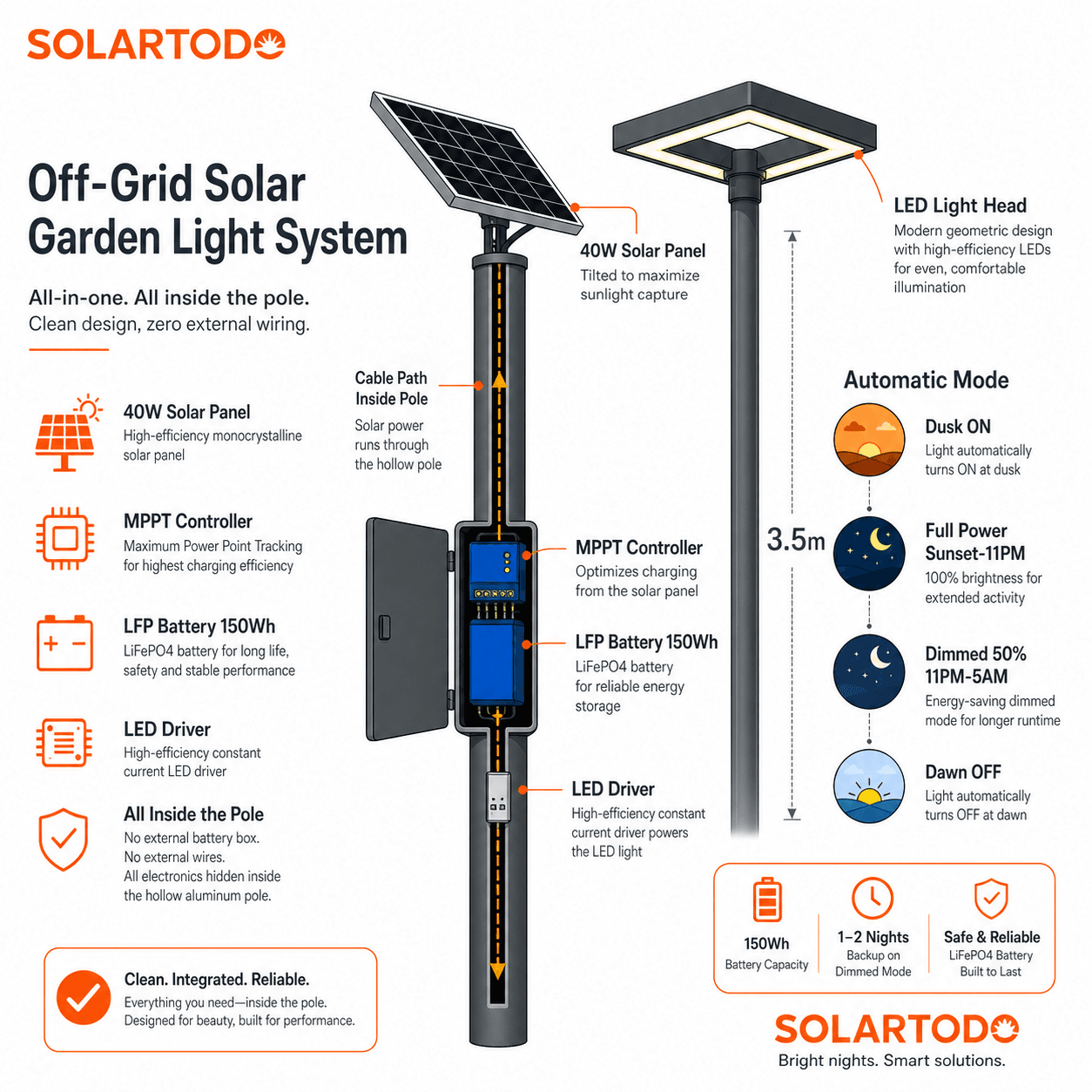
The 20W LED module is built around high-efficacy chipsets from supply classes such as Bridgelux, Cree, or Lumileds, with a practical target above 170 lm/W and a 50,000h design life under controlled thermal conditions. For park paths spaced at 10m to 18m intervals, the 3,400 lm output supports wayfinding, obstacle recognition, and improved perceived safety without the glare footprint of a 60W or 80W street fixture.
System Architecture
The 40Wp monocrystalline TOPCon panel uses 19% to 23% module-efficiency technology and a 25-year PV design life, which is consistent with NREL PV module performance modeling practice and IEC 61215 qualification logic. At 4.0 peak-sun-hours per day, a 40Wp module can generate about 160Wh/day before controller, temperature, soiling, and wiring losses, matching a 20W luminaire when smart dimming reduces the average nightly load below the 240Wh theoretical full-power maximum.
The 150Wh LiFePO4 battery is selected for more than 2,000 deep cycles and a safer iron-phosphate chemistry than cobalt-based packs in public-space installations. A 4-day autonomy target does not mean 20W continuous output for 96h; it means the MPPT controller applies time-based and PIR-based dimming so the stored energy can cover rainy-night operation at reduced average wattage.
The MPPT controller operates at greater than 98% peak conversion efficiency under stable irradiance and supports dusk-to-dawn automation, low-voltage disconnect, low-temperature charge protection, and programmable dimming profiles. For a typical 12h schedule, a 5-step curve such as 100% for 2h, 60% for 4h, 30% for 4h, and PIR-triggered 100% for 2h can cut energy use by up to 60% compared with fixed-output operation.
Lighting Performance and Standards
For procurement teams, this 3.5m garden light should be specified as an amenity and pathway luminaire rather than a high-speed roadway luminaire under EN 13201 or IES RP-8 design categories. A lighting designer can use 20W, 3,400 lm, 4000K, 3.5m pole height, and local pavement reflectance values to calculate average illuminance, uniformity ratio, and glare at the project spacing.
The product references IEC 62124 for PV standalone design verification, IEC 60598 for luminaire safety principles, IEC 61215 and IEC 61730 for PV module qualification and safety, and IEC 62133-style battery safety practices for rechargeable cells. IP66/IP67 enclosure targets protect the LED housing, controller bay, and cable entries against dust, rain, and temporary water exposure in public landscape corridors.
A conventional 20W grid-powered LED garden light can appear cheaper at fixture level, but it often requires trenching, conduit, copper cable, distribution protection, metering, and civil reinstatement across 100m to 1,000m of pathway. In many park projects, the solar version reduces underground electrical work by 70% to 95%, shortens installation from several days to 1 to 2 days per 20-light crew batch, and avoids night-time grid energy purchases.
Applications
This 3.5m 20W model is suitable for municipal parks, residential compounds, botanical gardens, hotel paths, university walkways, industrial greenbelts, waterfront promenades, and solar-farm access paths. For a 2km pedestrian loop using 14m average spacing, a developer would specify about 143 lights, creating roughly 486,200 lm of installed luminous flux without extending low-voltage feeders along the full route.
A solar farm operator in the MENA region deployed a comparable 3.5m, 20W class pathway system along 600m of inverter-station access lanes, using 43 luminaires at approximately 14m spacing. The project reduced civil cable trench length by about 600m, avoided 1 distribution cabinet, and kept lighting available during 2 grid-outage events because each lamp carried its own 150Wh battery reserve.
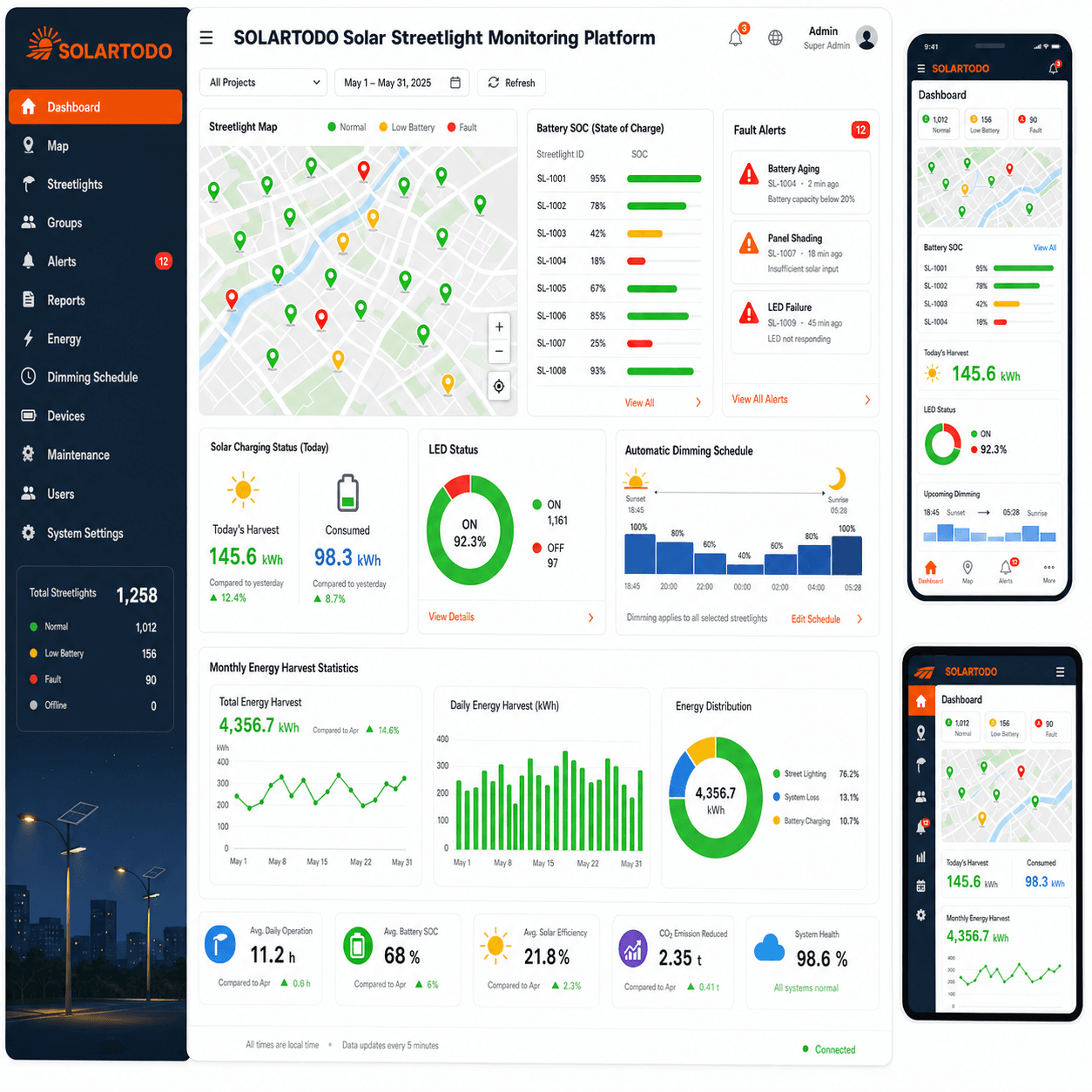
Cloud Monitoring
Optional 4G or LoRa monitoring allows a maintenance team to view battery voltage, charging current, LED load, fault codes, and operating hours for 50 to 5,000 lights from a web dashboard. The data model supports faster fault isolation than manual night patrols, and IEA digital-grid guidance consistently treats remote monitoring as a key enabler for distributed energy-asset reliability.
For larger parks and campus operators, fault alerts can reduce truck-roll time by 30% to 50% because technicians can identify a failed battery, controller, LED driver, or PV cable before dispatch. SOLARTODO can configure monitoring intervals such as 15 minutes, 30 minutes, or 60 minutes depending on project bandwidth, battery budget, and service-level requirements.
EPC Investment Analysis and Pricing Structure
EPC turnkey delivery includes 5 work packages: engineering, procurement, construction, commissioning, and warranty administration. For this 3.5m 20W garden-light variant, the EPC budget is $130 to $200 per unit, including site layout support, pole foundation work, installation, functional testing, and 1-year project support; detailed project pricing is available through Request a custom quotation.
| Pricing tier | Scope | Unit price, USD |
|---|---|---|
| FOB Supply | Equipment only, ex-works China | $81-$136 |
| CIF Delivered | Equipment plus ocean freight and insurance | $91-$153 |
| EPC Turnkey | Fully installed, commissioned, and 1-year warranty | $130-$200 |
| Order volume | Discount | Example EPC range after discount |
|---|---|---|
| 50+ units | 5% | $123.50-$190.00 |
| 100+ units | 10% | $117.00-$180.00 |
| 250+ units | 15% | $110.50-$170.00 |
ROI depends on trenching distance, grid tariff, and maintenance cost, but a 100-light park package at $160/unit EPC equals about $16,000 installed before volume discount. If a grid-connected alternative costs $120 per luminaire plus $70 per point for trenching, cable, protection, and reinstatement, the 100-point installed alternative reaches about $19,000, giving the solar option an immediate capex advantage of about $3,000 before electricity savings.
Annual energy savings are modest per point but material across a portfolio: 100 grid lights at 20W for 12h/day consume about 8,760kWh/year, and at $0.15/kWh the avoided electricity is about $1,314/year. With trenching avoided and grid energy eliminated, many temperate-climate projects achieve a simple payback of 2 to 4 years versus conventional wired landscape lighting, especially where civil works exceed 40% of the grid-light budget.
Payment terms are 30% T/T deposit plus 70% against B/L copy, or 100% irrevocable L/C at sight for qualified buyers. For infrastructure programs above $1,000K, SOLARTODO can coordinate staged deliveries, bank documentation, and financing discussions; EPC buyers can contact [email protected] or Configure your system online for a project-specific bill of quantities.
Procurement and Engineering Notes
Compared with all-in-one lamps, this separate-component architecture improves maintainability because the 40Wp panel, 150Wh battery, MPPT controller, and 20W LED head can be replaced independently. That modularity matters for public buyers planning 5-year to 10-year maintenance cycles, because a failed battery does not require scrapping the pole, luminaire shell, and PV module.
IRENA reports that renewable power cost reductions have made distributed solar increasingly practical for public infrastructure, while BloombergNEF battery-price tracking has shown long-term declines in lithium-ion system costs over more than 10 years. These trends support smaller off-grid assets such as 20W solar garden lights where the main economic benefit is avoided cabling, civil work, and grid dependency rather than energy arbitrage.
For specification writing, engineers should define 3.5m pole height, 120km/h wind basis, 150Wh LFP battery capacity, 40Wp PV rating, IP66/IP67 enclosure target, 4000K CCT, and 12h dusk-to-dawn operation in the tender schedule. Procurement teams comparing multiple suppliers should request photometric files, battery cycle documentation, controller settings, pole drawings, and warranty exclusions for at least 3 bidders.
SOLARTODO supplies solar lighting, energy storage, smart security, telecom power towers, and smart agriculture infrastructure from one B2B platform, which simplifies multi-package procurement for mixed sites with 20W pathways, 60W access roads, and monitored perimeter assets. Buyers can review related engineering guidance at Learn about topic and align lighting packages with wider solar, battery, and smart-infrastructure design standards.
Quality Control and Lifecycle
Factory QC covers at least 6 checkpoints: PV flash testing, LED photometric sampling, controller programming, battery capacity verification, pole coating inspection, and final 12h functional burn-in sampling. For a 250-unit order, SOLARTODO can add AQL inspection, random carton drop checks, serial-number records, and pre-shipment photo documentation to improve traceability.
Lifecycle planning should assume periodic lens cleaning every 6 to 12 months, battery health review after 3 to 5 years, and fastener inspection after major storms above 80km/h. With a 25-year PV module design life, 50,000h LED target life, and 2,000+ LFP deep-cycle rating, the main replacement item is usually the battery pack rather than the panel or pole.
Technical Specifications
| Pole Height | 3.5m |
| LED Power | 20W |
| Luminous Flux | 3400lm |
| Solar Panel | 40Wp |
| Battery Capacity | 150Wh LiFePO4 |
| Autonomy | 4rainy days |
| Pole Material | Aluminum alloy |
| Wind Resistance | 120km/h |
| Operating Temperature | -20 to +50°C |
| Lighting Hours | 12h/day |
| Color Temperature | 4000K |
| Warranty | 3 years system, 5 years pole |
Price Breakdown
| Item | Quantity | Unit Price | Subtotal |
|---|---|---|---|
| 40Wp TOPCon Solar Panel | 1 pcs | $4 | $4 |
| 150Wh LiFePO4 Battery Pack with BMS | 1 pcs | $15 | $15 |
| 20W LED Garden Luminaire Module | 1 pcs | $9 | $9 |
| MPPT Solar Charge Controller for 40Wp Panel | 1 pcs | $12 | $12 |
| 3.5m Aluminum Alloy Pole | 1 pcs | $77 | $77 |
| Cable Harness, Fasteners, and Mounting Accessories | 1 pcs | $5 | $5 |
| Concrete Foundation and Anchor Set | 1 pcs | $20 | $20 |
| Installation and Commissioning | 1 pcs | $20 | $20 |
| 1-Year Warranty and Support | 1 pcs | $6 | $6 |
| Engineering, QC, and Documentation | 1 pcs | $12 | $12 |
| Total Price Range | $130 - $200 | ||
Frequently Asked Questions
What is included in the $130-$200 EPC turnkey price?
How long can the 150Wh battery support lighting during rainy weather?
Is 20W enough for a public park pathway?
Which standards are relevant for this solar garden light?
Can the lights be monitored remotely?
Certifications & Standards



Data Sources & References
- •IEC 62124 Photovoltaic standalone systems design verification
- •IEC 60598 Luminaires safety standard
- •NREL PVWatts and PV performance modeling references
- •IRENA Renewable Power Generation Costs 2024
- •IEA renewables and distributed energy reliability guidance
- •BloombergNEF lithium-ion battery price survey references
- •IEEE and IES outdoor lighting engineering references
Interested in this solution?
Contact us for a customized quote based on your specific requirements.
Contact Us