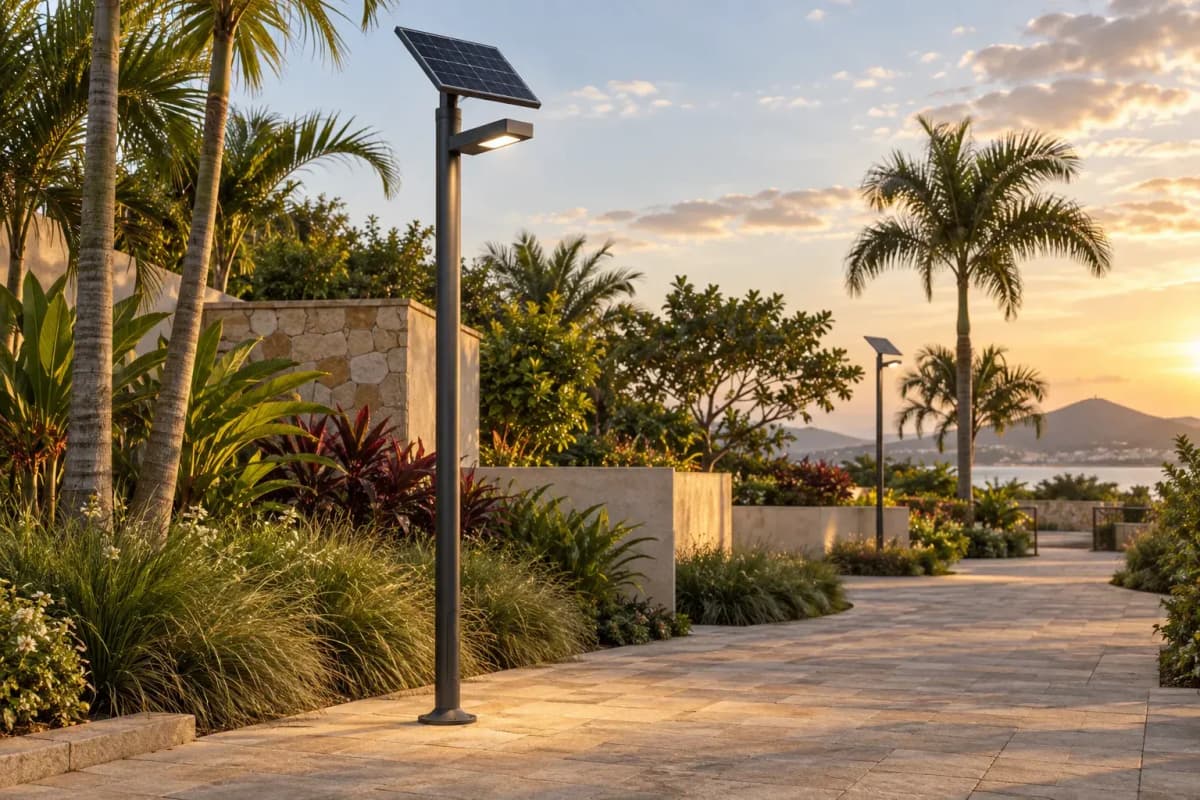
2.9m Garden Light 18W - 4-Day LFP Solar Pathway Light
Key Features
- 18W LED engine delivers an estimated 3,060lm at >170lm/W chip efficacy.
- 40Wp monocrystalline TOPCon panel supports 12h dusk-to-dawn garden lighting.
- 144Wh LiFePO4 battery provides 4 rainy-day autonomy in subtropical climates.
- 2.9m cast-aluminum pole is rated to a 120km/h wind design reference.
- EPC turnkey pricing is $72-$120 per unit with 5-15% volume discounts.
The 2.9m Garden Light 18W is a subtropical solar garden and pathway lighting system with a 40Wp TOPCon panel, 144Wh LiFePO4 battery, 3,060lm LED output, and 4 rainy-day autonomy. SOLARTODO prices the EPC turnkey package at $72-$120 per unit for compact parks, campuses, resorts, residential compounds, and smart-city pedestrian zones.
Description
The 2.9m Garden Light 18W is a compact solar garden lighting system using an 18W high-efficacy LED engine, a 40Wp monocrystalline TOPCon photovoltaic module, and a 144Wh LiFePO4 battery sized for 4 rainy days in subtropical climates. At an estimated 3,060lm output based on >170lm/W LED chips, the system is designed for pedestrian paths, landscaped entrances, courtyards, parks, residential compounds, and low-speed public areas where a 2.9m cast-aluminum pole provides human-scale lighting without trenching grid cables.
SOLARTODO positions this model inside the View all Solar Street Light products category as a standard solar streetlight architecture with separated PV, battery, controller, LED, and pole elements. For buyers comparing multiple wattages, the 18W/40Wp/144Wh configuration is best understood as a small-area luminaire with a typical 12h dusk-to-dawn operating profile, not as a 6m highway-class lantern or a 10m arterial-road light.
Technical Specifications
| Parameter | Value |
|---|---|
| Pole height | 2.9m |
| LED power | 18W |
| Estimated luminous flux | 3,060lm |
| Solar panel | 40Wp monocrystalline TOPCon |
| Battery capacity | 144Wh LiFePO4 |
| Autonomy | 4 rainy days |
| Pole material | Cast aluminum |
| Wind resistance | 120km/h design reference |
| Operating temperature | -20°C to +55°C |
| Lighting schedule | 12h/day dusk-to-dawn |
| Warranty | 3 years system, 5 years pole |
The 40Wp panel is sized for a subtropical duty cycle where useful solar resources commonly exceed 3.5-5.0 peak sun hours during many months, while the 144Wh LFP battery provides a conservative energy buffer for the 18W LED load under dimming profiles. NREL PVWatts notes that photovoltaic performance estimates depend on site assumptions and irradiance inputs, so SOLARTODO treats the 40Wp/144Wh design as an engineering baseline to be checked against local shading, tilt, dust, and rainy-season data before final procurement.
System Architecture
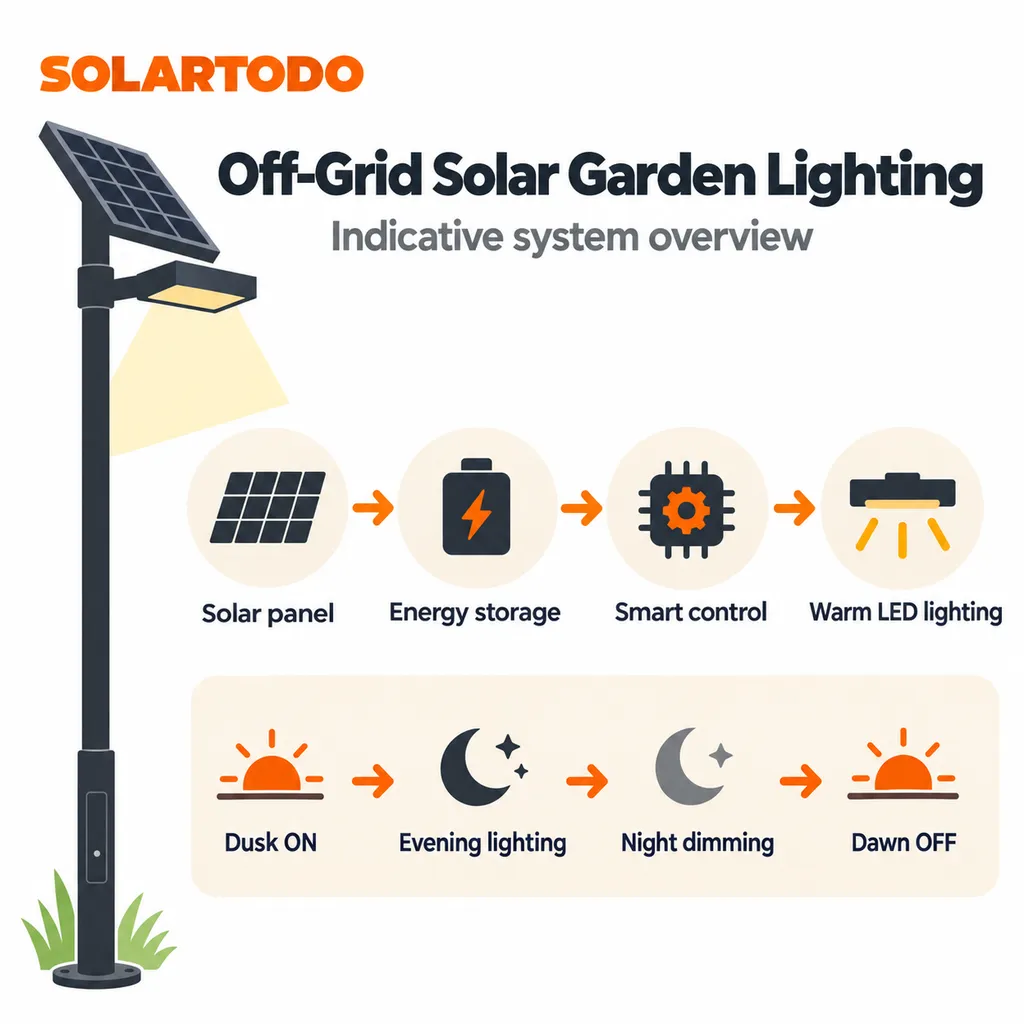
The system uses 5 primary hardware groups: the 40Wp TOPCon PV module, the 144Wh LiFePO4 battery pack, the MPPT charge controller, the 18W LED luminaire, and the 2.9m cast-aluminum pole assembly. This separated architecture improves serviceability because the battery, controller, panel, and LED module can be inspected as distinct components rather than sealed inside a single all-in-one housing.
The TOPCon panel is specified at 19-23% module efficiency and an expected 25-year PV service life, subject to IEC 61215 and IEC 61730 style qualification practices for crystalline silicon modules. IRENA reported a 2024 global weighted-average solar PV LCOE of about $0.043/kWh and total installed utility PV costs near $691/kW, which supports the continued cost competitiveness of small off-grid PV lighting where grid extension or cable trenching is expensive.
The LiFePO4 battery is selected for 2,000+ deep-cycle operation, improved thermal stability compared with many cobalt-bearing lithium chemistries, and a BMS that supports over-charge, over-discharge, short-circuit, and low-temperature protection. For subtropical operation at up to +55°C ambient design reference, battery enclosure placement and heat dissipation are important because a 10°C temperature increase can materially shorten lithium battery service life if the pack is poorly ventilated.
The MPPT controller operates at >98% tracking efficiency under suitable irradiance and manages dusk-to-dawn switching, 4-stage time dimming, and optional PIR motion response. A representative schedule can run at 100% output for the first 3h after sunset, 40-60% output for 6h during low traffic, and 80-100% output for 3h before dawn, reducing nightly battery draw by approximately 35-60% compared with a fixed 18W all-night load.
Lighting Performance and Design Use
At 3,060lm, the 18W luminaire is appropriate for garden paths, internal campus walkways, villa roads, perimeter pedestrian corridors, and low-speed landscaped zones where uniformity and glare control matter more than roadway-class pole spacing. The LED package uses Bridgelux, Cree, or Lumileds class chips with >170lm/W chip efficacy and a nominal 50,000h+ life, equal to more than 11 years at 12h/night before lumen-maintenance criteria become the main replacement driver.
For lighting design, the 2.9m mounting height should normally be paired with short spacing, controlled optics, and warm-to-neutral CCT options rather than excessive wattage. A typical layout may use 8-15m spacing depending on path width, target illuminance, mounting offset, vegetation, pavement reflectance, and national pedestrian-lighting requirements, while final photometric compliance should be checked using IES files and local road or park lighting standards.
Compared with a conventional 18W grid-connected LED garden light, this solar unit can reduce trenching, copper cable, conduit, breaker, and metering work by 60-90% in greenfield landscaped areas, depending on civil conditions. The tradeoff is that each solar light carries its own 40Wp generator and 144Wh battery, so design quality depends on shade analysis, panel orientation, battery temperature, and maintenance access rather than only on AC circuit availability.
Standards, Compliance, and Quality Control
SOLARTODO references IEC 62124 for standalone photovoltaic system design verification, IEC 60598-1 for luminaire safety requirements up to 1,000V, IEC 60529 for IP enclosure ratings, and IEC 61215/IEC 61730 for PV module qualification. These standards do not replace local electrical codes, but they give procurement teams a structured checklist for PV performance, luminaire construction, ingress protection, insulation, marking, and mechanical testing.
For outdoor deployment, the luminaire housing is specified to IP66 or IP67 depending on final enclosure selection, which means protection against dust ingress and high-pressure water jets or temporary immersion under defined IEC 60529 test conditions. In subtropical climates with annual rainfall often above 1,000mm, sealing quality, cable glands, breathable vents, and corrosion-resistant fasteners become procurement-critical details rather than secondary accessories.
The cast-aluminum pole is chosen for a small 2.9m garden-light form factor where visual finish, low weight, and corrosion resistance are valued. Aluminum alloy pricing is typically about 30% higher than galvanized steel on a per-meter basis, but the material can reduce handling weight and improve aesthetics in hotels, parks, residential courtyards, and municipal streetscape programs with 50-250 repeated units.
Cloud Monitoring
The base 18W garden light can operate as an autonomous dusk-to-dawn system, while optional 4G or LoRa monitoring adds remote fault alerts, dimming changes, battery status, and operation logs. In a 100-light site, monitoring can reduce manual night patrols by more than 50 visits per year if maintenance teams otherwise inspect each zone weekly, although actual savings depend on labor rates and municipal service-level agreements.
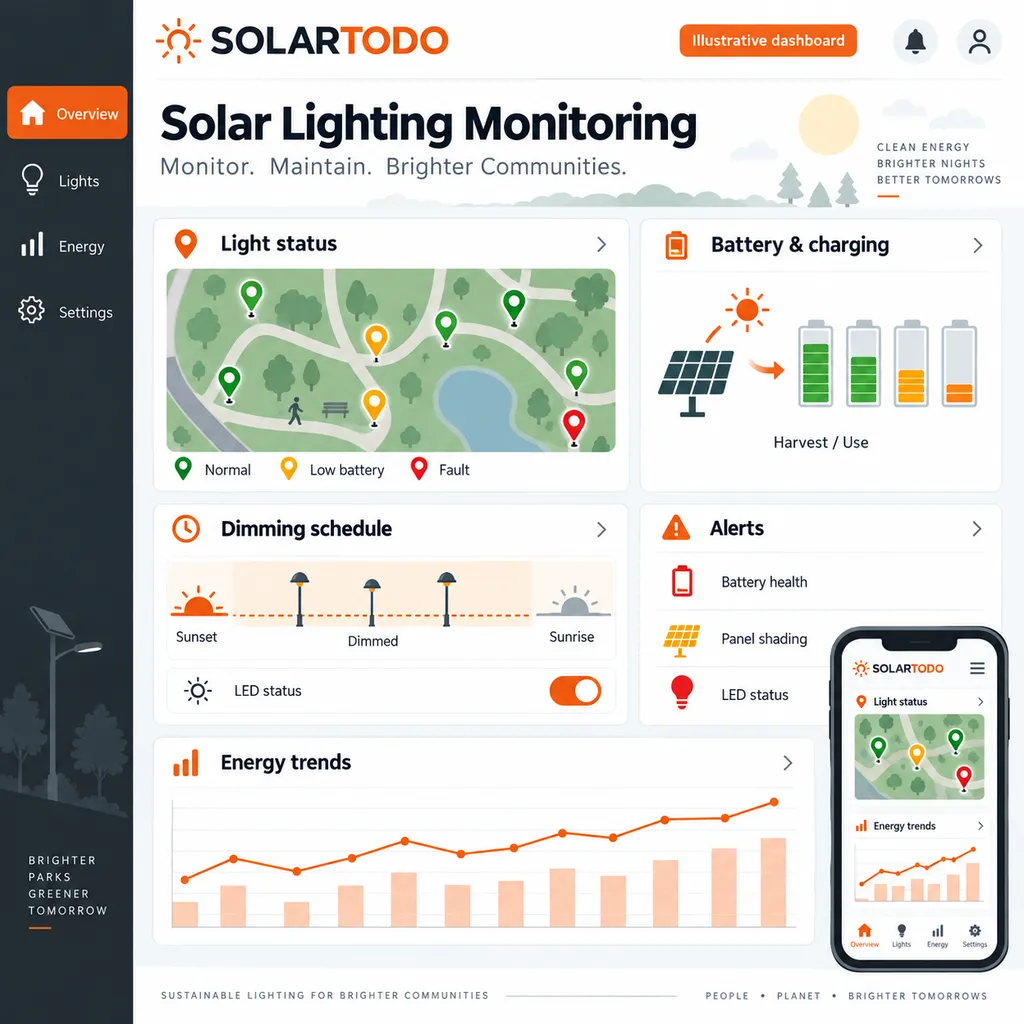
Cloud-connected lighting is most useful when the project has at least 50 nodes, dispersed assets, or a contractual uptime requirement above 95%. The controller can report low battery voltage, abnormal charging current, luminaire failure, door-open alarms if fitted, and operating-hour history, giving EPC teams a data trail for the 1-year commissioning warranty and the 3-year system warranty.
Representative Scenario
For a representative subtropical resort pathway scenario with 100 units, each 2.9m light is installed at 10m average spacing along approximately 1km of pedestrian circulation. The total LED connected load is only 1.8kW, and a motion-adaptive profile that averages 9W for 12h uses about 10.8kWh/night across the full site, supplied by distributed 40Wp panels and buffered by 14.4kWh of aggregate LFP battery capacity.
In the same 100-unit scenario, grid-connected alternatives may require 1,000m of trenching, AC cabling, junction boxes, protection devices, and reinstatement of hardscape or planting areas. If civil trenching and electrical distribution average $12-$25/m in a landscaped site, avoided buried infrastructure can offset $12,000-$25,000 of project cost, which is often larger than the premium of solar lighting hardware for low-power garden applications.
EPC Investment Analysis and Pricing Structure
SOLARTODO’s EPC turnkey scope includes 5 work packages: engineering, procurement, construction, commissioning, and a 1-year service warranty. Engineering covers lighting layout assumptions, PV/battery sizing, wiring diagrams, foundation or anchor checks, and bill of materials; procurement covers panel, battery, controller, luminaire, pole, fasteners, and packaging; construction covers assembly and site installation; commissioning covers dusk sensor tests, battery voltage checks, dimming profiles, and handover records.
| Pricing tier | Scope | Unit price |
|---|---|---|
| FOB Supply | Equipment only, ex-works China | $45-$82 |
| CIF Delivered | Equipment plus ocean freight and insurance | $51-$92 |
| EPC Turnkey | Installed, commissioned, and 1-year warranty | $72-$120 |
| Volume band | Discount | Example use |
|---|---|---|
| 50+ units | 5% | Small park, villa road, or campus path |
| 100+ units | 10% | Resort, residential compound, or municipal garden |
| 250+ units | 15% | Citywide pedestrian-lighting or multi-site rollout |
For ROI, assume 100 units replace grid-connected 18W garden lights operating 12h/night at $0.14/kWh and requiring $12,000 of trenching and distribution works. Direct energy savings are about 7,884kWh/year, equal to roughly $1,104/year, while avoided trenching can shorten simple payback to 1-3 years on greenfield projects; without trenching avoidance, payback is longer and depends mainly on tariff, maintenance labor, and financing cost.
Against solar alternatives, this 18W model costs less than 30W-60W streetlight packages because it uses a smaller 40Wp panel, 144Wh LFP battery, 2.9m pole, and compact LED engine. IEA reported solar PV supplied more than 600TWh of additional generation in 2025 and reached over 8% of global electricity generation, showing why distributed PV has become a mainstream design element even for small off-grid lighting loads.
Payment terms are normally 30% T/T deposit + 70% against B/L copy, or 100% L/C at sight for approved bank instruments. For infrastructure programs above $1,000K, SOLARTODO can discuss staged delivery, EPC milestone billing, and financing coordination; project owners can Request a custom quotation or contact [email protected] with site coordinates, unit quantity, road width, and target lighting level.
Procurement Notes for Engineers and Buyers
Before purchase, engineers should verify 6 inputs: nightly operating hours, average peak sun hours, shading percentage, rainy-season autonomy target, pole foundation method, and required CCT/CRI. The Configure your system online tool can help compare 18W, 30W, 60W, and higher-output solar streetlight configurations before a formal bill of materials is frozen.
Procurement teams should also specify spare battery packs, spare controllers, surge protection strategy, marine-coating needs, and carton-level labeling for projects above 250 units. For reference education on PV sizing, battery autonomy, and municipal lighting concepts, buyers can Learn about topic and then align the 2.9m garden-light design with local electrical, safety, and public-works requirements.
Maintenance and Lifecycle
Routine maintenance is simple but measurable: clean the 40Wp panel every 2-6 months depending on dust and pollen, inspect fasteners after major storms, check battery voltage during annual service, and review dimming logs where monitoring is enabled. A 50,000h LED life corresponds to about 4,167 nights at 12h/night, while the LFP battery is normally the first major consumable to plan for after several years of deep-cycle operation.
Lifecycle value depends on matching autonomy to climate instead of oversizing every component. In a subtropical site with recurring cloudy weather, 4-day autonomy is a practical compromise between a small aesthetic form factor and dependable operation; increasing autonomy from 4 days to 6 days would require roughly 50% more usable battery energy, increasing cost, weight, and enclosure size for a garden-scale fixture.
Applications
The 2.9m Garden Light 18W is best suited for 5 application groups: garden paths, resort walkways, residential compounds, school campuses, and municipal greenways. It is not intended to replace 6m-12m streetlights on arterial roads, but it can complement higher poles by covering pedestrian edges, park loops, plazas, parking islands, and low-speed internal circulation where a lower mounting height improves visual comfort.
For B2B buyers, the key purchasing decision is not only wattage but installed performance per meter of illuminated path. A 100-unit project using 10m spacing covers about 1,000m of walkway, while a 250-unit project covers about 2,500m under the same assumption; those simple planning numbers help procurement teams estimate budget, logistics volume, and installation sequencing before site-specific photometric design begins.
Technical Specifications
| Pole Height | 2.9m |
| LED Power | 18W |
| Luminous Flux | 3060lm |
| Solar Panel | 40Wp |
| Battery Capacity | 144Wh |
| Battery Type | LiFePO4 |
| Autonomy | 4rainy days |
| Pole Material | Cast aluminum |
| Wind Resistance | 120km/h |
| Operating Temperature | -20 to +55°C |
| Lighting Hours | 12h/day |
| Warranty | 3 years system, 5 years pole |
Price Breakdown
| Item | Quantity | Unit Price | Subtotal |
|---|---|---|---|
| 40Wp TOPCon Solar Panel (installed) | 1 pcs | $4 | $4 |
| 144Wh LiFePO4 Battery Pack with BMS (installed) | 1 pcs | $14 | $14 |
| 18W High-Efficiency LED Module (installed) | 1 pcs | $8 | $8 |
| 40W MPPT Solar Charge Controller (installed) | 1 pcs | $12 | $12 |
| 2.9m Cast-Aluminum Pole Assembly (installed) | 1 pcs | $64 | $64 |
| Installation and Commissioning | 1 pcs | $8 | $8 |
| Engineering, QA, and Documentation | 1 pcs | $4 | $4 |
| 1-Year Warranty and Support | 1 pcs | $6 | $6 |
| Total Price Range | $72 - $120 | ||
Frequently Asked Questions
What is included in the EPC turnkey price of $72-$120 per unit?
How long can the 144Wh battery operate during cloudy weather?
Is an 18W solar garden light bright enough for public pathways?
Which standards apply to this solar streetlight configuration?
Can the 2.9m Garden Light 18W support cloud monitoring?
Certifications & Standards



Data Sources & References
- •NREL PVWatts Calculator, photovoltaic performance modeling: https://pvwatts.nrel.gov
- •IRENA Renewable Power Generation Costs in 2024, July 2025: https://www.irena.org/Publications/2025/Jun/Renewable-Power-Generation-Costs-in-2024
- •IEA Global Energy Review 2026, Solar PV and wind: https://www.iea.org/reports/global-energy-review-2026/technology-solar-pv-and-wind
- •IEA Renewables 2025, renewable electricity forecast: https://www.iea.org/reports/renewables-2025/renewable-electricity
- •IEC 60598-1:2020 luminaires general requirements and tests: https://webstore.iec.ch/en/publication/61414
- •IEC 62124 photovoltaic standalone systems design verification reference: https://webstore.iec.ch
Interested in this solution?
Contact us for a customized quote based on your specific requirements.
Contact Us