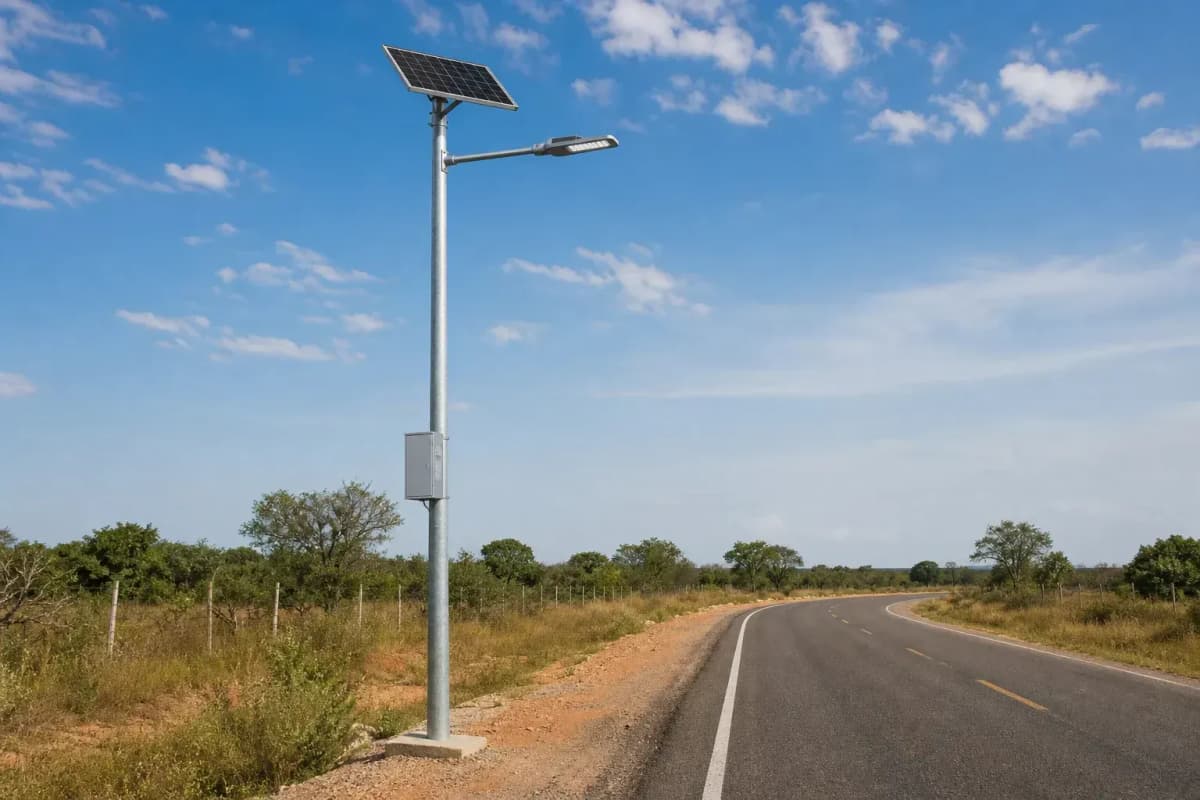
9.7m Split Solar Streetlight 88W - 8-Day Autonomy
Key Features
- 9.7m hot-dip galvanized steel pole for 8m-10m road-lighting layouts
- 88W LED luminaire delivers about 14,960lm at >170lm/W efficacy
- 176Wp monocrystalline TOPCon panel sized at 2.0W PV per 1W LED
- 792Wh LiFePO4 battery supports up to 8 rainy days with smart dimming
- EPC turnkey price range is $511-$972 per installed pole
The 9.7m Split Solar Streetlight 88W combines an 88W high-efficacy LED head, 176Wp monocrystalline TOPCon module, and 792Wh LiFePO4 battery for temperate-climate roads requiring 8 rainy days of autonomy. SOLARTODO supplies the system as FOB equipment, CIF delivery, or EPC turnkey installation from $511 to $972 per pole.
Description
The 9.7m Split Solar Streetlight 88W is a separated solar lighting system with a 9.7m hot-dip galvanized steel pole, 88W LED luminaire, 176Wp monocrystalline TOPCon solar panel, and 792Wh LiFePO4 battery. It is engineered for temperate road, parking, perimeter, and infrastructure corridors that need 12h dusk-to-dawn lighting and up to 8 rainy days of autonomy under controlled dimming.
This split design places the PV module on an adjustable top or side arm and locates the 792Wh LFP battery inside the pole base or a separate lockable box, improving service access compared with compact all-in-one fixtures. For procurement teams comparing 50, 100, or 250 pole packages, SOLARTODO provides FOB Supply, CIF Delivered, and EPC Turnkey pricing with transparent component and installation assumptions.
Product Positioning and Buyer Fit
The 9.7m height class is typically selected for 2-lane internal roads, logistics yards, campus roads, industrial perimeters, bus bays, and solar farm access roads where mounting heights between 8m and 10m balance illuminance uniformity and pole cost. The 88W LED package can produce approximately 14,960lm at 170lm/W, giving engineers a practical midpoint between 60W economy poles and 120W heavy-duty highway-style poles.
For B2B buyers, the product is designed as a repeatable infrastructure item rather than a decorative fixture, with 1 pole, 1 luminaire, 1 panel, 1 battery pack, 1 MPPT controller, and 1 foundation forming the standard bill of materials. Project developers can review related categories through View all Solar Street Light products or model site-specific options through Configure your system online.
System Architecture
The system architecture uses 4 primary electrical blocks: PV generation, MPPT charging, LFP storage, and LED load control. The 176Wp module charges the 792Wh battery through a high-efficiency MPPT controller rated above 98%, while the LED driver applies time-based or PIR-assisted dimming to keep nightly energy consumption within the 8-day autonomy target.
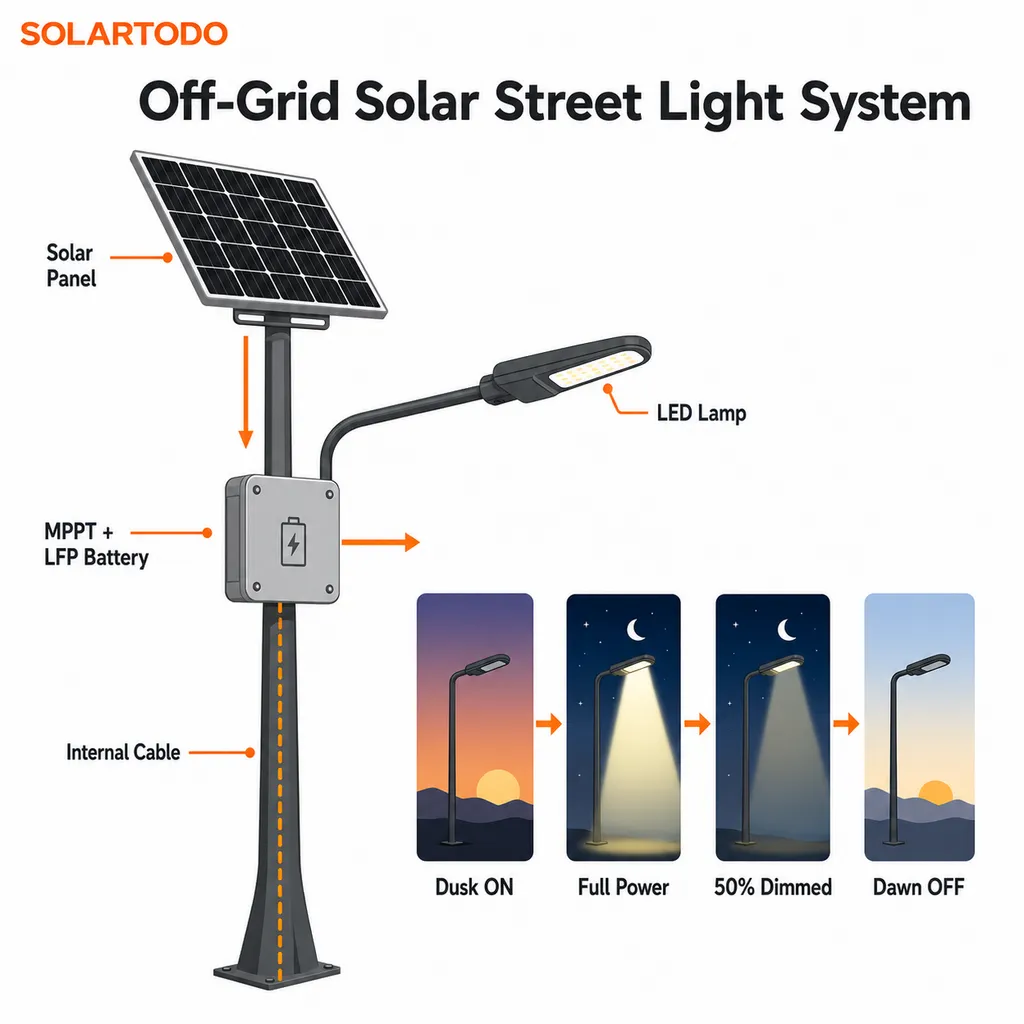
A split solar streetlight differs from an all-in-one design in at least 3 practical ways: the panel angle can be adjusted by latitude, the battery can be sized beyond the fixture housing, and maintenance teams can replace 1 component without removing the entire luminaire. These details matter on 100-pole projects because service time, spare-part isolation, and angle optimization directly affect lifetime operating cost.
The 176Wp panel is sized at 2.0W of PV for every 1W of LED nameplate power, a conservative ratio for temperate climates with seasonal irradiance changes. NREL PVWatts guidance emphasizes location, tilt, azimuth, and system losses as major inputs for PV yield modeling, so SOLARTODO treats 176Wp as a baseline that can be adjusted after project coordinates and shading are reviewed.
Technical Specifications
The luminaire uses Bridgelux, Cree, Lumileds, or equivalent high-efficacy LED chips with a design efficacy above 170lm/W and an expected LED service life above 50,000h. At 12h per night, 50,000h corresponds to roughly 11.4 years of lighting operation before lumen depreciation becomes a major replacement-planning variable.
The battery pack uses LiFePO4 chemistry with 792Wh nominal energy and a BMS covering overcharge, over-discharge, short-circuit, and low-temperature protection. BloombergNEF's 2025 battery market reporting continues to show LFP as a cost-stable chemistry for stationary and mobility applications, and the 2,000+ deep-cycle design target supports long-life public lighting projects.
The pole is hot-dip galvanized steel selected for 9.7m mounting height and a nominal 150km/h wind-resistance design basis, subject to local structural code confirmation. Galvanized steel is the standard choice for inland temperate projects, while aluminum alloy or FRP alternatives can be specified where 1 coastal site has higher corrosion exposure or stricter weight limits.
The operating temperature range is specified from -20 C to +55 C, covering most temperate municipal and industrial sites. In regions below -20 C for more than 30 nights per year, SOLARTODO recommends reviewing battery insulation, charging cut-off settings, and optional low-temperature heating before procurement approval.
Standards and Compliance Framework
Standalone PV lighting systems are commonly evaluated against IEC 62124 for photovoltaic standalone system design verification, while luminaires are aligned with IEC 60598 safety principles and ingress protection targets such as IP66 or IP67. The PV module specification can reference IEC 61215 and IEC 61730, and LED driver safety can be mapped to UL 8750 where a North American buyer requests UL-oriented documentation.
For grid-independent lighting, IEEE 1547 is generally less central than IEC standalone PV standards because this 88W product is not intended as a grid-interactive distributed generator. However, procurement specifications for 1 industrial campus may still cite IEEE documentation for broader electrical interconnection practices when hybrid AC backup or smart microgrid integration is added.
IEA analysis on electricity security and clean energy deployment highlights the strategic value of distributed energy systems that reduce dependence on centralized power infrastructure. For a 100-pole streetlight package, each pole functions as 1 independent energy node, which can reduce blackout exposure compared with a conventional grid-only lighting circuit.
Lighting Performance and Control Logic
The standard lighting profile is 12h per night, usually defined as dusk-to-dawn operation with 100%, 60%, and 30% timed dimming windows. A representative schedule might run 4h at 100%, 4h at 60%, and 4h at 30%, reducing delivered nightly energy by approximately 37% compared with a flat 88W output for all 12h.
Motion-adaptive dimming can add a further energy reduction of up to 60% in low-traffic areas, depending on detection frequency and safety policy. This means the 792Wh battery is not sized only by LED nameplate power; it is sized by controlled watt-hours, battery depth-of-discharge limits, and 8-day rainy-period resilience.
Compared with a conventional 88W grid-powered LED streetlight on a trench-fed circuit, this split solar system can reduce grid electricity use by nearly 100% at the pole and avoid cabling trenches over long distances. On a 1km access road with 30 poles, avoided trenching can become more important than the LED energy bill in the first 12 months of construction.
Representative Temperate-Climate Scenario
Representative scenario: for a 100-pole logistics park in a temperate region at approximately 35 degrees latitude, a 9.7m pole spacing plan may use 30m to 35m intervals depending on road width, fixture optics, and target illuminance. With 100 units, the installed PV capacity is 17.6kWp and total battery storage is 79.2kWh, giving the owner a distributed lighting asset rather than a single vulnerable feeder.
If each 88W light previously operated from the grid for 12h per night, annual electricity use would be about 385kWh per pole before controls, or 38,500kWh for 100 poles. At $0.16/kWh, the annual electricity value is about $6,160 before demand charges, cable losses, maintenance truck rolls, or trench repair costs are considered.
The 88W split solar alternative does not eliminate every operating cost because cleaning, inspection, battery testing, and controller diagnostics still require scheduled maintenance. It does remove the normal 220V or 110V feeder dependency at each pole, and it simplifies phased expansion when an industrial site adds 20, 50, or 100 lighting points after the first phase.
Applications
Common applications include 2-lane industrial roads, solar farm internal roads, warehouse yards, parking areas, residential compounds, perimeter roads, military-style temporary infrastructure, and telecom or power-tower access routes. The 9.7m height is especially useful where 6m lights underperform on spacing but 12m poles add unnecessary wind load, foundation volume, and freight cost.
For solar farms and utility sites, off-grid lighting can support nighttime inspection routes without extending low-voltage distribution to every service road. For municipalities, the same 88W configuration can be specified for road upgrades where trenching across 1 existing pavement section would cause traffic disruption, reinstatement cost, and permitting delays.
For engineering guidance across batteries, PV sizing, and lighting layouts, buyers can Learn about topic before releasing a tender package. When the route geometry, pole spacing, required lux level, and local wind code are available, SOLARTODO can convert the preliminary 9.7m 88W configuration into a project bill of quantities through Request a custom quotation.
Cloud Monitoring
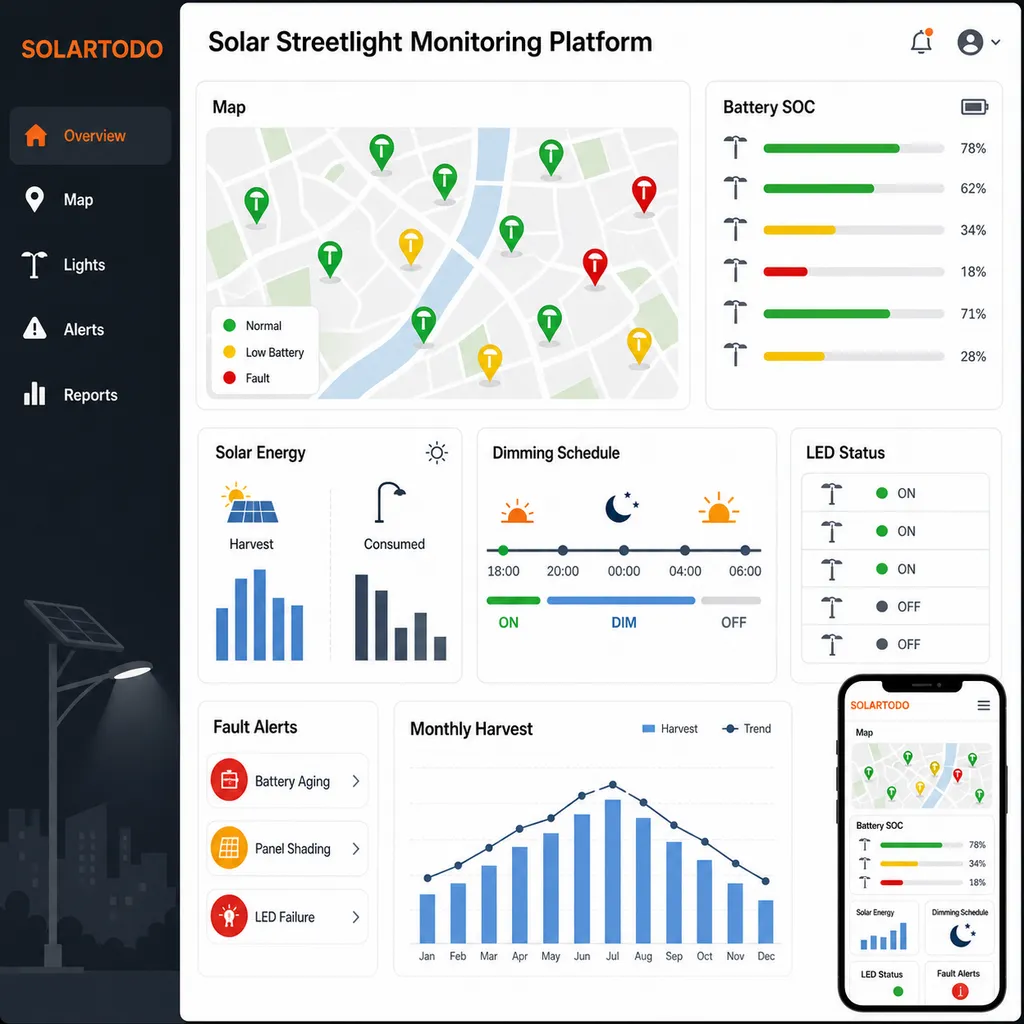
Optional 4G or LoRa monitoring connects each pole to a cloud platform with device status, battery voltage, PV charge current, lighting schedule, fault alerts, and location-level maintenance records. A 100-pole deployment can therefore be managed by exception, with field teams visiting the 3 or 5 poles that report faults instead of inspecting every pole on a fixed route.
The controller can support dusk-to-dawn automation, time-based dimming, PIR-triggered brightness recovery, and remote parameter adjustment. For buyers with security requirements, a 4G camera module can be added as 1 separate load, but camera power draw must be included in PV and battery calculations rather than assumed inside the 88W lighting budget.
EPC Investment Analysis and Pricing Structure
EPC Turnkey delivery includes 5 cost categories: engineering, procurement, construction, commissioning, and 1-year warranty support. Engineering covers photometric assumptions, wind and foundation review, cable-free power sizing, and drawing coordination; procurement covers the pole, luminaire, panel, battery, controller, brackets, fasteners, and packaging; construction covers foundation, erection, alignment, and electrical commissioning.
| Pricing tier | Scope | Unit price, USD |
|---|---|---|
| FOB Supply | Equipment only, ex-works China | $317-$661 |
| CIF Delivered | Equipment plus ocean freight and insurance | $356-$743 |
| EPC Turnkey | Installed, commissioned, and 1-year warranty | $511-$972 |
| Order volume | Discount from base EPC or supply quote | Typical use case |
|---|---|---|
| 50+ units | 5% | Small municipal road or campus phase |
| 100+ units | 10% | Logistics park, solar farm, or distributor stock |
| 250+ units | 15% | Framework order or multi-site rollout |
A practical ROI model compares the EPC range of $511 to $972 per pole with avoided trenching, grid connection, switchgear, cabling, electricity, and maintenance disruption. If grid trenching and wiring add $450 per pole and electricity adds $61.60 per pole per year at $0.16/kWh, payback can fall into the 4-year to 8-year range depending on civil costs, pole spacing, battery replacement policy, and local labor.
For a 100-pole project, EPC investment ranges from $51,100 to $97,200 before volume discounts and site-specific civil changes. A 10% discount at 100+ units can reduce the effective range to about $45,990 to $87,480, while 250+ units may qualify for a 15% framework discount after freight, steel, and battery quotations are locked.
Standard payment terms are 30% T/T deposit plus 70% against bill of lading, or 100% irrevocable L/C at sight for approved trade finance cases. Project financing can be reviewed for orders above $1,000K, and commercial questions can be sent to [email protected] with the required quantity, destination port, road length, and installation country.
Procurement Notes
The 2025 component basis uses about $0.10/W for monocrystalline TOPCon panel supply, about $0.10/Wh for LFP battery cells, about $0.45/W for split LED modules, about $0.30/W-panel for MPPT control, and about $80 for a 10m galvanized pole reference. These inputs explain why transparent EPC line items are better than a single inflated hardware price.
IRENA renewable cost reports repeatedly show that solar PV economics are driven by module price, installation cost, financing, and local resource quality rather than 1 headline wattage number. For this 176Wp product, the strongest cost variables are steel pole specification, foundation size, battery capacity, freight volume, and installation labor in the target country.
Quality Control and Warranty
Factory quality control normally includes 7 checks: LED burn-in, battery capacity sampling, BMS protection test, controller charge test, panel visual inspection, pole coating inspection, and packaging verification. For EPC projects, commissioning adds pole verticality, lighting function, controller settings, dusk sensor response, and battery voltage records for each installed unit.
The standard warranty structure is 3 years for the system and 5 years for the galvanized steel pole, with a 1-year EPC workmanship and support allowance included in turnkey pricing. Warranty terms exclude abnormal impact, unauthorized modification, flooding beyond rated enclosure design, and site conditions exceeding the agreed 150km/h wind basis.
Specification Customization
SOLARTODO can adapt the 88W platform to different optics, color temperatures, communication modes, battery reserve margins, and pole finishes. A buyer may request 3000K for residential comfort, 4000K for road balance, or 5000K for industrial visibility, while the same 176Wp and 792Wh baseline can be resized after a project-specific lighting simulation.
Before final procurement, engineers should confirm 5 site inputs: latitude, shading, road width, pole spacing, and required illuminance class. After these 5 values are known, the 9.7m split solar streetlight can be quoted as a supply-only item, a CIF shipment, or a fully commissioned EPC package with documented assumptions.
Technical Specifications
| Pole Height | 9.7m |
| LED Power | 88W |
| Luminous Flux | 14960lm |
| Solar Panel | 176Wp |
| Battery Capacity | 792Wh |
| Battery Type | LiFePO4 (LFP) |
| Autonomy | 8rainy days |
| Pole Material | Hot-dip galvanized steel |
| Wind Resistance | 150km/h |
| Operating Temperature | -20 to +55C |
| Lighting Hours | 12h/day |
| Warranty | 3 years system, 5 years pole |
Price Breakdown
| Item | Quantity | Unit Price | Subtotal |
|---|---|---|---|
| 176Wp Monocrystalline TOPCon Solar Panel | 1 pcs | $18 | $18 |
| 792Wh LiFePO4 Battery Pack with BMS | 1 pcs | $79 | $79 |
| 88W Split LED Cobra-Head Luminaire | 1 pcs | $40 | $40 |
| MPPT Solar Charge Controller for 176Wp Panel | 1 pcs | $53 | $53 |
| 9.7m Hot-Dip Galvanized Steel Pole | 1 pcs | $80 | $80 |
| Concrete Foundation and Anchor Set | 1 pcs | $80 | $80 |
| Mounting Brackets, Cabling, Fasteners, Packaging | 1 pcs | $52 | $52 |
| Engineering, Photometric Review, and QC Documentation | 1 pcs | $60 | $60 |
| Installation and Commissioning | 1 pcs | $135 | $135 |
| 1-Year Warranty and EPC Support | 1 pcs | $35 | $35 |
| Local Logistics and Site Handling Allowance | 1 pcs | $24 | $24 |
| Total Price Range | $511 - $972 | ||
Frequently Asked Questions
What is included in the EPC turnkey price for the 9.7m 88W split solar streetlight?
How much light does the 88W LED head provide?
Why use a split solar streetlight instead of an all-in-one design?
Can this model operate through several rainy days?
Which standards should buyers reference in tender documents?
Certifications & Standards




Data Sources & References
- •IEC 62124 photovoltaic standalone system design verification
- •IEC 60598 luminaires safety standard
- •NREL PVWatts solar resource and PV yield methodology
- •IRENA renewable power generation cost reporting
- •IEA clean energy and electricity security analysis
- •BloombergNEF 2025 battery market reporting
- •UL 8750 LED equipment safety reference
Interested in this solution?
Contact us for a customized quote based on your specific requirements.
Contact Us