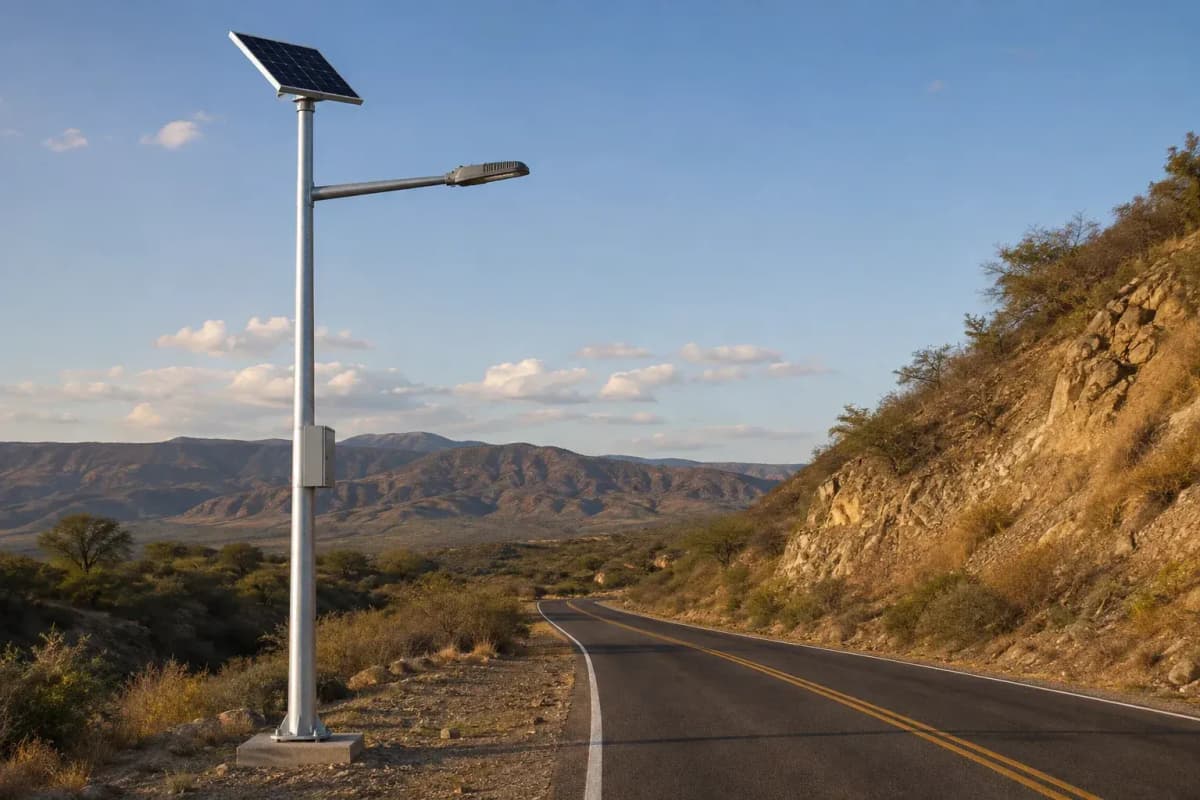
13.1m Split Solar Streetlight 117W - Continental LFP Split System
Key Features
- 13.1 m hot-dip galvanized steel pole for high-mast road, logistics, and perimeter lighting layouts.
- 117 W LED engine delivers approximately 19,890 lm at 170 lm/W nominal efficacy.
- 257 Wp monocrystalline TOPCon solar panel supports adjustable split mounting and 25-year PV design life.
- 936 Wh LiFePO4 battery with BMS supports 4 rainy days using smart dimming profiles.
- EPC turnkey price range is USD 711-1,302 per installed and commissioned unit.
The 13.1m Split Solar Streetlight 117W combines a 257 Wp TOPCon solar panel, 936 Wh LiFePO4 battery, 117 W high-efficiency LED engine, and 4-day autonomy for continental-climate roads, logistics yards, and perimeter lighting. EPC turnkey pricing is USD 711-1,302 per installed unit, including engineering, procurement, construction, commissioning, and 1-year support.
Description
The 13.1m Split Solar Streetlight 117W is a separated solar lighting system with a 13.1 m hot-dip galvanized steel pole, 117 W LED luminaire, 257 Wp monocrystalline TOPCon PV module, and 936 Wh LiFePO4 battery sized for 4 rainy days of autonomy. It is designed for continental environments with operating exposure from -30°C to +50°C, dusk-to-dawn 12 h lighting, IP66/IP67 outdoor protection, and EPC turnkey pricing from USD 711 to USD 1,302 per installed light.
This model belongs to SOLARTODO's Solar Street Light line for B2B infrastructure buyers who need 6-14 m pole options, 30-200 W LED packages, and repeatable engineering documentation across 50, 100, or 250+ unit road, campus, industrial, and municipal programs. For adjacent models, procurement teams can View all Solar Street Light products, while engineers can Configure your system online before issuing a 1-line or 500-line bill of quantities.
System Architecture
The split architecture separates the 257 Wp PV generator, 936 Wh LFP storage pack, 117 W luminaire, MPPT controller, and 13.1 m pole into serviceable subassemblies, which improves field access compared with compact all-in-one housings above 8 m. A top or side-arm solar panel can be tilted toward the local latitude, typically within a 10° to 45° range, while the battery can be mounted in the pole base or a locked equipment box for safer 1-person maintenance at ground level.
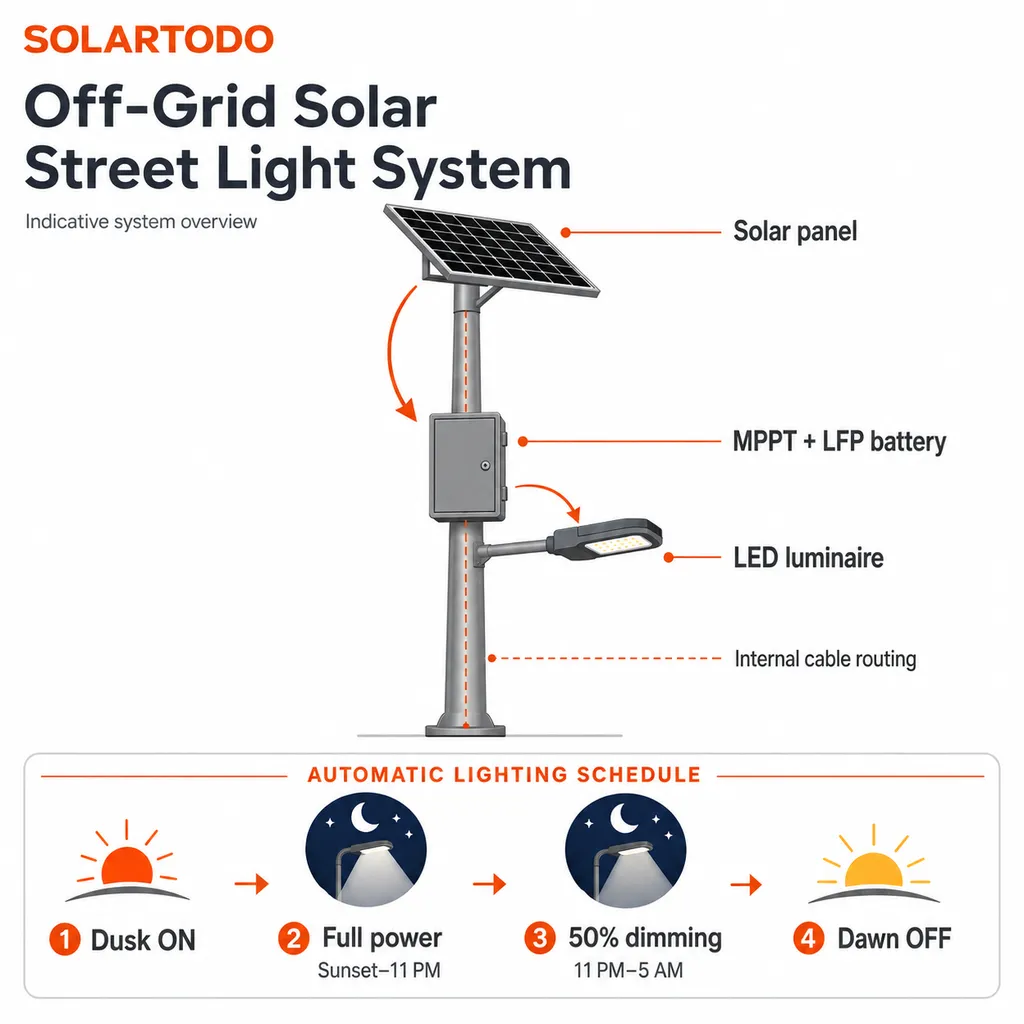
Energy production starts with a 257 Wp monocrystalline TOPCon panel using 19-23% module efficiency and a 25-year design life, consistent with modern crystalline-silicon PV modules qualified under IEC 61215-2:2021 for long-term outdoor exposure IEC 61215. The controller uses MPPT conversion above 98% peak efficiency, which is important because a 3% controller loss on a 257 Wp module equals about 7.7 W during peak production and can remove more than 25 Wh from a short winter charging day.
The storage subsystem uses a 936 Wh LiFePO4 battery with 2,000+ deep-cycle capability, BMS low-temperature charge protection, and an optional heated pack for -30°C continental starts. With a 117 W LED operating at 12 h/day, the maximum raw lighting load is 1,404 Wh/day, so practical dimming profiles such as 100% for 4 h, 60% for 4 h, and 30% for 4 h reduce daily consumption to about 889 Wh and keep the 4-day autonomy model realistic when solar input is available between events.
Technical Specifications
| Parameter | 13.1m Split Solar Streetlight 117W |
|---|---|
| Pole height | 13.1 m |
| LED power | 117 W |
| Nominal luminous flux | 19,890 lm at 170 lm/W |
| Solar panel | 257 Wp TOPCon mono |
| Battery capacity | 936 Wh LiFePO4 |
| Autonomy | 4 rainy days with smart dimming |
| Lighting schedule | 12 h/day dusk-to-dawn |
| Pole material | Hot-dip galvanized steel |
| Wind resistance | 160 km/h project basis |
| Operating temperature | -30°C to +50°C continental package |
| System warranty | 3 years system, 5 years pole |
The luminaire is specified around 170 lm/W LED efficacy, producing approximately 19,890 lm from 117 W before optical losses, and common chip platforms include Bridgelux, Cree, or Lumileds depending on tender requirements. IEC 60598-1:2020 covers luminaire safety requirements up to 1,000 V, including marking, construction, electrical safety, and photobiological considerations IEC 60598, while IP66/IP67 sealing supports exposure to dust, rain, snow, and road spray.
For structural design, the 13.1 m galvanized steel pole is treated as a civil component, not just an accessory, because wind load, luminaire arm length, PV module sail area, base plate size, anchor bolts, and soil bearing capacity all affect stability. The 160 km/h wind-resistance project basis should be verified against the local wind map, terrain category, snow load, and foundation calculation before releasing a 50+ pole procurement order.
Continental Climate Design
Continental sites create a 80°C annual thermal span when winter lows approach -30°C and summer cabinet temperatures approach +50°C, so battery chemistry and enclosure ventilation matter more than nominal wattage alone. LFP is selected because it offers better thermal stability than many high-energy lithium chemistries, and the BMS can stop charging below 0°C, restart after pack heating, and protect the 936 Wh battery from irreversible lithium plating during cold mornings.
Snow and low-sun seasons require more conservative design than equatorial projects, because a 257 Wp panel that performs well in April may receive materially lower daily insolation in December at 45° latitude. The adjustable split panel arm lets engineers increase winter tilt by 10-20° compared with a fixed all-in-one body, helping reduce snow retention and improving low-angle collection without changing the 117 W luminaire.
Standards and Design Methodology
Standalone PV lighting systems should be evaluated using energy-balance logic aligned with IEC 62124 photovoltaic stand-alone system design verification principles, including array sizing, storage autonomy, protection devices, and load characterization over a defined duty cycle. SOLARTODO normally treats 12 h/night operation, 4 autonomy days, MPPT charging, and site-specific solar irradiation as 4 linked variables rather than independent catalog claims.
NREL's PV O&M guidance emphasizes that predictable maintenance planning improves fielded PV performance and investor transparency, which is directly relevant to 100+ unit streetlight portfolios with distributed batteries and controllers NREL PV O&M. For this model, recommended maintenance intervals are 6 months for visual inspection, 12 months for torque and enclosure checks, and 24 months for battery health review where remote telemetry is not specified.
IRENA reported that utility-scale solar PV reached a global weighted-average LCOE of about USD 0.043/kWh in 2024 and that installed PV costs continued to decline across 2010-2024, reinforcing the procurement trend toward lower-cost solar-powered infrastructure IRENA 2024 Costs. Although a 257 Wp streetlight is not a utility plant, the same module learning curve affects panel procurement, replacement availability, and long-term supply resilience.
IEA reported that solar PV accounted for more than three-quarters of global renewable capacity additions in 2025, with annual solar additions surpassing 600 GW for the first time IEA Global Energy Review 2026. This scale matters for B2B buyers because standardized 257 Wp-class modules, MPPT electronics, and LFP batteries are supported by larger supply chains than niche lighting-only components.
Representative Scenario: Continental Logistics Road
For a representative continental logistics-road scenario with 100 poles, 35 m pole spacing, and 3.5 km of private internal roads, the 13.1 m height supports wider spacing than 8 m lighting while preserving usable illumination for truck circulation and perimeter surveillance corridors. At a representative EPC price of USD 1,046 per unit, a 100-light package has a project value near USD 104,600 before local taxes, unusual soil works, or third-party grid-interface fees.
Assuming a 117 W conventional grid LED operates 12 h/night, each fixture consumes about 512 kWh/year before driver losses, and 100 fixtures consume about 51,200 kWh/year. At USD 0.16/kWh, direct annual electricity cost is about USD 8,192 for the 100-light baseline, while the solar split system reduces purchased lighting energy by nearly 100% and avoids 3.5 km of trenching, conduit, copper cable, feeder panels, and outage exposure.
Compared with a conventional grid-connected alternative requiring USD 25-45/m trenching over 3,500 m, the avoided underground work can be roughly USD 87,500-157,500 before switchgear and utility interconnection charges. That means a 100-unit solar streetlight project can reduce initial civil-electrical work by 45-60% on remote internal roads, although final savings depend on soil class, asphalt cutting, cable size, and local labor rates.
Cloud Monitoring
The optional remote-monitoring package adds 4G or LoRa communication for charge status, nightly runtime, battery voltage, LED fault alarms, and controller temperature across 50, 100, or 250+ poles. Motion-adaptive dimming can reduce energy use by up to 60% in low-traffic windows, for example by operating at 30% output after midnight and returning to 100% output when PIR or radar detection identifies movement.
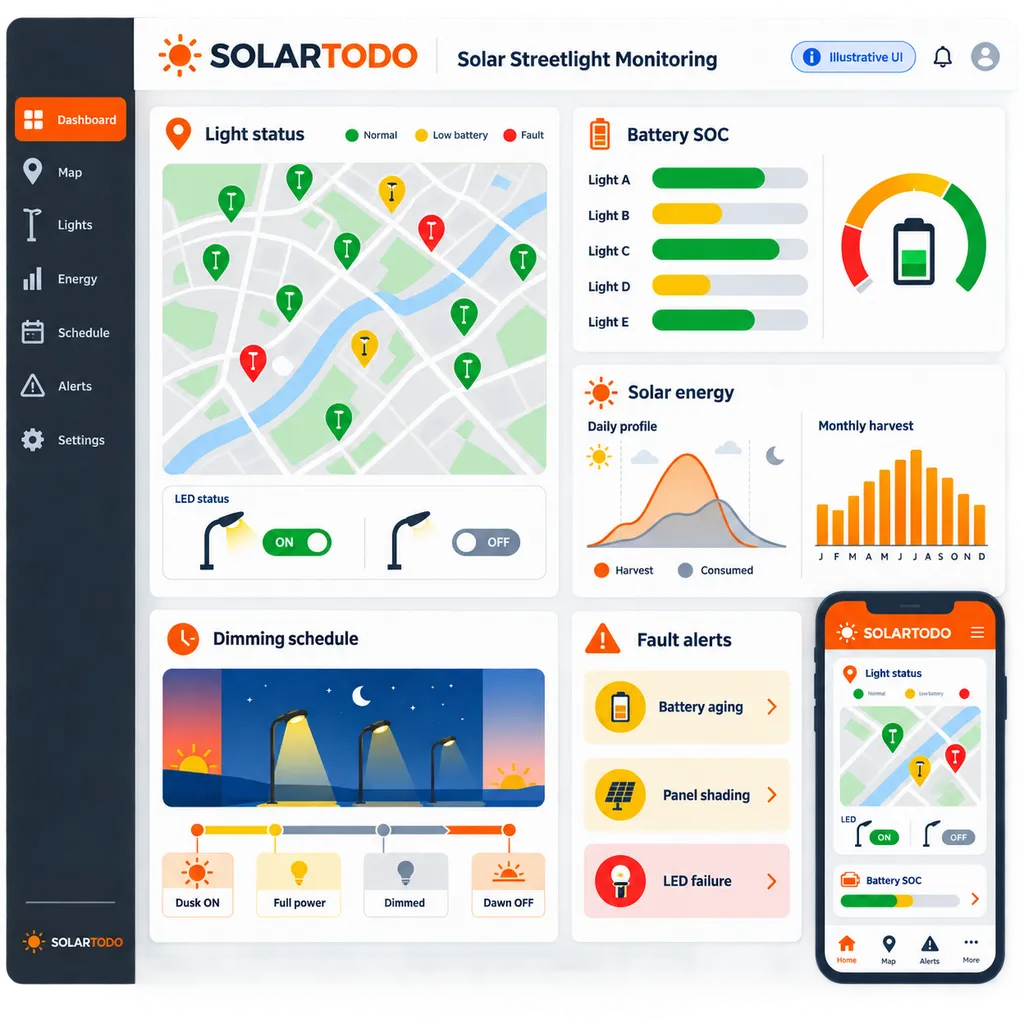
For tenders that require centralized operation, each controller can be mapped by pole ID, GPS coordinate, road segment, battery serial number, and commissioning date, creating 5 traceable fields for asset management. This structure supports NREL-style O&M documentation, monthly exception reporting, and warranty triage without dispatching a technician to every 13.1 m pole after a single cloudy week.
Applications
The 13.1m Split Solar Streetlight 117W is suited to arterial access roads, solar farm perimeters, logistics parks, industrial campuses, mining accommodation roads, rural highways, and parking aprons where 10-14 m mounting height is required. Buyers specifying Solar Street Light products often use this 117 W variant when 80 W fixtures are underpowered and 150-200 W dual-head split systems exceed the project illumination target or budget.
Project developers can use Learn about topic resources to align solar lighting with PV generation, LFP storage, smart-city controls, and off-grid infrastructure standards before tender release. For procurement files that require compliance matrices, SOLARTODO can map IEC 62124, IEC 60598, IEC 61215, IP66/IP67, CE, RoHS, and local pole-wind criteria into 7 separate submittal lines.
EPC Investment Analysis and Pricing Structure
EPC delivery includes 5 work packages: engineering design, procurement, construction, commissioning, and warranty support. For a 13.1 m streetlight, this normally covers lighting layout review, pole and foundation coordination, factory QC, ocean logistics when selected, foundation installation, pole erection, luminaire aiming, controller programming, nighttime commissioning, and 1-year post-handover support.
| Pricing tier | Scope | Unit price range |
|---|---|---|
| FOB Supply | Equipment only, ex-works China | USD 441-885 |
| CIF Delivered | FOB plus ocean freight and insurance | USD 495-994 |
| EPC Turnkey | Installed, commissioned, and 1-year warranty | USD 711-1,302 |
| Order quantity | Indicative discount | Use case |
|---|---|---|
| 50+ units | 5% | Small industrial road or campus phase |
| 100+ units | 10% | Logistics park, solar farm, or municipal package |
| 250+ units | 15% | Multi-site EPC framework or provincial program |
ROI depends on 4 variables: trenching distance, local electricity price, maintenance travel distance, and required lighting level. In the representative 100-unit road scenario, avoided grid energy is about 51,200 kWh/year and avoided electricity spending is about USD 8,192/year at USD 0.16/kWh, while avoided trenching can exceed USD 87,500 when cable routes average 35 m per pole.
A simple payback model compares the solar EPC cost against a conventional LED pole, underground cable, trenching, distribution protection, and 10-year purchased electricity. Where trenching is already available, payback may be 6-9 years; where new cable trenches are required, the solar option can be lower on day 1 and show positive lifecycle savings before year 3.
Standard payment terms are 30% T/T deposit plus 70% against bill of lading, or 100% L/C at sight for bankable international trade. For projects above USD 1,000,000, SOLARTODO can discuss staged delivery, EPC progress billing, or financing coordination; buyers can Request a custom quotation or contact [email protected] with road length, pole spacing, wind zone, and target lux level.
Procurement Notes
The bill of materials should specify 1 galvanized pole, 1 117 W LED luminaire, 1 257 Wp TOPCon module, 1 936 Wh LFP battery, 1 MPPT controller, 1 foundation set, and 1 commissioning record per pole. For public tenders, SOLARTODO recommends adding a 3% spare controller allowance and a 1% spare luminaire allowance for projects above 250 lights.
Before release to manufacturing, engineers should verify 6 inputs: solar irradiation, minimum winter temperature, road width, mounting geometry, wind speed, and dimming schedule. A project file with these 6 values is usually sufficient to convert the catalog configuration into a site-specific quotation, foundation note, packing list, and 12-month commissioning baseline.
Why SOLARTODO
SOLARTODO supplies solar, energy storage, smart lighting, security, telecom power towers, and smart-agriculture infrastructure through 1 integrated B2B sourcing channel at solartodo.com. For this 13.1 m split streetlight, the main value is not a single 117 W fixture, but a documented system package combining PV generation, LFP storage, lighting optics, pole engineering, EPC pricing, and standards-aware delivery for repeatable 50-250+ unit programs.
Technical Specifications
| Pole Height | 13.1m |
| LED Power | 117W |
| Luminous Flux | 19890lm |
| Solar Panel | 257Wp |
| Battery Capacity | 936Wh LFP |
| Battery Type | LiFePO4 |
| Autonomy | 4rainy days |
| Pole Material | Hot-dip galvanized steel |
| Wind Resistance | 160km/h |
| Operating Temperature | -30 to +50°C |
| Lighting Hours | 12h/day dusk-to-dawn |
| Controller | MPPT >98% peak efficiency |
| Ingress Protection | IP66/IP67 |
| Warranty | 3 years system, 5 years pole |
Price Breakdown
| Item | Quantity | Unit Price | Subtotal |
|---|---|---|---|
| 117 W split LED luminaire module | 1 pcs | $53 | $53 |
| 257 Wp monocrystalline TOPCon solar panel | 1 pcs | $26 | $26 |
| 936 Wh LiFePO4 battery pack with BMS | 1 pcs | $94 | $94 |
| MPPT controller for 257 Wp panel | 1 pcs | $77 | $77 |
| 13.1 m hot-dip galvanized steel pole | 1 pcs | $120 | $120 |
| Concrete foundation and anchor bolt set | 1 pcs | $170 | $170 |
| Cables, brackets, fasteners, and protection accessories | 1 pcs | $42 | $42 |
| Engineering, lighting layout review, and factory QC | 1 pcs | $92 | $92 |
| Installation and pole erection | 1 pcs | $210 | $210 |
| Commissioning and controller programming | 1 pcs | $48 | $48 |
| 1-year warranty and field support allowance | 1 pcs | $65 | $65 |
| Project logistics and EPC coordination allowance | 1 pcs | $39 | $39 |
| Total Price Range | $711 - $1,302 | ||
Frequently Asked Questions
What does the EPC turnkey price include for this 13.1m solar streetlight?
How is the 936 Wh LFP battery sized for 4 rainy days?
Can the 257 Wp solar panel angle be adjusted after installation?
Which standards are relevant for specification and tender documents?
Is remote monitoring required for every 117 W split solar streetlight?
Certifications & Standards




Data Sources & References
- •NREL Best Practices for Operation and Maintenance of Photovoltaic and Energy Storage Systems, 3rd Edition, 2018: https://www.nrel.gov/docs/fy19osti/73822.pdf
- •IEC 60598-1:2020 Luminaires - General requirements and tests: https://webstore.iec.ch/en/publication/61414
- •IEC 61215-2:2021 Terrestrial PV modules - Design qualification and type approval: https://webstore.iec.ch/en/publication/61350
- •IRENA Renewable Power Generation Costs in 2024: https://www.irena.org/Digital-Report/Renewable-Power-Generation-Costs-in-2024
- •IEA Global Energy Review 2026 - Technology: Solar PV and wind: https://www.iea.org/reports/global-energy-review-2026/technology-solar-pv-and-wind
- •IEA Renewables 2025 - Renewable electricity: https://www.iea.org/reports/renewables-2025/renewable-electricity
Interested in this solution?
Contact us for a customized quote based on your specific requirements.
Contact Us