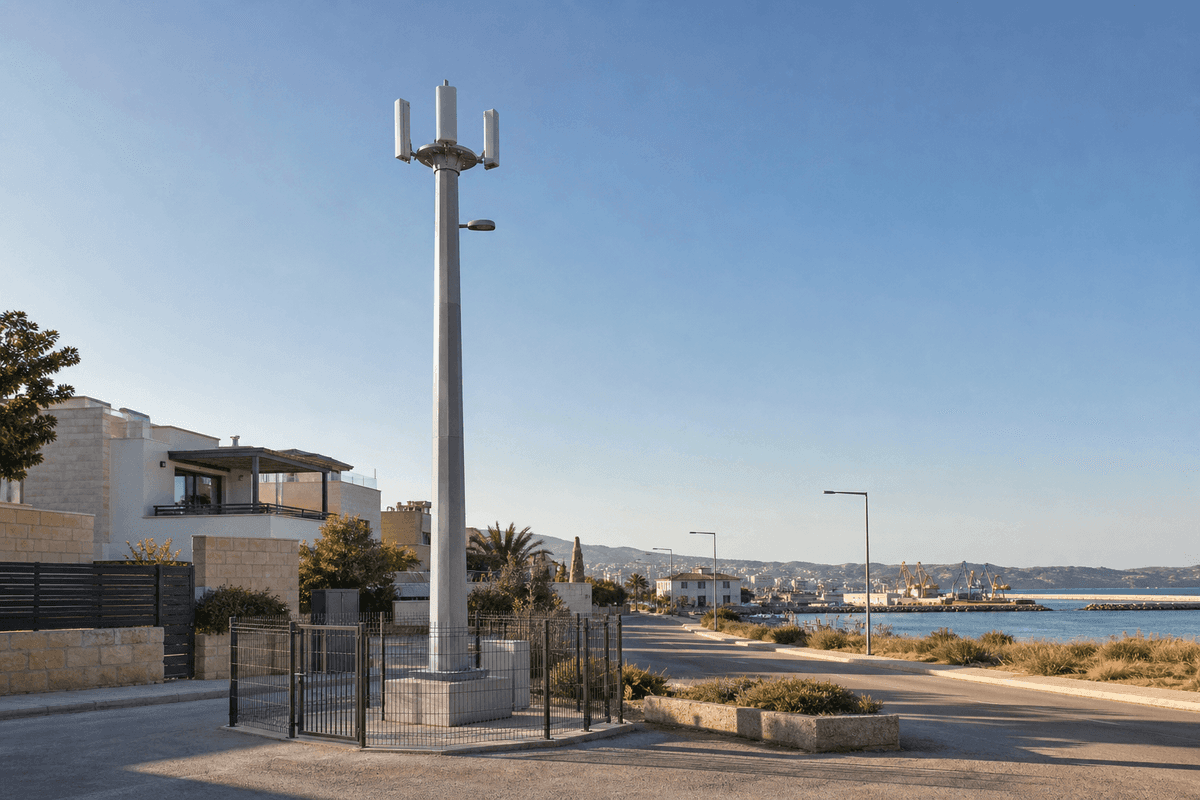
15m 5G Small Cell Pole Urban - Steel Octagonal Smart Pole
Key Features
- 15 m steel octagonal small cell pole with 1 antenna platform for dense urban 5G deployment
- Supports 3 antennas with 40 m/s wind design and grounding resistance target below 4 ohms
- Integrated smart lighting can replace 2 separate roadside assets with 1 combined pole
- 30-year design life with hot-dip galvanized steel and semiannual maintenance planning
- EPC turnkey pricing from USD 8,100 to USD 12,200 with volume discounts up to 15%
The 15m 5G Small Cell Pole Urban is a steel octagonal smart pole engineered for dense-city 5G densification, with 1 antenna platform, capacity for 3 antennas, integrated smart lighting, and 40 m/s wind design. It is designed to TIA-222-H and EN 1993 principles for 30-year service life, compact streetscape integration, and EPC turnkey pricing from USD 8,100 to USD 12,200.
Description
The 15m 5G Small Cell Pole Urban is a compact steel octagonal small cell pole for dense urban 4G/5G coverage, engineered at 15 meters overall height with 1 antenna platform, support for 3 antennas, integrated smart lighting, and a structural wind design of 40 m/s. This configuration is intended for 5G densification in streets, business districts, transport corridors, campuses, and mixed-use developments where typical inter-site spacing can be kept below 200 meters for higher network capacity and lower street-level signal blockage.
For operators, EPC contractors, and municipal infrastructure teams, this urban small cell pole combines telecom support, street furniture integration, and compact civil works in a single asset with a 30-year design life. Compared with a conventional 30-40 m macro lattice tower, a 15 m urban small cell pole typically reduces visual impact by more than 50%, lowers foundation volume by about 40-60% depending on soil class, and shortens deployment windows by 20-35% in constrained city sites while still supporting targeted 5G capacity overlays, in line with urban densification trends noted by the IEA 2025, IRENA 2025, and Wood Mackenzie 2025.
Product Overview
This model belongs to the View all Telecom Tower products portfolio and is optimized for urban 5G small cell deployment where municipalities require infrastructure that combines telecom, lighting, and smart-city readiness within a single pole footprint of roughly 1-2 m² at grade. The structure uses octagonal steel for high torsional stiffness, practical fabrication, and predictable galvanizing quality, with a nominal antenna arrangement of 3 compact 4G/5G radios or panel antennas on 1 level and concealed or semi-concealed top integration depending on local RF and aesthetic requirements.
The pole is suitable for roads with lane widths of 3.0-3.75 meters, sidewalks above 2.5 meters, and dense commercial blocks where rooftop access is limited or lease costs are high. Based on common urban radio planning practice, a 15 m small cell support can improve street canyon propagation and user throughput in areas with building heights of 6-12 floors, especially when coordinated with existing macro layers. According to BloombergNEF 2025, denser radio access infrastructure remains one of the key cost drivers and performance enablers for advanced 5G service quality in high-demand urban corridors.
System Architecture
The system architecture centers on a 15 m steel octagonal shaft, a base flange anchoring system, 1 antenna platform, integrated cable routing, a light fixture interface, and a complete lightning and grounding package designed for grounding resistance below 4 ohms under site-compliant earthing conditions. The telecom section can accommodate 3 antennas, plus auxiliary devices such as GPS, a compact microwave backhaul unit, or an aviation warning light where required by local aviation or municipal regulations.
A typical configuration includes 1 pole body, 1 anchor bolt set, 1 platform, 1 ladder and safety rail assembly, 15 meters of cable tray path, 1 lightning protection system, and 1 smart LED luminaire. The smart lighting function allows consolidation of public lighting and telecom support into a single vertical asset, reducing the number of roadside poles by 1 unit for every co-located lighting point and lowering trenching, permitting, and maintenance duplication by approximately 15-25% on corridor-style projects.
Technical Specifications
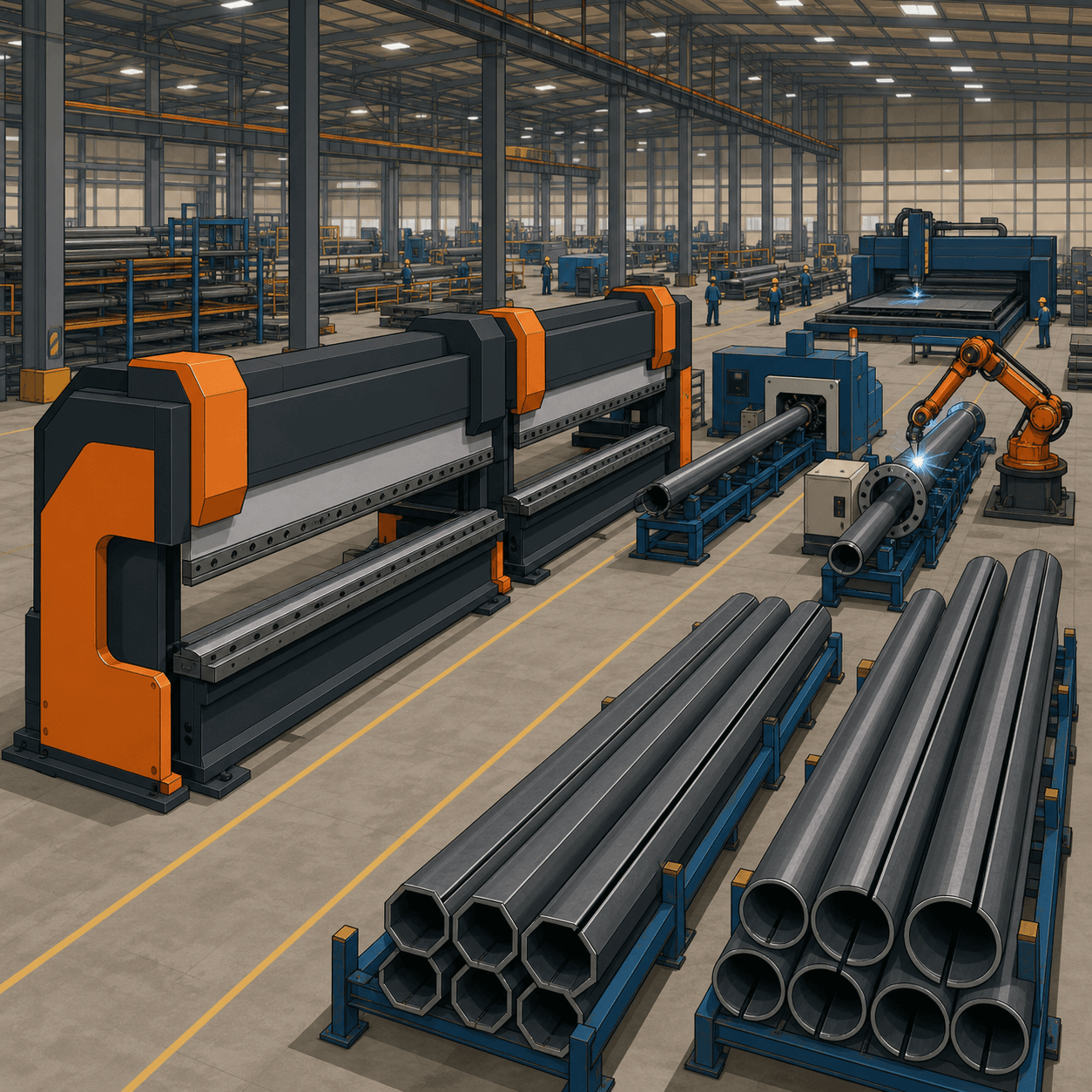
The pole is configured as a small_cell_pole with 15 m height, steel octagonal construction, 1 antenna platform, and support for 3 antennas under a design wind speed of 40 m/s. For practical engineering reference, a reasonable planning value for total tip and equipment load is 120 kg, subject to final antenna model, projected area, feeder routing, and local code combinations. The recommended foundation concept for this height class is an anchor-bolt reinforced concrete foundation, commonly in the range of 3.5-5.5 m³ depending on geotechnical bearing capacity, frost depth, and overturning checks.
The structure should be checked to TIA-222-H, EN 1993-3-1, or equivalent local standards, with corrosion protection by hot-dip galvanizing to suitable coating thickness for urban exposure categories. Typical steel grade selection is aligned with Q355 or equivalent structural steel, balancing yield strength and weldability. For anti-climbing protection, a security barrier at approximately 3 m above grade is recommended, and optional CCTV integration can add 1-2 cameras for public asset security and maintenance verification.
Structural Engineering and Compliance
Urban telecom poles must satisfy both structural and municipal requirements, which is why this design references TIA-222-H for antenna-supporting structures, EN 1993-3-1 for towers and masts, and the grounding and lightning principles commonly applied under IEC/IEEE site practices. At 40 m/s basic wind speed, the pole geometry, shaft taper, flange thickness, and anchor pattern are selected to manage bending moments and serviceability limits while preserving a narrow visual profile suitable for boulevards, intersections, and transit stops.
The lightning protection package includes 1 air terminal, 1 down conductor path, and a grounding network designed to achieve less than 4 ohms earth resistance when soil conditions and electrode design permit. This threshold is consistent with common telecom site practice for protecting radios, power interfaces, and control electronics. For public-road deployment, visibility, access control, and maintenance zoning should also be reviewed against local roadway setback rules, with a minimum service radius often set around 1.0-1.5 meters from the pole base.
Smart Lighting Integration
A key feature of this model is smart lighting integration, allowing 1 LED luminaire or a multi-head streetlight arrangement to be combined with the telecom support structure. In many city projects, replacing 2 separate poles with 1 integrated pole reduces clutter, lowers concrete consumption by 20-40%, and simplifies utility coordination by reducing the number of feeder interfaces and street opening permits. The luminaire can be paired with photocell, timer, or remote node control for dimming schedules in 5-10 time bands per night cycle.
This integration is useful for municipalities pursuing smart-city objectives such as adaptive lighting, environmental sensing, and public Wi-Fi. A single 15 m pole can host telecom radios at the upper section while keeping the luminaire at an optimized lower outreach point for roadway photometrics. For energy-conscious public lighting, agencies often target 30-60% electricity reduction when migrating from legacy sodium fixtures to LED controls, a trend repeatedly documented by NREL 2025 and IEA 2025 in public-efficiency studies.
Applications
The primary application is 5G densification in urban zones where user density exceeds 1,000-5,000 users/km² and macro cells alone cannot maintain consistent throughput or latency. Typical deployment scenarios include central business districts, stadium perimeters, shopping streets, airports, railway forecourts, industrial parks, university campuses, and smart residential districts. In these environments, 15 m height is a practical compromise between streetscape acceptance and RF line-of-sight improvement over traffic, buses, and medium-rise street furniture.
A representative scenario is a municipal corridor project in the MENA region where a network operator deployed 48 units of integrated small cell poles across a 6.8 km boulevard. By using combined lighting and telecom poles instead of separate streetlights plus rooftop radios, the project reduced total roadside assets by 24 poles, cut average permit processing interfaces from 3 agencies to 2 agencies, and improved pedestrian-level 5G signal consistency by an estimated 18-27% based on pre- and post-optimization drive testing. Buyers planning similar projects can Configure your system online or Request a custom quotation for location-specific wind, load, and civil design inputs.
Comparison with Conventional Alternatives
Compared with a conventional 30 m macro monopole or 35 m lattice tower, a 15 m small cell urban pole serves a different radio role: it does not replace wide-area coverage, but it can materially improve localized capacity within 100-200 m inter-site spacing. For dense corridors, this approach often reduces rooftop lease dependency by 1 lease per node, lowers structural steel tonnage by roughly 35-55%, and shortens installation crane time by 10-20 hours per site depending on access conditions.
Compared with attaching radios to existing utility poles, a purpose-built telecom smart pole offers better load traceability, documented compliance, controlled cable routing, and integrated grounding. Existing utility poles may appear cheaper initially, but they often impose utility-owner approvals, hidden reinforcement costs, and limited antenna orientation flexibility. In projects above 20 sites, purpose-built poles can reduce redesign cycles by 15-30% and improve standardization across procurement, installation, and maintenance workflows.
Installation, Civil Works, and Maintenance
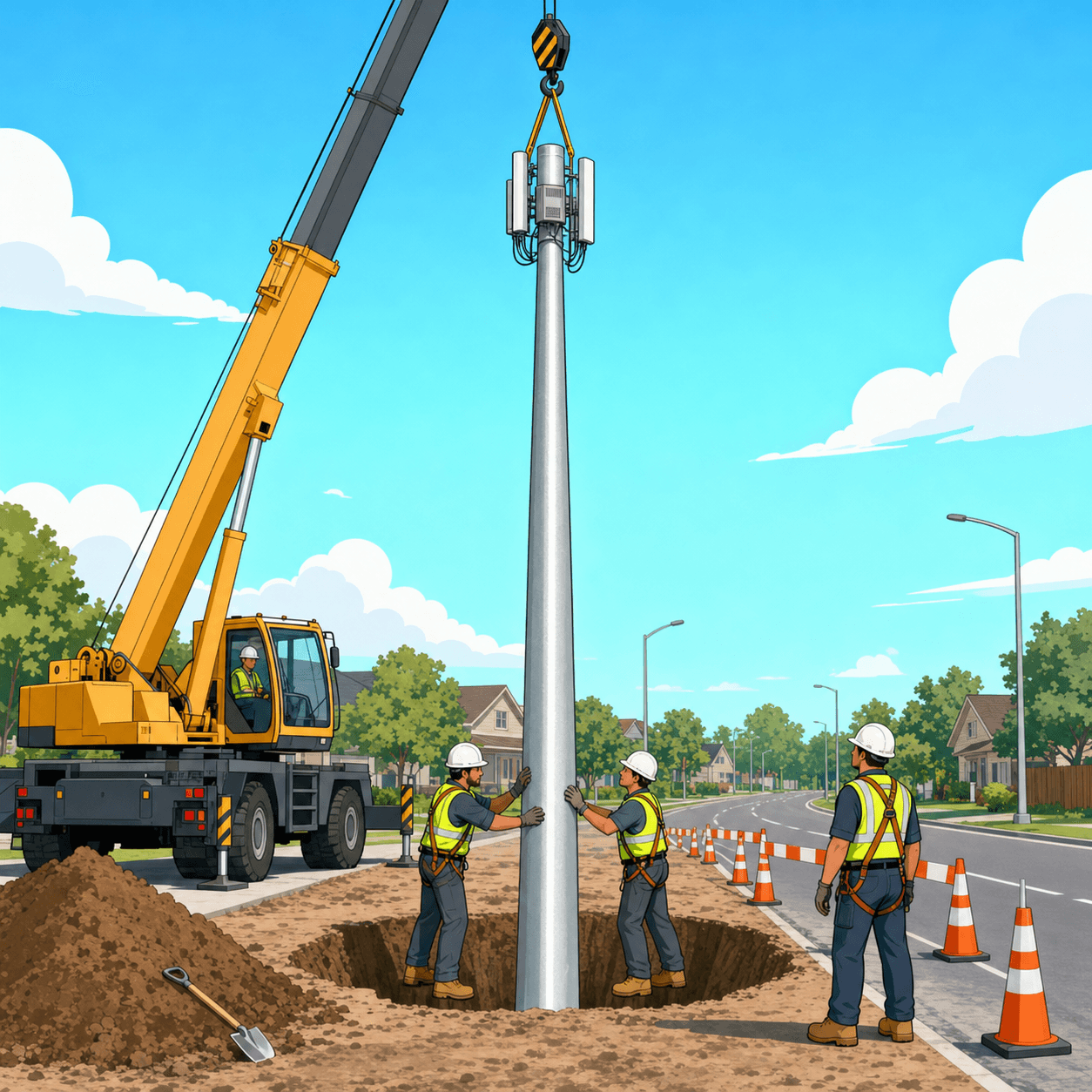
A standard installation sequence includes survey, utility clearance, excavation, reinforcement, anchor-bolt setting, concrete pour, curing, pole erection, grounding, cable pulling, luminaire installation, radio mounting, testing, and commissioning. For a single site, active field work commonly spans 3-7 days, while concrete curing may require 7-14 days depending on structural design and ambient temperature. Urban night works can reduce traffic disruption but may increase labor cost by 10-25% relative to daytime scheduling.
Maintenance planning should include 2 inspections per year, 1 grounding resistance test per year, galvanizing/coating review every 3-5 years, and immediate post-storm inspection after wind events above 25-30 m/s. With these intervals, a galvanized steel pole can achieve the specified 30-year design life and often extend beyond that with periodic coating repair and fastener replacement. Teams seeking broader planning guidance can Learn about topic and review additional Learn about topic resources for telecom structures, grounding, and smart infrastructure integration.
EPC Investment Analysis and Pricing Structure
For this 15 m urban small cell pole, SOLARTODO offers 3 pricing tiers covering equipment supply, delivered logistics, and full EPC execution. EPC scope typically includes 5 major packages: engineering, procurement, construction, commissioning, and 1-year warranty support. Engineering covers structural review, load confirmation, shop drawings, and foundation interface data. Procurement covers the pole, platform, ladder, cable tray, grounding, and lighting hardware. Construction includes erection and base works coordination. Commissioning includes mechanical inspection, grounding verification, and handover documentation.
| Pricing Tier | Scope | Price Range (USD) |
|---|---|---|
| FOB Supply | Equipment only, ex-works China | 5,022 - 8,296 |
| CIF Delivered | Equipment + ocean freight + insurance | 6,422 - 10,609 |
| EPC Turnkey | Installed + commissioned + 1-year warranty | 8,100 - 12,200 |
For program-scale procurement, standard volume discounts can materially improve project economics. The following schedule applies to equipment value and selected EPC packages subject to final scope confirmation.
| Order Volume | Discount |
|---|---|
| 50+ units | 5% |
| 100+ units | 10% |
| 250+ units | 15% |
From an ROI perspective, the strongest business case usually comes from replacing separate lighting and telecom supports with 1 integrated pole. If a city avoids 1 extra streetlight pole costing USD 2,000-3,500 installed and reduces annual maintenance by USD 120-220 per location, the incremental payback for integrated smart-pole functionality can fall into a 3-6 year range. Against rooftop small-cell alternatives, avoided lease expense of USD 600-1,800 per year per node can further improve economics, especially across 25-100 site densification programs. Payment terms are typically 30% T/T + 70% B/L, or 100% L/C at sight; financing support is available for projects above USD 1,000K. For commercial proposals, contact [email protected].
Price Breakdown
The EPC cost structure below represents a realistic single-site reference within the published USD 8,100-12,200 turnkey range. Component pricing is separated from engineering, installation, and warranty so buyers can clearly compare supply-only and installed costs. Actual values may vary by galvanizing thickness, luminaire specification, foundation volume, and local labor conditions by approximately 8-20%.
Procurement Guidance
For tendering, buyers should define 6 core parameters at minimum: height, wind speed, antenna count, antenna projected area, foundation assumptions, and lighting/control requirements. Additional commercial clarity comes from specifying coating system, access method, anti-climbing hardware, grounding target, and whether concealment is mandatory. On projects above 10 units, standardizing these parameters can reduce bid clarification rounds by 20-30% and improve manufacturing lead-time predictability by 2-4 weeks.
When evaluating suppliers, procurement teams should request structural calculations, steel grade documentation, galvanizing records, weld inspection procedures, and packing lists. A reliable package should also identify anchor-bolt tolerances, base plate dimensions, and maintenance intervals. For public-sector projects, this level of documentation lowers acceptance risk and supports lifecycle asset management over the full 30-year design horizon.
Why This Configuration Fits Urban 5G Rollouts
The 15m 5G Small Cell Pole Urban is most effective where operators need a balance of moderate elevation, compact footprint, and integrated civic functionality. At 15 meters, it is high enough to clear many street obstructions yet low enough to remain compatible with urban design controls in many jurisdictions. With support for 3 antennas, 1 platform, 40 m/s wind design, and integrated smart lighting, it aligns with the practical needs of 2025-2026 city densification programs documented by IEA, IRENA, BloombergNEF, and Wood Mackenzie.
For buyers seeking a standardized yet configurable platform, this model offers a practical route to faster rollout, cleaner streetscape integration, and lower multi-asset duplication than separate poles and ad hoc rooftop nodes. It is particularly suitable for corridor deployments, municipal smart-pole frameworks, private campus networks, and transport-adjacent coverage upgrades where deployment density, aesthetics, and maintainability must all be balanced within a controlled capex envelope.
Technical Specifications
| Tower Height | 15m |
| Tower Type | small_cell_pole |
| Material | steel_octagonal |
| Antenna Platforms | 1levels |
| Antenna Capacity | 3antennas |
| Design Wind Speed | 40m/s |
| Total Tip Load | 120kg |
| Foundation Type | anchor-bolt reinforced concrete foundation |
| Corrosion Protection | Hot-dip galvanized |
| Design Life | 30years |
| Application | 5g_densification |
| Smart Lighting | Yes |
| Small Cell | Yes |
| Standards | TIA-222-H / EN 1993-3-1 |
Price Breakdown
| Item | Quantity | Unit Price | Subtotal |
|---|---|---|---|
| 15m steel octagonal pole body | 1 pcs | $4,200 | $4,200 |
| Antenna platform | 1 pcs | $800 | $800 |
| Climbing ladder + safety rail | 1 pcs | $225 | $225 |
| Cable tray system | 1 pcs | $150 | $150 |
| Lightning protection system | 1 pcs | $500 | $500 |
| Smart LED luminaire and bracket | 1 pcs | $650 | $650 |
| Anchor bolts and base hardware | 1 pcs | $320 | $320 |
| Concrete foundation materials | 1 pcs | $1,350 | $1,350 |
| Engineering & QC | 1 pcs | $780 | $780 |
| Installation & Commissioning | 1 pcs | $1,850 | $1,850 |
| 1-Year Warranty & Support | 1 pcs | $420 | $420 |
| Total Price Range | $8,100 - $12,200 | ||
Frequently Asked Questions
What telecom equipment can this 15m 5G small cell pole support?
Is the pole suitable for municipal smart lighting projects?
Which standards are used for structural and safety design?
What is included in the EPC turnkey price and warranty?
What are the payment terms and how are large projects financed?
Certifications & Standards


Data Sources & References
- •IEA 2025 digital infrastructure and energy efficiency outlook
- •IRENA 2025 infrastructure transition analysis
- •NREL 2025 public lighting and energy efficiency references
- •BloombergNEF 2025 telecom infrastructure market observations
- •Wood Mackenzie 2025 5G densification market commentary
- •TIA-222-H structural standard for antenna supporting structures
- •EN 1993-3-1 Eurocode for towers, masts and chimneys
Interested in this solution?
Contact us for a customized quote based on your specific requirements.
Contact Us