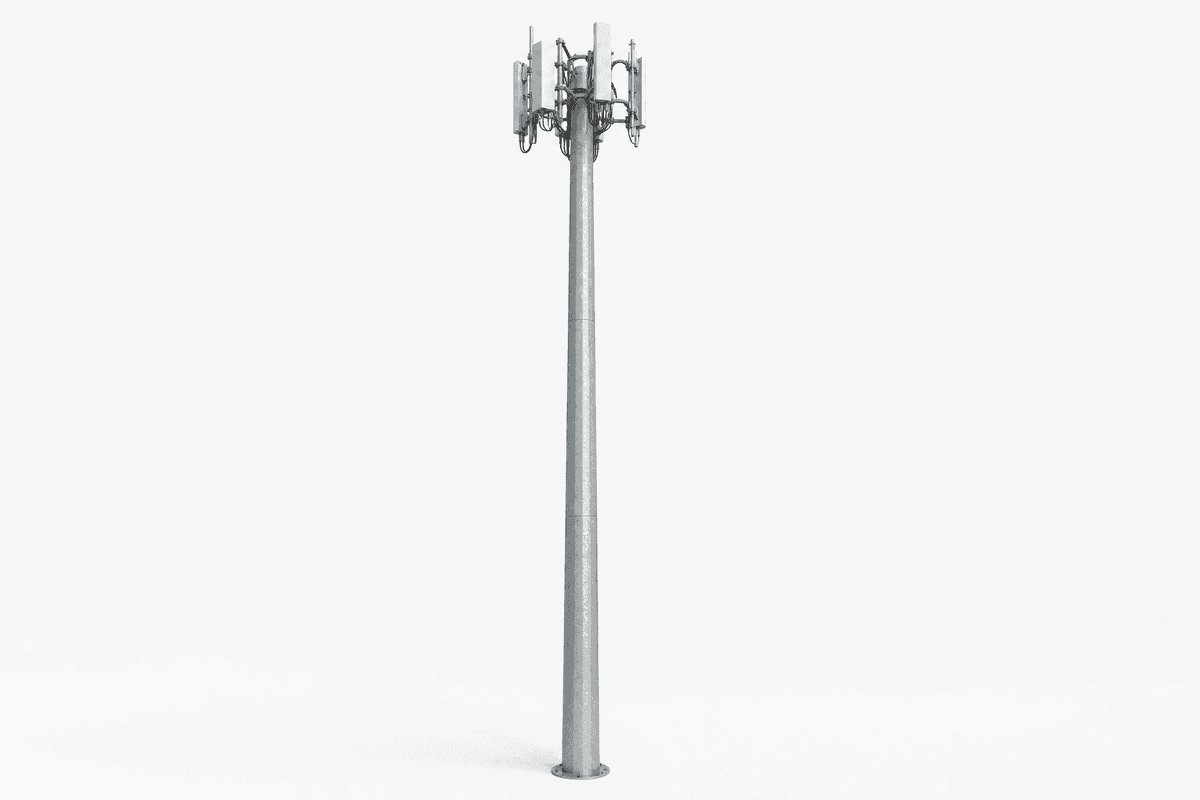
35m Monopole Urban Multi-Carrier 5G Slip-Joint - 3-Platform Steel Tower
Key Features
- 35 m steel monopole with slip-joint sections for faster urban installation in 2-4 days
- Supports 3 antenna platforms and up to 9 antennas for 3-carrier 4G/5G deployment
- Designed for 45 m/s wind speed with approximately 900-1200 kg total tip load envelope
- Compact monopole footprint reduces occupied land area by about 60-75% versus comparable lattice towers
- EPC turnkey pricing ranges from USD 40,500 to USD 56,700 with 1-year warranty included
The 35m Monopole Urban Multi-Carrier 5G Slip-Joint is a tubular steel telecom tower designed for 3 carriers, 3 antenna platforms, and up to 9 antennas under 45 m/s design wind conditions. Built with hot-dip galvanized steel tube sections, slip-joint connections, and a concrete pad foundation, it provides a compact 5G-ready urban macro-site solution with EPC turnkey pricing from USD 40,500 to USD 56,700.
Description
The 35m Monopole Urban Multi-Carrier 5G Slip-Joint is a 35-meter tubular steel telecom tower engineered for urban multi-carrier deployment, supporting 3 carriers, 3 antenna platforms, and up to 9 antennas under a 45 m/s design wind speed. This monopole configuration uses slip-joint steel tube sections, a concrete pad foundation, and hot-dip galvanized corrosion protection to deliver a compact footprint of approximately 3 meters at base level while meeting the structural and operational requirements of modern 4G/5G macro coverage sites. For buyers comparing configurations, View all Telecom Tower products or Configure your system online.
Product Overview
This tower variant is optimized for dense urban and suburban environments where land constraints, zoning pressure, and visual impact are significant factors within a 20-45 m telecom tower height range. The structure is fabricated from tapered steel tube sections in equal-length modules, using a slip-joint connection strategy that reduces visible flange interfaces and supports faster erection by 1-2 installation days compared with many multi-flanged conventional poles of similar height. According to TIA-222-H, EN 1993-3-1, and GB 50135, monopole towers in this class must balance slenderness, fatigue resistance, and serviceability under wind and antenna loading, and this 35 m model is configured specifically for urban multi-operator tenancy.
In practical network planning, a 35 m monopole often fills the gap between lower 20-25 m smart poles and larger 40-60 m lattice towers, especially where operators require broad sector coverage with limited land take. This unit supports 9 panel antennas across 3 levels, enabling 3-sector arrangements for 3 carriers with room for radio, feeder, and auxiliary mounting coordination. Industry demand for such infrastructure continues to rise as 5G densification expands; both the IEA and BloombergNEF have noted that digital infrastructure electricity and network equipment deployments are increasing alongside mobile broadband traffic growth, while IRENA highlights the parallel need for efficient shared infrastructure to reduce duplicated capital intensity.
System Architecture
The tower architecture consists of a single tapered monopole shaft rising to 35 m, segmented into transportable steel tube sections joined by precision-engineered slip joints. Typical section lengths are aligned for containerized logistics and crane handling, reducing field bolting complexity by approximately 15-25% versus heavily segmented flange-based alternatives. The top arrangement is designed for 3 antenna platforms, each capable of supporting 3 antennas, for a total rated antenna capacity of 9 units, with optional provision for microwave dishes, GPS antennas, aviation warning lights, and feeder or hybrid fiber-power routing.
The structural system is designed around a concrete pad foundation with anchor bolts and embedment typically in the 4-6 m range depending on soil bearing capacity, groundwater conditions, and local geotechnical design inputs. For urban deployment, the compact monopole footprint can reduce occupied land area by roughly 60-75% compared with a conventional 4-leg lattice tower of equivalent telecom loading and similar height. That smaller footprint can simplify municipal approvals, reduce fencing area, and lower civil reinstatement work around sidewalks, medians, or constrained rooftop-adjacent compounds. Buyers needing project-specific soil and load adaptation can Request a custom quotation.
Technical Specifications
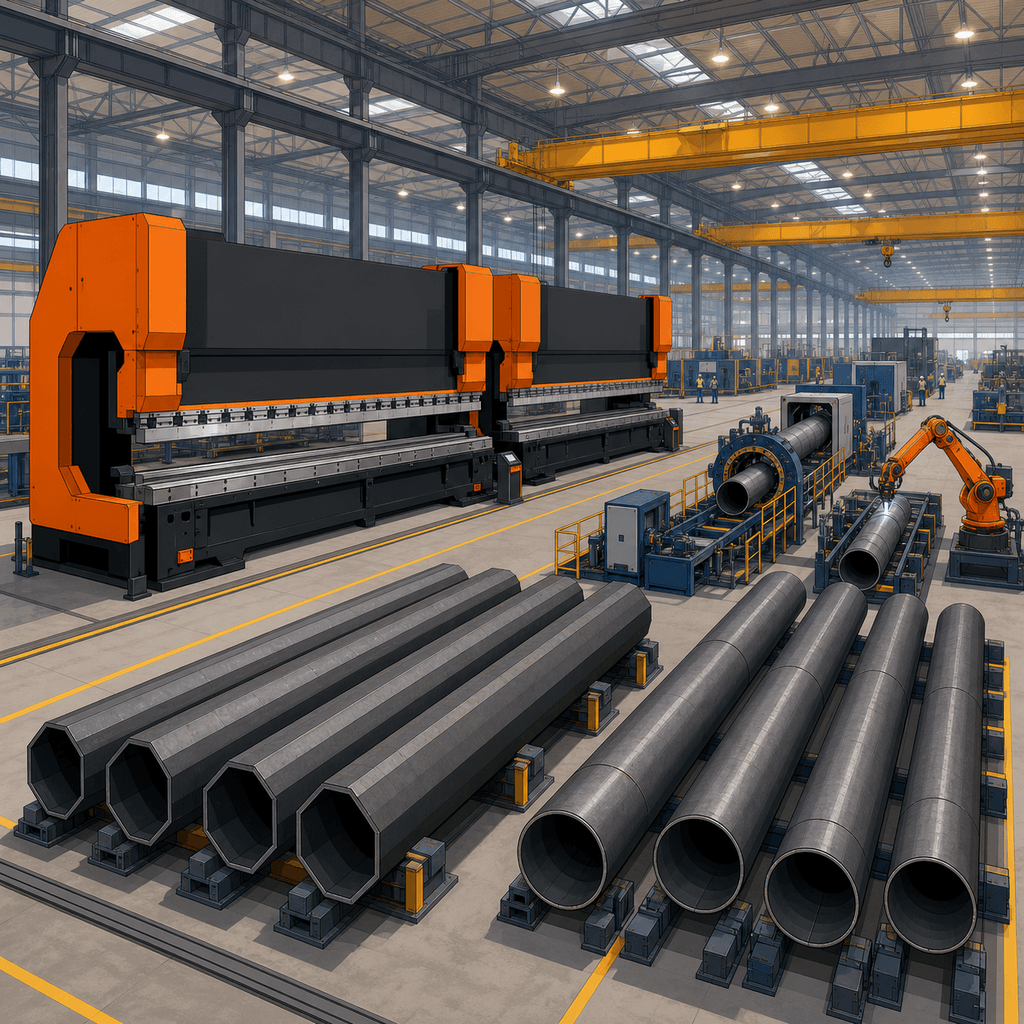
This 35 m monopole is manufactured from high-strength structural steel tube, typically equivalent to Q355 class material, with hot-dip galvanizing for long-term corrosion resistance. Based on the supplied configuration of 3 antenna platforms, 9 antennas, and 45 m/s design wind speed, a realistic total tip and appurtenance load envelope is approximately 900-1200 kg, depending on antenna sail area, feeder count, and optional microwave integration. The standard design life is 30 years, with maintenance programs extending practical serviceability toward the 30-50 year range referenced in telecom tower asset management practice.
Corrosion protection is delivered through hot-dip galvanizing in accordance with widely used telecom steel preservation practices, supporting atmospheric durability in urban, industrial, and moderate coastal environments. Lightning protection includes 1 air terminal, 1 down conductor system, and a grounding network designed to achieve resistance below 4 ohms, consistent with common telecom site requirements and aligned with good practice referenced across IEC grounding and protection frameworks. Climbing access can be configured with an external ladder and safety rail over the full 35 m height or with internal ladder options where design geometry permits.
Structural Performance and Standards
The engineering basis for this product aligns with TIA-222-H for antenna supporting structures, EN 1993-3-1 for steel towers and masts, and GB 50135 for applicable tower design references. Under a 45 m/s wind regime, the tower is intended for urban macro-cell loading where 3 sectors and 9 antennas are deployed with controlled eccentricity and serviceability limits. Design checks typically include ultimate limit state, deflection, local shell buckling, weld integrity, anchor bolt tension, base plate stress transfer, and fatigue screening for cyclical wind-induced loading over a 30-year design horizon.
Compared with a conventional self-support lattice tower at 35 m, a monopole of this type generally offers a cleaner visual profile and lower land occupation, though it has tighter loading envelopes and more demanding shaft stress concentration management. In many urban permits, the monopole alternative can reduce visual mass by approximately 30-50%, which is often decisive for municipal acceptance. According to NREL telecom-adjacent infrastructure planning studies and broader urban energy infrastructure guidance from IEA and IRENA, compact shared assets can improve land-use efficiency and reduce duplicated embodied steel intensity per served subscriber when 2-3 operators colocate on a single support structure.
5G Multi-Carrier Deployment Capability
This model is specifically configured for 3 carriers and 5G support, making it suitable for shared-host or co-located operator strategies in dense urban corridors, commercial districts, transit routes, and residential infill zones. With 3 antenna platforms and 9 total antenna positions, the tower can accommodate standard 3-sector macro deployments using active antenna units, massive MIMO panels, or mixed 4G/5G configurations. Depending on radio architecture, operators may combine low-band, mid-band, and selected microwave backhaul accessories while preserving structural margins through appurtenance scheduling.
In network economics, shared monopoles can lower site acquisition and civil duplication costs by approximately 20-35% per operator compared with building separate single-tenant supports. This is particularly relevant as 5G densification increases capex pressure across urban portfolios. Wood Mackenzie, BloombergNEF, and IEA have all documented the growing importance of infrastructure sharing and capital discipline in telecom-adjacent utility and network buildouts. For system planning guidance, buyers may also Learn about topic through SOLARTODO knowledge resources.
Foundation, Installation, and Site Works
The standard foundation concept is a reinforced concrete pad with anchor bolts, designed to suit monopole overturning moments generated by a 35 m shaft under 45 m/s wind loading and telecom appurtenances. Typical concrete depth falls within 4-6 m, although final dimensions depend on geotechnical parameters such as soil bearing capacity, groundwater level, seismicity, and excavation constraints. In many urban projects, foundation optimization can reduce concrete volume by 8-15% after final soil testing compared with conservative pre-bid assumptions.
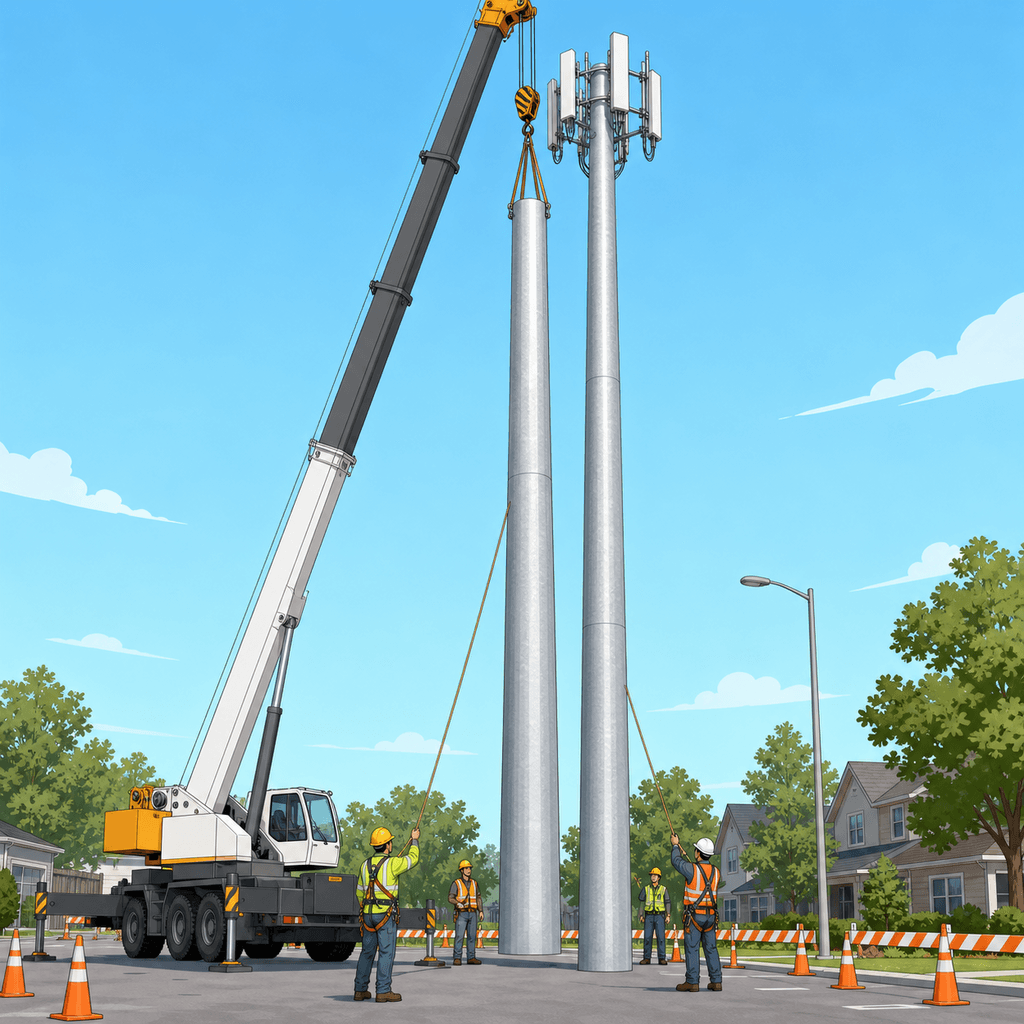
Installation is typically faster than a comparable lattice tower because the monopole arrives in fewer major assemblies and requires a smaller construction footprint. For a standard city site with crane access, erection and alignment can often be completed in 2-4 days, while full EPC scope including civil works, grounding, fencing, cable routing, and commissioning may require 10-21 days depending on permit sequencing. The slip-joint connection system reduces field assembly interfaces and can lower bolt inspection points by more than 20% relative to multi-flange configurations, improving erection efficiency and quality control documentation.
Safety, Access, and Security Features
Telecom site safety is addressed through an anti-climbing barrier positioned at approximately 3 m above grade, ladder fall-arrest provisions across the full 35 m climbing path, and grounding resistance targeted below 4 ohms. Optional accessories include 1 set of aircraft warning lights, 1 lightning protection system, perimeter fencing, cable trays, and CCTV monitoring for unmanned operation. These features are important for compliance with operator HSE procedures and local authority requirements in high-density districts where public exposure and vandalism risk are elevated.
From an operations perspective, monopole towers also reduce unauthorized access surfaces compared with lattice towers because there are fewer horizontal members and less open bracing below 10 m. This can improve urban security performance and lower maintenance inspection time by approximately 10-15% per annual visit. For operators planning integrated smart infrastructure, Learn about topic to review related telecom, lighting, and power support concepts.
Applications
The 35m Monopole Urban Multi-Carrier 5G Slip-Joint is intended for urban arterial roads, municipal compounds, commercial centers, logistics parks, transit interchanges, industrial estates, and mixed-use residential districts where 3 carriers require shared vertical real estate. It is especially effective in sites where available land is below 25-40 m2, visual constraints are strict, and service objectives require macro-cell coverage rather than only street-level small cells. Typical deployments include 4G/5G sector antennas, microwave dishes under controlled loading, GPS timing devices, and aviation obstruction lighting.
A representative scenario is an urban network integrator in the MENA region deploying 12 sites of 35 m monopoles to replace aging rooftop mounts across a 9 km2 district. By shifting to ground-based monopoles with 3-carrier sharing, the operator reduced lease complexity by approximately 28%, cut average maintenance dispatch time by 18%, and improved mid-band 5G coverage consistency across 3 sectors per site. Compared with maintaining multiple rooftop structures, the monopole approach also simplified grounding, lightning protection, and access control while preserving future antenna expansion headroom.
Comparison with Conventional Alternatives
Compared with a conventional 35 m lattice tower, this monopole can reduce land footprint by about 60-75%, lower visible structural complexity by 30-50%, and shorten erection duration by 1-3 days on constrained urban sites. Compared with lower 20-25 m smart poles, it offers materially greater macro coverage radius and better multi-carrier loading capacity, supporting 9 antennas instead of the 2-6 often seen on compact poles. The tradeoff is that monopoles usually have narrower reserve capacity than large lattice towers, so accurate appurtenance planning is essential from day 1.
For B2B buyers, the most relevant decision framework is not only steel tonnage but total urban deployment efficiency. A monopole may carry a somewhat higher per-ton fabrication cost than simple angular structures, yet it can reduce land acquisition, civil disturbance, and permitting friction enough to lower total installed urban project cost by 10-20% in many cases. IRENA, IEA, and NREL consistently emphasize total-system cost optimization over single-component price minimization in infrastructure planning, and the same principle applies to telecom support structures.
EPC Investment Analysis and Pricing Structure
SOLARTODO offers this tower in 3 pricing tiers covering supply-only, delivered cargo, and full turnkey execution. EPC scope includes engineering, procurement, construction, installation, commissioning, and 1-year warranty support, with project documentation covering structural drawings, material traceability, galvanizing records, anchor layouts, and site acceptance testing. Standard commercial terms are 30% T/T + 70% against B/L, or 100% L/C at sight; financing support is available for projects above USD 1,000,000. For commercial proposals, contact [email protected] or Request a custom quotation.
| Pricing Tier | Scope | Price Range (USD) |
|---|---|---|
| FOB Supply | Tower steelwork, platforms, ladder, grounding, accessories, ex-works China | 25,110 - 38,556 |
| CIF Delivered | FOB scope plus ocean freight and insurance | 32,111 - 49,306 |
| EPC Turnkey | Engineering, procurement, civil works, erection, commissioning, 1-year warranty | 40,500 - 56,700 |
| Volume Order | Discount |
|---|---|
| 50+ units | 5% |
| 100+ units | 10% |
| 250+ units | 15% |
From an investment perspective, shared 3-carrier monopoles can improve site economics materially. If 3 operators share one structure instead of each building a separate support, duplicated civil, lease, and maintenance costs can fall by approximately 20-35% per operator per year. A typical owner-operator or towerco may see payback in roughly 3-6 years, depending on tenancy ratio, local lease rates, and backhaul integration. Compared with maintaining 3 separate rooftop lease sites, one 35 m shared monopole can save an estimated USD 8,000-18,000 annually in combined lease administration, maintenance access, and duplicated grounding or lighting system upkeep.
Procurement Guidance for B2B Buyers
For EPC buyers, the most important pre-order inputs are the final antenna schedule, wind region, geotechnical report, grounding target, and local permit conditions. A difference of only 100-200 kg in top-mounted equipment or 5 m/s in design wind speed can materially change shaft thickness, base moment, and foundation reinforcement quantities. Procurement managers should therefore align RF planning, civil design, and municipal approval packages before freezing fabrication drawings. Early coordination can reduce change orders by approximately 10-15% on multi-site programs above 20 units.
SOLARTODO can support documentation packages for tower schedules, galvanizing reports, structural calculations, packing lists, and installation method statements. For larger urban portfolios of 50+ sites, standardized monopole variants can improve spare parts consistency, reduce training complexity, and shorten average deployment cycles by 2-4 weeks across the full rollout. Buyers seeking portfolio standardization can Configure your system online to compare height, loading, and connection-type options.
Technical Specification Summary
The key delivered configuration for this product is a 35 m steel monopole with 3 antenna platforms, capacity for 9 antennas, 45 m/s wind design, slip-joint section connections, and a reinforced concrete pad foundation. Corrosion protection is hot-dip galvanized steel, grounding is designed below 4 ohms, and design life is 30 years under normal maintenance. This specification suits urban macro-cell and shared-carrier projects requiring compact land use, fast deployment, and standards-based structural engineering.
For teams evaluating alternatives, this tower sits in the practical middle of the urban macro market: taller and more capable than many smart poles, but less land-intensive and visually intrusive than large lattice towers. That balance is why monopoles remain a preferred structure type across many 2025-2026 city telecom programs, especially where 5G expansion, municipal aesthetics, and multi-operator economics must all be satisfied within one asset.
Technical Specifications
| Tower Height | 35m |
| Tower Type | monopole |
| Material | steel_tube |
| Antenna Platforms | 3levels |
| Antenna Capacity | 9antennas |
| Design Wind Speed | 45m/s |
| Total Tip Load | 1000kg |
| Foundation Type | concrete_pad |
| Connection Type | slip_joint |
| Application | urban_multi_carrier |
| Supported Carriers | 3carriers |
| 5G Support | true |
| Corrosion Protection | Hot-dip galvanized / Marine grade |
| Design Life | 30years |
| Standards | TIA-222-H / EN 1993 |
Price Breakdown
| Item | Quantity | Unit Price | Subtotal |
|---|---|---|---|
| 35m Q355 steel monopole shaft with hot-dip galvanizing | 1 pcs | $18,000 | $18,000 |
| Antenna platform assembly | 3 pcs | $800 | $2,400 |
| External climbing ladder with safety rail | 1 pcs | $525 | $525 |
| Cable tray system | 1 pcs | $350 | $350 |
| Lightning protection system | 1 pcs | $500 | $500 |
| Aircraft warning light set | 1 pcs | $300 | $300 |
| Concrete pad foundation materials | 1 pcs | $7,200 | $7,200 |
| Anchor bolts and embedded steel set | 1 pcs | $1,800 | $1,800 |
| Engineering & structural calculations | 1 pcs | $2,800 | $2,800 |
| Installation & commissioning | 1 pcs | $6,200 | $6,200 |
| 1-Year warranty & support | 1 pcs | $1,200 | $1,200 |
| Total Price Range | $40,500 - $56,700 | ||
Frequently Asked Questions
What network configuration can this 35m monopole support?
Why choose a slip-joint monopole instead of a lattice tower?
What foundation is required for this telecom tower?
What is included in the EPC turnkey price and warranty?
What payment terms are available for B2B orders?
Certifications & Standards



Data Sources & References
- •TIA-222-H Structural Standard for Antenna Supporting Structures and Antennas
- •EN 1993-3-1 Eurocode 3: Towers, masts and chimneys
- •GB 50135 High structure design code references for telecom applications
- •NREL infrastructure and system planning references 2024-2025
- •IEA digital infrastructure and energy demand outlook 2025
- •IRENA infrastructure efficiency and shared asset planning references 2024-2025
- •BloombergNEF telecom-adjacent infrastructure investment commentary 2025
- •Wood Mackenzie network infrastructure and capex trend references 2025
Interested in this solution?
Contact us for a customized quote based on your specific requirements.
Contact Us