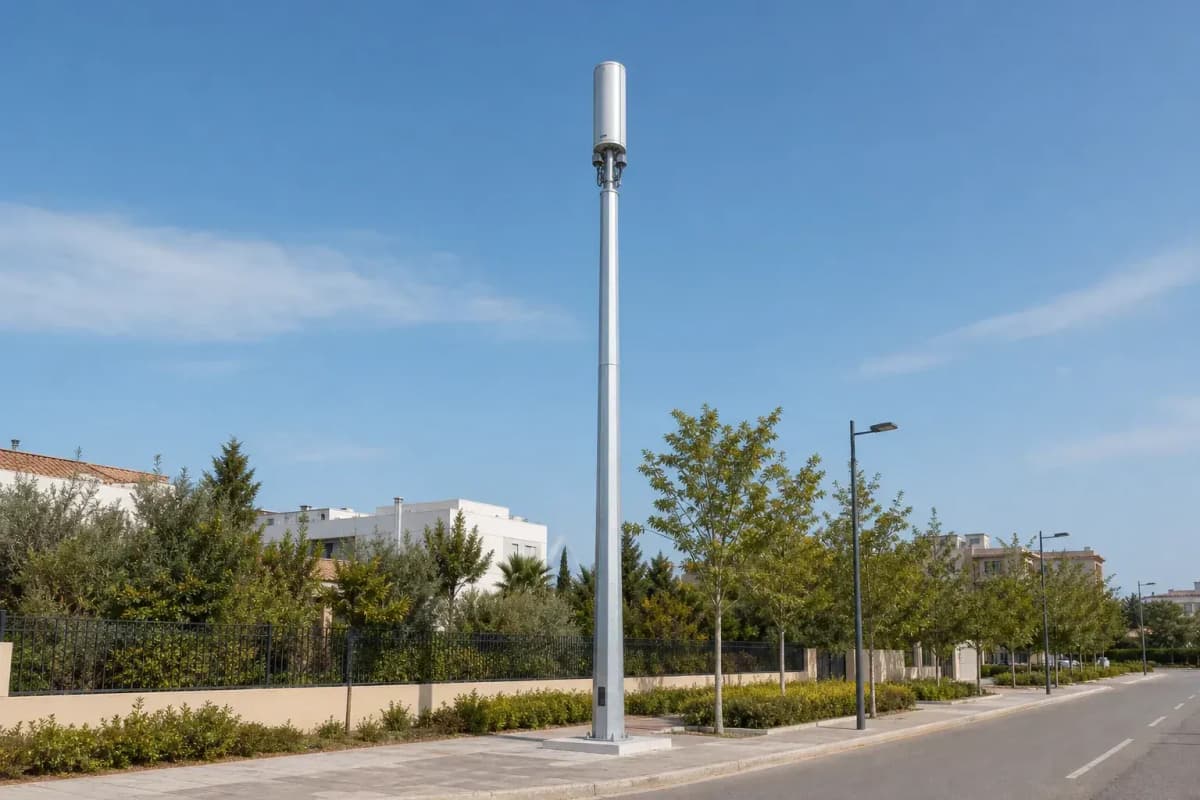
8m Small Cell Pole 5G Urban Slip-Joint - 37 m/s Steel Octagonal Telecom Pole
Key Features
- 8 m steel octagonal small cell pole for urban 5G densification under 200 m inter-site planning
- 37 m/s design wind speed baseline with final checks against local terrain, antenna EPA, and code factors
- 1 antenna level supports up to 4 antennas, GPS, CCTV, IoT, or smart-lighting accessories
- Slip-joint 2-section shaft reduces visible mid-height flange hardware by 1 joint set
- $450-$767 EPC turnkey price with engineering, installation, commissioning, and 1-year warranty
The SOLARTODO 8m Small Cell Pole 5G Urban Slip-Joint is a steel octagonal telecom pole for 4 antennas, 1 concealed antenna level, and 37 m/s design wind speed. EPC turnkey pricing is $450-$767 per pole for urban 5G densification, street corridors, campuses, and smart-city nodes.
Description
The SOLARTODO 8m Small Cell Pole 5G Urban Slip-Joint is a compact steel octagonal telecom support structure for 5G urban densification, 4 antenna positions, 1 integrated antenna level, and 37 m/s design wind speed. The EPC turnkey range is $450-$767 per installed pole, covering engineering, procurement, construction, commissioning, and a 1-year warranty for dense-city networks with typical inter-site distances below 200 m.
8 m Product Overview
This 8 m small cell pole is designed for operators, tower companies, smart-city contractors, and EPC developers that need low-visual-impact 5G coverage on urban streets, transport corridors, municipal plazas, commercial parks, and public-service zones. The slip-joint steel octagonal structure reduces exposed flange diameter by about 20-35% compared with a bolted-flange monopole of similar 8 m height, while keeping transport sections short enough for containerized export and fast street-level installation.
SOLARTODO positions this product inside the View all Telecom Tower products range as a compact, repeatable node for 4G/5G radios, GPS antennas, security cameras, smart lighting, and edge power cabinets. For procurement teams comparing 50, 100, or 250 pole packages, the main buying variables are wind map, antenna effective projected area, foundation class, galvanizing thickness, color finish, radio concealment, and whether installation is delivered as FOB, CIF, or EPC.
8 m System Architecture
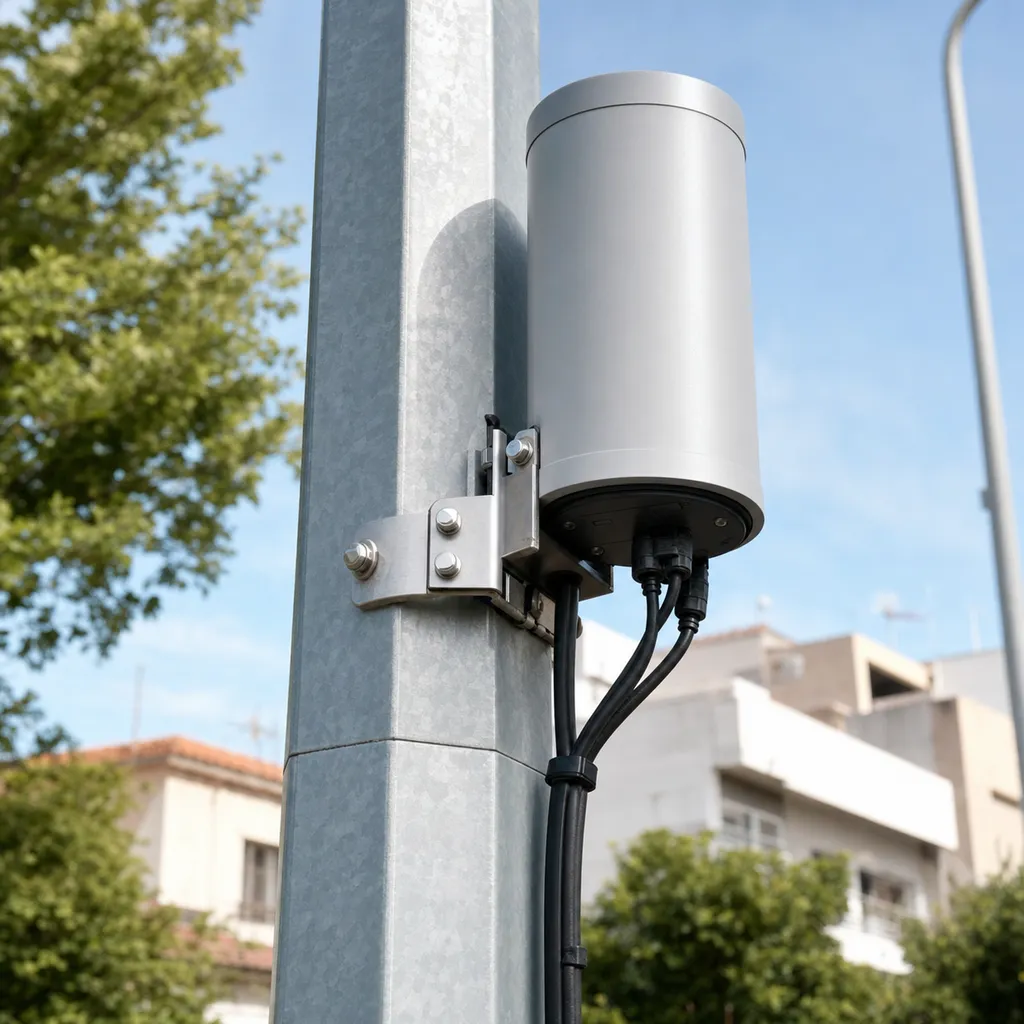
The pole uses a tapered octagonal steel shaft with a slip-joint connection, 1 top antenna platform or concealed mounting zone, internal or protected cable routing, a base plate with anchor bolts, and a grounding interface designed for a target resistance below 4 ohm where soil conditions allow. The 8 m height is suitable for sidewalk and roadway deployments where the antenna centerline normally needs 6-9 m elevation without the zoning burden of a 15-30 m macro tower.
The slip-joint connection works by overlapping 2 tapered steel sections under axial compression and erection load, eliminating 1 external bolted flange at the mid-height joint. In a typical 8 m shipment, the lower section and upper section can be nested or bundled to reduce package length by about 25-40%, which matters on 20 ft container routes, restricted urban staging areas, and projects with more than 100 sites.
Technical Specifications
The baseline configuration is 8 m tower height, steel octagonal material, 1 antenna level, 4 antenna positions, and 37 m/s design wind speed. Structural checking should be finalized against the local site category, terrain exposure, antenna EPA, cable load, ice load where applicable, and national annex because a 37 m/s wind case can produce materially different base moments in Exposure B, C, or D.
| Parameter | Baseline value | Procurement note |
|---|---|---|
| Tower height | 8 m | Urban 5G small cell elevation |
| Structure type | Steel octagonal pole | Compact street-furniture profile |
| Connection | Slip-joint | 2-section shaft, no mid flange |
| Antenna capacity | 4 antennas | 4G/5G panels, GPS, or IoT devices |
| Antenna levels | 1 level | Concealed or semi-concealed top zone |
| Design wind speed | 37 m/s | Site verification required |
| Grounding target | less than 4 ohm | Soil-dependent test value |
| Design life | 30 years | With galvanizing and maintenance |
Standards and Engineering Basis
For the United States, ANSI/TIA-222-H is the primary structural reference for antenna supporting structures, and TIA states that Revision H addresses structural design, fabrication, foundations, wind, seismic, climbing facilities, and inspection provisions for antenna-supporting structures: https://standards.tiaonline.org/news-media/press-releases/tia-announces-publication-tia-222-H-standard-antennas-and-supporting. For European projects, EN 1993-3-1 and national annex wind data are typically used for towers and masts, while local permitting may also require EN 40 checks when the pole is integrated with street lighting.
Lightning and earthing are specified around IEC 62305 risk management principles, IEC 62561 lightning protection components, ITU-T K.56 radio-base-station protection practice, and IEEE 81-2025 grounding measurement methods. The practical telecom objective is a low-impedance bonding network, a continuous down conductor, surge protective devices at power and signal interfaces, and measured grounding resistance commonly targeted below 4 ohm after installation.
The 37 m/s wind requirement corresponds to about 133 km/h before site-specific gust conversion, terrain factors, and code coefficients are applied. Because antenna panels, shrouds, radios, cameras, luminaires, and advertising attachments can add 0.1-0.8 m2 of projected area per device, SOLARTODO requires the buyer to confirm 4 antenna dimensions and weights before final shaft thickness, base plate diameter, and anchor bolt grade are released for production.
Urban 5G Applications
This 8 m pole is optimized for 5G densification where network planners often work with less than 200 m inter-site distance in dense urban streets, station approaches, venue perimeters, commercial zones, and mixed-use districts. The pole can support 4 small-cell antennas or a mixed set of 2 panel antennas, 1 GPS antenna, and 1 CCTV or IoT sensor module, depending on the carrier radio plan and municipal aesthetics rules.
For a representative MENA smart-district scenario, assume a 2 km boulevard using 20 poles at 100 m spacing, each with 4 antennas, 1 luminaire interface, and 1 fiber or microwave backhaul path. Compared with a conventional macro-only overlay using 1 tall tower for the same corridor, the small-cell layout improves street-level signal reuse and can reduce average user distance to the radio by about 60-80%, although actual throughput depends on spectrum, radio power, backhaul, and interference planning.
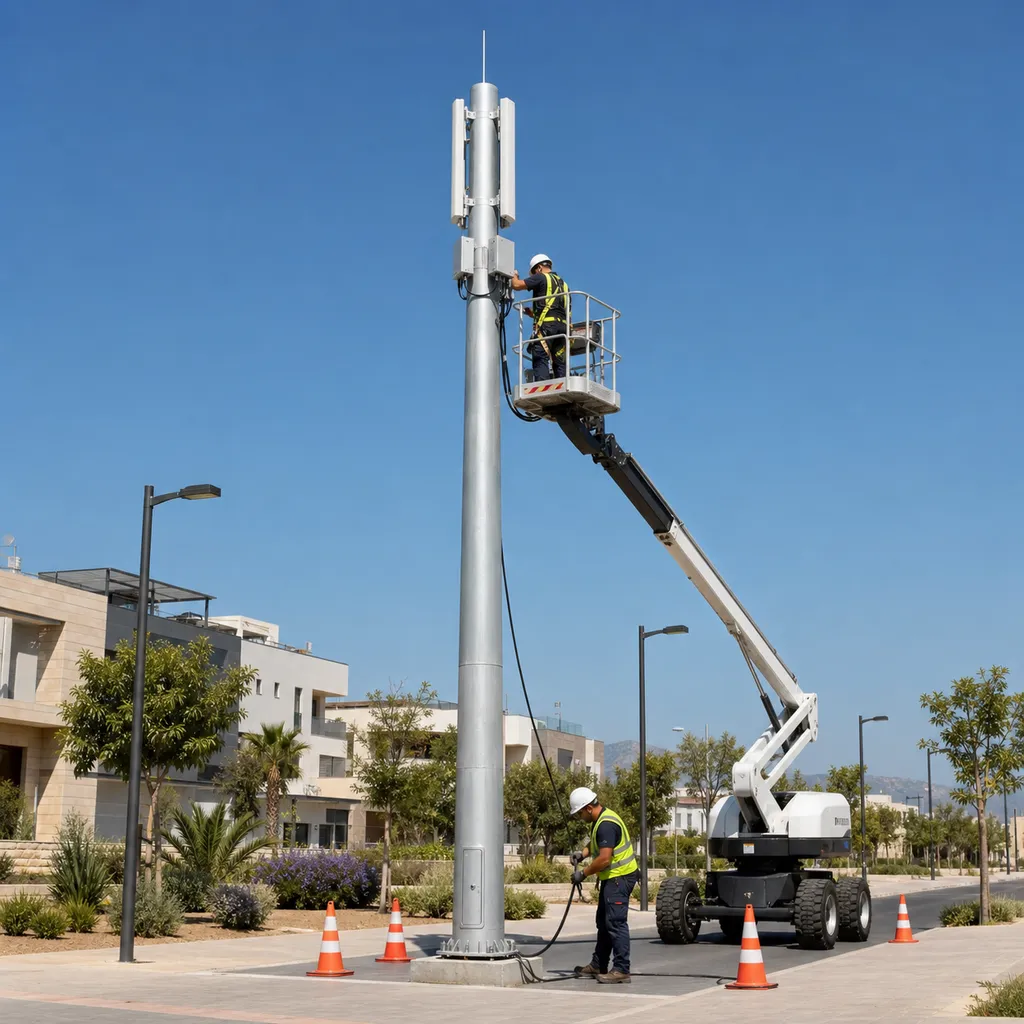
Small-cell deployment also aligns with the energy-system trend toward digitalized, flexible infrastructure. The IEA notes that demand flexibility can reduce peak stress and improve utilization of existing power-network assets in modern electricity systems: https://www.iea.org/reports/the-value-of-demand-flexibility. For a smart pole package, this supports optional integration of metering, remote switching, adaptive lighting, and edge monitoring so that 50-250 distributed nodes can be maintained as infrastructure assets rather than isolated telecom mounts.
Materials, Corrosion Protection, and Service Life
The default material is steel octagonal shaft construction using Q355-class or equivalent structural steel, hot-dip galvanized after fabrication, and optionally powder coated in RAL colors for 1 municipal visual standard. For inland C3 environments, a correctly specified zinc coating and 2 scheduled inspections per year can support a 30-year design life; for coastal C4-C5 environments, marine-grade coating systems and faster maintenance intervals should be priced before purchase.
Compared with FRP stealth poles, galvanized steel has higher stiffness for the same 8 m height and usually provides better capacity for 4 antennas plus brackets under 37 m/s wind. Compared with a conventional 8 m flange-connected steel pole, the slip-joint version can reduce visible joint hardware by 1 flange set and simplify facade integration, but it requires controlled overlap length, erection marks, and torque-controlled base anchor installation.
Cloud Monitoring
The pole can be delivered as a passive structural product or as a monitored smart-infrastructure node with power-meter input, cabinet door sensor, surge event counter, vibration alarm, and temperature monitoring for 1 equipment cabinet. A monitored 100-pole district can report alarms by pole ID, feeder circuit, and GPS coordinate, giving operators a structured maintenance queue instead of manual inspection notes after every storm or outage.
Cloud monitoring is optional because some telecom buyers already operate their own NOC, SCADA, OSS, or IoT platform. When included, SOLARTODO can provide API-ready telemetry fields for voltage, current, enclosure temperature, door status, SPD status, and 1-15 minute reporting intervals, while ownership of SIM cards, IP addressing, cybersecurity rules, and data-retention policy remains a project-level decision.
Procurement and Configuration Workflow
Procurement teams should start by confirming 8 inputs: city or coordinates, design wind speed, corrosion class, antenna count, antenna dimensions, radio weight, cable route, and foundation constraints. After those 8 items are known, buyers can Configure your system online or Request a custom quotation with a drawing package, bill of quantity, and installation boundary.
The typical submittal package includes 1 general arrangement drawing, 1 foundation drawing, 1 anchor bolt schedule, 1 galvanizing or coating specification, 1 packing list, and 1 installation method statement. For larger 50+ pole packages, project developers often add a prototype inspection, third-party coating test, batch traceability report, and sample pole approval before releasing mass production.
EPC Investment Analysis and Pricing Structure
EPC turnkey delivery includes engineering, procurement, construction, commissioning, and a 1-year warranty for the installed 8 m small cell pole. Engineering covers structural calculations and drawings; procurement covers steel pole fabrication, galvanizing, brackets, anchor hardware, and packing; construction covers foundation interface, pole erection, grounding, and handover; commissioning covers plumbness check, grounding test, visual inspection, and punch-list closure.
| Pricing tier | Scope | Unit price range |
|---|---|---|
| FOB Supply | Equipment only, ex-works China | $279-$522 |
| CIF Delivered | FOB supply plus ocean freight and insurance | $357-$668 |
| EPC Turnkey | Installed, commissioned, and covered by 1-year warranty | $450-$767 |
| Volume band | Discount | Example procurement effect |
|---|---|---|
| 50+ poles | 5% | Applies to repeat drawings and batch production |
| 100+ poles | 10% | Improves container utilization and QC efficiency |
| 250+ poles | 15% | Best for citywide or operator framework rollouts |
A representative ROI case can compare a 100-pole small-cell street network against 10 macro infill sites where rooftop leasing, heavy tower works, and longer permitting cycles dominate cost. If each small-cell pole avoids $250 per month of rooftop lease exposure versus an alternative mounting location, 100 poles can represent $300,000 per year of avoided lease cost, giving a simple payback of about 1-3 years against a $45,000-$76,700 EPC pole package before radio equipment costs.
The cost comparison is most favorable when municipalities already need lighting, cameras, Wi-Fi, or traffic-sensing infrastructure on the same 8 m streetscape asset. In that combined use case, 1 pole can replace 2-3 separate street fixtures, reducing civil works, cable trenches, and visual clutter by roughly 25-40% compared with separate lighting pole, camera pole, and telecom mount installations.
Standard payment terms are 30% T/T deposit plus 70% against bill of lading, or 100% irrevocable L/C at sight for approved buyers. Project financing can be discussed for orders above $1,000K, especially multi-city telecom, smart-lighting, and security infrastructure packages; contact [email protected] for a commercial structure with Incoterms, delivery schedule, and warranty boundary clearly stated.
Quality Control, Testing, and Handover
Factory QC normally includes 5 production controls: material certificate review, dimensional inspection, welding visual inspection, galvanizing thickness check, and trial-fit verification of slip-joint overlap marks. For 50+ pole orders, SOLARTODO recommends pre-shipment inspection using ANSI/TIA-222-H drawing assumptions, EN 1993 fabrication logic, and project-specific coating criteria rather than relying only on a generic catalog datasheet.
Site handover should record at least 6 acceptance items: foundation maturity, anchor bolt projection, pole verticality, grounding resistance, coating damage repair, and antenna bracket readiness. IEEE 81-2025 is relevant because it covers measurement of earth resistivity, ground impedance, and surface potentials of grounding systems, which makes the final less-than-4-ohm grounding target a measured value rather than a drawing-only assumption: https://standards.ieee.org/ieee/81/11218.
Buyer Notes and Related Knowledge
This product page describes the structural pole and EPC installation boundary, not the licensed 5G radio equipment, spectrum planning, SIM provisioning, or operator core network. Buyers can review general design context at Learn about topic and should submit 4 antenna datasheets, 1 wind map location, and 1 installation photo or site plan for a project-specific quotation.
For projects requiring solar power, battery backup, smart lighting, cameras, or perimeter security, SOLARTODO can combine the 8 m telecom pole with energy storage and monitoring components from its solar, security, and smart-infrastructure portfolio. IRENA and IEA both emphasize that electrified, distributed, and digital infrastructure requires coordinated planning, and this 8 m pole is best specified as 1 repeatable node inside a larger city or campus asset plan rather than as an isolated steel component.
Technical Specifications
| Tower Height | 8m |
| Tower Type | small_cell_pole |
| Material | steel_octagonal |
| Application | 5g_urban |
| Connection Type | slip_joint |
| Antenna Platforms | 1levels |
| Antenna Capacity | 4antennas |
| Design Wind Speed | 37m/s |
| Total Tip Load | 80kg |
| Foundation Type | reinforced concrete pier with anchor bolt cage |
| Grounding Resistance Target | <4ohm |
| Corrosion Protection | Hot-dip galvanized / marine grade coating optional |
| Design Life | 30years |
| Standards | TIA-222-H / EN 1993-3-1 / IEC 62305 / IEEE 81-2025 |
Price Breakdown
| Item | Quantity | Unit Price | Subtotal |
|---|---|---|---|
| 8 m steel octagonal slip-joint pole | 1 pcs | $279 | $279 |
| Integrated 4-antenna mounting kit | 1 pcs | $60 | $60 |
| Cable routing and grounding provision | 1 pcs | $48 | $48 |
| Base plate anchor hardware set | 1 pcs | $36 | $36 |
| Engineering drawings and QC documentation | 1 pcs | $48 | $48 |
| Installation and commissioning | 1 pcs | $82 | $82 |
| 1-year warranty and support | 1 pcs | $22 | $22 |
| Total Price Range | $450 - $767 | ||
Frequently Asked Questions
What is included in the $450-$767 EPC turnkey price?
How many antennas can the 8 m small cell pole support?
Which standards are used for structural and electrical design?
Why use a slip-joint pole instead of a bolted-flange pole?
Can SOLARTODO integrate lighting, solar power, or monitoring?
Certifications & Standards


Data Sources & References
- •TIA ANSI/TIA-222-H publication notice: https://standards.tiaonline.org/news-media/press-releases/tia-announces-publication-tia-222-h-standard-antennas-and-supporting
- •IEEE 81-2025 grounding measurement standard page: https://standards.ieee.org/ieee/81/11218
- •IEC 62561-6:2023 lightning protection component standard page: https://webstore.iec.ch/en/publication/68649
- •ITU-T K.56 radio base station lightning protection summary: https://www.itu.int/dms_pubrec/itu-t/rec/k/T-REC-K.56-202105-I!!SUM-HTM-E.htm
- •IEA The Value of Demand Flexibility 2025: https://www.iea.org/reports/the-value-of-demand-flexibility
- •SOLARTODO product and quotation context: https://solartodo.com/products/telecom-tower
Interested in this solution?
Contact us for a customized quote based on your specific requirements.
Contact Us