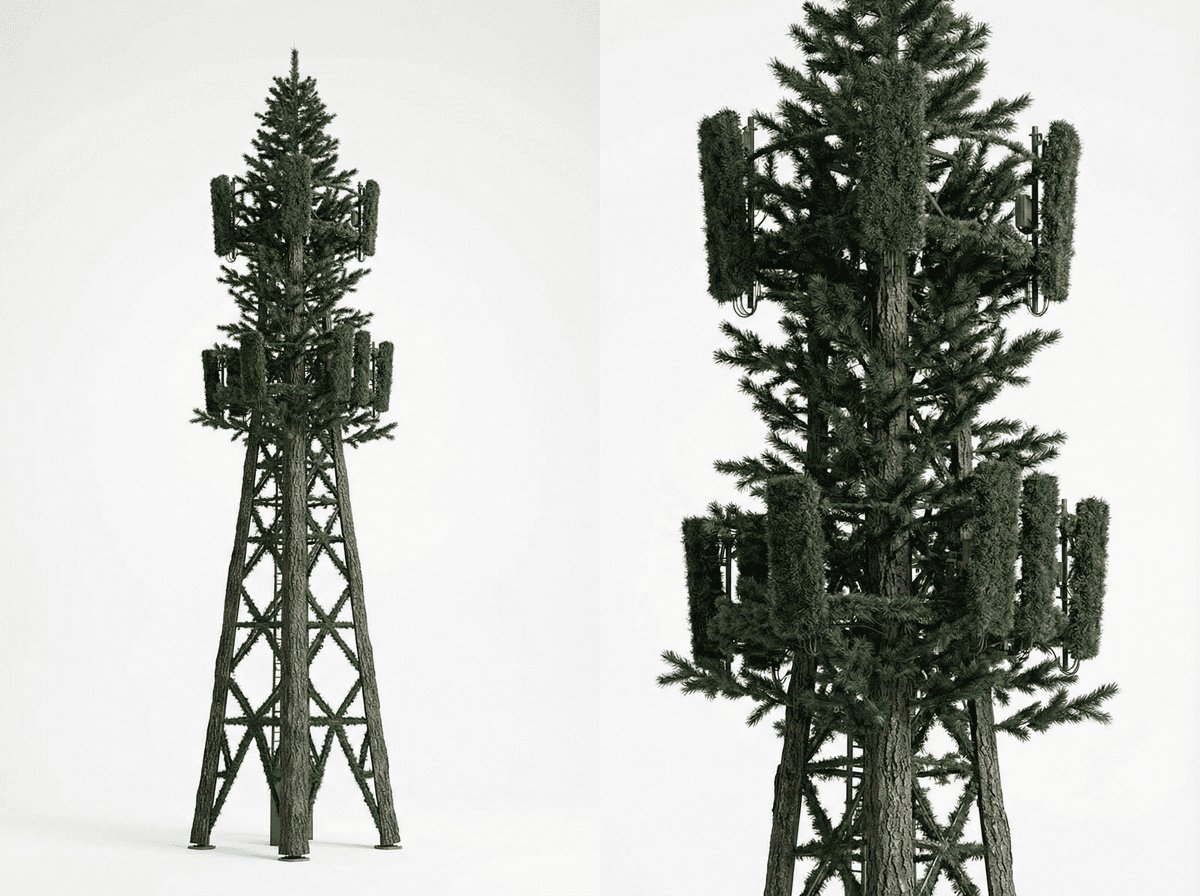
70m Camouflaged Pine Tree Tower — Stealth Telecom Structure for Scenic Areas
Key Features
- 70-meter structural height with pine-tree camouflage cladding achieving >85% visual opacity from 50m distance, concealing all 12 antenna units and cable systems from public viewpoints
- 4 independent antenna platforms at 35m, 45m, 55m, and 65m, each rated at 500 kg/m² load capacity, supporting 4G LTE, 5G NR massive MIMO (up to 64T64R), and microwave backhaul simultaneously
- Design wind speed of 45 m/s (50-year return period) per ASCE 7-22 and EN 1991-1-4, with structural core of Q345B steel lattice hot-dip galvanized to ISO 1461 (minimum 86 µm zinc coating)
- IEC 62305-3:2010 Protection Level I lightning protection system with grounding resistance guaranteed <4 ohms, plus ICAO Annex 14 compliant LED aviation warning lights rated 50,000 hours at 2,000 candela
- 30-year structural design life with 15-year UV-stability warranty on FRP/HDPE cladding; compliant with TIA-222-H (USA), EN 1993-3-1 (EU), and GB 50135 (China) standards
The SOLARTODO 70m Camouflaged Tree Tower is a stealth telecommunications structure designed for scenic areas, priced between $120,000 and $160,000. It supports 12 antenna units and features a high-strength Q345 steel lattice core with a photorealistic pine-tree camouflage. Certified to TIA-222-H and EN 1993-3-1 standards, it meets the growing demand for discreet connectivity solutions.
Description
The SOLARTODO 70m Camouflaged Tree Tower is a premium stealth telecommunications structure engineered to deliver full-height cellular and wireless infrastructure while maintaining complete visual harmony with natural forested environments. Designed specifically for deployment in scenic areas, national parks, eco-tourism corridors, and heritage-protected zones, this tower achieves a structural height of 70 meters through a high-strength Q345 steel lattice core fully enclosed within a multi-layer pine-tree camouflage cladding system. The result is a structure that is functionally indistinguishable from a mature conifer at ground level, yet capable of supporting 12 antenna units across 4 independent platforms simultaneously.
As 5G network densification accelerates globally, operators face increasing regulatory and community resistance to conventional lattice and monopole towers in visually sensitive locations. Camouflaged towers — sometimes referred to as "stealth towers" or "concealment towers" — represent the fastest-growing segment of the tower infrastructure market in 2025, driven by municipal zoning requirements, national park authority mandates, and the growing expectation of seamless connectivity in outdoor recreation areas. The SOLARTODO 70m Camouflaged Tree Tower directly addresses this market need by combining structural engineering excellence with a photorealistic pine-tree aesthetic, all within a design life of 30 years and compliance with TIA-222-H (USA), EN 1993-3-1 (EU), and GB 50135 (China) standards.
The structural core is a self-supporting steel lattice column fabricated from Q345B structural steel sections, hot-dip galvanized to a minimum coating thickness of 86 µm in accordance with ISO 1461. The lattice geometry is optimized through finite element analysis (FEA) to minimize material weight while achieving a design wind speed resistance of 45 m/s — equivalent to a Category 3 hurricane or a 50-year return period wind event under ASCE 7-22 loading criteria. The tower is divided into 14 bolted flange sections for transport and field assembly, each section weighing no more than 2.8 tonnes. Total structural steel weight is approximately 38 tonnes. The foundation system consists of a reinforced concrete spread footing consuming approximately 180 m³ of C30 concrete, engineered to resist an overturning moment of 8,500 kN·m at the base.
The pine-tree camouflage cladding system consists of three integrated layers: a structural FRP trunk shell, a modular branch-and-foliage assembly, and a UV-stabilized surface treatment. The FRP trunk shell is fabricated in 5-meter segments with a wall thickness of 8–12 mm and a tensile strength exceeding 180 MPa, textured with a high-fidelity bark mold derived from photogrammetric scans of actual Pinus sylvestris specimens. The branch-and-foliage assembly consists of 3,200 individual branch units arranged in 28 circumferential tiers, injection-molded from UV-stabilized HDPE with a Shore D hardness of 65. Foliage density is calibrated at 1.8 kg/m² of projected area, achieving a visual opacity greater than 85% when viewed from distances beyond 50 meters — effectively concealing all antenna hardware, cable trays, and structural members from public viewpoints.
The tower accommodates 4 antenna platforms positioned at heights of 35 m, 45 m, 55 m, and 65 m above ground level, each platform providing a 360° working circumference of 2.4 meters in diameter with a load rating of 500 kg/m². The tower supports a total of 12 antenna units distributed across the 4 platforms (3 per platform), accommodating standard 4G LTE macro panels, 5G NR massive MIMO arrays (up to 64T64R), microwave backhaul dishes, and GPS/GNSS reference antennas. Feeder cable management is provided by a 70-meter aluminum alloy ladder-type cable tray (300 mm wide) providing organized routing for up to 48 individual coaxial or fiber-optic feeders.
The lightning protection system is designed in accordance with IEC 62305-3:2010, achieving Protection Level I with a rolling sphere radius of 20 meters. The system comprises a stainless steel air terminal at the tower apex, a 70-meter copper down conductor (minimum cross-section 50 mm²), and a ring earth electrode buried at 0.8 meters depth. Measured grounding resistance is guaranteed to be less than 4 ohms. Aviation obstruction lighting complies with ICAO Annex 14, with two sets of medium-intensity red LED aviation warning lights (2,000 candela) installed at the 35-meter and 70-meter levels, rated IP66 with a service life of 50,000 hours.
Internal access is provided by a 70-meter FRP internal climbing ladder with a continuous fall-arrest rail (EN 353-1 compliant), with rest platforms at 15-meter intervals. An anti-climbing security barrier is installed at 3.0 meters above ground level. All structural steel receives hot-dip galvanizing to ISO 1461 (minimum 86 µm), and critical fasteners are treated with zinc-flake coating achieving 1,000 hours salt-spray resistance per ISO 9227. The structural steel core carries a design life of 30 years; the FRP cladding system is warranted for 15 years against UV-induced color change and structural delamination.
The complete tower system is delivered in 6 standard 12-meter flat-rack shipping containers with a total shipping weight of approximately 52 tonnes. On-site assembly requires a 50-tonne mobile crane and a skilled erection crew of 12 persons, with a typical installation duration of 18–22 working days. Standard lead time from order confirmation to factory dispatch is 16–20 weeks. The tower is priced in the range of $120,000–$160,000 (supply only, EXW factory), with installation costs estimated at an additional $45,000–$65,000 depending on site access conditions.
Technical Specifications
| Tower Height | 70m |
| Tower Type | Camouflaged (Pine Tree) |
| Structural Material | Q345B Steel Lattice + FRP/HDPE Cladding |
| Antenna Platforms | 4levels |
| Antenna Capacity | 12units |
| Design Wind Speed | 45m/s |
| Total Structural Steel Weight | ~38tonnes |
| Total Tip Load Capacity | 800kg |
| Foundation Concrete Volume | ~180m³ |
| Overturning Moment (Base) | 8,500kN·m |
| Grounding Resistance | <4ohm |
| Zinc Coating Thickness (ISO 1461) | 86 min.µm |
| Cladding Branch Units | 3,200pcs |
| Visual Opacity (>50m distance) | >85% |
| Aviation Warning Light Intensity | 2,000candela |
| Design Life (Structure) | 30years |
| Design Life (Cladding) | 15years |
| Standards | TIA-222-H / EN 1993-3-1 / GB 50135 |
| Application | Scenic Area / National Park / Heritage Zone |
| Price Range (Supply Only, EXW) | $120,000 – $160,000USD |
Price Breakdown
| Item | Quantity | Unit Price | Subtotal |
|---|---|---|---|
| Structural Steel (Q345B Lattice, ~38 tonnes) | 38 ton | $1,800 | $68,400 |
| Hot-Dip Galvanizing (ISO 1461) | 38 ton | $400 | $15,200 |
| FRP Trunk Cladding Sections (14 × 5m segments) | 70 m | $200 | $14,000 |
| HDPE Branch & Foliage Assembly (3,200 units) | 1 set | $12,000 | $12,000 |
| Antenna Platform (Steel, 4 levels) | 4 pcs | $2,500 | $10,000 |
| Internal Climbing Ladder (FRP, 70m) | 70 m | $120 | $8,400 |
| Cable Tray System (Aluminum, 70m) | 70 m | $50 | $3,500 |
| Lightning Protection System (IEC 62305-3 LPL I) | 1 set | $3,000 | $3,000 |
| Aircraft Warning Light (ICAO Annex 14, LED) | 2 set | $2,500 | $5,000 |
| Foundation (C30 Concrete, ~180 m³) | 180 m³ | $300 | $54,000 |
| Steel Installation & Erection | 38 ton | $800 | $30,400 |
| FRP Cladding Installation | 70 m | $150 | $10,500 |
| Total Price Range | $120,000 - $160,000 | ||
Frequently Asked Questions
How does the pine-tree camouflage affect the RF performance of installed antennas?
What is the maintenance schedule for the camouflage cladding, and how are damaged branches replaced?
Can the tower be approved for installation in a UNESCO World Heritage Buffer Zone or a national park?
What wind and seismic loading conditions can the tower withstand?
What is the lead time from order placement to delivery, and what documentation is provided?
Certifications & Standards



Data Sources & References
- •TIA-222-H (2017): Structural Standard for Antenna Supporting Structures and Antennas, Telecommunications Industry Association
- •EN 1993-3-1:2006: Eurocode 3 — Design of Steel Structures, Part 3-1: Towers, Masts and Chimneys
- •IEC 62305-3:2010: Protection Against Lightning — Part 3: Physical Damage to Structures and Life Hazard
- •ASCE 7-22: Minimum Design Loads and Associated Criteria for Buildings and Other Structures
- •ICAO Annex 14, Volume I: Aerodrome Design and Operations, 8th Edition (2018)
- •ISO 1461:2009: Hot Dip Galvanized Coatings on Fabricated Iron and Steel Articles
- •GSMA Intelligence: Global 5G Connections Forecast 2025–2030
- •GB 50135-2019: Code for Design of High-Rising Structures, Ministry of Housing and Urban-Rural Development of China
Interested in this solution?
Contact us for a customized quote based on your specific requirements.
Contact Us