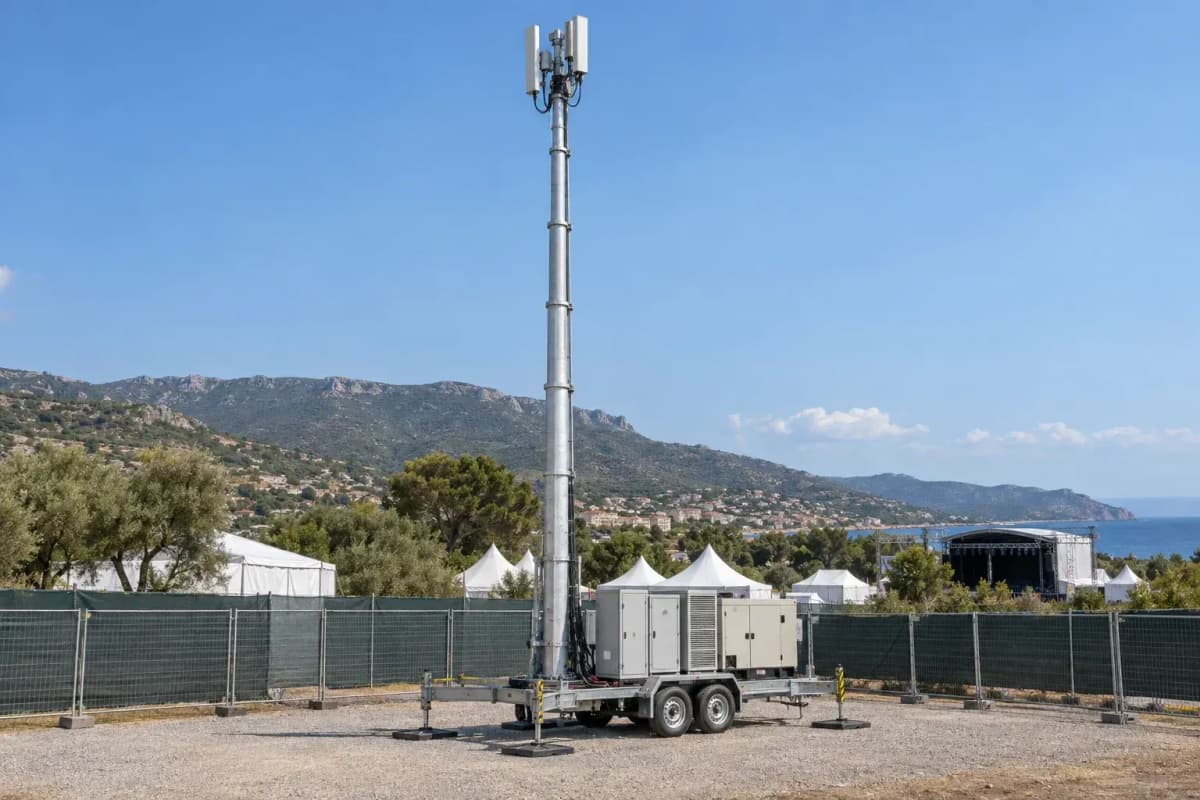
24m Rapid Deployment COW Event Coverage Slip-Joint - 39 m/s Mobile Telecom Tower
Key Features
- 24 m telescopic steel COW tower with hydraulic rapid deployment for 30-minute to 4-hour setup windows
- 39 m/s design wind speed, equal to approximately 140 km/h, with lowering procedures for extreme gust events
- 1 antenna platform with 4 antenna positions for LTE, 5G NR, microwave, GPS, and auxiliary payloads
- Supports event coverage models for approximately 1,000 to 2,000+ concurrent users when RF and backhaul are correctly engineered
- EPC turnkey price range of $48,809 to $75,964 with 1-year warranty and commissioning documentation
The 24m Rapid Deployment COW Event Coverage Slip-Joint is a trailer-mounted telescopic steel telecom tower with 1 antenna platform, 4 antenna positions, and a 39 m/s design wind speed. It is specified for temporary 4G/5G event coverage, emergency capacity, and EPC turnkey deployment priced from $48,809 to $75,964.
Description
The 24m Rapid Deployment COW Event Coverage Slip-Joint is a mobile Cell on Wheels telecom tower engineered for temporary 4G/5G capacity, 24 m elevated antenna height, 1 service platform, 4 antenna mounting positions, and 39 m/s design wind speed. It uses a telescopic steel mast, hydraulic elevation, slip-joint mast interfaces, trailer-mounted transport, and EPC turnkey delivery from $48,809 to $75,964 for event coverage, emergency response, and short-term network densification.
Product Overview
This SOLARTODO mobile COW tower is designed for operators, event organizers, neutral-host providers, and public-safety teams that need a deployable radio site within 30 minutes to 4 hours rather than the 30 to 120 days typically required for a conventional fixed macro tower. The 24 m height supports practical coverage for stadium perimeters, festivals, ports, emergency staging areas, and construction camps where 3 to 4 sector antennas, microwave backhaul, GPS timing, and aviation warning lights may be required. Buyers comparing temporary telecom infrastructure can View all Telecom Tower products or Configure your system online with project-specific RF loading.
The structure combines a steel telescopic mast, slip-joint mast alignment, hydraulic lift system, stabilization outriggers, equipment cabinet space, and a single antenna platform sized for 4 antennas. A typical mobile network payload can include 4G LTE, 5G NR, E-band microwave radios from 1 Gbps to 10 Gbps, GNSS timing, low-voltage distribution, and grounding. According to the IEA, mobile data growth continues to increase electricity and network-load pressure across digital infrastructure, while GSMA and IRENA publications show that rapid renewable and hybrid power integration can reduce diesel dependence in remote telecom deployments by measurable double-digit percentages.
System Architecture
The 24 m COW architecture is built around 5 functional subsystems: the trailer chassis, telescopic mast, RF antenna interface, power system, and site-control layer. The trailer and mast provide the structural path for vertical load, overturning moment, cable routing, and transport forces; the RF layer supports up to 4 panel antennas on 1 platform; the power layer can integrate a generator, battery cabinet, AC/DC distribution, and optional solar hybrid charging; and the site-control layer can monitor mast status, cabinet temperature, power alarms, and door access through cellular or satellite telemetry.
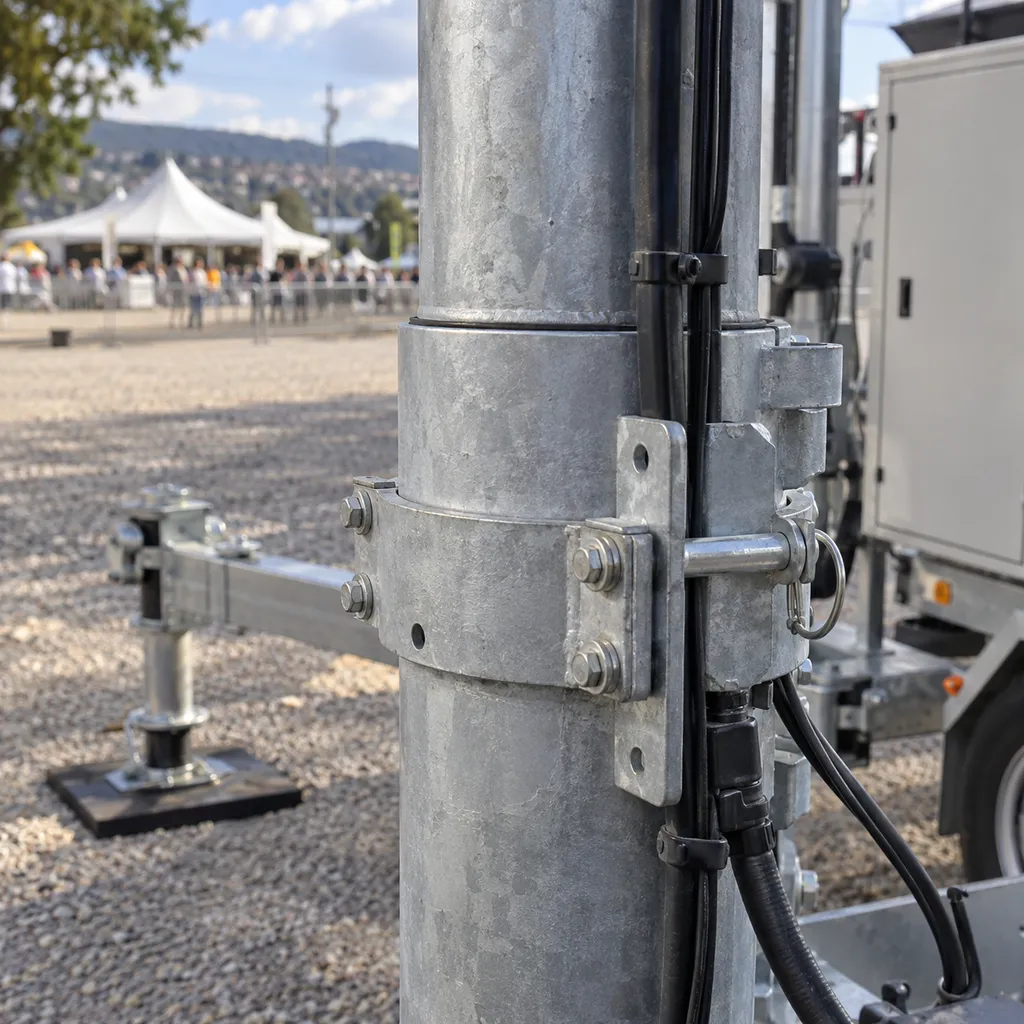
The slip-joint configuration is selected because a nested steel mast must align accurately during raising and lowering, especially when the structure is moved between 2 or more sites in a single deployment campaign. Compared with a fixed lattice or monopole alternative, a trailer-mounted 24 m COW can reduce civil-work time by more than 80% because it normally avoids a cast-in-place foundation, rebar cage, crane mobilization, and permanent compound construction. The trade-off is that operational wind limits, ballast setup, mast plumbness, and outrigger footprint must be checked at every location before antennas are energized.
Technical Specifications
| Parameter | Specification |
|---|---|
| Tower height | 24 m |
| Tower type | Rapid deployment mobile COW |
| Mast material | Telescopic steel |
| Connection type | Slip-joint telescopic interface |
| Antenna platforms | 1 level |
| Antenna capacity | 4 antennas |
| Design wind speed | 39 m/s |
| Typical deployment window | 30 minutes to 4 hours |
| Backhaul options | Fiber, satellite, microwave 1-10 Gbps |
| Design life | 30 years with maintenance |
The 39 m/s wind specification equals approximately 140 km/h, which places the structure in a demanding temporary-site category and requires appropriate operating procedures for gust monitoring, mast lowering, and ballast verification. TIA-222-H and ANSI/TIA-322 provide recognized North American practices for antenna-support structures and loading work, while EN 1993-3-1 provides European steel tower guidance for masts and chimneys. For grounding and lightning protection, IEC 62305 and IEEE Std 81 are relevant references for risk control, earth resistance testing, and grounding performance verification.
RF Capacity and Event Coverage Use
For event coverage, the tower supports a practical 3-sector or 4-sector configuration depending on radio vendor, antenna width, and permitted RF exposure zones. A common 5G/LTE arrangement uses 4 antennas with remote radio units mounted below the panels and jumper cables routed through a protected cable tray. In a dense public venue, a temporary COW can support approximately 1,000 to 2,000+ concurrent users when paired with adequate spectrum, backhaul, baseband capacity, and interference coordination.
A representative event package may use 2 low-band panels for blanket coverage, 2 mid-band panels for capacity, and 1 E-band microwave dish where fiber is unavailable, although the final bill of materials should be validated by the carrier radio plan. NREL guidance on distributed energy and hybrid systems is useful when sizing the generator-plus-battery runtime, while IRENA renewable-power data supports the economic case for adding solar charging where the tower remains deployed for 7 to 90 days. For broader deployment planning, Learn about topic provides SOLARTODO knowledge resources on hybrid power, smart infrastructure, and telecom support systems.
Representative MENA Event Scenario
For a representative MENA outdoor festival scenario with 50,000 attendees, the 24 m COW can be placed at the venue edge with 1 antenna platform, 4 antennas, an E-band microwave link, and a generator-battery cabinet sized for multi-hour operation. If temporary capacity prevents 1 hour of ticketing outage, payment congestion, or emergency-communications degradation, the avoided operational risk can exceed the daily rental or mobilization cost of a single COW site. In hotter climates where ambient temperatures can exceed 45 degrees C, cabinet ventilation, dust filtration, fuel logistics, and battery thermal management should be specified before shipment.
In this scenario, the 24 m tower is not presented as a verified customer deployment; it is a representative engineering and procurement model for budgetary comparison. The EPC team would confirm site access width, trailer turning radius, outrigger bearing pressure, mast setback from public zones, RF compliance boundary, grounding location, and backhaul line-of-sight before construction. A conventional fixed monopole may offer a longer 30 to 50 year site horizon, but it cannot usually match the same same-day relocation capability for concerts, disaster recovery, highway incidents, or seasonal tourism loads.
EPC Investment Analysis and Pricing Structure
EPC delivery includes 5 main scopes: engineering, procurement, construction, commissioning, and 1-year warranty support. Engineering covers tower loading, RF payload review, grounding design, transport interface, and deployment method statement; procurement covers the telescopic mast, trailer, hydraulic system, platform, electrical accessories, and documentation; construction covers installation, mast raising, anchoring or ballast setup, cable routing, and site acceptance; commissioning covers plumbness checks, grounding test, lift function, alarm verification, and handover records. To start a project budget, buyers can Request a custom quotation or email [email protected] with payload mass, antenna dimensions, wind code, destination port, and deployment country.
| Pricing tier | Scope | Price range |
|---|---|---|
| FOB Supply | Equipment only, ex-works China | $30,262 - $51,656 |
| CIF Delivered | FOB equipment plus ocean freight and insurance | $38,700 - $66,059 |
| EPC Turnkey | Installed, commissioned, documented, 1-year warranty | $48,809 - $75,964 |
The EPC price should be treated as a budgetary range because port distance, import duty, lifting equipment, local labor, foundation or ballast method, and RF integration can change project cost by 10% to 25%. Payment terms are typically 30% T/T deposit plus 70% against B/L copy, or 100% L/C at sight for bank-supported procurement. Project financing can be discussed for orders above $1,000K, especially when the package combines multiple COW units, energy storage, solar hybrid power, or recurring event-network programs.
| Order volume | Discount from equipment baseline |
|---|---|
| 50+ units | 5% |
| 100+ units | 10% |
| 250+ units | 15% |
ROI depends on whether the tower is purchased, leased, or used as part of a managed network service. A fleet owner using 1 unit for 40 event days per year at a net service margin of $1,000 to $1,800 per day can recover a $48,809 to $75,964 EPC investment in roughly 1.1 to 1.9 years, before financing and maintenance. Compared with a permanent macro-site build that may exceed $150,000 when land, foundation, permitting, grid work, and commissioning are included, a mobile COW can reduce first-site capital exposure by 50% to 70% for temporary coverage.
Standards, Safety, and Quality Control
The tower should be specified with TIA-222-H or EN 1993 loading assumptions, project-specific wind exposure, payload center of gravity, and transportation rules before production. Lightning protection should follow IEC 62305 principles with an air terminal, down conductor, bonding, and earth resistance target commonly specified below 4 ohms where soil conditions permit. IEEE Std 81 is relevant for grounding measurement, while aviation marking and obstruction lighting should be confirmed against local civil aviation rules for structures around 24 m height.
Factory quality control normally includes steel certificate review, weld inspection, hot-dip galvanizing thickness measurement, hydraulic lift testing, trailer brake inspection, electrical continuity checks, and a final dimensional record. For coastal or high-humidity sites, marine-grade galvanizing, sealed electrical enclosures, stainless fasteners in selected locations, and periodic corrosion inspections at 6 to 12 month intervals are recommended. The design life is listed as 30 years, but real service life depends on relocation frequency, road vibration, salt exposure, fuel quality, and maintenance discipline.
Cloud Monitoring
Cloud monitoring can be integrated through a low-power gateway that reports 5 to 20 operating points, including generator runtime, battery voltage, cabinet temperature, door status, mast raised or lowered state, GPS location, and alarm history. This telemetry is valuable when a fleet includes 10 or more mobile sites, because dispatchers can prioritize refueling, battery charging, maintenance, and redeployment without waiting for manual field reports. Cybersecurity controls should include role-based access, encrypted transport, password rotation, and event logs retained for at least 90 days.
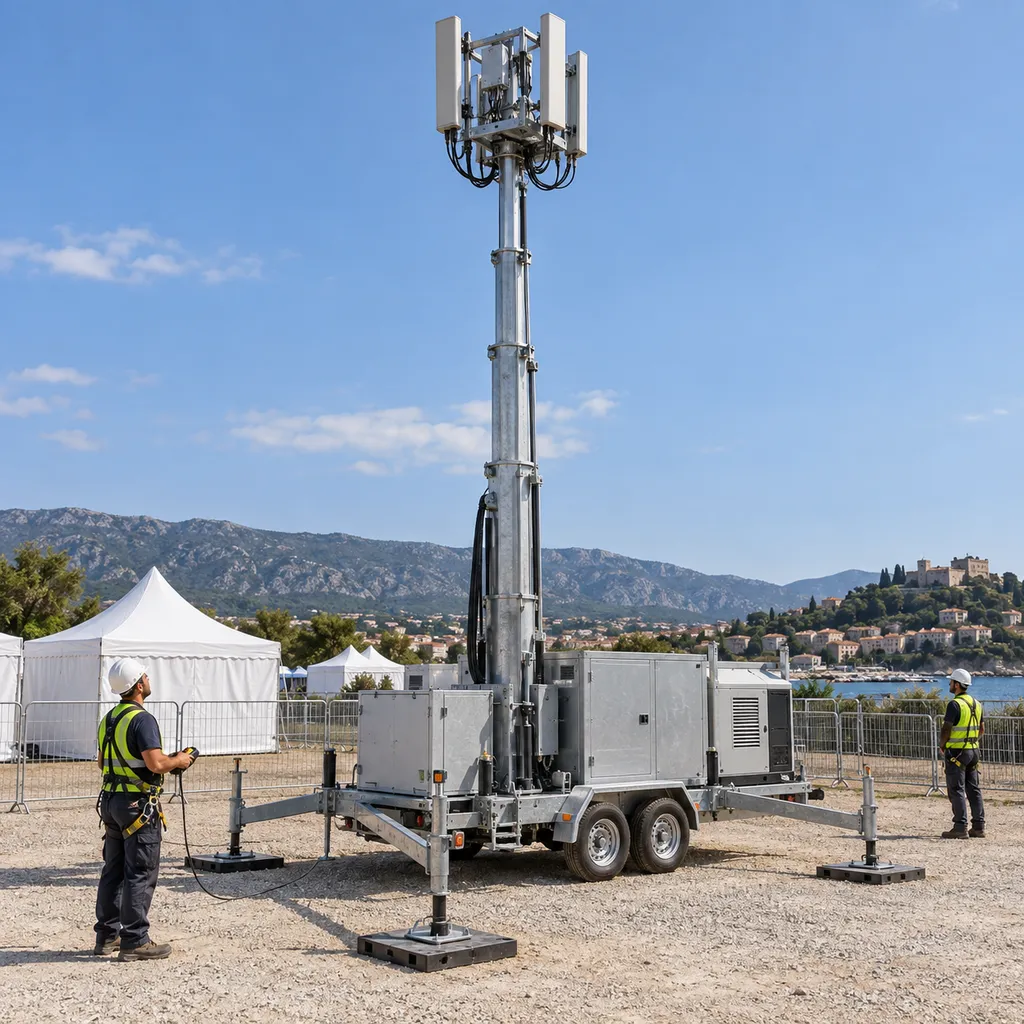
The monitoring layer is optional, but it becomes financially important when diesel, technician travel, and emergency maintenance dominate the operating budget. IRENA has repeatedly documented renewable and hybrid-power cost reductions across many markets, and the IEA has highlighted electricity-system flexibility as a core requirement for modern energy infrastructure. For towers that remain active for 14 to 180 days, a solar-battery-generator package may reduce generator runtime by 20% to 60% depending on solar resource, load profile, and battery capacity.
Applications
Primary applications include music festivals, sports events, disaster recovery, emergency command posts, temporary industrial camps, construction sites, highway incident response, border checkpoints, and seasonal tourist zones. The 24 m height is high enough for practical local coverage but still transportable compared with 30 m to 40 m larger COW designs that may require heavier vehicles, longer setup areas, and more complex permitting. Procurement teams can use this product page with Learn about topic resources to align tower, energy, security, and smart-lighting packages.
For operators already building smart infrastructure, the same trailer site can host CCTV, loudspeaker, IoT gateway, weather sensor, or temporary Wi-Fi equipment alongside telecom antennas, provided the combined wind area and tip load remain within the approved design. SOLARTODO can coordinate solar modules, batteries, hybrid inverters, smart lighting, site cameras, and telecom tower equipment within 1 procurement package. This reduces vendor interfaces from 4 or 5 separate packages to a single EPC workflow while preserving itemized pricing for technical and commercial review.
Procurement Notes
Before ordering, buyers should provide 7 data points: deployment country, design wind speed, maximum antenna quantity, antenna size and weight, backhaul method, power-runtime target, and logistics destination. The standard quoted configuration includes 24 m height, steel telescopic mast, 1 platform, 4 antenna positions, slip-joint connection, 39 m/s design wind speed, and EPC turnkey installation with 1-year warranty. Optional items include satellite backhaul, E-band microwave, battery expansion, solar hybrid charging, CCTV, anti-climb barrier, aviation light, generator upgrade, and fleet monitoring.
SOLARTODO positions this product for B2B procurement where engineering evidence, lifecycle cost, and deployment speed matter more than generic tower descriptions. Buyers should validate the final configuration against local telecom regulations, road transport limits, RF exposure rules, grounding standards, and site-owner restrictions before mobilization. With correct RF planning, power sizing, and field procedures, a 24 m rapid deployment COW can provide temporary capacity in 1 day and be redeployed to the next site after demobilization, inspection, and transport clearance.
Technical Specifications
| Tower Height | 24m |
| Tower Type | mobile_cow |
| Material | steel_telescopic |
| Connection Type | slip_joint |
| Application | event_coverage |
| Antenna Platforms | 1levels |
| Antenna Capacity | 4antennas |
| Design Wind Speed | 39m/s |
| Total Tip Load | 250kg |
| Foundation Type | Trailer outriggers with ballast or ground anchors by site design |
| Corrosion Protection | Hot-dip galvanized / Marine grade option |
| Design Life | 30years |
| Deployment Time | 30 minutes to 4 hours |
| Backhaul Capacity | 1-10Gbps |
| Standards | TIA-222-H / ANSI-TIA-322 / EN 1993-3-1 |
Price Breakdown
| Item | Quantity | Unit Price | Subtotal |
|---|---|---|---|
| 24 m telescopic steel slip-joint mast and tower assembly | 1 pcs | $18,000 | $18,000 |
| Trailer chassis with outriggers and hydraulic elevation system | 1 pcs | $9,500 | $9,500 |
| Steel antenna platform level | 1 pcs | $800 | $800 |
| Antenna mounting brackets and sector hardware | 4 pcs | $350 | $1,400 |
| Cable tray and internal cable routing package | 1 pcs | $240 | $240 |
| Lightning protection system | 1 pcs | $500 | $500 |
| Aircraft warning light set | 1 pcs | $300 | $300 |
| Generator, battery cabinet, and AC/DC distribution package | 1 pcs | $6,500 | $6,500 |
| Microwave backhaul preparation and mounting interface | 1 pcs | $4,200 | $4,200 |
| Grounding kit and site bonding materials | 1 pcs | $900 | $900 |
| Installation and commissioning labor | 1 pcs | $6,500 | $6,500 |
| Engineering, documentation, and quality control | 1 pcs | $4,500 | $4,500 |
| Site acceptance testing and operator handover | 1 pcs | $2,800 | $2,800 |
| 1-year warranty and support allowance | 1 pcs | $3,500 | $3,500 |
| CIF freight, insurance, and logistics allowance | 1 pcs | $6,000 | $6,000 |
| Total Price Range | $48,809 - $75,964 | ||
Frequently Asked Questions
What is included in the EPC turnkey price for this 24m COW tower?
How fast can the 24m Rapid Deployment COW be installed at an event site?
How many antennas can this slip-joint COW tower support?
What wind conditions are suitable for operation?
Can solar hybrid power be added to reduce generator fuel use?
Certifications & Standards


Data Sources & References
- •TIA-222-H Structural Standard for Antenna Supporting Structures and Antennas
- •ANSI/TIA-322 Loading, Analysis, and Design Criteria Related to Antenna Supporting Structures
- •EN 1993-3-1 Eurocode 3: Towers, Masts and Chimneys
- •IEC 62305 Protection Against Lightning
- •IEEE Std 81 Guide for Measuring Earth Resistivity, Ground Impedance, and Earth Surface Potentials
- •NREL distributed energy and hybrid power modeling resources
- •IEA and IRENA energy infrastructure and renewable-power reports
Interested in this solution?
Contact us for a customized quote based on your specific requirements.
Contact Us