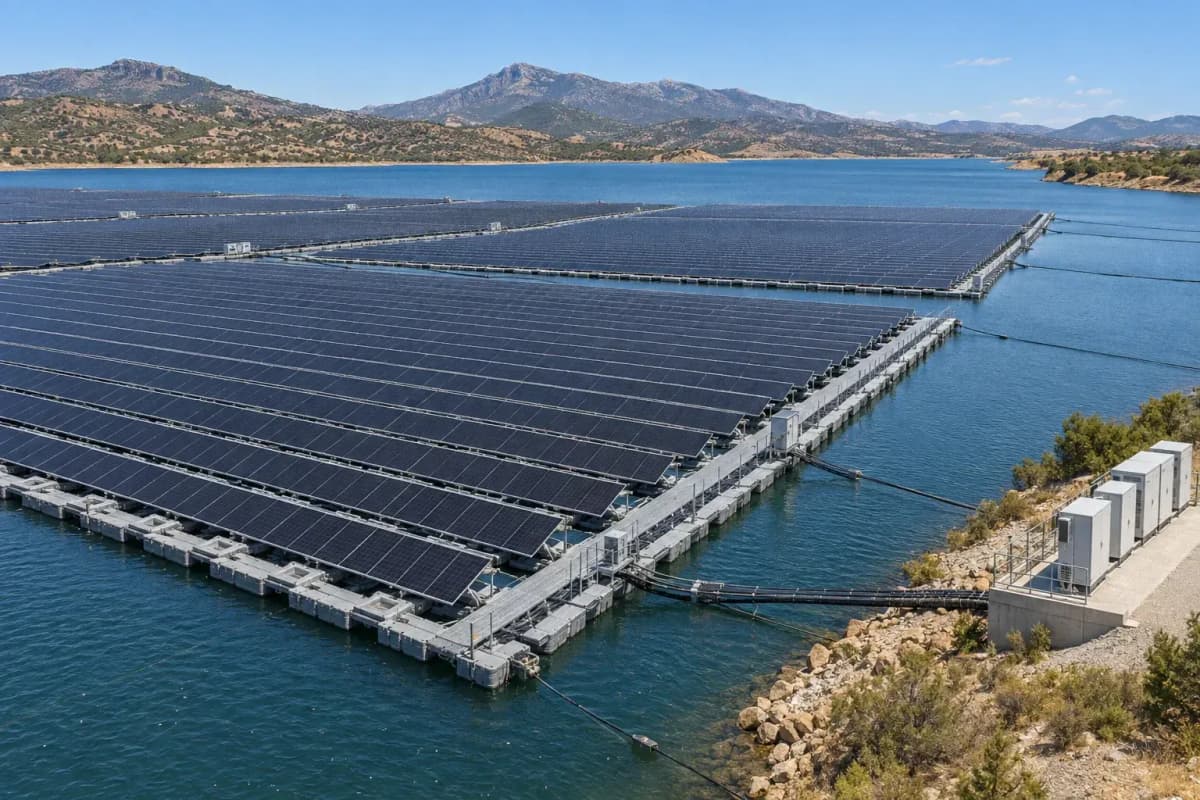
Sistema FV Solar Flutuante CdTe de Filme Fino em Escala Utilitária de 9.3MW - Pacote EPC FPV CdTe
Recursos Principais
- Sistema FV flutuante CdTe de filme fino de 9.256 MWp com eficiência do módulo de 19.3%
- Geração anual estimada de 14,426 MWh/year com fator de capacidade modelado de 17.8%
- Pegada flutuante de aproximadamente 65,000 m² com potencial de ganho de produção por resfriamento pela água de 5-10%
- Faixa de preço EPC chave na mão de USD 3,254,609-4,158,674 com suporte de garantia de 1 ano
- LCOE modelado de USD 0.035/kWh e compensação anual de CO2 de cerca de 6,492 toneladas
O Sistema FV Solar Flutuante CdTe de Filme Fino em Escala Utilitária de 9.256 MWp usa módulos CdTe com eficiência de 19.3% em um arranjo FV flutuante para aplicações em reservatórios, lagos de pedreira e águas industriais. O preço EPC chave na mão é de USD 3,254,609-4,158,674, com geração anual estimada de 14,426 MWh e LCOE modelado de USD 0.035/kWh.
Descrição
The 9.256 MWp Utility Scale Thin-Film CdTe Floating Solar PV System is an EPC-ready floating PV package using 19.3% efficient CdTe thin-film modules, central inverters, marine-grade pontoons, and grid-interconnection equipment for water-surface utility projects. The system is specified for approximately 14,426 MWh/year of AC energy, a 17.8% modeled capacity factor, and an EPC turnkey price range of USD 3,254,609-4,158,674 for procurement teams comparing land-constrained solar options.
This SOLARTODO configuration is designed for reservoirs, hydropower basins, mine lakes, irrigation ponds, wastewater lagoons, and industrial water bodies where 65,000 m² of usable surface can host solar generation without consuming agricultural or urban land. It combines CdTe thin-film performance in hot and humid climates with floating PV cooling benefits that commonly support a 5-10% yield advantage over comparable land-mounted arrays, depending on irradiance, wind speed, water temperature, and row geometry.
Product Scope and Buyer Fit
The 9.256 MWp platform belongs to SOLARTODO's View all Solar PV System products portfolio and is intended for utility developers, independent power producers, water utilities, industrial parks, and public agencies procuring 5-20 MW distributed utility assets. The bill of system covers modules, floating structures, anchoring, DC collection, central inversion, AC infrastructure, monitoring, engineering, construction management, commissioning, and a 1-year EPC warranty layer.
CdTe thin-film modules are selected where high ambient temperature, diffuse light, humidity, and soiling risk can reduce crystalline-silicon output by measurable percentages. First Solar Series 7-class CdTe technology typically falls in the 19-21% module-efficiency range, while its lower temperature coefficient can reduce thermal loss during 40-50°C module-surface operation compared with many conventional silicon modules.
System Architecture
The array is organized as floating blocks with DC strings routed through UV-resistant cable trays, combiner boxes, inverter skids, medium-voltage transformers, and a supervisory monitoring gateway. A representative 9.256 MWp design may use about 17,141 modules at roughly 540 W per module, 10 central inverter positions, 20-35 DC combiner groups, and a medium-voltage export interface sized around 6.6-11 kV or project-specific grid requirements.
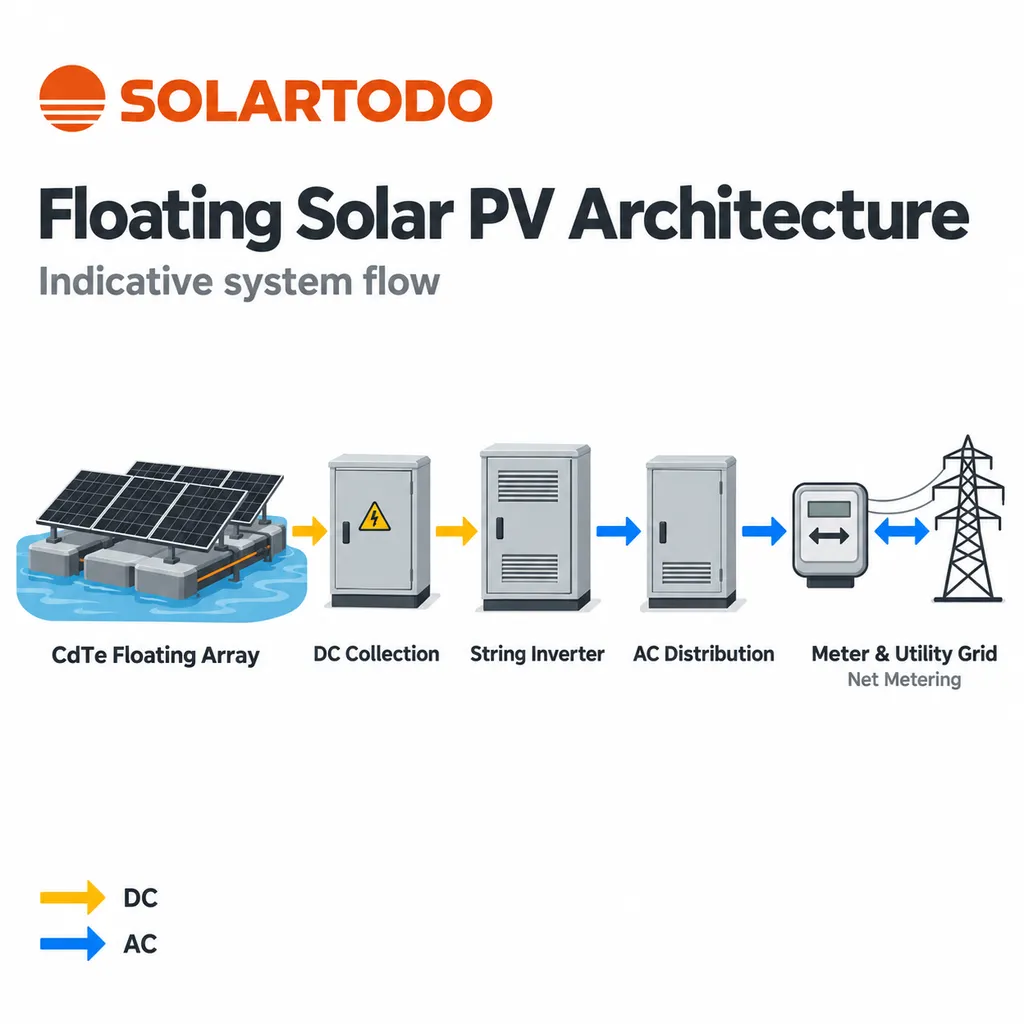
Floating PV architecture requires 4 engineering layers beyond a ground-mounted solar farm: buoyancy calculation, anchoring and mooring design, bathymetry review, and water-level variation analysis. For a reservoir with 2.0 m seasonal level change and 20 m water depth, the anchoring plan must preserve cable bend radius, inverter access, emergency walkways, and wind-load stability under local design wind speeds.
Technical Specifications
| Parameter | Value |
|---|---|
| DC capacity | 9,256 kWp |
| Module technology | Thin-film CdTe |
| Module efficiency | 19.3% |
| Array configuration | Floating PV, utility scale |
| Estimated annual generation | 14,426 MWh/year |
| Modeled capacity factor | 17.8% |
| Approximate water-surface area | 65,000 m² |
| Annual CO2 offset | 6,492 tCO2/year |
| EPC price range | USD 3,254,609-4,158,674 |
| Modeled LCOE | USD 0.035/kWh |
The active module aperture area is approximately 47,958 m² when calculated from 9,256,000 W divided by 19.3% efficiency at 1,000 W/m² standard test irradiance. The installed floating footprint is larger at approximately 65,000 m² because walkways, row spacing, inverter access, mooring tolerance, and maintenance lanes add about 35% to the theoretical module-only area.
The performance model uses 14,426 MWh/year for the representative AC output, equivalent to 1,559 kWh/kWp-year. This value is consistent with high-irradiance utility PV assumptions and includes inverter losses, DC wiring losses, module mismatch, thermal behavior, soiling, and a 5-10% floating-cooling benefit where water and wind conditions are favorable.
Standards, Compliance, and Bankability
Module qualification should reference IEC 61215 for design qualification, IEC 61730 for PV module safety, and UL 1703 or locally accepted North American successor requirements when the authority having jurisdiction requires UL-style certification. Inverter and grid equipment should be reviewed against IEC 62116 for anti-islanding behavior and IEEE 1547-2018 for distributed energy resource interconnection in applicable markets.
IEC describes IEC 61730-1:2023 as a photovoltaic module safety qualification standard covering construction requirements for safe electrical and mechanical operation, which is directly relevant to 1,500 Vdc utility arrays. Procurement teams should verify the exact module certificate, factory audit, bill of materials, fire rating, salt-mist rating, and ammonia rating before issuing a final notice to proceed.
CdTe Floating PV Performance Rationale
CdTe thin-film modules are valuable in hot, humid, and diffuse-light sites because their energy yield is less dependent on perfect standard-test-condition temperatures. A 9.256 MWp CdTe array operating at 45°C module temperature can preserve more output during peak afternoon load periods than a higher-nameplate silicon module with a weaker temperature coefficient, especially when floating PV cooling lowers operating temperature by several degrees.
Floating PV also reduces land pressure by moving generation to underutilized water surfaces, which can be important when land leasing, grading, fencing, vegetation management, and environmental offsets add 5-15% to a conventional ground-mount project budget. Compared with a 9.3 MW fixed-tilt land system, this FPV design can reduce direct land occupation by approximately 100% while adding specialized floating and anchoring hardware.
The NREL floating PV reservoir analysis notes that water beneath panels can support module cooling and that FPV may also influence evaporation-loss calculations. The U.S. DOE AquaPV dataset includes floating PV potential, evaporative-loss estimates, and waterbody screening inputs, which are useful during early 30%, 60%, and 90% engineering reviews.
Representative MENA Solar Farm Scenario
For a representative MENA solar farm scenario, assume a 9.256 MWp CdTe FPV system on an industrial reservoir with 2,100 kWh/m²-year global horizontal irradiation, 42°C summer ambient temperature, and a 13.2 kV interconnection point within 800 m of the inverter pad. Under these assumptions, annual generation of 14,426 MWh and a 17.8% capacity factor can support utility offtake, behind-the-meter desalination, or industrial load offset.
At an electricity value of USD 0.075/kWh, the modeled first-year gross energy value is approximately USD 1,081,950 before O&M, curtailment, taxes, and financing costs. Using the midpoint EPC investment of about USD 3.71 million, simple payback falls near 3.4 years, while a more conservative case at USD 0.055/kWh gives about USD 793,430/year and a 4.7-year simple payback.
EPC Investment Analysis and Pricing Structure
EPC turnkey delivery includes engineering, procurement, construction, grid coordination, commissioning, as-built documentation, operator training, and 1 year of post-commissioning warranty support. For this 9.256 MWp system, SOLARTODO separates equipment value from installation value so that component prices remain transparent and EPC scope is not hidden inside inflated module or inverter unit prices.
| Pricing tier | Scope | Price range |
|---|---|---|
| FOB Supply | Equipment only, ex-works China | USD 2,017,858-2,827,898 |
| CIF Delivered | Equipment plus ocean freight and insurance | USD 2,226,303-3,120,020 |
| EPC Turnkey | Installed, commissioned, and 1-year warranty | USD 3,254,609-4,158,674 |
| Volume level | Discount | Typical procurement condition |
|---|---|---|
| 50+ systems | 5% | Framework procurement or repeat-site program |
| 100+ systems | 10% | Multi-country utility rollout or water-utility portfolio |
| 250+ systems | 15% | Annual strategic supply agreement with production planning |
ROI depends on 6 variables: solar resource, tariff value, curtailment, finance cost, O&M cost, and grid-connection charge. At USD 0.035/kWh modeled LCOE, the system is positioned below many diesel generation cases above USD 0.18/kWh and below many grid-import tariffs above USD 0.08/kWh, while IRENA reported that 91% of newly commissioned utility-scale renewable capacity in 2024 beat the cheapest new fossil alternative on LCOE.
Payment terms are normally 30% T/T deposit plus 70% against bill of lading, or 100% irrevocable L/C at sight for approved buyers. Project financing support can be discussed for qualified projects above USD 5,000K, and buyers can Request a custom quotation or contact [email protected] with site coordinates, bathymetry, grid voltage, and target commercial operation date.
Applications
Primary applications include 9-10 MW reservoir solar, hydropower hybridization, industrial water-body generation, irrigation-district power supply, quarry-lake redevelopment, and wastewater-treatment energy offset. The design is especially relevant where land costs exceed USD 25,000/hectare, where environmental permitting limits ground disturbance, or where a water utility wants solar generation within 1 km of existing pumping loads.
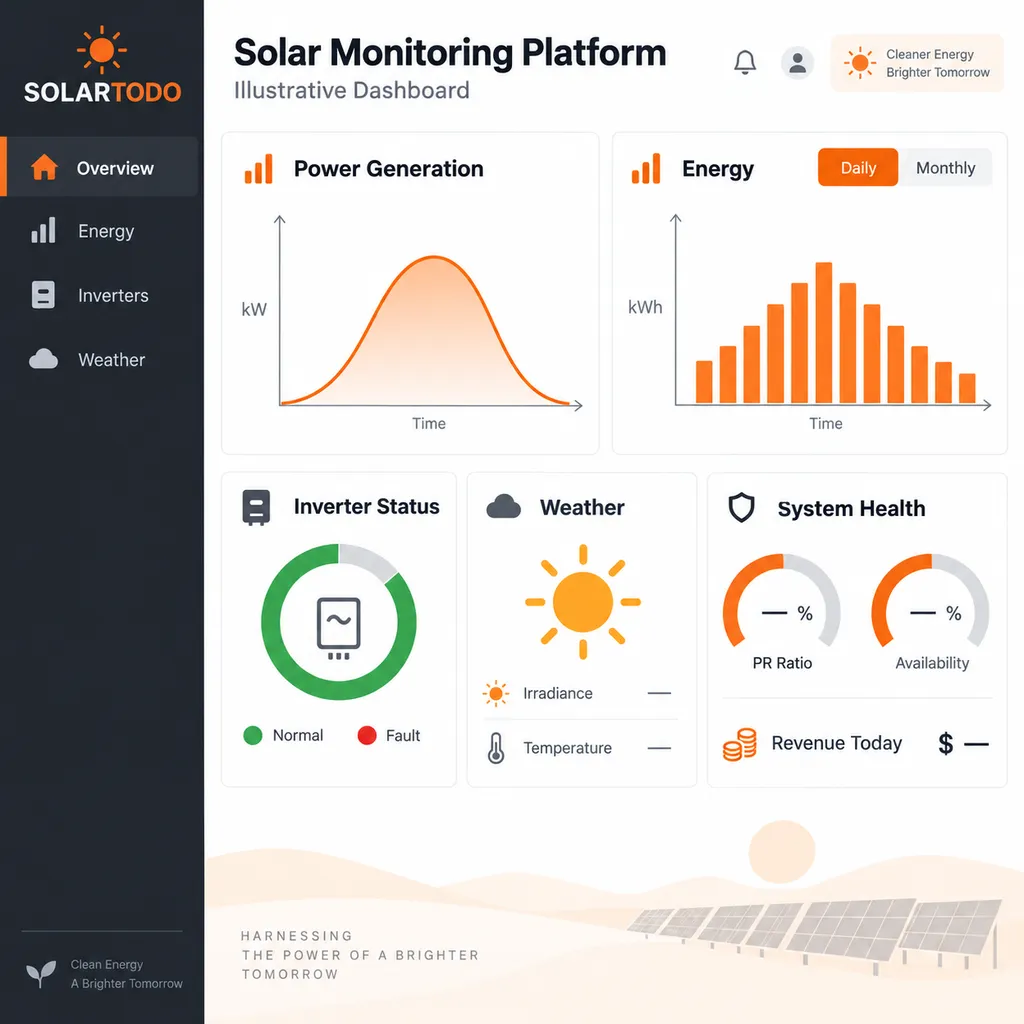
Cloud monitoring tracks inverter status, string current, AC output, module-block alarms, weather-station data, water-level inputs, and daily production against the 14,426 MWh/year baseline. A typical dashboard should include 15-minute interval data, monthly PR reporting, IEC 61724-style performance ratio logic where specified, and alarm escalation for insulation resistance, inverter trips, and communications loss.
Procurement and Engineering Workflow
Buyers can Configure your system online using capacity, module type, array type, voltage, delivery term, and installation scope as the first 6 inputs. A bankable quotation normally requires at least 10 documents: site coordinates, single-line diagram, grid code, waterbody ownership proof, bathymetry, wind record, water-level range, access-road plan, load or PPA profile, and import-tax classification.
SOLARTODO recommends a 4-stage engineering sequence: feasibility screening, concept design, detailed EPC design, and commissioning acceptance. The 30% concept design confirms waterbody suitability and interconnection, the 60% design fixes module blocks and mooring, the 90% package freezes electrical protection and civil interfaces, and final commissioning verifies insulation, polarity, inverter operation, SCADA data, and export-meter accuracy.
Market Context and Reference Sources
IEA Renewables 2025 states that solar PV represents nearly 80% of global renewable electricity capacity expansion in its forecast, confirming that utility solar remains the dominant new-build renewable technology class. IEA Electricity 2025 also projects solar PV to become the second-largest low-emissions electricity source globally by 2027, after hydropower.
IRENA's 2025 cost report shows that utility-scale solar PV remains one of the lowest-cost renewable generation options, with global weighted-average solar PV LCOE near USD 0.043/kWh in 2024. BloombergNEF and Wood Mackenzie market commentary for 2025-2026 similarly indicates large-format modules, TOPCon expansion, and continued balance-of-system optimization, while CdTe maintains a differentiated role for hot climates, low-carbon supply chains, and utility-scale procurement diversity.
For technical learning beyond this product page, buyers can Learn about topic for solar PV design fundamentals and use SOLARTODO knowledge resources to compare CdTe, TOPCon, bifacial glass-glass, fixed-tilt, tracker, and floating architectures. A final EPC proposal should always reconcile local codes, IEC certification, grid-operator requirements, bank technical-advisor comments, and site-specific waterbody constraints before construction release.
Especificações Técnicas
| Capacidade do Sistema | 9256kWp |
| Tipo de Módulo | thin_film_cdte |
| Eficiência do Módulo | 19.3% |
| Configuração do Arranjo | floating |
| Geração Anual Est. | 14426MWh/year |
| Fator de Capacidade | 17.8% |
| Área do Sistema | 65000m² |
| Compensação de CO₂ | 6492tons/year |
| Período de Retorno | 3.4-4.7years |
| LCOE | 0.035USD/kWh |
| Garantia | 25yr panels, 10yr inverter |
Detalhamento de Preços
| Item | Quantidade | Preço Unitário | Subtotal |
|---|---|---|---|
| Módulos FV CdTe de filme fino, classe 540 W | 17141 pcs | $97 | $1,666,105 |
| Estações de inversores centrais, escala utilitária | 10 pcs | $46,280 | $462,800 |
| Sistema de pontões flutuantes e passarelas | 1 pcs | $555,360 | $555,360 |
| Pacote de amarração, ancoragem e batimetria | 1 pcs | $160,000 | $160,000 |
| Cabos DC, caixas combinadoras e proteção | 1 pcs | $185,120 | $185,120 |
| Infraestrutura AC e interface de transformador | 1 pcs | $277,680 | $277,680 |
| Monitoramento em nuvem e estação meteorológica | 1 pcs | $25,000 | $25,000 |
| Provisão para frete marítimo e seguro | 1 pcs | $180,000 | $180,000 |
| Engenharia, revisão de projeto e documentação de CQ | 1 pcs | $120,000 | $120,000 |
| Instalação e construção mecânica/elétrica | 1 pcs | $320,000 | $320,000 |
| Comissionamento, testes e treinamento do operador | 1 pcs | $60,000 | $60,000 |
| Reserva de garantia e suporte de 1 ano | 1 pcs | $45,000 | $45,000 |
| Faixa de Preço Total | $3,254,609 - $4,158,674 | ||
Perguntas Frequentes
O que está incluído no preço EPC chave na mão deste sistema FV flutuante de 9.256 MWp?
Por que usar módulos CdTe de filme fino em vez de módulos convencionais de silício cristalino?
Quanta superfície de água é necessária para um projeto solar flutuante de 9.3 MW?
Que geração anual os compradores devem esperar deste sistema?
Quais normas são relevantes para aquisição e bancabilidade?
Certificações e Normas


Fontes de Dados e Referências
- •NREL floating PV reservoir analysis 2024
- •DOE AquaPV dataset 2025
- •IEA Renewables 2025
- •IEA Electricity 2025
- •IRENA Renewable Power Generation Costs in 2024
- •IEC 61730-1:2023 photovoltaic module safety qualification
Interessado nesta solução?
Entre em contato para um orçamento personalizado conforme suas necessidades.
Fale Conosco