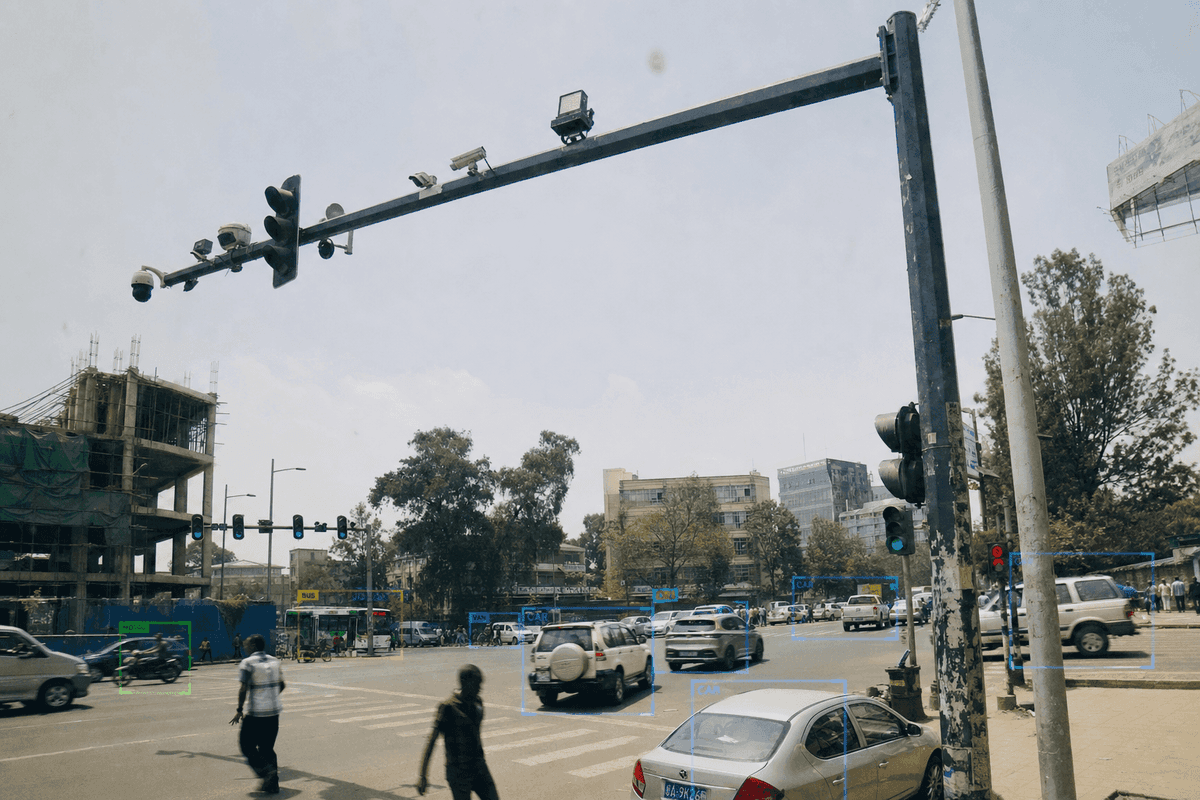
Addis Ababa Smart Traffic System Market Analysis: 15-Intersection 6m Pole EPC Configuration
Summary
Addis Ababa's 3.945M residents, 527 km2 city area, and 26-city national 5G footprint make a 15-intersection Smart Traffic System technically suitable for EPC rollout. It would specify 6m poles, 77GHz radar, 4K AI, and TrafficGPT.
Key Takeaways
For a 15-intersection Addis Ababa corridor, the recommended SOLARTODO Smart Traffic System uses 6m L-arm poles, edge AI, and 5G/fiber backhaul.
- A typical 15-intersection deployment would use approximately 60-180 poles, depending on 4-12 poles per intersection geometry.
- The specified pole class is 6m dark grey L-arm hot-dip galvanized steel, suitable for urban signal heads and camera sightlines.
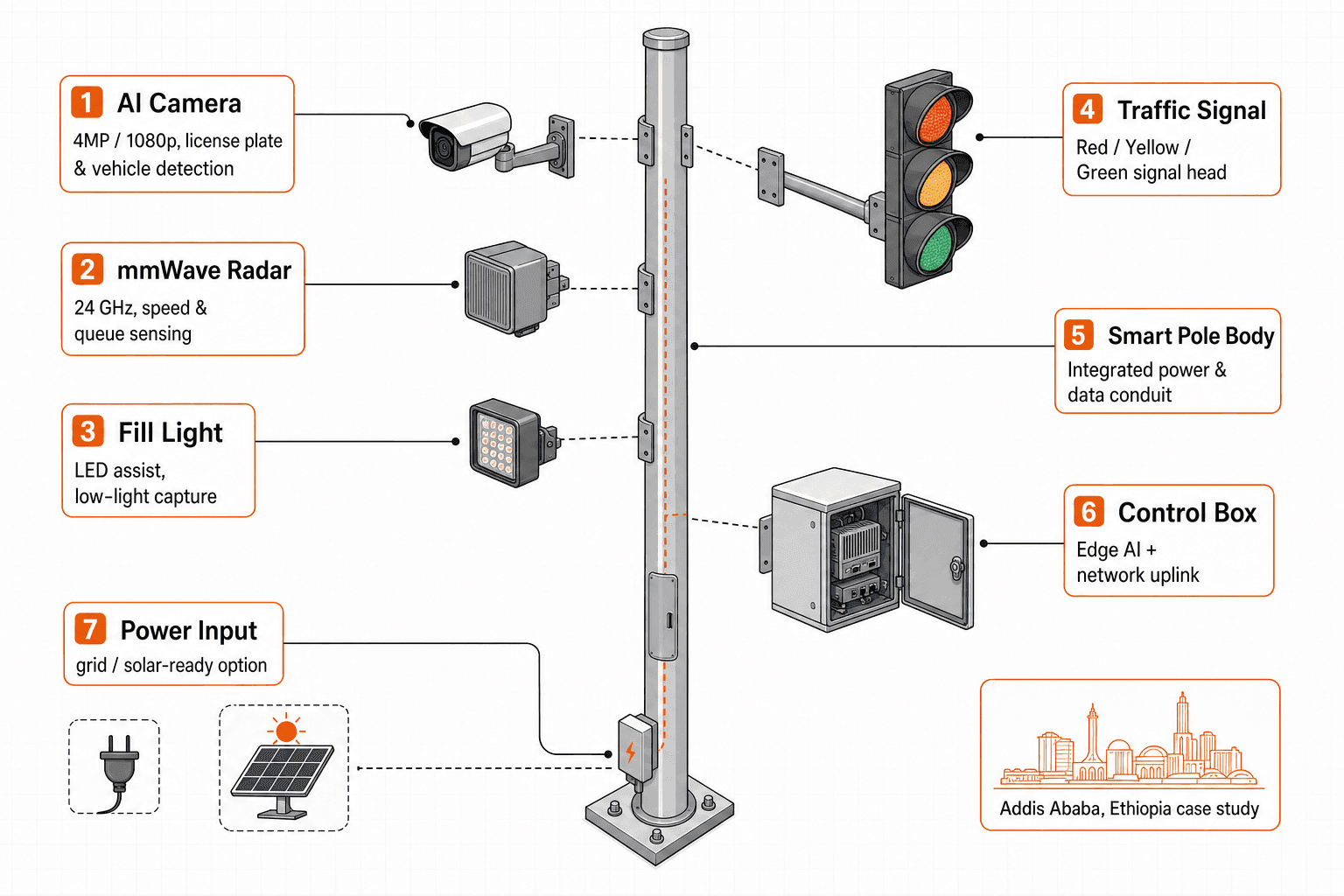
- Each 4-in-1 node integrates a 4K AI camera, 77GHz mmWave radar, LED fill light, and LED signal head.
- Edge processing would run on NVIDIA Jetson with <50ms response and 98% camera analytics accuracy under defined conditions.
- The analytics package should cover vehicle counting, speed detection, plate recognition, and 45+ detection types.
- Backhaul should use dual-path 5G/fiber where feasible, aligned with Ethio telecom's 14,340 km metro fiber footprint.
- The cooperation model should be EPC turnkey, with procurement, installation, commissioning, and 1-year warranty bundled.
- Standards alignment should include NTCIP for traffic-system interoperability and GB 25280 for signal-controller compliance.
Market Context for Addis Ababa
Addis Ababa's 3.945 million 2023 population and 527 km2 administrative area create high-value demand for signalized-intersection sensing and adaptive control.
According to Ethiopian Statistical Service (2023), Addis Ababa's estimated population reached approximately 3.945 million, up from the 2007 census count of 2.739 million. That growth changes the design problem for intersections: fixed-time signaling alone becomes less resilient when commuter peaks, minibus stops, pedestrian crossings, and corridor construction patterns shift by hour. According to the World Bank Open Data (2023), Ethiopia's urban population share is about 23%, which means Addis Ababa remains the country's dominant urban traffic management reference point.
Addis Ababa's elevation of roughly 2,355m and annual rainfall around 1,200mm create two practical design constraints: pole corrosion protection and reliable night/rain sensing. Hot-dip galvanized steel is therefore a sensible base form for an outdoor pole system, and the dark grey finish fits central urban corridors without adding visual clutter. For buyers comparing SOLARTODO Smart Traffic System options, the key local fit is not solar generation; it is multimodal traffic detection, local edge inference, and integration into a central platform.
According to Addis Ababa Road and Transport Bureau and ITDP (2019), about 85% of city trips are by walking, cycling, and public transport. That makes intersection intelligence especially important because cameras must recognize mixed traffic, pedestrians, minibuses, buses, and turning conflicts rather than only private-car volumes. WHO states, 'Approximately 1.19 million people die each year', and its 2026 fact sheet also reports that road crashes cost many countries around 3% of GDP, reinforcing why safer intersections carry economic value.
Recommended Technical Configuration
A 15-intersection Addis Ababa configuration should prioritize 6m urban L-arm smart poles because the project scope is signalized junctions, not highway gantries.
Based on the specified project profile, a recommended SOLARTODO configuration would consist of approximately 15 intersections with 6m L-arm hot-dip galvanized steel poles in dark grey. A typical N-unit deployment of this scale would use one pole per approach plus auxiliaries, or approximately 4-12 poles per intersection depending on lane count, pedestrian crossings, sightline conflicts, and existing mast-arm locations. For planning purposes, that equals approximately 60-180 smart pole nodes across the 15 intersections, with final quantities confirmed after intersection surveys.
The 6m height class is the correct fit because Addis Ababa's central corridors require camera and radar coverage over lanes and sidewalks without the wind load and foundation cost of 10-12m highway gantry structures. The product's broader height family can rotate between 6m, 8m, and 10m for larger intersections, but this specific guide uses the required 6m pole specification. Each node would carry the 4-in-1 package: 4K AI camera, 77GHz mmWave radar, LED fill light, and LED signal head.
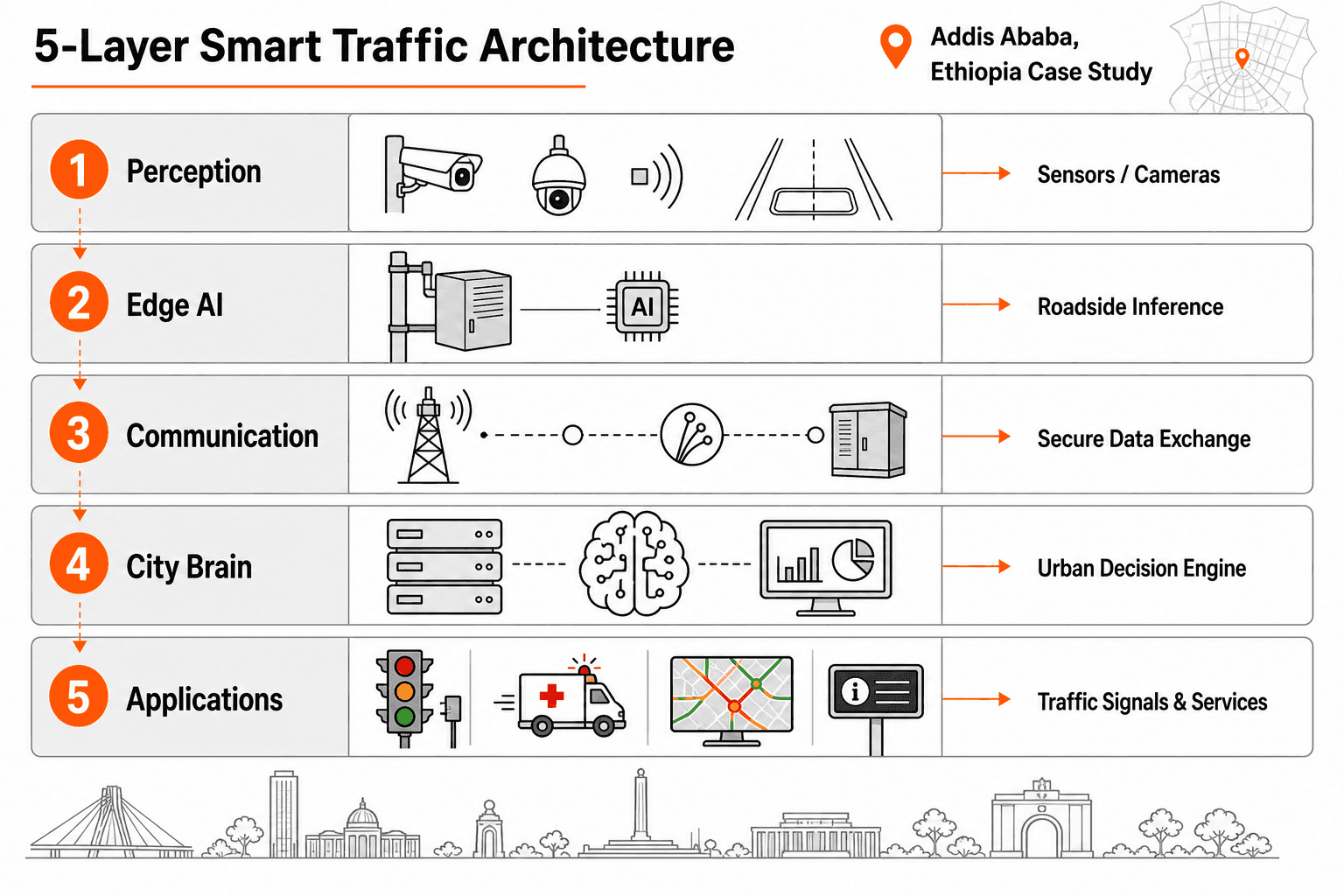
The software architecture should use the 5-layer SOLARTODO stack: Perception > Edge AI > Comm via 5G/fiber > City Brain with TrafficGPT > Apps. According to Ethio telecom (2025), 5G service had expanded to 26 cities, 4G population coverage reached 70.8%, and Addis Ababa had 1,342 fiber-to-the-tower connected sites. That supports a practical dual-backhaul model in which fiber is preferred for high-bandwidth video metadata and 5G is used for redundancy, fast commissioning, or corridors where duct access is delayed.
Technical Specifications
The technical specification for this Addis Ababa guide is a 6m 4-in-1 pole node with <50ms edge response, 77GHz radar, and NTCIP/GB 25280 alignment.
- Product: SOLARTODO Smart Traffic System, 4-in-1 smart traffic pole.
- Pole: 6m L-arm steel pole, dark grey, hot-dip galvanized finish.
- Intersection scope: approximately 15 intersections; typical 4-12 poles per intersection after survey.
- Sensing: 4K AI camera with 98% analytics accuracy under defined operating conditions.
- Radar: 77GHz mmWave radar for speed detection, vehicle presence, and movement tracking.
- Lighting and signals: integrated LED fill light plus LED signal head.
- Edge AI: NVIDIA Jetson module for local inference and event filtering.
- Response: <50ms edge response for detection-to-event processing.
- Functions: vehicle counting, speed detection, plate recognition, and 45+ detection types.
- Backhaul: 5G/fiber to TrafficGPT central platform for natural language queries.
- Standards: NTCIP for ITS device interoperability and GB 25280 for road traffic signal equipment compliance.
- Cooperation model: EPC turnkey, including supply, installation, commissioning, and 1-year warranty.
According to NTCIP (2023), NTCIP 1202 v03b covers object definitions for actuated traffic signal controller units, which is relevant when a city wants multi-vendor device management rather than isolated proprietary equipment. According to ITU-R (2017), IMT-2020 defines 5G performance targets including 1ms latency for ultra-reliable low-latency communications and 10^6 devices per km2 for massive machine-type communications. Those targets do not guarantee field latency on every Addis Ababa corridor, but they justify 5G as a standards-based backhaul option.
Implementation Approach
A 15-intersection EPC rollout would normally be executed in 5 phases: survey, design, procurement, civil installation, and TrafficGPT commissioning.
The first phase should be an intersection audit covering lane geometry, pedestrian crossings, existing signal heads, utility conflicts, available power, 5G signal strength, fiber handholes, and line-of-sight for 4K cameras. The second phase should produce pole schedules, foundation drawings, cabinet layouts, IP addressing, and NTCIP integration requirements. This is also where the TrafficGPT data model should be mapped to local terms such as corridor, approach, lane, queue, violation class, and event priority.
Procurement under EPC turnkey would bundle the 6m poles, integrated sensing modules, signal heads, edge AI units, mounting accessories, cabinets, network equipment, and commissioning support. CKD or modular shipping can reduce packaging volume and simplify customs inspection because pole bodies, L-arms, electronics, and cabinets can be checked separately. Factory acceptance testing should validate camera stream quality, radar calibration, LED signaling, Jetson inference, and 5G/fiber failover before shipment.
Civil installation would typically proceed intersection by intersection to limit traffic disruption. Foundations, ducting, earthing, pole erection, module alignment, power connection, and network tests should be sequenced so that each junction can be commissioned independently. SOLARTODO would recommend staged go-live windows outside peak periods, followed by 14-30 days of detection tuning for plate recognition, vehicle classification, and false-positive reduction.
Expected Performance & ROI
Expected performance for the 15-intersection system should be measured against 10%+ travel-time improvement benchmarks, 3-5 year payback logic, and reduced manual counts.
FHWA states, 'Poor traffic signal timing contributes to traffic congestion and delay.' According to FHWA (2017), adaptive signal control improves travel time by more than 10% on average and can exceed 50% in areas with outdated timing. For Addis Ababa, a conservative financial model should not assume the maximum case; it should model savings from reduced delay, lower manual survey cost, better enforcement evidence, and faster incident detection.
The primary ROI driver is data continuity. Manual turning-movement counts provide snapshots, while 4K AI plus 77GHz radar can produce recurring counts, speed profiles, lane occupancy, and event logs across all 15 intersections. According to WHO (2026), road crashes cost most countries about 3% of GDP, so even modest improvements in conflict detection, speeding alerts, and pedestrian crossing visibility can support public-sector economic justification.
A practical payback model for EPC buyers should use three cases. The base case assumes 10% corridor travel-time improvement, fewer manual traffic surveys, and improved maintenance dispatch. The upside case assumes signal retiming, enforcement integration, and incident workflows mature within 12 months. The risk case assumes backhaul gaps, limited agency staffing, or delayed signal-controller integration; these risks are mitigated by the TrafficGPT central platform and standardized NTCIP interfaces.
Results and Impact
For Addis Ababa, the expected impact is a 15-intersection intelligence layer that converts cameras, radar, and signal heads into operational traffic data.
This is not a claim of completed deployment or a fabricated SOLARTODO project record. It is a technical configuration guide for a buyer evaluating whether 6m 4-in-1 smart traffic poles match Addis Ababa's urban corridors. The expected operational result would be a centralized view of vehicle counts, speed events, plate recognition, queue patterns, and signal performance through TrafficGPT natural language queries.
The impact should be evaluated through measurable KPIs rather than narrative claims. Suggested KPIs include detection uptime above 95%, radar-camera event match rate, percentage of intersections with usable fiber or 5G redundancy, average response latency below 50ms at the edge, and monthly reduction in manually collected traffic-count hours. For procurement discussion, contact us to align the bill of quantities with surveyed intersections and municipal integration requirements.
Comparison Table
This 4-option comparison shows why a 6m integrated smart pole is the best match for 15 Addis Ababa urban intersections.
| Option | Typical height | Core sensing | Best use in Addis Ababa | Limitation | Recommended role |
|---|---|---|---|---|---|
| Fixed-time signal pole | 6m | None or loop detector | Low-volume junctions | No 4K AI, no 77GHz radar, weak analytics | Not preferred |
| Camera-only retrofit | Existing pole | 4K camera | Quick monitoring | Limited speed detection and poor night robustness without radar/fill light | Selective retrofit |
| SOLARTODO 4-in-1 pole | 6m | 4K AI + 77GHz radar | 15 urban intersections | Requires EPC integration and backhaul planning | Recommended |
| Highway gantry variant | 10-12m | Multi-lane sensing | Expressway ramps or arterial gateways | Higher foundation and wind-load cost | Use only for highways |
The integrated 6m option gives the best balance of civil cost, sensor accuracy, maintainability, and standards alignment for dense urban intersections. It also reduces equipment fragmentation because the pole, camera, radar, fill light, signal head, edge AI, and backhaul are engineered as one roadside node. For larger junctions, 8m or 10m variants may be considered, but the required Addis Ababa project-specific configuration remains 6m.
Pricing & Quotation
Pricing for a 15-intersection Addis Ababa EPC package depends on pole count, civil works, backhaul mix, signal-controller integration, and commissioning scope.
SOLARTODO offers three pricing tiers for this product line: FOB Supply (equipment ex-works China), CIF Delivered (including ocean freight and insurance), and EPC Turnkey (fully installed, commissioned, with 1-year warranty). Volume discounts are available for large-scale deployments. Configure your system online for an instant estimate, or request a custom quotation from our engineering team at [email protected].
For the specified Addis Ababa guide, EPC turnkey is the correct commercial model because integration risk sits in foundations, power, controller interfaces, camera/radar alignment, and TrafficGPT commissioning. FOB or CIF can fit buyers with their own civil contractor and ITS integrator, but they shift schedule and performance responsibility back to the city or prime contractor. A quotation should separate pole hardware, edge AI, signal modules, network equipment, installation labor, traffic management during works, and software platform licensing.
Frequently Asked Questions
These 10 FAQs cover the 15-intersection configuration, EPC pricing logic, installation timeline, ROI, warranty, maintenance, and alternatives for Addis Ababa buyers.
Q1: What technical configuration is recommended for Addis Ababa? A typical Addis Ababa configuration would use approximately 15 intersections with 6m dark grey L-arm hot-dip galvanized steel poles. Each SOLARTODO Smart Traffic System node integrates a 4K AI camera, 77GHz mmWave radar, LED fill light, LED signal head, and NVIDIA Jetson edge AI, with 5G/fiber backhaul to TrafficGPT.
Q2: Why is the 6m pole height selected instead of 8m or 10m? The 6m pole is appropriate for urban signalized intersections where cameras and radar need clear approach-lane coverage without oversized foundations. The 8m and 10m variants fit larger intersections, while 10-12m gantry structures fit highways. This guide uses the project-specific 6m L-arm steel pole requirement for Addis Ababa.
Q3: How long would installation typically take for 15 intersections? A normal EPC schedule would require about 8-16 weeks after survey approval, depending on customs, foundation readiness, fiber access, traffic permits, and controller integration. The work can be staged by corridor so early intersections are commissioned while later sites are still under civil installation and network testing.
Q4: What ROI should a city expect from this system? ROI should be modeled using delay reduction, fewer manual counts, faster incident response, and safer enforcement evidence. According to FHWA (2017), adaptive signal control improves travel time by more than 10% on average. For Addis Ababa, a conservative 3-5 year payback model is more defensible than assuming maximum benefits.
Q5: What maintenance is required after commissioning? Maintenance should include quarterly camera cleaning, radar alignment checks, LED signal inspection, cabinet thermal checks, firmware updates, and TrafficGPT data-quality review. Because Addis Ababa has a wet season and highland dust, cleaning cycles should tighten near construction corridors. Remote diagnostics should reduce unnecessary site visits.
Q6: How does this compare with a camera-only retrofit? A camera-only retrofit can support counting and visual monitoring, but it lacks the radar redundancy needed for stronger speed detection and low-visibility tracking. The 4-in-1 SOLARTODO pole combines camera, 77GHz radar, fill light, and signal head, so it produces richer data with fewer separate roadside devices.
Q7: What is included in EPC turnkey pricing? EPC turnkey pricing normally includes equipment supply, shipping coordination, foundations, pole erection, wiring, cabinet work, network setup, signal integration, TrafficGPT commissioning, training, and a 1-year warranty. Final pricing depends on the number of poles per intersection, trenching needs, traffic management requirements, and whether fiber or 5G is primary.
Q8: What warranty should be specified? The recommended EPC scope includes a 1-year warranty covering supplied equipment and commissioning defects under agreed operating conditions. Buyers should also request optional extended support for software updates, spare parts, Jetson module replacement, LED signal components, and remote diagnostics. Warranty exclusions should be explicit for vandalism, accidents, and utility faults.
Q9: Can TrafficGPT answer natural language traffic questions? Yes, the recommended architecture sends 5G/fiber metadata to the TrafficGPT central platform, where authorized operators can query counts, speeds, plate events, queues, and alerts in natural language. The best results require consistent intersection naming, lane definitions, event taxonomies, and permissions before go-live.
Q10: What standards matter for procurement? NTCIP is important for interoperability with traffic controllers and roadside ITS devices, while GB 25280 supports road traffic signal equipment compliance. Procurement documents should also define cybersecurity, data retention, camera privacy rules, cabinet protection, grounding, and acceptance tests for the <50ms edge-response requirement.
References
These 7 references combine Addis Ababa demographics, Ethiopia telecom capacity, traffic-signal standards, road-safety risk, and adaptive-control performance benchmarks for buyer verification.
- Ethiopian Statistical Service (2023): Population Size by Sex, Region, Zone and Wereda, July 2023; Addis Ababa estimate approximately 3.945 million. URL: https://ess.gov.et/
- Addis Ababa City Administration (2025): City profile data identifying Addis Ababa as Ethiopia's capital with approximately 527 km2 administrative area. URL: https://cityaddisababa.gov.et/
- World Bank Open Data (2023): Ethiopia urban population share and urbanization indicators used to frame national city-growth context. URL: https://data.worldbank.org/
- Addis Ababa Road and Transport Bureau / ITDP (2019): Addis Ababa Non-Motorized Transport Strategy, reporting high walking, cycling, and public transport mode share near 85%.
- Ethio telecom (2025): 2024/25 Fiscal Year Annual Performance; 26 5G-enabled cities, 70.8% 4G population coverage, 14,340 km metro fiber, and 1,342 Addis Ababa FTTT sites. URL: https://www.ethiotelecom.et/2024-25-fiscal-year-annual-performance-and-three-year-lead-growth-strategy-performance/
- NTCIP (2023): NTCIP 1202 v03b, Object Definitions for Actuated Traffic Signal Controller Units; published standards list for ITS interoperability. URL: https://www.ntcip.org/document-numbers-and-status/
- U.S. Federal Highway Administration (2017): Adaptive Signal Control Technology; ASCT improves travel time by more than 10% on average and up to 50% where timing is outdated. URL: https://www.fhwa.dot.gov/innovation/everydaycounts/edc-1/asct.cfm
- World Health Organization (2026): Road traffic injuries fact sheet; 1.19 million annual deaths, 92% in low- and middle-income countries, and crash costs near 3% of GDP. URL: https://www.who.int/news-room/fact-sheets/detail/road-traffic-injuries
Equipment Deployed
- 6m dark grey L-arm hot-dip galvanized steel smart traffic pole
- 4K AI camera with 98% analytics accuracy and <50ms response
- 77GHz mmWave radar for speed and vehicle detection
- Integrated LED fill light for night and low-visibility imaging
- Integrated LED signal head aligned with NTCIP and GB 25280 requirements
- NVIDIA Jetson edge AI module for local inference
- 5G/fiber backhaul equipment for TrafficGPT platform connection
- TrafficGPT central platform with natural language traffic queries
- Vehicle counting, speed detection, plate recognition, and 45+ detection types
- EPC turnkey package with installation, commissioning, and 1-year warranty