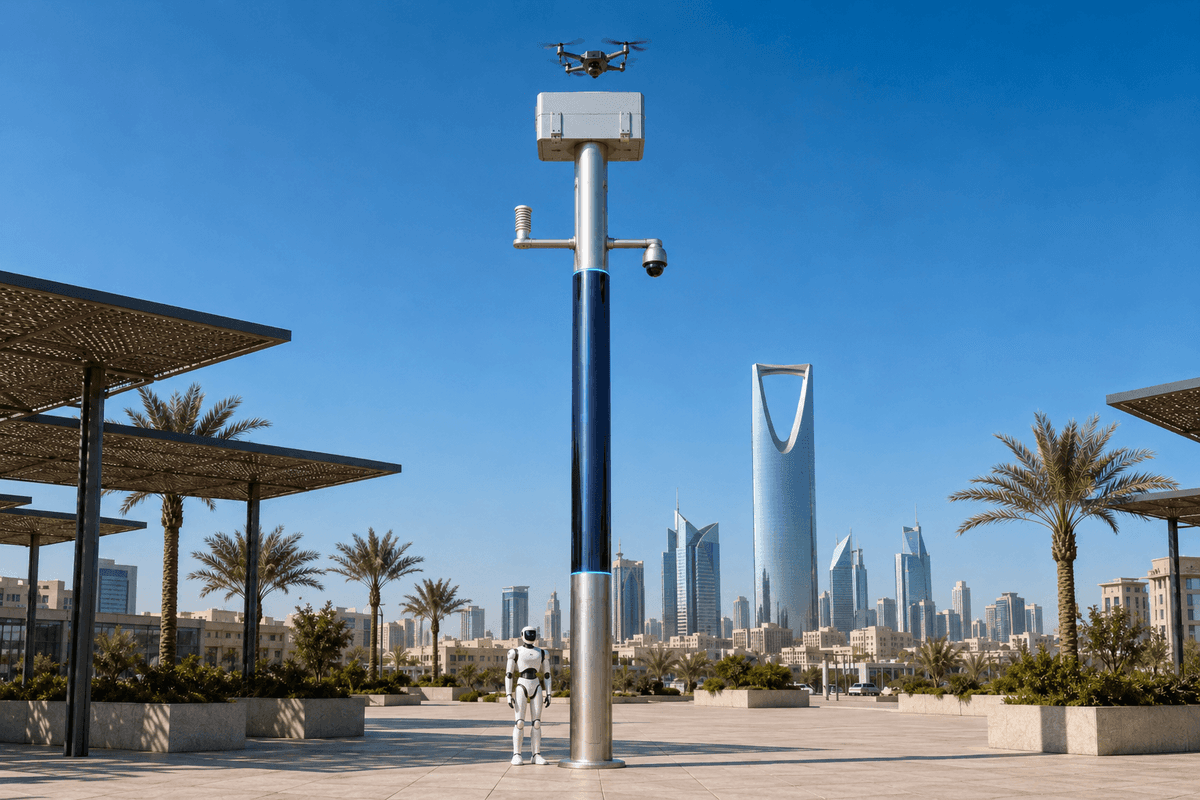
Athens Police Pilot Report: SOLARTODO Sentinel for Power-Resilient AI Night Patrol After Network Outage
TL;DR: SOLARTODO Sentinel is a solar-powered Physical-AI pole for Athens night patrols, targeting 72-hour autonomy, sub-10-second degraded-mode alerts, and below-5% false alarms after calibration.
Key Takeaways for Municipal and Security Buyers
Answer Capsule: A 10-30 pole Athens pilot should prove 72-hour autonomy, 99.5% availability, and below-5% false alarms before citywide procurement.
- Deploy the first 10-30 SOLARTODO Sentinel poles in outage-prone night-patrol routes, station perimeters, junctions, and reconstruction corridors.
- Require 72 hours of battery autonomy using measured load profiles, not nameplate battery capacity.
- Target below 5% false alarms for priority alert classes after a 2-week calibration period.
- Set degraded-mode alert delivery at under 10 seconds using LTE, 5G, private radio, or mesh fallback.
- Specify 1.2-2.4 kWh LiFePO4 storage and 400-550 W monocrystalline PV for Mediterranean winter testing.
- Require 7 days of encrypted local evidence retention when all backhaul paths are unavailable.
- Validate operational performance over 90 days, including patrol feedback, uptime, evidence integrity, and maintenance logs.
- Compare lifecycle cost per protected route segment, not only per pole, including avoided generator, tower, and truck-roll costs.
Executive Context
Answer Capsule: Athens needs resilient edge infrastructure because 1 damaged router cabinet can disable many cameras despite intact poles and lenses.
Post-disaster urban security often fails at the edge. Cameras, lighting, routers, and patrol coordination tools may remain physically present but lose power, backhaul, or command-center connectivity. The proposed Athens pilot positions SOLARTODO Sentinel as a compact city edge node that keeps visibility, lighting, local AI detection, and evidence capture active during degraded communications.
The commercial question for B2B buyers is practical: can a solar-integrated AI pole reduce night-patrol blind spots without heavy civil works? SOLARTODO Sentinel combines photovoltaic generation, LiFePO4 storage, low-power AI compute, environmental sensing, adaptive lighting, and layered communications in one deployable asset. The best initial zones are public squares, road junctions, evacuation routes, station perimeters, and temporary reconstruction corridors.
According to IEA (2024), global renewable capacity additions reached about 510 GW in 2023, nearly 50% higher than the previous year. According to IRENA (2024), renewables represented 86% of new power capacity added globally in 2023. These trends support the procurement logic for solar-backed public-safety infrastructure, but the Athens pilot must still prove local autonomy, alarm quality, and maintainability.
Deployment Scenario in Athens
Answer Capsule: The Athens pilot should test 3 operating states: connected service, degraded backhaul, and fully isolated local recording.
The pilot scenario assumes a localized outage after severe weather, infrastructure fire, earthquake-related utility disruption, or civil-works damage. Conventional CCTV may still be mounted and powered in some locations, yet become unavailable because upstream fiber, router cabinets, or grid-fed equipment fails. Sentinel is designed to preserve critical field functions when that edge failure occurs.
Priority Athens sites include transport-hub approaches, narrow historic streets with limited vehicle access, police station perimeters, and temporary reconstruction zones. The system should function as a resilient infill layer, not a full replacement for citywide CCTV. A practical program would start with 10-30 poles, run a 90-day field test, and scale only if autonomy, false-alarm performance, and maintenance workload meet predefined KPIs.
System Design
Answer Capsule: Each Sentinel pole should integrate 6 core layers: PV, battery, lighting, sensing, edge AI, and communications fallback.
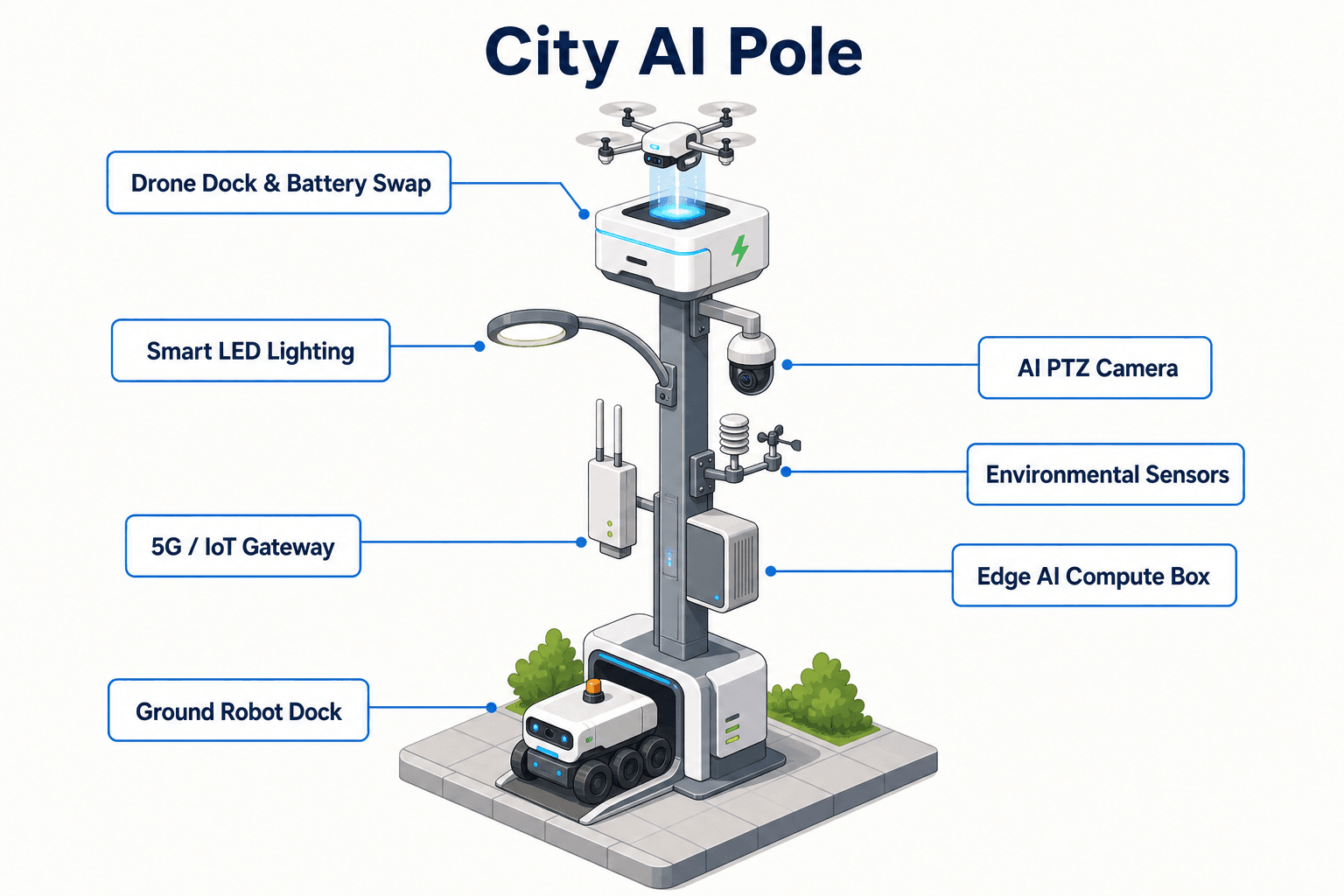
SOLARTODO Sentinel is structured as a self-powered edge node rather than a passive camera pole. The baseline architecture includes a 400-550 W monocrystalline PV module, 1.2-2.4 kWh LiFePO4 battery, 48 V DC bus, adaptive LED lighting, industrial AI inference, low-light video, local storage, and multipath communications.
In connected mode, the pole sends telemetry, selected event clips, and health data to a command platform. In degraded-backhaul mode, it reduces bandwidth to alert metadata, thumbnails, confidence scores, and device health. In isolated mode, it continues local AI detection, stores encrypted evidence, and synchronizes when connectivity returns.
According to NREL (2014), PVWatts uses explicit inputs for tilt, azimuth, losses, and local production modeling, including a commonly referenced default system loss of 14.08%. Athens procurement should apply the same discipline by documenting shading, temperature derating, battery depth of discharge, and winter irradiance before accepting the design.
Technical Parameters
Answer Capsule: The recommended pilot baseline uses 400-550 W PV, 1.2-2.4 kWh storage, and 10-40 TOPS edge inference.
Acceptance parameters should be defined before installation because resilience claims must be measured under field conditions. Final values should be adjusted after shading analysis, pole-height review, cellular testing, privacy screening, and local permitting. The table below gives a baseline specification for a Mediterranean urban pilot.
| Subsystem | Recommended Pilot Specification | Acceptance Metric |
|---|---|---|
| Solar module | 400-550 W monocrystalline PV, tempered glass, IP-rated junction box | IEC 61215 and IEC 61730 alignment |
| Battery | 1.2-2.4 kWh LiFePO4, 48 V DC, BMS with cell balancing | 72-hour low-power autonomy |
| AI compute | 10-40 TOPS edge inference, fanless enclosure | Below 250 ms classification latency |
| Camera payload | 4 MP to 8 MP low-light camera, optional thermal channel | Above 90% person and vehicle precision after calibration |
| Communications | Ethernet, LTE/5G, Wi-Fi bridge, optional mesh fallback | Alert delivery below 10 seconds in degraded mode |
| Lighting | 20-60 W dimmable LED with motion boost | Average resilience-mode night load below 22 W |
| Enclosure | IP65 or higher, IK10 impact resistance | 90 days outdoors with no water ingress or critical fault |
According to IEC (2021), IEC 61215-1 defines design qualification and type approval requirements for terrestrial photovoltaic modules. According to IEC (2016), IEC 61730 addresses PV module safety qualification. These standards do not guarantee site performance, but they create a procurement baseline for module durability and safety evidence.
Procurement Comparison Framework
Answer Capsule: Buyers should compare 5 options by autonomy, alert quality, deployment speed, maintenance burden, and outage performance.
Municipal buyers should compare Sentinel against the temporary and fixed alternatives normally used during emergency operations. The key distinction is not camera resolution alone. The stronger question is whether the asset preserves lighting, evidence capture, alert delivery, and patrol visibility when power or backhaul is degraded.
| Option | Resilience Strength | Operational Limitation | Best Use Case |
|---|---|---|---|
| SOLARTODO Sentinel | Solar, battery, edge AI, adaptive lighting, local storage, LTE/mesh fallback | Requires solar access, calibration, and battery health review | Outage-prone patrol routes and reconstruction corridors |
| Conventional CCTV | Mature evidence workflow and command-center integration | Depends on grid power, fiber, and upstream cabinets | Permanent monitored corridors with stable utilities |
| Mobile patrols | Human judgment and flexible response | Limited continuous coverage and high staffing cost | Incident verification and deterrence |
| Temporary camera towers | Rapid deployment and wide-area visibility | May need generators, refueling, trailers, and separate routers | Events, construction sites, and staging zones |
| Grid-tied smart poles | High continuous power budget and smart-city integration | Resilience depends on grid continuity or external backup | Routine urban services with reliable utilities |
According to BloombergNEF (2023), lithium-ion battery pack prices fell 14% in 2023 to a volume-weighted average of about $139/kWh. That trend improves the business case for battery-backed field infrastructure, but Athens buyers should still evaluate installed cost, battery replacement timing, maintenance labor, and avoided emergency equipment costs.
Power Resilience Model
Answer Capsule: A 1.8 kWh usable reserve can support about 72 hours if average resilience-mode load stays near 25 W or lower.
The energy model should start with measured loads: camera, AI compute, router, storage, lighting, sensors, standby losses, and charge-controller overhead. It should then include shading loss, winter irradiance, temperature derating, battery depth of discharge, and aging margin. Athens should test winter operation because night-patrol continuity is hardest when daylight hours are shorter.
A practical resilience profile can limit average night load to 16-22 W by dimming LED lighting, reducing continuous transmission, and prioritizing event-based analytics. With about 1.8 kWh usable reserve, the pole can approach 72 hours of low-power operation, depending on temperature, alarm frequency, and daytime recharge. Runtime must be verified with logged state of charge, not vendor estimates alone.
Battery safety should be mandatory in the RFP. LiFePO4 is preferred for thermal stability, cycle life, and municipal maintenance tolerance. The dashboard should report state of charge, state of health, pack temperature, charge current, discharge current, protective cutoffs, and abnormal drain events.
Physical-AI Module Breakdown
Answer Capsule: A modular pole reduces service risk because 4 major units can be replaced without removing the complete structure.
The Sentinel pole integrates energy assets, sensors, communications, and edge intelligence into a field-maintainable unit. This matters for police and municipal buyers because service teams may need to replace cameras, batteries, routers, or lighting modules quickly. The same architecture can support phased upgrades such as acoustic sensors, air-quality monitoring, flood detection, or traffic analytics.
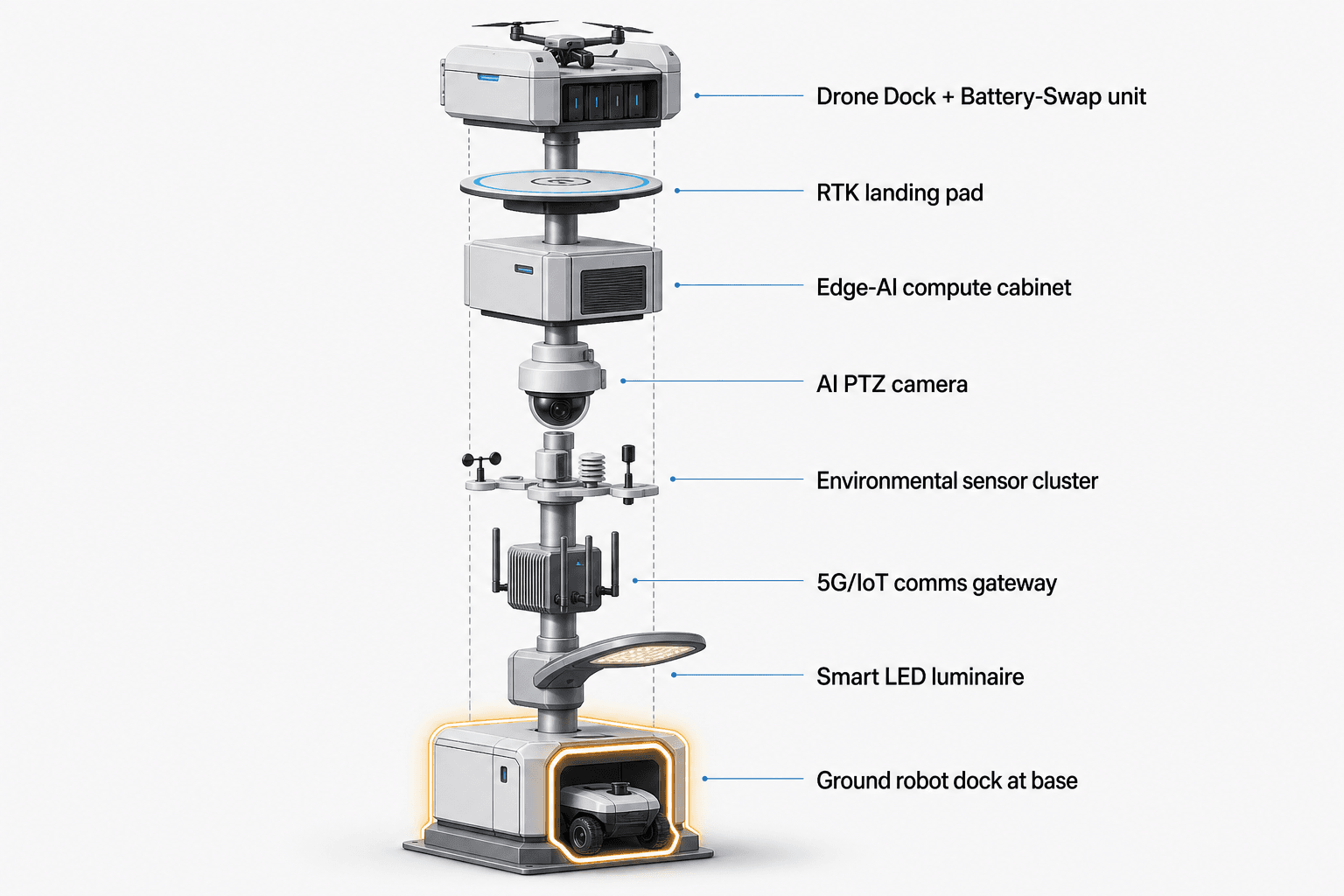
For night patrol, the critical modules are the low-light camera, AI processor, communications gateway, power controller, and adaptive lighting. The camera should support high dynamic range and low-noise imaging under streetlight or moonlight conditions. The AI processor should run detection models locally so priority alerts continue even when cloud services are unavailable.
False-Alarm Evaluation
Answer Capsule: The Athens acceptance target should be below 5% false alarms after 14 days of site-specific calibration and masking.
False alarms determine whether the pilot is operationally useful. A resilient pole that produces noisy alerts will drain dispatcher attention, patrol capacity, and political support. The Athens pilot should set a target below 5% false alarms for priority event classes after a 2-week tuning period.
The evaluation should separate technical detection quality from operational triage quality. Technical metrics include precision, recall, F1 score, missed-event rate, duplicate-alert rate, and classification latency. Operational metrics include dispatcher review time, patrol dispatch rate, confirmed incident rate, and escalation accuracy.
Typical false triggers in dense streets include shadows, scooters, delivery vehicles, reflections, construction work, rain, dust, smoke-like haze, and crowd movement near nightlife districts. The system should use region-of-interest rules, time-of-day policies, object persistence thresholds, and multi-frame confirmation. Human review remains essential before high-impact actions such as pursuit, emergency escalation, or evidence handover.
Communications During Network Outage
Answer Capsule: Sentinel should support at least 3 connectivity paths: wired backhaul, cellular fallback, and local mesh or store-and-forward operation.
The communications design should assume partial failure rather than a clean online-or-offline state. A pole may lose fiber but retain LTE, lose LTE but maintain a mesh path, or lose every backhaul route while still recording locally. Sentinel should therefore prioritize layered connectivity and evidence store-and-forward.
In normal mode, the pole can transmit telemetry, event clips, firmware status, and selected live streams. In degraded mode, it should transmit only event type, timestamp, GPS location, confidence score, thumbnail, and system health. If no path is available, encrypted local storage should retain evidence for at least 7 days, with tamper logs and automatic synchronization when the network returns.
According to IEEE (2018), IEEE 2030.5 defines an application protocol for smart energy communication. According to IEEE (2017), IEEE 2030.7 specifies microgrid controller functions, including monitoring and dispatch concepts. These references are useful for structuring distributed energy telemetry and islanded operating logic in a pole-level resilience system.
Installation and Logistics Plan
Answer Capsule: A practical Athens deployment can install 10-30 poles in phases after site survey, permits, signal testing, and privacy review.
Phase 1 should identify candidate sites with documented patrol relevance, outage exposure, sunlight availability, and installation feasibility. Each site should receive a shading study, cellular signal test, pole foundation review, camera field-of-view check, and privacy-impact screening. The output should be a ranked deployment map with expected energy yield and operational value.
Phase 2 should confirm electrical safety, mechanical stability, camera angle, communications handoff, dashboard registration, and local storage encryption. Baseline testing should run for 2 weeks without operational dispatch influence. This period is essential for tuning detection zones, masking private windows, and reducing nuisance triggers.
Phase 3 should simulate loss of primary backhaul, reduced solar input, and low-power patrol operation. Acceptance should require documented uptime, state-of-charge behavior, degraded-mode alert latency, and evidence integrity. Phase 4 should review 90 days of results against KPIs before any scale-up order.
Business Value for B2B Stakeholders
Answer Capsule: The buyer value is repeatable resilience: 1 pole combines power, lighting, sensing, AI, communications, and evidence storage.
For police agencies, the value is continuity of visibility during the exact period when conventional infrastructure is fragile. For municipalities, the value is a deployable smart-city node that can support security, lighting, emergency coordination, and environmental sensing from the same location. For EPCs and solar integrators, SOLARTODO creates a higher-value category beyond commodity PV installation.
The procurement case improves when evaluated as avoided downtime, faster incident verification, and lower temporary-infrastructure cost. A mobile generator, camera mast, trailer, and router cabinet can be expensive to deploy and maintain after a disaster. SOLARTODO Sentinel reduces that complexity by combining energy, sensors, communications, and control software in one engineered package.
According to IRENA (2024), renewable power capacity increased by 473 GW in 2023, with solar PV accounting for the largest share of new renewable additions. This macro trend does not replace field validation, but it supports the long-term availability of PV supply chains, service expertise, and public-sector familiarity with solar-backed infrastructure.
FAQ
Answer Capsule: The FAQ answers 10 buyer questions on cost, specifications, logistics, warranty, installation, privacy, maintenance, and alternatives.
How much does a SOLARTODO Sentinel pilot cost?
Pilot pricing should be evaluated as total installed cost, not pole hardware alone. Cost drivers include PV size, battery capacity, camera payload, AI compute, communications, foundation work, permitting, software, cybersecurity integration, and maintenance. For Athens, buyers should compare cost per protected route segment and include avoided generators, temporary towers, refueling, router cabinets, and emergency truck rolls.
What technical specifications should the RFP require?
A strong RFP should specify 400-550 W monocrystalline PV, 1.2-2.4 kWh LiFePO4 storage, 10-40 TOPS edge AI, 4 MP to 8 MP low-light imaging, IP65 or higher enclosure protection, and IK10 impact resistance. It should also define 72-hour autonomy, below-10-second degraded-mode alerts, 7-day encrypted local retention, and below-5% false alarms after calibration.
How long can the pole operate without grid power?
The Athens target is 72 hours under a defined low-power patrol profile. Runtime depends on LED dimming level, camera frame rate, AI inference duty cycle, router duty cycle, battery age, temperature, alarm frequency, and solar recharge during the outage. Acceptance testing should use state-of-charge logs, voltage, temperature, and measured load data rather than nameplate battery capacity.
How difficult is installation in dense urban streets?
Installation difficulty depends on foundation conditions, sunlight access, camera field of view, cellular coverage, pedestrian safety, and local permitting. The pilot should complete shading analysis, signal testing, privacy masking, and structural review before equipment delivery. Modular installation reduces disruption because the pole integrates PV, battery, lighting, camera, communications, and AI hardware in one field asset.
What warranty terms should municipal buyers request?
Buyers should request separate warranty terms for PV modules, battery packs, electronics, cameras, lighting, enclosures, and software support. The RFP should define response time, spare-part availability, firmware support, cybersecurity patching, and battery capacity retention thresholds. A practical pilot should also require maintenance coverage through the first 90 days and clear replacement procedures for failed modules.
How does Sentinel compare with temporary camera towers?
Temporary camera towers are useful for short events, construction zones, and emergency staging, but they may require trailers, generators, refueling, and separate communications equipment. Sentinel is better suited for repeated patrol-route resilience where solar charging, local AI, adaptive lighting, and evidence retention must stay available during outages. Buyers should compare uptime, staffing burden, fuel logistics, and evidence workflow.
Does the system still work if the network is down?
Yes. The edge AI module can continue detection, event tagging, and encrypted recording without cloud connectivity. If partial connectivity remains, the pole sends lightweight metadata such as event type, timestamp, GPS location, confidence score, thumbnail, and health status. If all backhaul fails, evidence remains in local encrypted storage and synchronizes when connectivity returns.
How should privacy be handled in Athens streets?
Privacy controls should be designed before installation. Each site needs documented field-of-view review, private-window masking, retention limits, role-based access, and audit logging. The workflow should prioritize event metadata and short clips instead of unnecessary continuous streaming. Human review should be required before high-impact escalation, and complaints should trigger documented camera-angle or masking review.
What maintenance model is realistic?
A realistic maintenance plan includes quarterly visual inspection, PV cleaning when soiling reduces output, annual battery health review, firmware verification, lens cleaning, communications testing, and tamper inspection. The dashboard should report charge status, battery health, enclosure temperature, network status, storage status, and fault codes. Field teams should replace batteries, routers, cameras, and lighting modules without removing the entire pole.
Is this a replacement for citywide CCTV?
No. The Athens concept is a resilient infill layer for high-risk or outage-prone patrol zones. Conventional CCTV remains appropriate for permanent corridors with reliable power, fiber, and established monitoring workflows. Sentinel is most useful where restoration is uncertain, civil works are limited, or temporary reconstruction areas need lighting, detection, communications, and evidence capture from one deployable asset.
Standards and Compliance References
Answer Capsule: Procurement should cite at least 8 references covering PV safety, battery safety, enclosure ratings, communications, and performance modeling.
Procurement documents should reference recognized standards to reduce ambiguity and improve vendor accountability. IEC 61215 is relevant for crystalline PV module design qualification, while IEC 61730 addresses PV module safety. IEC 62133 is useful for rechargeable cell and battery safety, and IEC 60529 provides the basis for ingress-protection ratings such as IP65.
IEEE 2030.5 and IEEE 2030.7 can guide distributed energy communication and controller logic where pole assets report energy state into a broader smart-city platform. NREL PVWatts-style modeling should be used during design review to validate production assumptions. Cybersecurity requirements should include encrypted identity, signed firmware, role-based access, and audit logs aligned with municipal IT policy.
These references do not replace Greek or EU legal requirements. Local rules for electrical safety, public-space installation, radio equipment, personal data, video surveillance, and police operations remain controlling. The pilot should treat standards as acceptance-test anchors, not as generic marketing claims.
References
Answer Capsule: The reference set includes 9 authoritative sources from NREL, IEC, IEEE, IEA, IRENA, and BloombergNEF.
- According to IEA (2024), global renewable capacity additions reached about 510 GW in 2023, nearly 50% higher than the previous year.
- According to IRENA (2024), renewables represented 86% of new power capacity added globally in 2023, with 473 GW of renewable additions.
- According to NREL (2014), PVWatts documents explicit PV modeling inputs and a commonly referenced default system loss of 14.08%.
- According to IEC (2021), IEC 61215-1 defines design qualification and type approval requirements for terrestrial photovoltaic modules.
- According to IEC (2016), IEC 61730 defines safety qualification requirements for photovoltaic modules.
- According to IEC (2017), IEC 62133-2 addresses safety requirements for rechargeable lithium cells and batteries.
- According to IEEE (2018), IEEE 2030.5 defines the Smart Energy Profile application protocol for distributed energy communications.
- According to IEEE (2017), IEEE 2030.7 specifies functional requirements for microgrid controllers.
- According to BloombergNEF (2023), lithium-ion battery pack prices fell 14% in 2023 to about $139/kWh.
Conclusion
Answer Capsule: A successful 90-day pilot should prove 5 outcomes: autonomy, uptime, alert quality, evidence integrity, and maintainability.
The proposed Athens police pilot gives SOLARTODO Sentinel a clear operational test: maintain night-patrol awareness when power and communications are unreliable. By combining solar generation, battery storage, edge AI, adaptive lighting, and layered communications, the system addresses a real post-disaster gap in urban security infrastructure. The pilot should be judged by measured autonomy, alarm quality, uptime, evidence integrity, and serviceability.
For B2B buyers, the strongest case is repeatable resilience. A successful 90-day pilot would create a procurement blueprint for municipalities, police agencies, solar EPCs, and smart-city integrators seeking deployable Physical-AI infrastructure. With standards-based design and disciplined false-alarm evaluation, SOLARTODO Sentinel can move from demonstration pole to scalable public-safety asset.