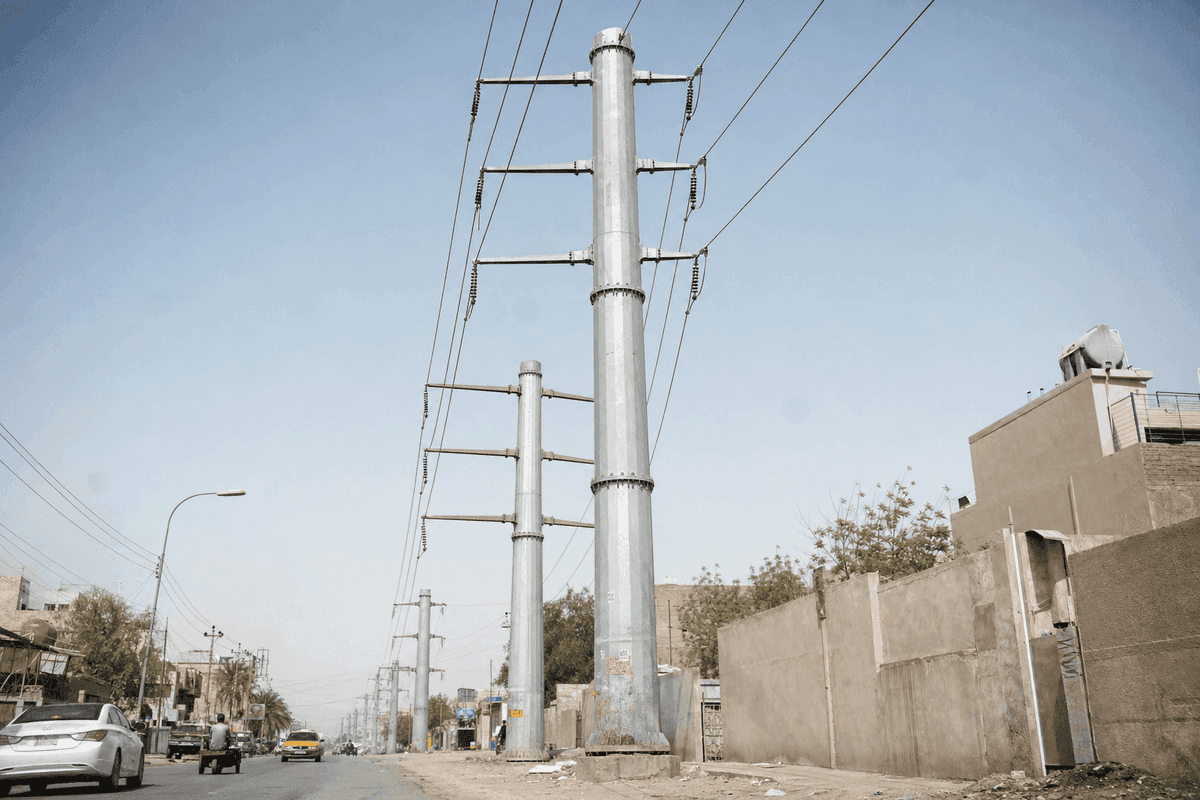
Baghdad Power Transmission Tower Market Analysis: 110kV Double-Circuit Steel Tubular Pole Configuration Guide
Summary
Baghdad’s grid reinforcement profile supports a 110kV backbone solution using approximately 59 steel tubular poles across about 15km, with 250m spans, 35m/s wind design, and ACSR-240 conductors for urban sub-transmission reliability.
Key Takeaways
- Baghdad’s metropolitan population exceeds 7 million, which keeps pressure on 110kV and 132kV-class urban transmission corridors feeding dense load centers, according to UN-Habitat and World Bank datasets.
- A typical Baghdad backbone segment of this scale would use approximately 59 hot-dip galvanized Q345 steel tubular poles over about 15km at 250m average spans.
- The specified line profile is 110kV double circuit with 40m pole height, 4m phase spacing, 6m ground clearance, and 1.5m insulator length.
- Conductor selection in this configuration is ACSR-240, rated here at about 920kg/km with maximum tension of 70kN for medium-span urban sub-transmission duty.
- Wind Class 3 at 35m/s is a practical design basis for Baghdad’s open urban and peri-urban corridors, aligned with IEC 60826 loading methodology.
- Each pole in this configuration is approximately 40t, using a flanged hot-dip galvanized tubular steel structure with concrete base foundation and anchor system.
- A typical implementation window for a 15km 110kV line segment would often fall in the 8-14 month range, depending on right-of-way, foundation curing, and utility outage coordination.
- SOLARTODO’s Power Transmission Tower line fits this market where utilities want monopole-style structures instead of lattice towers in constrained corridors, road medians, or urban-edge substations.
Market Context for Baghdad
Baghdad’s transmission upgrade requirement is shaped by dense urban demand, high summer temperatures above 45°C, and the need to move bulk power through limited right-of-way using 110kV-class corridors.
Baghdad is Iraq’s political and economic center, and its metropolitan population is commonly estimated above 7 million. According to UN-Habitat (2024), Baghdad remains the country’s dominant urban agglomeration, while the World Bank (2023) continues to identify electricity reliability as a core infrastructure constraint across Iraq. That combination matters for tower selection because dense demand centers usually need compact sub-transmission structures in the 66-110kV range before power is stepped down into distribution networks.
Climate also affects structure choice. According to the World Bank Climate Change Knowledge Portal (2021), Baghdad experiences very hot summers, low annual rainfall, and frequent dust events. For a steel monopole or tubular pole, that points to three practical requirements: hot-dip galvanizing for corrosion resistance, conductor and insulator selection that tolerates contamination, and wind-load verification under IEC 60826. In Baghdad, a 35m/s wind basis is a reasonable design point for many utility corridors, especially where open exposure and dust accumulation are expected.
At grid level, Iraq continues to prioritize transmission reinforcement and interconnection. According to the International Energy Agency (IEA) (2023), Iraq’s power system still faces supply-demand imbalance, network bottlenecks, and high technical losses. The Ministry of Electricity has repeatedly emphasized transmission and substation expansion in the 132kV and 400kV systems, but 110kV-class steel tubular solutions remain relevant where utilities or EPCs need compact urban backbone links, industrial feeders, or substation-to-substation connectors.
This is where SOLARTODO’s Power Transmission Tower product line fits Baghdad. A tubular steel pole occupies a smaller footprint than a conventional lattice tower, which is useful near roads, canals, industrial estates, and built-up districts. For Baghdad, the decision is not about using the tallest structure possible; it is about matching the voltage class, span, loading, and right-of-way constraint to a practical 110kV double-circuit design.
As IEC states, "The aim of this International Standard is to specify procedures and requirements for the mechanical design of overhead lines." That statement from IEC 60826 is directly relevant in Baghdad because mechanical loading, not only electrical rating, drives pole height, section thickness, and foundation size. The World Bank also notes that "Reliable electricity is a prerequisite for economic recovery and private-sector growth," which reinforces the case for sub-transmission reinforcement in major Iraqi cities.
Recommended Technical Configuration
For Baghdad’s dense urban load profile, a typical 110kV double-circuit steel tubular pole line of about 15km would suit backbone reinforcement better than lower 35kV distribution-class structures.
The correct engineering sequence starts with voltage class. Based on the product rules, 110kV belongs to the 66-110kV sub-transmission category, which normally maps to 18-30m height, 5-15t per pole, 200-300m spans, and about 4-5 poles/km. However, the project-specific configuration provided for this article must be used exactly: approximately 59 units of 40m tapered steel tubular pole for a 110kV double-circuit line, over about 15km with 250m spans. That makes this a utility-specific high-clearance backbone profile rather than a generic minimum-height 110kV line.
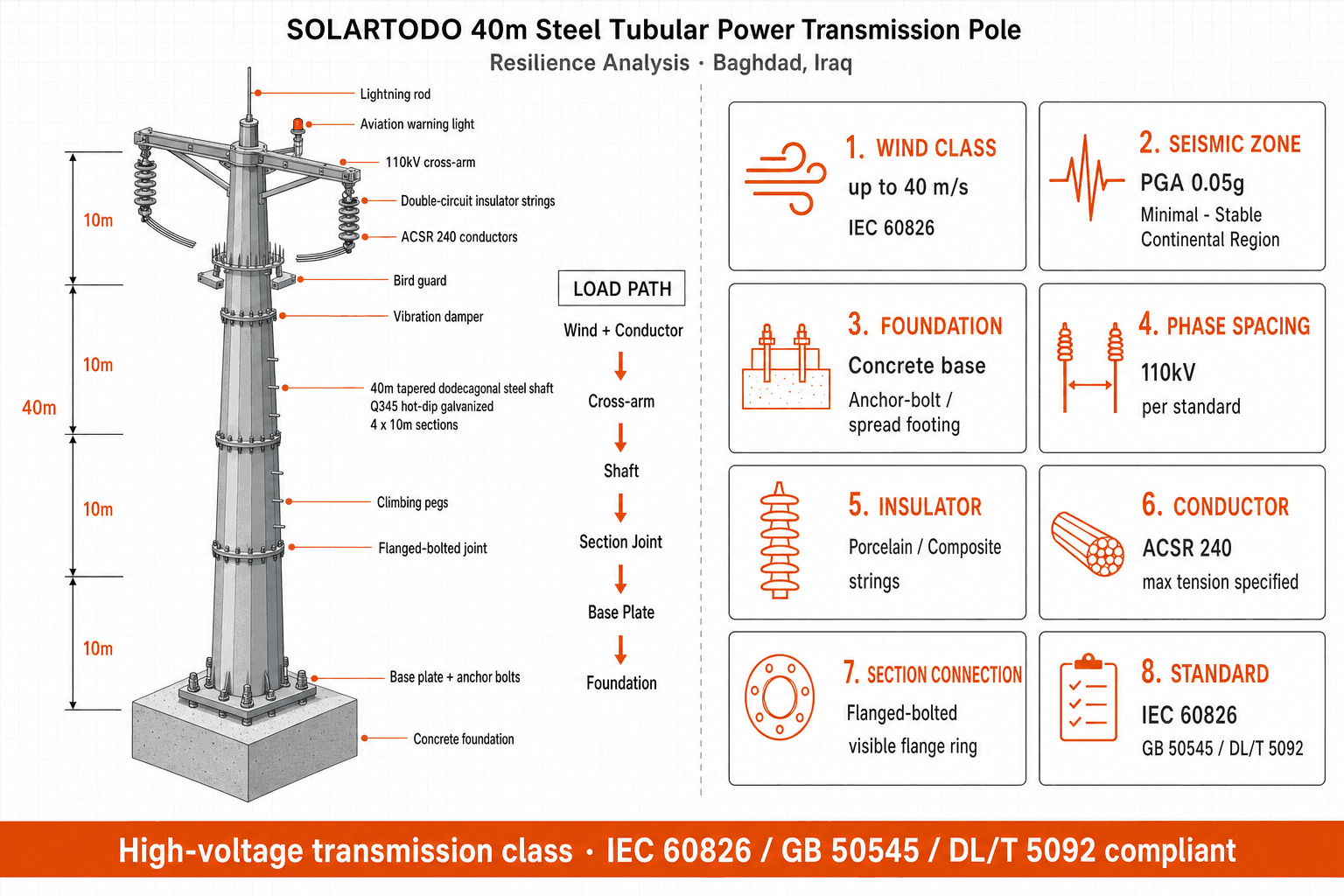
A typical Baghdad deployment of this scale would consist of approximately 59 hot-dip galvanized Q345 steel tubular poles in flanged sections, installed on concrete base foundations with anchor cages. The line would use double-circuit cross-arm arrangements, 4m phase spacing, 6m ground clearance, and 1.5m insulator strings. Conductor selection would be ACSR-240, listed here at about 920kg/km and up to 70kN maximum tension.
Why use a 40m tubular pole for 110kV in Baghdad? The answer is corridor geometry. In built-up areas, utilities often need additional clearance over roads, mixed-use development, drainage channels, or future road widening. A taller monopole can reduce the visual spread and land take compared with broader lattice structures. It can also simplify line routing where a double circuit is required on one structure to save corridor width.
The quantity also aligns with the stated route length. At 15km total line length and 59 poles, the average density is about 3.9 poles/km, which is close to the expected 4-5 poles/km range for 66-110kV sub-transmission. The 250m span is also inside the 200-300m range for this voltage class. So while the 40m height and 40t pole weight are heavier than a generic 110kV profile, the span logic and corridor use remain consistent with sub-transmission practice.
For buyers comparing options, SOLARTODO would typically position this as a high-voltage transmission backbone monopole package for urban-edge or industrial-grid reinforcement. It is not a 35kV distribution pole, and it should not be specified as one. Baghdad’s network planners should treat this configuration as a compact 110kV transfer corridor solution where double-circuit continuity and right-of-way efficiency matter more than minimum steel tonnage.
Technical Specifications
The recommended Baghdad configuration is a 110kV double-circuit tubular steel line using approximately 59 poles at 40m height, 250m spans, and ACSR-240 conductors over a total route of about 15km.
- Product type: SOLARTODO Power Transmission Tower, tapered steel tubular pole
- Application class: High-voltage transmission backbone
- Voltage class: 110kV
- Circuit arrangement: Double circuit
- Pole quantity: Approximately 59 units
- Pole height: 40m
- Pole mass: Approximately 40t per pole
- Linear steel index: 1000kg/m
- Pole material: Q345 steel
- Surface treatment: Hot-dip galvanized
- Pole form: Flanged bolt-section tubular pole
- Conductor type: ACSR-240
- Conductor mass: Approximately 920kg/km
- Maximum conductor tension: 70kN
- Typical span: 250m
- Total line length: Approximately 15km
- Phase spacing: 4m
- Minimum ground clearance: 6m
- Insulator length: 1.5m
- Wind class: Class 3
- Basic wind speed: 35m/s
- Foundation type: Concrete base foundation
- Accessories: Climbing steps, cross arm, grounding set, bird guard, vibration damper
- Design life: 30 years
- Reference standards: IEC 60826 / GB 50545 / DL/T 5092
From a standards standpoint, IEC 60826 governs loading and strength methodology for overhead lines, while GB 50545 and DL/T 5092 are commonly referenced for transmission line structural and design practice. According to IRENA (2023), transmission investment quality is strongly tied to lifecycle durability, which is why galvanizing thickness, bolt protection, and foundation detailing matter as much as nominal kV rating.
Implementation Approach
A 15km Baghdad 110kV tubular pole project would typically move through 5 phases: route survey, foundation works, pole fabrication, erection, and energized commissioning.
Phase 1 is route and geotechnical confirmation. For a 15km corridor with about 59 poles, the utility or EPC contractor would first confirm centerline alignment, crossing points, geotechnical bearing capacity, and ground resistivity. In Baghdad, alluvial soils near the Tigris basin can vary significantly over short distances, so foundation design should be based on actual borehole data rather than standard assumptions every 250m.
Phase 2 is detailed design and procurement. The pole package would include tapered shaft sections, flange bolts, anchor cage assemblies, cross-arm brackets, grounding kits, vibration dampers, and bird guards. According to IEC 60826, mechanical design should account for wind, conductor tension, broken-wire conditions, and installation loads. For Baghdad, buyers should also ask for galvanizing certificates, steel mill certificates for Q345, and bolt-grade documentation before shipment.
Phase 3 is civil works. Concrete base foundations are normally sequenced in blocks so that excavation, rebar placement, anchor cage positioning, and pour schedules can proceed in parallel. A 59-pole program might be split into 3 to 5 civil fronts, depending on access roads and traffic management. Foundation curing time often controls the critical path, especially when heavy 40t-class poles require strict anchor alignment tolerance.
Phase 4 is erection and stringing. Tubular poles are usually delivered in flanged sections and assembled by crane. This is useful in Baghdad because sectioned transport can move through urban roads more easily than very wide lattice assemblies. Once structures are plumbed and torqued, insulators, ACSR-240 conductors, grounding, and damping hardware are installed, followed by sag-tension checks at the specified 70kN limit.
Phase 5 is testing and energization. Typical pre-commissioning steps include foundation inspection, bolt torque verification, verticality measurement, earthing continuity, insulator inspection, and conductor clearance checks. If the line connects active substations, outage coordination can add several weeks to the handover schedule. For a 15km line in Baghdad, a practical planning range is often 8 to 14 months from approved drawings to energization, assuming permits and imported materials are available on time.
Expected Performance & ROI
A 110kV double-circuit tubular pole line in Baghdad would primarily deliver reliability, corridor efficiency, and lower urban land-use impact over a 30-year design life rather than a short payback measured only by energy sales.
The main performance value is transfer capacity and outage reduction. According to the IEA (2023), Iraq’s electricity system continues to face congestion and service interruptions, especially during peak summer demand. A double-circuit 110kV line adds redundancy because one circuit can support partial continuity during maintenance or contingency events. For industrial feeders, water infrastructure, and dense municipal loads, the avoided cost of outage hours can be more important than the initial steel tonnage.
Lifecycle economics also favor galvanized tubular poles in constrained corridors. According to NREL (2022), transmission asset economics should be evaluated across capital cost, maintenance frequency, outage risk, and land-use constraints. A monopole-style structure can reduce right-of-way width, simplify roadside siting, and lower visual clutter relative to broad-base lattice alternatives. In city-edge Baghdad sites where land and access are difficult, that can improve total project economics even if the pole itself is heavier.
Maintenance intervals are generally predictable. With proper galvanizing, grounding, and bolt protection, a 30-year design life is realistic for this class of structure. Routine inspection would usually include annual visual checks, 3- to 5-year bolt torque sampling, grounding resistance testing, and post-storm inspections after high-wind or dust events above the 35m/s design threshold. According to the World Bank (2023), reduced forced outages and better grid availability have direct economic value for urban productivity.
For procurement teams, the ROI discussion should focus on four metrics:
- Cost per km for a 15km, 59-pole line
- Cost of right-of-way acquisition versus lattice alternatives
- Expected outage reduction on a double-circuit 110kV segment
- Maintenance cost over 30 years under Baghdad dust and heat conditions
Results and Impact
For Baghdad, a 15km 110kV double-circuit tubular pole corridor would typically improve transfer resilience, preserve corridor width, and support substation-to-load-center connectivity with approximately 59 structures.
The expected impact is strongest where conventional broad-footprint towers are difficult to place. A tubular steel pole can support road-adjacent routing, industrial estate connections, and constrained urban-edge alignments with fewer land conflicts. In Baghdad, where utility works often intersect transport corridors and dense built form, that smaller footprint is a practical advantage.
The second impact is network continuity. Double-circuit arrangement does not eliminate outages, but it improves operational flexibility during maintenance and contingency switching. For utilities planning staged reinforcement, a 15km 110kV segment can also serve as a modular package between substations, generation tie-ins, or major load pockets.
The third impact is asset durability. With Q345 steel, hot-dip galvanizing, concrete foundations, and accessories such as vibration dampers and bird guards, the line is designed for a 30-year service horizon under Baghdad’s heat, dust, and wind exposure. This is the type of specification that procurement teams can evaluate directly against local utility standards and bid documents.
Comparison Table
For Baghdad, the main procurement choice is usually between a compact 110kV tubular pole line and a conventional lattice alternative across footprint, span, erection method, and corridor use.
| Metric | SOLARTODO 110kV Tubular Pole Recommendation | Conventional Lattice 110kV Alternative |
|---|---|---|
| Voltage class | 110kV double circuit | 110kV single or double circuit |
| Structure form | Tapered steel tubular pole | Angle-steel lattice tower |
| Typical quantity for 15km | Approx. 59 poles | Similar route-dependent count |
| Typical span in this guide | 250m | 220-300m |
| Pole/tower height | 40m | Often 25-40m depending on profile |
| Footprint at ground | Smaller | Larger |
| Urban corridor suitability | Better in constrained ROW | Less suitable in narrow ROW |
| Pole/tower mass | Approx. 40t each | Varies by tower family |
| Transport format | Flanged sections | Multiple steel members |
| Erection method | Crane assembly of sections | Piece-by-piece tower assembly |
| Visual profile | Narrow vertical form | Wider silhouette |
| Design standards | IEC 60826 / GB 50545 / DL/T 5092 | IEC / local utility standard set |
Pricing & Quotation
SOLARTODO offers three pricing tiers for this product line: FOB Supply (equipment ex-works China), CIF Delivered (including ocean freight and insurance), and EPC Turnkey (fully installed, commissioned, with 1-year warranty). Volume discounts are available for large-scale deployments. Configure your system online for an instant estimate, or request a custom quotation from our engineering team at [email protected].
For Baghdad tenders, buyers should request a line-item quotation that separates steel pole supply, galvanizing, conductor hardware, foundation drawings, packing, freight, and site erection scope. SOLARTODO can also be compared on an equipment-only basis against local EPC execution models. Product details are available on the Power Transmission Tower product page, and technical RFQs can be sent via the contact page.
Frequently Asked Questions
This FAQ answers the most common Baghdad buyer questions on 110kV tubular pole sizing, installation, maintenance, warranty scope, and quotation structure in 8-12 concise responses.
Q1: Why is 110kV the recommended class for this Baghdad configuration?
110kV fits sub-transmission and backbone transfer duty between substations and major load centers. In Baghdad, dense demand and constrained corridors often require a higher-capacity line than 35kV distribution can provide. This guide uses a 110kV double-circuit profile with 250m spans and about 15km route length for that reason.
Q2: Why use a tubular pole instead of a lattice tower?
A tubular steel pole uses less ground footprint and usually suits narrow rights-of-way better. That matters in Baghdad near roads, canals, industrial plots, and built-up districts. The tradeoff is higher single-piece structural demand, but flanged sections and crane erection can simplify urban installation compared with broad-base lattice assemblies.
Q3: What is the recommended conductor for this configuration?
The specified conductor is ACSR-240, listed here at approximately 920kg/km with maximum tension of 70kN. This conductor size is commonly used where utilities need a practical balance between ampacity, mechanical strength, and manageable sag over 250m spans in 110kV double-circuit service.
Q4: How long would a 15km project typically take?
A practical planning range is about 8 to 14 months, depending on route permits, geotechnical conditions, imported material lead time, and outage coordination. The critical path usually includes foundation curing, pole delivery, and stringing access. Urban traffic control in Baghdad can also affect crane and conductor installation windows.
Q5: What maintenance does a 30-year tubular pole line require?
Typical maintenance includes annual visual inspection, periodic bolt torque sampling every 3 to 5 years, grounding checks, and post-storm inspection after severe wind or dust events. Buyers should also monitor galvanizing condition, insulator contamination, and vibration damper performance, especially in hot, dusty Baghdad environments.
Q6: Is there a measurable ROI for this type of line?
Yes, but ROI is usually measured through reliability and network capacity rather than direct product revenue. Utilities often evaluate avoided outage cost, reduced right-of-way burden, lower maintenance exposure, and improved transfer flexibility from the double-circuit arrangement. In Baghdad, these factors can outweigh pure material-cost comparisons.
Q7: What should be included in an EPC quotation?
An EPC quotation should separate design, pole supply, galvanizing, anchor cages, conductors, insulators, civil works, erection, stringing, testing, and commissioning. For Baghdad, it should also clarify whether customs clearance, inland transport, outage coordination, and utility acceptance testing are included or excluded from the offered scope.
Q8: What warranty terms are typical for this product line?
Commercial warranty terms vary by contract, but buyers usually ask for at least 1 year after commissioning for supplied equipment under EPC scope. That should be distinct from the 30-year design life. The contract should define exclusions for vandalism, third-party damage, extraordinary weather, and improper site handling.
Q9: Can this configuration be adapted for higher wind or different soil conditions?
Yes. The 35m/s Wind Class 3 basis can be recalculated if the utility or consultant requires a different design speed. Foundation geometry can also be adjusted after geotechnical testing. In practice, wind load, broken-wire load, and bearing capacity are verified before final pole wall thickness and anchor cage details are frozen.
Q10: Is 59 poles over 15km a realistic density for 110kV?
Yes. At about 3.9 poles/km and 250m average spans, the route density is close to the typical 4-5 poles/km expected for 66-110kV sub-transmission lines. That makes the quantity reasonable for a Baghdad corridor of this length, especially with double-circuit arrangement and urban clearance constraints.
References
- International Energy Agency (2023): Iraq energy sector overview and electricity system constraints, including transmission bottlenecks and reliability challenges.
- World Bank (2023): Iraq development and infrastructure data highlighting electricity reliability as a major economic constraint.
- World Bank Climate Change Knowledge Portal (2021): Baghdad climate profile including high summer temperatures, arid conditions, and wind-related environmental exposure.
- IEC (2017): IEC 60826, Design criteria of overhead transmission lines.
- UN-Habitat (2024): Iraq urbanization and Baghdad metropolitan demographic context.
- IRENA (2023): Power system and transmission investment considerations for reliability, durability, and lifecycle performance.
- National Renewable Energy Laboratory (2022): Transmission planning and lifecycle evaluation guidance relevant to grid asset cost-benefit assessment.
- GB 50545 / DL/T 5092: Chinese power transmission line design and structural reference standards commonly used for steel pole engineering packages.
Equipment Deployed
- 59 × 40m tapered steel tubular Power Transmission Tower poles, double-circuit, approx. 40t/pole
- Q345 hot-dip galvanized flanged steel pole sections
- 110kV double-circuit cross-arm assemblies
- ACSR-240 conductor, approx. 920kg/km, max tension 70kN
- 1.5m insulator strings for 110kV line configuration
- Concrete base foundations with anchor cage assemblies
- Grounding system set for each pole location
- Climbing steps for maintenance access
- Bird guards for avian protection on line hardware
- Vibration dampers for conductor motion control under wind loading