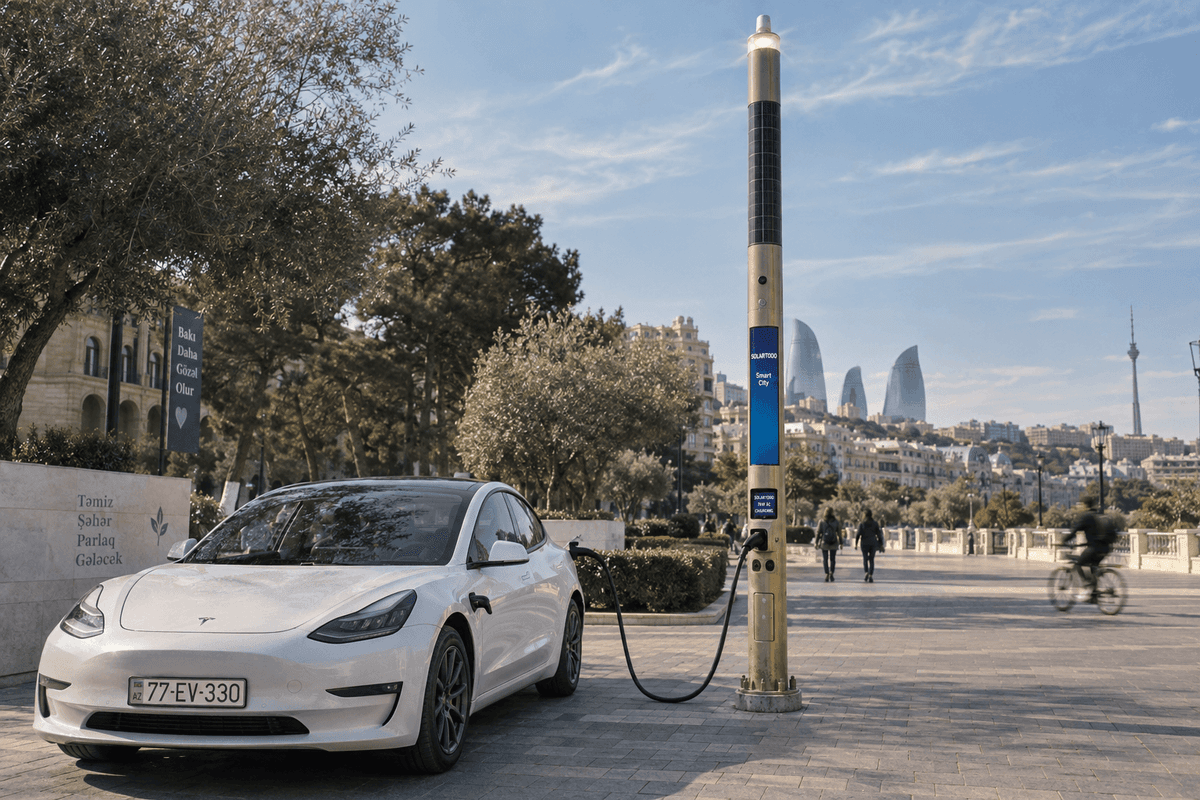
Baku Salt-Air Boulevard Corridors: Smart Streetlight Technical Fit for Flush Cylindrical Poles
Summary
Baku’s Caspian coast, 2,300 km street network, and 2040 plan for 2,668 km of roads favor approximately 97 flush 7m Smart Streetlight poles at 25m spacing for premium urban corridors.
Key Takeaways
A Baku Smart Streetlight package should prioritize 7m sealed cylindrical poles, 25m spacing, and flush hardware to handle coastal exposure and dense streets.
- Approximately 97 units would cover about 2.4 km at 25m spacing, matching 30-50 poles/km urban street density.
- The recommended pole is a 7m seamless Ø200mm cylinder with 5mm wall thickness and no side arms or external boxes.
- Baku’s Master Plan 2040 targets street-network expansion from 2,300 km to 2,668 km, creating retrofit demand for connected lighting.
- According to the State Statistical Committee of Azerbaijan (2024), Azerbaijan’s population was 10.1808 million at the start of 2024, with Baku as the capital.
- According to ARXKOM (2024), Baku is planned for 285 km of cycling lanes and 112.2 lane-km of dedicated public transport lanes by 2040.
- The selected electrical design uses a 100W, 15,000 lm, 4000K integrated COB luminaire plus a 3,000Wh LFP battery and 128W CIGS wrap.
- Azerbaijan distribution interfaces commonly reference 0.4/6/10/35 kV classes, so local LV service coordination should be planned early with the utility.
Market Context for Baku
Baku’s streetlight modernization case is shaped by a Caspian coastal climate, dense central corridors, and a 2040 municipal road-expansion program.
Baku is not a generic inland city. It sits on the Absheron Peninsula beside the Caspian Sea, with salt-laden air, frequent wind, and a semi-arid coastal climate that makes corrosion control and sealed electronics more important than decorative hardware. The city is also the administrative and economic center of Azerbaijan, so procurement typically involves municipal bodies, utility coordination, and nationally approved technical rules rather than a purely private-lighting decision.
According to ARXKOM (2024), the Baku General Plan 2040 increases the street network from 2,300 km to 2,668 km and targets roughly 285 km of cycling lanes. That matters for Smart Streetlight planning because lighting poles increasingly need to serve illumination, environmental sensing, safety calls, WiFi/5G readiness, and EV charging without adding sidewalk clutter. According to the same Baku transport plan, dedicated public transport lanes are expected to expand from 16 lane-km to 112.2 lane-km by 2040, which strengthens the case for sensor-ready corridor furniture.
Power coordination is also specific to Azerbaijan. According to Azerishiq-related grid-code work (2024), distribution-system technical coverage includes 0.4, 6, 10, and 35 kV voltage ranges. For a Smart Streetlight corridor, that does not mean the pole is a medium-voltage asset; it means LV service, protection, metering, and cabinet access should be aligned with local 0.4 kV connection rules and the medium-voltage feeder context. According to the Ministry of Energy of Azerbaijan (2024), consumer facilities up to 200 kW may be connected from the 0.4 kV network under Cabinet of Ministers Resolution No. 315 dated 25 June 2024.
Baku also has terrain and heritage constraints. The coastal boulevard and newer business districts need corrosion-resistant finishes and sealed interfaces, while İçərişəhər-adjacent or central pedestrian streets cannot accept bulky external cabinets, speaker columns, or side-arm luminaires. This is why the SOLARTODO flush cylindrical Smart Streetlight is a better fit for premium Baku corridors than a conventional accessory-heavy pole.
ITU states, “A smart sustainable city is an innovative city that uses ICTs and other means to improve quality of life.” For Baku, the practical interpretation is not more visible gadgets on every sidewalk; it is a compact pole that keeps the public realm clear while collecting environmental, safety, and connectivity data.
Recommended Technical Configuration
For Baku’s premium coastal and central corridors, the recommended configuration is approximately 97 seamless 7m cylindrical Smart Streetlight poles.
A typical 97-unit deployment of this scale would use the SOLARTODO cylindrical Ø200mm Smart Streetlight variant rather than an octagonal pole with external accessories. The 7m height suits urban streets, promenade approaches, hospitality frontages, and mixed pedestrian-vehicle corridors where luminance uniformity and visual discipline matter more than high-mast coverage. At 25m spacing, the package covers approximately 2.4 km and remains within the common 30-50 poles/km density for urban streets.
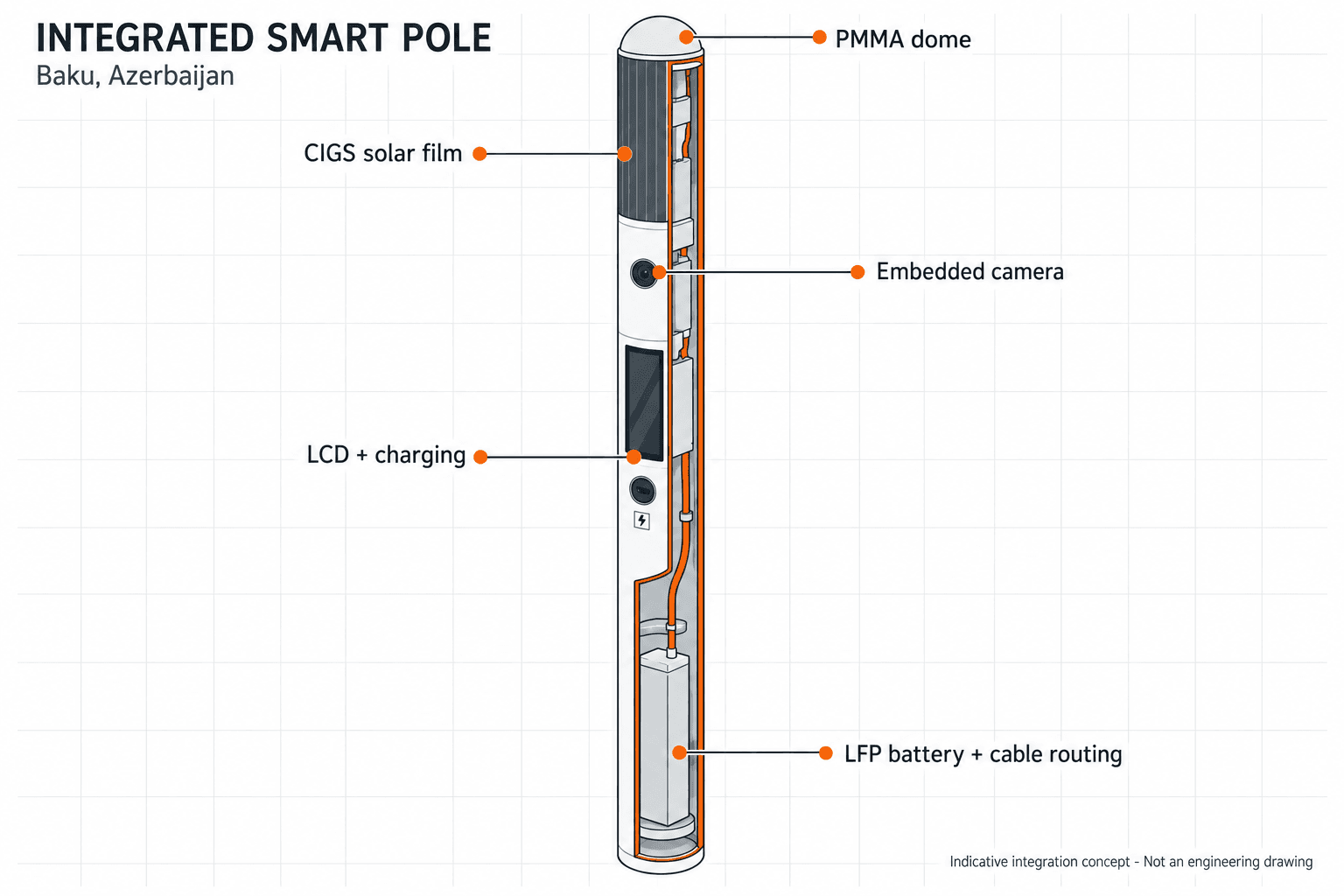
The recommended form factor is the SOLARTODO Smart Streetlight cylindrical model with one monolithic body. The pole remains Ø200mm from top to bottom, with charging hardware, SOS interface, camera, antennas, display, solar film, and light engine embedded into the cylinder skin. This directly addresses Baku’s salt-air exposure and dense streets because there are no side arms, luminaire outriggers, external speaker columns, or separate EV bollards to corrode, obstruct, or complicate cleaning.
This specification is not positioned as a completed Baku project. It is a market-analysis configuration for municipal, developer, or EPC evaluation. SOLARTODO would recommend site photometrics, wind exposure review, corrosion class confirmation, underground utility scanning, and connection approval before procurement quantities are frozen.
Technical Specifications
The Baku specification centers on a 7m Ø200mm monolithic cylinder with 100W lighting, 128W CIGS wrap, and 7kW embedded EV charging.
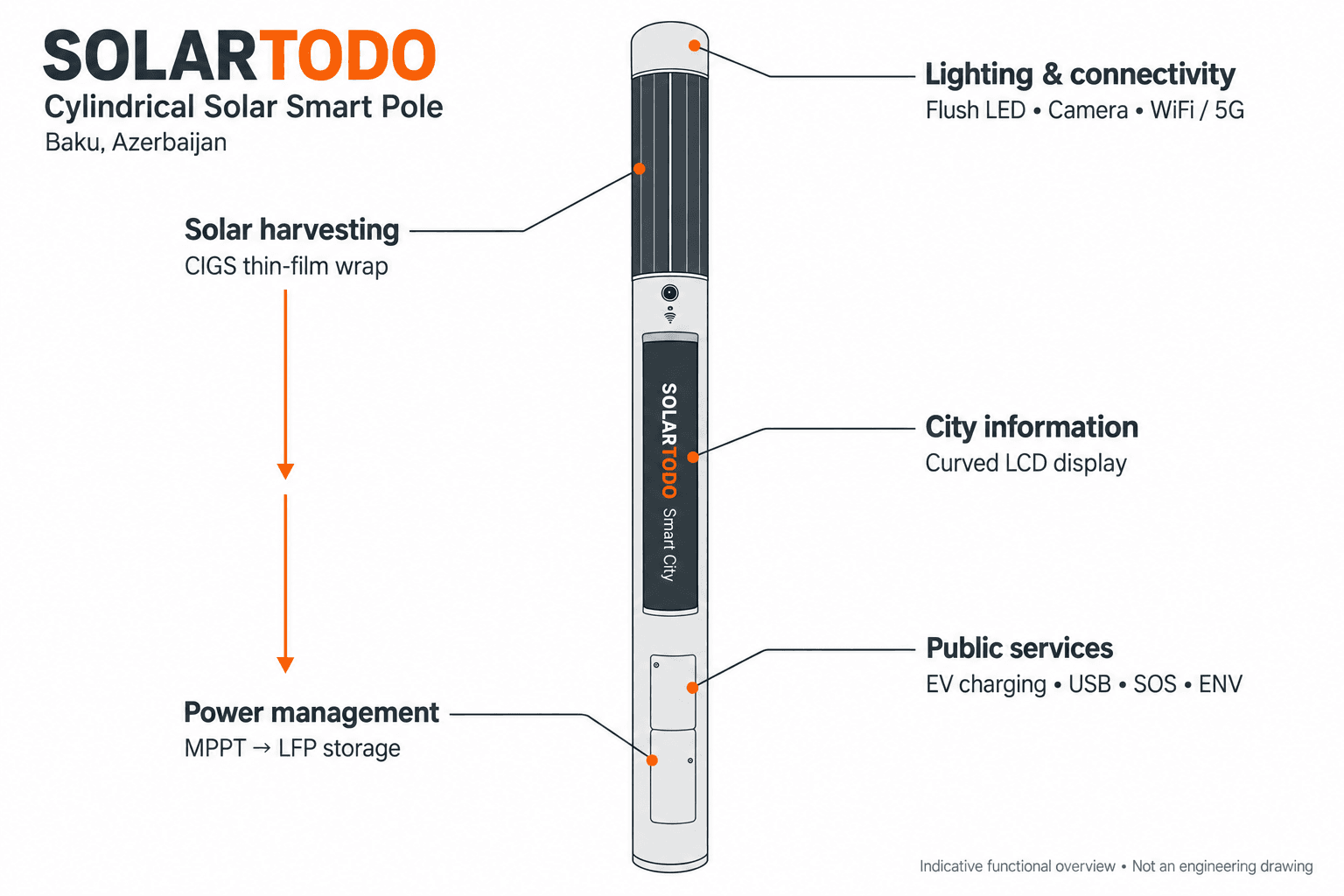
- Product form: Smart Streetlight, cylindrical flagship variant, 97 units for a typical corridor package.
- Pole body: 7m seamless cylindrical Ø200mm pole, constant diameter top-to-bottom, 5mm wall, hot-dip galvanized steel.
- Finish: champagne gold RAL1036 pearl gold brushed finish for premium boulevard and civic frontage use.
- Integration rule: all modules flush-integrated into the cylinder skin; no side arms, no luminaire outriggers, no public-address columns, no external boxes, no widened base, and no separate bollard.
- Luminaire: Ø200mm internal COB flood behind PMMA top window segment, 100W, 15,000 lm, 4000K.
- Solar surface: CIGS flexible thin-film cells wrapped 360 degrees around the pole mid-section from 6.5m to 6.3m, approximately 128W total, dark blue-black semi-transparent film laminated flush to the pole skin.
- Battery and control: 3,000Wh LFP battery inside pole base with MPPT, LoRaWAN/4G smart controller, and cloud platform readiness.
- Sensor package: flush top pod with temperature, humidity, wind, pressure, noise, PM2.5, PM10, and illuminance.
- Camera: flush 8MP fisheye 180-degree panoramic camera behind a dome glass window, with no protruding bracket.
- Communications: embedded dual-mode WiFi 6 plus 5G-ready internal antennas.
- Emergency panel: flush 12cm × 12cm SOS panel with integrated micro-camera, microphone, and speakerphone grille.
- EV charging: embedded 7kW dual-outlet charger with Type 2 and Type 1 flush flip-caps, 5m coiled Type 2 cable, and flush touchscreen at 1.5m.
- Display: vertical curved LCD, 2,000mm tall × approximately 170mm wide, bent to Ø200mm radius and flush inset into the front face.
- Display content: strictly “SOLARTODO Smart City” text stacked vertically, with SOLARTODO uppercase above Smart City in white sans-serif on deep blue.
- Spacing: 25m between poles, subject to final photometric and civil survey validation.
- Standards basis: IEC 60598 for luminaire safety and GB/T 37024 for smart lighting system reference.
IEC states, “IEC 60598-1:2014 specifies general requirements for luminaires” up to 1,000 V supply voltages. That standard framing is relevant because the Baku pole integrates lighting, electronics, display, communications, and EV hardware in one conductive body, so insulation, marking, mechanical construction, and photobiological safety must be handled as a system.
Implementation Approach
A 97-unit Baku corridor program would typically move through survey, utility approval, CKD logistics, foundations, erection, and commissioning.
The first phase should be route selection and survey. Baku-specific inputs include salt-air exposure from the Caspian waterfront, underground utilities, heritage-sensitive streets, pedestrian clear width, curbside parking behavior, and flood-prone low points. Photometric simulation should confirm 25m spacing with the 100W, 15,000 lm top luminaire before civil works begin.
The second phase is utility and authority coordination. Because Azerbaijan’s distribution context includes 0.4/6/10/35 kV classes, the Smart Streetlight package should be mapped to the local low-voltage service point, metering arrangement, overcurrent protection, and EV-charger load profile. Cabinet-free design simplifies the streetscape, but it does not remove the need for accessible isolation and maintenance procedures.
The third phase is logistics and installation. For Baku, CKD shipping and protected surface handling are important because brushed RAL1036 finish quality is part of the product value. Foundations should account for wind exposure, coastal soil conditions, cable ducts, drainage, and the constant Ø200mm base geometry. Erection should be sequenced by 10-20 pole work zones so pedestrian and traffic disruption remains controlled.
The fourth phase is commissioning. Each pole should be checked for luminaire operation, CIGS/MPPT input, battery state, EV outlet function, SOS audio path, camera privacy masking, WiFi/5G antenna performance, display content lock, and cloud-controller telemetry. SOLARTODO would normally recommend acceptance records by pole ID, GPS location, serial number, and electrical test result.
Expected Performance & ROI
Expected value comes from reduced cabinet clutter, lower maintenance touchpoints, 15,000 lm lighting, and multi-service revenue options rather than solar generation alone.
This configuration should be assessed as smart urban infrastructure, not as a standalone solar-power project. The CIGS wrap and 3,000Wh LFP battery support resilience and auxiliary loads, while grid service and MPPT management keep the pole suitable for year-round municipal operation. According to the World Bank (2023), Azerbaijan reports full or near-full electricity access in recent national datasets, so Baku’s streetlight opportunity is modernization and service integration rather than basic electrification.
The main lifecycle benefit is consolidation. One Ø200mm pole can replace separate lighting, camera, SOS, WiFi, display, sensor, and EV-charging street furniture. For a typical 97-unit Baku package, this means fewer foundation points, fewer visible cabinets, fewer pole attachments exposed to salt air, and cleaner maintenance zoning on narrow sidewalks.
Payback depends on tariffs, operating hours, maintenance contracts, advertising restrictions, EV utilization, telecom leasing rules, and municipal financing. A conservative B2B model should compare the avoided cost of separate poles, cabinets, camera mounts, charger bollards, display pylons, wiring runs, and civil reinstatement. In premium Baku corridors where streetscape quality has economic value, the flush cylindrical format can justify specification even when simple LED-only replacement has a lower first cost.
Comparison Table
The Baku recommendation ranks the Ø200mm cylindrical pole highest for coastal premium corridors because it removes 6 visible accessory categories.
| Criterion | Recommended SOLARTODO Cylindrical Smart Streetlight | Standard Octagonal Smart Pole | Hybrid Wind-Solar 12m Pole |
|---|---|---|---|
| Suggested Baku use | Premium coastal and central corridors | Wider municipal streets | Open sites with self-power priority |
| Height | 7m | 6-12m | 12m |
| Body form | Ø200mm constant seamless cylinder | Octagonal galvanized pole | Octagonal 12m hybrid pole |
| Visible side arms | 0 | Often 1-3 accessory arms | Solar/wind equipment visible |
| Lighting | 100W, 15,000 lm, 4000K | 80-150W LED | 80-150W LED |
| Solar format | 128W CIGS 360-degree flush wrap | Optional module | 2 monocrystalline panels plus wind turbine |
| Battery | 3,000Wh LFP inside base | Optional | LFP battery in base |
| EV charging | 7kW dual outlet embedded flush | Optional external or modular | Integrated EV charging |
| Best constraint fit | Salt air, narrow sidewalks, premium finish | Cost-led municipal lighting | Remote or backup-heavy sites |
Pricing & Quotation
SOLARTODO provides 3 commercial routes for Baku buyers: FOB Supply, CIF Delivered, and EPC Turnkey with engineering review.
SOLARTODO offers three pricing tiers for this product line: FOB Supply (equipment ex-works China), CIF Delivered (including ocean freight and insurance), and EPC Turnkey (fully installed, commissioned, with 1-year warranty). Volume discounts are available for large-scale deployments. Configure your system online for an instant estimate, or request a custom quotation from our engineering team at [email protected].
For Baku, the quotation file should define pole quantity, delivery Incoterm, corrosion specification, foundation scope, cable trenching, grid-connection responsibility, SIM or network plan, privacy configuration, and commissioning records. EPC proposals should also identify which party obtains utility approval and municipal right-of-way permits.
Frequently Asked Questions
These 10 answers cover Baku-specific sizing, installation, ROI, maintenance, EPC pricing, warranty, and comparison issues for a 97-unit Smart Streetlight package.
Q1: Why is a 7m cylindrical Smart Streetlight recommended for Baku instead of a taller 12m pole? A 7m pole is more appropriate for Baku’s premium urban streets, waterfront promenades, and central pedestrian corridors where 25m spacing and controlled glare matter. A 12m pole is better for wider arterial roads or traffic applications. The Ø200mm cylindrical body also reduces visual clutter in dense sidewalks and heritage-adjacent areas.
Q2: How many poles would a typical Baku corridor require? At 25m spacing, approximately 97 poles cover about 2.4 km of corridor frontage. Final quantity should be confirmed by photometric simulation, road width, tree canopy, pedestrian crossings, intersections, and utility constraints. The 30-50 poles/km planning density is a useful early estimate, not a substitute for design drawings.
Q3: Is the CIGS solar wrap the main power source? No. The 128W CIGS wrap supports auxiliary generation and battery charging, but the pole should be evaluated as a grid-connected smart infrastructure asset. Baku has strong urban electricity access, so resilience, data services, lighting quality, and reduced street clutter are more important than claiming full solar autonomy.
Q4: What is the expected deployment timeline for 97 units? A typical schedule would include 2-4 weeks for survey and photometrics, 3-6 weeks for authority and utility coordination, 6-10 weeks for manufacturing and logistics, and 4-8 weeks for staged installation. Baku’s central streets may require night works, traffic management, and tighter delivery windows.
Q5: How should ROI be calculated for Baku municipalities or developers? ROI should compare the integrated pole against separate lighting poles, camera masts, SOS columns, WiFi hardware, display pylons, EV bollards, foundations, conduits, and maintenance visits. Revenue assumptions may include EV charging or telecom use, but those depend on local permissions. Streetscape value should be included for premium corridors.
Q6: What maintenance is required in a Caspian coastal environment? Maintenance should prioritize surface inspection, gasket checks, lens cleaning, charger-cap inspection, battery diagnostics, and corrosion monitoring. Salt air and wind-blown dust make flush integration valuable because there are fewer brackets and external boxes. A quarterly visual check and annual electrical inspection would be a practical starting plan.
Q7: How does this compare with a standard octagonal smart pole? A standard octagonal pole is often cheaper and easier to customize with external accessories, but it creates more visible equipment. The cylindrical SOLARTODO variant keeps the Ø200mm profile constant, embeds the 7kW charger, and removes side arms. For Baku’s premium streets, that cleaner form is the main advantage.
Q8: Can the embedded 7kW EV charger serve public curbside charging? Yes, the configuration includes a 7kW dual-outlet charger with Type 2 and Type 1 flip-caps plus a 5m coiled Type 2 cable. Public operation still requires utility approval, metering, user authentication, payment integration if needed, safety signage, and local parking enforcement so charging bays remain usable.
Q9: What should be included in an EPC quotation? An EPC quotation should define pole supply, ocean freight if applicable, foundations, trenching, cabling, protection devices, commissioning, cloud setup, training, warranty, and as-built documentation. For Baku, it should also clarify municipal permits, utility interface, traffic management, corrosion class, and responsibility for network subscriptions.
Q10: What warranty and standards should buyers request? Buyers should request warranty terms for the pole body, LED engine, battery, charger, display, controller, camera, and sensors separately. Standards documentation should include IEC 60598 luminaire compliance and GB/T 37024 smart-lighting reference alignment. Acceptance should be tied to serial-numbered tests, not only visual inspection.
References
The 7 references below ground the Baku configuration in official planning, Azerbaijan energy context, and recognized smart-city and lighting standards.
- State Statistical Committee of Azerbaijan (2024): Azerbaijan in Figures 2024 reports national population of 10.1808 million at the beginning of 2024 and identifies Baku as the capital.
- ARXKOM, State Committee on Urban Planning and Architecture (2024): Baku General Plan 2040 targets street-network growth from 2,300 km to 2,668 km, roughly 285 km of cycling lanes, and 112.2 lane-km of dedicated public transport lanes.
- Ministry of Energy of Azerbaijan (2024): Electricity network connection rules under Cabinet of Ministers Resolution No. 315 define 0.4 kV consumer connection procedures up to 200 kW.
- Azerishiq / ARPA Consulting (2024): Azerbaijan distribution grid-code development covers 0.4, 6, 10, and 35 kV distribution-system voltage ranges.
- World Bank (2023): World Development Indicators / SDG 7 datasets report Azerbaijan’s recent electricity access as full or near-full, shifting Baku’s need toward modernization rather than basic access.
- IEC (2014): IEC 60598-1 specifies general requirements and tests for luminaires, including classification, marking, mechanical construction, electrical construction, and photobiological safety up to 1,000 V.
- ITU-T (2016): Recommendation ITU-T Y.4902/L.1602 defines smart sustainable city KPIs related to ICT sustainability impact, supporting measurable smart-city infrastructure planning.
Equipment Deployed
- 97 units × 7m seamless cylindrical Ø200mm Smart Streetlight pole, 5mm wall, hot-dip galvanized steel
- Champagne gold RAL1036 pearl gold brushed finish for premium coastal and civic corridors
- 100W COB top luminaire, 15,000 lm, 4000K, behind PMMA top window segment
- 128W CIGS flexible thin-film solar wrap, 360° flush laminated at 6.5m-6.3m mid-section
- 3,000Wh LFP battery inside pole base with MPPT controller
- Flush 8-param environmental sensor: temperature, humidity, wind, pressure, noise, PM2.5, PM10, illuminance
- Flush 8MP fisheye 180° panoramic camera behind dome glass window
- Embedded dual-mode WiFi 6 + 5G-ready internal antennas
- Flush SOS panel 12×12cm with micro-camera, mic, speakerphone grille
- Embedded 7kW dual-outlet EV charger with Type 2 + Type 1 flip-caps and 5m coiled Type 2 cable
- Vertical curved LCD display, 2000mm × ~170mm, flush inset with SOLARTODO Smart City text only
- 25m pole spacing, IEC 60598 and GB/T 37024 reference standards