Barranquilla Smart Traffic System Market Analysis: 10m 4-in-1 Pole Configuration Guide
Summary
Barranquilla’s 2.29M metro area and 27.6°C tropical climate support a typical 20-intersection Smart Traffic System using 10m poles, Jetson edge AI, 77GHz radar, and 5G/fiber backhaul.
Key Takeaways
A Barranquilla Smart Traffic System configuration should prioritize 20 intersections, 10m L-arm poles, sub-50ms edge response, and standards-based NTCIP integration.
- A typical 20-intersection deployment would use approximately 80-240 dark grey 10m hot-dip galvanized L-arm poles, based on 4-12 poles per intersection.
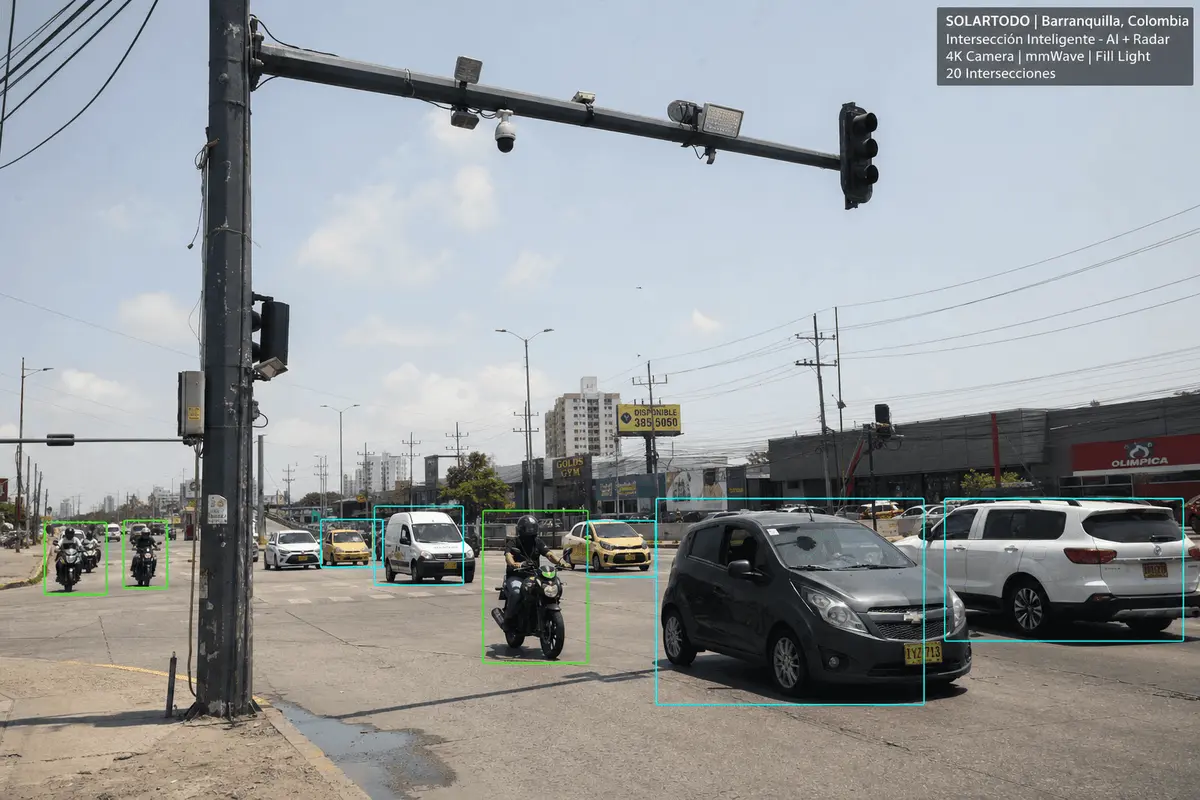
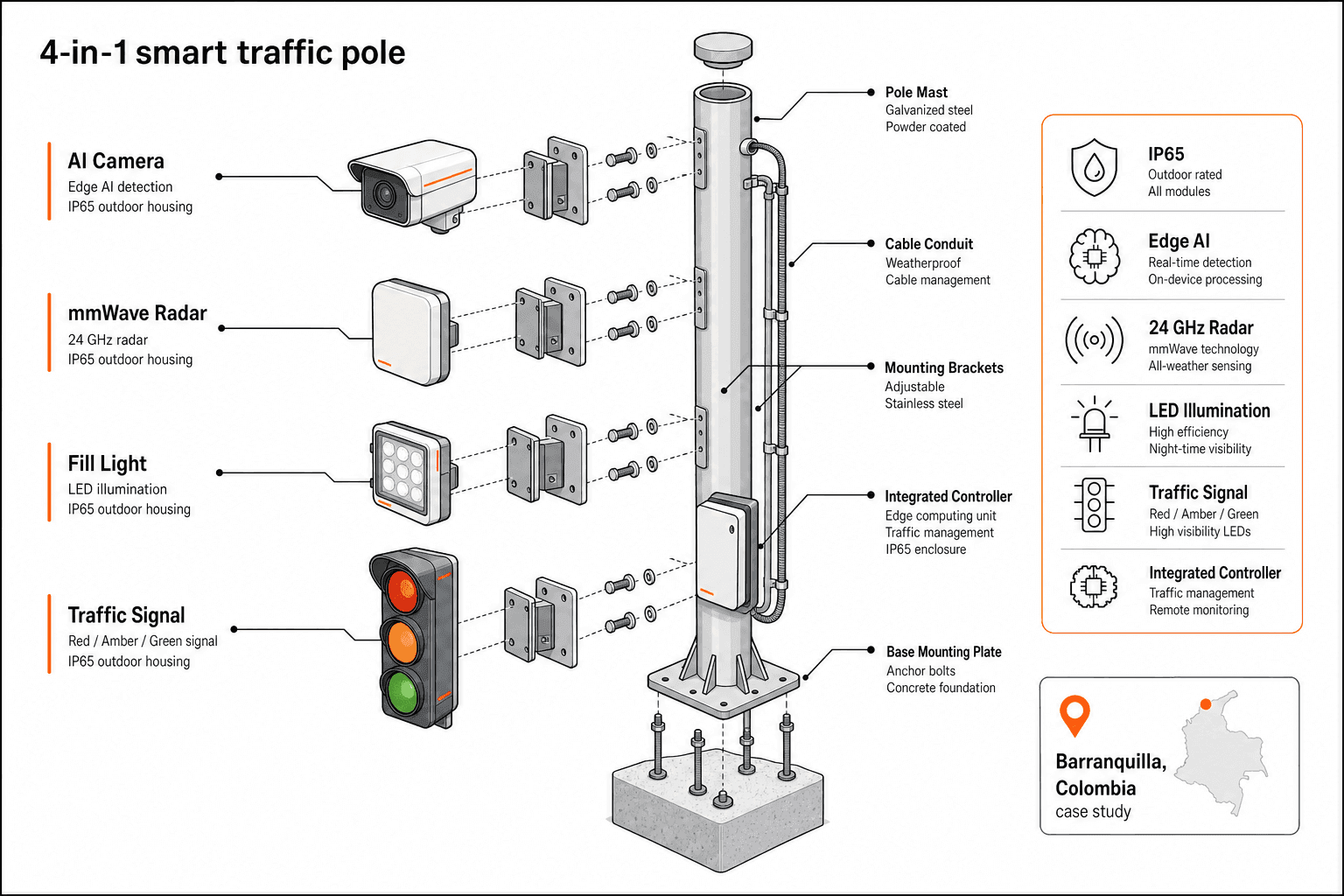
- Each 4-in-1 pole integrates 1 4K AI camera, 1 77GHz mmWave radar, LED fill light, and LED signal head.
- Edge processing uses NVIDIA Jetson hardware with 98% AI detection accuracy, 45+ detection types, and less than 50ms response.
- Barranquilla’s municipal population is about 1.33 million, while the wider metropolitan area is about 2.29 million.
- The recommended backhaul architecture combines 5G and fiber to connect field devices to the TrafficGPT central platform.
- Core use cases include pedestrian detection, adaptive signal optimization, and incident auto-alert across 20 signalized intersections.
- BOT financing can reduce upfront municipal capex to zero, while lifecycle obligations should be modeled over 8-12 years.
Market Context for Barranquilla
Barranquilla’s traffic-control requirement is shaped by a 1.33M-city core, a 2.29M metropolitan area, Caribbean heat, and a port-driven arterial network.
According to DANE (2023), Barranquilla’s city population is approximately 1,327,209, with the metropolitan area including Soledad, Malambo, Puerto Colombia, and Galapa at roughly 2,291,114 residents. That scale creates corridor-level demand peaks rather than isolated intersection demand, particularly on commuter links between Barranquilla and Soledad. A smart traffic program therefore needs coordinated signal timing, pedestrian protection, and incident recognition across multiple junctions, not only upgraded signal heads.
According to IDEAM climate normals summarized for Barranquilla, the city has an average temperature near 27.6°C and annual precipitation around 904mm. This matters technically because cabinets, cameras, radar modules, LED fill lights, and signal controllers must tolerate heat, humidity, wind-driven rain, and coastal corrosion exposure. The recommended SOLARTODO configuration uses hot-dip galvanized steel poles and sealed electronics to reduce corrosion risk in the Caribbean operating environment.
Barranquilla is also a logistics and port city, so traffic reliability affects buses, freight, taxis, pedestrians, and emergency response. According to the World Bank (2024), Colombia is about 82% urban, making metropolitan mobility a national productivity issue rather than only a local road issue. For a city at coordinates 10.96, -74.78, adaptive operation is especially useful where peak flows, school trips, freight windows, rain events, and pedestrian demand vary by time of day.
Recommended Technical Configuration
A typical 20-intersection Barranquilla program would use 10m 4-in-1 poles with edge AI, radar, signal control, and TrafficGPT integration.
The recommended SOLARTODO Smart Traffic System for Barranquilla is a 20-intersection configuration using 10m L-arm hot-dip galvanized steel poles in dark grey. The 10m height class is appropriate for large urban intersections where signal heads need clear visibility over mixed traffic, buses, freight vehicles, and pedestrian crossings. For smaller local junctions, 6m or 8m variants can be considered, but the project-specific configuration requires 10m poles.
A typical 20-intersection deployment of this scale would consist of approximately 80-240 smart traffic poles, depending on whether each junction needs one pole per approach or additional auxiliary poles for turn lanes, pedestrian islands, or wide approaches. Each pole is a 4-in-1 unit combining a 4K AI camera, 77GHz mmWave radar, LED fill light, and LED signal head. The system would run perception and event filtering at the pole using NVIDIA Jetson edge AI, then send structured events over 5G/fiber backhaul to SOLARTODO’s TrafficGPT central platform.
The recommended feature set is pedestrian detection, adaptive signal optimization, and incident auto-alert. In procurement language, the system should be specified as a standards-based intelligent transportation field layer rather than a camera-only surveillance package. NTCIP compatibility, GB 25280 conformance, 5G/fiber communications, and TrafficGPT natural-language queries should be treated as core requirements.
Technical Specifications
The Barranquilla specification is a 10m L-arm smart traffic pole with 4K AI video, 77GHz radar, Jetson edge compute, and NTCIP/GB 25280 compliance.
- Product: SOLARTODO Smart Traffic System, smart-traffic product line, available at Smart Traffic System.
- Pole form: L-arm hot-dip galvanized steel pole, dark grey finish, 10m height variant for the 20-intersection configuration.
- Intersection sizing: approximately 4-12 poles per intersection, with one per approach plus auxiliary poles where geometry requires.
- Perception module: 4K AI camera with 98% detection accuracy, 45+ detection types, and less than 50ms response.
- Radar module: 77GHz mmWave radar for vehicle presence, approach speed, queue validation, and adverse-weather redundancy.
- Lighting and signaling: integrated LED fill light and LED signal head on the same 4-in-1 pole platform.
- Edge AI: NVIDIA Jetson processor for on-pole inference, event filtering, and low-latency pedestrian and incident detection.
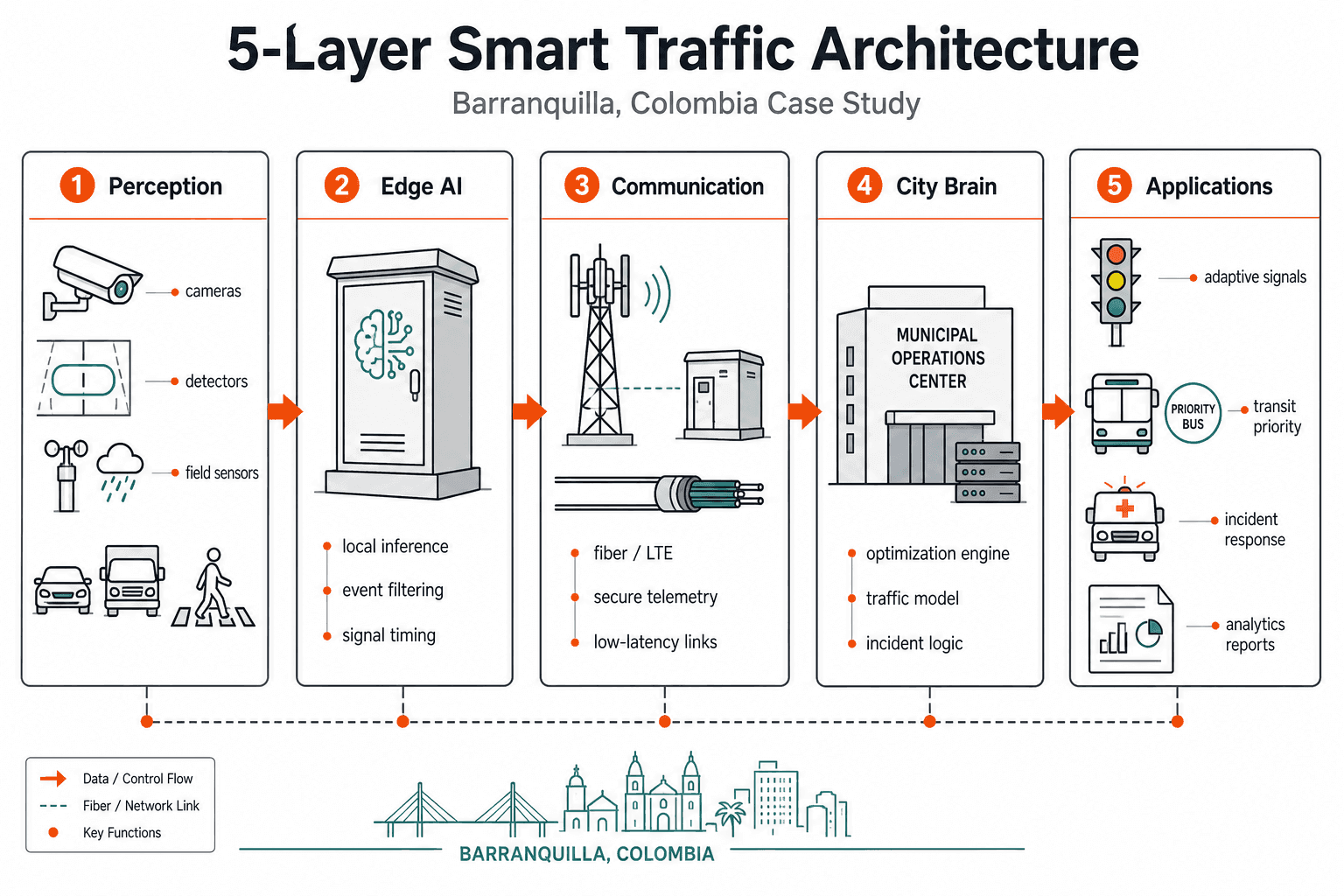
- Architecture stack: Perception → Edge AI → Communications by 5G/fiber → City Brain TrafficGPT → operational applications.
- Barranquilla feature set: pedestrian detection, adaptive signal optimization, and incident auto-alert.
- Backhaul: dual-path 5G/fiber recommended for critical intersections and fiber-priority operation where ducts are available.
- Cooperation model: BOT, structured for zero upfront municipal capex and service-level performance accountability.
- Standards: NTCIP for ITS device interoperability and GB 25280 for road traffic signal technical requirements.
According to NTCIP (2023), NTCIP 1202 covers object definitions for actuated traffic signal controllers, while NTCIP 1209 covers transportation sensor systems and NTCIP 1218 covers roadside units. AASHTO/ITE/NEMA states, "The NTCIP standards define common data definitions and open protocols." This is important for Barranquilla because future expansion should not depend on a single proprietary controller vendor.
Implementation Approach
A 20-intersection BOT rollout would normally move through survey, civil design, CKD logistics, foundation works, pole erection, commissioning, and acceptance testing.
The implementation should begin with intersection surveys, traffic-count baselines, line-of-sight mapping, power checks, fiber/5G availability, and foundation design. The design package should identify each approach, turning lane, pedestrian crossing, signal head position, and camera/radar field of view. Civil drawings should also account for drainage, underground utilities, sidewalk clearance, and wind exposure.
Procurement can follow a CKD or semi-knockdown shipping model, with poles, LED signal assemblies, camera/radar modules, Jetson edge units, and cabinets packaged for phased installation. Field installation would normally proceed in batches of 4-6 intersections to reduce traffic disruption. Each batch should include foundation construction, pole erection, signal wiring, backhaul activation, edge-AI calibration, and TrafficGPT integration.
Commissioning should test at least 5 categories: signal head operation, AI detection accuracy, radar validation, incident alert delivery, and central-platform query response. The BOT structure should define uptime, maintenance response time, data retention, cybersecurity controls, and handback conditions. SOLARTODO can support this as a BOT model with zero upfront payment, or provide EPC turnkey and JV options for other procurement structures.
Expected Performance & ROI
Expected ROI for Barranquilla depends on delay reduction, crash-risk mitigation, enforcement value, and avoided capex under an 8-12-year BOT service model.
According to FHWA (2023), adaptive signal control adjusts signal timing to actual traffic demand rather than fixed plans. FHWA states, "Real-time management of traffic systems is proven to work." Academic and agency evaluations vary, but adaptive control studies frequently report corridor delay reductions in the 10-30% range when baseline timing is poor and detection quality is high.
For Barranquilla, the economic case should be modeled from minutes saved, incident response time, public transport reliability, reduced manual traffic-control labor, and fewer secondary crashes after lane-blocking events. The most defensible ROI model is not a guaranteed payback claim; it is a sensitivity table using current traffic counts, local value of time, accident data, and operating cost assumptions. Under BOT, the city can shift the initial equipment capex into availability payments or revenue-linked service fees.
According to ITU (2020), IMT-2020 5G systems target ultra-reliable low-latency communication and high device density, which supports traffic edge networks when fiber is unavailable or redundant paths are required. According to IEEE (2022), IEEE 802.3 defines Ethernet physical and data-link standards, supporting fiber and copper networking for field cabinets and traffic management centers. These communication standards allow SOLARTODO’s 5G/fiber design to balance latency, resilience, and lifecycle maintainability.
Results and Impact
A 20-intersection Smart Traffic System should be measured by delay, pedestrian conflicts, incident alert latency, uptime, and maintenance cost per pole.
Because this is a market analysis and technical recommendation, not a fabricated Barranquilla case study, the expected impact should be written as measurable targets rather than claimed results. For the 20-intersection profile, the baseline should include average control delay, peak-hour queue length, pedestrian crossing compliance, incident detection-to-alert time, and signal downtime. A reasonable first-year target is to establish stable detection performance, centralize signal visibility, and create a repeatable operating model for expansion.
TrafficGPT adds operational value because dispatchers and engineers can query the central platform in natural language, for example by asking which intersections had repeated pedestrian conflicts after 18:00 or which corridors showed abnormal queue growth during rain. The 5-layer stack converts raw video and radar into structured events, then into traffic-management decisions. For SOLARTODO, this positions the product as a city infrastructure layer rather than a standalone pole sale.
Comparison Table
The recommended 10m Barranquilla configuration offers more coverage and signal visibility than 6m or 8m variants while avoiding highway gantry complexity.
| Configuration option | Best-fit use | Height | Typical poles per intersection | Core modules | Barranquilla fit |
|---|---|---|---|---|---|
| Compact urban junction | Local streets, short spans | 6m | 4-8 | 4K AI, 77GHz radar, LED fill, LED signal | Limited for large arterials |
| Standard arterial junction | Medium intersections | 8m | 4-10 | 4K AI, 77GHz radar, LED fill, LED signal | Suitable for secondary corridors |
| Recommended configuration | 20 major city intersections | 10m | 4-12 | 4K AI, 77GHz radar, Jetson edge AI, TrafficGPT | Recommended for Barranquilla |
| Highway gantry variant | Expressway or very wide approaches | 10-12m | Site-specific | 4K AI, radar, signal/variable control | Use only where road geometry requires |
Pricing & Quotation
Pricing for a 20-intersection Barranquilla program should compare FOB supply, CIF delivery, EPC turnkey, and BOT availability-payment structures.
SOLARTODO offers three pricing tiers for this product line: FOB Supply (equipment ex-works China), CIF Delivered (including ocean freight and insurance), and EPC Turnkey (fully installed, commissioned, with 1-year warranty). Volume discounts are available for large-scale deployments. Configure your system online for an instant estimate, or request a custom quotation from our engineering team at [email protected].
For Barranquilla, BOT is the project-specific cooperation model and should be evaluated as a zero-upfront option with payment tied to uptime, commissioning milestones, and service-level performance. EPC turnkey pricing is still useful as a benchmark because it clarifies the equipment, civil works, installation, commissioning, training, and warranty scope. For procurement support, contact us with intersection drawings, traffic-count data, and preferred contract term.
Frequently Asked Questions
These 10 FAQs cover the 20-intersection Barranquilla configuration, including 10m poles, BOT financing, installation, maintenance, ROI, warranty, and standards.
Q1: What Smart Traffic System configuration is recommended for Barranquilla? The recommended configuration is a typical 20-intersection Smart Traffic System using 10m dark grey L-arm hot-dip galvanized steel poles. Each pole integrates a 4K AI camera, 77GHz mmWave radar, LED fill light, LED signal head, and NVIDIA Jetson edge AI. Backhaul should use 5G/fiber to connect each intersection to TrafficGPT for natural-language traffic queries and centralized monitoring.
Q2: How many poles would a 20-intersection deployment typically require? A typical 20-intersection deployment would require approximately 80-240 smart traffic poles, because each intersection usually needs 4-12 poles. The exact count depends on approach geometry, turning lanes, pedestrian islands, signal head visibility, and whether auxiliary poles are needed. The quantity should always be finalized after field survey and intersection-by-intersection layout design.
Q3: What deployment timeline should Barranquilla expect? A realistic timeline is 3-6 months for survey, design, procurement, shipping, civil works, installation, commissioning, and acceptance testing across 20 intersections. A phased rollout is recommended, typically 4-6 intersections per batch. This reduces traffic disruption, allows calibration lessons from early sites, and gives operators time to validate TrafficGPT dashboards and alert workflows.
Q4: What ROI or payback period is reasonable? ROI should be modeled from local traffic counts, value of time, crash data, signal maintenance cost, and current delay levels. In many adaptive-signal programs, delay reduction is the largest economic lever, but it should not be guaranteed without baseline data. Under BOT, payback shifts from municipal capex recovery to service availability, uptime, and performance-based payments.
Q5: How does this compare with a camera-only traffic system? A camera-only system can detect visual events, but it is weaker in heavy rain, glare, occlusion, or night operation. SOLARTODO’s 4-in-1 pole combines 4K AI video with 77GHz radar, LED fill lighting, and integrated signal control. This multi-sensor approach improves redundancy and supports both perception and adaptive signal optimization from the same field platform.
Q6: What maintenance is required for the 10m smart poles? Maintenance should include quarterly camera cleaning, radar alignment checks, LED signal inspection, cabinet thermal checks, firmware updates, and backhaul diagnostics. In Barranquilla’s coastal and humid environment, corrosion inspection is important even with hot-dip galvanized steel. A BOT contract should define preventive maintenance intervals, spare-part stock, uptime targets, and response times for critical signal faults.
Q7: How is EPC turnkey pricing different from BOT pricing? EPC turnkey pricing covers equipment, delivery, civil works, installation, commissioning, training, and a 1-year warranty as a capital project. BOT pricing is structured as zero-upfront deployment with longer-term service payments, typically tied to availability and performance. For Barranquilla, BOT is the specified cooperation model, while EPC can serve as a cost benchmark.
Q8: What warranty should be specified? The baseline EPC warranty should be 1 year, covering equipment defects, commissioning issues, and agreed installation scope. For BOT, warranty language should be replaced or expanded by service-level obligations across the contract term. The city should specify uptime, response times, replacement procedures, software support, cybersecurity patching, and handback conditions for the full operating period.
Q9: What standards matter for procurement? NTCIP and GB 25280 should be specified. NTCIP supports interoperability among traffic controllers, sensors, roadside units, and management systems, while GB 25280 addresses road traffic signal requirements. The communication layer should also reference fiber/Ethernet and 5G requirements so the system can integrate with municipal traffic centers and future smart-city applications.
Q10: Can TrafficGPT support natural-language traffic operations? Yes. TrafficGPT is designed as the central platform layer where operators can query structured traffic events in natural language. For example, staff can ask for intersections with repeated pedestrian conflicts, abnormal queues, or incident alerts during a time window. The platform depends on clean field data from 4K AI cameras, 77GHz radar, and Jetson edge processing.
References
These 7 references support the Barranquilla market context, ITS standards, communications architecture, climate assumptions, and adaptive-signal performance benchmarks.
- DANE (2023): Municipal and metropolitan population projections for Barranquilla and the Atlántico region, based on CNPV 2018. https://www.dane.gov.co/
- IDEAM (1991-2020): Colombian climate normals and Barranquilla tropical savanna context, including heat and rainfall considerations. http://www.ideam.gov.co/
- World Bank (2024): Colombia urban population share, supporting the metropolitan mobility demand context. https://data.worldbank.org/indicator/SP.URB.TOTL.IN.ZS?locations=CO
- NTCIP / AASHTO / ITE / NEMA (2023): NTCIP 1202, 1209, 1213, and 1218 published ITS standards for signals, sensors, lighting, and roadside units. https://www.ntcip.org/document-numbers-and-status/
- AASHTO / ITE / NEMA (2009): NTCIP 9001 v04 Guide explaining interoperability, interchangeability, and open protocols for ITS field devices. https://www.ntcip.org/file/2018/11/NTCIP9001v0406r.pdf
- FHWA (2023): Adaptive Signal Control Technology guidance describing real-time signal timing based on actual traffic demand. https://ops.fhwa.dot.gov/arterial_mgmt/adaptive_sig_control.htm
- ITU (2020) and IEEE (2022): IMT-2020 5G capability framework and IEEE 802.3 Ethernet standards for resilient traffic communications. https://www.itu.int/ and https://standards.ieee.org/ieee/802.3/10422/
Equipment Deployed
- Approximately 80-240 10m L-arm hot-dip galvanized steel poles, dark grey, for 20 intersections
- 4-in-1 smart traffic pole with 4K AI camera, 77GHz mmWave radar, LED fill light, and LED signal head
- NVIDIA Jetson edge AI module with 98% detection accuracy, 45+ detection types, and <50ms response
- 5G/fiber backhaul from intersections to TrafficGPT central platform with natural-language queries
- Pedestrian detection, adaptive signal optimization, and incident auto-alert feature package
- Standards package: NTCIP and GB 25280 compliance for traffic signal interoperability