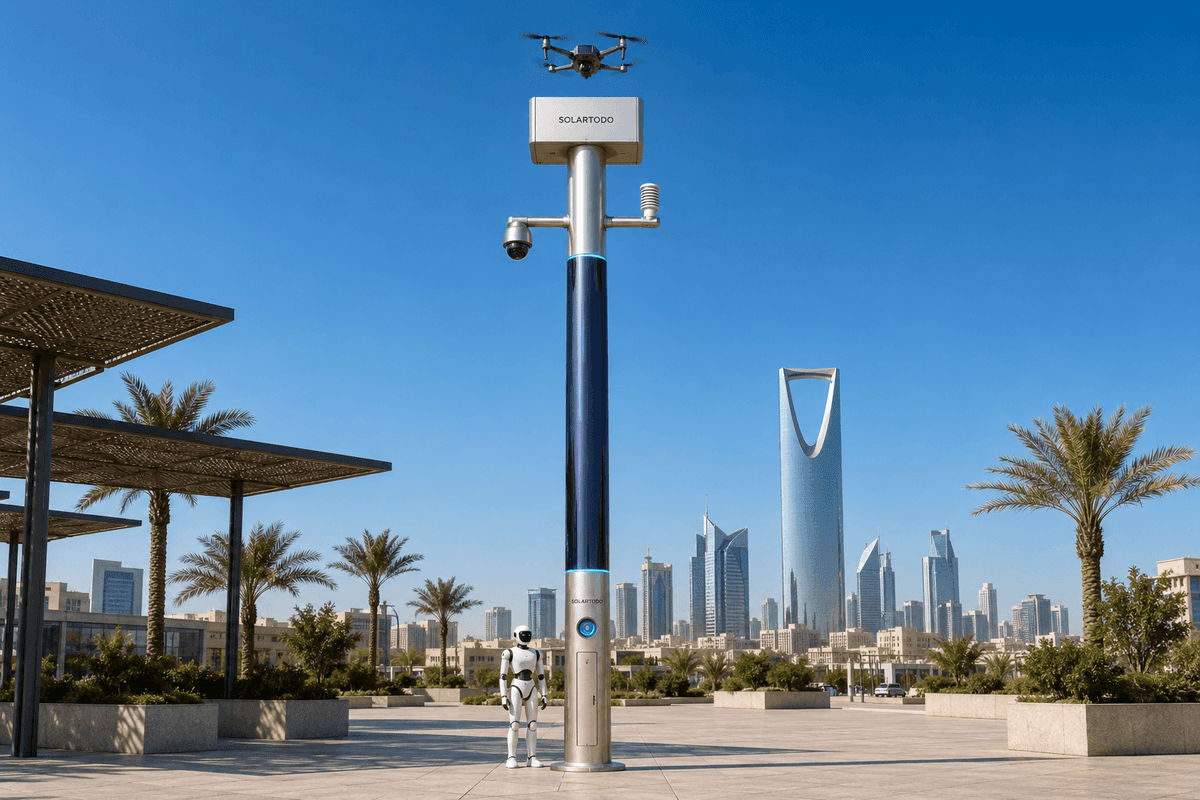
Cairo Night-Economy Incident Review: SOLARTODO Sentinel Sky Hub
TL;DR: SOLARTODO Sentinel Sky Hub uses 1.2-1.8 kW solar, 5-10 kWh LiFePO4 storage, and 20-60 TOPS edge AI to support 24-72 hour Cairo night patrols, faster evidence triage, and field drone battery swaps.
Key Takeaways
Answer Capsule: A 12-20 pole SOLARTODO deployment can cover about 1.5-4 km when nodes are spaced at 150-250 m intervals.
- Use 1.2-1.8 kW PV per pole to support cameras, AI compute, communications, lighting, and controlled drone charging.
- Specify 5-10 kWh LiFePO4 batteries with a 48 V architecture, BMS telemetry, and thermal protection for Cairo heat.
- Plan 24-72 hours of autonomy based on night load, dust losses, camera count, AI workload, and drone battery demand.
- Deploy poles at 150-250 m spacing after confirming camera field of view, RF coverage, shadows, and pedestrian clearance.
- Require 20-60 TOPS edge AI for event tagging, tamper detection, crowd-flow alerts, and vehicle classification.
- Include 2-4 protected drone battery bays with access logging, temperature monitoring, and charge-profile compatibility.
- Use IP65 or higher enclosures and wind-load validation for pole height, payload weight, and temporary anchoring method.
- Measure pilot success with at least 6 KPIs: autonomy, uptime, evidence retrieval time, AI precision, maintenance hours, and operator acceptance.
Operational Context
Answer Capsule: Cairo night patrols need relocatable surveillance nodes that can operate for 3 nights without trenching, diesel generators, or permanent grid work.
Cairo’s night economy depends on safe movement through cultural districts, hospitality zones, riverfront corridors, transit approaches, and temporary event areas. During festivals, tourism peaks, public celebrations, and road closures, fixed municipal cameras may not match actual crowd density or police routes. A temporary AI pole network helps close that coverage gap without waiting for permanent civil works.
SOLARTODO Sentinel Sky Hub is designed for police, municipal security teams, and event operators that need faster evidence collection in high-density public corridors. Each pole combines solar generation, battery storage, edge AI, cameras, sensors, encrypted communications, and drone battery support. The system supports officers and command centers; it does not replace trained human decision-making.
According to IEA (2024), global renewable capacity additions reached 510 GW in 2023, a 50% year-on-year increase, with solar PV accounting for roughly three quarters of additions. That market trend strengthens the procurement case for solar-powered public-safety infrastructure. For Cairo, the practical goal is resilience: keep the field node powered, searchable, and operational during crowded night events.
Solution Overview
Answer Capsule: One Sentinel Sky Hub pole is a 4-layer off-grid node for power, perception, compute, and response support.
The Sentinel Sky Hub is an off-grid physical-AI pole for temporary or semi-permanent deployment in public corridors. A typical Cairo pilot can start with 4-6 poles, then expand to 12-20 poles after solar yield, wireless uptime, AI accuracy, and evidence workflows are validated. The same fleet can be reused across festivals, tourism seasons, public holidays, and emergency staging areas.
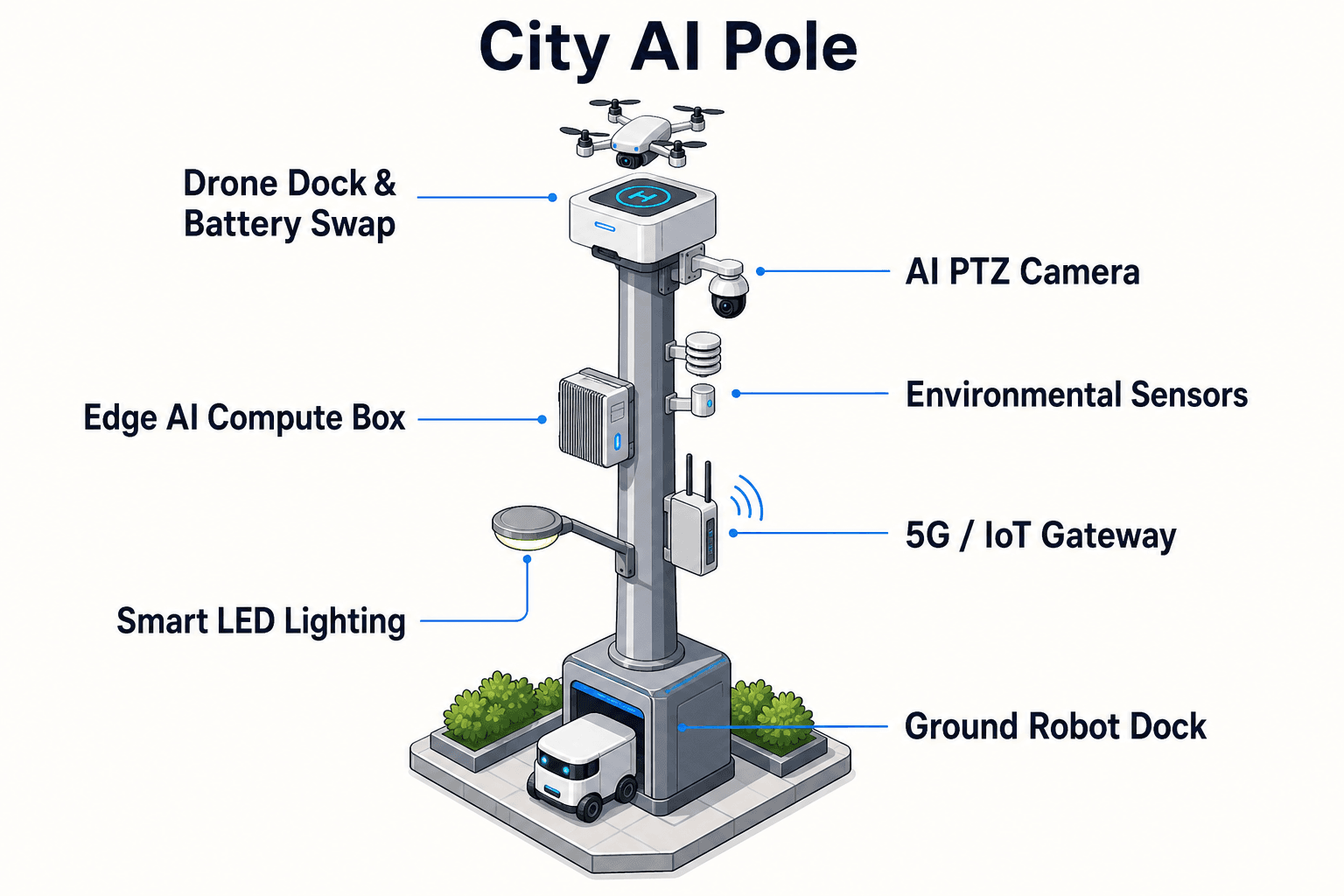
Each pole includes a PV array, LiFePO4 battery cabinet, MPPT controller, AI edge processor, camera payload, optional acoustic or environmental sensors, encrypted wireless backhaul, and a protected service bay for drone battery hot-swap operations. Anchoring can use precast ballast, reversible civil works, or site-specific foundations depending on deployment duration and crowd exposure. The preferred specification should treat the pole as a system, not a bundle of unrelated devices.
According to IRENA (2024), renewable power generation costs continued to support new solar procurement, and utility-scale solar PV remained one of the lowest-cost new power sources in many markets. That matters because temporary security systems often compete with diesel towers, cable runs, and permanent grid-connected CCTV works. Solar autonomy can reduce operating friction when events move between sites.
System Design
Answer Capsule: The recommended system separates 1 pole into 4 engineering layers so buyers can upgrade sensors without redesigning power or mounting.
The recommended design uses four layers: power, perception, compute, and response support. This modular approach lets police, event operators, and infrastructure contractors tune each deployment for tourism corridors, vehicle-control points, waterfront gathering areas, or temporary festival entrances. A route with hotel approaches may prioritize low-light video, while a vehicle checkpoint may prioritize license plate capture and directional lighting.
Power Layer
Each pole should use 1.2-1.8 kW of monocrystalline PV, selected after shade analysis, orientation review, and load modeling. A 5-10 kWh LiFePO4 battery bank provides overnight operation and resilience during dusty or low-irradiance periods. MPPT charging, fused DC distribution, surge protection, thermal monitoring, and remote battery-state reporting should be mandatory.
Perception Layer
The perception layer can include 4K low-light cameras, wide-angle situational cameras, PTZ cameras, thermal imaging, environmental sensors, and optional acoustic event detection. Camera placement should avoid unnecessary capture of private interiors and follow approved policing and data-protection procedures. Procurement documents should define lens type, frame rate, enclosure rating, night performance, retention period, and redaction workflow.
Compute Layer
The edge-compute module should support 20-60 TOPS AI inference for object detection, crowd-flow alerts, vehicle classification, tamper alarms, and event bookmarking. Local processing reduces the need to stream every frame to a command center. Priority clips, metadata, and alarms can be transmitted immediately, while full-resolution material stays under controlled evidence procedures.
Response-Support Layer
The response layer supports police field activity through encrypted connectivity, controlled lighting, public-address integration, emergency beacons, and drone battery hot-swap. A pole with 2-4 protected charging or storage slots can keep patrol drones near the corridor instead of forcing battery exchange at a distant base. This is useful when traffic restrictions or crowd density slow ground movement.
Module Breakdown
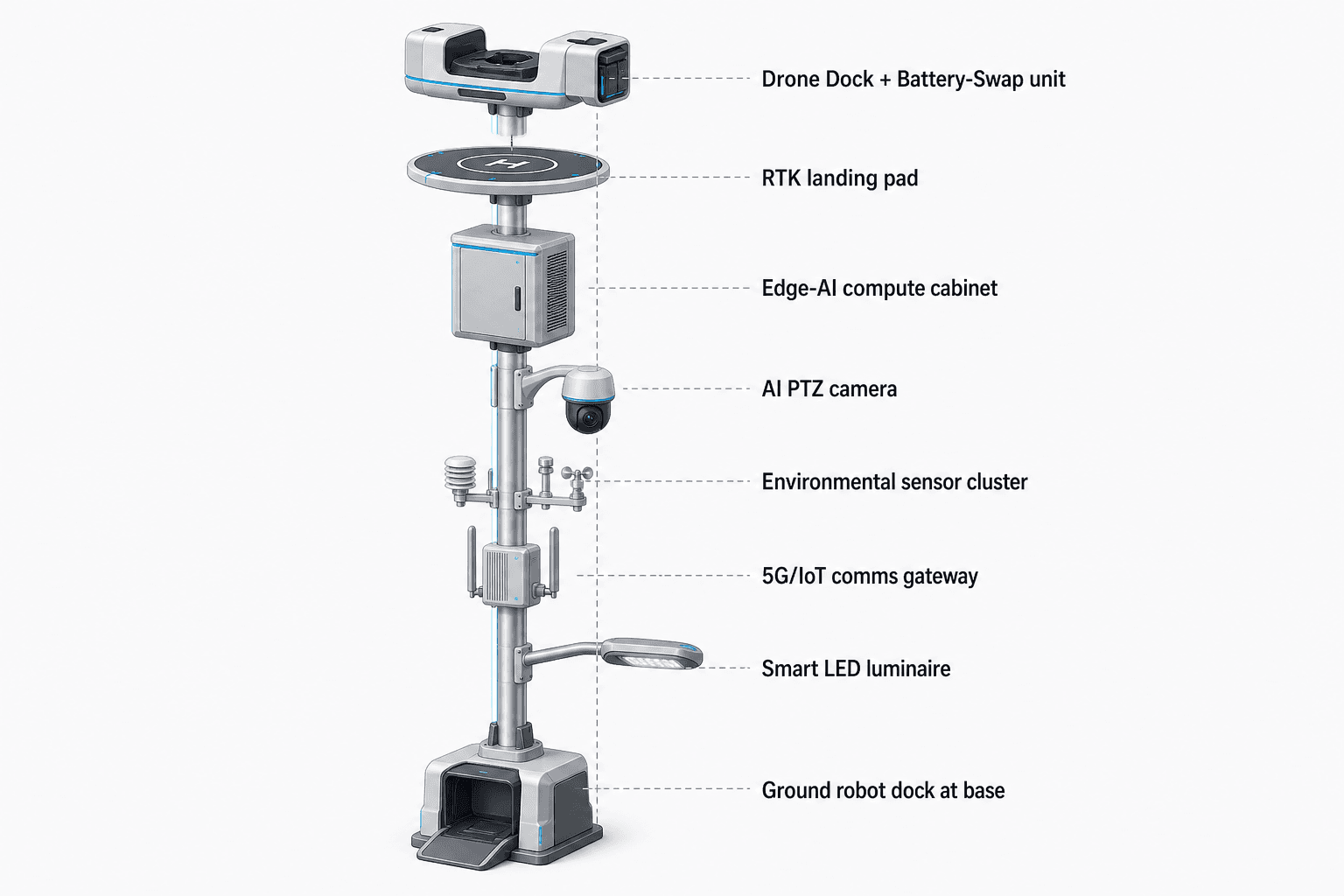
Answer Capsule: Procurement should divide each pole into at least 8 modules covering power, AI, sensors, communications, mechanics, drones, security, and maintenance.
A SOLARTODO Sentinel Sky Hub should be procured as an integrated system with clear interface control documents. Buyers should require cybersecurity specifications, mechanical load calculations, electrical schematics, maintenance procedures, and evidence-export documentation before pilot approval. The module breakdown below supports engineering, procurement, operations, and legal review.
Technical Parameters and Comparison
Answer Capsule: A practical Cairo specification uses 1.2-1.8 kW PV, 5-10 kWh batteries, IP65 enclosures, and 20-60 TOPS AI compute.
| Requirement | Recommended Specification | Why It Matters |
|---|---|---|
| PV capacity | 1.2-1.8 kW per pole | Supports autonomous night operation and drone charging reserve |
| Battery storage | 5-10 kWh LiFePO4, 48 V | Balances safety, cycle life, and overnight runtime |
| Autonomy target | 24-72 hours | Covers multi-night events and cloudy or dusty periods |
| Edge AI | 20-60 TOPS | Enables local analytics without full-time video streaming |
| Camera payload | 4K fixed, PTZ option, low-light, optional thermal | Supports evidence quality across varied night scenes |
| Connectivity | 4G/5G, private LTE, Wi-Fi mesh, or P2P backhaul | Allows deployment across streets, plazas, and riverfronts |
| Enclosure rating | IP65 or higher | Protects electronics from dust, water, and public-space exposure |
| Drone support | 2-4 battery bays | Extends patrol flight time without a central depot return |
Compared with mobile CCTV trailers, the pole format is more suitable for repeated corridor coverage and tighter pedestrian environments. Compared with permanent grid-connected camera works, it is faster to deploy and easier to relocate. Compared with diesel generator towers, it reduces fuel logistics, noise, and exposed cabling.
Evidence Collection Workflow
Answer Capsule: The evidence workflow should package video, metadata, AI labels, audit logs, and device health within 1 searchable incident file.
During an incident, the pole cluster should automatically create an event package with timestamped video, sensor metadata, AI-generated event labels, device health data, and operator actions. Authorized personnel can review the package at a field command post or transmit it to a central evidence platform. This reduces manual searching across disconnected cameras, drone logs, and handheld reports.
For chain-of-custody integrity, the system should apply synchronized time, role-based access, immutable audit logs, and cryptographic hashing for exported evidence files. AI detections should be treated as triage signals, not final determinations. Procurement specifications should require confidence thresholds, false-positive reporting, model-version records, and a process for disabling analytics not approved in the jurisdiction.
Standards and Authority Support
Answer Capsule: A bankable specification should reference at least 5 authorities for PV quality, interconnection, modeling, energy trends, and market costs.
According to IEC (2021), IEC 61215 defines design qualification and type approval requirements for terrestrial photovoltaic modules, making it relevant to PV module durability procurement. According to IEEE (2018), IEEE 1547 establishes interconnection and interoperability requirements for distributed energy resources connected to electric power systems. These references matter even when the system is normally off-grid, because backup or hybrid configurations may be added later.
According to NREL (2024), PVWatts estimates energy production for grid-connected PV systems using solar-resource and system-performance assumptions. For SOLARTODO feasibility studies, NREL-style derating helps prevent unrealistic claims about daily yield, battery autonomy, and seasonal performance. According to IEA (2024), solar PV drove most of the record 510 GW renewable additions in 2023, showing that PV is now a mainstream infrastructure platform.
According to IRENA (2024), utility-scale solar PV remained cost-competitive in global renewable power generation cost analysis. According to BloombergNEF (2024), battery and clean-energy supply-chain trends continue to shape procurement pricing, lead times, and bankability for solar-plus-storage systems. These sources should be cited in technical appendices, vendor submittals, and pilot evaluation reports.
Deployment Model for Cairo
Answer Capsule: Cairo deployment should start with 4-6 poles, expand to 12-20 poles, and validate performance over at least 2 event cycles.
A phased pilot is recommended. Phase 1 should use 4-6 poles in a controlled corridor to validate solar yield, network reliability, video quality, edge-AI accuracy, and drone battery handling. Phase 2 can expand to 12-20 poles across multiple route segments after command workflow and evidence export are accepted.
Site selection should consider crowd density, existing lighting, building shadows, emergency-vehicle access, RF coverage, and safe maintenance zones. Poles should improve response visibility without obstructing pedestrians or historic streetscapes. In cultural-tourism districts, visual integration and reversible installation methods are important procurement criteria.
For night-economy patrols, the most useful coverage points are intersections, taxi and rideshare pickup areas, hotel approach roads, pedestrian bottlenecks, waterfront gathering points, and temporary event entrances. A spacing of 150-250 m is a practical planning range. Final spacing should be confirmed by camera field-of-view testing and wireless-network surveys.
Business Value for Public-Safety Buyers
Answer Capsule: The main business value is reducing evidence search time, generator logistics, cable work, and patrol support gaps across recurring events.
The main B2B value is operational compression: less time to find relevant footage, fewer site visits to retrieve storage media, and faster coordination between patrol units and command staff. Solar autonomy reduces trenching, diesel generators, and temporary cable runs. Edge AI reduces bandwidth demand while keeping priority events visible to supervisors.
For event operators and municipal buyers, the system also provides reusable infrastructure. The same pole fleet can support festivals, tourism seasons, public holidays, temporary traffic plans, and emergency response staging. After one deployment, poles can be relocated, reconfigured, and redeployed with different sensor or communications packages.
Cost justification should compare SOLARTODO Sentinel Sky Hub against generator towers, mobile CCTV trailers, manual patrol expansion, and permanent camera works. The strongest case appears where recurring events need rapid setup, predictable coverage, and resilient operation during power or network disruption. Buyers should calculate total cost across at least 3 years, not only the first deployment.
Risk Controls
Answer Capsule: Public-safety deployments should control 4 risk groups: privacy, cybersecurity, physical access, and evidence integrity.
The Sentinel Sky Hub should include visible ownership markings, approved signage, strict access permissions, data-retention limits, and documented escalation rules. Analytics should be configured for public-safety functions such as crowd density, object presence, vehicle movement, tamper alarms, and event bookmarking. Face recognition or sensitive analytics should require explicit legal authorization before use.
Cybersecurity controls should include encrypted data transport, signed firmware, secure boot, disabled default credentials, vulnerability-management procedures, and audit logging. Maintenance crews should use named accounts rather than shared passwords. Evidence exports should be restricted to authorized users and recorded automatically.
Physical risks include vandalism, overheating, dust accumulation, pole impact, and unauthorized access to battery compartments. Mitigation measures include tamper sensors, anti-climb design, filtered ventilation, scheduled cleaning, impact-aware placement, and lockable service panels. Thermal derating is especially important because battery and compute performance can degrade in high summer temperatures.
FAQ
Answer Capsule: Buyers should resolve at least 10 procurement questions before approving price, logistics, installation, warranty, and technical acceptance.
How long can the SOLARTODO Sentinel Sky Hub operate without grid power?
A typical node with 1.2-1.8 kW PV and 5-10 kWh LiFePO4 storage can operate for 24-72 hours, depending on camera count, AI workload, weather, dust, and drone-charging demand. Final autonomy should be modeled with local solar-resource data, real nighttime loads, and a conservative battery reserve.
What is the expected price range for a project?
Pricing depends on pole count, camera package, AI hardware, battery capacity, anchoring method, communications, and evidence-system integration. Buyers should request a line-item quote covering hardware, installation, commissioning, training, warranty, cloud or software fees, and maintenance. For fair comparison, evaluate total cost over 3-5 years, not only unit price.
What technical specifications should be mandatory?
Mandatory specifications should include 1.2-1.8 kW PV, 5-10 kWh LiFePO4 storage, MPPT charging, 20-60 TOPS AI compute, 4K low-light video, encrypted backhaul, IP65 enclosures, access logging, and chain-of-custody export. Procurement teams should also require interface documents, cybersecurity controls, and environmental operating limits.
How long does installation take?
A small pilot of 4-6 poles can usually be staged faster than permanent grid-connected CCTV, but timing depends on permitting, anchoring, traffic control, RF surveys, and command-center integration. Temporary ballast installations are typically faster than foundation work. Site walks should confirm pedestrian clearance, emergency access, solar exposure, and maintenance safety before delivery.
What logistics are required for Cairo deployments?
Logistics should cover transport, lifting equipment, temporary traffic control, secure storage, battery handling, spare parts, cleaning schedules, and trained field technicians. Dust management is important because soiling can reduce PV output. For event use, buyers should plan deployment, commissioning, live operations, demobilization, inspection, and redeployment as one repeatable workflow.
What warranty should buyers request?
Buyers should separate warranties for PV modules, batteries, electronics, cameras, mechanical structures, software, and workmanship. PV modules often carry long performance warranties, while batteries and compute hardware usually have shorter terms. The contract should define response time, spare-unit availability, firmware support, battery capacity thresholds, and exclusions for vandalism or unauthorized modification.
How does this compare with mobile CCTV trailers?
Mobile CCTV trailers are useful for open lots and temporary observation, but they can be bulky in pedestrian corridors. Sentinel Sky Hub poles provide a slimmer, repeatable corridor layout with integrated solar, AI compute, communications, and drone battery support. For recurring cultural-tourism events, a relocatable pole fleet can be easier to standardize across multiple routes.
Can the pole network support drone battery hot-swap?
Yes. A practical configuration includes 2 active charging bays, 2 conditioned storage bays, fire-resistant separation, battery-temperature monitoring, access logging, and clear fault states. Drone compatibility must be specified by voltage, connector, chemistry, charge profile, and physical dimensions. Damaged or overheated batteries should be rejected by procedure and not charged in the pole.
Does edge AI replace police review?
No. Edge AI should accelerate triage by tagging events, detecting tampering, identifying motion patterns, and creating searchable metadata. Human operators remain responsible for response decisions, investigation, and legal interpretation. The system should record model version, confidence thresholds, false-positive review, and any operator action taken after an alert.
What standards should procurement documents cite?
Procurement documents should cite IEC 61215 for PV module qualification, IEEE 1547 for grid-interactive distributed-energy requirements, and NREL PVWatts or equivalent modeling for solar-yield assumptions. They should also cite IEA and IRENA market data for solar adoption and cost context. Local electrical, aviation, data-governance, and police evidence procedures remain mandatory.
Conclusion
Answer Capsule: SOLARTODO Sentinel Sky Hub gives Cairo a reusable 24-72 hour patrol node for power, AI evidence triage, and drone support.
SOLARTODO Sentinel Sky Hub provides a practical architecture for Cairo night-economy patrol support: off-grid power, local AI processing, temporary deployment flexibility, and drone battery hot-swap capability in one field node. For police, municipal agencies, and event-security operators, the main outcome is faster access to reliable incident evidence without waiting for permanent infrastructure works. The system is strongest where recurring events require rapid setup and predictable coverage.
A successful pilot should measure solar autonomy, evidence retrieval time, wireless uptime, AI alert accuracy, maintenance burden, and operator acceptance. With standards-based procurement and disciplined governance, the system can become a reusable public-safety asset for cultural-tourism corridors, seasonal events, and high-density night operations. The best procurement path is phased validation, not a large untested rollout.
References
Answer Capsule: This article cites 6 authority sources covering solar performance, module qualification, interconnection, renewable growth, costs, and market intelligence.
- IEA (2024), Renewables 2023 / renewable capacity additions reporting: global renewable capacity additions reached 510 GW in 2023, up 50% year on year, with solar PV contributing about three quarters of additions. https://www.iea.org/
- IRENA (2024), Renewable Power Generation Costs in 2023: renewable cost analysis shows solar PV remains a cost-competitive generation source in many markets. https://www.irena.org/
- NREL (2024), PVWatts Calculator: PVWatts estimates photovoltaic energy production using solar-resource and system-performance inputs. https://pvwatts.nrel.gov/
- IEC (2021), IEC 61215 photovoltaic module design qualification and type approval: standard reference for terrestrial PV module qualification. https://webstore.iec.ch/
- IEEE (2018), IEEE 1547 distributed energy resource interconnection standard: reference for DER interconnection and interoperability requirements. https://standards.ieee.org/
- BloombergNEF (2024), clean-energy and battery market research: market intelligence source for battery pricing, clean-energy supply chains, and project procurement trends. https://about.bnef.com/