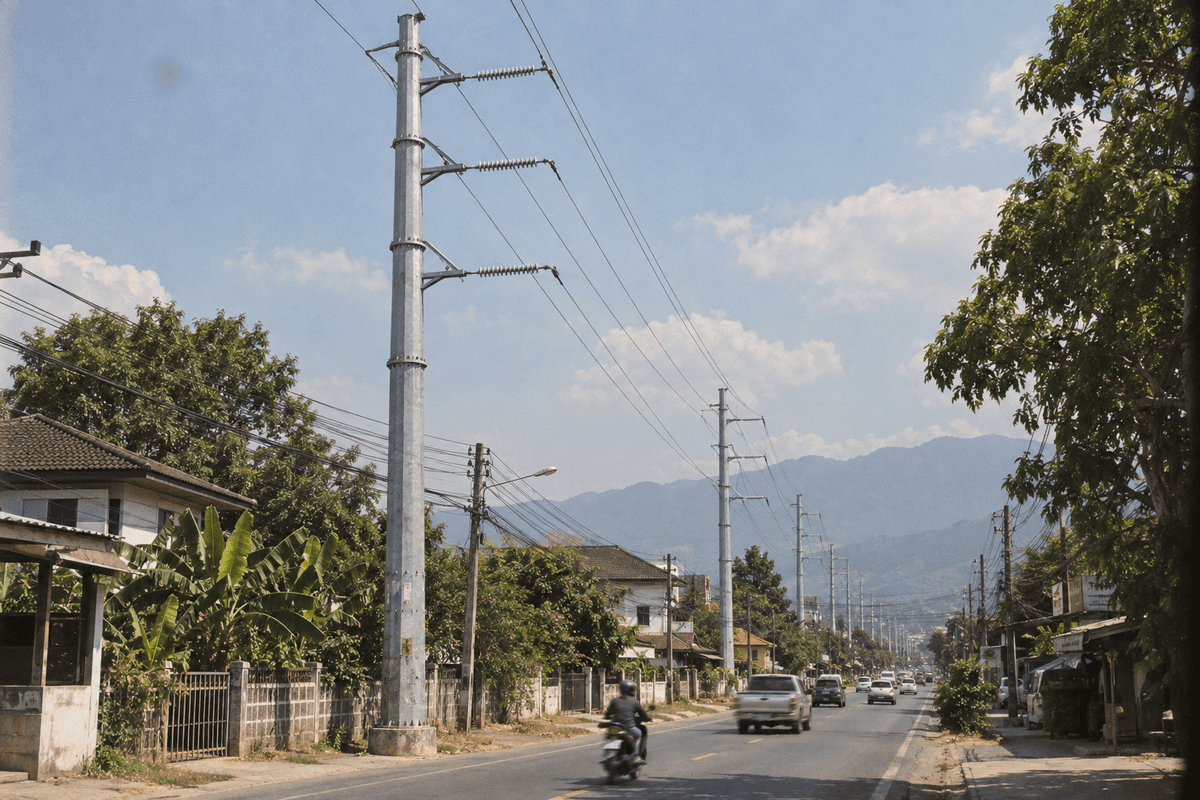
Chiang Mai 110kV Corridor Clearance Decision: Power Transmission Tower Configuration for Inland Northern Thailand
Summary
Chiang Mai’s 40.2km2 core, 1.2M urban market, inland haze season, and EGAT 115kV backbone context favor approximately 21 galvanized 40m steel tubular poles for a constrained 3km 110kV single-circuit corridor.
Key Takeaways
This Chiang Mai guide sizes a 110kV Power Transmission Tower corridor around 21 poles, 40m height, 150m spans, and 30-year service life.
- A typical deployment of this scale would use approximately 21 units over about 3km, based on 150m span planning.
- The recommended pole is a 40m tapered steel tubular monopole using hot-dip galvanized Q345 steel at about 24t per pole.
- The electrical configuration is 110kV single circuit with ACSR 400 conductor rated at about 1,520kg/km and 110kN maximum tension.
- Chiang Mai is inland, about 300m above sea level, so corrosion risk is lower than coastal Thailand but haze dust and wet-season runoff matter.
- Thailand’s EGAT transmission system uses 69kV, 115kV, 230kV, and 500kV levels; 110kV design aligns with the regional 115kV class.
- A 25m/s wind class, 1.5m insulator length, 4m phase spacing, and 6m ground clearance fit an inland northern Thailand corridor.
- Anchor-bolt cage foundations should account for Ping River flood exposure, old-town access constraints, and narrow construction staging.
- SOLARTODO should position this as a high-voltage backbone pole package, not a low-voltage lighting or solar pole product.
Market Context for Chiang Mai
Chiang Mai’s inland 18.79N, 98.98E location creates a 110kV planning problem shaped by haze, flood drainage, and constrained urban access.
Chiang Mai is not a coastal salt-air environment; it is an inland northern Thai city on the Ping River plain near the Thai highlands. Public city profiles commonly place the municipal core at about 40.2km2, while the wider urban area is often cited around 1.2 million residents. That split matters for transmission planning because the tight historic center and expanding peri-urban districts create different pole-access constraints within the same load area.
According to the Thai Meteorological Department climate normals for 1991-2020, Chiang Mai has a hot tropical climate with a strong wet-season pattern rather than year-round rainfall. According to World Bank CCKP (2021), Thailand faces rising heat and precipitation-risk variability, which makes drainage, foundation embedment, and galvanizing quality more important for 30-year infrastructure. Chiang Mai’s PM2.5 haze season also affects maintenance planning because dust accumulation can increase inspection demand for insulator strings, grounding interfaces, and vibration hardware.
Power-sector fit is equally specific. According to EGAT (2021), Thailand’s transmission network operates at 69kV, 115kV, 230kV, and 500kV, with EGAT connecting generation to MEA and PEA distribution systems. In Chiang Mai, the practical city-edge backbone class is therefore closest to a 110kV/115kV sub-transmission interface, not a 35kV distribution feeder and not a 220kV bulk corridor.
Local logistics favor steel tubular monopoles where right-of-way is narrow or where road occupation time must be controlled. Chiang Mai’s old-town moat roads, dense shopfront streets, tourist traffic, and flood-prone river approaches make lattice structures harder to stage. For SOLARTODO, the market question is not whether a tower can be taller; it is whether a compact, flanged, galvanized 110kV monopole can reduce corridor width while preserving clearance and maintainability.
Recommended Technical Configuration
A Chiang Mai 110kV backbone corridor of about 3km would use approximately 21 steel tubular poles at 40m height and 150m spans.
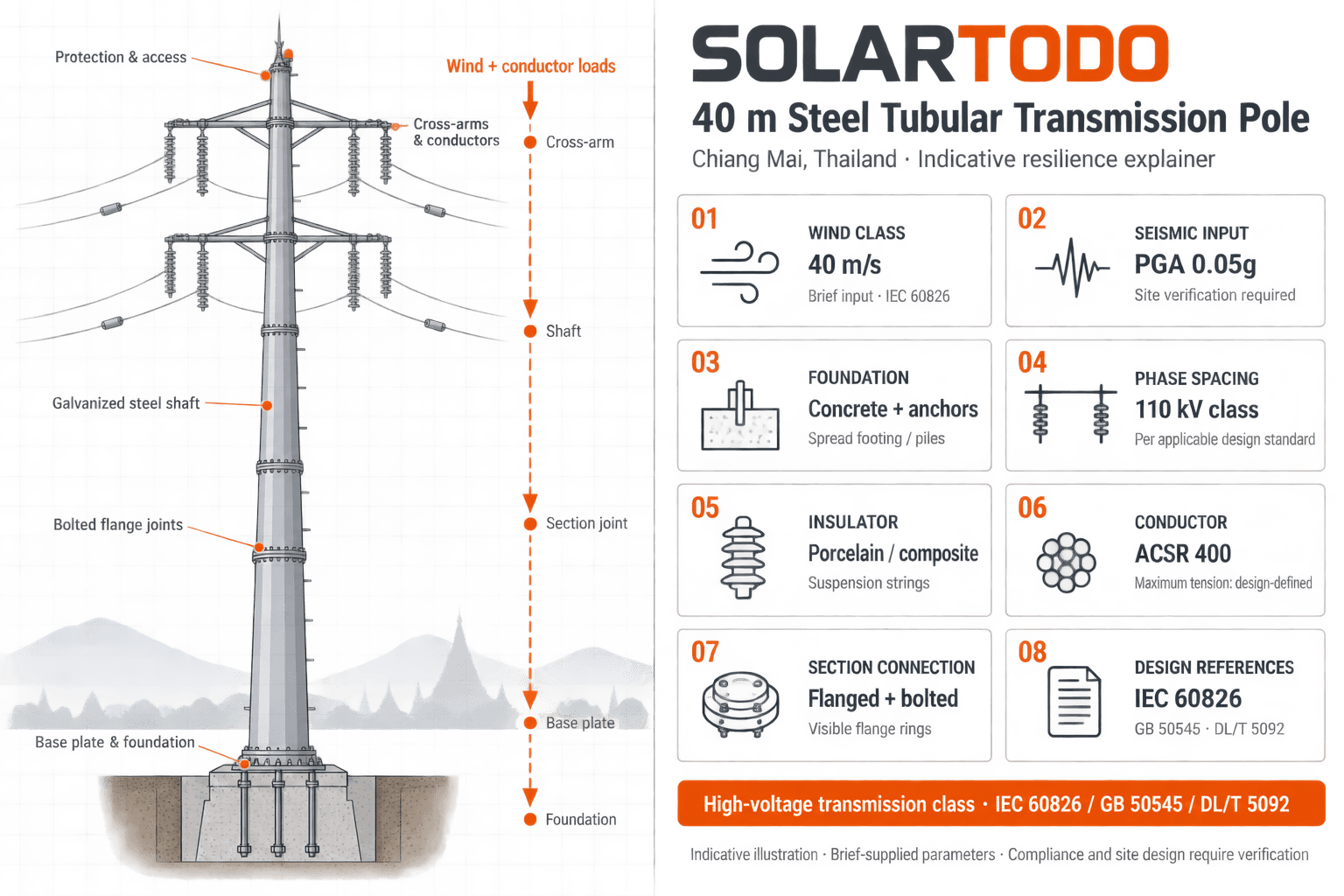
The recommended SOLARTODO Power Transmission Tower configuration is a 110kV single-circuit tapered steel tubular monopole. A typical 21-unit deployment in this profile would consist of hot-dip galvanized Q345 steel poles, flanged bolt sections, cross-arm brackets, insulator strings, ACSR 400 conductors, grounding, bird guards, vibration dampers, and anchor-bolt cage foundations. This is a technical recommendation, not a claim of past installation.
The 40m height and about 24t per pole should be treated as a high-clearance backbone specification for a constrained urban or peri-urban crossing. It sits above the normal 66-110kV reference class of 18-30m and 5-15t per pole, so the engineering justification must be explicit: clearance, conductor tension, 150m spans, road crossings, and access limitations drive the taller pole, not voltage alone. SOLARTODO should therefore present this as a project-specific 110kV high-clearance monopole package rather than a generic 110kV catalog pole.
For Chiang Mai, this configuration also avoids the wrong product language. It is not a lattice tower, FRP pole, wood pole, concrete pole, solar lighting pole, or telecom mast. It is a steel tubular Power Transmission Tower intended for high-voltage conductor support, mechanical reliability, compact right-of-way, and a 30-year design life.
Technical Specifications
The Chiang Mai configuration uses 21 units of 40m galvanized Q345 steel poles, ACSR 400 conductor, and 25m/s wind design.
- Product: SOLARTODO Power Transmission Tower, tapered steel tubular monopole.
- Quantity basis: approximately 21 units for a typical 3km, 150m-span corridor.
- Voltage class: 110kV single circuit, aligned with Thailand’s 115kV transmission class.
- Pole class: high-voltage transmission backbone, project-specific high-clearance design.
- Pole height: 40m.
- Pole weight: about 24t per pole, calculated from approximately 600kg/m.
- Steel grade: hot-dip galvanized Q345 steel.
- Conductor: ACSR 400, about 1,520kg/km, maximum tension 110kN.
- Phase spacing: 4m.
- Minimum ground clearance: 6m.
- Insulator length: 1.5m.
- Span: 150m typical, about 3km total line length.
- Wind class: Class 1, 25m/s.
- Foundation: concrete anchor-bolt cage foundation.
- Accessories: climbing steps, cross arm, grounding, bird guard, and vibration damper.
- Design life: 30 years.
- Standards basis: IEC 60826, GB 50545, and DL/T 5092.
IEC states, “overhead lines shall be designed” for mechanical loading conditions; for Chiang Mai this means wind, conductor tension, and foundation risk must be modeled together. EGAT states that its system uses “115 kV, 230 kV, and 500 kV” transmission levels, making the 110kV recommendation compatible with Thai high-voltage practice.
Implementation Approach
A 21-pole Chiang Mai rollout would normally move from route survey to anchor cages, pole erection, conductor stringing, and commissioning.
The first phase is route and utility coordination. In Chiang Mai, survey teams should identify old-town street pinch points, canal or moat-road crossings, Ping River flood exposure, and access routes for 24t pole sections. Coordination should involve the relevant utility authority, local road agency, and municipal permitting body because heavy lifts can disrupt dense commercial streets.
The second phase is engineering and procurement. SOLARTODO would finalize wind loading, conductor sag-tension, phase clearance, grounding, galvanized coating thickness, and anchor cage drawings before fabrication. CKD or sectioned shipping is recommended because flanged pole segments are easier to move through Thai inland road corridors than full-length assemblies.
The third phase is civil works and erection. Anchor-bolt cage foundations should be installed before pole delivery, with concrete cure time planned into the schedule. Pole erection would typically use mobile cranes, torque-controlled flange bolting, grounding checks, cross-arm installation, and conductor stringing with vibration dampers placed according to span and tension calculations.
Commissioning should include verticality checks, bolt torque records, grounding resistance tests, conductor clearance verification, insulator inspection, and as-built documentation. For a 3km corridor, a practical schedule is often several months rather than several weeks once permitting, foundation cure, weather windows, and traffic-control constraints are included.
Expected Performance & ROI
A 30-year Chiang Mai 110kV monopole corridor should prioritize avoided outages, reduced land take, and lower lifecycle maintenance over first-cost claims.
Expected performance should be measured in electrical availability, mechanical durability, inspection access, and right-of-way efficiency. Hot-dip galvanized steel is appropriate for Chiang Mai because the site is inland rather than marine, while still exposed to heavy rain, dust, and seasonal haze. The 25m/s wind basis should be validated against final route exposure and terrain category before fabrication.
ROI should not be framed as a simple energy-saving payback because a Power Transmission Tower does not generate power. The economic value comes from avoided outage cost, corridor compactness, reduced relocation conflicts, faster construction compared with wider lattice structures, and 30-year service planning. According to IEA (2023), investment in grids must rise materially to support electrification and clean-energy integration; that global grid-pressure logic applies to Thailand’s growing secondary cities as well.
For EPC budgeting, payback is usually indirect. A utility or industrial buyer would compare monopole cost against right-of-way acquisition, outage exposure, construction time, maintenance truck rolls, and future conductor uprating options. SOLARTODO can support this comparison through route-specific bill of materials, loading calculations, foundation drawings, and shipping plans via contact us or the Power Transmission Tower product page.
Results and Impact
A typical 3km configuration would support 110kV backbone continuity with 21 compact poles, 150m spans, and 30-year maintainability.
The practical impact for Chiang Mai is corridor discipline. A steel tubular monopole reduces the footprint compared with broad-base lattice structures, which is valuable near narrow road reserves, moat-edge approaches, and expanding urban districts. The 40m high-clearance specification also gives engineers more flexibility where road, drainage, or crossing constraints make lower 18-30m standard poles insufficient.
Operationally, the main benefits are standardized inspection points, galvanized steel durability, modular replacement of accessories, and clearer grounding and climbing-step provisions. Bird guards and vibration dampers are not cosmetic accessories; they reduce avoidable faults and conductor fatigue in a corridor where maintenance access can be affected by traffic, rain, and haze-season visibility.
Comparison Table
This comparison shows why the 40m Chiang Mai pole is a special 110kV backbone configuration rather than a generic distribution pole.
| Option | Typical Voltage Fit | Height / Weight | Chiang Mai Fit | Main Trade-Off |
|---|---|---|---|---|
| 10-35kV distribution pole | 10-35kV | 12-18m / 1-3t | Too small for 110kV backbone | Lower cost but wrong voltage class |
| Standard 66-110kV monopole | 66-110kV | 18-30m / 5-15t | Suitable where clearance is normal | May be too low for constrained crossings |
| Recommended SOLARTODO pole | 110kV single circuit | 40m / about 24t | Best fit for 3km high-clearance route | Heavier foundation and crane planning |
| 220kV transmission pole | 220kV | 35-55m / 15-35t | Electrically oversized for this guide | Higher cost and permitting burden |
Pricing & Quotation
SOLARTODO quotes 110kV Power Transmission Tower projects in 3 tiers: FOB Supply, CIF Delivered, and EPC Turnkey.
SOLARTODO offers three pricing tiers for this product line: FOB Supply (equipment ex-works China), CIF Delivered (including ocean freight and insurance), and EPC Turnkey (fully installed, commissioned, with 1-year warranty). Volume discounts are available for large-scale deployments. Configure your system online for an instant estimate, or request a custom quotation from our engineering team at [email protected].
Frequently Asked Questions
These 10 FAQs address Chiang Mai technical fit, timeline, ROI, pricing scope, maintenance, warranty, and installation for 110kV steel tubular poles.
Q1: Why is a 40m pole recommended for a 110kV Chiang Mai corridor? The 40m height is not a generic 110kV default; it is a high-clearance recommendation for a constrained 3km corridor using 150m spans. Chiang Mai has dense streets, road crossings, flood-prone approaches, and urban expansion pressure. The extra height supports 6m ground clearance, 4m phase spacing, and safer conductor geometry.
Q2: Is this a lattice tower or a steel tubular pole? This guide specifies one form only: a tapered steel tubular monopole made from hot-dip galvanized Q345 steel. It is not lattice, FRP, wood, or concrete. The pole uses flanged bolt sections, cross-arm brackets, insulator strings, ACSR conductors, anchor-bolt cage foundations, and transmission-line accessories.
Q3: What conductor is used in the recommended configuration? The recommended conductor is ACSR 400, with an approximate mass of 1,520kg/km and maximum tension of 110kN. That conductor class matches the high-voltage backbone intent of the 110kV single-circuit line. Final sag-tension calculations should be verified against route temperature, span profile, and wind exposure.
Q4: How long would a typical 21-pole deployment take? A 21-pole, 3km project is usually scheduled in months, not days. The critical path includes route survey, utility approval, shop drawings, fabrication, galvanizing, inland logistics, anchor cage installation, concrete curing, pole erection, conductor stringing, and commissioning. Wet-season rain and traffic management can extend the field schedule.
Q5: What is the expected ROI for a Power Transmission Tower project? ROI is indirect because the tower does not generate electricity. The value comes from avoided outages, reduced right-of-way pressure, fewer relocation conflicts, faster installation than wider structures, and 30-year maintainability. Buyers should compare lifecycle cost, land constraints, outage risk, foundation complexity, and future uprating flexibility.
Q6: How does this compare with a 35kV distribution pole? A 35kV pole normally belongs in the 12-18m and 1-3t class, so it is not appropriate for this 110kV backbone guide. Chiang Mai’s recommended configuration uses 40m and about 24t per pole because the design addresses high-voltage clearance and constrained corridor geometry, not ordinary distribution support.
Q7: What maintenance is required in Chiang Mai’s haze and rainy seasons? Maintenance should include visual inspection of galvanizing, insulator contamination checks during PM2.5 haze periods, grounding resistance tests, bolt torque sampling, vibration damper inspection, and vegetation clearance. After heavy rain or Ping River flood alerts, foundation drainage and access-road conditions should be checked before close-up inspection work.
Q8: Does SOLARTODO provide EPC pricing? Yes. SOLARTODO can quote FOB Supply, CIF Delivered, or EPC Turnkey scopes for this product line. EPC pricing depends on route survey, foundation design, crane access, permitting, conductor package, grounding design, and installation responsibility. Buyers should request a route-specific quotation rather than applying a generic pole price.
Q9: What warranty should buyers expect? The pricing section defines a 1-year warranty for EPC Turnkey scope, while the recommended design life is 30 years. Warranty coverage should be reviewed against coating specification, fabrication tolerances, installation scope, accessories, and local maintenance responsibilities. Long service life still depends on inspection discipline and correct foundation execution.
Q10: What standards apply to the Chiang Mai configuration? The stated standards basis is IEC 60826, GB 50545, and DL/T 5092. IEC 60826 is used for overhead transmission-line design criteria, while GB and DL/T references support structural and transmission-line design practice. Thailand-specific utility approval should also align with EGAT or PEA requirements where applicable.
References
These 7 references ground the Chiang Mai recommendation in Thai grid practice, climate risk, public infrastructure context, and transmission standards.
- EGAT (2021): Thailand’s transmission system uses 69kV, 115kV, 230kV, and 500kV voltage levels and connects generation to MEA and PEA distribution systems.
- OECD / IEA (2016): Thailand electricity security assessment describes EGAT as transmission operator and MEA/PEA as distribution authorities, with 500kV, 230kV, 115kV, 69/22kV, and 380V levels.
- Thai Meteorological Department (2022): Climatological Data for the Period 1991-2020 includes Chiang Mai station temperature and rainfall normals for engineering climate context.
- World Bank CCKP (2021): Thailand climate-risk profile notes heat and rainfall variability risks relevant to drainage, foundation, and infrastructure resilience planning.
- Pollution Control Department / Royal Thai Government (2026): Chiang Mai and northern provinces face recurring wildfire, haze, and PM2.5 management requirements during dry-season periods.
- IEC (2017): IEC 60826 provides design criteria for overhead transmission lines, including mechanical loading and reliability-based line design principles.
- IEA (2023): Electricity Grids and Secure Energy Transitions states that grid investment must increase to support electrification, renewables integration, and energy security.
Equipment Deployed
- 21 units × 40m tapered steel tubular Power Transmission Tower, Q345 hot-dip galvanized steel
- 110kV single-circuit configuration with 4m phase spacing and 6m ground clearance
- ACSR 400 conductor, 1,520kg/km, maximum tension 110kN
- 1.5m insulator strings with cross-arm brackets
- Concrete anchor-bolt cage foundations for 24t/pole structures
- Accessories: climbing steps, cross arm, grounding, bird guard, vibration damper
- Wind class 1 design basis at 25m/s
- Standards basis: IEC 60826 / GB 50545 / DL/T 5092