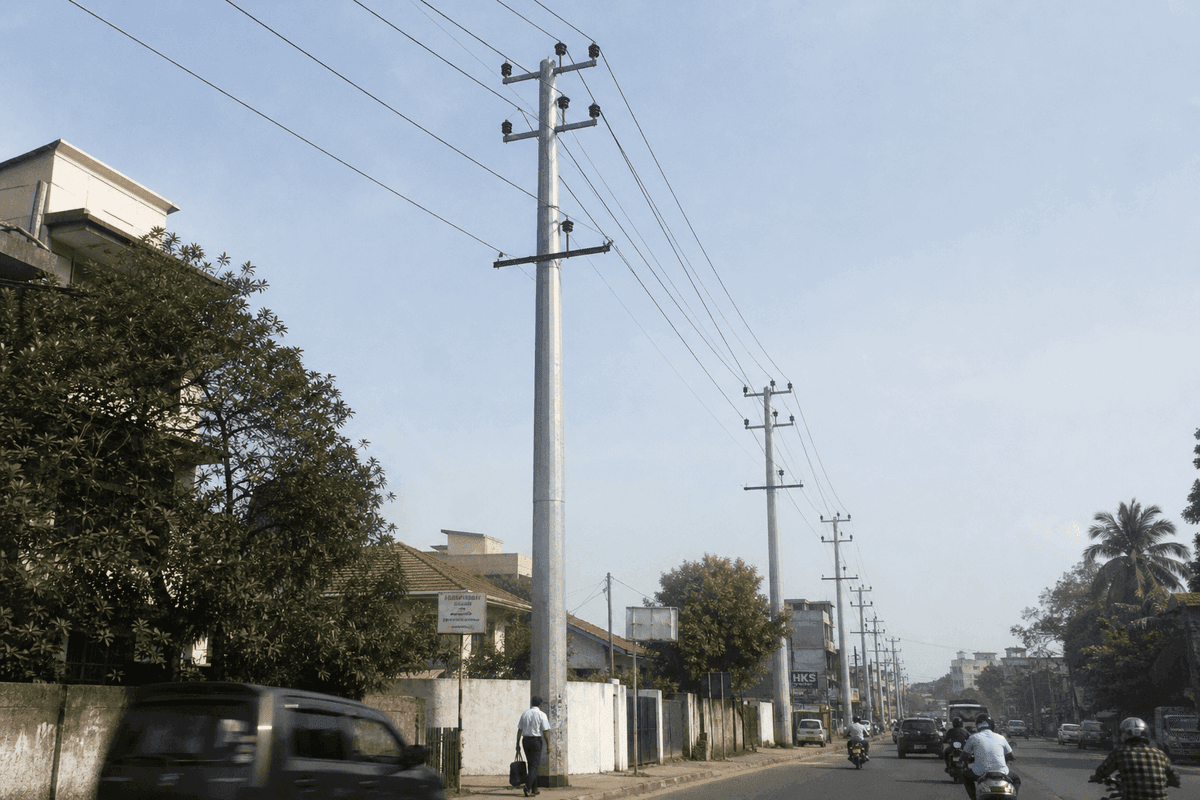
Colombo Power Transmission Tower Market Analysis: 35kV Municipal Distribution Configuration Guide
Summary
Colombo's 35kV municipal distribution corridors require 12-18m standard pole classes, while the supplied 204-unit, 25m elevated variant suits constrained 12km routes with 60m spans and 40m/s wind design.
Key Takeaways
- A standard 35kV distribution pole class is 12-18m high, 1-3t per pole, with 80-150m spans and typically 8-12 poles/km.
- The supplied Colombo configuration is approximately 204 units across about 12km, using 25m tapered Q345 steel tubular poles at about 10t/pole.
- ACSR-120 conductors at 470kg/km and 38kN maximum tension fit medium-voltage municipal feeder reinforcement.
- The recommended structural check should reconcile the 25m elevated variant with IEC 60826 loading and GB 50545 overhead-line design.
- Wind Class 4 at 40m/s is appropriate for coastal exposure, monsoon rain, and corrosion risk near Colombo's port and marine air.
- The configuration uses 1.5m phase spacing, 5.5m ground clearance, 0.8m insulator strings, anchor-bolt cage foundations, and bird guards.
- A typical 204-unit deployment would be phased through survey, foundation works, flanged-section erection, conductor stringing, testing, and commissioning.
Market Context for Colombo
Colombo's power-distribution challenge is dense urban load growth, coastal corrosion exposure, and limited right-of-way for 35kV municipal feeders. The Colombo metropolitan area is Sri Lanka's commercial center, and public sources place the metro population near 5 million while the city remains the country's main port and business district. According to the World Bank (2013), Western Province accounts for less than 6% of Sri Lanka's land area but about 25% of national population and about 80% of industrial value additions. That concentration makes medium-voltage feeder reliability a practical economic issue, not only an engineering issue.
According to the World Meteorological Organization (2024), Colombo has a tropical climate with heavy monsoon rainfall and annual rainfall often reported around 2,500mm. Coastal distribution structures therefore need corrosion resistance, high wind allowance, and maintainable access hardware. A Power Transmission Tower for this market should prioritize hot-dip galvanizing, compact monopole geometry, and controlled foundation footprint. SOLARTODO's Power Transmission Tower line fits that need when configured as a steel tubular distribution pole rather than a lattice, wood, FRP, or concrete alternative.
According to Ceylon Electricity Board planning documents and public grid summaries, Sri Lanka's bulk transmission network includes 220kV and 132kV corridors, while urban distribution commonly steps down through 33kV/11kV systems. For Colombo's municipal distribution class, the relevant selection begins at the voltage level: 10-35kV. IEC states, "This International Standard specifies loading and strength requirements," which is the correct design logic for matching wind, conductor tension, and pole strength. World Bank describes the Colombo metropolitan area as an "engine of growth," which explains why short feeder interruptions can have outsized commercial impact.
Recommended Technical Configuration
A typical 204-unit Colombo feeder package would use a 35kV single-circuit steel tubular monopole configuration across about 12km of constrained urban route. For baseline engineering, the 35kV class maps to 12-18m height, 1-3t/pole, 80-150m spans, and 8-12 poles/km. The supplied configuration is an elevated municipal variant: approximately 204 units of 25m tapered hot-dip galvanized Q345 steel tubular pole, about 10t/pole, with 60m spans. Because 25m and 10t exceed the standard 35kV class envelope, the design should be documented as a special clearance, compact-route, or high-loading municipal variant rather than a normal 35kV default.
For Colombo, that elevated variant can be technically reasonable only when route constraints justify it: road crossings, utility congestion, flood-prone foundations, vegetation clearance, or conductor uplift limits. The line would remain a medium-voltage municipal distribution asset, not a 110kV or 220kV transmission-class structure. SOLARTODO should present the configuration as a recommendation subject to local utility approval, geotechnical report, route survey, and statutory clearance verification. A conservative engineering package would include IEC 60826 load combinations, GB 50545 line design checks, corrosion allowance, earthing design, and foundation pull-out resistance.
Technical Specifications
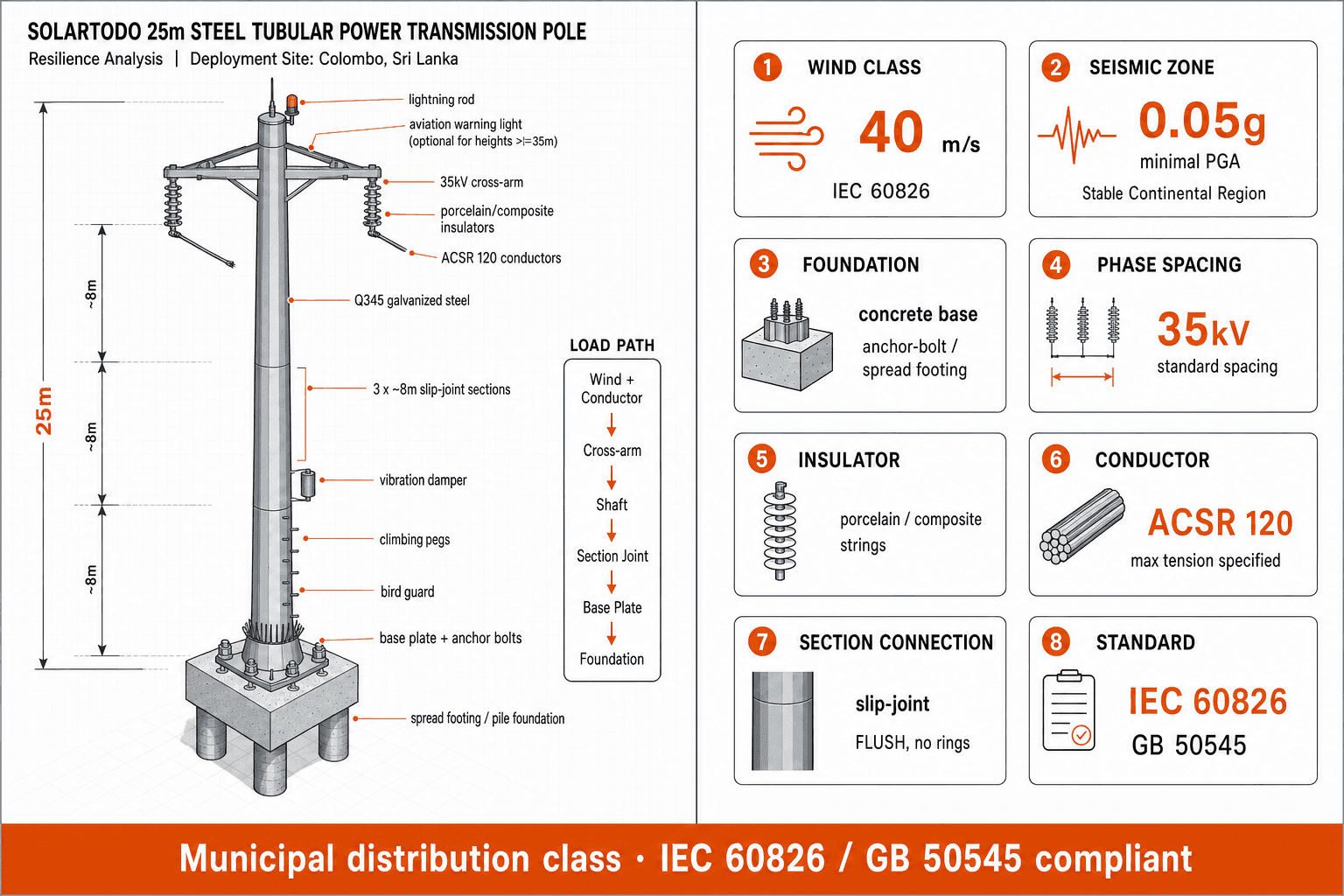
A 35kV Colombo Power Transmission Tower package should separate the standard voltage class from the supplied elevated municipal variant. Standard 10-35kV distribution guidance is 12-18m height, 1-3t/pole, single or double circuit, 80-150m span, and typically 8-12 poles/km. The supplied route-specific configuration is approximately 204 units, 25m height, about 10t/pole, 400kg/m, and 60m span for about 12km of line. This difference should be approved as a nonstandard municipal distribution variant before procurement.
- Product form: tapered round or dodecagonal steel tubular monopole, not lattice, FRP, wood, or concrete.
- Voltage class: 35kV single-circuit municipal distribution.
- Material: hot-dip galvanized Q345 steel, with Q420 available for higher stress zones if design review requires it.
- Height and weight: supplied 25m, about 10t/pole, with standard 35kV class noted as 12-18m and 1-3t/pole.
- Span and route length: 60m nominal span, about 12km total line, approximately 204 units.
- Conductor: ACSR-120, 470kg/km, maximum tension 38kN.
- Electrical geometry: 1.5m phase spacing, 5.5m ground clearance, 0.8m insulator length.
- Circuit hardware: cross-arm brackets, insulator strings, vibration dampers, bird guards, grounding, and climbing steps.
- Foundation: concrete anchor-bolt cage foundation with site-specific uplift, overturning, and soil-bearing checks.
- Wind loading: Wind Class 4, 40m/s design basis.
- Design life: 30 years with planned inspection, galvanizing maintenance, and fastener torque checks.
- Standards basis: IEC 60826 for overhead-line loading and strength; GB 50545 for overhead transmission-line design.
Implementation Approach
A typical 204-unit 35kV steel tubular pole deployment in Colombo would be delivered through six controlled phases over roughly 4-8 months. The first phase is route survey, geotechnical sampling, utility mapping, and clearance confirmation against roads, buildings, telecom cables, drainage channels, and existing 11kV/33kV feeders. The second phase is structural and electrical design freeze, including conductor sag-tension calculation for ACSR-120, wind loading at 40m/s, earthing resistance targets, and foundation cage drawings.
Procurement would then move into Q345 steel plate preparation, pole rolling, longitudinal seam welding, flange fabrication, trial fit-up, hot-dip galvanizing, and accessory packing. CKD or sectioned shipping is preferred because 25m poles with flanged bolt sections reduce transport constraints near Colombo's dense urban roads. Site works would sequence foundations ahead of pole delivery to reduce storage time and corrosion exposure. Erection would use crane placement, anchor-bolt leveling, flange torqueing, cross-arm installation, insulator fitting, conductor stringing, vibration damper placement, grounding, and final commissioning tests.
For SOLARTODO, the main engineering discipline is documenting that the elevated 25m/10t variant is intentionally selected for constrained municipal clearance rather than accidentally oversized. Quality controls should include galvanizing thickness reports, material certificates, weld inspection, bolt-grade verification, foundation cube tests, verticality checks, and as-built coordinates. Before energization, the EPC team should verify phase clearance, ground clearance, grounding continuity, insulator condition, and conductor sag under expected temperature range.
Expected Performance & ROI
A 35kV steel tubular pole system in Colombo should be evaluated on reliability, land-use efficiency, maintenance reduction, and outage-risk reduction over a 30-year design life. According to the World Bank (2013), Colombo's metropolitan economy is a national growth engine, so feeder reliability supports commercial continuity, logistics, healthcare, port activity, and high-density mixed-use districts. Compared with lattice structures, steel tubular monopoles generally reduce corridor footprint and simplify urban installation, especially where road medians or narrow utility reservations constrain foundations.
ROI for a municipal distribution pole package is normally assessed through avoided outage cost, reduced maintenance visits, faster installation, lower land acquisition exposure, and longer structural service life. A hot-dip galvanized monopole with bird guards, dampers, and climbing steps can reduce inspection complexity compared with multiple-member structures. For payback modeling, utilities typically compare total lifecycle cost across 30 years rather than only initial procurement. A practical Colombo model should include foundation cost, traffic management, crane access, shipping, corrosion maintenance, outage scheduling, and replacement risk.
According to IEA (2024), power-system investment increasingly needs to support reliability and grid flexibility as electrification grows. According to IEC (2017), overhead-line design should combine climatic loading, conductor loads, and structural strength rather than sizing by voltage alone. For this Colombo profile, SOLARTODO's recommended technical value is compact urban fit, predictable galvanized steel fabrication, and a clear upgrade path from supply-only packages to EPC turnkey delivery through contact us.
Comparison Table
The Colombo 35kV recommendation should be compared against standard voltage-class limits so utility engineers can see where the supplied variant is special. The table below separates baseline engineering classes from the supplied municipal elevated profile. This prevents the common error of treating a 35kV line as if it automatically required 220kV-scale heights or weights. It also clarifies why local approval is required for the 25m and 10t values.
| Configuration | Voltage class | Height | Weight | Span | Typical use | Colombo fit |
|---|---|---|---|---|---|---|
| Standard distribution steel tubular pole | 10-35kV | 12-18m | 1-3t/pole | 80-150m | Urban and suburban distribution | Baseline reference |
| Supplied elevated municipal variant | 35kV | 25m | ~10t/pole | 60m | Constrained clearances, compact route, high loading | Recommended only with design approval |
| Sub-transmission monopole | 66-110kV | 18-30m | 5-15t/pole | 200-300m | Regional sub-transmission | Not required for 35kV feeder |
| HV transmission monopole | 220kV | 35-55m | 15-35t/pole | 350-450m | Bulk transmission | Over-class for this route |
| UHV transmission monopole | 500kV | 50-70m | 35-55t/pole | 400-500m | National backbone | Not applicable |
Pricing & Quotation
A 35kV Colombo quotation should specify supply scope, 204-unit approximate quantity, 12km route basis, foundation responsibility, and commissioning boundary. SOLARTODO offers three pricing tiers for this product line: FOB Supply (equipment ex-works China), CIF Delivered (including ocean freight and insurance), and EPC Turnkey (fully installed, commissioned, with 1-year warranty). Volume discounts are available for large-scale deployments. Configure your system online for an instant estimate, or request a custom quotation from our engineering team at [email protected].
A quotation should not be based on pole count alone. For Colombo, the cost drivers include steel grade, galvanizing thickness, flange diameter, anchor cage mass, cross-arm geometry, conductor supply, insulator rating, vibration dampers, bird guards, traffic management, soil conditions, and crane access. EPC pricing should also define whether outages, local permits, route clearing, foundation excavation, and grid commissioning are included. SOLARTODO can provide supply-only documentation or a turnkey technical package depending on the utility's procurement model.
Frequently Asked Questions
A Colombo 35kV Power Transmission Tower package typically requires 8-12 standard poles/km, but this supplied 12km constrained route uses about 204 units.
Q1: Is the recommended Colombo configuration a transmission tower or a distribution pole? It is best classified as a medium-voltage municipal distribution pole, even though the product family is Power Transmission Tower. The voltage is 35kV single circuit, so the normal engineering class is 12-18m and 1-3t/pole. The supplied 25m, 10t/pole configuration should be treated as an elevated municipal variant requiring local utility approval.
Q2: Why does the supplied configuration use 25m poles for a 35kV line? A 25m pole is above the standard 35kV class and should not be presented as a default. It can be justified only for special clearance, constrained urban alignment, road crossing, conductor uplift, flood-prone foundation, or utility-conflict conditions. Engineering documents should clearly state that this is a route-specific elevated variant, not standard 35kV sizing.
Q3: What conductor is recommended for this Colombo route? The specified conductor is ACSR-120, with about 470kg/km mass and 38kN maximum tension. This conductor class is suitable for a 35kV municipal distribution feeder when sag-tension, wind loading, temperature, vibration, and insulator coordination are verified. Vibration dampers should be included because coastal wind exposure can accelerate conductor fatigue.
Q4: How long would a typical 204-unit deployment take? A typical schedule would be about 4-8 months after design approval, depending on permits, foundation access, outage windows, and shipping. The work normally runs through survey, geotechnical checks, fabrication, galvanizing, CKD delivery, foundation construction, pole erection, conductor stringing, grounding, testing, and commissioning. Dense Colombo traffic can make logistics a critical-path item.
Q5: What maintenance is required over the 30-year design life? Maintenance should include annual visual inspections, post-monsoon checks, grounding resistance tests, bolt torque audits, galvanizing condition review, bird-guard inspection, and vibration damper verification. Coastal air and heavy rainfall make corrosion monitoring important. Utilities should keep as-built drawings and inspection logs so damaged hardware can be replaced without redesigning the complete feeder.
Q6: How does steel tubular pole compare with lattice tower for Colombo? Steel tubular poles use a smaller footprint and cleaner urban profile than lattice towers, which helps in road corridors and dense utility zones. Lattice structures can be efficient for higher-voltage long spans, but they require more members, more connection points, and wider visual impact. For a 35kV Colombo route, a galvanized monopole is usually easier to integrate.
Q7: What is the likely ROI logic without using product prices? ROI should be measured through lifecycle cost, not only procurement cost. Benefits can include reduced land requirements, faster erection, fewer member inspections, lower corrosion exposure than unprotected steel, and avoided outage costs. For Colombo, the economic value is strongest where feeder reliability supports port, commercial, healthcare, and high-density residential loads over a 30-year service life.
Q8: What should be included in an EPC quotation? An EPC quotation should define pole supply, anchor cages, cross arms, insulators, ACSR conductor, grounding, bird guards, vibration dampers, foundations, erection, traffic management, testing, and commissioning. It should also state exclusions, permit responsibilities, outage scheduling, soil-risk assumptions, warranty period, and handover documents. SOLARTODO's quotation should separate FOB, CIF, and EPC scopes clearly.
Q9: What warranty is appropriate for this product line? For turnkey procurement, the required commercial paragraph specifies a 1-year warranty. Engineering buyers should also request material certificates, galvanizing reports, welding inspection records, bolt specifications, and design calculations. Long-term performance depends on correct installation, foundation quality, grounding continuity, and scheduled maintenance, not only the warranty period.
Q10: Which standards should govern the Colombo technical review? IEC 60826 should guide loading and strength calculations for overhead lines, while GB 50545 can support overhead transmission-line design practice. Local utility requirements, Sri Lankan grid codes, road authority clearances, and site-specific geotechnical data should control final approval. The 35kV voltage class must remain the starting point for height, weight, span, and clearance checks.
References
- World Bank (2013): Metro Colombo Urban Development Project documentation describes Colombo Metropolitan Area as Sri Lanka's key industrial, commercial, and administrative center, with Western Province representing about 25% of population and about 80% of industrial value additions. https://www.worldbank.org/
- World Meteorological Organization (2024): World Weather Information Service climate profile for Colombo reports tropical conditions and heavy annual rainfall, commonly around 2,500mm/year. https://worldweather.wmo.int/
- Ceylon Electricity Board (2022): Long-Term Generation and Transmission Expansion Planning references Sri Lanka's 220kV and 132kV transmission backbone and distribution step-down planning context. https://ceb.lk/
- IEC (2017): IEC 60826, Design criteria of overhead transmission lines, defines loading and strength criteria for overhead-line structures. https://webstore.iec.ch/
- GB 50545 (2010): Code for design of 110kV-750kV overhead transmission lines; used here as a structural design reference alongside project-specific 35kV requirements.
- Public Utilities Commission of Sri Lanka (2024): Electricity-sector regulatory materials and tariff proceedings define consumer classes and grid-service context for Sri Lankan electricity users. https://www.pucsl.gov.lk/
- International Energy Agency (2024): Electricity and grid investment analysis highlights reliability and grid flexibility as central power-sector investment priorities. https://www.iea.org/
Equipment Deployed
- 204 units × 25m tapered hot-dip galvanized Q345 steel tubular pole for 35kV single-circuit municipal distribution
- ACSR-120 conductor, 470kg/km, maximum tension 38kN
- Cross-arm brackets with 1.5m phase spacing and 0.8m insulator length
- Concrete anchor-bolt cage foundation for each pole
- Grounding set, bird guard, vibration damper, climbing steps, and flanged bolt-section hardware
- Wind Class 4 design basis at 40m/s with 30-year design life