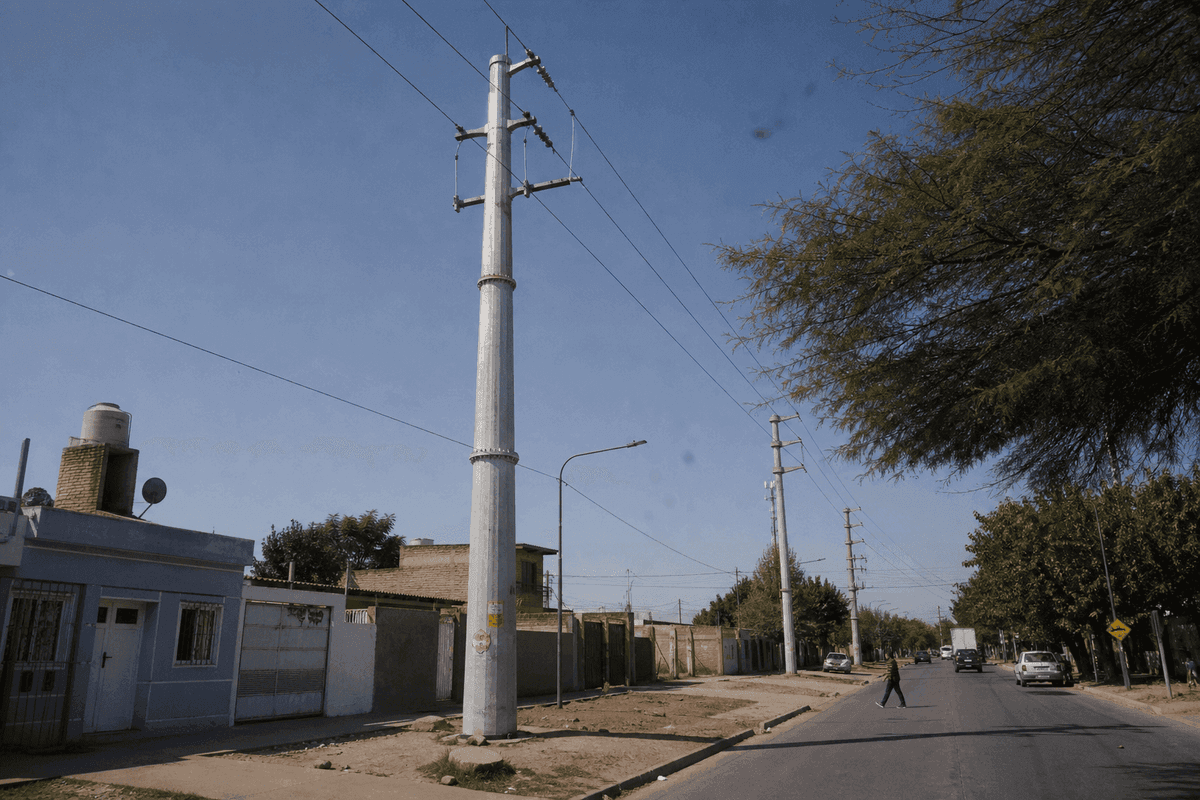
Córdoba Power Transmission Tower Market Analysis: 10kV Double-Circuit Steel Tubular Pole Guide
Summary
Córdoba’s 1,505,250 residents and 553,470 households support a 10kV double-circuit municipal distribution profile using approximately 194 steel tubular poles across 12km, with 60m spans and ACSR-120 conductors.
Key Takeaways
For a 12km Córdoba feeder corridor, SOLARTODO recommends a 10kV double-circuit configuration centered on 22m galvanized steel monopoles and 60m spans.
- Córdoba Capital recorded 1,505,250 residents in 2022, making medium-voltage reliability planning relevant for dense municipal feeders.
- A typical deployment of this scale would use approximately 194 units for a 12km route at 60m nominal spans.
- The recommended pole is a 22m tapered steel tubular monopole using hot-dip galvanized Q345 steel and flanged bolt sections.
- Electrical fit is 10kV double circuit with ACSR-120 conductors rated about 470kg/km and 38kN maximum tension.
- The project-specific wind class is 25m/s, with anchor-bolt cage foundations, grounding, bird guards, and vibration dampers.
- Clearance targets include 0.8m phase spacing, 0.5m insulator length, and 5m ground clearance for municipal distribution routing.
- SOLARTODO’s Power Transmission Tower line should be evaluated against IEC 60826 and GB 50545 for wind, clearance, and foundation loads.
Market Context for Córdoba
Córdoba’s 2022 population of 1,505,250 and metropolitan load concentration make 10kV municipal distribution reinforcement a practical steel tubular pole application.
Córdoba is Argentina’s second major urban market, located at approximately -31.42, -64.18, with a dense mix of residential, university, industrial, and public-service loads. According to INDEC (2022), the Capital Department recorded 1,505,250 residents and 553,470 households, which creates a utility profile where feeder continuity, urban clearances, and fast construction matter more than long rural span length. For a power-line buyer, this points toward compact medium-voltage infrastructure rather than 220kV or 500kV corridor hardware.
According to INDEC (2022), 82.5% of Capital Department households reported in-home internet access, a useful proxy for dense urban service expectations and dependence on reliable electricity for communications, public lighting, and small commercial operations. According to World Bank (2023), Argentina’s national electricity access rate is effectively 100%, so the technical challenge in Córdoba is not first-time electrification; it is grid quality, feeder capacity, replacement of aging structures, and safer routing through mixed municipal corridors.
The local grid context also favors medium-voltage planning. EPEC is the provincial electricity company responsible for generation, transmission, and distribution functions in Córdoba Province, while Argentina’s bulk transmission backbone is served by the SADI system and high-voltage operators. According to Transener (2024), the national extra-high-voltage network includes about 12,383km of 500kV and 220kV lines linked to more than 50 transformer stations, confirming that city-level projects normally sit downstream of bulk transmission and closer to 10kV to 35kV distribution classes.
Climate and mechanical loading are also relevant. Córdoba’s humid subtropical climate includes summer thunderstorms, hail risk, and dry winter conditions; regional climate summaries commonly place annual rainfall near 715-800mm. For a municipal distribution line, that does not justify a 220kV tower class, but it does justify galvanized steel, vibration dampers, bird guards, reliable grounding, and conservative anchor-bolt cage foundations.
Recommended Technical Configuration
A typical Córdoba municipal feeder of 12km would use approximately 194 SOLARTODO 10kV double-circuit steel tubular poles with 60m design spans.
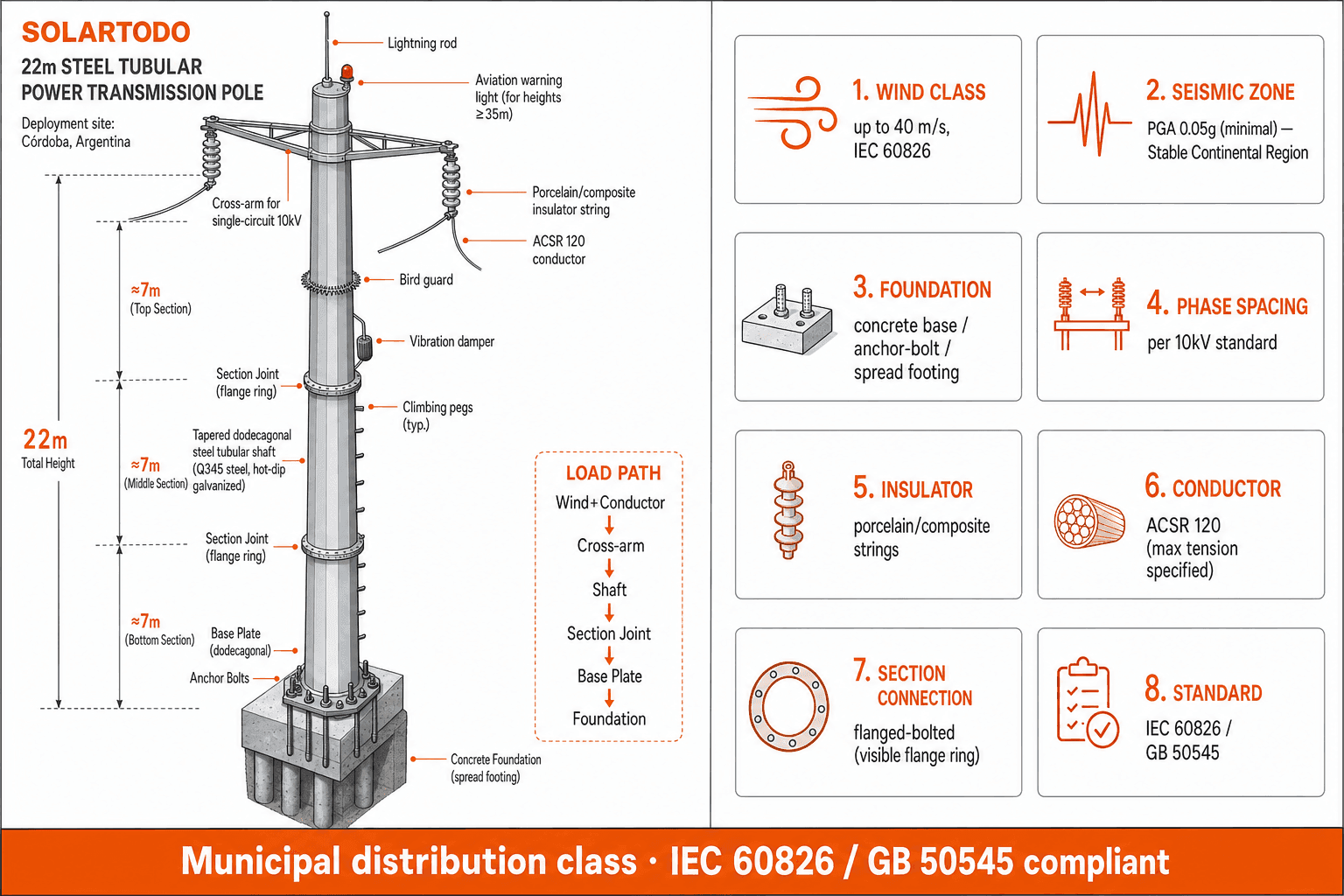
The recommended product is the SOLARTODO Power Transmission Tower in steel tubular monopole form: tapered round or dodecagonal Q345 steel, hot-dip galvanized, with cross-arm brackets for insulator strings and ACSR conductors. The recommended Córdoba configuration is not lattice, FRP, wood, or concrete; it is a flanged steel monopole designed for municipal distribution access, smaller right-of-way needs, and repeatable foundation installation.
A typical N-unit deployment in this profile would consist of approximately 194 units of 22m tapered steel tubular poles for a 10kV double-circuit line. The specified span is 60m, so a 12km route requires close pole spacing compared with rural 10-35kV planning spans of 80-150m. That tighter span can be justified where municipal routing, road crossings, existing utilities, and clearance constraints dominate the civil design.
The project-specific configuration calls for approximately 9t per pole at about 400kg/m. This is heavier than the general 10-35kV distribution planning row of 12-18m and 1-3t/pole, so it should be treated as a custom heavy-duty municipal pole rather than a default distribution pole. The engineering reason is the supplied 22m height, double-circuit geometry, cross-arm set, climbing steps, grounding, bird guards, dampers, and anchor-bolt cage foundation package.
According to IEC (2017), IEC 60826 is the design standard for “overhead transmission lines,” and that is the correct reliability framework for wind, conductor tension, and structural coordination. IEC states, “Design criteria of overhead transmission lines,” which is directly relevant when translating a local wind class into pole shaft, flange, cross-arm, and foundation checks. SOLARTODO would specify the configuration as a design recommendation and submit final drawings for utility review before procurement.
Technical Specifications
The Córdoba technical baseline is a 10kV double-circuit, 22m steel tubular monopole package using ACSR-120 conductors and 25m/s wind design.
- Product form: steel tubular transmission pole only; tapered round or dodecagonal monopole, not lattice, FRP, wood, or concrete.
- Voltage class: 10kV medium-voltage municipal distribution, double circuit.
- Typical project quantity: approximately 194 units for about 12km of line at 60m spans.
- Pole height: 22m project-specific heavy-duty municipal configuration.
- Pole weight: approximately 9t/pole, about 400kg/m.
- Material: hot-dip galvanized Q345 steel with flanged bolt sections.
- Conductor: ACSR-120, approximately 470kg/km, maximum tension about 38kN.
- Phase spacing: 0.8m; insulator length: 0.5m; target ground clearance: 5m.
- Wind class: Class 1, 25m/s basic design basis for this configuration.
- Foundation: concrete anchor-bolt cage foundation coordinated with geotechnical bearing values.
- Accessories: climbing steps, cross arm, grounding, bird guard, vibration damper, and hardware for insulator strings.
- Design life: 30 years under specified coating, inspection, and maintenance conditions.
- Standards basis: IEC 60826 and GB 50545, with local utility approval for final clearances and foundation drawings.
For engineering screening, voltage must be selected before height and weight. A standard 10-35kV distribution class normally uses 12-18m poles, 1-3t/pole, 80-150m spans, and about 8-12 poles/km. The supplied Córdoba configuration is therefore a custom 10kV municipal variant with shorter 60m spans and heavier 22m poles; it should not be confused with 66-110kV, 220kV, or 500kV transmission classes.
Implementation Approach
A 194-unit Córdoba feeder rollout would typically proceed through 5 stages: route survey, engineering approval, supply, foundations, and energized commissioning checks.
The first stage is survey and design validation. The EPC or utility engineer confirms route length, road-crossing clearances, existing underground utilities, soil bearing capacity, service continuity constraints, and final pole spotting. For this profile, the 60m span is the controlling layout assumption; any route segment with intersections, railway approaches, or constrained sidewalks may require shorter spans or special foundations.
The second stage is technical submittal and procurement. SOLARTODO’s engineering package would include general arrangement drawings, shaft section details, flange bolt layouts, cross-arm assembly drawings, galvanizing specifications, conductor hardware, insulator coordination, and anchor cage drawings. According to IEA (2023), electricity grid investment needs to nearly double by 2030 to keep pace with secure energy transitions, making standardized procurement packages valuable for utilities trying to reduce engineering cycle time.
The third stage is manufacturing and logistics. Steel plates are formed into tapered sections, welded, drilled for flanges and accessories, hot-dip galvanized, inspected, bundled, and shipped as sectional monopoles. CKD-style shipping reduces container and handling complexity compared with one-piece poles, while preserving fast on-site assembly by crane and bolted flange connections.
The fourth stage is civil works and erection. Crews excavate foundation pits, place anchor-bolt cages, pour concrete, verify curing strength, assemble pole sections, install cross arms, mount grounding, and string ACSR-120 conductors through the specified insulator strings. Installation planning should maintain safe work zones around public roads and coordinate outage windows with the local utility.
The fifth stage is testing and commissioning. Typical checks include bolt torque, grounding resistance, conductor sag and tension, phase spacing, bird guard placement, vibration damper location, nameplate traceability, and as-built drawings. IEA states, “grids are essential for energy transitions,” and the same reliability logic applies to medium-voltage feeders serving dense municipal loads.
Expected Performance & ROI
A 30-year steel tubular pole design can reduce lifecycle risk by improving corrosion resistance, clearances, maintainability, and urban route efficiency.
For Córdoba, the main expected performance value is not generation revenue; it is municipal distribution reliability and lower whole-life maintenance. Hot-dip galvanized Q345 steel is better suited than timber for repeatable strength, predictable flange connections, climbing access, and long service intervals. A 30-year design life also supports capex planning because pole inspection, grounding checks, and hardware replacements can be scheduled rather than reactive.
ROI should be evaluated as avoided outage cost, avoided emergency replacement, reduced right-of-way complexity, faster erection, and fewer structure types in inventory. According to World Bank (2023), access to electricity in Argentina is essentially universal, so the business case depends on continuity and capacity quality rather than new customer connection counts. In a dense city, even a modest reduction in feeder interruptions can carry high value for traffic signals, telecom equipment, hospitals, commercial corridors, and public services.
The technical configuration also supports maintenance economics. ACSR-120 at approximately 470kg/km and 38kN maximum tension is a practical conductor size for medium-voltage municipal distribution, and the included vibration dampers reduce fatigue risk under wind-induced motion. Bird guards and grounding reduce two common reliability concerns: wildlife contact and fault-current path uncertainty.
Results and Impact
For planning purposes, a 12km Córdoba line with 194 poles would create a repeatable 10kV feeder template for municipal distribution upgrades.
The expected result is a technically coherent distribution structure package: 10kV double circuit, 60m spans, 22m galvanized monopoles, ACSR-120 conductors, 25m/s wind basis, and 30-year design life. This is a planning and procurement recommendation, not a statement that SOLARTODO has completed a Córdoba deployment. The impact should be measured during utility review through load-flow requirements, feeder reliability targets, clearance compliance, route constructability, and inspection cost.
A second impact is standardization. If a city utility approves a repeatable pole-family specification, future corridors can reuse the same manufacturing drawings, foundation templates, and inspection procedures with only site-specific adjustments. For buyers, SOLARTODO’s role is to support technical selection, drawing review, and quotation for the Power Transmission Tower package, with final application engineering coordinated through the EPC, utility, and local permitting process.
Comparison Table
The 10kV Córdoba recommendation differs sharply from 66-110kV, 220kV, and 500kV classes in height, span, pole weight, and selection criteria.
| Voltage class | Correct height range | Correct weight range | Typical span | Typical use | Córdoba fit |
|---|---|---|---|---|---|
| 10-35kV distribution | 12-18m standard; 22m custom here | 1-3t standard; 9t custom here | 80-150m standard; 60m custom here | Urban or suburban distribution | Recommended 10kV municipal profile |
| 66-110kV sub-transmission | 18-30m | 5-15t/pole | 200-300m | Regional sub-transmission | Not required for this 10kV feeder |
| 220kV HV transmission | 35-55m | 15-35t/pole | 350-450m | Bulk power transfer | Over-scaled for municipal distribution |
| 500kV UHV | 50-70m | 35-55t/pole | 400-500m | National backbone transmission | Not applicable to city feeder routing |
| Recommended Córdoba package | 22m project-specific | Approximately 9t/pole | 60m | 10kV double-circuit municipal line | Use with utility engineering validation |
Pricing & Quotation
SOLARTODO structures quotations in 3 commercial scopes so Córdoba buyers can separate equipment supply, delivered materials, and turnkey EPC responsibility.
SOLARTODO offers three pricing tiers for this product line: FOB Supply (equipment ex-works China), CIF Delivered (including ocean freight and insurance), and EPC Turnkey (fully installed, commissioned, with 1-year warranty). Volume discounts are available for large-scale deployments. Configure your system online for an instant estimate, or request a custom quotation from our engineering team at [email protected].
No project price should be inferred from this market guide because foundations, route access, outage windows, soil conditions, utility inspection requirements, and customs treatment can materially change the final EPC scope. For Córdoba, the recommended quotation package should at minimum request 194 galvanized Q345 tubular poles, ACSR-120 conductor hardware, cross arms, insulators, anchor cages, grounding, bird guards, dampers, packing lists, drawings, and inspection documentation.
Frequently Asked Questions
These 10 FAQs summarize the key technical, commercial, maintenance, installation, and lifecycle questions for a 10kV Córdoba steel tubular pole project.
Q1: What is the recommended technical specification for Córdoba? The recommended configuration is a 10kV double-circuit municipal distribution line using approximately 194 tapered steel tubular poles over about 12km. Each pole is specified at 22m, approximately 9t, hot-dip galvanized Q345 steel, with ACSR-120 conductor, 0.8m phase spacing, 5m ground clearance, 25m/s wind class, and anchor-bolt cage foundations.
Q2: Why is the guide using a 10kV class instead of 35kV or 110kV? The supplied project profile is explicitly 10kV double circuit, which places the application in medium-voltage municipal distribution rather than sub-transmission. Córdoba’s dense urban load and feeder-routing needs support a compact distribution recommendation. A 110kV design would require 18-30m structures and different insulation, clearances, substations, and protection studies.
Q3: Is a 22m, 9t pole normal for 10kV distribution? It is heavier and taller than a standard 10-35kV planning row, which is usually 12-18m and 1-3t/pole. In this guide, the 22m and 9t values are treated as a custom heavy-duty municipal configuration driven by double-circuit geometry, accessories, clearance needs, anchor-cage foundations, and utility-specific approval requirements.
Q4: How long would a 194-unit deployment typically take? A typical schedule would depend on permits, outage windows, soil testing, and import logistics. For planning, buyers often separate the work into survey and design approval, manufacturing, shipping, foundation construction, pole erection, conductor stringing, and commissioning. A realistic EPC schedule should be confirmed after route survey and utility review, not assumed from quantity alone.
Q5: What ROI or payback logic applies to a power transmission tower project? ROI is normally calculated from avoided outages, reduced emergency maintenance, longer structure life, faster erection, and reduced corridor complexity. This product does not generate electricity, so solar-style energy payback is the wrong metric. For Córdoba, the strongest case is continuity value for municipal feeders serving homes, commerce, traffic systems, and public services.
Q6: What maintenance is required over a 30-year design life? Maintenance should include scheduled inspection of galvanizing condition, flange bolts, grounding resistance, conductor sag, cross-arm hardware, insulator contamination, bird guards, and vibration dampers. After severe storms, crews should check pole plumbness, foundation cracking, conductor damage, and hardware loosening. Good records help utilities prioritize interventions before faults occur.
Q7: How does steel tubular compare with lattice, concrete, wood, or FRP? Steel tubular poles offer compact urban appearance, predictable strength, fast crane erection, and standardized flange sections. Lattice towers suit larger transmission corridors but require wider visual and land footprints. Wood and concrete can be useful in some distribution networks, while FRP has corrosion advantages, but this SOLARTODO configuration is specifically galvanized steel monopole hardware.
Q8: What does EPC pricing include for this product line? EPC Turnkey normally includes detailed engineering, procurement, delivery coordination, foundations, pole erection, conductor installation, grounding, commissioning, documentation, and a 1-year warranty. FOB Supply and CIF Delivered separate the equipment scope from installation responsibility. Final quotation depends on route conditions, foundation design, customs, local labor, and utility inspection requirements.
Q9: What warranty should buyers expect? The Pricing & Quotation scope specifies a 1-year warranty for EPC Turnkey work. Product life is different from warranty length: the recommended Córdoba configuration is designed for 30 years under specified conditions. Buyers should request coating certificates, material traceability, inspection reports, bolt specifications, and warranty exclusions before purchase order approval.
Q10: What installation details matter most on site? The highest-risk site details are anchor cage alignment, concrete curing, bolt torque, grounding continuity, conductor sag, phase spacing, and safe public-road work zones. For this 10kV configuration, the 60m span, 5m clearance, ACSR-120 tension, and 25m/s wind basis should be checked against final route geometry and utility standards.
References
These 7 references provide demographic, grid, standards, and market evidence for Córdoba’s 10kV Power Transmission Tower configuration and standards-backed procurement decisions.
- INDEC (2022): National census data for Córdoba Capital Department, including 1,505,250 residents and 553,470 households.
- World Bank (2023): Access to electricity indicator for Argentina, supporting the distinction between coverage and reliability investment.
- EPEC (2025): Provincial electricity company context for Córdoba generation, transmission, and distribution responsibilities.
- Transener (2024): Argentine high-voltage transmission operator profile, including 500kV and 220kV network references.
- IEC (2017): IEC 60826, Design criteria of overhead transmission lines, used for structural reliability and loading design.
- IEA (2023): Electricity Grids and Secure Energy Transitions, including the need for accelerated grid investment through 2030.
- GB Standards (2010): GB 50545 code basis for overhead transmission line design review and China-origin manufacturing documentation.
Equipment Deployed
- 194 units × 22m tapered steel tubular pole, hot-dip galvanized Q345 steel
- 10kV double-circuit medium-voltage municipal distribution configuration
- ACSR-120 conductor, approximately 470kg/km, maximum tension 38kN
- Anchor-bolt cage concrete foundation system
- Cross arms, 0.5m insulator strings, 0.8m phase spacing hardware
- Grounding kit, bird guard, vibration damper, and climbing steps
- Flanged bolt sections with 25m/s wind class design basis
- IEC 60826 / GB 50545 documentation package for engineering review