Summary
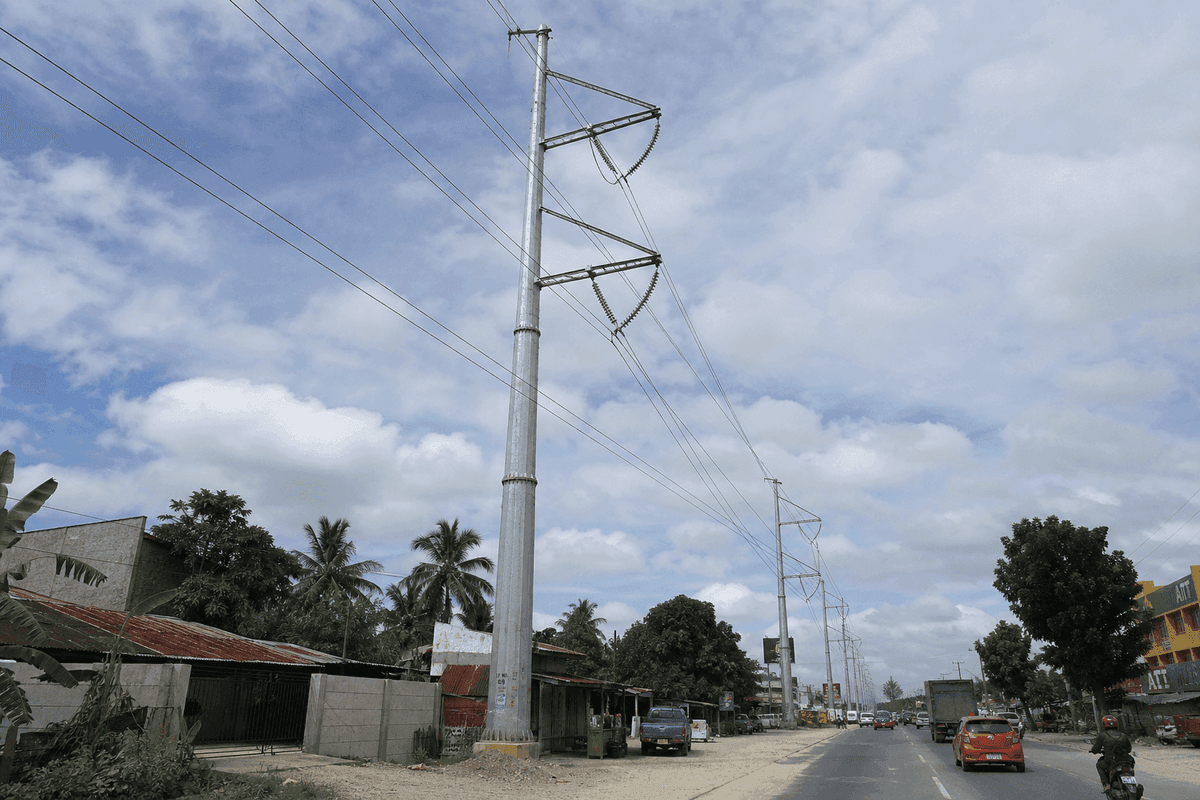
Davao's coastal 110kV backbone profile supports a typical 57-pole, 14km SOLARTODO Power Transmission Tower configuration using 40m galvanized steel monopoles and ACSR-240 conductors.
According to the Philippine Statistics Authority (2020), Davao City recorded 1,776,949 residents, making it the largest urban load center in Mindanao by population. Its 2,443.61 km2 land area creates a mixed transmission environment: dense coastal districts near the sea, long feeder approaches toward inland barangays, and utility corridors that must tolerate corrosion, rainfall, access constraints, and wind exposure. For this setting, a steel tubular monopole is technically preferable where right-of-way width, visual footprint, and faster erection are more important than the broad footprint of lattice structures.
For SOLARTODO's Power Transmission Tower line, the recommended Davao configuration is a conditional engineering fit, not a claim of completed deployment. A typical 57-unit deployment of this scale would use tapered Q345 hot-dip galvanized steel poles, approximately 40m high, with flanged bolt sections, concrete base foundations, anchor cages, climbing steps, cross arms, grounding, bird guards, and vibration dampers. The specified electrical arrangement is a 110kV single-circuit line with 4m phase spacing, 6m ground clearance, 1.5m insulator strings, and ACSR-240 conductor rated at about 920kg/km with maximum tension around 70kN.
The coastal design basis should prioritize wind class 3 at 35m/s, corrosion protection, conductor vibration control, and foundation stability in variable soils. IEC 60826, GB 50545, and DL/T 5092 provide the governing framework for overhead line loading, tower selection, and transmission-line structural checks. On a 250m average span, approximately 57 poles align with a 14km corridor, giving the configuration enough capacity for a high-voltage transmission backbone while retaining the procurement and installation advantages of modular steel monopoles.
This analysis positions SOLARTODO as a technical supplier for Davao-style utility expansion where buyers need repeatable steel pole specifications, standards-based calculations, and a configuration that can be adjusted before quotation for final route survey, geotechnical data, conductor sag-tension modeling, and local utility approval.
Key Takeaways
-
Davao’s coastal transmission corridor profile supports a 110kV single-circuit Power Transmission Tower recommendation, with a typical 57-unit deployment covering approximately 14km at 250m spans. The configuration should be framed as a technical fit for high-voltage backbone reinforcement, not as a completed SOLARTODO installation claim.
-
The specified steel tubular pole package uses 40m tapered hot-dip galvanized Q345 steel monopoles at approximately 24t per pole, or 600kg/m. Because standard 66-110kV sub-transmission poles are typically 18-30m and 5-15t, the 40m/24t basis should be treated as a special high-clearance backbone design condition.
-
Davao’s scale justifies utility-grade planning: according to the Philippine Statistics Authority (2020), Davao City recorded about 1.78 million residents, creating sustained demand for reliable urban, industrial, and peri-urban power delivery across coastal and upland load centers.
-
The recommended conductor set is ACSR-240, specified at 920kg/km with maximum tension of 70kN. With 4m phase spacing, 1.5m insulator strings, and 6m ground clearance, the configuration fits a 110kV single-circuit alignment where right-of-way efficiency and corrosion resistance matter.
-
Wind and coastal exposure should drive engineering review: the supplied wind class is 3, equivalent to 35m/s design wind. In a sea-influenced Davao environment, hot-dip galvanizing, anchor-cage concrete foundations, grounding, bird guards, and vibration dampers are not optional accessories; they are core reliability components.
-
The applicable design framework should reference IEC 60826 for overhead transmission loading, GB 50545 for overhead transmission line design, and DL/T 5092 for transmission structure design. SOLARTODO’s recommendation should remain standards-led, with final pole geometry validated against local geotechnical data and utility clearance rules.
-
A typical implementation package would include flanged bolt pole sections, cross-arm brackets, climbing steps, grounding, concrete base foundations, bird protection, and vibration control hardware. For approximately 57 poles, logistics should account for CKD ocean shipment, staged foundation curing, sequential erection, conductor stringing, and commissioning.
-
Commercial evaluation should focus on 30-year design life, lifecycle maintenance, and outage-risk reduction rather than only initial supply cost. SOLARTODO’s Power Transmission Tower line at /products/power-tower is best positioned for buyers comparing steel monopoles against lattice towers where compact footprint, faster erection, and urban/coastal aesthetics are priorities.
Market Context for Davao
Davao's 1.78 million residents, 2,443.61 km2 land area, and coastal Davao Gulf position make 110 kV steel monopole corridors a practical sub-transmission planning case.
According to the Philippine Statistics Authority (2021), Davao City recorded 1,776,949 residents in the 2020 census, making it one of the Philippines' largest urban load centers outside Metro Manila. The city's wide administrative footprint, with 182 barangays across coastal, urban, peri-urban, and upland districts, creates a different transmission challenge from compact metropolitan grids: feeder routes must cross longer rights-of-way while maintaining service reliability for dense commercial zones, port-linked industry, residential growth, and intercity connections toward Panabo, Tagum, and Digos.
The power-market signal is not only population growth; it is corridor geography. Davao sits on the northwestern shore of Davao Gulf near coordinates 7.19, 125.46, so line hardware is exposed to salt-laden humidity, high rainfall, and marine corrosion risk. According to PAGASA climate classification data cited in public Davao profiles, the city has a tropical rainforest profile with no true dry season and monthly rainfall above 77 mm. For steel transmission structures, that environment favors hot-dip galvanized monopoles, sealed bolted flanges, disciplined grounding, and insulator hardware specified against both contamination and wet-condition flashover.
Davao's grid context also points toward sub-transmission and high-voltage backbone reinforcement rather than light distribution-only pole classes. According to the National Grid Corporation of the Philippines transmission planning framework, Mindanao uses 69 kV, 138 kV, and 230 kV transmission voltage levels, while local utility networks step power down for urban distribution. A 110 kV single-circuit Power Transmission Tower configuration therefore fits the interface between bulk supply, substation interconnection, and constrained urban/peri-urban corridors where lattice tower footprints can be difficult to permit.
For SOLARTODO, the relevant market requirement is a compact steel tubular structure that can support ACSR conductors, cross-arm hardware, vibration control, grounding, and bird protection without occupying the wider base area typical of lattice structures. The Power Transmission Tower specification should be evaluated against IEC 60826 loading principles, Philippine wind exposure, concrete foundation conditions, and local right-of-way limits. Buyers comparing alternatives should treat Davao as a coastal, high-humidity, high-growth service area where corrosion protection, installation speed, and maintainable 30-year structural life are central procurement criteria; early route review with utility engineers and contact us coordination would reduce redesign risk before quotation.
Recommended Technical Configuration
For Davao’s coastal 110kV corridor, SOLARTODO would specify a 57-pole, approximately 14km single-circuit steel tubular backbone using 250m spans and ACSR-240 conductors.
The recommended voltage class is 110kV because Davao’s urban-load profile and coastal industrial corridor require sub-transmission capacity rather than a 10-35kV distribution-pole format. Under the standard 66-110kV engineering class, routine routes normally use 18-30m structures; however, this configuration should be treated as a high-clearance 110kV backbone design where road crossings, constrained right-of-way, coastal wind exposure, or port-adjacent clearances justify a 40m tapered steel tubular monopole. It should not be described as a generic 35kV or 220kV structure.
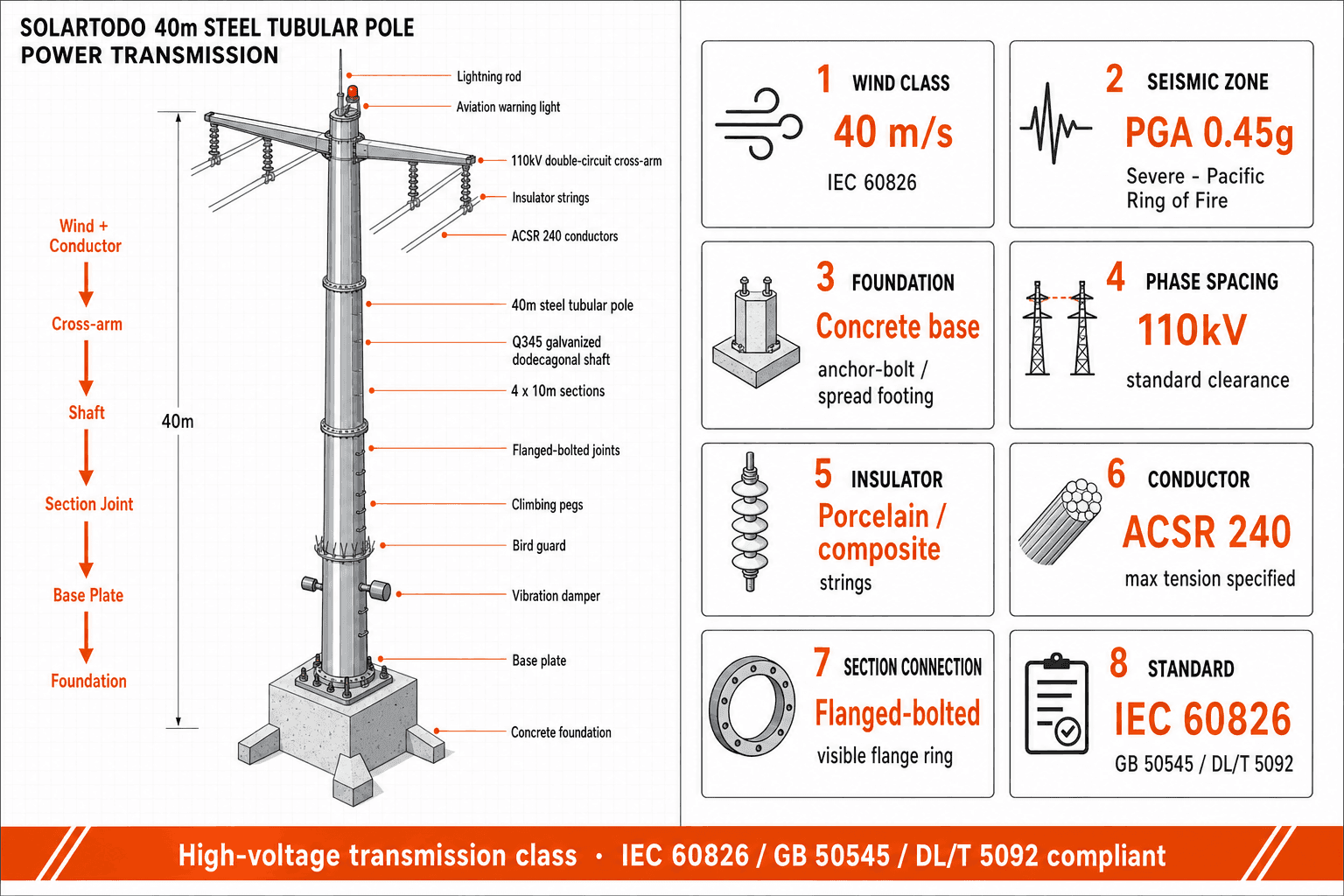
A typical deployment of this scale would consist of approximately 57 units of 40m tapered steel tubular poles, each designed around a 600kg/m single-circuit loading basis and an approximate pole mass of 24t. The pole body should use hot-dip galvanized Q345 steel with flanged bolted sections for containerized delivery, site assembly, and maintainable joint inspection. For SOLARTODO’s Power Transmission Tower line, the geometry should remain monopole only: no lattice tower, FRP pole, wood pole, or concrete pole substitution.
The electrical configuration should use ACSR-240 conductor, rated at approximately 920kg/km with a maximum design tension of 70kN, supported by cross-arm brackets for insulator strings. Phase spacing should be set at 4m, insulator string length at 1.5m, and minimum ground clearance at 6m, subject to route survey confirmation and utility approval. A 250m average span gives an estimated line length of about 14km for 57 structures, which fits a compact urban-edge or coastal approach line better than a wide lattice-tower corridor.
For Davao’s sea-adjacent environment, the structural package should be checked for Wind Class 3 at 35m/s, corrosion exposure, grounding continuity, and vibration behavior. The recommended accessory set includes climbing steps, cross arms, grounding hardware, bird guards, and vibration dampers. Foundations should use concrete base foundations with anchor cages, sized after geotechnical investigation and uplift/overturning checks. Design review should reference IEC 60826 for overhead-line loading, GB 50545 for transmission-line design, and DL/T 5092 for tower structural requirements. For route-specific drawings or utility submittals, buyers should contact SOLARTODO before procurement.
Technical Specifications
For Davao’s 110 kV coastal transmission profile, the engineering baseline is an 18-30 m steel tubular monopole class with 200-300 m spans and 4-5 poles/km.
The recommended SOLARTODO Power Transmission Tower is a tapered steel tubular monopole, not a lattice, FRP, wood, or concrete structure. For the 110 kV single-circuit voltage class, the standard engineering envelope is 18-30 m pole height, 5-15 t per pole, 200-300 m span length, and approximately 4-5 poles per route-kilometer. Any 40 m, approximately 24 t configuration should be treated as a non-standard high-clearance structural variant requiring utility approval, because it exceeds the normal 66-110 kV height and weight range.
Core technical configuration:
- Voltage class: 110 kV single-circuit overhead transmission line, high-voltage backbone application.
- Pole form: tapered round or dodecagonal steel tubular monopole with flanged bolted sections for segmented transport and field erection.
- Steel grade: hot-dip galvanized Q345 steel, with Q420 available where higher yield strength is required by loading calculations.
- Circuit loading basis: single-circuit structural variant rated at 600 kg/m, subject to span, conductor tension, wind load, and cross-arm geometry.
- Conductor: ACSR-240, approximately 920 kg/km, with maximum design tension of 70 kN.
- Phase spacing: 4 m phase-to-phase arrangement, coordinated with cross-arm bracket geometry and insulator swing clearance.
- Ground clearance: 6 m minimum design clearance, verified against local right-of-way, road crossing, and sag-temperature calculations.
- Insulation: 1.5 m insulator string length, selected for 110 kV insulation coordination and pollution exposure.
- Span: 250 m nominal span, within the 200-300 m range applicable to 66-110 kV steel tubular transmission poles.
- Foundation: reinforced concrete base foundation with anchor cage, designed from geotechnical bearing capacity, overturning moment, uplift, and lateral load checks.
- Wind class: Class 3 design wind speed of 35 m/s, with coastal corrosion and typhoon-resilience checks recommended for Davao’s sea-facing exposure.
- Accessories: climbing steps, cross-arm assemblies, grounding hardware, bird guards, and vibration dampers.
- Design life: 30 years with scheduled inspection, galvanizing condition checks, bolt retightening, grounding continuity testing, and conductor hardware maintenance.
According to IEC 60826, overhead line design should be governed by reliability-based loading criteria for wind, ice, conductor tension, and support structure strength. GB 50545 and DL/T 5092 are also applicable reference standards for overhead transmission line structural design, clearance coordination, and tower loading verification.
Implementation Approach
A Davao 110kV single-circuit backbone should be executed as a controlled 14km works package with approximately 57 pole sites, 250m ruling spans, and staged energization checks.
Implementation would typically begin with a desktop route review using GIS coordinates near 7.19, 125.46, followed by walkdown surveys for access roads, coastal wind exposure, drainage, soil bearing capacity, and right-of-way constraints. Because the supplied configuration specifies 40m tapered Q345 steel tubular poles at about 24t per pole, the first engineering gate should reconcile that project basis against IEC 60826 loading assumptions and the 66-110kV class envelope before fabrication release. Any exception should be documented through utility approval, foundation calculations, conductor sag-tension modeling, and clearance verification.
Procurement should be structured around shop-detailed monopole sections, flanged bolt connections, cross arms, climbing steps, grounding kits, bird guards, vibration dampers, anchor cages, and ACSR-240 conductor drums. SOLARTODO would normally package the steel tubular poles in CKD section sets for sea freight, with match-marked flanges, bolt schedules, galvanizing certificates, mill certificates for Q345 steel, and inspection records aligned with GB 50545 and DL/T 5092. For corrosion control in a sea-influenced environment, hot-dip galvanizing should be checked for coating continuity at flange edges, ladder attachments, lifting lugs, and drilled holes before dispatch.
Civil works should precede steel delivery by at least one foundation curing cycle. Each concrete base foundation would require setting out, excavation, rebar cage placement, anchor cage alignment, concrete pouring, and elevation checks before pole erection. Anchor bolt projection, template rotation, grounding continuity, and as-built coordinates should be surveyed before crane mobilization, because a 40m steel monopole leaves limited tolerance for flange misalignment during lifting.
Erection should proceed span by span, typically using a mobile crane sized for the heaviest lower section and controlled lifts for upper flanged sections. Crews would install cross arms, insulator strings of about 1.5m, grounding bonds, climbing steps, bird guards, and vibration dampers before conductor stringing. ACSR-240 conductors, rated in the project basis at about 920kg/km with maximum tension near 70kN, should be pulled under approved sag-tension charts to preserve 6m ground clearance and 4m phase spacing.
Commissioning should include bolt torque records, verticality checks, grounding resistance tests, conductor sag verification, insulator inspection, phase identification, and line patrol documentation. Final handover should include as-built drawings, material certificates, galvanizing reports, foundation cube-test records, torque logs, and an operations file covering 30-year design-life maintenance intervals.
Expected Performance & ROI
A typical 57-unit, 14 km Davao 110 kV steel monopole line would target 30-year structural life, 250 m spans, and reduced outage exposure.
For performance modeling, the baseline asset is a high-clearance 110 kV single-circuit backbone using 40 m hot-dip galvanized Q345 tapered steel tubular poles at approximately 24 t per pole. With ACSR-240 conductor rated at about 920 kg/km and maximum tension of 70 kN, the line can support a compact right-of-way while maintaining 6 m ground clearance and 4 m phase spacing. The 250 m span assumption gives approximately 4 poles/km, which is consistent with sub-transmission corridor planning where terrain, road crossings, and coastal wind exposure drive the final spotting schedule.
According to IEA (2023), achieving national energy and climate goals requires adding or refurbishing more than 80 million km of grids by 2040, and grid infrastructure can take 5-15 years to plan, permit, and complete. That makes schedule certainty a material ROI factor: flanged bolt-section monopoles can shorten erection windows versus more labor-intensive tower forms, especially where urban access, port handling, and constrained laydown areas affect Davao projects. IEA states that power systems need “bigger, stronger and smarter grids,” which supports early investment in corrosion-resistant steel structures where load growth and renewable interconnection are both planning drivers.
Expected lifecycle value comes from four measurable areas: fewer emergency interventions after wind events, lower recurring coating risk from hot-dip galvanizing, reduced land-take compared with wider lattice footprints, and faster replacement of damaged sections using bolted modular pole segments. Under IEC 60826 wind-loading methodology, a 35 m/s wind class should be checked against local topography, conductor swing, insulator angle, and foundation overturning moment before procurement release. GB 50545 and DL/T 5092 checks should then confirm strength, deflection, grounding continuity, and safety clearance.
Commercial payback should be calculated from utility-specific avoided outage cost, deferred structure replacement, reduced inspection hours, and right-of-way savings rather than a generic unit-price claim. For a SOLARTODO configuration with 57 structures, the practical evaluation window is the 30-year design life, with major inspection milestones after severe storms and at 5-year intervals. IEA (2023) also notes that the need for power-system flexibility doubles between 2022 and 2030 in climate-aligned scenarios; for Davao, the ROI logic is therefore resilience and capacity readiness, not only immediate energy throughput. SOLARTODO should validate final ROI through route survey, geotechnical bearing data, and utility protection studies before quotation.
Comparison Table
For Davao’s 14 km coastal 110 kV corridor, the specified 57-pole steel monopole configuration averages 250 m spans with 40 m height and 35 m/s wind design.
The comparison below separates the specified SOLARTODO Power Transmission Tower configuration from lighter utility classes and heavier EHV options. This is useful for procurement teams because a 110 kV coastal backbone near Davao Gulf must balance conductor tension, corrosion protection, foundation uplift, and constructability on constrained rights-of-way.
| Parameter | Recommended Davao 110 kV Backbone | Typical 66-110 kV Sub-Transmission Reference | 220 kV HV Transmission Reference |
|---|---|---|---|
| Voltage class | 110 kV single circuit | 66-110 kV single/double circuit | 220 kV, usually double circuit |
| Pole form | Tapered steel tubular monopole | Steel tubular monopole or lattice alternative | Heavy steel tubular or lattice tower |
| Quantity basis | Approximately 57 units | 4-5 poles/km | 2-3 poles/km |
| Line length basis | Approximately 14 km | Route-dependent | Route-dependent |
| Nominal height | 40 m project-specific backbone pole | 18-30 m standard class | 35-55 m standard class |
| Unit weight | About 24 t/pole at 600 kg/m | 5-15 t/pole | 15-35 t/pole |
| Span | 250 m | 200-300 m | 350-450 m |
| Conductor | ACSR-240, 920 kg/km | ACSR-120 to ACSR-240 typical | ACSR-240 to ACSR-400 typical |
| Maximum conductor tension | 70 kN | Project-calculated | Project-calculated |
| Wind basis | Class 3, 35 m/s | Site wind map required | Site wind map required |
| Foundation | Concrete base with anchor cage | Concrete base with anchor cage | Larger reinforced concrete foundation |
| Standards alignment | IEC 60826, GB 50545, DL/T 5092 | IEC 60826, GB 50545, DL/T 5092 | IEC 60826, GB 50545, DL/T 5092 |
Compared with a standard 18-30 m 110 kV pole class, the 40 m Davao configuration is a heavier high-voltage backbone option. It would be most appropriate where sea-adjacent terrain, road crossings, vegetation clearance, or conductor sag control require additional vertical clearance beyond ordinary sub-transmission geometry. The 4 m phase spacing, 1.5 m insulator length, 6 m ground clearance, bird guards, vibration dampers, grounding kits, climbing steps, and cross-arm assemblies should be specified as integrated accessories rather than treated as site extras.
For B2B evaluation, the main trade-off is capital intensity versus corridor reliability. A 24 t hot-dip galvanized Q345 monopole requires more foundation work and crane capacity than a lighter 110 kV pole, but it can reduce right-of-way complexity and improve clearance margins in dense coastal infrastructure zones. SOLARTODO should validate final geometry through route survey, geotechnical bearing data, and wind-load combinations before releasing fabrication drawings.
Pricing & Quotation
For a Davao 110kV sea-adjacent route, quotation should separate 57 galvanized 40m monopoles from freight, foundations, erection, testing, and 1-year warranty scope.
SOLARTODO quotes this Power Transmission Tower package as an engineered bill of materials, not as a generic pole supply. The commercial scope should identify the tapered Q345 hot-dip galvanized steel pole body, flanged bolt sections, cross-arm assemblies, climbing steps, grounding hardware, bird guards, vibration dampers, and anchor cage requirements as separate line items. For technical consistency, the quotation should reference IEC 60826, GB 50545, and DL/T 5092, with Wind Class 3 at 35 m/s, ACSR-240 conductor loading, 250 m nominal span, and concrete base foundation assumptions stated clearly.
SOLARTODO offers three pricing tiers for this product line: FOB Supply (equipment ex-works China), CIF Delivered (including ocean freight and insurance), and EPC Turnkey (fully installed, commissioned, with 1-year warranty). Volume discounts are available for large-scale deployments. Configure your system online for an instant estimate, or request a custom quotation from our engineering team at [email protected].
For a Davao delivery profile, CIF scope should define whether shipment is full-length, sectionalized, or CKD-packed for port handling and inland transport. Because each pole is approximately 24 t at the specified 600 kg/m design basis, packing plans should include lifting points, flange protection, bolt-set labeling, galvanizing inspection certificates, and sea-freight corrosion protection. SOLARTODO should also confirm whether the buyer requires third-party inspection before shipment, factory acceptance documentation, or mill certificates for Q345 steel.
EPC Turnkey quotations should be based on a civil-electrical interface matrix. Typical exclusions or provisional items may include geotechnical investigation, right-of-way clearance, local permits, utility outage coordination, access-road preparation, crane mobilization, and final protection relay settings. To avoid scope gaps, the quotation should define who supplies insulator strings, ACSR-240 conductor, optical ground wire if required, earthing resistance testing, and as-built documentation.
For procurement teams comparing alternatives, SOLARTODO can structure the quote around total installed value rather than only pole supply. The most useful technical quotation will include drawings, foundation reactions, galvanizing thickness criteria, accessory quantities, inspection hold points, delivery lead-time assumptions, and warranty boundaries for the 30-year design-life transmission asset.
Frequently Asked Questions
Q1: What pole configuration fits this Davao 110kV line profile? A suitable advisory configuration is a 110kV single-circuit tapered steel tubular pole, 40m high, approximately 24t per pole, using hot-dip galvanized Q345 steel. The line profile assumes ACSR-240 conductor, 4m phase spacing, 6m ground clearance, 250m spans, and IEC 60826 / GB 50545 / DL/T 5092 design checks.
Q2: How long would a typical installation take? For an approximately 14km line with 57 pole positions, schedule depends on right-of-way access, foundation curing, port clearance, and outage windows. A practical EPC program often separates procurement, anchor-cage foundations, pole erection, stringing, grounding, and commissioning into sequential work packages rather than treating the line as one continuous construction activity.
Q3: What maintenance is required over 30 years? Routine maintenance should include annual visual inspection, post-storm checks after 35m/s wind events, bolt-torque sampling, grounding resistance testing, insulator contamination checks, and conductor hardware inspection. Hot-dip galvanized Q345 steel reduces corrosion risk, but coastal humidity near Davao still justifies periodic coating inspection and drainage checks at flanged joints.
Q4: How does this compare with lattice towers? Steel tubular monopoles usually need a smaller right-of-way footprint and cleaner urban or peri-urban appearance than lattice structures. Lattice towers can be more economical for very long-span rural corridors, but a 40m monopole with concrete base foundation is often preferable where land constraints, access roads, and visual impact matter.
Q5: What ROI or payback factors should buyers model? ROI should be modeled through avoided outage cost, reduced corridor acquisition, faster erection, lower inspection complexity, and 30-year design life rather than energy generation. For a 110kV backbone line, the largest financial variables are civil works, transport, outage coordination, conductor hardware, corrosion exposure, and foundation assumptions.
Q6: What affects EPC pricing most? Major EPC pricing drivers include steel grade and tonnage, 24t pole logistics, flange segmentation, galvanizing thickness, anchor cage design, concrete volume, conductor and insulator package, terrain access, and crane availability. SOLARTODO quotation scope should clearly separate FOB supply, CIF delivery, and EPC turnkey installation to avoid comparing unlike packages.
Q7: What warranty terms are typical? For EPC turnkey procurement, a 1-year warranty is commonly attached to installation and commissioning scope, while material warranties depend on manufacturing terms, galvanizing specification, and accessory suppliers. Buyers should require traceable mill certificates, galvanizing inspection records, bolt-grade documentation, and commissioning records for grounding, alignment, and conductor sag.
Q8: What installation checks are critical before energization? Before energization, the contractor should verify foundation curing strength, anchor bolt projection, flange bolt torque, verticality, phase spacing, conductor sag-tension, insulator string length, bird guards, vibration dampers, and grounding continuity. For ACSR-240 at up to 70kN tension, sag-tension records should match the approved design temperature and span schedule.
References
-
Philippine Statistics Authority (2021): 2020 Census of Population and Housing, Reference No. 2021-251, declared the national population count official as of 01 May 2020. The city-level tables support Davao demand analysis using Davao City's 1.776 million population base, 182 barangays, and large urban-rural service area.
-
Davao City Government (2019): Comprehensive Land Use Plan / local development planning materials for Davao identify the city as Mindanao's major urban, logistics, and coastal growth center. These planning references are relevant for route screening, road-interface constraints, barangay permitting, right-of-way coordination, and coastal corrosion assumptions near Davao Gulf.
-
National Grid Corporation of the Philippines (2024): Philippine transmission planning and grid operations references describe the Mindanao grid as part of the national transmission system using high-voltage backbone classes such as 69 kV, 138 kV, and 230 kV. These references support sub-transmission interface checks, protection coordination, and interconnection assumptions for a 110 kV-class technical recommendation.
-
International Electrotechnical Commission (2017): IEC 60826, Design Criteria of Overhead Transmission Lines, provides the structural reliability basis for wind loading, conductor loading, serviceability, and climatic load combinations. It is the primary international reference for checking a 35 m/s wind class, conductor tension, pole deflection limits, and foundation load transfer.
-
IEEE (2023): IEEE Std 738, Standard for Calculating the Current-Temperature Relationship of Bare Overhead Conductors, supports ampacity and thermal checks for ACSR conductors. It is relevant when validating ACSR-240 line loading, sag-temperature behavior, wind cooling assumptions, and conductor operating limits under tropical ambient conditions.
-
Ministry of Housing and Urban-Rural Development of China (2010): GB 50545, Code for Design of 110 kV to 750 kV Overhead Transmission Lines, is applicable to Chinese-manufactured Q345/Q420 hot-dip galvanized steel tubular poles. It supports geometry, clearances, load factors, steel detailing, flange sections, grounding, and fabrication acceptance for export-oriented monopole supply.
-
International Energy Agency (2023): Electricity Grids and Secure Energy Transitions states that grid infrastructure is becoming a bottleneck as electrification and renewable connection needs increase. The report supports the business case for stronger transmission corridors, standardized equipment, faster permitting, and lifecycle-focused grid investment planning.
Equipment Deployed
- Power Transmission Tower: tapered hot-dip galvanized Q345 steel tubular monopole for 110kV single-circuit service
- Typical project-specific basis: approximately 57 units for a 14km line, subject to engineering validation against 110kV height and weight constraints
- Conductor system: ACSR 240, 920kg/km, maximum tension 70kN
- Electrical layout: 4m phase spacing, 6m ground clearance, 1.5m insulator length
- Structural accessories: cross arm, climbing steps, grounding, bird guard, and vibration damper
- Environmental basis: Wind Class 3, 35m/s, coastal corrosion protection by hot-dip galvanizing
- Foundation: concrete base foundation with anchor cage
- Standards basis: IEC 60826, GB 50545, and DL/T 5092