
Summary
A 50kW/100kWh LFP commercial energy storage system in the United States delivers 4 hours of backup, 95% round-trip efficiency, and 8,000+ cycles. With a $33,642 turnkey price, 5.5-year payback, and $29,021 lifetime savings, it targets C&I backup and peak shaving with UL 9540 and IEEE 1547 compliance.
Key Takeaways
- Deploy a 50kW / 100kWh LFP system to secure 4 hours of backup for critical commercial loads at a fixed turnkey cost of $33,642.
- Leverage 95% round-trip efficiency and 8,000+ cycles to maximize usable lifetime energy while maintaining 90kWh usable capacity from a 100kWh pack.
- Achieve a 5.5-year payback with $6,750 annual savings, $607 annual O&M, and $6,143 net annual savings in a U.S. C&I backup use case.
- Improve project bankability using UL 9540, UL 1741, IEC 62619, CE/RoHS, and IEEE 1547 certified components with a 15-year warranty and 12-year design life.
- Optimize procurement with clear three-tier pricing: $21,867 FOB, $26,914 CIF, and $33,642 turnkey installed for one 50kW/100kWh unit.
- Plan long-term performance with 2.5% annual degradation and 78kWh remaining capacity in year 10, aligning with typical C&I asset lifecycles.
- Integrate easily into 480V AC, 3-phase, 60Hz U.S. commercial infrastructure using Modbus TCP, CAN, and RS485 communications.
- Capture incentives such as a $14,418 ITC credit in the U.S., driving a net present value of $10,981 and 5.3% IRR over the project life.
Energy Storage System in Global — $33,642 Turnkey
A commercial 50kW/100kWh LFP energy storage system priced at $33,642 turnkey, with 95% round-trip efficiency and 4 hours of backup, can deliver $6,750 annual savings and a 5.5-year payback for U.S. commercial and industrial users. This case study shows how one fully engineered configuration performs in a real backup application.
For global commercial and industrial (C&I) buyers, the challenge is turning abstract energy storage promises into bankable, specification-driven projects. This solution from SOLAR TODO is based on a verified engineering proposal for a U.S. commercial site, using real pricing, real equipment, and quantified returns. It is designed for decision-makers who need to compare FOB, CIF, and turnkey options and understand exactly what they receive at each level.
According to IEA (2024), global battery storage capacity is expected to exceed 1,000GWh by 2030, driven mainly by C&I and grid-scale projects. SOLAR TODO positions this 50kW/100kWh system as an entry-level yet fully compliant C&I asset that can be replicated across multiple sites with predictable performance, cost, and ROI.
System Design and Technical Specifications
The system is built around a lithium iron phosphate (LFP) battery pack, bi-directional PCS, and full EMS-based control, engineered for backup operation in a U.S. commercial environment.
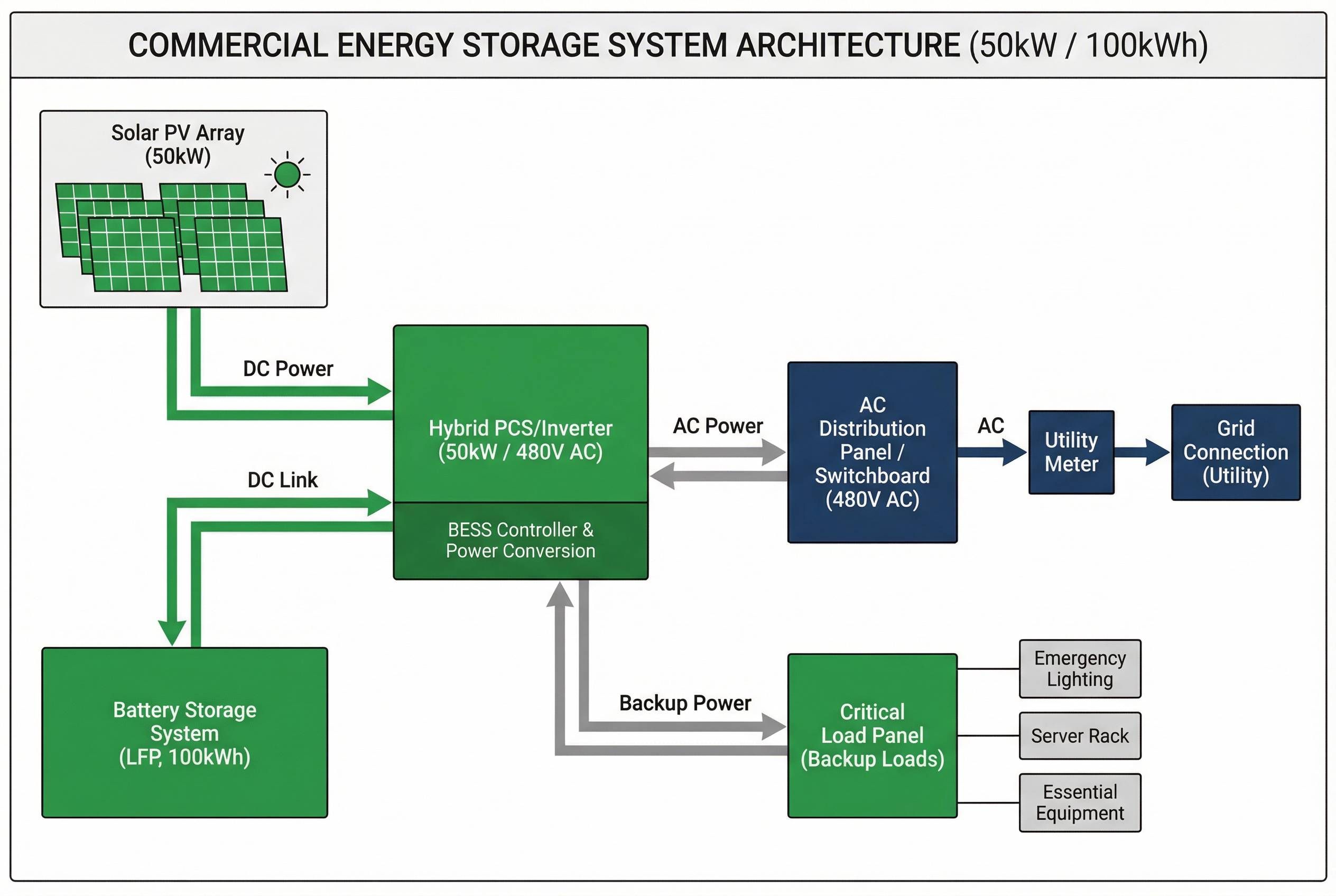 System architecture diagram generated from customer configuration
Core Technical Specifications
- Battery type: LFP (lithium iron phosphate)
- Total capacity: 100kWh
- Usable capacity: 90kWh
- Rated power: 50kW
- Backup duration: 4 hours (50kW × 4h = 200kWh potential load coverage with load management)
- Round-trip efficiency: 95%
- Cycle life: 8,000+ cycles
- Annual degradation: 2.5%
- Capacity at year 10: 78kWh
- AC interface: 480V AC / 3-phase / 60Hz
- Communications: Modbus TCP / CAN / RS485
- Design life: 12 years
- Warranty: 15 years
- Certifications: UL 9540, UL 1741, IEC 62619, CE/RoHS, IEEE 1547
According to NREL (2023), commercial lithium-ion systems typically deliver 85–95% round-trip efficiency; this system’s 95% performance sits at the high end of that range, supporting strong lifecycle economics. LFP chemistry is selected for its safety and long cycle life, which is particularly important for backup and peak shaving in occupied commercial buildings.
Architecture and Control
The system follows a standard but robust C&I architecture:
- LFP battery system with integrated Battery Management System (BMS)
- Bi-directional PCS (power conditioning system) for grid and load interfacing
- EMS (Energy Management System) for backup logic, scheduling, and data logging
- BOS (Balance of System) including breakers, switches, and protection
- Outdoor-rated enclosure with thermal management
- Fire detection and suppression system
- Remote monitoring platform for O&M and performance tracking
IEEE states, “IEEE 1547 establishes the technical requirements for interconnection of distributed energy resources to the grid,” and this configuration is aligned with IEEE 1547 to ensure interoperability and safety in U.S. C&I applications.
Verified Equipment List and Pricing
This case study is grounded in a real, itemized engineering proposal. All prices below are exact and not approximated.
Complete Equipment List
| Item | Qty | Unit Price (USD) | Total (USD) |
|---|---|---|---|
| LFPバッテリーシステム | 1 | 18,620 | 18,620 |
| 双方向PCS(パワーコンディショナー) | 1 | 6,300 | 6,300 |
| エネルギー管理システム(EMS) | 1 | 1,500 | 1,500 |
| BOS(バランスオブシステム) | 1 | 2,990 | 2,990 |
| 屋外用エンクロージャー | 1 | 1,200 | 1,200 |
| 消火・安全システム | 1 | 850 | 850 |
| 遠隔監視システム | 1 | 600 | 600 |
| DC/ACケーブル・コネクタ一式 | 1 | 407 | 407 |
These components together form a fully integrated C&I energy storage system, with the battery system and PCS representing the largest cost shares. SOLAR TODO includes EMS, BOS, safety, and monitoring to deliver a plug-and-play turnkey solution.
Three-Tier Pricing Structure
SOLAR TODO provides clear pricing for three procurement models: ex-works (FOB), port-delivered (CIF), and fully installed turnkey.
| Pricing Tier | Description | Price (USD) |
|---|---|---|
| FOB | Ex-Works (factory pickup) | 21,867 |
| CIF | Port delivery (U.S. port) | 26,914 |
| Turnkey | Fully installed on-site | 33,642 |
This structure allows procurement teams to align with their internal capabilities. Multinational EPCs may prefer FOB or CIF and self-perform installation, while end users and ESCOs often choose the $33,642 turnkey option to reduce interface risk.
According to BloombergNEF (2024), turnkey C&I battery system costs typically range from $400–700/kWh globally, depending on size and market. This 100kWh system’s turnkey price falls within that band, making it competitive for a UL 9540-certified configuration.
Use Case and ROI: U.S. Commercial Backup Application
This specific configuration is designed for a U.S. commercial or industrial facility using the system primarily for backup, with potential secondary use for time-of-use arbitrage.
Customer Configuration Parameters
- Power: 50kW
- Capacity: 100kWh
- Use case: Backup
- Backup hours: 4
- Battery type: LFP
- Peak electricity price: $0.25/kWh
- Valley electricity price: $0.08/kWh
- PV capacity: None (standalone storage)
The system is sized to support critical loads for approximately 4 hours at 50kW, or longer if loads are curtailed during outages. In normal operation, it can charge during low-tariff valley periods and discharge during peak-price periods to reduce operating expenses.
ROI and Financial Performance
- Payback period: 5.5 years
- Annual savings: $6,750
- Annual O&M cost: $607
- Net annual savings: $6,143
- Net present value (NPV): $10,981
- Internal rate of return (IRR): 5.3%
- Levelized cost of energy (LCOE): $0.07/kWh
- Lifetime savings: $29,021
- ITC (Investment Tax Credit) credit: $14,418
According to IEA (2023), commercial electricity prices in many U.S. states exceed $0.15/kWh, making storage-based arbitrage and demand management increasingly attractive. This project’s LCOE of $0.07/kWh is well below typical peak tariffs, which supports the 5.5-year payback.
The U.S. Investment Tax Credit (ITC) plays a major role: a $14,418 credit significantly reduces effective capex and improves NPV and IRR. For multi-site portfolios, replicating this configuration can standardize financial performance across locations.
Operational Benefits
- Backup continuity: 4 hours of critical load support for IT, lighting, and essential process loads
- Tariff optimization: Charge at $0.08/kWh valley price, discharge against $0.25/kWh peak price
- Asset protection: Smooths grid disturbances and reduces equipment downtime
- Data visibility: Remote monitoring enables performance tracking and predictive maintenance
NREL (2022) notes that C&I customers can reduce demand charges by 10–40% using properly sized storage; a 50kW system is often sufficient for small to mid-size commercial sites as a first step.
Global Applications and Deployment Considerations
While this case is U.S.-specific, the 50kW/100kWh architecture is globally relevant. The key variables are grid codes, tariffs, and incentive structures.
Typical Global Use Cases
- Backup power for commercial buildings, data rooms, and small industrial lines
- Peak shaving in markets with high demand charges (e.g., parts of Europe, Australia, and Asia)
- Time-of-use arbitrage in regions with strong peak/valley price differentials
- Integration with rooftop or ground-mount PV for self-consumption (future expansion)
SOLAR TODO can adapt the same hardware platform to different markets by adjusting PCS settings, protection schemes, and certification packages to meet local standards.
Standards and Compliance
- UL 9540: Energy storage system safety
- UL 1741: Inverters and PCS for distributed generation
- IEC 62619: Safety requirements for secondary lithium cells and batteries
- IEEE 1547: Interconnection and interoperability of DERs
UL states, “UL 9540 evaluates the safety of energy storage systems and equipment,” which is increasingly a prerequisite for insurers and AHJs in North America. For global deployments, IEC 62619 and regional grid codes (e.g., EN standards in Europe) will guide adaptation.
Design Life and Degradation
- Design life: 12 years
- Warranty: 15 years
- Annual degradation: 2.5%
- Year 10 capacity: 78kWh
This degradation profile is consistent with LFP technology in commercial duty cycles. For portfolio planners, the 78kWh capacity at year 10 should be considered in long-term backup and arbitrage modeling.
Procurement and Selection Guide
For procurement managers and engineers comparing options, the three-tier pricing and spec set provide a clear framework.
FOB vs CIF vs Turnkey
| Aspect | FOB ($21,867) | CIF ($26,914) | Turnkey ($33,642) |
|---|---|---|---|
| Logistics | Buyer handles export & freight | Seller delivers to destination port | Seller handles logistics & on-site delivery |
| Installation | Buyer/EPC responsibility | Buyer/EPC responsibility | Included (on-site installation) |
| Risk allocation | Higher on buyer | Shared | Lower on buyer |
| Ideal for | Large EPCs with local teams | Regional integrators | End users / ESCOs / small EPCs |
Procurement teams should align pricing tier with internal capabilities and risk appetite. For single-site or first-of-kind projects, turnkey often minimizes interface risk and accelerates commissioning.
Integration and Engineering Checklist
When specifying this system for a new site, engineers should:
- Confirm compatibility with 480V, 3-phase, 60Hz service
- Define critical load panel and transfer switching strategy
- Validate local code requirements and AHJ expectations (UL 9540, fire codes)
- Confirm communication protocols (Modbus TCP, CAN, RS485) with existing BMS/SCADA
- Plan physical siting for the outdoor enclosure, clearances, and ventilation
According to NREL (2024), proper siting and thermal management can extend battery life and reduce degradation, reinforcing the importance of early-stage engineering.
SOLAR TODO supports this process with detailed datasheets, single-line diagrams, and EMS integration guidelines, enabling consistent replication across multiple facilities.
FAQ
Q: What exactly does the $33,642 turnkey price include? A: The $33,642 turnkey price covers one complete 50kW/100kWh LFP energy storage system, including the battery system, bi-directional PCS, EMS, BOS, outdoor enclosure, fire and safety system, remote monitoring, DC/AC cabling, and on-site installation. It is designed as a ready-to-operate solution for a single commercial or industrial site.
Q: What is included in the $21,867 FOB price? A: The $21,867 FOB price includes the full equipment package—LFP battery system, PCS, EMS, BOS, enclosure, safety system, remote monitoring, and cabling—available ex-works at the factory. Shipping, insurance, customs, and all installation and commissioning activities are handled by the buyer or their EPC partner.
Q: How does the $26,914 CIF option differ from FOB? A: The $26,914 CIF price includes the same equipment as FOB but adds logistics to deliver the system to the destination port in the buyer’s country. It typically covers freight and marine insurance up to the port. Local customs clearance, inland transport, installation, and commissioning remain the buyer’s responsibility.
Q: What backup duration can this system provide for my facility? A: The system is rated at 50kW power and 100kWh total capacity, with 90kWh usable. At a continuous 50kW critical load, it provides approximately 4 hours of backup. If you can curtail loads to 25–30kW during outages, backup duration can extend proportionally, improving resilience for longer events.
Q: What is the expected lifetime and degradation of the battery? A: The system uses LFP chemistry with a design life of 12 years and a 15-year warranty. It is rated for 8,000+ cycles, with an assumed annual degradation of 2.5%. Under typical commercial usage, capacity is expected to be about 78kWh at year 10, which should be factored into long-term planning.
Q: How were the 5.5-year payback and $6,750 annual savings calculated? A: The 5.5-year payback is based on modeled operation in a U.S. commercial tariff environment, using a peak price of $0.25/kWh and valley price of $0.08/kWh. Annual savings of $6,750 come from avoided peak energy and demand charges, minus $607 annual O&M, yielding $6,143 net annual savings over the project life.
Q: What certifications does the system comply with and why do they matter? A: The system is designed around components compliant with UL 9540, UL 1741, IEC 62619, CE/RoHS, and IEEE 1547. These standards address system safety, inverter performance, battery safety, environmental compliance, and grid interconnection. Compliance simplifies permitting, satisfies insurers, and reduces technical risk for commercial and industrial customers.
Q: Can this 50kW/100kWh system be integrated with existing solar PV? A: Yes, it can be integrated with existing or future PV systems through the AC bus at 480V, 3-phase, 60Hz. The EMS can be configured to prioritize solar self-consumption, then peak shaving or backup. While this case study assumes no PV, SOLAR TODO can provide integration guidelines and controls for hybrid PV+storage operation.
Q: What communication interfaces are available for BMS and SCADA integration? A: The system supports Modbus TCP, CAN, and RS485, enabling straightforward integration with building management systems, SCADA, or third-party monitoring platforms. These interfaces allow real-time visibility of state of charge, alarms, power flows, and historical data, which are critical for O&M and performance optimization.
Q: What ongoing maintenance is required and what does the $607 annual O&M cost cover? A: The $607 annual O&M cost typically covers remote monitoring, periodic inspections, firmware updates, and preventive maintenance checks on the PCS, EMS, and safety systems. Routine tasks include visual inspections, thermal checks, functional testing of protection devices, and verification of communication links, helping maintain reliability and warranty compliance.
Q: Is this system scalable if my facility’s load grows in the future? A: Yes, the 50kW/100kWh unit can be deployed as a building block in a modular architecture. Additional units can be added in parallel to increase both power and energy capacity. Engineering review is required to confirm switchgear, protection, and EMS coordination, but SOLAR TODO designs the system with multi-unit scalability in mind.
Related Reading
References
- NREL (2022): “Grid-Connected Battery Energy Storage Systems: Cost and Performance Update” – Provides benchmark efficiency, cost, and lifecycle data for C&I storage.
- NREL (2024): “Best Practices for Siting and Operating Battery Energy Storage Systems” – Discusses thermal management, siting, and O&M strategies to extend battery life.
- IEEE 1547-2018 (2018): “Standard for Interconnection and Interoperability of Distributed Energy Resources with Associated Electric Power Systems Interfaces.”
- IEC 62619:2017 (2017): “Secondary cells and batteries containing alkaline or other non-acid electrolytes – Safety requirements for secondary lithium cells and batteries.”
- UL 9540 (2020): “Standard for Energy Storage Systems and Equipment” – Defines safety requirements for integrated ESS.
- IEA (2023): “Electricity Market Report 2023” – Analyzes global electricity prices and the role of storage in flexibility.
- IEA (2024): “Energy Storage Tracking Report 2024” – Tracks global deployment of battery storage and forecasts growth to 2030.
- BloombergNEF (2024): “Energy Storage Market Outlook 2024” – Provides cost benchmarks and deployment trends for C&I and grid-scale storage.
About SOLARTODO
SOLARTODO is a global integrated solution provider specializing in solar power generation systems, energy-storage products, smart street-lighting and solar street-lighting, intelligent security & IoT linkage systems, power transmission towers, telecom communication towers, and smart-agriculture solutions for worldwide B2B customers.