Gaborone Smart Streetlight Market Analysis: 55-Unit Hybrid 12m Configuration Guide for Urban Corridors
Summary
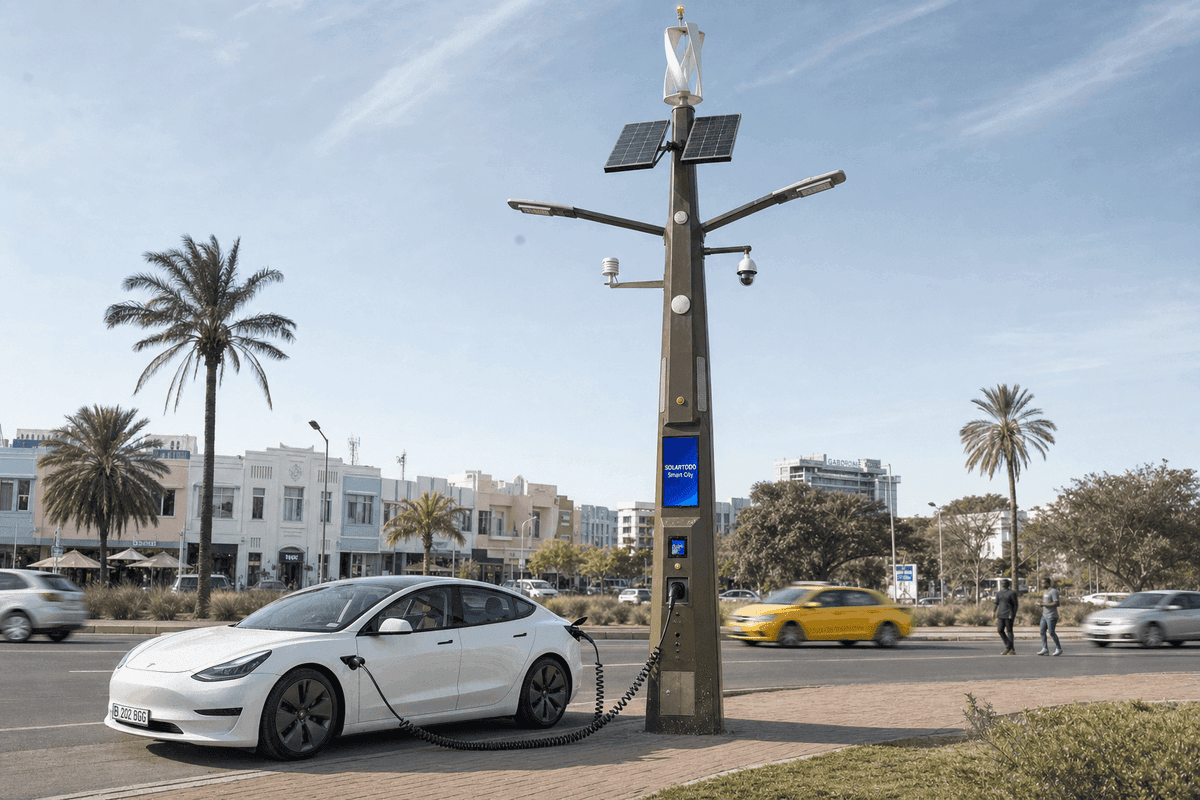
Gaborone’s dry climate, dispersed urban growth, and rising EV-connectivity needs support a typical 55-unit smart streetlight corridor using 12m hybrid poles at 32m spacing, with 11kW AC charging, 10kWh LFP storage, and 5G n78 coverage of about 200m per pole.
Key Takeaways
A Gaborone urban-corridor smart streetlight program would typically fit approximately 55 units of 12m octagonal tapered steel poles over a 1.76km corridor at 32m spacing.
- A typical deployment of this scale would use 55 hybrid 12m poles, each with 2 × 80W LED luminaires, for 17.6kW total connected lighting load before controls.
- Each pole would combine 500W Darrieus H-type VAWT, 2 × 200W monocrystalline panels, and 10kWh LFP battery storage with grid backup for mixed off-grid/on-grid resilience.
- The recommended EV format is an integrated 11kW single-gun AC charger built into the lower 2.2m of the pole body, compliant with IEC 62196-2 and OCPP 1.6J.
- With 32m spacing, a 55-pole layout covers about 1,760m of urban street length, matching collector-road and mixed-use boulevard conditions better than highway lighting classes.
- Each pole would carry a 5G NR n78 small cell with 4T4R MIMO and about 200m coverage, reducing the need for separate street furniture in dense commercial strips.
- Public-safety hardware includes 1 PTZ dome camera, 1 IP audio column speaker, 1 SOS intercom, and 1 8-parameter environmental sensor on every pole.
- Botswana’s national electrification rate reached about 75% in 2022, according to the World Bank (2022), which supports hybrid-grid designs rather than fully isolated street assets in Gaborone.
- Gaborone receives strong solar resource; the World Bank Global Solar Atlas indicates annual photovoltaic output potential above 2,000 kWh/kWp in much of Botswana, supporting 400W per-pole solar input as a practical supplement.
Market Context for Gaborone
Gaborone’s infrastructure profile supports hybrid smart streetlights because the city combines strong solar resource, expanding urban traffic demand, and a grid that is available but not always optimal for single-purpose street assets.
Gaborone is Botswana’s capital and main administrative and commercial center, with city population commonly cited above 240,000 and a wider Greater Gaborone urban area substantially larger. According to Statistics Botswana (2022), the 2022 Population and Housing Census confirms continued urban concentration in South-East District and Gaborone, which increases demand for higher-function road lighting, surveillance, and public communications on arterial and collector roads. For smart streetlight planning, that means the correct class is urban street infrastructure at 25-50m spacing, not parks and not highways.
Climate also matters. According to the World Bank Group’s Climate Change Knowledge Portal (2021), Botswana has a semi-arid climate with high solar irradiation, low annual rainfall, and summer heat regularly above 30°C. That favors a hybrid pole with on-board generation and battery buffering, especially where daytime solar can support auxiliary loads such as displays, telecom devices, and control electronics. Wind conditions in open boulevards and peri-urban connectors also make a compact 500W vertical-axis turbine technically reasonable as a supplemental source rather than a primary energy source.
Grid context supports hybrid backup rather than full islanding. According to the World Bank (2022), Botswana’s access to electricity was about 75% of the population, while urban access is materially higher. In Gaborone, the practical issue is not basic electrification but the cost and complexity of adding separate foundations and cabinets for lighting, telecom, charging, and public-safety devices. A multi-function pole reduces civil clutter by placing lighting, 5G, camera, SOS, and EV charging on one 12m structure.
Telecom demand is also relevant. The Botswana Communications Regulatory Authority, BOCRA, has continued to support broadband and mobile network growth, while the ITU notes that dense urban mobile traffic increasingly depends on small-cell infill in mid-band spectrum such as 3.5 GHz classes. For Gaborone’s commercial corridors, a pole carrying 5G NR n78 at 8.7m mounting height is more useful than a lighting-only pole because it can add localized capacity without a separate mast.
Two authority statements frame the technical direction. The International Energy Agency states, "Solar PV is now the cheapest source of electricity in many parts of the world," which is relevant in Botswana’s high-irradiation context. IEC states that outdoor lighting equipment must comply with recognized safety and performance requirements under IEC 60598, which is the baseline for municipal procurement and inspection.
Recommended Technical Configuration
For Gaborone’s mixed commercial and civic corridors, the best technical fit is a typical 55-unit deployment of SOLAR TODO Smart Streetlight using the hybrid 12m integrated EV-charging form factor rather than a basic modular pole.
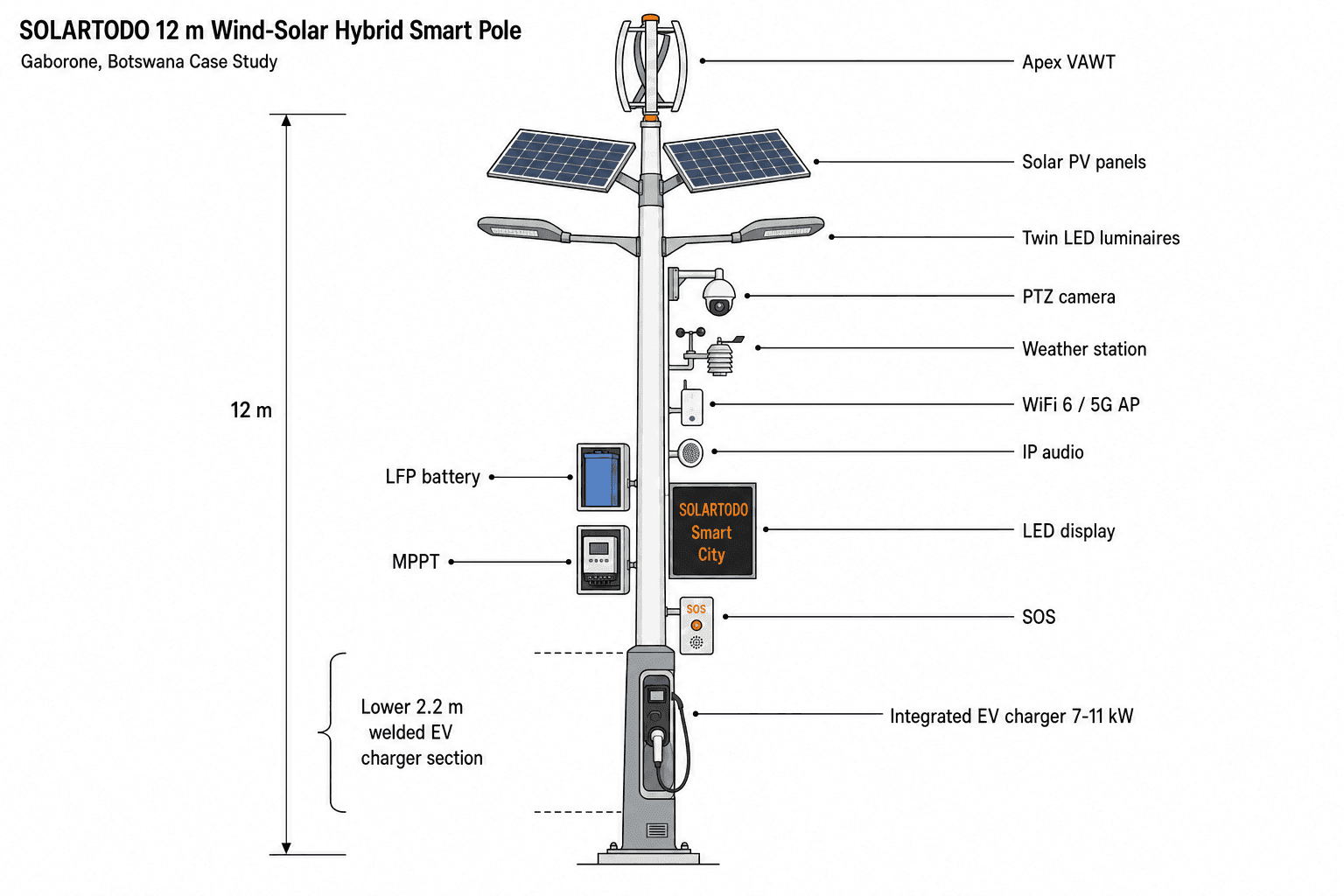
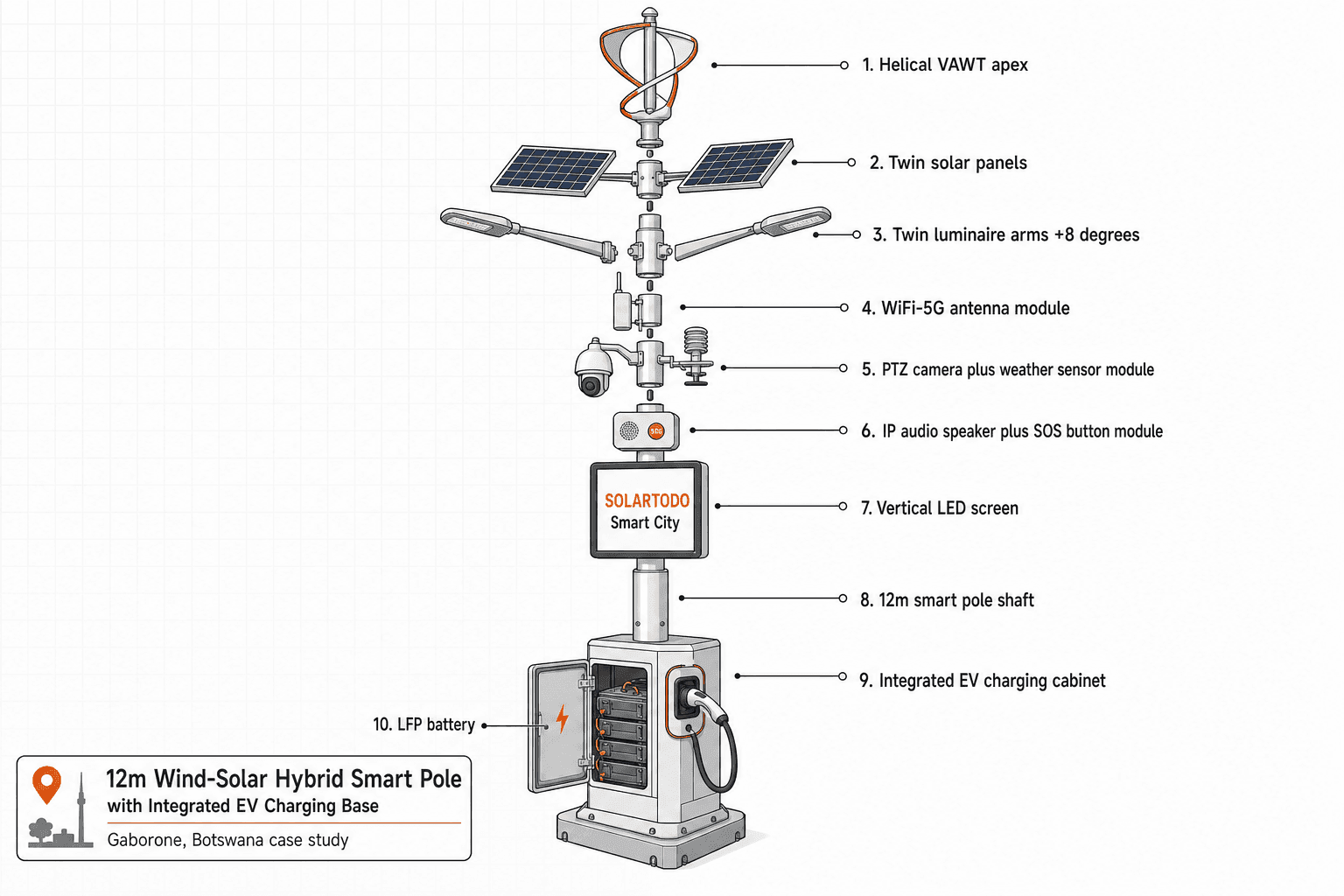
The recommended size class is the 12m octagonal tapered steel smart pole because Gaborone’s target roads are urban corridors rather than local lanes. The specified geometry is base Ø45cm to top Ø15cm, which is appropriate for carrying twin 1.5m lighting arms, a 500W VAWT, a 1000 × 2000mm LED display, a PTZ camera, an environmental sensor, and a flush-mounted 5G NR n78 unit. A shorter 6-8m garden-light class would not provide enough mounting separation for lighting, surveillance, and telecom.
A typical 55-unit deployment in this profile would consist of poles spaced at 32m, covering approximately 1.76km of boulevard, collector street, transit frontage, or mixed-use district edge. This spacing falls within the product line’s normal 25-50m urban density range. It also provides a practical balance between illuminance uniformity, camera overlap, and EV charger visibility.
The recommended finish is antique bronze RAL8011, which is technically useful in Gaborone because darker earth-tone finishes tend to blend better with civic and commercial streetscapes than bright galvanized silver. The charging section is not a separate pedestal. The lower 2.2m of the pole is the EV charging cabinet itself, welded as one continuous steel structure. That matters in procurement because it reduces separate plinths, separate cable guards, and visual clutter.
SOLAR TODO’s specified hybrid package fits Botswana’s resource profile well. Each pole combines a Darrieus H-type VAWT with 3 straight vertical blades, Ø80 × 110cm, rated 500W, plus 2 × 200W deep-black monocrystalline modules on an east-west A-frame at 15° tilt. Battery storage is 10kWh LFP inside the base with MPPT control and grid tie backup. In practical terms, the renewable package supports priority loads and resilience, while the grid remains available for EV charging continuity and low-sun periods.
The communications stack is also aligned with Gaborone’s urban use case. Each pole would carry a 5G NR n78 small cell with 4T4R MIMO and about 200m coverage, integrated flush on the flat pole face at 8.7m. That mounting height is high enough for localized urban coverage but low enough for maintenance compared with rooftop-only alternatives. For city buyers, the benefit is fewer separate structures competing for pavement space.
Natural internal links for procurement review are the SOLAR TODO Smart Streetlight product page and the direct contact us channel for corridor-specific layouts and BOQ review.
Technical Specifications
The recommended Gaborone configuration is a 55-unit hybrid 12m smart streetlight package with 11kW integrated AC charging, 10kWh LFP storage, 5G n78 small cells, and IEC-aligned lighting hardware.
- Quantity basis: approximately 55 units for a typical urban corridor deployment
- Pole type: 12m octagonal tapered steel smart pole
- Pole geometry: base Ø45cm → top Ø15cm
- Finish: antique bronze RAL8011
- Integrated charging body: lower 2.2m of pole is the EV charging cabinet, welded as one continuous steel structure
- Wind generation: Darrieus H-type VAWT, 3 straight vertical blades, Ø80 × 110cm, 500W, with red aviation LED
- Solar generation: 2 × 200W monocrystalline deep-black panels on A-frame brackets, 15° tilt, symmetric east-west pair
- Battery: 10kWh LFP inside pole base with MPPT controller
- Lighting: twin symmetric arms, each 1.5m, with +8° upward tilt
- LED luminaires: 2 × 80W LED, 150 lm/W, 4000K
- Camera: 15cm mini white PTZ dome, 360°, 20x zoom, IR 100m, mounted on 40cm L-bracket
- Environmental sensing: top-mounted 8-parameter sensor for temperature, humidity, wind, pressure, noise, PM2.5, PM10, illuminance
- Public address: 1 × IP audio column speaker, Ø10 × 50cm, 30W, 93dB, TCP/IP networked, flush against pole face
- Emergency system: one-press SOS button, dual-way audio intercom, visual LED indicator
- EV charging: integrated 11kW single-gun AC charger, Type 2, OCPP 1.6J, 5m coiled cable, touchscreen, E-stop, maintenance door
- Display: P3 vertical LED screen, 1000 × 2000mm, portrait, >6000 cd/m², content restricted to “SOLARTODO Smart City” in white sans-serif on deep blue
- Telecom: 5G NR n78 small cell, 4T4R MIMO, about 200m coverage, mounted at 8.7m flush on flat pole face
- User charging extras: USB-C PD 30W and USB-A
- Spacing: 32m typical center-to-center
- Applicable standards: IEC 60598, GB/T 37024, IEC 62196-2
According to IEC (2020), IEC 60598 sets the general safety requirements for luminaires used in outdoor public lighting. According to IEC (2016), IEC 62196-2 defines dimensional compatibility requirements for AC charging connectors such as Type 2. According to ITU (2020), dense urban mobile broadband increasingly depends on closer radio nodes, which supports the use of integrated small cells on street furniture.
Implementation Approach
A practical Gaborone rollout would usually be executed in 4 phases over about 16-28 weeks, starting with corridor survey and utility coordination, then foundations, pole erection, and final systems commissioning.
Phase 1 is site definition and authority review. For a 55-unit corridor, the first step is a topographic and utility survey covering lane widths, underground services, transformer proximity, and sightline conflicts. Pole spacing at 32m should then be checked against lighting targets, EV parking demand, and 5G radio overlap. In Botswana, this stage would normally require coordination with city authorities, the utility, and telecom stakeholders before civil work starts.
Phase 2 is civil and electrical preparation. A multi-function 12m pole carrying an 11kW charger, 10kWh battery, display, and telecom equipment typically needs a more substantial foundation and cable plan than a standard streetlight. The practical sequence is foundation casting, ducting, earthing, feeder routing, and charger protection design. According to IEEE guidance on grounding and power quality practice, sensitive electronics and EV charging systems need controlled earthing and surge protection, especially where lightning exposure is seasonal.
Phase 3 is pole erection and subsystem installation. The steel body, integrated charger section, lighting arms, VAWT, PV modules, PTZ camera, speaker, SOS unit, and display are assembled and tested in sequence. Because the charger is built into the lower 2.2m of the pole, there is no separate charger pedestal to align. That shortens streetscape coordination and reduces the number of exposed interfaces.
Phase 4 is software commissioning and acceptance testing. This includes luminaire aiming, PTZ calibration, environmental sensor validation, OCPP charger communication, display content lock, and 5G small-cell integration. A typical acceptance package would verify LED load, battery charge behavior, emergency call functionality, and telecom backhaul. For a 55-unit package, staged commissioning by 10-15 poles per block is usually easier than energizing the full corridor at once.
Expected Performance & ROI
For Gaborone, the expected value case is lower civil duplication, better asset utilization per pole, and a payback driven by avoided separate infrastructure, energy savings from LED lighting, and optional telecom or charging revenue streams.
Lighting efficiency is the simplest part of the ROI. Each pole uses 2 × 80W LED luminaires, or 160W total, at 150 lm/W. Compared with legacy 250W-400W HID streetlights commonly used in older municipal corridors, LED conversion alone can reduce lighting energy use by roughly 36-60%, depending on operating hours and dimming strategy. According to the U.S. Department of Energy (2022), LED streetlighting commonly delivers major maintenance and energy savings over conventional HID systems.
The hybrid power package reduces auxiliary consumption from the grid. Botswana’s solar resource is strong; according to the World Bank Global Solar Atlas (2024), much of Botswana offers photovoltaic power potential above 2,000 kWh/kWp/year. On a per-pole basis, 400W of PV in such a climate can materially support sensors, communications, display standby loads, and part of nightly lighting demand when paired with 10kWh of LFP storage. The 500W VAWT should be treated as supplemental generation, not the primary source.
The integrated design also changes the capex logic. A conventional corridor might require separate poles, separate EV charger pedestals, separate camera mounts, separate emergency stations, and possibly separate telecom street furniture. Combining these into one 12m structural asset can cut the number of foundations and service interfaces by 3-5 asset classes on the same block. That does not eliminate engineering work, but it can reduce trenching length, permit interfaces, and visual clutter.
On payback, the range depends on which revenue streams are activated. If the project is lighting-only, the return is mainly from reduced energy and maintenance over 8-12 years. If EV charging and telecom tenancy are activated, the payback can shorten materially, often into a 4-7 year range for premium urban corridors, subject to utilization, electricity tariff, and lease terms. According to IRENA (2023), battery-backed solar and efficient end-use equipment continue to improve lifecycle economics in high-irradiation markets.
Results and Impact
For Gaborone, a 55-unit smart streetlight corridor would typically improve lighting quality, add public-safety hardware every 32m, and create one shared platform for EV charging, 5G infill, and environmental monitoring.
The first impact is corridor densification without street clutter. Over about 1.76km, the city would gain 55 cameras, 55 SOS points, 55 IP speakers, 55 environmental sensors, and 55 EV charging interfaces without adding separate cabinets or poles for each function. That is useful on civic corridors, commercial boulevards, transit edges, and mixed-use redevelopment areas where pavement width is limited.
The second impact is better operational visibility. An 8-parameter sensor on every pole creates a distributed environmental dataset for dust, temperature, wind, and ambient noise. In a dry city such as Gaborone, PM monitoring and illuminance data can support maintenance and public-health reporting. The PTZ camera with IR 100m also gives better nighttime observation than lighting-only infrastructure.
The third impact is network readiness. A 5G NR n78 node with about 200m coverage on each pole can support denser urban data demand than macro-only coverage in areas with heavy pedestrian and commercial activity. For municipal planning, that means SOLAR TODO Smart Streetlight can serve as a shared digital-infrastructure host rather than a single-purpose luminaire.
Comparison Table
The table below compares the recommended hybrid 12m Gaborone configuration with a conventional LED streetlight layout and a basic modular smart pole option.
| Metric | Recommended SOLAR TODO Hybrid 12m | Conventional LED Streetlight | Basic Modular Smart Pole |
|---|---|---|---|
| Pole height | 12m | 9-12m | 8-10m |
| Pole count in sample corridor | 55 | 55 | 55 |
| Spacing | 32m | 30-35m | 30-35m |
| Lighting per pole | 2 × 80W LED | 1 × 120-180W LED typical | 1 × 80-150W LED |
| Renewable input per pole | 500W wind + 400W solar | None | Optional, usually none |
| Battery per pole | 10kWh LFP | None | Optional small battery |
| EV charging | Integrated 11kW AC, Type 2 | Separate pedestal required | Optional modular EV box |
| Telecom | 5G NR n78, 4T4R, 200m | Not included | Optional add-on |
| Surveillance | PTZ 360°, 20x, IR 100m | Separate camera pole needed | Optional camera |
| Emergency/SOS | Included | Separate kiosk needed | Optional |
| Display | P3 1000 × 2000mm, >6000 cd/m² | Not included | Optional smaller display |
| Civil interfaces | One integrated pole body | Multiple separate assets | Fewer than conventional, more than integrated |
| Best fit in Gaborone | Premium urban corridors | Lighting-only roads | Mid-spec smart streets |
Pricing & Quotation
SOLAR TODO offers three pricing tiers for this product line: FOB Supply (equipment ex-works China), CIF Delivered (including ocean freight and insurance), and EPC Turnkey (fully installed, commissioned, with 1-year warranty). Volume discounts are available for large-scale deployments. Configure your system online for an instant estimate, or request a custom quotation from our engineering team at [email protected].
Frequently Asked Questions
This FAQ answers 10 common buyer questions on sizing, standards, installation, ROI, warranty scope, and how a 55-unit SOLAR TODO Smart Streetlight configuration would fit Gaborone.
Q1: Why is a 12m pole recommended for Gaborone instead of an 8m or 10m model?
A 12m pole gives enough vertical separation for twin 80W luminaires, a 5G n78 small cell at 8.7m, a PTZ camera, and a 1000 × 2000mm display without excessive crowding. On collector roads and mixed-use boulevards, this height also improves lighting spread and camera sightlines compared with shorter poles.
Q2: Is the EV charger a separate box beside the pole?
No. In this recommended configuration, the lower 2.2m of the pole body is the charger cabinet itself. It is welded as one continuous steel structure, not a separate pedestal. That reduces pavement clutter, removes an extra foundation, and simplifies the visual layout along commercial streets.
Q3: Can the hybrid system run fully off-grid in Gaborone?
It can support many auxiliary loads from on-board generation, but this specification is better treated as a hybrid system with grid backup. Each pole has 400W PV, a 500W VAWT, and 10kWh LFP storage, yet the 11kW EV charger makes grid support important for reliable charging continuity.
Q4: What standards matter most for municipal procurement?
The key references in this configuration are IEC 60598 for luminaire safety, IEC 62196-2 for the Type 2 charging interface, and GB/T 37024 for smart-pole framework alignment. Buyers should also request local structural checks, earthing design, and utility interconnection review before final approval.
Q5: How long would a 55-unit deployment typically take?
A normal program would often take about 16-28 weeks, depending on permitting, civil readiness, and telecom coordination. The main stages are survey, utility review, foundation and ducting, pole erection, electrical termination, software commissioning, and acceptance testing. Integrated poles usually reduce the number of separate asset installations.
Q6: What is the expected payback period?
For lighting-only economics, payback often falls in the 8-12 year range because the return comes mainly from LED energy and maintenance savings. If EV charging usage and telecom tenancy are active, premium urban corridors can shorten that range to about 4-7 years, subject to utilization, tariff, and lease structure.
Q7: What maintenance does this system require?
Routine maintenance usually includes quarterly inspection of the 5m charging cable, touchscreen, doors, and speaker openings; semiannual cleaning of the 2 × 200W PV modules and camera dome; and annual checks for battery health, turbine fasteners, and surge protection. Software diagnostics should run continuously through the controller platform.
Q8: How does this compare with a standard LED streetlight plus separate devices?
A conventional layout often needs separate poles or cabinets for CCTV, SOS, telecom, and EV charging. This integrated 12m format combines those functions on one structure, which can reduce foundations, trench interfaces, and visual clutter. The tradeoff is a higher unit complexity and a more detailed design review upfront.
Q9: What warranty terms are typical for procurement planning?
Warranty terms vary by supply scope, but buyers usually separate structural steel, LED drivers, battery pack, charger electronics, display modules, and telecom equipment into different coverage periods. The quotation stage should define each line clearly. For turnkey scope, the mandatory pricing note includes a 1-year warranty baseline.
Q10: Is this suitable for highways or parks in Botswana?
No. This product class is intended for urban streets at 25-50m spacing, with the sample layout set at 32m. Highways usually need a different traffic-pole class and photometric design, while parks generally use lower 6-8m garden-light forms with different optics and lower equipment density.
References
- Statistics Botswana (2022): 2022 Population and Housing Census preliminary and urban population data for Gaborone and surrounding districts.
- World Bank (2022): Access to electricity in Botswana, about 75% of population; useful baseline for hybrid-grid street infrastructure planning.
- World Bank Group / Global Solar Atlas (2024): Botswana solar resource maps showing photovoltaic power potential above 2,000 kWh/kWp/year in many areas.
- World Bank Group Climate Change Knowledge Portal (2021): Botswana climate profile, including semi-arid conditions, temperature patterns, and rainfall constraints relevant to outdoor equipment design.
- IEC (2020): IEC 60598 luminaire safety and performance requirements for public lighting equipment.
- IEC (2016): IEC 62196-2 dimensional compatibility and interchangeability requirements for AC charging connectors including Type 2.
- International Telecommunication Union, ITU (2020): IMT-2020 and dense-network guidance relevant to small-cell deployment on urban street furniture.
- U.S. Department of Energy (2022): LED streetlighting performance and maintenance benefits compared with conventional HID systems.
- International Renewable Energy Agency, IRENA (2023): Renewable power cost and storage economics trends relevant to hybrid urban infrastructure.
- International Energy Agency, IEA (2023): Solar PV cost competitiveness and system value in high-irradiation markets.
Equipment Deployed
- 55 × 12m octagonal tapered steel smart poles, base Ø45cm to top Ø15cm, antique bronze RAL8011
- Integrated EV charging body in lower 2.2m of pole, welded as one continuous steel structure
- 55 × Darrieus H-type VAWT, 3 straight vertical blades, Ø80×110cm, 500W, red aviation LED
- 110 × 200W deep-black monocrystalline solar panels, 2 per pole, A-frame, 15° tilt
- 55 × 10kWh LFP battery packs with MPPT controllers inside pole base
- 55 × twin-arm lighting sets, 1.5m per arm, +8° upward tilt
- 110 × 80W LED luminaires, 150 lm/W, 4000K
- 55 × mini white PTZ dome cameras, 360°, 20x zoom, IR 100m, on 40cm L-bracket
- 55 × 8-parameter environmental sensors: temperature, humidity, wind, pressure, noise, PM2.5, PM10, illuminance
- 55 × IP audio column speakers, Ø10×50cm, 30W, 93dB, TCP/IP
- 55 × one-press SOS button and dual-way audio intercom units with LED indicator
- 55 × integrated 11kW AC chargers, Type 2, OCPP 1.6J, 5m coiled cable, touchscreen, E-stop
- 55 × P3 vertical LED displays, 1000×2000mm, portrait, >6000 cd/m²
- 55 × 5G NR n78 small cells, 4T4R MIMO, about 200m coverage, mounted at 8.7m
- 55 × USB-C PD 30W and USB-A user charging modules