Georgetown Smart Streetlight Market Analysis: 195-Unit 12m Integrated EV Configuration Guide
Summary
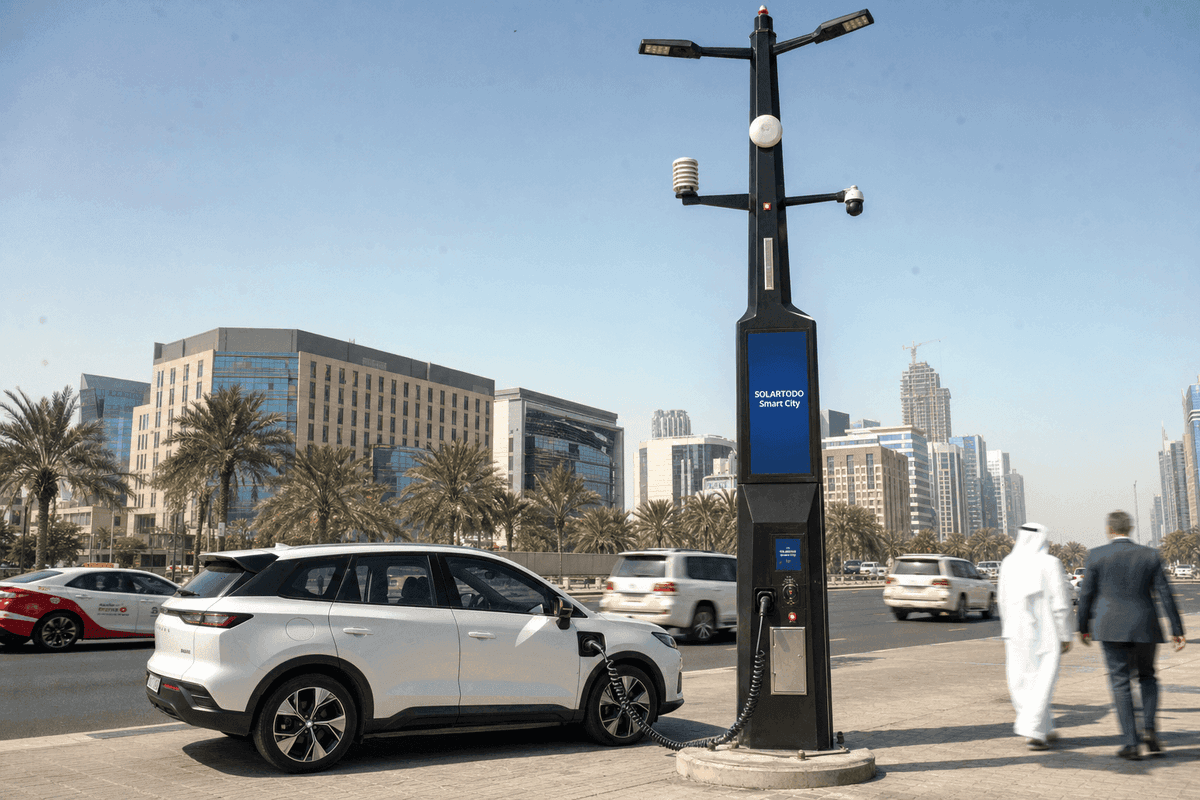
Georgetown’s 125,683-person capital market, below-sea-level coastal exposure, and 30m urban pole spacing support a typical 195-unit, 12m grid-powered SOLARTODO Smart Streetlight configuration with integrated 11kW EV charging and 5G-ready hardware.
Key Takeaways
A 195-unit Georgetown Smart Streetlight program would cover approximately 5.85km at 30m spacing while consolidating lighting, EV charging, telecom, sensing, and safety systems.
- A typical 195-unit deployment would use 12m octagonal tapered steel poles with a base diameter of 45cm and top diameter of 15cm.
- Each pole would include 2 x 80W SOLARTODO LED luminaires, delivering approximately 24,000 lm at 150 lm/W and 4000K.
- The integrated EV module would provide 11kW AC Type 2 charging with OCPP 1.6J, a 5m coiled cable, and an 8-inch touchscreen.
- At 30m spacing, the configuration fits 30-50 poles per km urban street density and avoids highway or park-size mismatches.
- Each pole would include 5G NR n78 small-cell readiness with 4T4R MIMO and approximately 200m coverage per radio node.
- Georgetown’s low coastal elevation and 2 rainy seasons justify IP-rated enclosures, drainage-aware foundations, and corrosion-resistant RAL9005 powder coating.
- Standards alignment should include IEC 60598 for luminaires, GB/T 37024 for smart lighting systems, and IEC 62196-2 for Type 2 EV connectors.
Market Context for Georgetown
Georgetown’s capital-city street infrastructure needs multi-function poles because a 37km2 urban core concentrates government, finance, port, transit, and CARICOM functions.
According to the Bureau of Statistics Guyana and 2022 census reporting (2024), Georgetown recorded approximately 125,683 residents, after 118,363 residents in the 2012 census. The city sits at about 6.8 latitude and -58.16 longitude on the Atlantic coast, where the Demerara River estuary creates a dense administrative and logistics corridor. A Smart Streetlight program should therefore be treated as public infrastructure, not decorative lighting.
According to the World Bank/GFDRR (2005), the January 2005 Georgetown flood affected approximately 290,000 people and caused about US$465 million in damage, equivalent to 59% of Guyana’s GDP at the time. The World Bank/GFDRR states, “the coastal strip below mean sea level,” which is directly relevant to foundation height, cabinet sealing, and maintenance access. For smart poles, the practical implication is simple: the lower 2.2m integrated cabinet must be protected against splash, ponding, and service-door water ingress.
According to Guyana Power and Light (2024), GPL remains the utility serving coastal Guyana, including the Georgetown load center. The recommended SOLARTODO design therefore uses grid-powered AC 220/380V rather than a solar-only streetlight architecture. EV charging, LED display, PTZ camera, IP audio, 5G small cell, and environmental sensing create a multi-load node, so feeder sizing and protection should be coordinated with the local distribution operator before procurement.
According to Guyana’s Low Carbon Development Strategy 2030 (2022), transport and energy modernization are part of the national decarbonization pathway. A Georgetown Smart Streetlight specification should support future EV adoption with Type 2 charging and OCPP communication, while still solving immediate streetlighting, safety, public information, and telecom densification needs. SOLARTODO’s Smart Streetlight product page at Smart Streetlight is the relevant product family for this application.
Recommended Technical Configuration
A typical Georgetown configuration would specify approximately 195 units of 12m grid-powered integrated smart poles over about 5.85km of urban streets.
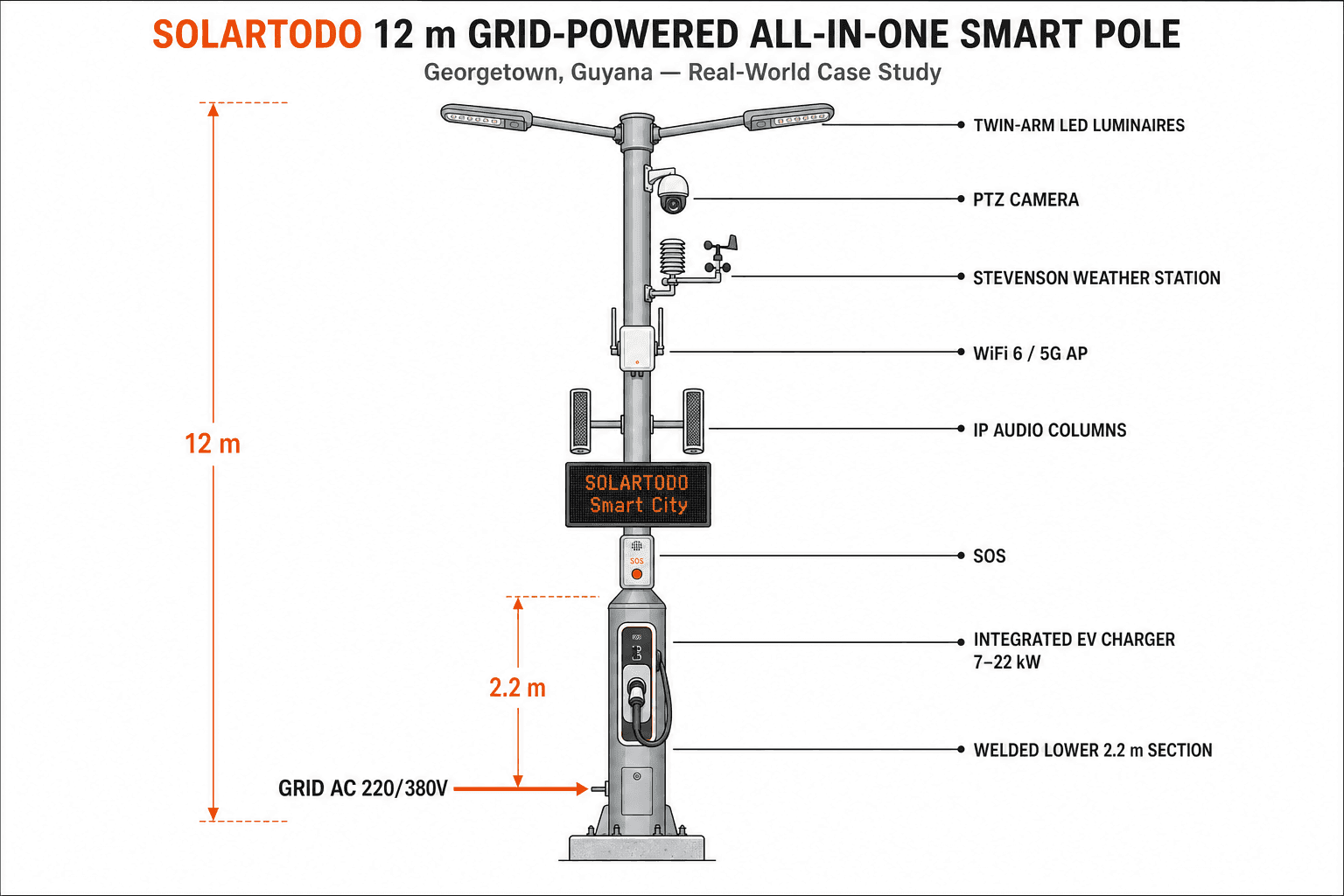
The recommended form variant is the grid-powered 12m octagonal tapered steel smart pole, because Georgetown is a coastal capital with established urban grid access and road-corridor demand for EV charging, cameras, signage, and telecom densification. The lower 2.2m of the pole should be the EV charging cabinet itself, seamlessly welded to the upper pole as one continuous steel structure. It should not be designed as a separate charger beside the pole, because separate pillars increase sidewalk clutter, foundation count, bollard requirements, and service conflicts.
A typical 195-unit deployment of this scale would use black RAL9005 powder-coated steel poles, AC 220/380V grid input, and 30m spacing. That spacing is within the normal 25-50m urban street class for multi-function city poles and would cover approximately 5.85km of priority corridors. Suitable streets would include civic, commercial, waterfront access, bus-route, and parking-adjacent segments where lighting, video, emergency communication, and slow AC EV charging have overlapping value.
For Georgetown, this is a street-class system, not a highway mast and not a garden-lighting product. Highways should use 12m+ traffic pole systems with road authority photometrics, while parks typically need 6-8m garden lighting with lower glare and different public-realm priorities. The Georgetown fit is strongest where sidewalk charging, public address, cameras, environmental monitoring, and 5G readiness can share one structural asset.
Technical Specifications
The Georgetown Smart Streetlight specification would combine 12m steel structure, 160W LED output, 11kW EV charging, 5G n78, PTZ surveillance, and environmental sensing per pole.
- Structure: 12m octagonal tapered steel smart pole, base diameter 45cm to top diameter 15cm, black RAL9005 powder coat.
- Power: grid-powered AC 220/380V, with internal routing for lighting, EV charging, display, camera, audio, sensor, USB, and telecom loads.
- Integrated EV design: lower 2.2m of the pole is the welded EV charging cabinet, forming one continuous steel structure rather than a separate standalone charger.
- Lighting: twin symmetric 1.5m arms with +8° upward tilt, 2 x 80W SOLARTODO LED luminaires, 150 lm/W, 4000K.
- Camera: 22cm white PTZ dome camera with 360° rotation, 25x zoom, IR 150m, mounted on a 50cm L-bracket outrigger.
- Environmental sensor: 12-parameter top-mounted sensor covering meteorology, air quality, rain, CO, NO2, and O3.
- Public address: 1 x IP audio column, diameter 10cm x 50cm, 30W/93dB, TCP/IP networked, slim vertical perforated aluminum tube mounted flush against the pole face.
- Emergency system: SOS button, panic alarm, camera linkage, and emergency broadcast trigger.
- EV charging: integrated 11kW single-gun AC charger, Type 2 connector, OCPP 1.6J, 5m coiled Type 2 cable, 8-inch touchscreen at 1.5m, red mushroom E-stop, stainless maintenance door.
- Display: P3 vertical LED screen, 1000 x 2000mm portrait, over 6000 cd/m2, content restricted to “SOLARTODO Smart City” in white sans-serif on deep blue.
- Communications: 5G NR n78 small cell, 4T4R MIMO, approximately 200m coverage, integrated flush at 8.7m with color-matched housing.
- Extras: USB-A x2, 5V/2.4A, mounted on the charging cabinet.
- Standards: IEC 60598, GB/T 37024, and IEC 62196-2.
According to IEC (2024), IEC 60598 defines safety requirements for luminaires, making it the baseline reference for LED streetlight electrical and thermal design. According to IEC (2022), IEC 62196-2 covers dimensional compatibility requirements for AC EV connector systems, including Type 2 interfaces. ITU states, “A smart sustainable city is an innovative city,” which supports treating the pole as a connected infrastructure node rather than a single-purpose lamp.
Implementation Approach
A Georgetown rollout of approximately 195 units would usually be implemented through survey, utility coordination, CKD logistics, civil works, erection, commissioning, and platform onboarding.
The first phase should map road width, sidewalk clearances, drainage channels, overhead lines, existing lighting circuits, telecom assets, and parking behavior. Because the pole includes an 11kW charger, each site should be checked for feeder capacity, earthing, RCD protection, service isolation, and maintenance truck access. Flood-prone areas should receive raised plinths or drainage-aware foundations where local civil rules allow.
Procurement would typically use approved drawings, pole load calculations, photometric layouts, wiring diagrams, OCPP settings, display-content rules, and telecom mounting interfaces. CKD shipping can reduce transport volume and allow local assembly of arms, doors, screens, chargers, and communication devices. Factory acceptance should verify coating, weld quality, touchscreen height, display content, cable management, charger safety, and IP audio integration before shipment.
Field installation would normally proceed by corridor, not by scattered individual sites. Civil crews install foundations and ducts first, electrical teams pull AC feeds and earthing conductors, then mechanical teams erect the 12m poles. Commissioning should test LED output, OCPP charger sessions, E-stop, PTZ video, IR night mode, SOS call flow, emergency broadcast trigger, USB output, LED display brightness, 5G housing fit, and environmental sensor telemetry.
Expected Performance & ROI
A 195-unit Georgetown configuration would provide approximately 31.2kW of LED lighting load and up to 2.145MW of distributed AC charging capacity if all 11kW chargers operated simultaneously.
According to IEA (2023), lighting remains one of the largest electricity uses in buildings and public infrastructure, while LED adoption and controls are central efficiency measures. A 2 x 80W LED pole should be evaluated against the existing lamp wattage, operating schedule, and tariff class rather than against a generic global payback claim. Where legacy high-pressure sodium or metal-halide luminaires are replaced, the lighting portion can often reduce energy use materially, but EV charging, display, camera, and telecom loads must be included in the total load model.
The ROI logic is multi-stream rather than lighting-only. Benefits can include lower lamp energy per lumen, reduced maintenance visits through long-life LED luminaires, EV charging service revenue or municipal fleet charging value, improved public-safety response through PTZ and SOS linkage, paid or civic use of P3 display time, and telecom lease potential where 5G small cells are commercially activated. A conservative model should separate public-service value from cash revenue, then test 5-year and 10-year scenarios.
According to ITU-T Y.4903/L.1603 (2016), smart-city KPIs help cities measure ICT, environmental, and service performance across urban systems. For Georgetown, practical KPIs would include lighting uptime above 98%, charger availability above 95%, emergency-call response logging, display uptime, PTZ camera availability, and sensor data completeness. SOLARTODO can support system configuration and quotation through contact us, but local grid approval and permitting should remain city-led.
Results and Impact
Expected impact should be framed as modeled infrastructure performance, with approximately 5.85km of coverage and no claim that SOLARTODO has deployed these units in Georgetown.
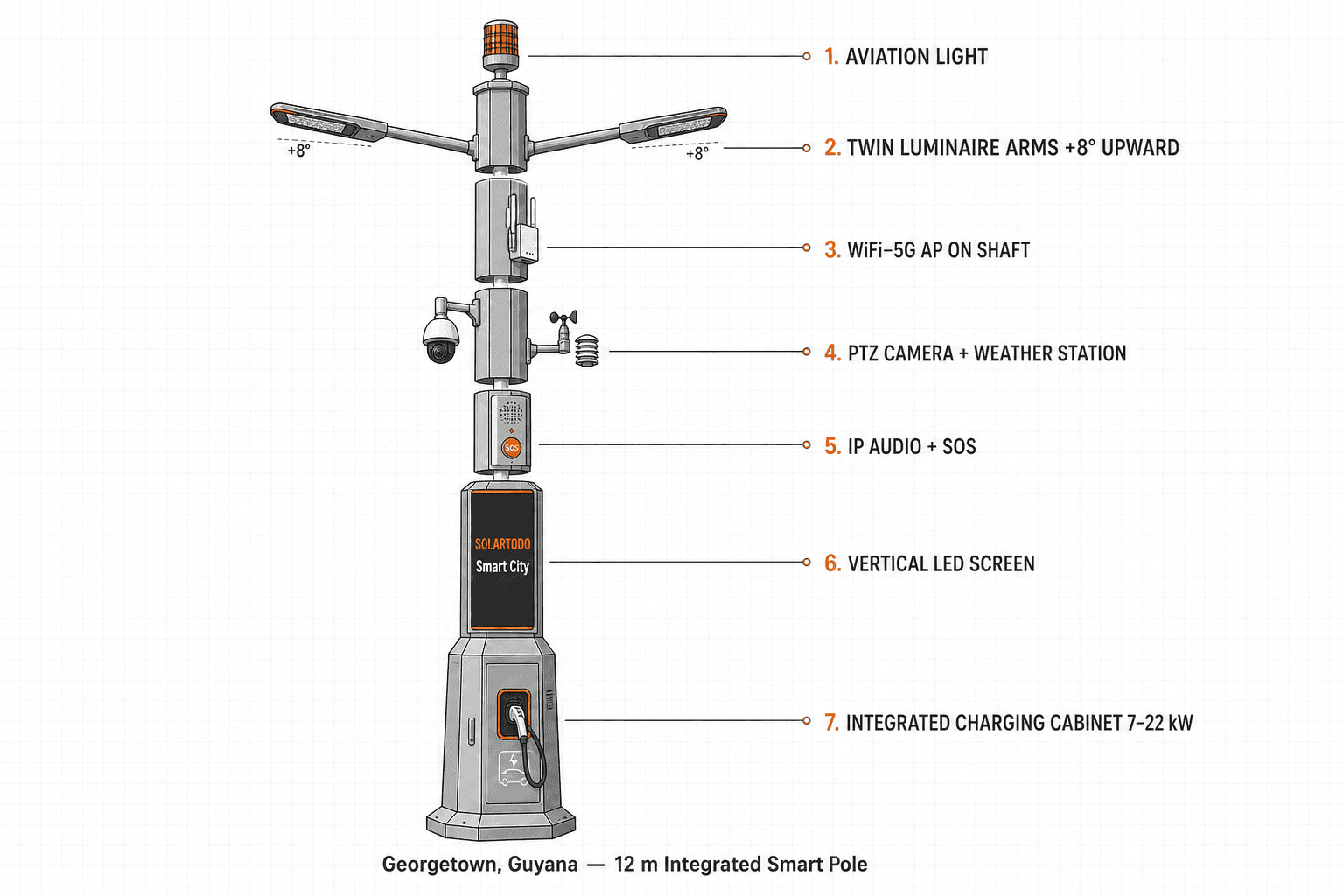
A typical 195-unit configuration would consolidate five separate streetscape functions into one pole foundation: lighting, EV charging, surveillance, public communication, and telecom readiness. This reduces visual clutter compared with separate lamp posts, charger pillars, camera masts, audio columns, and small-cell mounts. It also creates a repeatable urban asset model for corridors where Georgetown needs better lighting and future EV infrastructure without multiplying sidewalk obstructions.
The technical impact is strongest where the integrated lower cabinet removes the need for a side-mounted EV pedestal. A welded pole-as-charger design improves urban appearance, reduces cable-trip hazards, and simplifies protective bollard planning. The 5G flush module at 8.7m also keeps the pole profile cleaner than external telecom boxes, while the RAL9005 finish and flush housing allow the device boundary to read as one continuous structure.
Comparison Table
A Georgetown 12m grid-powered Smart Streetlight offers higher urban-service density than a standard pole, hybrid pole, or premium cylindrical pole in this specific grid-connected capital setting.
| Option | Best fit | Power architecture | Georgetown suitability | Key limitation |
|---|---|---|---|---|
| 12m grid smart pole with integrated EV cabinet | Civic and commercial streets | AC 220/380V grid | High: 195 units, 30m spacing, 11kW EV charging | Requires utility coordination |
| 12m hybrid wind-solar pole | Areas with weaker grid continuity | Wind-solar + LFP + grid backup | Medium: useful for selected backup corridors | More components to maintain in coastal humidity |
| Ø180/200/315/400 cylindrical CIGS pole | Premium districts | Wrapped CIGS + embedded modules | Medium: strong aesthetics | Less suited to the specified outrigger PTZ and twin-arm layout |
| Standard 6-12m modular pole | Basic urban lighting upgrades | Grid or modular accessories | Medium: lower integration cost | Less clean for EV, 5G, display, and SOS consolidation |
Pricing & Quotation
A Georgetown quotation should separate FOB, CIF, and EPC scope for approximately 195 units without publishing unit prices in the technical guide.
SOLARTODO offers three pricing tiers for this product line: FOB Supply (equipment ex-works China), CIF Delivered (including ocean freight and insurance), and EPC Turnkey (fully installed, commissioned, with 1-year warranty). Volume discounts are available for large-scale deployments. Configure your system online for an instant estimate, or request a custom quotation from our engineering team at [email protected].
Frequently Asked Questions
These 10 FAQs address Georgetown’s 195-unit Smart Streetlight configuration, 12m pole class, 11kW EV charging, deployment timing, ROI, maintenance, warranty, and EPC scope.
Q1: What Smart Streetlight configuration is recommended for Georgetown? A typical Georgetown configuration would use approximately 195 units of 12m octagonal tapered steel smart poles at 30m spacing. Each pole would include 2 x 80W LED luminaires, integrated 11kW Type 2 AC EV charging, PTZ camera, 12-parameter environmental sensor, IP audio, SOS alarm, P3 display, USB ports, and 5G NR n78 small-cell readiness.
Q2: Why is the grid-powered 12m variant preferred over a solar-only streetlight? Georgetown is a dense capital-city corridor with multiple continuous loads: lighting, 11kW EV charging, display, camera, audio, sensors, and telecom equipment. A grid-powered AC 220/380V architecture is better aligned with those loads than a solar-only system. Solar or hybrid variants can be considered for selected weak-grid areas, but not as the base specification here.
Q3: How long would a 195-unit deployment typically take? A realistic schedule would often require 4-8 weeks for survey, engineering drawings, and utility coordination, followed by manufacturing, shipping, foundation works, pole erection, and commissioning. Final duration depends on permitting, feeder availability, weather, port clearance, and whether installation proceeds corridor-by-corridor or in several parallel work fronts.
Q4: What ROI factors should Georgetown evaluate? ROI should be calculated as a multi-stream model, not a lighting-only payback. Inputs should include LED energy reduction versus existing lamps, maintenance savings, EV charging utilization, civic or paid display value, telecom lease potential, safety response value, and platform operating costs. A 5-year and 10-year scenario is more useful than a single payback number.
Q5: How is the EV charger integrated into the pole? The lower 2.2m of the pole is the EV charging cabinet itself, welded as one continuous steel structure with the upper pole. It is not a separate standalone charger beside the pole. The cabinet includes an 11kW single-gun AC Type 2 charger, OCPP 1.6J, 5m coiled cable, 8-inch touchscreen, E-stop, and maintenance door.
Q6: What maintenance is required in Georgetown’s coastal climate? Maintenance should include quarterly checks of cabinet seals, drainage conditions, coating damage, charger cable wear, E-stop function, touchscreen status, PTZ movement, IR illumination, audio output, SOS linkage, and display brightness. Coastal humidity and flood exposure make enclosure inspection important. Annual torque, earthing, insulation, and platform telemetry checks should also be planned.
Q7: How does this compare with a standard smart pole? A standard 6-12m modular pole can support LED lighting and accessories, but the Georgetown specification requires deeper integration: 11kW EV charging inside the pole body, a 1000 x 2000mm P3 display, 5G n78 small-cell readiness, 12-parameter sensing, emergency systems, and coordinated cable routing. The 12m grid variant is more suitable for high-function civic corridors.
Q8: What standards apply to the recommended configuration? The lighting system should align with IEC 60598, the smart lighting functions should reference GB/T 37024, and the EV connector should align with IEC 62196-2 for Type 2 AC charging compatibility. OCPP 1.6J is recommended for charger-network communication. Local electrical, civil, telecom, road, and permitting rules must be checked before final installation.
Q9: What warranty and EPC scope should buyers request? For EPC procurement, buyers should request equipment supply, foundations, installation, commissioning, platform onboarding, training, as-built drawings, and a 1-year warranty as a minimum commercial scope. Warranty terms should identify exclusions for flooding, vandalism, grid surges, collision damage, and unauthorized modifications. Spare parts for chargers, displays, and sensors should be listed separately.
Q10: Does the guide claim SOLARTODO has installed these poles in Georgetown? No. This is a market analysis and technical configuration guide, not a fabricated case study. The 195-unit figure is a recommended or typical deployment scale based on the provided Georgetown configuration and 30m spacing. It should not be read as a completed installation, client reference, project ID, or past deployment claim.
References
These 8 references support the Georgetown market context, smart-city architecture, luminaire safety, EV connector compatibility, and energy-efficiency assumptions used in this guide.
- Bureau of Statistics Guyana (2014): Guyana Population and Housing Census 2012 preliminary reporting lists Georgetown at 118,363 residents; later 2022 census aggregations list approximately 125,683 residents. https://statisticsguyana.gov.gy/
- World Bank/GFDRR (2005): Guyana preliminary damage and needs assessment for the January 2005 flood estimated about 290,000 affected people and US$465 million in damage. https://www.gfdrr.org/
- Guyana Power and Light (2024): GPL is the main coastal Guyana electricity utility and relevant coordination body for Georgetown grid-connected loads. https://gplinc.com/
- Government of Guyana (2022): Low Carbon Development Strategy 2030 identifies transport, energy, and climate-resilient development as national priorities. https://lcds.gov.gy/
- IEC (2024): IEC 60598 series defines safety requirements for luminaires, including general and application-specific luminaire requirements. https://www.iec.ch/
- IEC (2022): IEC 62196-2 specifies dimensional compatibility and interchangeability requirements for AC EV plugs, socket-outlets, connectors, and inlets. https://www.iec.ch/
- ITU (2016): ITU-T Y.4903/L.1603 defines key performance indicators for smart sustainable cities and ICT-enabled urban services. https://www.itu.int/
- IEA (2023): Energy-efficiency guidance identifies LED lighting and controls as core measures for reducing lighting electricity consumption. https://www.iea.org/
Equipment Deployed
- Approximately 195 units x 12m octagonal tapered steel Smart Streetlight poles, base Ø45cm to top Ø15cm, RAL9005 powder coat
- Integrated lower 2.2m pole-as-EV-charger cabinet, welded as one continuous steel structure
- 2 x 80W SOLARTODO LED luminaires per pole, 150 lm/W, 4000K, twin 1.5m symmetric arms with +8° tilt
- 11kW single-gun AC Type 2 EV charger, OCPP 1.6J, 5m coiled cable, 8-inch touchscreen, red mushroom E-stop
- 22cm white PTZ dome camera, 360° rotation, 25x zoom, IR 150m, 50cm L-bracket outrigger
- 12-parameter environmental sensor for meteorology, air quality, rain, CO, NO2, and O3
- IP audio column Ø10 x 50cm, 30W/93dB, TCP/IP, flush color-matched mounting
- P3 vertical LED display, 1000 x 2000mm portrait, >6000 cd/m², SOLARTODO Smart City text only
- 5G NR n78 small cell, 4T4R MIMO, approximately 200m coverage, flush-mounted at 8.7m
- USB-A x2, 5V/2.4A, mounted on the integrated charging cabinet