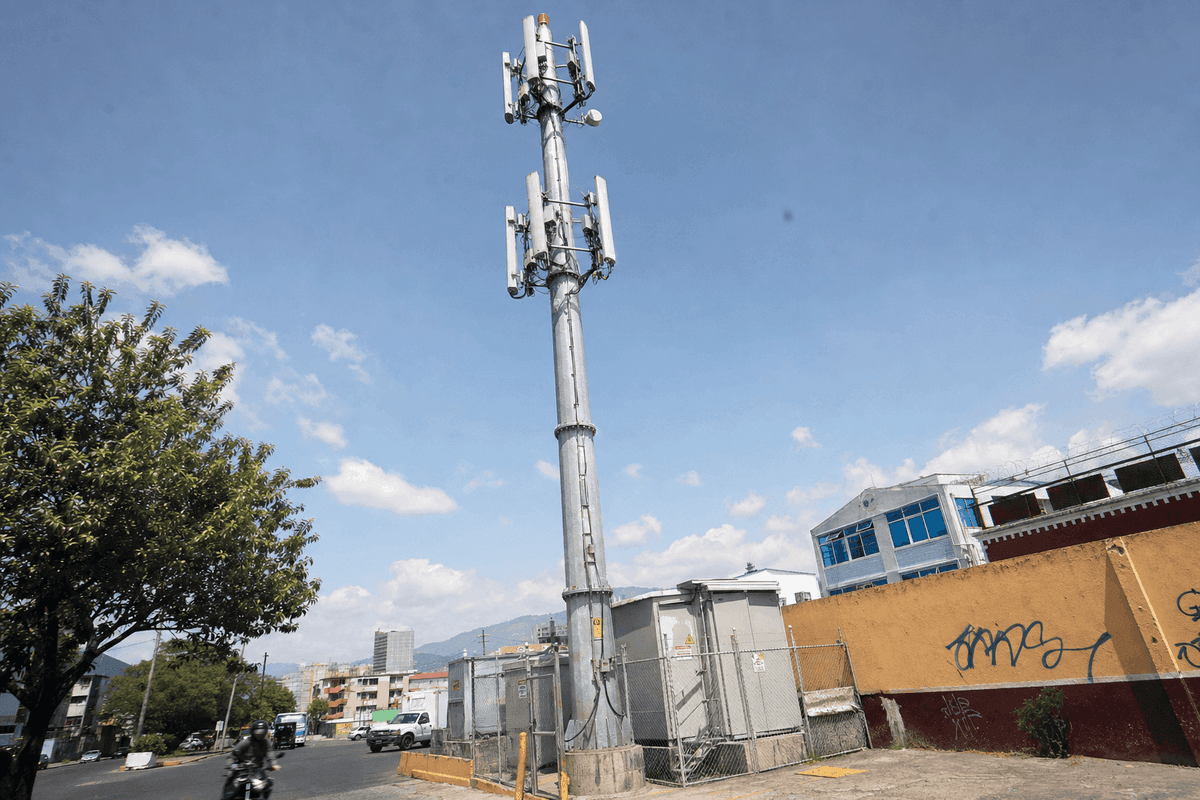
Guatemala City Telecom Tower Market Analysis: 30m Monopole Configuration Guide for Urban Macro Coverage
Summary
Guatemala City’s dense urban footprint and high mobile-data demand support a typical 20-unit, 30m steel monopole Telecom Tower program using wind class 2 at 50 m/s, with about 15t of galvanized Q345 steel per tower and CKD shipping that cuts transport volume by 60-70%.
Key Takeaways
- A typical Guatemala City macro-cell expansion package would use approximately 20 units of 30m tapered steel monopole towers for urban and suburban coverage infill.
- The specified tower class fits the 25-35m suburban/residential engineering band, where 15-22t structural mass is standard; this configuration is about 15t per tower.
- The recommended antenna load is 6× panel antennas + 1× 50kg microwave dish + 3× 30kg RRUs, matching a common 4G/5G urban macro loading profile.
- For Guatemala City’s wind exposure and elevated corrosion risk, a practical design basis is TIA-222-H wind class 2, or 50 m/s with 1.15 load factor, plus hot-dip galvanizing.
- A typical civil scope would use concrete pad foundations, 3 antenna platforms, a climbing ladder, safety cage, lightning rod, and a full grounding system designed to GB/T 50233 and TIA-222-H.
- With CKD shipping, tower sections can reduce container volume by 60-70%, which matters for imported steel structures moving through regional logistics corridors.
- A normal manufacturing window for this specification is 30-45 days, while field installation and commissioning for a 20-site rollout would usually be phased over several additional weeks.
- The design life target is 30 years, and lifecycle performance depends more on coating integrity, bolt inspection cycles, and grounding resistance tests than on initial steel tonnage alone.
Market Context for Guatemala City
Guatemala City combines a metropolitan population base above 3 million with concentrated commercial districts, hillside neighborhoods, and transport corridors that increase the need for medium-height macro telecom structures in the 25-35m class. According to the World Bank (2023), Guatemala’s urban population exceeds 52% of the national total, while the UN data platform for metropolitan areas places the Guatemala City agglomeration above 3 million residents, supporting sustained mobile traffic growth in a compact service area.
The local infrastructure issue is not only coverage but also site geometry. Guatemala City sits at approximately 1,500 m elevation and is affected by seasonal rainfall, localized slope conditions, and corrosion exposure from urban pollution and moisture. According to INSIVUMEH, Guatemala’s rainy season typically runs from May to October, which affects foundation scheduling, crane access, and grounding works for telecom sites. For monopole planning, that climate pattern generally favors pad-foundation work during drier construction windows and galvanizing suitable for a high-corrosion zone.
Mobile network demand also supports macro-tower investment. According to the ITU (2023), mobile-broadband adoption continues to rise across Latin America, and network quality increasingly depends on denser site grids rather than only higher spectrum allocations. GSMA states, "5G and 4G expansion in Latin America requires continued investment in backhaul and site densification," a point that is directly relevant to Guatemala City’s combination of dense districts and suburban edge growth.
Guatemala’s telecom environment also favors monopoles over larger lattice footprints in many urban parcels. Municipal and private land constraints often make a 30m monopole more practical than a wider base structure because the foundation envelope is smaller and the visual profile is simpler. According to the World Bank (2020), digital infrastructure gaps in developing urban markets are frequently tied to permitting, right-of-way, and site access constraints as much as to radio equipment costs.
From a structural standpoint, Guatemala City does not usually require the 35-45m highway or peri-urban class for every site. The city’s mixed-density neighborhoods, ring-road corridors, and commercial clusters more often point to the 25-35m size class for macro infill and capacity relief. That is why the specified 30m Telecom Tower is a technically consistent fit: it sits in the correct height band, supports a 6-panel + microwave + RRU loading package, and remains within the expected 15-22t weight range for this class.
A second local factor is resilience. Guatemala is exposed to seismic activity and seasonal storm events, so telecom buyers usually prioritize code-based structural verification, foundation simplicity, and maintenance access. TIA states, "Telecommunications structures shall be designed to resist loads and load combinations as specified for the applicable reliability class" in TIA-222-H, which is the correct basis for monopole design review alongside GB/T 50233 for fabrication and erection control.
SOLARTODO’s Telecom Tower line is relevant here because the product format matches the city’s practical need: sectional steel monopoles that can be shipped in CKD form, erected on constrained sites, and configured for common urban macro antenna arrays. For Guatemala City, the market fit is less about extreme height and more about repeatable 30m deployments with predictable civil works, corrosion protection, and microwave-ready top sections.
Recommended Technical Configuration
A typical 20-unit deployment in Guatemala City would consist of 30m hot-dip galvanized steel monopole towers with urban macro loading, concrete pad foundations, and 3 antenna platforms for mixed 4G/5G coverage and microwave backhaul.
Based on the city profile, the correct engineering class is the 25-35m suburban/residential category from the tower sizing table. That class is defined for 2 platforms, 6-9 panel antennas, and approximately 15-22t per tower. The project-specific requirement is 30m and about 15t per tower, which fits the lower end of that weight band and aligns with the rule of roughly 500 kg/m × height.
For Guatemala City, a recommended configuration is:
- Approximately 20 units of 30m tapered steel monopole Telecom Tower
- Hot-dip galvanized Q345 steel construction
- Wind class 2 per TIA-222-H, based on 50 m/s design wind speed and 1.15 factor
- High-corrosion zone treatment strategy
- Concrete pad foundation for standard urban and suburban parcels where soil conditions allow shallow civil works
- Antenna load: 6× panel antennas + 1× microwave dish (50kg) + 3× RRUs (30kg each)
- 3 antenna platforms, plus ladder, cable tray, warning light, grounding, lightning rod, and safety cage
- 30-year design life with scheduled coating and bolt inspections
This loading profile is technically suitable for Guatemala City because it balances sector coverage and backhaul without pushing the monopole into the heavier 35-45m class. A 6-panel arrangement supports a common three-sector macro layout with dual-band or multi-band panel combinations, while 1 microwave dish adds practical backhaul flexibility where fiber is delayed or leased capacity is limited.
The choice of concrete pad foundation is also logical for a standardized 20-site program. Pad foundations reduce field complexity compared with pile solutions when the geotechnical report shows adequate bearing capacity and manageable groundwater conditions. In Guatemala City, soil conditions vary by district, so pad foundations should still be confirmed by site-specific geotechnical review, but they remain a common baseline for 30m monopole structures.
For logistics, CKD shipment is a notable advantage. A 60-70% reduction in shipping volume can improve container utilization and reduce inland handling complexity for sectional poles, flanges, ladders, and platforms. For buyers comparing imported monopoles with locally fabricated alternatives, this has planning value even when total landed cost depends on freight timing, customs, and crane mobilization.
SOLARTODO should be evaluated in this context as a supply and configuration option rather than as a claimed completed project in the city. The recommended package is a market-fit specification for Guatemala City, not a statement of past deployment. Buyers that need site-specific loading checks can contact us or review the Telecom Tower product page before final structural verification.
Technical Specifications
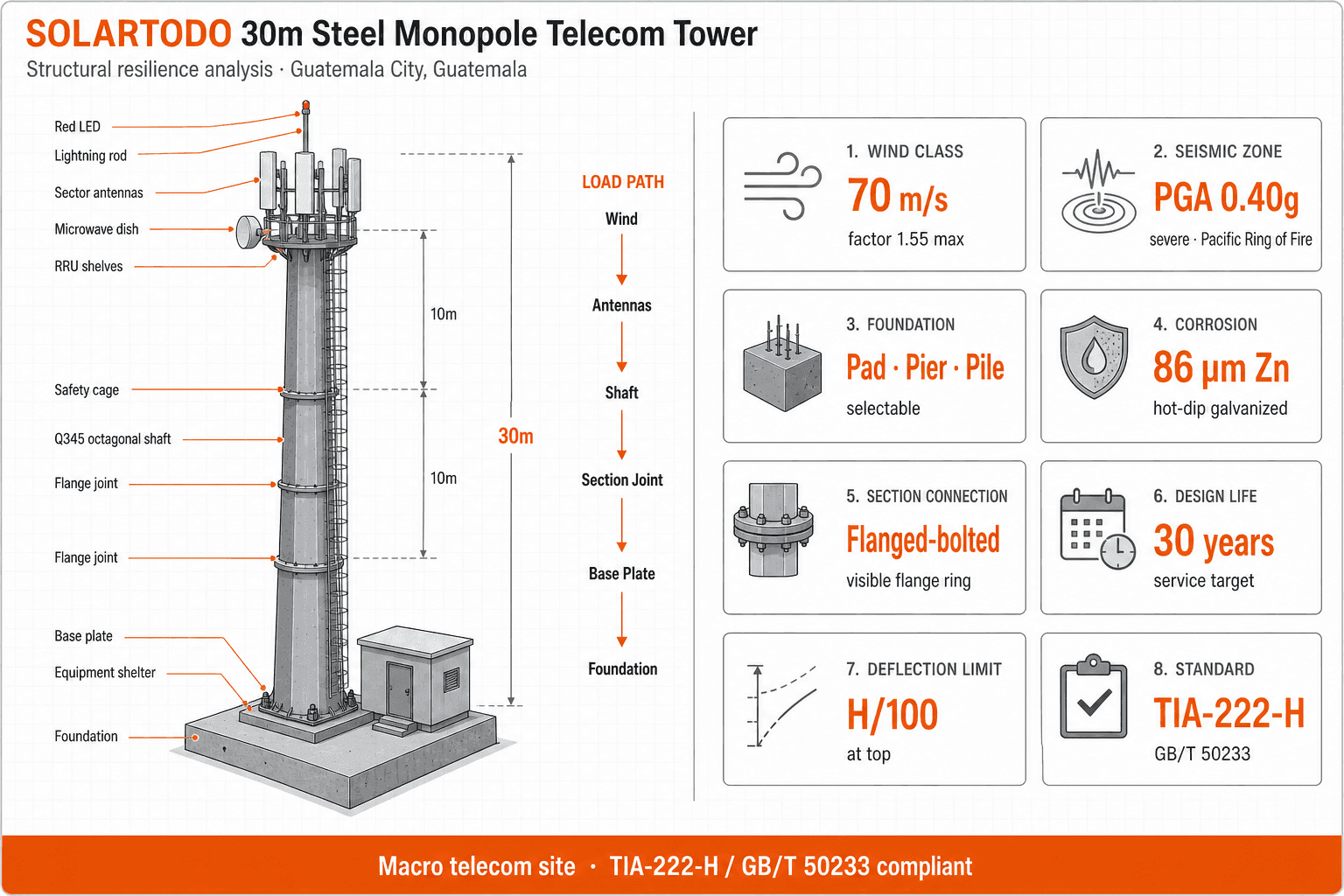
The Guatemala City recommendation is a 30m, 15t steel monopole in wind class 2 with 6 panels, 1 microwave dish, 3 RRUs, and a 30-year design life under TIA-222-H and GB/T 50233.
- Product type: Steel Telecom Tower monopole, tapered round or octagonal tube form
- Recommended city configuration: 30m sectional monopole for urban macro / high-coverage use
- Quantity basis: Approximately 20 units for a medium-scale city coverage or infill package
- Material: Q345 steel, hot-dip galvanized for high-corrosion zone exposure
- Tower weight: ~15t per tower, consistent with the engineering rule of 500kg/m × 30m
- Size-class compliance: Falls within 25-35m class for suburban/residential deployment, where 15-22t is standard
- Antenna load: 6× panel antennas + 1× microwave dish (50kg) + 3× RRUs (30kg each)
- Platforms: 3 antenna platforms
- Wind rating: Class 2, 50 m/s, factor 1.15, designed to TIA-222-H
- Foundation type: Concrete pad foundation, subject to geotechnical confirmation at each site
- Section connection: Flanged bolt-on sectional design for transport and erection efficiency
- Accessories: Climbing ladder, cable tray, aircraft warning light, grounding system, lightning rod, safety cage
- Design life: 30 years
- Shipping mode: CKD, with 60-70% volume reduction versus fully assembled transport
- Production lead time: 30-45 days under normal factory scheduling
- Applicable standards: TIA-222-H and GB/T 50233
Implementation Approach
A standard Guatemala City rollout would move through 5 phases over roughly 10-20 weeks after design release, starting with geotechnical checks and ending with grounding, antenna mounting, and acceptance testing.
Phase 1: Site screening and permitting. A telecom buyer would normally begin with 20 candidate parcels or rooftops, radio planning outputs, and municipal review of height, setback, and aviation-light obligations. At this stage, the key output is not fabrication but a site matrix covering access width, crane position, utility conflicts, and soil assumptions for the 30m monopole and concrete pad foundation.
Phase 2: Structural and civil design. Each site should be checked against TIA-222-H load combinations, local wind assumptions, and the exact antenna stack of 6 panels + 1 microwave dish + 3 RRUs. Foundation drawings should confirm bearing pressure, anchor-bolt cage geometry, and grounding layout. For Guatemala City’s rainy season, drainage details around the pad are important because standing water can accelerate corrosion around base plates and cable entries.
Phase 3: Manufacturing and CKD shipping. The specified production window is 30-45 days. During this stage, pole sections, flanges, ladders, cable trays, safety cages, and platform members are fabricated, galvanized, packed, and prepared for CKD export. Because shipment volume can drop by 60-70%, container planning should be done early so the erection sequence matches the packing list and site-by-site delivery order.
Phase 4: Civil works and erection. A concrete pad foundation usually requires excavation, rebar placement, anchor-bolt setting, concrete pouring, and curing before pole erection. After curing, the flanged sections are lifted and bolted, then plumbed and torque-checked. Accessory installation includes the climbing ladder, 3 platforms, cable tray, lightning rod, and warning light.
Phase 5: Commissioning and acceptance. Final work includes grounding resistance tests, bolt-torque verification, verticality checks, galvanizing inspection, and antenna-mount confirmation. According to IEEE guidance on grounding practice, telecom sites need low-resistance earthing suited to local soil conditions and lightning exposure. For Guatemala City, this step matters because seasonal storms can stress both RF equipment and structural grounding paths.
From a procurement perspective, SOLARTODO’s role in such a project is best evaluated on manufacturing consistency, standards compliance, and documentation quality. Buyers should request loading calculations, galvanizing specifications, packing lists, and installation drawings before award. For site-specific review or quotation support, use contact us.
Expected Performance & ROI
For Guatemala City, a 20-site 30m macro-tower package would typically improve coverage continuity, sector capacity, and backhaul flexibility, while the economic return depends on tenancy, avoided lease churn, and lower lifecycle maintenance versus heavier tower classes.
The direct output of a 30m monopole is not energy generation but network utility. In practical terms, the expected performance gain comes from better antenna elevation, cleaner line-of-sight for microwave links, and more consistent sector geometry than lower street-level assets can provide. According to the ITU (2023), mobile-broadband quality is strongly influenced by access-network densification and backhaul readiness, both of which are supported by the specified 6-panel + microwave configuration.
On ROI, telecom tower payback is usually modeled through revenue per tenant, reduced dropped-session rates, and lower incremental cost per added sector compared with entirely new greenfield compounds. Industry tower portfolios in Latin America often target payback in the 4-8 year range depending on land lease, power availability, and co-location rates, although site-specific returns vary widely. For a 30-year design life, the more durable financial metric is lifecycle cost per usable antenna position rather than only upfront capex.
Maintenance costs are also relevant. A 30m, 15t monopole generally has fewer members and less bolt complexity than a larger lattice structure, which can reduce inspection labor over a 30-year period. According to NREL (2023), lifecycle asset performance in infrastructure projects is improved when preventive maintenance intervals are defined from the start, not deferred until visible failure appears. For telecom towers, that means planned checks on galvanizing condition, flange bolts, grounding continuity, and platform hardware.
A second ROI factor is logistics. CKD shipping that reduces volume by 60-70% can improve import efficiency and staging, especially for multi-site programs. That does not automatically guarantee a lower total installed cost, but it can reduce handling bottlenecks and storage requirements. For Guatemala City, where urban access windows and site congestion matter, that operational benefit can shorten the time between delivery and erection.
Results and Impact
In Guatemala City, the likely impact of a 20-unit 30m monopole program is stronger urban macro coverage, faster microwave-ready site activation, and a 30-year asset base that fits constrained parcels better than broader-footprint tower alternatives.
Comparison Table
For Guatemala City buyers, the 30m wind-class-2 monopole offers the best balance between coverage, weight, and site footprint when compared with shorter infill poles or taller peri-urban tower classes.
| Configuration Option | Height | Typical Load Profile | Approx. Tower Weight | Foundation | Best Fit in Guatemala City | Comments |
|---|---|---|---|---|---|---|
| Short urban infill pole | 20-25m | 3-6 panel antennas | 8-15t | Pad/pier | Dense infill only | Lower visual impact, but less macro reach |
| Recommended SOLARTODO Telecom Tower | 30m | 6 panels + 1 microwave + 3 RRUs | ~15t | Concrete pad | Urban macro and suburban edge | Best match to 25-35m class and 20-site rollout |
| Taller peri-urban monopole | 35-40m | 6-9 panels + 1-2 microwave | 22-30t | Pad/pile | Highway and wider-area coverage | Higher steel tonnage and larger civil scope |
| Rural wide-coverage tower | 45m+ | 9-12 panels | 30-40t | Pile/pad | Rural outskirts only | Excess height for many city parcels |
Pricing & Quotation
SOLARTODO offers three pricing tiers for this product line: FOB Supply (equipment ex-works China), CIF Delivered (including ocean freight and insurance), and EPC Turnkey (fully installed, commissioned, with 1-year warranty). Volume discounts are available for large-scale deployments. Configure your system online for an instant estimate, or request a custom quotation from our engineering team at [email protected].
Frequently Asked Questions
This FAQ covers 10 common buyer questions on 30m monopole specs, timeline, maintenance, ROI, warranty, and installation for Guatemala City Telecom Tower procurement.
Q1: Why is a 30m Telecom Tower recommended for Guatemala City instead of a 40m tower? A 30m monopole fits the 25-35m engineering class used for suburban and urban macro coverage, with standard weight of 15-22t and support for 6-9 panels. In Guatemala City, many sites are space-constrained, so 40m structures can add civil cost and permitting complexity without proportional RF benefit on every parcel.
Q2: What antenna load does this recommended configuration support? The specified load is 6× panel antennas, 1× microwave dish at 50kg, and 3× RRUs at 30kg each. That is a practical urban macro arrangement for 4G/5G sectors plus microwave backhaul. Final approval still depends on mount geometry, projected area, and the full TIA-222-H structural calculation.
Q3: Is 15t a realistic weight for a 30m monopole tower? Yes. The rule used here is about 500kg per meter, so a 30m tower is approximately 15t. That aligns with the product engineering table for the 25-35m class, which indicates 15-22t per tower. A much lower figure would understate steel demand; a much higher figure would suggest a different structure class.
Q4: Why use hot-dip galvanized Q345 steel in Guatemala City? Q345 steel provides a common structural grade for telecom monopoles, and hot-dip galvanizing is important in a high-corrosion zone with urban moisture and seasonal rainfall. For a 30-year design life, coating quality is one of the main lifecycle variables. Buyers should review zinc-coating specifications and inspection records before shipment.
Q5: How long would a 20-unit program usually take? Manufacturing is typically 30-45 days for this specification. Total program duration is longer because it includes geotechnical review, foundation curing, logistics, erection, and antenna installation. For approximately 20 sites, a phased schedule often runs 10-20 weeks after final design approval, depending on permitting and weather windows.
Q6: What kind of foundation is suitable for this tower in Guatemala City? The baseline recommendation is a concrete pad foundation. It is suitable for many 30m monopole sites when the geotechnical report confirms adequate bearing capacity and manageable groundwater conditions. If soils are weak or access is difficult, a pier or pile solution may be required, but that would be a site-specific design change.
Q7: What maintenance should buyers expect over 30 years? Routine maintenance usually includes annual visual checks, periodic bolt-torque verification, grounding resistance testing, and coating inspection. After major storm seasons, operators often repeat checks on the lightning rod, warning light, and cable supports. The main lifecycle items are galvanizing condition, flange bolts, platform hardware, and earthing continuity.
Q8: How does a monopole compare with a lattice telecom tower? A monopole generally uses a smaller footprint and cleaner urban profile, which helps on compact city parcels. A lattice tower can be advantageous for very heavy loads or taller structures, but for a 30m, 6-panel + microwave macro site, a monopole is often the simpler choice. It also tends to reduce member count and visual clutter.
Q9: What does CKD shipping mean for this product? CKD means the tower ships in sectional form rather than as a fully assembled structure. For this product, that can reduce transport volume by 60-70%. The benefit is better container utilization and easier staging for multi-site programs. Buyers should still verify packing sequence, flange protection, and accessory labeling before dispatch.
Q10: What warranty and pricing formats are usually available? The standard quotation structure includes FOB Supply, CIF Delivered, and EPC Turnkey options. The required pricing section above notes that EPC Turnkey includes a 1-year warranty. Commercial terms vary by scope, but buyers should always request a clear inclusion list covering steelwork, galvanizing, accessories, drawings, and installation boundaries.
References
- World Bank (2023): Urban population data for Guatemala, showing national urbanization above 52% and supporting demand concentration in metropolitan service areas.
- United Nations, World Urbanization Prospects (2018 revision / latest available metro dataset): Guatemala City metropolitan population above 3 million, relevant to telecom density planning.
- INSIVUMEH (2023): Guatemala climate and seasonal rainfall patterns, including May-October rainy season relevant to foundation works and corrosion exposure.
- ITU (2023): Mobile broadband and digital infrastructure indicators for Latin America, supporting the need for access-network densification and backhaul readiness.
- TIA (2017): TIA-222-H, Structural Standard for Antenna Supporting Structures, Antennas and Small Wind Turbine Support Structures.
- GB/T 50233 (2014): Standard for construction and acceptance of communication line engineering / telecom structure works, relevant to fabrication and erection control.
- NREL (2023): Asset management and lifecycle planning guidance for infrastructure systems, relevant to preventive maintenance and long-term performance.
- GSMA (2023): Latin America mobile infrastructure outlook; GSMA states, "5G and 4G expansion in Latin America requires continued investment in backhaul and site densification."
Equipment Deployed
- 20 units × 30m tapered steel monopole Telecom Tower
- Hot-dip galvanized Q345 steel structure, approx. 15t per tower
- Wind class 2 design: 50 m/s, factor 1.15, per TIA-222-H
- Antenna load: 6× panel antennas
- 1× microwave dish, 50kg
- 3× RRUs, 30kg each
- Concrete pad foundation
- 3 antenna platforms
- Climbing ladder
- Cable tray
- Aircraft warning light
- Grounding system
- Lightning rod
- Safety cage
- Flanged bolt-on sectional connection
- CKD shipping format with 60-70% volume reduction