Ho Chi Minh City Smart Traffic System Market Analysis: 24-Intersection 8m Pole Configuration Guide
Summary
Ho Chi Minh City’s dense urban traffic profile and tropical rainfall support a typical 24-intersection smart traffic upgrade using approximately 24 sets of 8m L-arm poles, 77GHz radar, and 4K AI cameras with <50ms response over 5G/fiber backhaul under NTCIP and GB 25280.
Key Takeaways
- Ho Chi Minh City has about 9.3 million residents, and the metro area exceeds 14 million, which increases demand for adaptive signal control at high-conflict junctions according to the Ho Chi Minh City Statistics Office and World Bank (2023).
- A typical city-core deployment profile would use approximately 24 intersections × 8m dark-grey hot-dip galvanized L-arm steel poles, with 4-12 poles per intersection depending on approach geometry and auxiliary lanes.
- The specified sensing stack combines 4K AI video at 98% detection accuracy with 77GHz mmWave radar and <50ms response, which supports mixed traffic detection across 45+ object and event types.
- Ho Chi Minh City’s annual rainfall is roughly 1,900-2,000mm and average temperatures stay near 27°C, so corrosion protection, sealed enclosures, and stable edge computing hardware are important for roadside uptime according to Vietnam’s hydro-meteorological data.
- A recommended architecture connects NVIDIA Jetson edge AI to 5G/fiber backhaul and a central TrafficGPT platform, allowing natural-language traffic queries, adaptive signal timing, emergency vehicle priority, and wrong-way alerts.
- For a 24-intersection package, EPC turnkey is the most practical commercial model because it aligns civil works, signal integration, backhaul, commissioning, and standards compliance under one contract structure.
- According to the World Bank (2023), congestion in large cities can cost several percentage points of urban productivity, so even a 10-20% reduction in delay at priority corridors can justify smart signal investment over a 3-7 year horizon.
- SOLAR TODO positions this Smart Traffic System around NTCIP and GB 25280 compliance, with 8m poles suited to urban intersections rather than 10-12m highway gantry applications.
Market Context for Ho Chi Minh City
Ho Chi Minh City is Vietnam’s largest urban mobility market, with about 9.3 million residents in the municipality and a much larger commuting region above 14 million people, making intersection throughput and incident response central procurement issues. According to the Ho Chi Minh City Statistics Office (2023), the city remains the country’s main commercial hub, while the World Bank (2023) notes that congestion in major Vietnamese cities creates measurable economic losses through delay, fuel waste, and logistics friction.
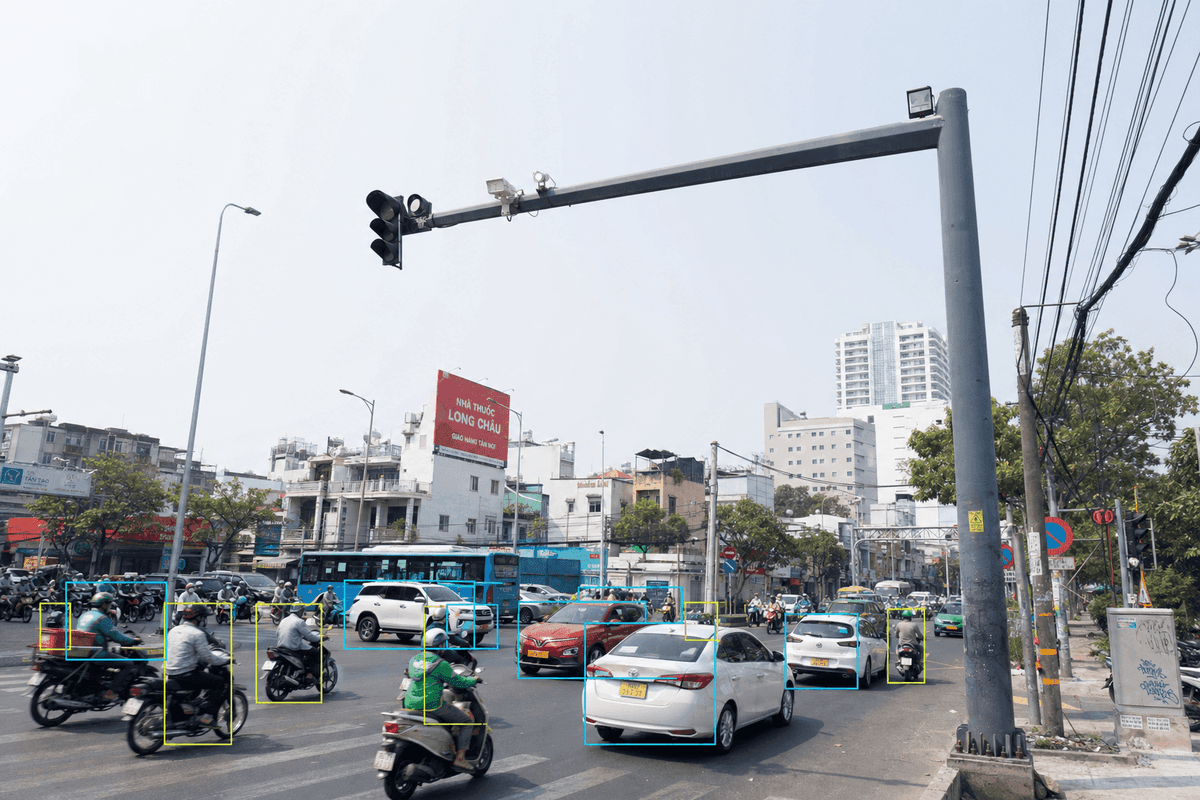
The transport challenge is not only volume but traffic mix. According to the World Bank (2023), motorcycles still dominate urban travel in Vietnam, while buses, freight vehicles, cars, and emergency vehicles compete for limited signalized road space. That mix matters because a Smart Traffic System in Ho Chi Minh City must classify more than private cars; it should detect two-wheelers, buses, trucks, stopped vehicles, queue spillback, and wrong-way movement with low latency under heavy lane-sharing conditions.
Climate also affects equipment choice. According to the Vietnam Institute of Meteorology, Hydrology and Climate Change and city climate records, Ho Chi Minh City has average annual temperatures near 27°C and rainfall close to 1,900-2,000mm, with a long wet season from roughly May to November. For roadside electronics, that means hot-dip galvanizing, sealed housings, stable thermal design, and reliable communications matter as much as pure AI accuracy.
Telecom readiness supports centralized traffic analytics. According to the International Telecommunication Union (2023), Vietnam continues expanding mobile broadband and fiber access, and urban districts in Ho Chi Minh City have strong 4G/5G and metro fiber availability compared with secondary cities. That makes a 5G/fiber hybrid backhaul design practical for intersections that need sub-second event transmission and central platform visualization.
The local policy direction also favors signal intelligence. Ho Chi Minh City’s transport planning documents and smart-city programs prioritize digital management, camera systems, and traffic control center integration. In practical terms, that creates a fit for the SOLAR TODO Smart Traffic System where edge detection at the pole level feeds a city platform instead of relying only on fixed-time signal plans.
As the IEA states, "Digitalization can improve the efficiency, reliability and resilience of energy and infrastructure systems." In traffic operations, that principle translates into better phase timing, faster fault detection, and data-backed corridor optimization. The ITU also states, "Smart sustainable cities use information and communication technologies to improve quality of life and the efficiency of urban operation and services," which directly supports AI-assisted signal control in a dense city like Ho Chi Minh City.
Recommended Technical Configuration
For Ho Chi Minh City’s dense urban intersections, a typical 24-intersection deployment would use 8m L-arm smart traffic poles rather than 6m compact poles or 10-12m highway gantry variants. The 8m class fits standard city junction sightlines, overhead signal mounting, mixed-lane detection, and roadside equipment clearance without moving into expressway-scale structures.
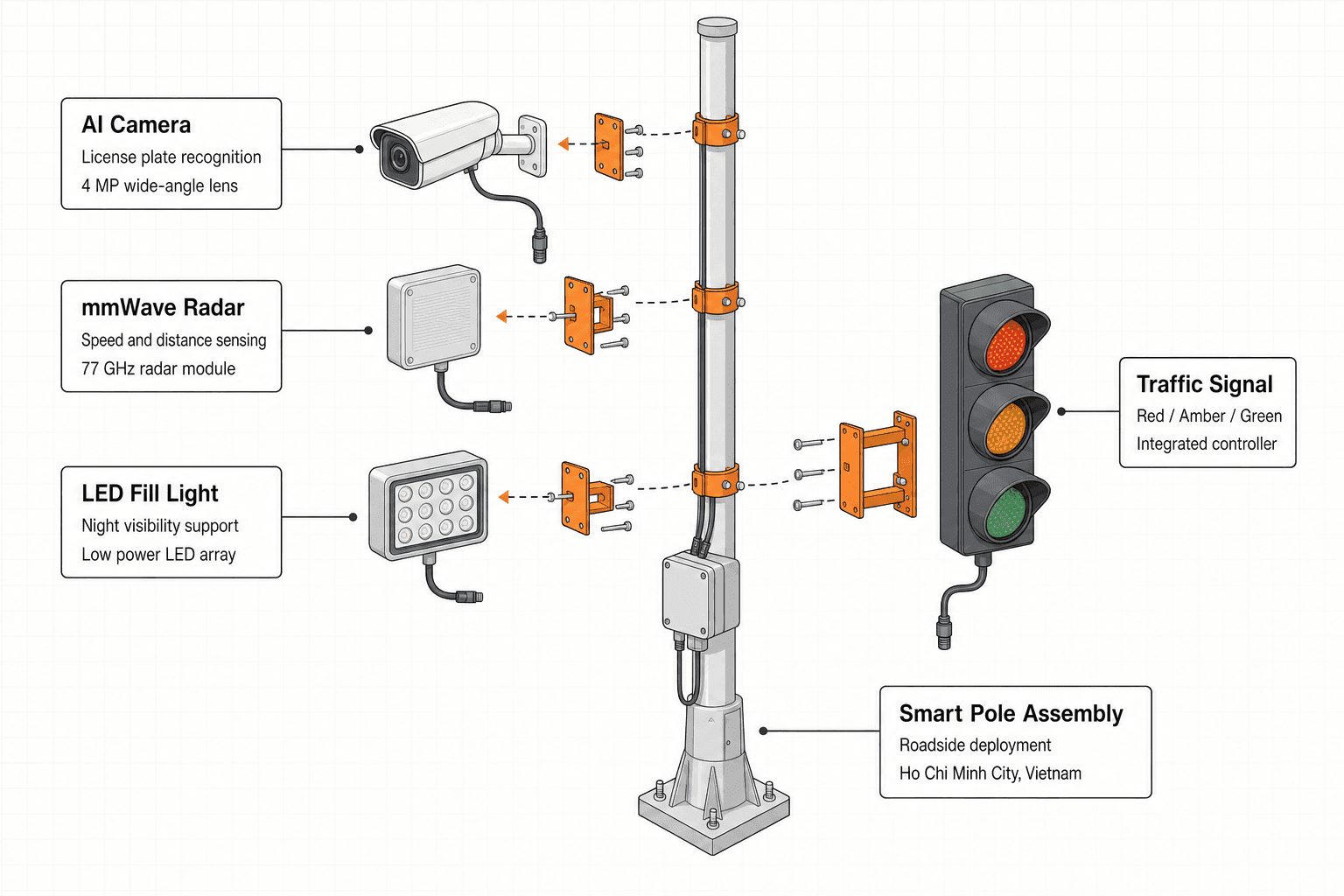
The project-specific configuration is clear. A typical deployment of this scale would consist of approximately 24 intersections × 8m L-arm steel poles in dark grey with hot-dip galvanizing. Each pole would integrate a 4-in-1 module set: 4K AI camera with 98% accuracy and <50ms response, 77GHz mmWave radar, LED fill light, and LED signal head, with NVIDIA Jetson edge AI processing at the pole.
At the intersection level, the total pole count would normally range from 4 to 12 poles per junction, depending on whether the site has four standard approaches, channelized right turns, bus priority lanes, pedestrian refuge islands, or auxiliary stop-line monitoring. For 24 intersections, that means a practical planning envelope of approximately 96 to 288 poles. Buyers usually start quantity definition from lane geometry and visibility requirements, not from a fixed per-intersection average.
The functional stack should include full 45-type detection, adaptive signal control, emergency vehicle priority, and wrong-way alerting. In Ho Chi Minh City, those features are relevant because mixed traffic and curbside friction make queue estimation and conflict detection more difficult than in car-dominant cities. A radar-plus-video architecture improves reliability during heavy rain, partial occlusion, and nighttime glare compared with video-only sensing.
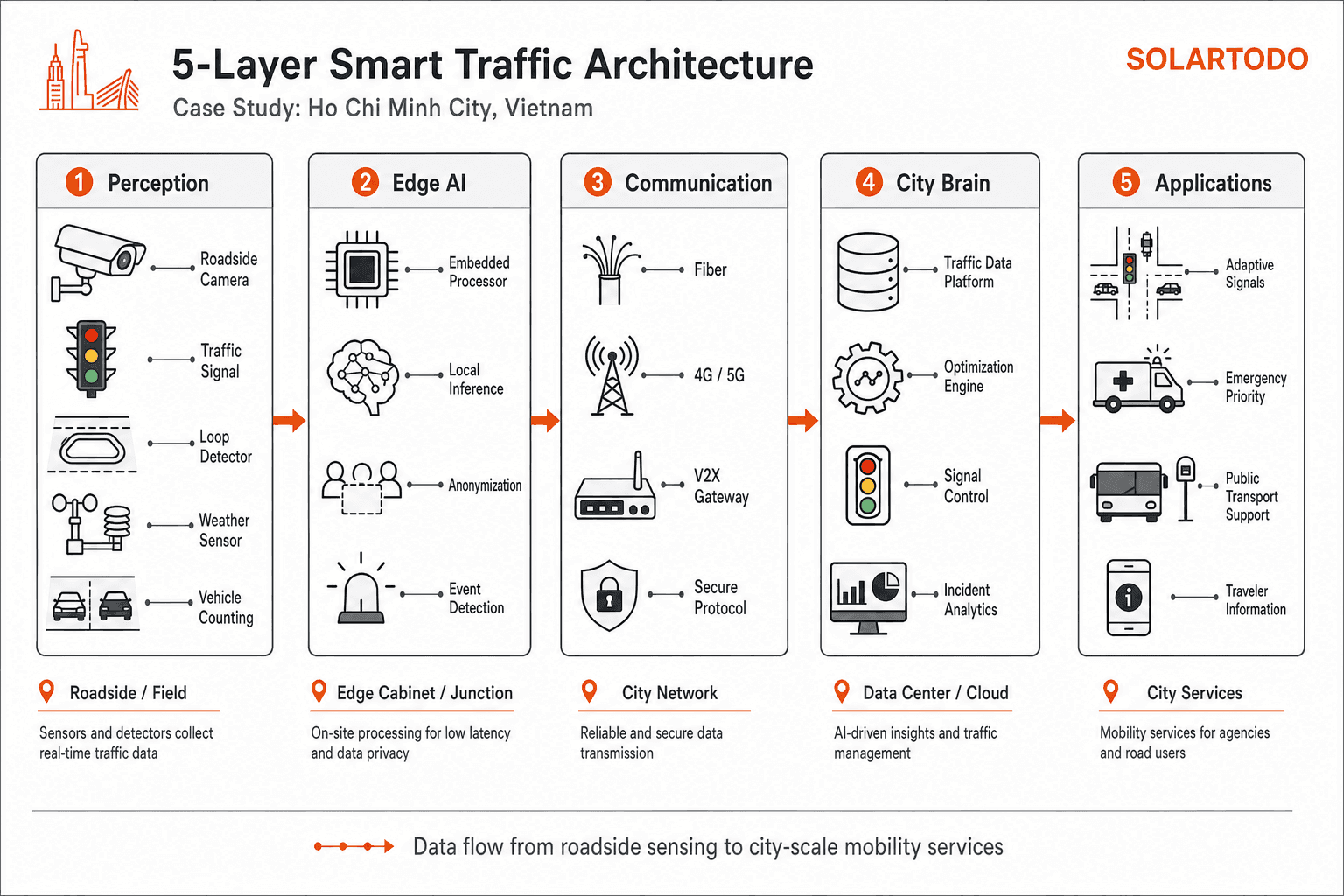
Backhaul should connect by 5G or fiber to a central TrafficGPT platform. Fiber is preferred for major arterials and traffic management centers because it provides stable bandwidth for 4K streams and event data. 5G is useful where trenching is difficult or where phased rollout requires faster activation. SOLAR TODO’s recommended architecture uses a 5-layer stack: Perception → Edge AI → Communication → City Brain (TrafficGPT) → Applications.
The commercial model for this profile should be EPC turnkey. For 24 intersections, EPC reduces interface risk across civil foundations, pole erection, signal controller connection, power distribution, communications, and software commissioning. BOT can fit concession-style projects, and joint venture can fit municipal-industrial partnerships, but EPC is the cleanest structure for a city traffic package with defined acceptance tests.
For buyers comparing suppliers, the key fit point is not only AI accuracy. It is whether the hardware, controller protocols, and central software can support NTCIP and GB 25280 while remaining serviceable in a coastal tropical city. That is where SOLAR TODO should be evaluated: urban 8m pole geometry, multimodal detection, and practical interoperability.
Technical Specifications
The recommended Ho Chi Minh City configuration uses an 8m hot-dip galvanized L-arm steel pole with 4-in-1 sensing and signaling, designed for urban intersections, 5G/fiber backhaul, and NTCIP/GB 25280 compliance.
- Pole type: L-arm smart traffic pole, dark grey, hot-dip galvanized steel
- Pole height: 8m urban intersection class
- Deployment scale: approximately 24 intersections in a typical package
- Pole quantity logic: 4-12 poles per intersection, depending on approaches and auxiliary lanes
- Core module 1: 4K AI camera
- AI camera accuracy: 98%
- AI response time: <50ms
- Detection library: 45+ detection types
- Core module 2: 77GHz mmWave radar
- Core module 3: LED fill light
- Core module 4: LED signal head
- Edge processor: NVIDIA Jetson
- Functional features: adaptive signal control, emergency vehicle priority, wrong-way alert, multimodal detection
- Communications: 5G and/or fiber backhaul
- Platform layer: TrafficGPT central platform with natural-language queries
- Architecture stack: Perception → Edge AI → Comm → City Brain → Apps
- Recommended cooperation model: EPC turnkey
- Applicable standards: NTCIP, GB 25280
- Use case fit: urban arterial intersections, mixed traffic corridors, bus-priority junctions, incident-prone approaches
- Not the preferred fit: highway gantries, which normally move to 10-12m variants
Implementation Approach
A 24-intersection Ho Chi Minh City program would normally be delivered in 4 phases over roughly 4-9 months, depending on utility clearance, controller compatibility, and civil permit timing. The sequence should run from survey and design to factory integration, then foundation and pole works, and finally software commissioning and acceptance.
Phase 1 is survey and design. This stage usually takes 3-6 weeks and includes junction geometry capture, mast-arm placement, power access review, lane-by-lane detection zoning, and communications planning. In Ho Chi Minh City, survey teams should verify flood-prone curb sections, existing duct banks, and line-of-sight constraints caused by signage, trees, and dense overhead utilities.
Phase 2 is manufacturing and integration. This usually takes 4-8 weeks for 8m galvanized poles, signal heads, radar, cameras, edge controllers, and cabinet integration. Factory acceptance should test NTCIP messaging, event response below 50ms at the edge, radar-video fusion, and TrafficGPT query workflows before shipment.
Phase 3 is civil and roadside installation. Typical tasks include foundation excavation, anchor bolt setting, conduit work, cabinet placement, pole erection, and signal head alignment. For 24 intersections, installation is usually staged corridor by corridor to keep lane closures short and to avoid simultaneous disruption at too many junctions.
Phase 4 is commissioning and optimization. This stage usually takes 2-6 weeks and includes detector calibration, adaptive timing logic, emergency vehicle priority rules, wrong-way alert thresholds, and central dashboard verification. A practical acceptance plan should include daytime, nighttime, and wet-weather tests because Ho Chi Minh City’s rainfall profile can change sensor performance if calibration is weak.
For imported systems, buyers should also define spare strategy early. A common B2B approach is 2-5% spare camera and radar inventory, 1-2 spare Jetson edge units per package, and preconfigured replacement boards for signal interfaces. SOLAR TODO can support that planning through the Smart Traffic System page or a technical review via contact us.
Expected Performance & ROI
For a 24-intersection urban package, a well-tuned Smart Traffic System can reasonably target 10-25% delay reduction, 15-35% faster incident recognition, and measurable gains in bus and emergency priority performance based on international adaptive signal benchmarks. Actual results depend on baseline congestion, lane discipline, controller quality, and whether timing plans are actively maintained after commissioning.
According to the FHWA (widely cited in adaptive signal control studies), adaptive signal systems can reduce travel time by more than 10% and delay by more than 20% on selected corridors. According to the World Bank (2023), congestion in major cities creates substantial economic losses through travel delay and fuel waste, so corridor-level savings can be material even before safety benefits are counted. In Ho Chi Minh City, those savings are most visible on arterial routes with recurrent queue spillback and bus interference.
Safety and enforcement support also matter. According to the OECD/ITF and WHO road safety literature, faster detection of wrong-way movement, red-light conflicts, and stopped vehicles supports earlier intervention and lower secondary crash risk. A 77GHz radar plus 4K camera stack is useful here because radar remains effective during heavy rain and low visibility, while video provides classification detail and evidence review.
From a finance perspective, municipal buyers typically evaluate payback over 3-7 years rather than in pure hardware terms. The return usually comes from lower delay, reduced manual traffic policing, fewer signal timing complaints, better emergency response progression, and lower lifecycle maintenance compared with fragmented single-function devices. EPC projects also reduce integration overruns because one contractor carries the interface scope.
Lifecycle cost should include galvanizing durability, communications fees, software support, and spare parts. According to NREL (2023) and IEA digital infrastructure guidance, total cost of ownership improves when edge processing filters events locally instead of sending all raw video continuously to the center. That architecture lowers bandwidth demand and reduces central compute load while keeping high-value event data available.
Results and Impact
A 24-intersection Ho Chi Minh City Smart Traffic System would primarily target measurable reductions in delay, faster event response within seconds rather than manual review cycles, and more stable signal timing for mixed traffic under wet-season conditions.
For city operators, the practical impact is operational visibility. A TrafficGPT platform can allow staff to query queue length, detector health, emergency preemption events, or wrong-way alerts in natural language instead of searching multiple dashboards. That matters when one control room manages dozens or hundreds of intersections.
For road users, the main value is shorter and more predictable intersection delay. Even a 10-15% reduction in average control delay at 24 busy junctions can improve bus schedule adherence, reduce fuel waste in stop-start traffic, and cut the spillback that blocks adjacent intersections. In Ho Chi Minh City, where motorcycles and cars often share limited storage space, that network effect is more important than a single-junction speed gain.
For procurement teams, the impact is standardization. A common 8m pole platform with the same camera, radar, LED fill light, LED signal, and Jetson edge stack simplifies spares, training, and maintenance. That is one reason SOLAR TODO’s standardized 4-in-1 pole format is commercially attractive for corridor-scale packages rather than one-off intersections.
Comparison Table
The table below compares the recommended 8m Ho Chi Minh City configuration against other common intersection equipment approaches using practical B2B criteria.
| Configuration | Pole Height | Sensors | Edge Processing | Key Functions | Best Fit | Limits |
|---|---|---|---|---|---|---|
| SOLAR TODO 4-in-1 Smart Traffic System | 8m | 4K AI camera + 77GHz radar + LED fill light + LED signal | NVIDIA Jetson | 45-type detection, adaptive signal, emergency priority, wrong-way alert | Urban signalized intersections | Higher upfront capex than basic signals |
| Basic fixed-time traffic pole | 6-8m | Signal head only | None | Fixed cycle control | Low-complexity junctions | No adaptive timing, no event analytics |
| Video-only smart pole | 6-8m | 4K camera only | Local IPC/NVR | Detection and recording | Clear-weather urban sites | Lower reliability in rain, glare, occlusion |
| Highway gantry smart system | 10-12m | Camera + radar + VMS options | Industrial edge computer | Speed, lane control, incident warning | Expressways and ramps | Oversized for many city intersections |
Pricing & Quotation
SOLAR TODO offers three pricing tiers for this product line: FOB Supply (equipment ex-works China), CIF Delivered (including ocean freight and insurance), and EPC Turnkey (fully installed, commissioned, with 1-year warranty). Volume discounts are available for large-scale deployments. Configure your system online for an instant estimate, or request a custom quotation from our engineering team at [email protected].
For Ho Chi Minh City, EPC turnkey is usually the most accurate comparison basis because local pricing depends on 24-intersection geometry, number of poles per junction, fiber availability, foundation depth, and controller integration scope. Buyers should request a bill of materials that separates pole steelwork, sensing modules, edge computing, communications, civil works, software licenses, and commissioning.
Frequently Asked Questions
Q1: Why is the 8m pole class recommended for Ho Chi Minh City instead of 6m or 10m?
An 8m L-arm pole fits most urban intersections because it provides enough mounting height for signal heads, 4K cameras, and 77GHz radar without moving into highway-scale structures. A 6m pole can limit sightlines at multi-lane junctions, while 10-12m variants are usually better for gantries, ramps, or expressway applications.
Q2: What exactly is included in the 4-in-1 Smart Traffic System configuration?
The specified package includes an 8m dark-grey hot-dip galvanized L-arm steel pole, 4K AI camera, 77GHz mmWave radar, LED fill light, LED signal head, NVIDIA Jetson edge AI, and 5G/fiber connection to the TrafficGPT platform. Core functions include 45-type detection, adaptive signal control, emergency vehicle priority, and wrong-way alerting.
Q3: How many poles would a 24-intersection deployment typically require?
The normal planning rule is 4-12 poles per intersection, depending on approach count, auxiliary lanes, medians, and pedestrian coverage. For 24 intersections, that gives an approximate range of 96-288 poles. Final quantity should be based on lane geometry, stop-line visibility, and whether each approach needs dedicated sensing and signal hardware.
Q4: How long would deployment usually take for 24 intersections?
A realistic program window is about 4-9 months. Survey and design can take 3-6 weeks, manufacturing and integration 4-8 weeks, field installation 4-10 weeks, and commissioning 2-6 weeks. Permits, utility relocation, and controller compatibility can extend the schedule if they are not resolved early.
Q5: What ROI or payback period should municipal buyers expect?
Typical public-sector evaluation horizons are 3-7 years rather than a simple hardware payback. Value comes from 10-25% lower delay on selected corridors, faster incident response, reduced manual traffic management, and better bus or emergency progression. Sites with recurrent queue spillback and high enforcement demand usually justify investment faster.
Q6: How does radar-plus-video compare with video-only detection?
Radar-plus-video gives better reliability in heavy rain, nighttime glare, and partial occlusion. The 77GHz radar detects motion and range well, while the 4K camera provides classification and visual review. Video-only systems can work at lower cost, but they are generally more sensitive to weather, shadows, and lane-sharing behavior common in Ho Chi Minh City.
Q7: What maintenance plan is typical for this system?
A practical plan includes quarterly inspection of pole coatings, brackets, and signal alignment; monthly remote checks for camera, radar, and communication status; and annual calibration review for adaptive timing logic. Buyers often hold 2-5% spare sensor inventory and 1-2 spare edge units per package to reduce roadside downtime.
Q8: Does the system support existing traffic management platforms and standards?
Yes, the specified configuration is aligned with NTCIP and GB 25280, which helps with controller interoperability and signal equipment compliance. Buyers should still verify message mapping, cabinet I/O, and local signal controller compatibility during factory acceptance testing because standards compliance does not guarantee plug-and-play behavior in every legacy cabinet.
Q9: What does EPC turnkey usually include for a smart traffic package?
EPC turnkey normally includes detailed design, pole fabrication, sensors, edge computing, communications equipment, civil foundations, installation, testing, commissioning, and a defined warranty period. It may also include software integration and operator training. Buyers should confirm whether fiber trenching, utility fees, and traffic police coordination are included or excluded.
Q10: What warranty terms are typical for this type of equipment?
The pricing section specifies EPC turnkey with a 1-year warranty. In practice, buyers often negotiate separate warranty terms for pole steelwork, electronics, and software support. It is useful to define response times, spare-part availability, and remote diagnostic coverage because roadside faults can affect signal performance immediately.
References
- Ho Chi Minh City Statistics Office (2023): Population and socio-economic indicators for Ho Chi Minh City, supporting urban mobility demand estimates.
- World Bank (2023): Vietnam urban transport and congestion analysis, noting economic losses from traffic delay and the need for smarter traffic management.
- International Telecommunication Union (2023): ICT infrastructure and smart sustainable city guidance relevant to 5G/fiber-connected urban systems.
- IEA (2023): Digitalization guidance for infrastructure efficiency and operational resilience, applicable to intelligent transport systems.
- GB 25280 (latest applicable edition): Road traffic signal controller and related signal equipment requirements used in signal system compliance.
- NTCIP (latest applicable framework): National Transportation Communications for Intelligent Transportation System Protocol for traffic controller interoperability.
- Vietnam Institute of Meteorology, Hydrology and Climate Change (2023): Climate and rainfall characteristics for southern Vietnam, relevant to corrosion protection and sensor reliability.
- FHWA (2022): Adaptive signal control performance references showing travel time and delay improvement potential on urban corridors.
SOLAR TODO recommends that buyers treat this Ho Chi Minh City guide as a configuration baseline, then refine pole count, communications method, and controller interface details through site survey. For corridor-specific design review, the next step is to compare junction geometry, lane count, and backhaul availability through the Smart Traffic System configurator or contact us.
Equipment Deployed
- 24-intersection configuration baseline with approximately 24 sets of 8m L-arm steel poles, dark grey, hot-dip galvanized
- 4K AI camera, 98% detection accuracy, <50ms response
- 77GHz mmWave radar for all-weather motion and range detection
- LED fill light for low-light roadside visibility support
- LED signal head integrated on pole assembly
- NVIDIA Jetson edge AI processor
- 45-type detection software stack
- Adaptive signal control module
- Emergency vehicle priority logic
- Wrong-way alert function
- 5G/fiber backhaul connection to TrafficGPT central platform
- NTCIP and GB 25280 compliance framework
- EPC turnkey delivery model