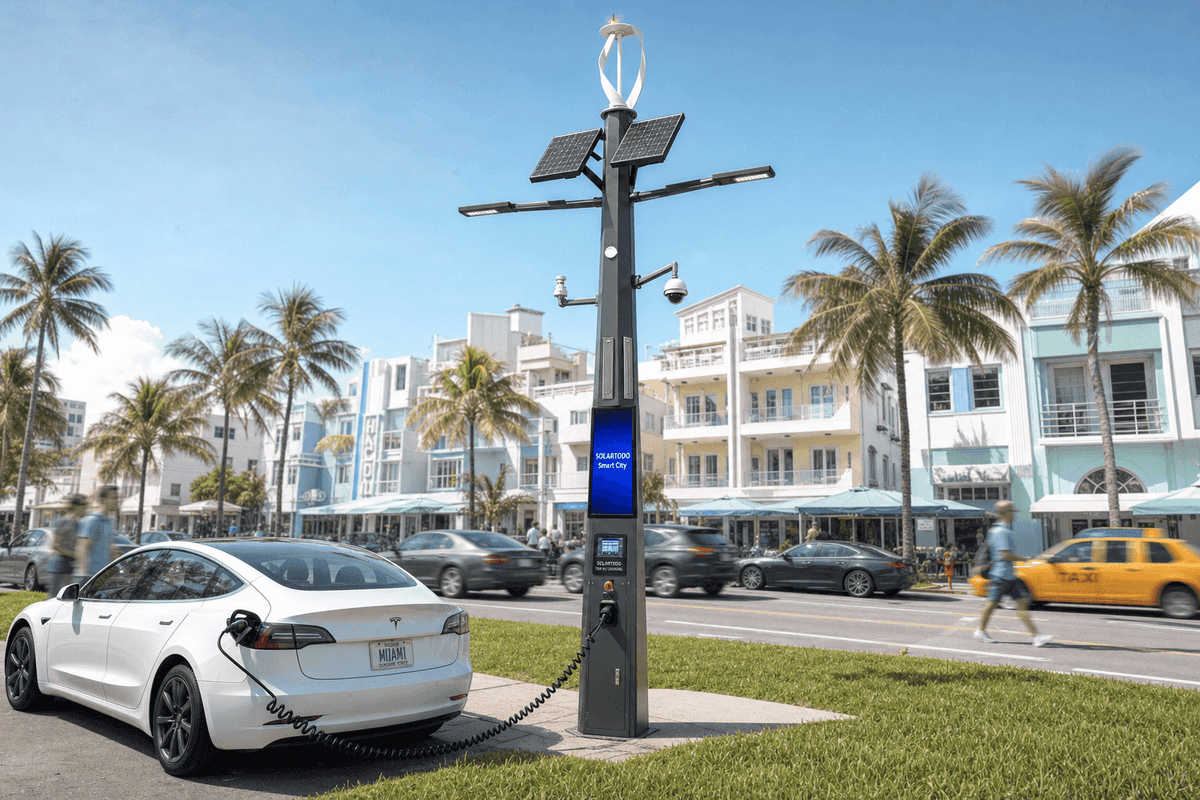
Hong Kong Smart Streetlight Market Analysis: 9m Hybrid EV-Charging Pole Configuration Guide
Summary
Hong Kong’s 7.5 million residents, dense urban corridors, and EV growth point to a compact smart streetlight format with approximately 129 poles at 32 m spacing per 4.1 km corridor. A 9 m hybrid pole with 11 kW AC charging, 15 kWh LFP storage, and 2×80 W LED lighting fits mixed transport-commercial streets.
Key Takeaways
- A typical 4.1 km urban corridor in Hong Kong would require approximately 129 smart streetlights at 32 m spacing, equal to about 31 poles per km.
- Hong Kong’s population was about 7.5 million in 2024 according to the Census and Statistics Department, which supports high-utilization curbside digital and mobility infrastructure.
- According to the Environmental Protection Department (2024), road transport remains a major local air pollution source, so 11 kW Type 2 AC charging on lighting assets supports electrification at street level.
- The recommended configuration is a 9 m octagonal tapered steel hybrid pole with a 400 W Gorlov-type VAWT, 2×150 W PV modules, and 15 kWh LFP battery backup.
- Lighting output in the proposed format is 2×80 W LED at 150 lm/W and 4000 K, delivering about 24,000 lm per pole for urban distributor roads and commercial streets.
- Communications capacity is suitable for dense districts: WiFi 6 at up to 1.8 Gbps and 256 devices, plus a 4 MP IR 50 m camera and TCP/IP public address system.
- The integrated charger is not a separate bollard: the lower 2.2 m of the pole is the 11 kW AC charging cabinet, fabricated as one continuous steel structure.
- A practical municipal rollout would usually be phased over 12-24 weeks for design review, utility coordination, civil works, pole erection, OCPP setup, and commissioning of approximately 129 units.
Market Context for Hong Kong
Hong Kong’s smart streetlight opportunity is driven by density, transport intensity, and limited curb space, which favors multi-function poles that combine lighting, charging, communications, and public-safety devices within a 9 m footprint. According to the Census and Statistics Department (2024), Hong Kong’s population is about 7.5 million, concentrated in a land area of roughly 1,114 km², making streetscape equipment density and right-of-way efficiency critical procurement factors.
The street environment is also electrically and climatically demanding. CLP Power and HK Electric distribute power at low-voltage and medium-voltage classes across dense urban districts, while the Buildings Department and HyD road environment require durable steelwork, controlled clearances, and maintainable street furniture. According to the Hong Kong Observatory (2024), Hong Kong’s mean annual rainfall exceeds 2,300 mm and the city is exposed to tropical cyclone conditions, so corrosion protection, drainage, enclosure sealing, and wind loading are not secondary issues for a 9 m pole system.
Transport electrification strengthens the case for integrated charging. According to Hong Kong’s Environmental Protection Department (2024), the government continues to expand EV charging support under its Roadmap on Popularisation of Electric Vehicles. Curbside AC charging at 11 kW is relevant where parking dwell time is measured in 1-4 hours rather than 15-30 minutes, especially in mixed commercial, residential, and municipal frontage conditions.
Telecom and public-information demand also matter. According to the Office of the Communications Authority (2024), Hong Kong maintains high mobile and broadband penetration, which supports adding WiFi 6 access points, IP audio, and digital display functions to street assets. For corridors with bus stops, taxi stands, loading bays, and municipal service frontage, a single smart streetlight can reduce the number of standalone cabinets, speakers, cameras, and chargers competing for pavement space.
Two authority statements are relevant here. The IEA states, "Electric car sales continue to break records," highlighting the need for broader charging access beyond off-street parking. IEC states, "International Standards ensure that electrical and electronic products and systems are safe and perform as intended," which is directly relevant to IEC 60598 and IEC 62196-2 compliance in a public-right-of-way charging pole.
Recommended Technical Configuration
For Hong Kong’s dense urban corridors, a 9 m hybrid smart streetlight with integrated EV charging is the most suitable size class because it combines municipal lighting, curbside charging, and digital functions without requiring a separate charger pedestal. A typical 129-unit deployment of this scale would suit an approximately 4.1 km corridor at 32 m spacing, matching city-street rather than highway geometry.
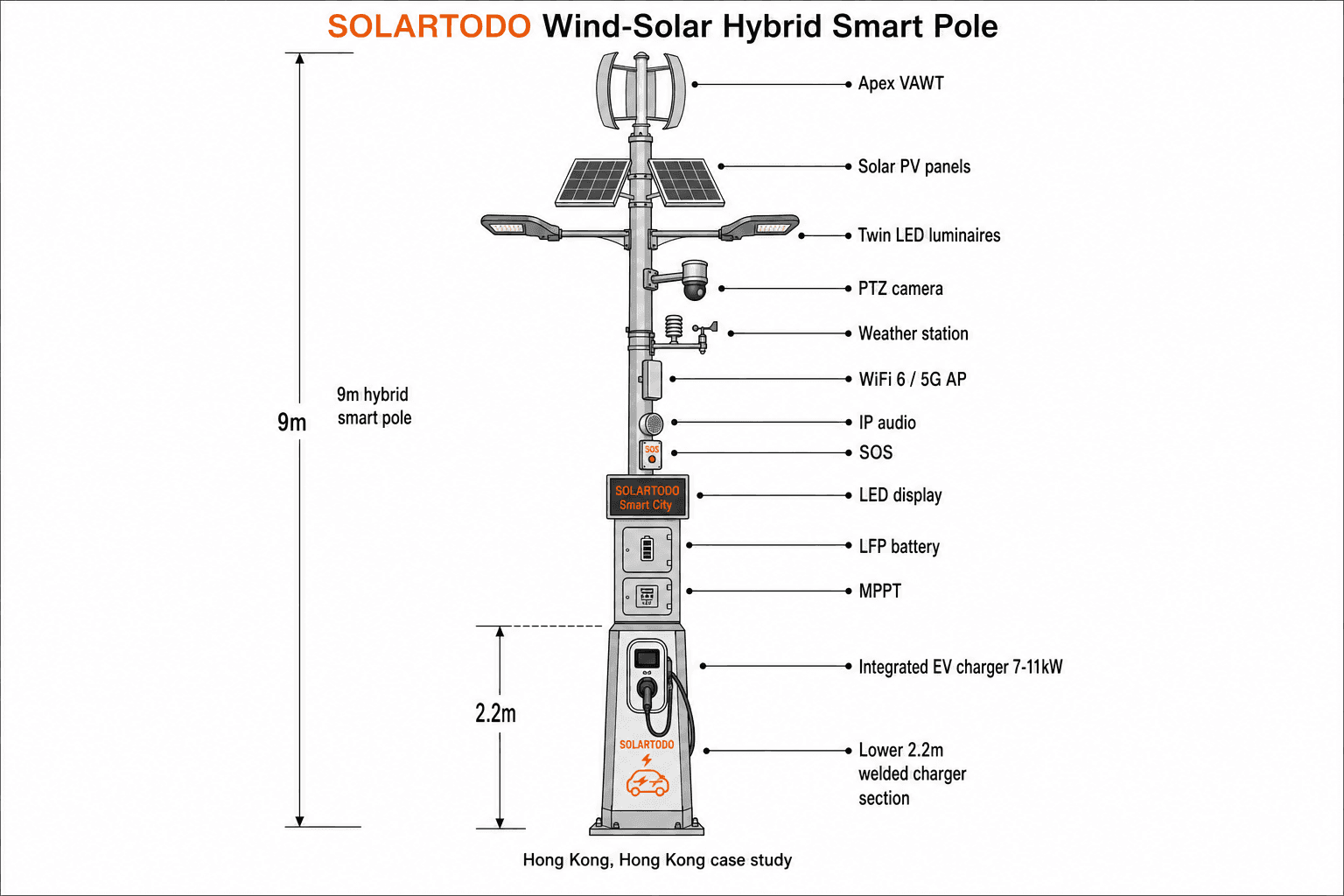
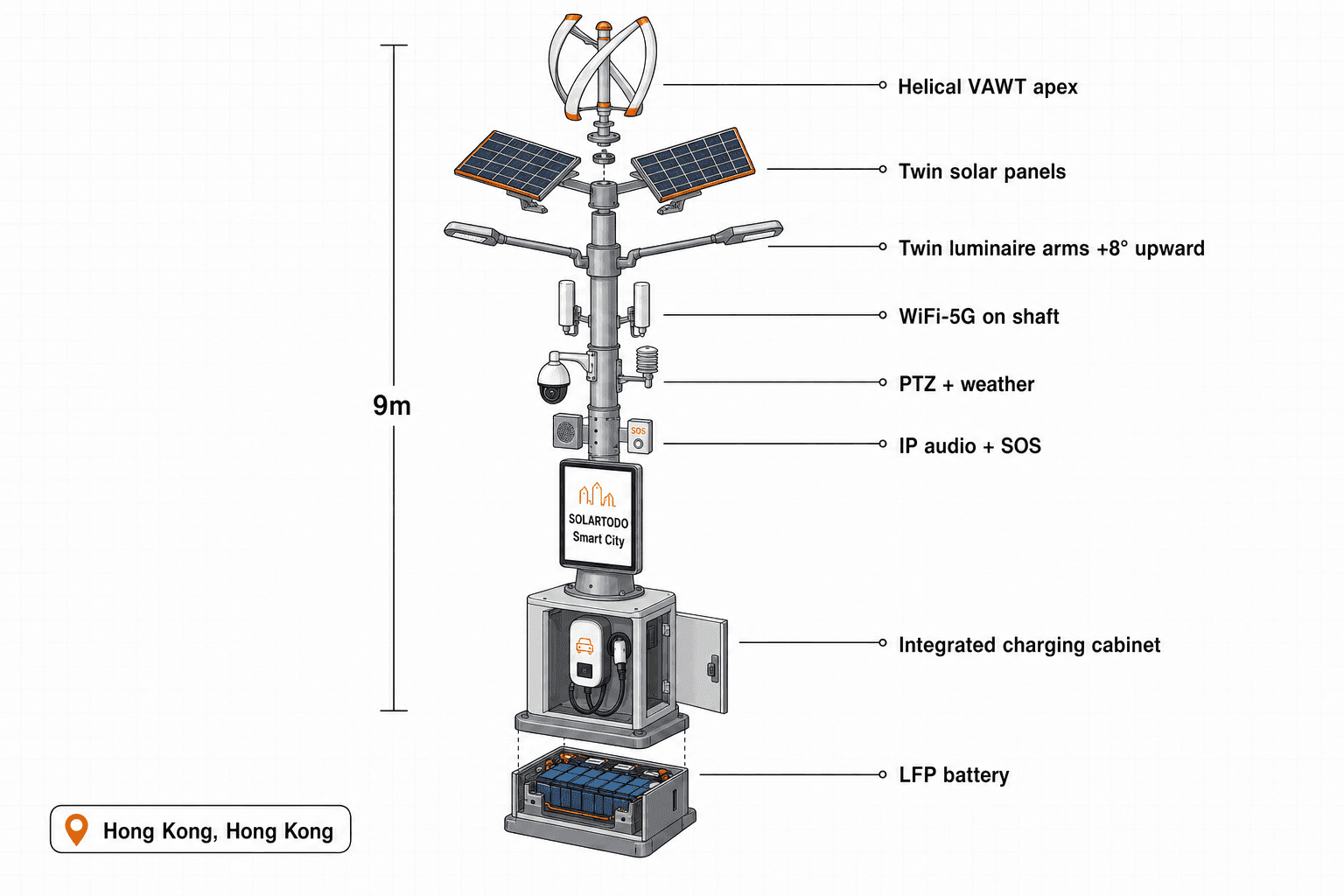
The recommended SOLARTODO configuration uses the project-specific hybrid format rather than a basic modular pole because Hong Kong’s pavement width and roadside asset congestion favor vertical consolidation. In this arrangement, the lower 2.2 m of the pole is the EV charging cabinet itself, welded into one continuous steel structure. That matters in Hong Kong because a separate charger pillar would consume more sidewalk area and add another foundation interface.
Structurally, the pole would be a 9 m octagonal tapered steel body with base diameter 45 cm and top diameter 15 cm, finished in dark grey RAL7024 powder coating. For mixed-use urban roads, this height is appropriate for twin-arm 2×80 W LED lighting while still keeping the charger, display, and emergency interface accessible at pedestrian level. It also leaves room for a WiFi 6 access point at 8.7 m and a top-mounted 4-parameter environmental sensor.
From an energy architecture standpoint, the recommended system is hybrid rather than off-grid only. The pole carries a 400 W Gorlov-type helical VAWT at the apex, 2×150 W monocrystalline panels at 15° tilt in an east-west A-frame, and a 15 kWh LFP battery with MPPT controller in the base, plus backup grid tie. In Hong Kong, this configuration is useful because public lighting and communications require continuity during low-solar periods, typhoon recovery windows, and variable curbside charger utilization.
For corridor planning, approximately 129 units would typically include all core urban functions in one asset:
- LED roadway lighting
- 11 kW Type 2 AC EV charging
- 4 MP security camera
- 4-parameter environmental sensing
- TCP/IP public address columns
- SOS intercom with indicator
- WiFi 6 access point
- P3 vertical LED information display
- USB-C PD 30 W and USB-A convenience charging
For buyers comparing alternatives, this is a city-street class smart streetlight rather than a park bollard or a highway mast. The 32 m spacing and 9 m height fit distributor roads, frontage roads, station approach streets, logistics edges, and commercial corridors where 30-50 poles per km is typical. For more product details, see the Smart Streetlight product page or contact us for corridor-specific layouts.
Technical Specifications
The recommended Hong Kong configuration is a 9 m hybrid SOLARTODO Smart Streetlight with 129-unit typical corridor scale, 32 m spacing, and IEC 60598 / GB/T 37024 / IEC 62196-2 compliance.
- Quantity basis: approximately 129 units for a representative 4.1 km corridor
- Pole height: 9 m
- Pole form: octagonal tapered steel smart pole
- Pole diameter: base Ø45 cm to top Ø15 cm
- Finish: dark grey RAL7024 powder coat
- Structural concept: lower 2.2 m of pole is the integrated EV charging cabinet, welded as one continuous steel structure
- Wind generation: Gorlov-type helical VAWT, 3 twisted white aluminum blades, Ø70×100 cm, 400 W, red aviation LED
- Solar generation: 2×150 W monocrystalline deep-black panels on A-frame brackets, symmetric east-west pair, 15° tilt
- Battery: 15 kWh LFP inside pole base with MPPT controller
- Grid interface: backup grid tie for lighting, communications, and charger continuity
- Lighting arms: twin symmetric arms, 1.5 m each, +8° upward tilt
- LED lighting: 2×80 W LED, 150 lm/W, 4000 K
- Approximate light output: 24,000 lm per pole
- Camera: 4 MP bullet camera with IR 50 m on 30 cm short arm bracket
- Top sensor: 4-parameter environmental sensor for temperature, humidity, wind speed, and noise
- Public address: 2× symmetric IP audio columns, Ø10×50 cm, 30 W, 93 dB, TCP/IP networked
- Emergency interface: one-press SOS button, dual-way audio intercom, visual LED indicator
- EV charging: integrated 11 kW single-gun AC charger, Type 2, OCPP 1.6J, 5 m coiled cable, touchscreen, E-stop, maintenance door
- LED display: P3 vertical screen, 1000×2000 mm portrait, brightness above 6000 cd/m², content format suitable for municipal messaging
- WiFi: WiFi 6 AP, 802.11ax, up to 256 devices, up to 1.8 Gbps, flush-mounted at 8.7 m
- User charging ports: USB-C PD 30 W and USB-A
- Typical spacing: 32 m
- Applicable standards: IEC 60598, GB/T 37024, IEC 62196-2
Implementation Approach
A practical Hong Kong rollout would usually move through 5 phases over roughly 12-24 weeks for a 129-unit corridor, depending on utility approvals, road opening permits, and foundation access windows. The main constraint is not pole fabrication alone; it is coordination among civil, electrical, telecom, and traffic-management stakeholders.
Phase 1 is corridor survey and design freeze. This normally includes pole siting every 32 m, photometric checks for the 2×80 W luminaires, charger accessibility review, and confirmation of clear pedestrian paths. In Hong Kong, this step should also review drainage, bus stop conflicts, sign clutter, and emergency vehicle access because a 1000×2000 mm display and integrated charger affect frontage geometry.
Phase 2 is utility and communications planning. The hybrid system includes 400 W wind, 300 W total PV, and 15 kWh LFP storage, but the 11 kW charger still requires grid backup planning, metering logic, and OCPP 1.6J backend configuration. If the corridor uses municipal or franchised utility feeds, the buyer would normally define whether charging energy is billed through a central operator, a municipal wallet, or a roaming platform.
Phase 3 is fabrication and FAT. The critical inspection point is the monolithic lower 2.2 m charger section because it is part of the pole body, not an attached kiosk. Factory acceptance should verify powder-coat adhesion, door alignment, cable routing, luminaire arm geometry, display sealing, WiFi housing flush fit, and electrical protection to the cited IEC standards.
Phase 4 is civil works and erection. Typical works include excavation, anchor cage placement, conduit routing, earthing, and base preparation before lifting the 9 m pole. Because the battery is inside the base and the charger is built into the lower section, installers should sequence heavy lifting, cable dressing, and commissioning access carefully to avoid repeated crane use.
Phase 5 is commissioning and software integration. This includes luminaire testing, charger handshake, camera stream validation, WiFi throughput checks, IP audio paging, SOS call routing, and display content control. For municipal buyers, a 7-14 day burn-in period is common before final handover so that charging sessions, battery cycling, and communications alarms can be observed under live street conditions.
Expected Performance & ROI
For Hong Kong, the strongest business case is asset consolidation and curb-space efficiency rather than standalone renewable generation, and a 129-unit smart streetlight corridor can replace several separate street assets with one 9 m pole. The measurable value comes from lower civil duplication, fewer separate power interfaces, improved service coverage, and added EV charging utilization.
Lighting performance is straightforward to estimate. Each pole carries 160 W of LED load and delivers about 24,000 lm at 150 lm/W. According to the U.S. Department of Energy (2023), LED street lighting typically reduces energy use substantially versus legacy HID systems; where a corridor is replacing 250 W-400 W sodium or metal-halide fixtures, energy savings in the 40%-70% range are common depending on control strategy and operating hours.
The EV charging value depends on utilization, not hardware headline alone. An 11 kW AC Type 2 charger is best suited to dwell-based charging in commercial streets, public parking edges, and municipal frontage. According to the IEA (2024), public charging growth remains necessary to support EV adoption where home charging access is constrained, which is particularly relevant in Hong Kong’s high-rise residential pattern.
The hybrid energy package adds resilience rather than full charger autonomy. The 400 W wind turbine plus 300 W PV array can support auxiliary loads such as sensors, communications, display standby, and part of lighting support when battery state of charge is healthy. The 15 kWh LFP battery improves ride-through capability for communications and safety functions, and it can reduce short-duration grid interruptions affecting public services.
A realistic payback model should count 4 value buckets over 8-12 years: lighting energy reduction, avoided standalone charger pedestal costs, avoided separate communications/public-address hardware, and digital-screen or data-service revenue where local policy permits. In districts with moderate charger utilization and legacy-light replacement, buyers often evaluate payback in the 5-9 year range, but the exact result depends on civil costs, electricity tariffs, O&M scope, and monetization of WiFi or display services.
Results and Impact
For Hong Kong, the expected impact of this smart streetlight format is a denser service layer per meter of curb without adding multiple cabinets, poles, and bollards. A typical 129-unit corridor would place lighting, 11 kW charging, public safety, WiFi 6, and environmental sensing into one 9 m asset family, which is useful where sidewalks, loading zones, and frontage access are tightly managed.
The operational effect is also broader than lighting alone. According to the World Bank (2023), urban digital infrastructure supports service efficiency and data-based management when devices are connected and maintained through common platforms. In practice, that means one corridor can provide 129 charging points, 129 camera nodes, 129 SOS positions, and 129 environmental data points while keeping the streetscape more orderly than a multi-device approach.
Comparison Table
The table below compares the recommended Hong Kong smart streetlight configuration against a conventional split-asset streetscape using separate poles, charger pedestals, and standalone communications devices.
| Metric | Recommended SOLARTODO Smart Streetlight | Conventional Separate Assets |
|---|---|---|
| Pole height | 9 m | 8-10 m lighting pole + separate charger pedestal |
| Pole spacing | 32 m | 30-40 m lighting, charger spacing independent |
| Lighting load | 2×80 W LED = 160 W | Typically 1×100-250 W fixture equivalent |
| Light output | Approx. 24,000 lm | Varies by fixture selection |
| EV charging | Integrated 11 kW AC, Type 2, OCPP 1.6J | Separate 7-22 kW pedestal usually required |
| Battery | 15 kWh LFP in base | Usually none on lighting pole |
| Renewable assist | 400 W VAWT + 2×150 W PV | Usually none |
| Camera | 4 MP IR 50 m | Separate camera mount or standalone pole |
| Public address | 2×30 W, 93 dB IP audio columns | Separate speaker pole/cabinet |
| WiFi | WiFi 6, 256 devices, 1.8 Gbps | Separate AP and bracket |
| Display | P3, 1000×2000 mm, >6000 cd/m² | Separate digital sign structure |
| Streetscape footprint | One combined foundation zone | Multiple foundations and cabinets |
| Best fit | Dense urban roads, station streets, mixed-use corridors | Sites with ample space and low integration need |
Pricing & Quotation
SOLARTODO offers three pricing tiers for this product line: FOB Supply (equipment ex-works China), CIF Delivered (including ocean freight and insurance), and EPC Turnkey (fully installed, commissioned, with 1-year warranty). Volume discounts are available for large-scale deployments. Configure your system online for an instant estimate, or request a custom quotation from our engineering team at [email protected].
Frequently Asked Questions
This FAQ answers the main Hong Kong procurement questions on 9 m smart streetlights, including 11 kW charging, 15 kWh battery sizing, 32 m spacing, installation, warranty, and ROI.
Q1: What smart streetlight configuration is most suitable for Hong Kong streets? A 9 m octagonal tapered steel pole is a practical fit for Hong Kong’s dense urban roads because it supports 2×80 W LED lighting, an 11 kW Type 2 charger, WiFi 6, IP audio, and a 4 MP camera in one footprint. The 32 m spacing suits distributor roads and commercial corridors better than park or highway applications.
Q2: Is the EV charger a separate cabinet next to the pole? No. In this recommended SOLARTODO format, the lower 2.2 m of the pole is the charging cabinet itself, welded as one continuous steel structure. That reduces sidewalk clutter, removes the need for a second pedestal, and simplifies the visual profile compared with separate charger bollards.
Q3: Can the hybrid wind-solar system run the 11 kW charger by itself? Not as a primary full-time source. The 400 W wind turbine, 2×150 W PV modules, and 15 kWh LFP battery are best treated as support for lighting, controls, communications, and resilience functions. The 11 kW AC charger should be planned with grid backup, especially in Hong Kong’s high-utilization urban context.
Q4: How long would a 129-unit corridor deployment typically take? A typical 129-unit project would often require about 12-24 weeks from design freeze to commissioning. The schedule depends on utility approvals, road opening permits, foundation access, and software integration. Fabrication is only one part; civil works and charger backend setup usually control the critical path.
Q5: What standards should buyers ask for in Hong Kong tenders? At minimum, this configuration should be aligned with IEC 60598 for luminaires, GB/T 37024 for smart poles, and IEC 62196-2 for the Type 2 charging interface. Buyers may also request local electrical, earthing, ingress protection, and structural verification documents during FAT and pre-shipment review.
Q6: What payback period is realistic for this type of smart streetlight? Many buyers model payback over roughly 5-9 years when the pole replaces legacy lighting and avoids separate charger pedestals, camera poles, and speaker structures. The result depends on electricity tariff, charger utilization, civil cost, maintenance scope, and whether display or data services generate revenue.
Q7: How does this compare with a standard smart pole without hybrid energy? A standard grid-powered pole can be simpler where utility access is easy and resilience is less important. The hybrid version adds a 400 W VAWT, 300 W PV, and 15 kWh LFP battery, which helps support critical low-power functions during outages and can reduce dependence on continuous grid availability for auxiliary systems.
Q8: What maintenance tasks should be budgeted each year? Typical annual maintenance includes charger inspection, RCD and connector checks, luminaire cleaning, battery health review, turbine fastener inspection, PV cleaning, display diagnostics, and camera/WiFi firmware updates. In coastal Hong Kong conditions, buyers should also budget for corrosion inspection and coating touch-up due to humidity and salt exposure.
Q9: What warranty structure is common for this product category? Warranty terms vary by scope, but buyers usually request separate coverage lines for the steel structure, LED modules, charger electronics, battery, display, and communications hardware. The quotation stage should define warranty duration, spare-parts obligations, response times, and whether labor is included for local rectification.
Q10: Is this smart streetlight suitable for highways or parks? No, not as the primary recommendation. This 9 m configuration is a city-street class product suited to urban roads, frontage streets, and mixed-use corridors at about 30-50 poles per km. Highways normally require taller traffic-pole classes, while parks generally use 6-8 m garden-light formats with different optics and lower accessory density.
References
- Hong Kong Census and Statistics Department (2024): Population and demographic statistics for Hong Kong, approximately 7.5 million residents.
- Hong Kong Observatory (2024): Climate statistics for Hong Kong, including annual rainfall above 2,300 mm and tropical cyclone exposure relevant to outdoor equipment design.
- Environmental Protection Department, HKSAR (2024): Roadmap on Popularisation of Electric Vehicles and charging policy direction for Hong Kong.
- Office of the Communications Authority, HKSAR (2024): Telecommunications and broadband market statistics relevant to WiFi and connected street infrastructure.
- IEC (2023): IEC 60598 luminaires safety and performance requirements; IEC 62196-2 conductive charging interface requirements for Type 2 AC charging.
- U.S. Department of Energy (2023): LED street lighting energy-saving benchmarks versus conventional HID systems.
- International Energy Agency (2024): Global EV Outlook data on continued EV sales growth and the need for public charging expansion.
- World Bank (2023): Urban digital infrastructure and connected public-service systems guidance relevant to smart city assets.
SOLARTODO Smart Streetlight configurations for Hong Kong should be evaluated as compact urban infrastructure platforms rather than only lighting poles. For corridor-specific layouts, charger backend options, or tender documentation support, buyers can review the Smart Streetlight product page or contact us.
Equipment Deployed
- 9 m octagonal tapered steel smart pole, base Ø45 cm to top Ø15 cm, dark grey RAL7024 powder coat
- Integrated lower 2.2 m EV charging cabinet fabricated as one continuous steel pole structure
- Gorlov-type helical VAWT, 3 twisted white aluminum blades, Ø70×100 cm, 400 W, red aviation LED
- 2×150 W monocrystalline deep-black solar panels on 15° east-west A-frame brackets
- 15 kWh LFP battery pack inside pole base with MPPT controller and backup grid tie
- Twin 1.5 m symmetric lighting arms with +8° upward tilt
- 2×80 W LED luminaires, 150 lm/W, 4000 K
- 4 MP bullet camera with IR 50 m on 30 cm short arm bracket
- 4-parameter environmental sensor for temperature, humidity, wind speed, and noise
- 2× IP audio columns, Ø10×50 cm, 30 W, 93 dB, TCP/IP networked
- One-press SOS button with dual-way audio intercom and visual LED indicator
- Integrated 11 kW single-gun AC charger, Type 2, OCPP 1.6J, 5 m coiled cable, touchscreen, E-stop
- P3 vertical LED display, 1000×2000 mm portrait, brightness >6000 cd/m²
- WiFi 6 AP, 802.11ax, 256 devices, 1.8 Gbps, flush-mounted at 8.7 m
- USB-C PD 30 W and USB-A charging ports
- Compliance set: IEC 60598, GB/T 37024, IEC 62196-2