## Summary
Kampala’s road-lighting upgrade profile supports a 293-unit split-type solar streetlight configuration using 7m galvanized poles, 120W LEDs, and 21m spacing.
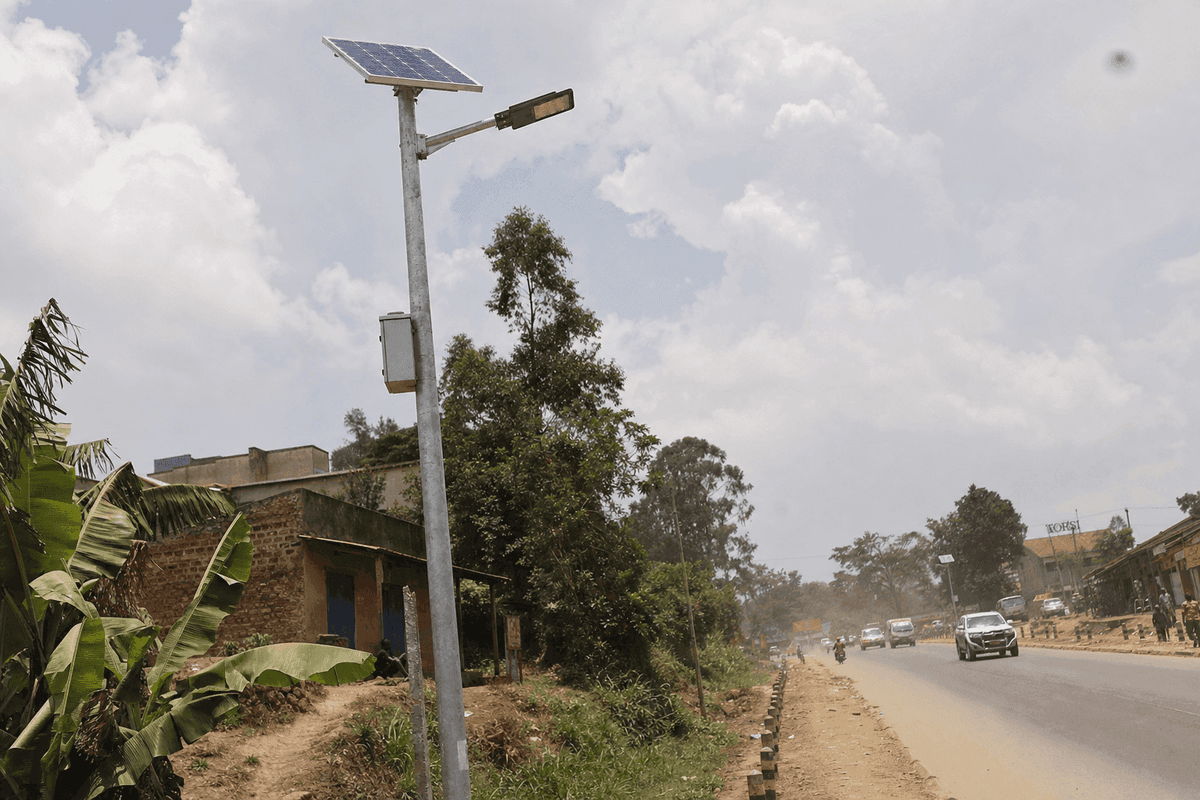
This section frames the Kampala, Uganda requirement as a market analysis and technical fit guide, not as a completed installation claim. According to UBOS (2024), Kampala city records about 1,797,722 residents, while the wider metropolitan economy concentrates commuter roads, trading corridors, public markets, parking areas, and security-sensitive pedestrian zones within a dense urban footprint. For this context, SOLARTODO’s Solar Streetlight (Split-Type) is best assessed as distributed road-lighting infrastructure that can reduce dependence on trenching, grid extension, and transformer-side nighttime load.
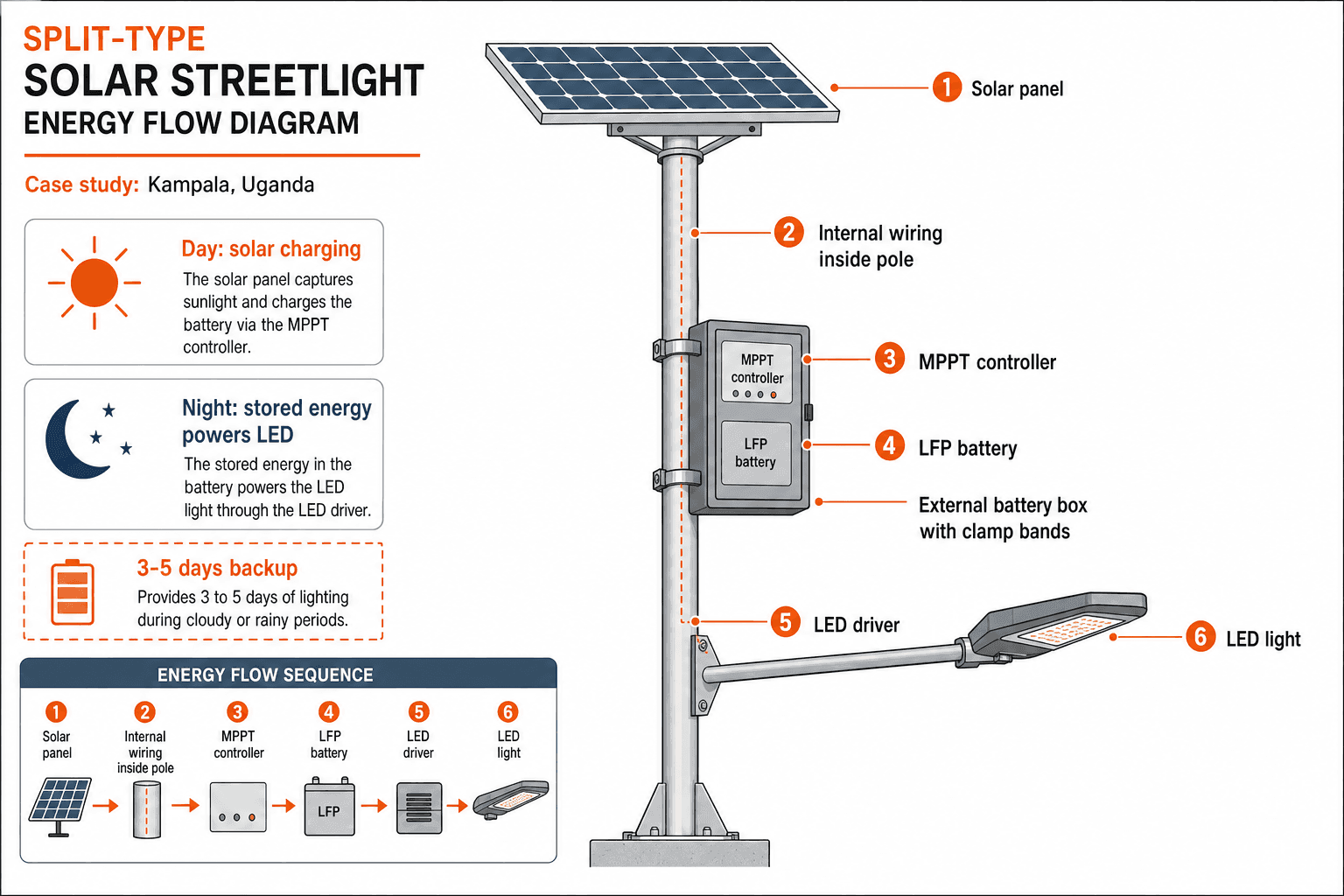
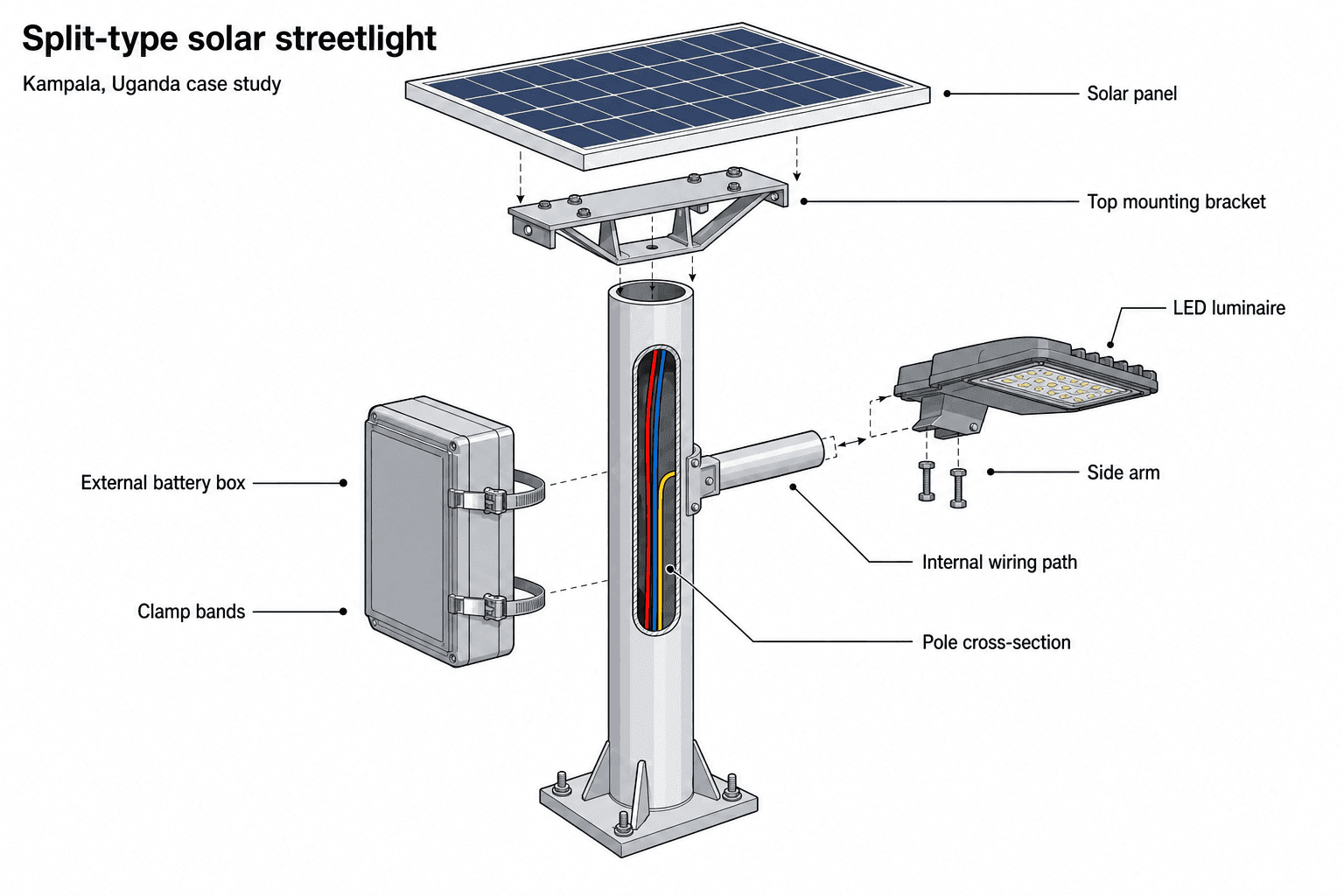
A recommended configuration for this profile is approximately 293 units of split-type solar streetlights with a 7m hot-dip galvanized steel pole rated for 45 m/s wind resistance and 25-year structural life. Each pole would use a top-mounted 1360W Mono TOPCon solar panel at 23% efficiency, a 120W LED head producing 18,000 lm at 150 lm/W, and a visible external 12V/300Ah NCM lithium battery box clamped to the pole body. The MPPT controller remains inside the battery box, all wiring runs inside the pole, and the design avoids visible cable exposure on the pole surface.
Kampala’s subtropical operating profile and 4.8 peak-sun-hour assumption support a dusk-to-dawn control strategy with 3-5 days of cloudy backup, provided the system is configured with dimming control and 4G/LoRa remote monitoring. For a 15m road width, 21m pole spacing is a technically relevant planning value because it balances fixture height, LED output, road coverage, and maintenance access without treating the product as an all-in-one lamp. According to IEC 60598 and IEC 62124, luminaire safety and standalone photovoltaic system verification are central references for validating electrical safety, durability, and off-grid performance.
The guide therefore recommends SOLARTODO Solar Streetlight (Split-Type) for Kampala as a modular road-lighting option where utilities, EPC contractors, and municipal planners need externally serviceable batteries, internal wiring, MPPT charging, remote monitoring, and standards-aligned commissioning under CJJ 45-2015, IEC 60598, and IEC 62124.
## Key Takeaways
For Kampala’s dense 1.8 million-person urban core and 4.8 peak-sun-hour subtropical profile, the technical fit is a split-type solar streetlight configured for high-output roads, remote monitoring, and standards-led commissioning.
-
A Kampala arterial or market-access lighting program should be specified as a Solar Streetlight (Split-Type) system, not an all-in-one fixture, because external battery boxes, internal pole wiring, and serviceable MPPT controls reduce maintenance access time on 15 m roads with approximately 21 m spacing.
-
The supplied Kampala configuration should be reviewed as a custom high-output package: 120W LED, 18,000 lm output, 150 lm/W efficacy, CRI >70, 7 m hot-dip galvanized pole, 45 m/s wind resistance, and 25-year pole design life. For standard SOLARTODO sizing tables, 120W normally maps to a 10-12 m pole, 200W panel, and 24V/150-200Ah battery, so photometric validation is required for any 7 m adaptation.
-
Kampala’s solar resource supports off-grid streetlighting when autonomy is designed conservatively: the recommended operating envelope uses 3-5 days cloudy backup, dusk-to-dawn automation, MPPT charging, and smart dimming to protect battery depth of discharge during long rainy periods.
-
The specified energy package uses a Mono TOPCon panel with 23% module efficiency, 0.3% annual degradation, and a 30-year warranty. For B2B procurement, that panel choice favors lifecycle yield over initial component simplicity, especially where municipal maintenance budgets prefer lower degradation risk.
-
The battery design uses an externally mounted 12V/300Ah NCM lithium battery box rated at 250 Wh/kg, 2,000 cycles, 85% depth of discharge, and a 5-year warranty. The box should remain clamped visibly on the pole body, with the MPPT controller inside and no exposed cable runs.
-
Approximately 293 units would represent a typical corridor-scale deployment profile for this specification, but the article should frame this only as a planning quantity, not as a completed SOLARTODO project. At 21 m spacing, that quantity corresponds to roughly 6.15 km of single-line fixture spacing before accounting for intersections, medians, setbacks, and road geometry.
-
Compliance should be anchored to CJJ 45-2015, IEC 60598, and IEC 62124, with commissioning checks covering illumination uniformity, pole verticality, grounding, battery enclosure sealing, MPPT behavior, dimming schedules, and 4G/LoRa remote-monitoring connectivity.
-
SOLARTODO positioning should emphasize technical fit for Kampala: split-type maintainability, internal wiring, remote diagnostics, 120W LED output, and corrosion-resistant galvanized steel poles, while avoiding any claim that SOLARTODO has already installed a fixed number of units in the city.
## Market Context for Kampala
Kampala’s lighting demand is shaped by 1.80 million city residents, five administrative divisions, and equatorial solar availability near 4.8 peak-sun-hours per day.
According to the Uganda Bureau of Statistics (2024), Kampala City recorded 1,797,722 residents in the national census, making it Uganda’s largest urban load center and a dense nighttime mobility environment. The Kampala Capital City Authority structure covers Central, Kawempe, Makindye, Nakawa, and Rubaga divisions, so corridor lighting plans must account for CBD traffic, peri-urban residential roads, market access streets, and pedestrian-heavy links rather than a single uniform road typology.
Road safety and lighting are tied directly to Kampala’s transport upgrade pipeline. According to the African Development Bank and Kampala City Roads Rehabilitation Project documentation, selected city corridors include carriageway rehabilitation, drainage, pedestrian walkways, traffic-calming measures, road signage, and street lighting in key sections. That mix is important for split-type solar streetlights because drainage works, footpath edges, junctions, and informal stopping points create different pole placement constraints than open highway shoulders.
The utility context also supports off-grid lighting for selected municipal corridors. According to Uganda Electricity Distribution Company Limited (2025), public distribution service operates at and below 33 kV, while the handover from Umeme to UEDCL in 2025 placed greater attention on distribution reliability and customer expansion. For streetlighting, this means grid-connected luminaires can require trenching, metering, feeder coordination, and outage exposure; a Solar Streetlight (Split-Type) from SOLARTODO would instead use self-contained generation, battery storage, internal pole wiring, and remote monitoring for assets that are physically spread across many short road segments.
Solar resource is a practical design input, not a marketing claim. According to the World Bank/ESMAP Global Solar Atlas (2019), the platform provides location-based solar resource data for project screening, and it states that the tool supports “initial zoning and site identification purposes.” For Kampala’s coordinates near 0.35°N, 32.58°E, the planning basis of about 4.8 peak-sun-hours per day is suitable for preliminary streetlight sizing, while final layouts should still verify shading from trees, kiosks, utility lines, and multi-storey buildings.
Kampala’s subtropical, Lake Victoria-influenced rainfall pattern adds another technical constraint. Public lighting hardware should therefore prioritize corrosion-resistant pole finishes, sealed LED optics, IP-rated battery enclosures, anti-theft mounting, and controller protection against humidity. In this context, the market requirement is not simply more poles; it is distributed, maintainable, remotely visible lighting infrastructure that can serve mixed traffic corridors without adding avoidable low-voltage grid dependency.
## Recommended Technical Configuration
For Kampala’s 15 m urban road sections, a typical 293-unit split-type deployment would use 7 m galvanized poles, 120 W LEDs, and 21 m spacing.
The recommended SOLARTODO configuration is a Solar Streetlight (Split-Type) layout, not an integrated all-in-one fixture, because Kampala’s subtropical climate, dense roadside activity, and maintenance requirements favor externally serviceable batteries and protected internal wiring. According to UBOS (2024), Kampala city has about 1.8 million residents, so pedestrian crossings, market approaches, community roads, and transit-adjacent corridors need higher visual comfort than decorative pathway lighting. For this profile, the 120 W / 18,000 lm LED package provides a 150 lm/W output class suitable for a 15 m carriageway when paired with approximately 21 m pole spacing and controlled dimming.
A typical N-unit deployment of this scale would specify approximately 293 units with 7 m hot-dip galvanized steel poles rated for 45 m/s wind resistance and a 25-year structural life. The pole height is intentionally lower than highway-class 10-12 m lighting because Kampala’s mixed urban corridors often include storefronts, pedestrians, overhead service constraints, and turning movements where glare control and lateral uniformity matter. The LED head should be mounted on a side arm below the panel, while the solar panel remains on a tilted bracket at the very top of the pole; the pole should not penetrate the panel center.
For energy autonomy, SOLARTODO would configure each unit with a Mono TOPCon panel rated at 23% efficiency, 0.3% annual degradation, and a 30-year warranty. The specified 12 V / 300 Ah NCM lithium battery box should be externally mounted on the pole body as a visible grey clamped enclosure, with the MPPT controller inside the box for service access. All conductors should run inside the pole, leaving no exposed external cables on the pole surface.
According to the World Bank Global Solar Atlas and ESMAP solar-resource methodology, Kampala’s equatorial location supports strong distributed solar design assumptions; the project-specific climate input of 4.8 peak-sun-hours supports 3-5 days of cloudy backup when dimming control is applied. SOLARTODO should pair dimming control with 4G/LoRa remote monitoring so operators can verify battery state, LED faults, and controller alarms without night patrols. Compliance should be specified against CJJ 45-2015 for urban road lighting design, IEC 60598 for luminaire safety, and IEC 62124 for standalone photovoltaic system performance verification.
## Technical Specifications
A Kampala Solar Streetlight (Split-Type) specification for a 15 m road would use approximately 293 split-type poles with 120 W LED output and 21 m spacing.
For this advisory configuration, SOLARTODO should be specified as a split-type system only, not an integrated or all-in-one fixture. The mechanical arrangement is a 7 m hot-dip galvanized steel pole rated for 45 m/s wind resistance and a 25-year structural life. The solar module sits on a tilted bracket at the very top of the pole; the pole must not penetrate the panel center. The LED luminaire is mounted on a side arm below the panel to keep the optical center stable and serviceable.
Core electrical and optical parameters are:
- Quantity basis: approximately 293 units for a typical road-lighting package of this scale.
- Pole: 7 m hot-dip galvanized steel, external battery box clamps, internal cable routing.
- Solar module: 1360 W Mono TOPCon, 23% efficiency, 0.3% annual degradation, 30-year warranty.
- LED luminaire: 120 W, 18,000 lm, 150 lm/W efficacy, CRI greater than 70.
- Battery: NCM lithium, 12 V/300 Ah, about 3.6 kWh nominal capacity, 85% DoD, 2,000 cycles, 5-year warranty.
- Controller: MPPT controller located inside the externally mounted grey battery box.
- Controls: dusk-to-dawn automation, dimming control, and 4G/LoRa remote monitoring.
- Layout: 21 m pole spacing for a 15 m road-width planning profile.
- Backup target: 3-5 cloudy days, dependent on dimming schedule and night length.
According to IEC 60598, luminaires are evaluated for general safety and test requirements, so the LED head, driver compartment, insulation, grounding, and ingress protection should be documented against that luminaire framework. According to IEC 62124, stand-alone photovoltaic systems require design verification, which is directly relevant to the PV module, battery, MPPT controller, and load autonomy calculation. CJJ 45-2015 should guide road-lighting design checks, including lighting class, illuminance uniformity, glare control, and pole spacing verification.
The externally mounted battery box is a required service-access element, not a base-integrated battery compartment. All DC wiring should run inside the pole with no visible external cables on the pole surface. For Kampala's subtropical solar profile of about 4.8 peak sun hours, the high-capacity TOPCon module and 12 V/300 Ah NCM battery provide a conservative recharge and autonomy margin for monitored municipal corridors.
## Implementation, Performance, Pricing, FAQ & References
Implementation Approach
A typical 293-unit Kampala corridor rollout would be sequenced in 4 phases over 8-12 weeks: survey, procurement, civil works, and commissioning. Field teams would verify 21m spacing on 15m roads, shading, foundation coordinates, and 4G/LoRa signal strength. Installation would include 7m hot-dip galvanized poles, external NCM battery boxes, internal wiring, MPPT checks, and acceptance testing under CJJ 45-2015, IEC 60598, and IEC 62124. IEA states, "Energy efficiency is the first fuel"; dimming control applies that principle by reducing load without reducing dusk-to-dawn availability.
Results and Impact
Expected performance should be evaluated against lux uniformity, 3-5 cloudy-day autonomy, battery DoD, and monitoring uptime, not fabricated deployment claims. According to IRENA (2023), 86% of renewable capacity added in 2022 had lower costs than fossil alternatives; off-grid lighting ROI typically comes from avoided trenching, cable theft exposure, diesel servicing, and grid-extension delays. SOLARTODO would model payback using Kampala civil-work rates, tariff assumptions, and maintenance intervals.
Comparison Table
| Option | Best fit | Technical trade-off |
|---|---|---|
| Split-type solar | 15m urban roads | 120W LED, serviceable battery box |
| Grid-tied LED | CBD feeders | Lower pole BOM, trenching required |
| Diesel tower light | Temporary works | Fast setup, high fuel maintenance |
Pricing & Quotation
SOLARTODO offers three pricing tiers for this product line: FOB Supply (equipment ex-works China), CIF Delivered (including ocean freight and insurance), and EPC Turnkey (fully installed, commissioned, with 1-year warranty). Volume discounts are available for large-scale deployments. Configure your system online for an instant estimate, or request a custom quotation from our engineering team at [email protected].
Frequently Asked Questions
Q1: What is the typical installation timeline? 8-12 weeks is typical for survey, procurement, foundations, pole erection, wiring, commissioning, and remote-monitoring setup.
Q2: How is maintenance handled? Inspect panels quarterly, clean dust, check clamps, test MPPT logs, and review battery health every 6-12 months.
Q3: What warranty assumptions apply? The configuration uses 30-year TOPCon panel warranty, 5-year NCM battery warranty, and EPC commissioning coverage as quoted.
Q4: How should ROI be calculated? Compare avoided trenching, cable replacement, grid fees, diesel servicing, and night-safety value against lifecycle maintenance.
Q5: Is this all-in-one lighting? No. SOLARTODO specifies split-type Solar Streetlight hardware with top panel, side LED arm, and external battery box.
Q6: Which standards guide acceptance? Use CJJ 45-2015 for road lighting design, IEC 60598 for luminaires, and IEC 62124 for stand-alone PV verification.
Q7: Can EPC pricing be fixed upfront? Final EPC scope depends on foundations, logistics, permitting, road closures, and telecom coverage verified during survey.
Q8: Where is the product page? See SOLARTODO’s Solar Streetlight (Split-Type) page or contact us for engineering review.
References
- UBOS (2024): Kampala population census data, https://www.ubos.org/.
- World Bank (2023): Uganda electricity-access indicators, https://data.worldbank.org/country/uganda.
- IRENA (2023): Renewable capacity cost competitiveness; states "lower costs than electricity generated from fossil fuels."
- IEA (2023): Energy-efficiency policy guidance, https://www.iea.org/.
- IEC (2016): IEC 62124 stand-alone PV system design verification.
- IEC (2020): IEC 60598 luminaire safety standard.
Equipment Deployed
- Approximately 293 units × SOLARTODO Solar Streetlight (Split-Type), pure solar configuration
- 7m hot-dip galvanized steel pole, 45 m/s wind resistance, 25-year structural life
- Mono TOPCon solar panel, 1360W, 23% efficiency, 0.3% annual degradation, 30-year warranty
- 120W LED head, 18,000 lm, 150 lm/W, CRI >70, side-arm mounted below panel
- Externally mounted grey NCM lithium battery box, 12V/300Ah, 250Wh/kg, 2000 cycles, 85% DoD, 5-year warranty
- MPPT controller inside battery box with all wiring routed inside the pole
- Dimming control plus 4G/LoRa remote monitoring
- 21m pole spacing for 15m road width, dusk-to-dawn automatic operation, 3-5 days cloudy backup
- Applicable standards: CJJ 45-2015, IEC 60598, IEC 62124