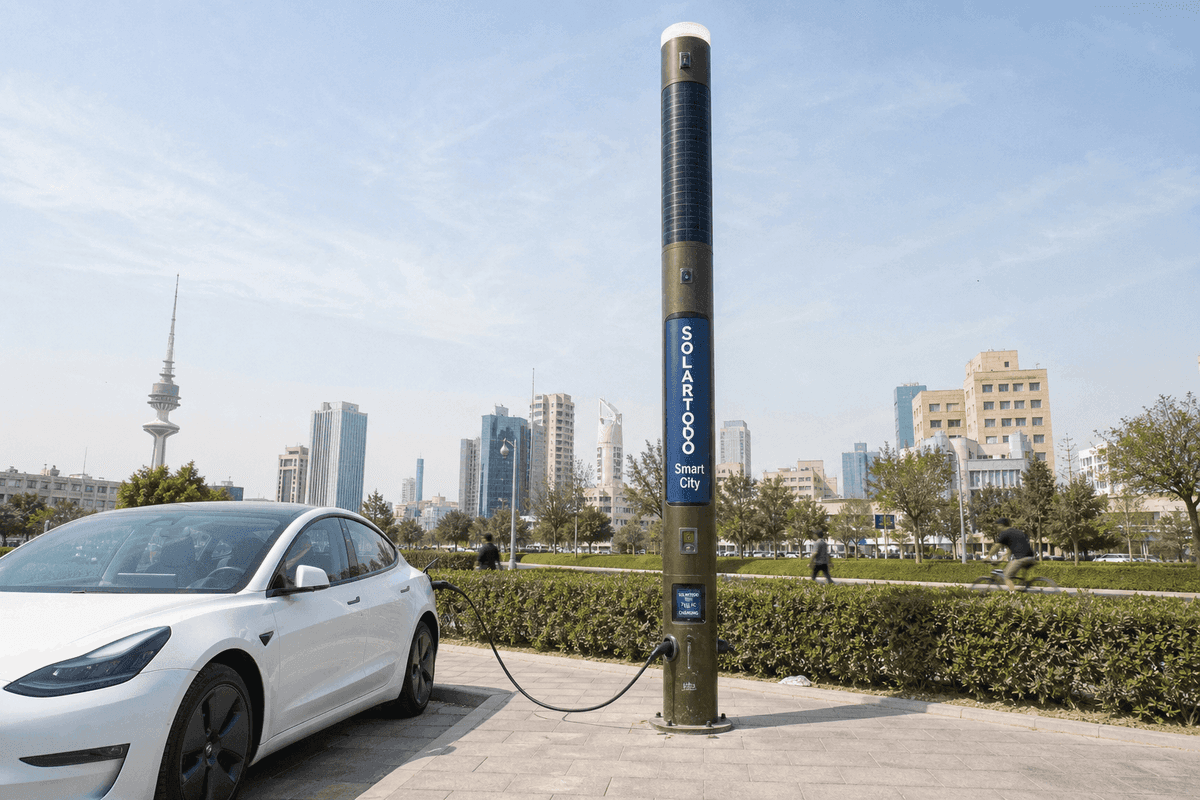
Kuwait City Smart Streetlight Market Analysis: 10m Seamless Cylindrical Pole Configuration
Summary
Kuwait City's 3.7 million metro market, 98% urbanization, and 5.5-6.0 kWh/m2/day solar resource support a typical 100-unit, 10m seamless cylindrical Smart Streetlight deployment at 28m spacing.
Key Takeaways
- A typical Kuwait City corridor configuration would use approximately 100 units of 10m seamless cylindrical Ø200mm poles at 28m spacing, covering about 2.8km of urban frontage.
- Each SOLARTODO Smart Streetlight integrates 100W LED output at 15,000lm, 4000K color temperature, and a top PMMA diffuser with the same Ø200mm diameter.
- The recommended pole is a constant-diameter Ø200mm monolithic cylinder with 5mm wall thickness, hot-dip galvanizing, and antique bronze RAL8011 finish.
- Solar input is limited to approximately 183W of 360-degree CIGS thin-film wrap between 6.5m and 9.3m, with no rigid panels, brackets, or tilt.
- Each unit includes a 3,000Wh LFP battery, MPPT controller, embedded WiFi 6, 4MP IR 50m camera, 12-parameter environmental sensor, and 11kW Type 2 AC EV charger.
- At 28m spacing, the layout equals about 35.7 poles per km, within the urban street class range of 30-50 poles per km.
- Standards alignment should reference IEC 60598 for luminaires and GB/T 37024 for smart lighting system requirements.
Market Context for Kuwait City
Kuwait City's dense coastal urban core and 98% national urbanization rate make 10m multi-function poles more suitable than highway-scale 12m+ traffic poles. According to World Bank urban indicators (2024), Kuwait is among the world's most urbanized countries, with about 98% of residents living in urban areas. According to UN urban area estimates referenced for 2024, the Al Kuwait metropolitan area is approximately 3.7 million people, creating high demand for compact street assets that combine lighting, sensing, connectivity, display, emergency communication, and EV charging.
Kuwait City's infrastructure planning is also shaped by extreme heat, dust, corrosion exposure near Kuwait Bay, and electricity peak-load stress during summer. According to the World Bank and ESMAP Global Solar Atlas (2019), Kuwait has strong solar resource conditions, commonly around 5.5-6.0 kWh/m2/day in the capital region. According to Kuwait Vision 2035, the national development agenda includes coherent infrastructure, environmental sustainability, and interlinked government services; that policy direction favors smart street assets that can collect environmental data and support municipal digital services.
For power context, Kuwait's Ministry of Electricity, Water and Renewable Energy is responsible for transmission and distribution networks, utility specifications, and energy policy. For a Smart Streetlight, this does not imply a 35kV or transmission-pole class; the correct product class is city/urban street furniture. The SOLARTODO Smart Streetlight configuration should therefore remain in the 6-12m urban street range, not a high-voltage tower category.
ITU states, "A smart sustainable city is an innovative city" using ICT-enabled systems to improve service quality and efficiency. IEC states that IEC 60598 specifies "general requirements for luminaires," which is relevant because the luminaire is integrated into the pole's top diameter. These references support a standards-led specification rather than a fabricated deployment claim.
Recommended Technical Configuration
A typical 100-unit deployment in Kuwait City's premium streetscape profile would use 10m Ø200mm seamless cylindrical Smart Streetlight poles with all equipment flush-integrated. This form factor fits high-visibility waterfront roads, CBD streets, commercial promenades, government districts, hotel frontages, and mixed-use corridors where protruding boxes, side arms, and separate charger bollards would reduce visual order and pedestrian clearance.
The recommended size class is the SOLARTODO cylindrical premium market variant, not the grid_12m MENA flagship. Although grid-powered 12m poles are common for large arterial roads, the project-specific requirement is a 10m seamless cylindrical pole with 360-degree CIGS thin-film wrap and embedded 11kW AC charging. At 28m spacing, approximately 100 units would support about 2.8km of streetscape, with around 35.7 poles per km, consistent with the 30-50 poles per km urban density guideline.
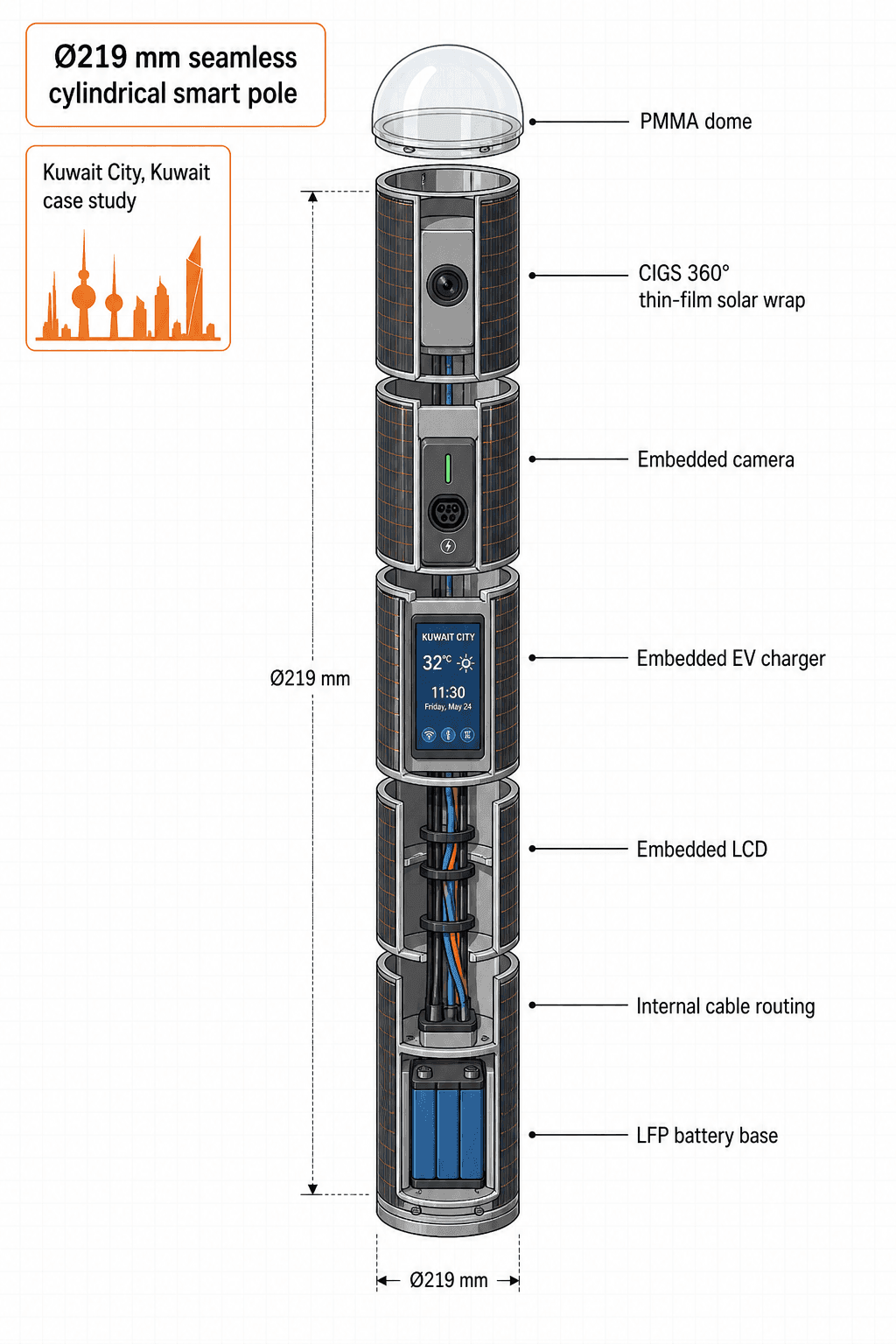
The key design constraint is the constant Ø200mm cylinder. Charging hardware, touchscreen, coiled Type 2 cable, emergency panel, camera, WiFi antenna, display, battery, and control electronics should remain inside the cylinder or flush with the skin. No side arms, luminaire outriggers, IP speaker columns, public-address modules, external boxes, widened base, or separate EV bollard should be added.
Technical Specifications
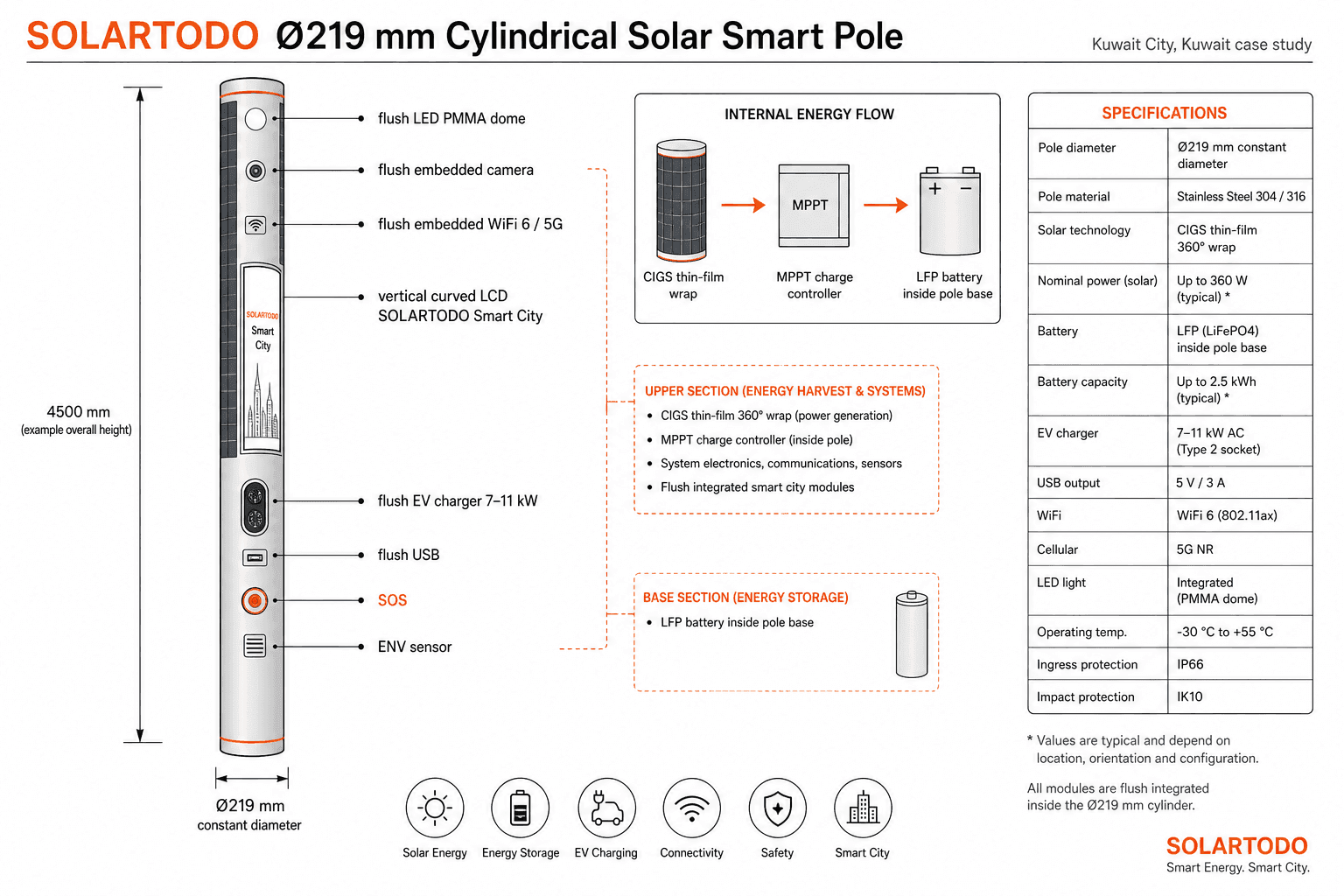
The Kuwait City technical fit is a 10m, Ø200mm, 5mm-wall Smart Streetlight with 100W LED, 183W CIGS wrap, 3,000Wh LFP battery, and embedded 11kW AC charging. Recommended technical configuration:
- Quantity profile: approximately 100 units for a typical premium urban corridor package.
- Pole body: 10m seamless cylindrical Ø200mm pole, constant diameter top-to-bottom, 5mm wall thickness, hot-dip galvanized steel.
- Finish: antique bronze RAL8011 for architectural streetscape compatibility.
- Luminaire: Ø200mm PMMA translucent diffuser dome, flush on top, same diameter as pole, no side arms, 100W, 15,000lm, 4000K.
- Solar: CIGS flexible thin-film cells wrapped 360 degrees around the mid-section from 6.5m to 9.3m, approximately 183W total, dark blue-black semi-transparent film, laminated flush to the pole skin.
- Battery and power control: LFP 3,000Wh battery inside pole base with MPPT controller and grid-backup-ready control architecture.
- Environmental sensing: 12-parameter ENV sensor pod for meteorology, air quality, rain, CO, NO2, and O3, flush on dome top.
- Camera: flush bullet camera behind a rectangular glass window, 4MP resolution, IR range 50m, no protruding body.
- Communication: embedded WiFi 6 with internal antenna inside the cylinder and smart controller options for LoRaWAN or 4G cloud integration.
- Emergency interface: flush SOS button panel, 12cm x 12cm, with integrated micro-camera, microphone, and speakerphone grille.
- EV charging: fully flush embedded 11kW AC charger, Type 2 flip-cap socket, 5m coiled Type 2 cable, and flush touchscreen at 1.5m.
- Display: vertical curved LCD, 2,000mm tall x approximately 170mm wide, bent to Ø200mm radius, front face only, portrait orientation.
- Display content: strictly “SOLARTODO Smart City” text stacked vertically, SOLARTODO uppercase top, Smart City title case bottom, white sans-serif on deep blue, no imagery, video, or advertising.
- Spacing: 28m between poles, equal to about 35.7 poles per km.
- Standards: IEC 60598 for luminaire requirements and GB/T 37024 for smart lighting system alignment.
According to IEC (2024), IEC 60598 covers luminaire safety and performance requirements across lighting products. According to ITU-T Y.4900/L.1600 series guidance, smart city indicators should support measurable infrastructure performance, making environmental sensing and connectivity useful for public-asset monitoring.
Implementation Approach
A Kuwait City rollout of 100 Smart Streetlight units would typically proceed through 5 phases: survey, engineering approval, CKD logistics, civil installation, and commissioning. The first phase should verify road hierarchy, sidewalk width, setback clearances, underground utilities, camera privacy requirements, EV charging connection points, and local permitting constraints. Because the pole remains Ø200mm throughout, the foundation and cable ducting design must carry the load without relying on a widened base cabinet.
The second phase should lock the manufacturing drawing package: 10m height, Ø200mm seamless cylinder, 5mm wall, RAL8011 finish, 6.5-9.3m CIGS wrap, and flush cutouts for camera, SOS, LCD, charging socket, touchscreen, and service access. CKD or assembled shipping can then be planned based on port handling and site storage constraints. Kuwait City's logistics access through Shuwaikh Port supports conventional project cargo planning, but the flush LCD and CIGS laminate require protective packing and controlled handling.
Installation should follow a corridor-by-corridor sequence, typically 10-20 poles per work zone depending on traffic management. Civil works include anchor foundation, earthing, ducting, feeder connection where required, pole erection, waterproofing checks, charger safety inspection, controller registration, camera alignment, WiFi testing, display content verification, and night-time illumination validation. Commissioning should verify that no external speaker columns, advertising video, protruding camera bodies, or auxiliary bollards have been added.
Expected Performance & ROI
A 100-unit Kuwait City configuration would consolidate at least 7 functions per pole while keeping 10m height, 28m spacing, and a constant Ø200mm architectural profile. Expected performance should be assessed as total corridor infrastructure value, not only solar generation. The CIGS wrap and 3,000Wh LFP battery support auxiliary power resilience, while grid support remains important for 11kW EV charging and continuous urban services.
According to the IEA (2023), efficient LED lighting is central to reducing electricity demand from lighting systems, and LED retrofits commonly reduce lighting energy use versus legacy discharge lamps. For Kuwait City, a 100W, 15,000lm LED head provides 150 lm/W efficacy, which is a strong fit for urban street lighting where glare control, uniformity, and maintenance access matter. The payback logic should include reduced pole clutter, fewer separate cabinets, avoided standalone EV bollards, shared civil works, and improved serviceability.
A practical ROI model would compare a typical 100-unit Smart Streetlight package against separate lighting poles, separate EV chargers, separate camera poles, separate WiFi access points, separate environmental stations, and separate emergency call boxes. Without quoting prices, many municipal and EPC evaluations would expect a 4-7 year payback window where trenching, foundations, operations visits, and equipment duplication are reduced. The exact payback depends on tariff structure, utilization of the 11kW charging points, maintenance contract scope, and whether the corridor monetizes connectivity or data services.
Comparison Table
The Kuwait City recommendation favors a 10m seamless cylindrical form over 12m grid or hybrid variants because Ø200mm visual continuity is the controlling requirement.
| Metric | Recommended Kuwait City Configuration | Grid 12m Variant | Hybrid 12m Variant | Standard 6-12m Variant |
|---|---|---|---|---|
| Best fit | Premium urban streetscape | MENA arterial grid-powered streets | Americas/APAC hybrid corridors | General municipal streets |
| Pole height | 10m | 12m | 12m | 6-12m |
| Pole geometry | Ø200mm seamless cylinder | Octagonal tapered steel | Octagonal tapered steel | Octagonal galvanized steel |
| Module integration | 100% flush, no side arms | Integrated EV cabinet in lower 2.2m | Wind-solar hybrid plus integrated EV | Modular accessories |
| Solar system | 183W CIGS 360-degree wrap | Grid-powered AC focus | 100-300W wind plus 2 panels | Optional by project |
| Battery | 3,000Wh LFP | Grid-powered | LFP in base | Optional by project |
| EV charging | 11kW Type 2 flush embedded | Integrated lower cabinet | Integrated charger | Optional module |
| Visual impact | Constant Ø200mm, RAL8011 | Larger cabinet mass | Visible turbine and panels | Functional municipal appearance |
| Kuwait City suitability | High for CBD and waterfront | Medium for wider arterials | Medium where renewables are visible | Medium for standard roads |
Pricing & Quotation
SOLARTODO offers 3 quotation paths for Kuwait City Smart Streetlight projects: FOB Supply, CIF Delivered, and EPC Turnkey, with volume discounts for large deployments. SOLARTODO offers three pricing tiers for this product line: FOB Supply (equipment ex-works China), CIF Delivered (including ocean freight and insurance), and EPC Turnkey (fully installed, commissioned, with 1-year warranty). Volume discounts are available for large-scale deployments. Configure your system online for an instant estimate, or request a custom quotation from our engineering team at [email protected].
For Kuwait City, the quotation package should define civil foundation scope, AC feeder availability, Type 2 charging compliance, LCD content lock, sensor calibration, connectivity plan, warranty period, spare parts, and commissioning acceptance criteria. Buyers can also contact us for engineering review of street geometry, corrosion exposure, and government approval requirements.
Frequently Asked Questions
Kuwait City Smart Streetlight buyers typically need clarity on 10m pole geometry, 11kW charging, 183W CIGS solar, maintenance, ROI, warranty, and EPC scope.
Q1: What Smart Streetlight configuration is recommended for Kuwait City? A typical Kuwait City configuration would use approximately 100 units of 10m seamless cylindrical Ø200mm Smart Streetlight poles. Each pole would include a 100W LED dome, 183W CIGS wrap, 3,000Wh LFP battery, 4MP camera, WiFi 6, SOS panel, 12-parameter sensor, curved LCD, and flush 11kW Type 2 AC charging.
Q2: Why use a Ø200mm seamless cylindrical pole instead of a 12m octagonal pole? The Ø200mm cylindrical pole is better for premium urban streets where visual continuity and pedestrian clearance matter. The 12m octagonal variants suit wider arterial or hybrid-energy applications. Kuwait City's CBD, waterfront, hotel, and government frontages benefit from the 10m constant-diameter pole because all modules are flush-integrated with no arms, cabinets, or external boxes.
Q3: How long would a 100-unit deployment typically take? A typical 100-unit deployment would be planned in 5 phases: survey, engineering approval, manufacturing, installation, and commissioning. Depending on permitting, utility connection, shipping route, and civil works access, a realistic program may require several months. The timeline should be confirmed after road surveys, foundation design, charger connection checks, and corridor traffic-management approval.
Q4: Does the 183W CIGS wrap power the whole pole? No. The 183W CIGS wrap and 3,000Wh LFP battery support auxiliary energy resilience and smart electronics, but the 11kW EV charger requires grid supply. In Kuwait City's hot urban environment, the design should be treated as a smart grid-connected street asset with supplemental solar input, not as an off-grid EV charging station.
Q5: What ROI factors should an EPC buyer model? ROI should compare integrated infrastructure against separate poles, charger bollards, camera poles, WiFi nodes, emergency call boxes, display columns, and environmental stations. The strongest savings often come from shared foundations, reduced trenching, fewer service visits, lower visual clutter, and consolidated monitoring. A 4-7 year payback model may be reasonable, subject to tariffs and charger utilization.
Q6: What maintenance is required in Kuwait City's climate? Maintenance should include quarterly cleaning of the PMMA dome, camera window, touchscreen, LCD face, and CIGS wrap because dust and salt can reduce optical performance. Annual checks should cover earthing, charger safety, LFP battery health, gasket integrity, MPPT operation, firmware updates, sensor calibration, and corrosion inspection of the RAL8011 galvanized steel surface.
Q7: Can the pole display advertising or video content? For this Kuwait City configuration, no. The vertical curved LCD is restricted to static “SOLARTODO Smart City” text, stacked vertically with SOLARTODO uppercase on top and Smart City below. It should use white sans-serif text on a deep blue background, with no imagery, video, public advertising, or third-party media content.
Q8: What installation constraints matter most? The most important constraint is preserving the constant Ø200mm cylinder. Installers should not add external boxes, a widened charger base, speaker columns, side-arm luminaires, separate EV bollards, or protruding cameras. Foundation design, internal cable routing, service access, waterproofing, and touchscreen height at 1.5m must be coordinated before manufacturing release.
Q9: What warranty should be expected for EPC turnkey work? The specified SOLARTODO EPC Turnkey tier includes fully installed and commissioned equipment with a 1-year warranty. Longer warranty structures may be negotiated for LED modules, pole coating, CIGS laminate, battery, charger, touchscreen, LCD, and control electronics. Warranty terms should define exclusions for vandalism, impact damage, unauthorized content changes, and non-approved modifications.
Q10: How does this compare with a conventional streetlight? A conventional streetlight usually provides only illumination, often with a separate arm and limited sensing. This Smart Streetlight combines 100W LED lighting, 11kW EV charging, 4MP security imaging, WiFi 6, SOS calling, environmental sensing, battery backup, LCD identity display, and cloud control in one 10m Ø200mm pole, reducing duplicated street furniture.
References
- World Bank / ESMAP (2019): Global Solar Atlas 2.0 provides solar resource and PV potential mapping, including Kuwait-area irradiance estimates around 5.5-6.0 kWh/m2/day. https://globalsolaratlas.info
- World Bank (2024): Kuwait urban population indicators show approximately 98% urbanization, supporting dense city-infrastructure planning. https://data.worldbank.org/country/kuwait
- United Nations DESA (2018): The World's Cities data booklet identifies Kuwait City's metropolitan concentration and supports urban demand analysis. https://population.un.org
- Kuwait Vision 2035 / New Kuwait (2017): National development priorities include coherent infrastructure, environmental sustainability, and interlinked government services. https://www.newkuwait.gov.kw
- IEC (2024): IEC 60598 defines luminaire safety and performance requirements relevant to integrated LED streetlight design. https://www.iec.ch
- ITU (2016): ITU-T Y.4900/L.1600 smart sustainable city indicators support measurable ICT-enabled urban infrastructure performance. https://www.itu.int
- IEA (2023): Energy efficiency guidance identifies LED lighting as a major route for reducing lighting electricity demand. https://www.iea.org
Equipment Deployed
- 100 units × 10m seamless cylindrical Ø200mm pole, constant diameter top-to-bottom, 5mm wall, hot-dip galvanized steel, RAL8011 antique bronze
- Ø200mm PMMA translucent diffuser dome, flush top-mounted, 100W, 15,000lm, 4000K, no side arms
- 360-degree CIGS thin-film solar wrap from 6.5m to 9.3m, approximately 183W total, flush laminated to pole skin
- LFP 3,000Wh battery inside pole base with MPPT controller
- 12-parameter environmental sensor pod for meteorology, air quality, rain, CO, NO2, and O3
- Flush 4MP bullet camera behind rectangular glass window with IR 50m range
- Embedded WiFi 6 with internal antenna inside the cylinder
- Flush SOS button panel 12cm x 12cm with micro-camera, microphone, and speakerphone grille
- Embedded 11kW AC EV charger with Type 2 flip-cap socket, 5m coiled Type 2 cable, and flush touchscreen at 1.5m
- Vertical curved LCD display, 2,000mm tall × approximately 170mm wide, bent to Ø200mm radius, static SOLARTODO Smart City text only