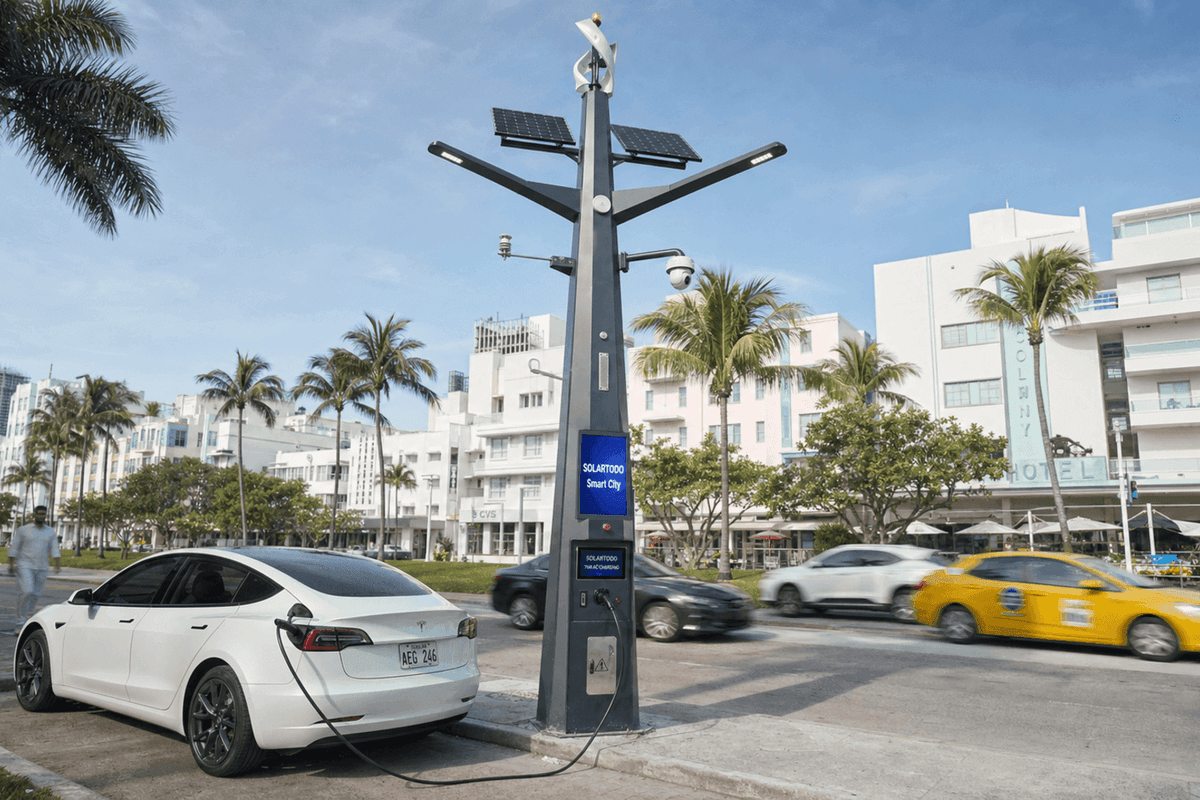
Lahore Smart Streetlight Market Analysis: 168-Unit Hybrid 9m Multi-Function Pole Configuration
Summary
Lahore's 13.0 million population, 758.8 mm annual rainfall profile, and dense urban corridors support a typical 168-unit, 9m hybrid Smart Streetlight deployment at 32m spacing with 11kW AC EV charging and 15kWh LFP backup.
Key Takeaways
A Lahore Smart Streetlight program of 168 poles would cover about 5.38 km at 32m spacing and consolidate lighting, EV charging, video, WiFi, 5G gateway, and environmental sensing.
- A typical 168-unit deployment at 32m spacing would cover approximately 5.38 km of urban streets, using 30-50 poles per km guidance for city-class corridors.
- Each 9m octagonal tapered pole would use a base diameter of 45cm and top diameter of 15cm with RAL7024 dark grey powder coating.
- Each pole would integrate 2 x 80W LED luminaires at 150 lm/W and 4000K, producing about 24,000 lm per pole before optical losses.
- The hybrid energy package combines a 300W Savonius VAWT, 2 x 100W monocrystalline panels, a 15kWh LFP battery, MPPT control, and grid backup.
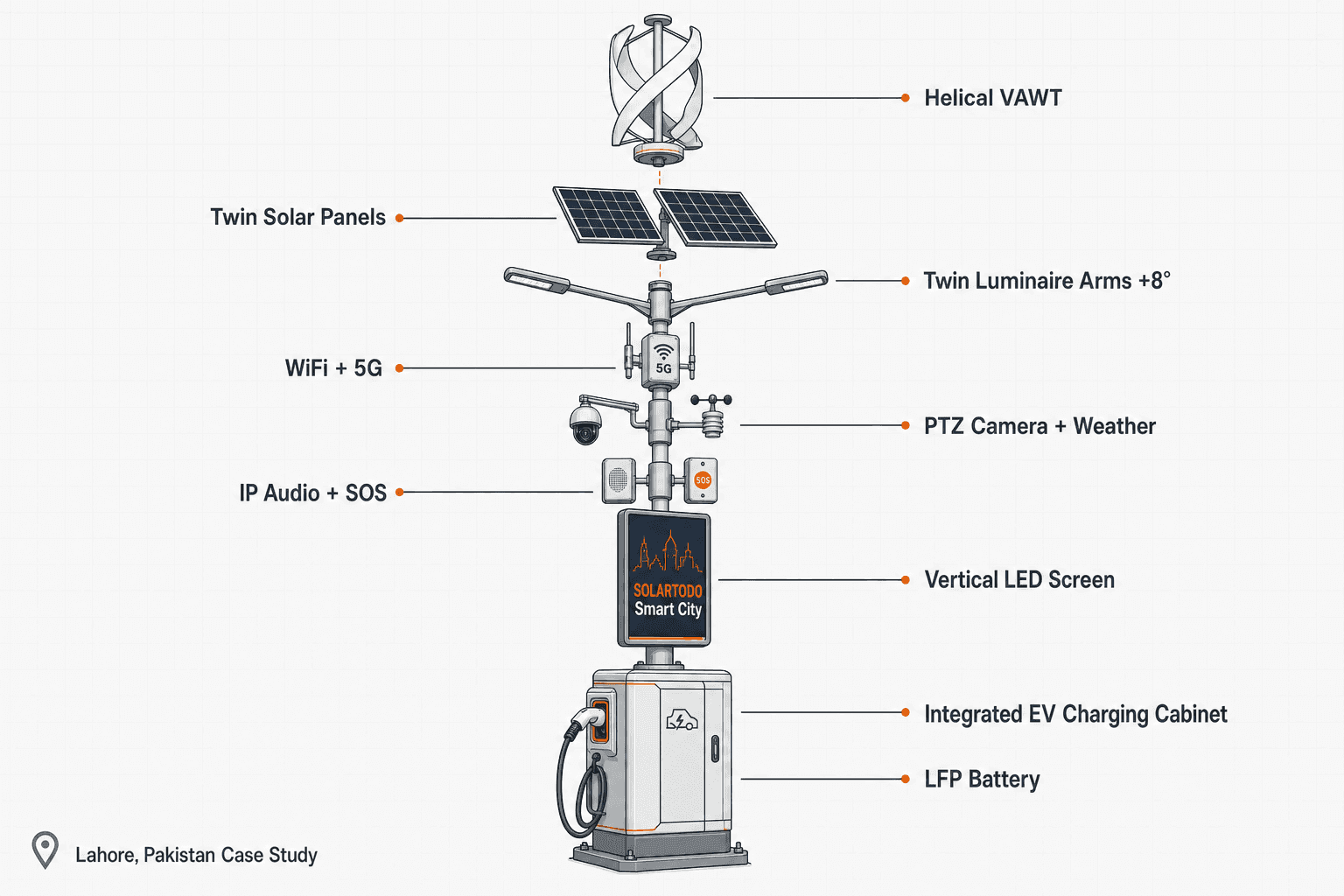
- The lower 2.2m of the SOLARTODO pole is the 11kW Type 2 AC EV charging cabinet, welded as one continuous steel structure.
- Public-safety modules include a 20x mini PTZ dome, IR 100m coverage, SOS button, 30W IP audio column, and an 8-parameter environmental sensor.
- Communications would combine WiFi 6, 5G gateway, GbE uplink, LoRaWAN, and OCPP 1.6J for charger supervision.
Market Context for Lahore
Lahore's 13,004,135 residents and fully urban district profile make it a high-density smart-infrastructure market rather than a highway-lighting or garden-lighting application.
According to Pakistan Bureau of Statistics census data reported for 2023, Lahore district has about 13.0 million people, 2,010,225 households, and a literacy rate near 79.6%. That density supports multifunction poles because street furniture must carry more than lighting: video, connectivity, environmental data, emergency call points, advertising display, and EV charging can share one civil foundation. Lahore's urban corridors also require equipment that can withstand dust, heat, monsoon rain, and maintenance constraints without adding separate roadside cabinets.
According to Pakistan Meteorological Department climate summaries, Lahore receives about 758.8 mm of annual rainfall, with monsoon concentration from late June through September and average June highs often exceeding 40C. Those conditions favor hot-dip galvanized or coated steel, sealed electrical compartments, high-brightness LED screens above 6000 cd/m2, and battery chemistry with stable thermal behavior. For air-quality monitoring, Lahore's recurring smog episodes make PM2.5 and PM10 sensing commercially relevant rather than decorative.
According to LESCO public service-area descriptions, Lahore Electric Supply Company supplies Lahore and surrounding districts, while distribution practice in Pakistan commonly steps down from grid substations to 11kV feeders and low-voltage service for municipal loads. A Smart Streetlight deployment should therefore be designed around low-voltage service connection, local protection, metering, OCPP charger telemetry, and optional grid backup rather than a high-voltage tower form factor. ITU states, 'smart sustainable city uses ICTs and other means' to improve operations and services; this is the correct lens for SOLARTODO Smart Streetlight planning in Lahore.
Recommended Technical Configuration
A typical Lahore configuration would use approximately 168 hybrid 9m smart poles because the corridor scale, climate, and EV-readiness needs fit a city-street integrated asset class.
The recommended SOLARTODO configuration is the hybrid 12m product family adapted to the project-specific 9m octagonal tapered steel pole. The shorter 9m height is appropriate for urban streets, commercial roads, transit-adjacent access, and parking-linked curbside zones; it is not a highway mast and not a park bollard. At 32m spacing, approximately 168 units would form a 5.38 km smart corridor, staying within the 25-50m spacing and 30-50 poles per km class used for urban street lighting.
A typical 168-unit deployment of this scale would include approximately 26.88 kW of installed LED lighting load, 50.4 kW of small wind nameplate capacity, 33.6 kW of pole-mounted solar panel capacity, 2.52 MWh of distributed LFP storage, and 1.848 MW of theoretical simultaneous AC EV charging capacity if every 11kW charger operated at full output. In real operations, the EV charging load should be diversity-managed through OCPP 1.6J, feeder capacity checks, and site-level load profiles. SOLARTODO would position the integrated pole-as-charger as a curbside infrastructure product, not a separate charger pedestal attached to a lighting column.
For Lahore, the strongest technical fit is hybrid resilience plus grid backup. According to Global Solar Atlas methodology by the World Bank and ESMAP, its resource maps provide solar data at about 250m grid resolution and PV output data at about 1km resolution, which is adequate for early-stage feasibility screening. According to Pakistan solar-resource summaries, national irradiation is about 5.3 kWh/m2/day, making 2 x 100W panels useful for sensing, communications, and partial auxiliary support, while the grid tie remains important for EV charging reliability.
Technical Specifications
The Lahore Smart Streetlight specification uses 168 x 9m hybrid octagonal poles with 160W LED load, 500W renewable generation nameplate, 15kWh LFP storage, and 11kW AC charging per pole.
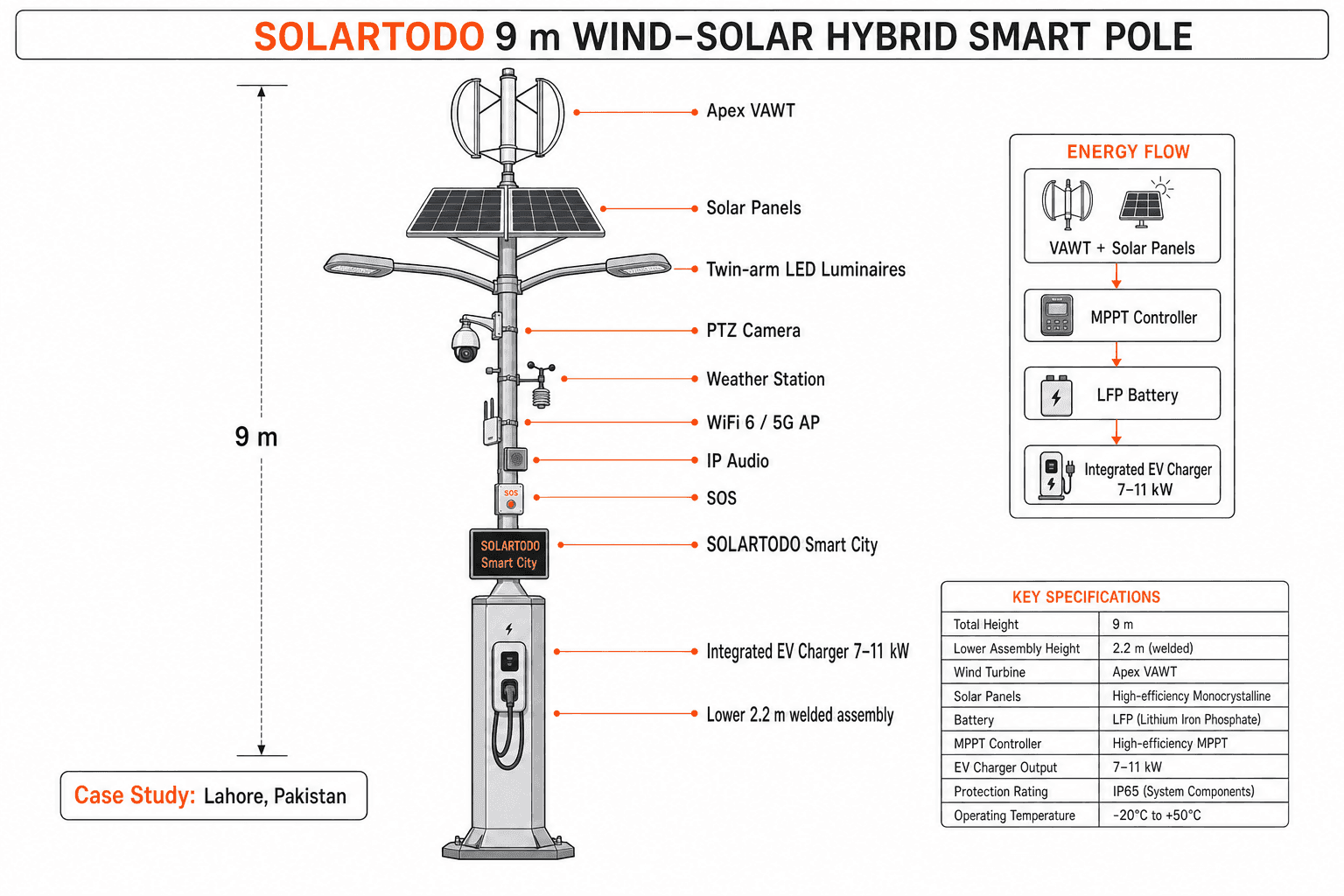
- Product: SOLARTODO Smart Streetlight, hybrid wind-solar self-powered model with backup grid tie.
- Quantity basis: approximately 168 units for a 5.38 km corridor at 32m spacing.
- Pole body: 9m octagonal tapered steel, base Ø45cm to top Ø15cm, RAL7024 dark grey powder coat.
- Integrated EV cabinet: lower 2.2m of pole is the welded charger body, not a separate roadside pillar.
- Wind module: Savonius bucket VAWT, 2 curved scoops, Ø60 x 90cm, 300W, with red aviation LED.
- Solar module: 2 x 100W deep-black monocrystalline panels on symmetric east-west A-frame brackets at 15 degrees.
- Storage and control: 15kWh LFP battery inside pole base with MPPT controller and backup grid tie.
- Lighting: twin symmetric 1.5m arms, +8 degree upward tilt, 2 x 80W LED, 150 lm/W, 4000K.
- Video: 15cm white mini PTZ dome, 360 degrees, 20x zoom, IR 100m, mounted on 40cm L-bracket.
- Environmental sensing: 8-parameter sensor for temperature, humidity, wind, pressure, noise, PM2.5, PM10, and illuminance.
- Public address: 1 x slim 30W/93dB IP audio column, Ø10 x 50cm, TCP/IP networked, flush against a flat pole face.
- Emergency: one-press SOS button with camera linkage and cloud event logging.
- EV charging: integrated 11kW single-gun AC charger, Type 2, OCPP 1.6J, 5m coiled cable, touchscreen, E-stop, maintenance door.
- Display: P3 portrait LED screen, 1000 x 2000mm, above 6000 cd/m2, showing only SOLARTODO Smart City in white sans-serif on deep blue.
- Communications: dual-mode WiFi 6 plus 5G gateway, GbE uplink, LoRaWAN, flush-mounted at 8.7m with color-matched housing.
- Extras: USB-A x 2, 5V/2.4A on the charging cabinet.
- Standards basis: IEC 60598 for luminaires, GB/T 37024 for smart pole systems, and IEC 62196-2 for Type 2 AC charging interfaces.
According to IEC 62196-2, Type 2 AC accessories are standardized for dimensional compatibility of EV plugs, socket-outlets, connectors, and inlets. IEC states, 'International Standards provide a common language' for safety and interoperability, which is essential when chargers, lighting, and telecom modules share one structure.
Implementation Approach
A 168-unit Lahore rollout would normally be phased over 12-20 weeks from survey to commissioning, depending on utility approvals, civil access, and import clearance.
The first phase should confirm corridor geometry, utility availability, drainage, right-of-way limits, camera sight lines, and EV parking dwell-time assumptions. Engineering drawings should define foundation dimensions, anchor bolt cages, earthing, cable routing, service isolation, and OCPP network topology. For Lahore's monsoon season, civil planning should protect cabinet thresholds, touchscreen placement, cable glands, and base-compartment ventilation from splash and standing water.
The second phase would cover factory acceptance, CKD or finished-unit packing, sea freight, customs documentation, and site storage. A typical procurement package should include pole bodies, VAWT assemblies, solar brackets, LFP battery packs, LED arms, PTZ cameras, IP audio columns, EV charger internals, LED displays, gateways, LoRaWAN controllers, and spare module kits. Before installation, each pole should be electrically tested for insulation resistance, charger communications, lighting dimming, camera PTZ movement, and display content lock.
The third phase would install foundations, conduits, earthing rods, poles, renewable attachments, communications, and charger commissioning. The final stage should verify lux levels, OCPP charger registration, WiFi coverage, 5G gateway backhaul, SOS camera linkage, IP audio broadcast, environmental sensor calibration, and cloud dashboard alarms. SOLARTODO engineering documentation should also define maintenance access so the 2.2m charger cabinet remains serviceable without dismantling the pole.
Expected Performance & ROI
A 168-unit Lahore Smart Streetlight system would provide about 26.88 kW of LED lighting, 2.52 MWh of distributed storage, and up to 1.848 MW of managed AC charging capacity.
The main return profile comes from asset consolidation and service stacking, not from claiming solar generation alone. One foundation can support lighting, EV charging, CCTV, sensing, public address, SOS, WiFi, 5G gateway, USB charging, and a regulated LED information display. Compared with separate light poles, CCTV poles, charger pedestals, and telecom cabinets, this reduces civil interfaces, clutter, trenching conflicts, and maintenance dispatch complexity.
According to IEA grid analysis, electricity networks require major investment as transport, buildings, and distributed energy become more electrified. IEA states, 'Grid investment needs to nearly double by 2030,' a relevant warning for EV-enabled street assets. For Lahore, this means 11kW chargers should be commissioned with load management, feeder review, and OCPP rules rather than assumed to run simultaneously at all 168 locations.
Expected payback depends on tariff structure, advertising permissions, EV utilization, telecom lease policy, maintenance labor, and security value. A conservative B2B model should test 5-8 year payback under low EV use and limited media revenue, and 3-5 year payback where charging sessions, 5G gateway leasing, and municipal advertising are active. The ROI worksheet should separately model lighting energy reduction, avoided standalone infrastructure, charger revenue, communications lease income, and lower incident response time.
Results and Impact
A typical 168-unit configuration would convert about 5.38 km of Lahore streets into a managed digital corridor with 168 sensing nodes and 168 AC charging points.
The expected impact is operational capability: better night visibility, distributed environmental data, curbside EV charging access, video coverage, public alerting, and a communications layer for future smart-city services. It should not be described as a completed Lahore project unless an actual client record, installation certificate, and commissioning date are supplied. The technically defensible position is that Lahore's density, air-quality challenges, and urban mobility growth make this configuration a strong fit for future municipal or EPC procurement.
Comparison Table
The 168-unit hybrid 9m option offers higher resilience than a standard grid-only smart pole while avoiding the visual complexity of separate EV charger pedestals.
| Option | Typical height | Power architecture | EV charging | Best fit in Lahore | Main limitation |
|---|---|---|---|---|---|
| Recommended hybrid Smart Streetlight | 9m | 300W VAWT + 200W solar + 15kWh LFP + grid backup | Integrated 11kW Type 2 AC | Dense urban corridors, EV-ready curbside zones, smog monitoring | Requires utility coordination for charger load |
| Grid-only smart pole | 9-12m | Low-voltage grid supply | Optional integrated AC | Stable feeder zones with low renewable requirement | Lower resilience during outages |
| Standard modular pole | 6-12m | Grid or project-defined | Optional module | Budget-sensitive lighting plus CCTV | Less integrated visual finish |
| Separate charger + light pole | 6-10m | Separate electrical cabinets | Standalone pedestal | Existing parking sites | More civil clutter and more foundations |
Pricing & Quotation
SOLARTODO provides 3 commercial quotation modes for Smart Streetlight procurement: FOB Supply, CIF Delivered, and EPC Turnkey, with final scope driven by foundation, grid, charger, and communications requirements.
SOLARTODO offers three pricing tiers for this product line: FOB Supply (equipment ex-works China), CIF Delivered (including ocean freight and insurance), and EPC Turnkey (fully installed, commissioned, with 1-year warranty). Volume discounts are available for large-scale deployments. Configure your system online for an instant estimate, or request a custom quotation from our engineering team at [email protected].
For technical product review, see the SOLARTODO Smart Streetlight product page, or contact us for corridor drawings, load schedules, and EPC documentation.
Frequently Asked Questions
A Lahore buyer should evaluate 8 main areas before procurement: pole structure, EV load, battery autonomy, communications, standards, timeline, maintenance, warranty, and EPC scope.
Q1: What Smart Streetlight configuration is recommended for Lahore? A typical Lahore configuration would use approximately 168 hybrid 9m octagonal tapered steel poles at 32m spacing. Each pole integrates twin 80W LEDs, 300W VAWT, 2 x 100W solar panels, 15kWh LFP battery, 11kW Type 2 AC charger, PTZ camera, environmental sensor, WiFi 6, 5G gateway, SOS, IP audio, and LED display.
Q2: Is the EV charger a separate pedestal beside the pole? No. In this configuration, the lower 2.2m of the pole is the EV charging cabinet, welded into one continuous steel structure. The integrated charger includes an 11kW single-gun AC output, Type 2 connector, OCPP 1.6J communication, 5m coiled cable, touchscreen, E-stop, and maintenance door.
Q3: How long would a 168-unit deployment typically take? A realistic program would usually take 12-20 weeks after final drawings and utility approvals. The sequence includes survey, electrical design, factory production, FAT testing, sea freight or regional logistics, foundation works, pole erection, grid tie-in, OCPP charger registration, lighting tests, communications commissioning, and operator training.
Q4: What payback period should Lahore planners assume? A conservative model should test 5-8 years where EV utilization and advertising revenue are limited. In corridors with paid charging, approved LED media use, lower maintenance dispatch, and telecom gateway value, a 3-5 year payback may be possible. Final ROI depends on tariffs, parking dwell time, permissions, and EPC scope.
Q5: What maintenance is required for the hybrid pole? Maintenance should include quarterly visual inspection, charger connector checks, cabinet seal checks, camera cleaning, LED screen diagnostics, VAWT bearing inspection, solar panel cleaning, firmware updates, and annual battery health review. Lahore's dust and smog conditions make optical cleaning and air-quality sensor calibration more important than in cleaner coastal markets.
Q6: How does this compare with a normal smart pole? A normal smart pole may provide lighting, camera, sensor, or WiFi modules, but it often relies fully on the grid and may use separate charger hardware. The recommended SOLARTODO hybrid pole adds 300W wind, 200W solar, 15kWh LFP storage, and a welded 11kW EV cabinet in the same 9m structure.
Q7: Does SOLARTODO provide EPC pricing for Lahore? SOLARTODO can quote FOB Supply, CIF Delivered, or EPC Turnkey. EPC pricing depends on foundation design, trenching, grid connection distance, customs route, site safety requirements, commissioning scope, and local subcontractor rates. The article does not list prices because a Lahore quotation needs drawings, load schedules, and installation boundaries.
Q8: What standards apply to this configuration? The relevant standards basis includes IEC 60598 for luminaires, GB/T 37024 for smart pole systems, and IEC 62196-2 for Type 2 AC EV charging interfaces. OCPP 1.6J should be used for charger supervision, while local electrical approval should verify protection, earthing, metering, and feeder capacity.
Q9: What warranty structure is typical? A typical turnkey package includes a 1-year warranty in the commercial paragraph, with extended component coverage negotiable by contract. Buyers should define separate warranty terms for steel structure, LED driver, LFP battery, EV charger, camera, LED display, gateway, and software platform, because each module has different service life.
Q10: Can the system operate during grid outages? Yes, the hybrid design includes a 15kWh LFP battery, MPPT controller, 300W VAWT, 200W solar input, and grid backup. Lighting, sensing, communications, SOS, and camera functions can be prioritized during outages. EV charging should normally be limited or disabled under backup mode unless the site has confirmed surplus energy.
References
- Pakistan Bureau of Statistics (2023): 7th Population and Housing Census reports Lahore district population at about 13,004,135; https://www.pbs.gov.pk
- Pakistan Meteorological Department (2023): Lahore climate records show monsoon rainfall concentration and annual precipitation near 758.8 mm; https://www.pmd.gov.pk
- Lahore Electric Supply Company (2024): LESCO service-area information covers Lahore and nearby Punjab districts for distribution planning context; https://lesco.gov.pk
- World Bank and ESMAP (2019): Global Solar Atlas 2.0 provides solar resource and PV potential mapping at about 250m to 1km resolution; https://globalsolaratlas.info
- IEC (2022): IEC 62196-2 defines dimensional requirements for AC EV charging plugs, socket-outlets, connectors, and inlets; https://www.iec.ch
- IEC (2020): IEC 60598 series defines luminaire safety and performance requirements relevant to LED streetlighting; https://www.iec.ch
- ITU (2015): Smart sustainable city definitions emphasize ICT-enabled service efficiency and urban quality-of-life improvements; https://www.itu.int
- IEA (2023): Electricity grids and secure energy transitions report highlights the need for much higher grid investment by 2030; https://www.iea.org
Equipment Deployed
- 168 x 9m octagonal tapered steel Smart Streetlight poles, base Ø45cm to top Ø15cm, RAL7024 powder coat
- 168 x integrated 11kW single-gun Type 2 AC chargers with OCPP 1.6J, 5m coiled cable, touchscreen, E-stop, and maintenance door
- 168 x 15kWh LFP battery systems inside pole bases with MPPT controller and backup grid tie
- 168 x 300W Savonius bucket VAWT modules, Ø60 x 90cm, 2 curved scoops, red aviation LED
- 336 x 100W deep-black monocrystalline solar panels on 15-degree A-frame brackets
- 336 x 80W LED luminaires, 150 lm/W, 4000K, on twin 1.5m symmetric arms with +8 degree upward tilt
- 168 x mini PTZ dome cameras, 360 degrees, 20x zoom, IR 100m, on 40cm L-brackets
- 168 x 8-parameter environmental sensors for temperature, humidity, wind, pressure, noise, PM2.5, PM10, and illuminance
- 168 x 30W/93dB TCP/IP IP audio columns, Ø10 x 50cm, flush-mounted and color-matched
- 168 x P3 vertical LED displays, 1000 x 2000mm, above 6000 cd/m2, fixed SOLARTODO Smart City content
- 168 x dual-mode WiFi 6 and 5G gateway units with GbE uplink and LoRaWAN, flush-mounted at 8.7m
- 168 x one-press SOS buttons with camera linkage plus USB-A x 2 charging points at 5V/2.4A