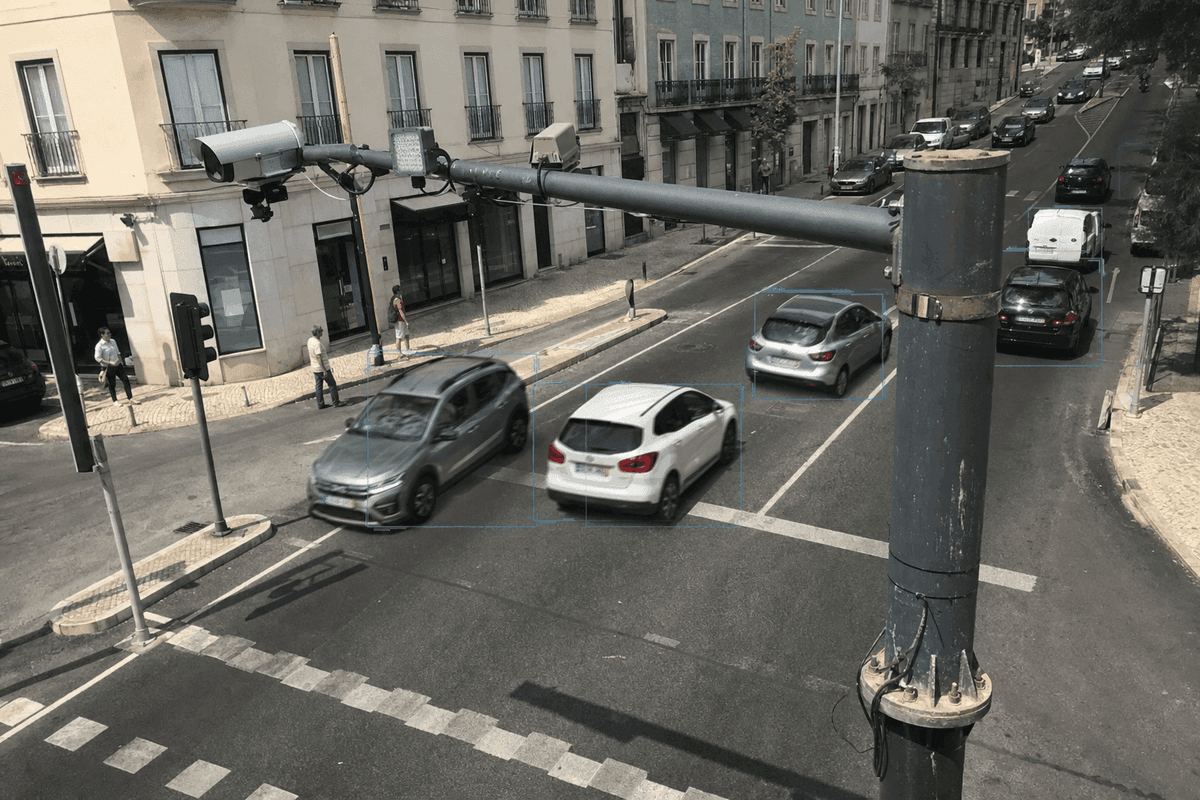
Lisbon Smart Traffic System Market Analysis: 15-Intersection 8m L-Arm Configuration Guide
Summary
Lisbon's 575,739 residents and 3.0M metro population support a 15-intersection Smart Traffic System using 8m poles, 4K AI, 77GHz radar, and 5G/fiber backhaul.
Key Takeaways
A 15-intersection Lisbon smart traffic package would typically use 60-120 integrated 8m L-arm poles, depending on lane geometry and auxiliary signal needs.
- Lisbon municipality covers about 100.05 km2 with 575,739 residents, creating high-density signal coordination requirements.
- A typical 15-intersection deployment would use approximately 60-120 dark grey, hot-dip galvanized 8m L-arm steel poles.
- Each 4-in-1 pole integrates 1 4K AI camera, 1 77GHz mmWave radar, LED fill light, and LED signal head.
- The edge stack uses NVIDIA Jetson processing for 45+ detection types, 98% AI accuracy, and sub-50ms response.
- Recommended backhaul is dual-path 5G/fiber to TrafficGPT for natural language traffic queries and central monitoring.
- NTCIP and GB 25280 alignment supports controller interoperability, LED signal safety, and procurement standardization.
- A BOT model can reduce municipal upfront capex to 0 while shifting performance risk into service-level milestones.
Market Context for Lisbon
Lisbon's compact 100.05 km2 municipal area and 3.0M metropolitan catchment make adaptive signal control a high-fit investment for constrained corridors.
According to Statistics Portugal / INE (2025), Lisbon municipality reached approximately 575,739 residents in 2024, while the Lisbon metropolitan area reached about 3,005,119 people. This means a central traffic system must manage local commuting, tourism, freight, bus priority, and emergency movement within a dense historic street network. The city's coordinates, 38.72 latitude and -9.14 longitude, also place equipment close to the Atlantic, so pole coatings and outdoor electronics need corrosion-aware specifications.
According to Lisbon Municipality's climate and mobility planning (2020), the city targets a 60% reduction in emissions by 2030 and carbon neutrality by 2050. Traffic signal optimization is not a substitute for public transport investment, but it can reduce delay, idling, and response time at bottleneck junctions. For SOLARTODO, the relevant product fit is not solar generation; it is an integrated Smart Traffic System that combines detection, signal actuation, edge AI, communications, and a central traffic intelligence layer.
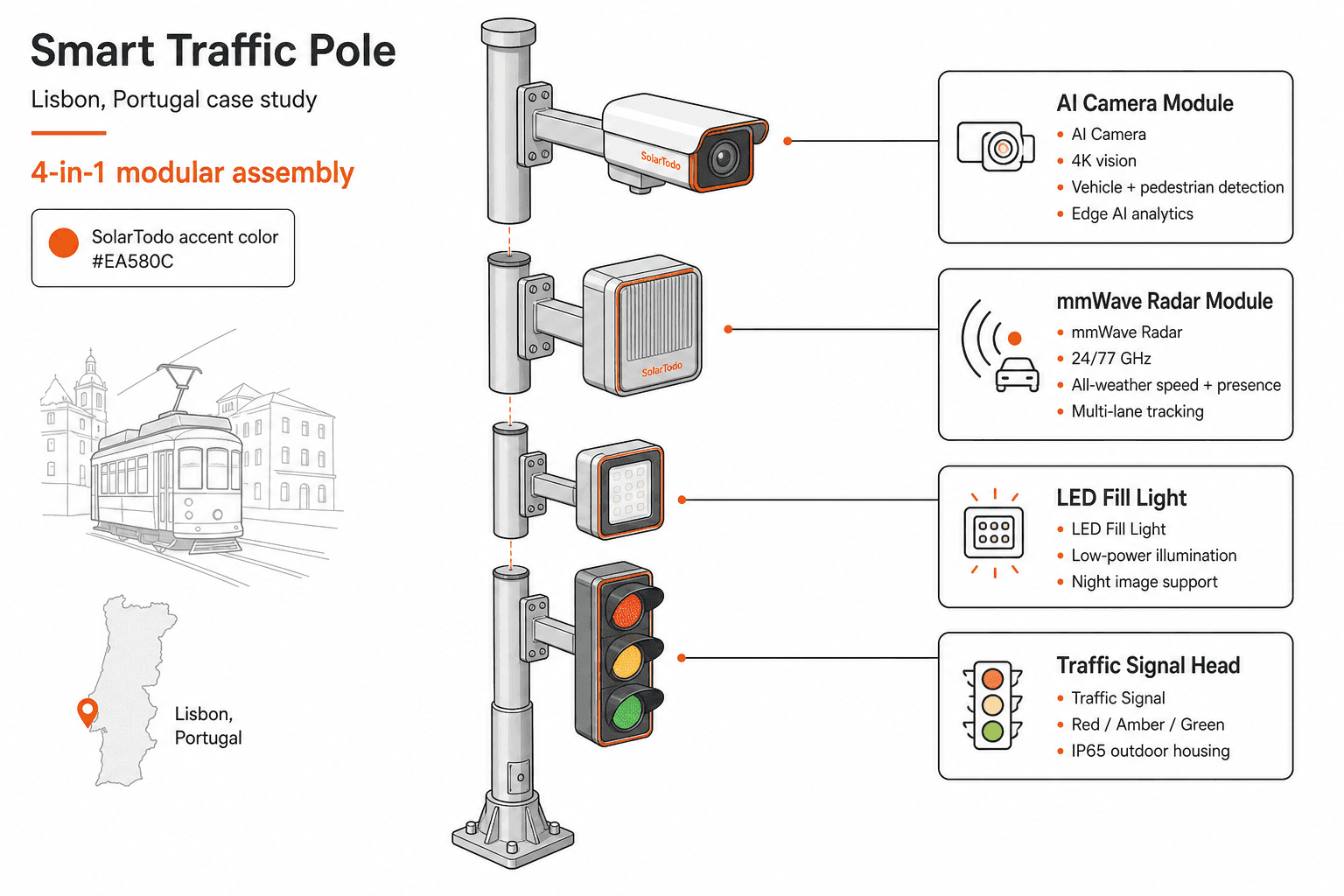
According to ANACOM (2021), Portugal's 5G spectrum auction assigned national and regional frequency rights for commercial 5G rollout. That matters because Lisbon intersections can use fiber where ducts are available and 5G where construction disruption or heritage constraints make trenching less practical. ITU states, "A smart sustainable city is an innovative city that uses ICTs," which supports a 5G/fiber hybrid architecture for connected roadside infrastructure.
Recommended Technical Configuration
A Lisbon configuration of 15 intersections should use 8m L-arm integrated poles because urban signal visibility matters more than highway gantry clearance.
Based on the project-specific configuration, a typical 15-intersection deployment of this scale would consist of approximately 60 primary poles for four-approach junctions, with up to 120 poles where pedestrian phases, turning lanes, tram interfaces, or auxiliary signal heads require extra mounting points. The correct size class is the 8m L-arm hot-dip galvanized steel pole in dark grey, matching central Lisbon's urban scale and signal mounting requirements. The 10-12m variant should be reserved for highway gantries or wide arterial spans, not normal city intersections.
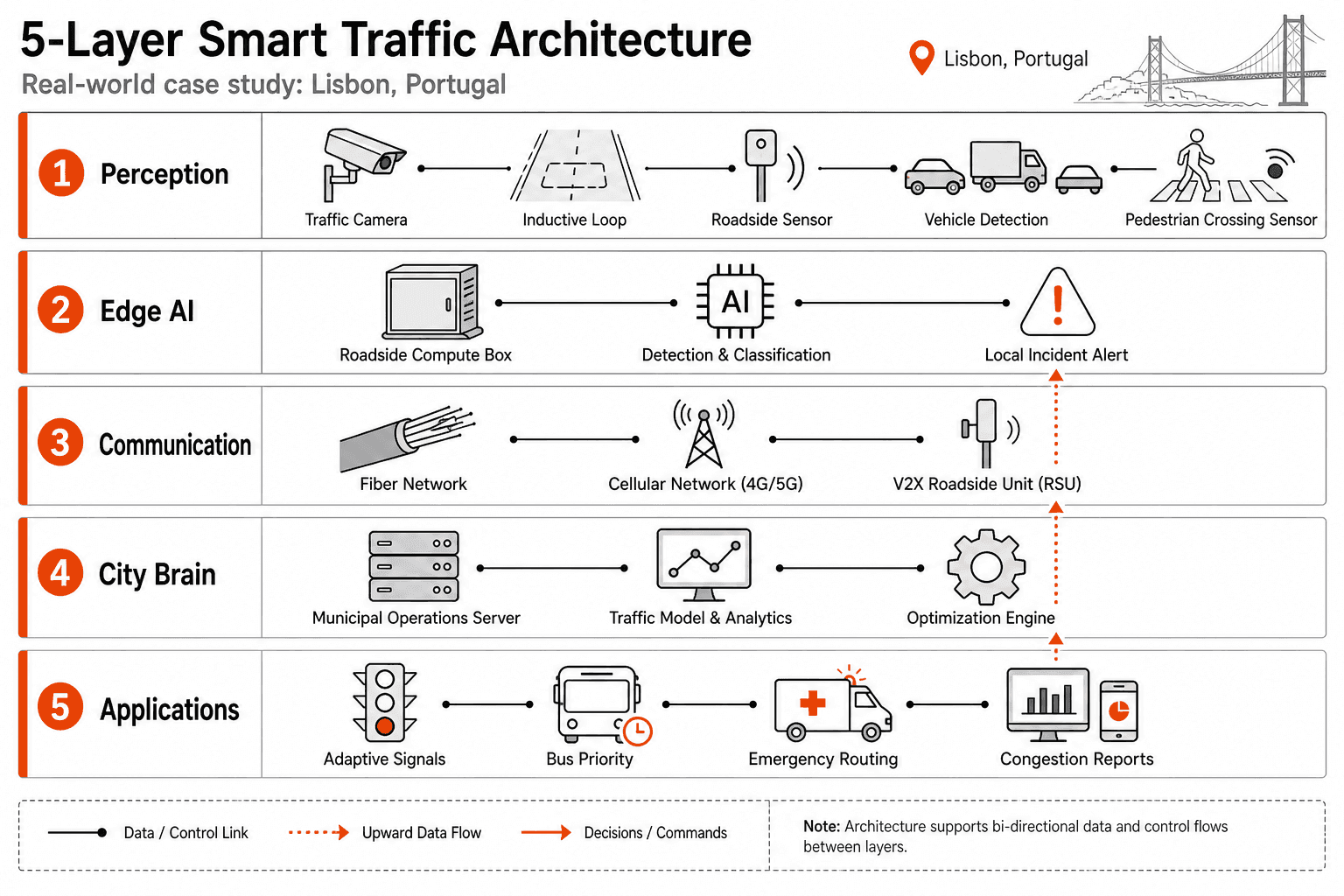
The recommended SOLARTODO Smart Traffic System configuration is a 4-in-1 smart traffic pole with a 4K AI camera, 77GHz mmWave radar, LED fill light, and LED signal head. Edge processing runs on NVIDIA Jetson, allowing local perception and signal actuation even when the central platform is temporarily unreachable. Features should include full 45-type detection, adaptive signal control, emergency vehicle priority, wrong-way alerts, and 5G/fiber backhaul to TrafficGPT for natural language queries.
A BOT cooperation model is technically appropriate where the city wants zero upfront expenditure and staged performance acceptance. Under this model, milestones would normally cover survey approval, factory acceptance testing, CKD shipment, civil works, pole erection, controller integration, TrafficGPT onboarding, and 30-90 days of operational tuning. SOLARTODO can position this as a technical recommendation for Lisbon without claiming a past local deployment.
Technical Specifications
Each 8m Lisbon smart traffic pole should combine 4K vision, 77GHz radar, LED signaling, and Jetson edge AI in one galvanized L-arm structure.
- Product line: SOLARTODO Smart Traffic System for urban intersections.
- Pole form: 8m L-arm steel pole, dark grey finish, hot-dip galvanized for outdoor corrosion resistance.
- Deployment scale: 15 intersections; approximately 60-120 poles depending on site geometry.
- Integrated modules: 4K AI camera, 77GHz mmWave radar, LED fill light, and LED signal head.
- AI performance: 98% detection accuracy, 45+ detection types, and less than 50ms edge response.
- Edge hardware: NVIDIA Jetson for local video/radar fusion and adaptive control decisions.
- Network layer: 5G/fiber backhaul to TrafficGPT central platform with natural language traffic queries.
- Features: adaptive signal timing, emergency vehicle priority, full 45-type detection, and wrong-way alert.
- Standards alignment: NTCIP for ITS device interoperability and GB 25280 for LED traffic signal requirements.
NEMA, AASHTO, and ITE describe NTCIP as enabling "interoperability and interchangeability between computers and electronic traffic control equipment." For Lisbon procurement, that reduces vendor lock-in risk because field devices, controllers, and the central system can be specified against known ITS communication profiles. GB 25280 alignment supports LED signal performance discipline, while local installation would still need Portuguese civil, electrical, and road authority approvals.
Implementation Approach
A 15-intersection rollout should be phased across 12-24 weeks, with surveys and integration testing completed before citywide signal optimization.
The first phase is intersection survey and design validation. Engineers would map approach lanes, pedestrian crossings, existing mast arms, controller cabinets, fiber availability, 5G signal quality, utility conflicts, and foundation constraints. In Lisbon's historic zones, the survey should also flag heritage streetscapes, narrow sidewalks, underground utilities, and installation windows that minimize disruption.
The second phase is factory configuration and CKD logistics. Pole sections, L-arms, LED signal heads, radar, cameras, Jetson edge devices, surge protection, cabinet interfaces, and mounting kits should be pre-checked before shipment. Factory acceptance testing should verify power, camera framing, radar detection zones, LED signal output, controller messages, and TrafficGPT data ingestion.
The third phase is civil installation and commissioning. A typical sequence would include foundation work, pole erection, L-arm alignment, signal head aiming, radar calibration, camera masking, 5G/fiber connection, controller integration, and safety testing. Final commissioning should include emergency vehicle priority tests, wrong-way alert validation, night fill-light checks, and adaptive timing observation during peak and off-peak periods.
Expected Performance & ROI
A 15-intersection BOT deployment should be evaluated on delay reduction, emergency priority response, violation detection, uptime, and 5-8 year lifecycle economics.
According to the World Bank (2023), more than 56% of the global population lives in cities, and dense urban corridors concentrate congestion costs. According to the IEA (2023), transport accounts for roughly 20% of global CO2 emissions, so reducing stop-start delay has climate and operating-cost relevance. For Lisbon, the most defensible ROI framework is not a guaranteed fuel-saving claim; it is a monitored baseline-versus-after comparison using travel time, queue length, signal compliance, emergency preemption success, and maintenance calls.
Expected operating benefits would include faster incident recognition, shorter manual review time, and more consistent adaptive timing at coordinated intersections. A 98% AI detection target and sub-50ms edge response are useful because traffic actuation must remain local enough for safety-critical timing. The central TrafficGPT layer adds value for operations teams by allowing natural language queries such as "show wrong-way alerts by corridor this week" or "compare bus delay before and after emergency priority activation."
Results and Impact
The expected impact of a 15-intersection Lisbon system is measurable operational control rather than a claimed historical deployment outcome.
A recommended acceptance scorecard should include at least 10 measurable KPIs: intersection uptime, camera availability, radar availability, detection accuracy, controller response, wrong-way alert latency, emergency vehicle priority success rate, mean repair time, communications uptime, and operator query response time. For a BOT model, payment or service fees can be tied to these metrics instead of equipment delivery alone. That structure gives city stakeholders a clearer way to evaluate value over the contract term.
For SOLARTODO, the Lisbon fit is strongest at mixed-use junctions where vehicles, buses, delivery traffic, pedestrians, cyclists, and emergency vehicles overlap. The 8m L-arm class provides adequate urban mounting height without imposing highway-scale visual mass. The integrated 4-in-1 architecture also reduces pole clutter by consolidating camera, radar, fill light, and signal functions into one dark grey galvanized structure.
Comparison Table
The 8m L-arm option is the best technical fit for Lisbon intersections, while 10-12m poles should be reserved for gantries.
| Configuration Option | Typical Use | Height | Detection Package | Lisbon Fit | Procurement Notes |
|---|---|---|---|---|---|
| 6m smart traffic pole | Small local junctions | 6m | 4K AI + 77GHz radar | Limited for major avenues | Lower visual impact, less signal clearance |
| 8m L-arm smart pole | Urban signalized intersections | 8m | 4K AI + 77GHz radar + LED signal | Recommended for 15 intersections | Matches project-specific configuration |
| 10m smart traffic pole | Wide arterials | 10m | 4K AI + radar + larger mounting envelope | Conditional | Use where sightlines require added height |
| 10-12m gantry variant | Highway or multi-lane gantry | 10-12m | Multi-lane detection | Not primary Lisbon fit | Use outside normal city junctions |
Pricing & Quotation
SOLARTODO should quote Lisbon using FOB, CIF, and EPC Turnkey tiers, with BOT financing modeled separately for zero-upfront procurement.
SOLARTODO offers three pricing tiers for this product line: FOB Supply (equipment ex-works China), CIF Delivered (including ocean freight and insurance), and EPC Turnkey (fully installed, commissioned, with 1-year warranty). Volume discounts are available for large-scale deployments. Configure your system online for an instant estimate, or request a custom quotation from our engineering team at [email protected].
For Lisbon, the quotation should separate equipment cost, pole foundations, controller integration, fiber or 5G communications, TrafficGPT platform licensing, civil permits, commissioning, and maintenance. A BOT option can convert the project into a service payment model, but it still requires clear assumptions for uptime, data retention, preventive maintenance, and handback condition. Buyers comparing SOLARTODO with local ITS integrators should request the same 15-intersection bill of quantities for each bidder.
Frequently Asked Questions
These 10 Lisbon Smart Traffic System FAQs cover the 8m pole configuration, installation, ROI, maintenance, pricing, and standards fit.
Q1: What is the recommended Smart Traffic System configuration for Lisbon? A typical Lisbon configuration would use 15 intersections with approximately 60-120 8m L-arm hot-dip galvanized steel poles. Each pole integrates a 4K AI camera, 77GHz mmWave radar, LED fill light, and LED signal head. NVIDIA Jetson edge AI supports 45+ detection types, adaptive signal control, emergency vehicle priority, and wrong-way alerts.
Q2: Why is the 8m pole selected instead of a 10m or 12m structure? The 8m L-arm class fits urban signalized intersections where signal visibility, camera angle, and streetscape impact must be balanced. Lisbon's dense municipal core does not usually need highway gantry clearance at normal junctions. The 10-12m variant is better reserved for high-speed corridors, gantries, or unusually wide arterials.
Q3: How long would a 15-intersection deployment usually take? A typical schedule would be 12-24 weeks after survey approval, depending on permits, utility conflicts, fiber availability, and night-work restrictions. The work usually moves through survey, engineering design, factory acceptance testing, CKD shipment, foundations, pole erection, controller integration, TrafficGPT onboarding, and 30-90 days of operational tuning.
Q4: What ROI should Lisbon buyers use for evaluation? ROI should be based on measured delay reduction, emergency priority success, incident response time, communications uptime, and maintenance savings. A conservative BOT model can avoid upfront capex while tying payments to agreed service levels. Buyers should require baseline and post-commissioning data rather than relying on generic percentage improvement claims.
Q5: How does maintenance work for the 4-in-1 pole? Maintenance should include quarterly camera cleaning, radar calibration checks, LED signal inspection, cabinet thermal review, grounding tests, firmware updates, and TrafficGPT data validation. The integrated design reduces roadside clutter, but it also requires disciplined module-level spares. A 15-intersection package should include replacement cameras, radar units, LED drivers, and Jetson edge devices.
Q6: How does this compare with conventional traffic signal poles? A conventional signal pole mainly supports signal heads and may require separate camera, radar, lighting, and communications mounts. The SOLARTODO Smart Traffic System consolidates those functions into one 8m L-arm structure. That improves installation density, reduces visual clutter, and supports edge AI decisions with fused camera and 77GHz radar data.
Q7: What pricing model is best for Lisbon: FOB, CIF, EPC, or BOT? FOB works for buyers with their own logistics and installation teams. CIF adds freight and insurance to Portugal. EPC Turnkey fits agencies wanting installed and commissioned equipment with a 1-year warranty. BOT is the best fit when the procurement goal is zero upfront capex with service-level payments over time.
Q8: What warranty should be specified? The EPC Turnkey tier includes a 1-year warranty, but Lisbon buyers should also define response times, spare-part availability, firmware support, and corrosion inspection responsibilities. For BOT, warranty language should be embedded into the service-level agreement. Critical intersections should carry stricter uptime and mean-time-to-repair requirements than secondary sites.
Q9: Does the system support emergency vehicle priority? Yes. The recommended configuration includes emergency vehicle priority using edge AI, radar-supported detection, controller integration, and TrafficGPT event logging. Acceptance testing should include priority request recognition, signal phase response, recovery timing, and audit reports. Lisbon should test the function on at least peak, off-peak, and night operating profiles.
Q10: Which standards are relevant for procurement? NTCIP is relevant for ITS device communications and interoperability, while GB 25280 is relevant for LED traffic signal requirements. Local Portuguese and EU electrical, civil, road safety, and data protection requirements still apply. Procurement documents should map every interface: pole structure, signal controller, edge device, communications link, and central platform.
References
These 7 references support Lisbon demographics, climate targets, telecom readiness, ITS interoperability, smart-city architecture, and transport-sector relevance.
- Statistics Portugal / INE (2025): 2024 resident population estimates list Lisbon municipality at about 575,739 residents and the Lisbon metropolitan area at about 3,005,119 residents.
- Câmara Municipal de Lisboa (2020): Lisbon climate and mobility planning identifies 2030 emissions reduction and 2050 carbon neutrality objectives relevant to traffic efficiency programs.
- ANACOM (2021): Portugal's 5G spectrum auction assigned frequency rights for commercial 5G rollout, supporting hybrid 5G/fiber roadside communications.
- ITU (2014): Smart sustainable city definition emphasizes ICT-enabled urban services, supporting TrafficGPT and connected intersection architecture.
- NEMA / AASHTO / ITE (2020): NTCIP standards define interoperable communications for traffic signals, sensors, CCTV, and center-to-field ITS devices.
- IEA (2023): Transport contributes roughly one-fifth of global CO2 emissions, making congestion and idling reduction relevant to city climate programs.
- World Bank (2023): More than 56% of the world's population lives in urban areas, reinforcing the need for scalable urban mobility management systems.
Equipment Deployed
- 15 intersections with approximately 60-120 8m L-arm steel poles, dark grey, hot-dip galvanized
- 4-in-1 smart traffic pole with 4K AI camera, 77GHz mmWave radar, LED fill light, and LED signal head
- NVIDIA Jetson edge AI module supporting 45+ detection types, 98% accuracy, and <50ms response
- 5G/fiber backhaul to TrafficGPT central platform for natural language traffic queries
- Adaptive signal control, emergency vehicle priority, and wrong-way alert feature set
- Standards alignment: NTCIP and GB 25280
- BOT cooperation model with zero upfront procurement structure