Lisbon Telecom Tower Market Analysis: 20m Urban Macro Configuration Guide for 62-Unit Infill Coverage
Summary
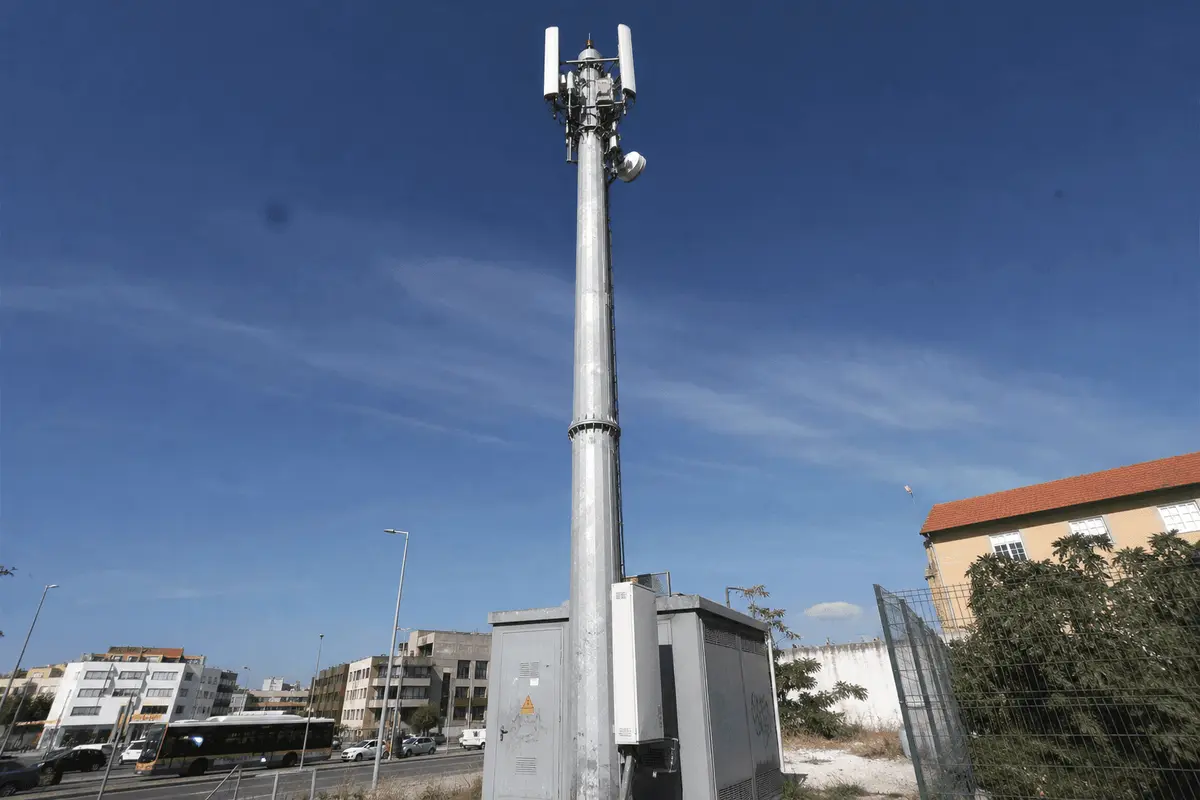
Lisbon’s dense urban fabric, Atlantic wind exposure, and rising 5G traffic make 20m urban macro Telecom Tower configurations a practical fit for infill coverage. A typical 62-unit program would use Q345 steel monopoles, 60 m/s wind class 3 loading, and CKD shipping that cuts logistics volume by 60-70%.
Key Takeaways
- A typical Lisbon infill program of approximately 62 Telecom Tower units would use 20m tapered steel monopoles, matching the 15-25m urban infill size class and keeping structural mass near 7t per tower.
- According to ANACOM (2024), Portugal continues expanding 5G coverage and spectrum-based mobile capacity, which increases demand for compact urban macro sites with 3-panel antenna loading.
- Lisbon’s Atlantic exposure supports specifying wind class 3 at 60 m/s with a 1.35 factor under TIA-222-H, especially for rooftop-adjacent and open-corridor urban locations.
- A recommended tower material for this profile is hot-dip galvanized Q345 steel in a high-corrosion environment, with a 30-year design life and grounding plus lightning protection.
- A typical 62-unit deployment would ship in CKD form, reducing shipping volume by 60-70% and supporting staged installation over roughly 30-45 days of production lead time.
- The specified antenna load of 3× panel antennas at 25kg each fits a low-visual-impact urban infill arrangement while leaving room for cable tray, ladder, warning light, and safety cage accessories.
- Concrete pad foundations are a practical recommendation for many Lisbon urban plots where excavation control, utility avoidance, and fast civil sequencing matter more than deep pile solutions.
- SOLARTODO’s Telecom Tower line for this profile aligns with TIA-222-H and GB/T 50233, and it fits buyers seeking standardized urban macro poles rather than lattice towers.
Market Context for Lisbon
Lisbon’s telecom tower requirement is shaped by high urban density, strong mobile-data demand, and coastal exposure, making 20m steel monopoles more suitable than larger rural tower classes for many infill sites.
Lisbon is Portugal’s capital and core metro node, with a municipality population above 540,000 and a metropolitan population above 2.8 million, depending on the statistical boundary used. According to PORDATA (2024), Lisbon municipality remains one of the country’s most concentrated service-economy areas, which typically correlates with high mobile traffic per square kilometer. According to Eurostat (2024), Portugal’s urban regions continue to concentrate digital service use, commuter flows, and enterprise activity in major cities such as Lisbon.
From a telecom planning perspective, dense streets, heritage-sensitive districts, and mixed-height neighborhoods favor compact monopole forms over lattice structures. A 20m pole sits inside the 15-25m size class defined for rooftop and urban infill applications, where 3-6 panel antennas are common and tower mass generally ranges from 8-15t. The project-specific configuration here is lighter at about 7t per tower, or 350kg/m, which is plausible for a lower-load 20m urban macro monopole and remains well below heavy power-tower mass ranges.
Climate and corrosion are equally important in Lisbon. According to IPMA, Portugal’s national meteorological institute, Lisbon has strong Atlantic influence, seasonal gust events, and marine humidity that can accelerate corrosion on exposed steel assets. For that reason, a high-corrosion specification with hot-dip galvanization is not optional in many coastal or river-adjacent districts; it is a practical durability choice for a 30-year design life.
Mobile network demand also supports infill tower programs. According to the European Commission’s Digital Economy and Society indicators and ANACOM (2024), Portugal’s 5G rollout and mobile broadband usage continue rising, while operators push denser urban layers to improve capacity and indoor-edge performance. The ITU states, “5G and future IMT systems will require denser network deployments in many urban environments,” a point directly relevant to Lisbon’s compact blocks and traffic corridors.
A second authority signal comes from GSMA. GSMA states, “Mobile infrastructure sharing and site densification are both central to cost-efficient 5G expansion,” which fits Lisbon’s need for smaller urban macro sites rather than only tall perimeter towers. For buyers evaluating SOLARTODO, this means the main decision is not whether Lisbon needs towers at all, but which monopole class best balances zoning, wind loading, corrosion resistance, and installation speed.
Recommended Technical Configuration
A typical Lisbon urban infill program would consist of approximately 62 units of 20m tapered steel monopoles with 3-panel antenna loading, concrete pad foundations, and class 3 wind design at 60 m/s.
The correct size class for this city profile is the 15-25m category: rooftop or urban infill, 1 platform, 3-6 panel antennas, and roughly 8-15t per tower. The project-specific requirement uses 20m height, urban macro positioning, and 3× panel antennas at 25kg each, so it clearly fits the lower end of that class. Although the accessory list includes 3 antenna platforms, the pole still remains an urban infill monopole rather than a suburban 25-35m structure because the antenna count and height are both modest.
A typical 62-unit deployment of this scale would be recommended where operators need to close coverage gaps between existing rooftop cells, improve street-level 4G/5G consistency, or support capacity in mixed residential-commercial districts. In Lisbon, that often means transport corridors, riverfront redevelopment zones, denser neighborhoods, and municipal rights-of-way where a lattice tower would face stronger visual and permitting resistance. SOLARTODO’s monopole format is relevant here because it uses sectional flanged steel construction and CKD shipment, which simplifies port-to-site logistics.
The recommended structural configuration is a tapered steel monopole in hot-dip galvanized Q345 steel. The specified 60 m/s wind class 3 with factor 1.35 is a conservative fit for Atlantic gust exposure and open urban canyons. TIA-222-H is the correct loading reference for telecom structures, while GB/T 50233 supports fabrication and erection quality control for steel masts and towers.
For foundations, the project-specific requirement is a concrete pad foundation. This is technically reasonable for 20m poles where soil bearing is adequate, groundwater is manageable, and urban excavation depth is constrained by utilities. If a Lisbon site has weak fill, buried services, or strict settlement limits, geotechnical review may still push some locations toward piers or piles; however, the baseline recommendation for this configuration remains the pad foundation provided.
Accessory selection also matches urban macro use. A climbing ladder, cable tray, aircraft warning light, grounding system, lightning rod, 3 antenna platforms, and safety cage support maintainability and code compliance. According to IEC 62305 principles for lightning protection and common telecom grounding practice, exposed urban towers require low-impedance grounding paths and bonded metallic components to reduce surge risk during storms.
SOLARTODO should therefore be evaluated in Lisbon as a standardized 20m infill Telecom Tower option rather than a rural coverage mast. Buyers needing higher microwave backhaul loads or 35-45m peri-urban spans would normally move to a different size class. For this city profile, the 20m class is the more precise fit.
Technical Specifications
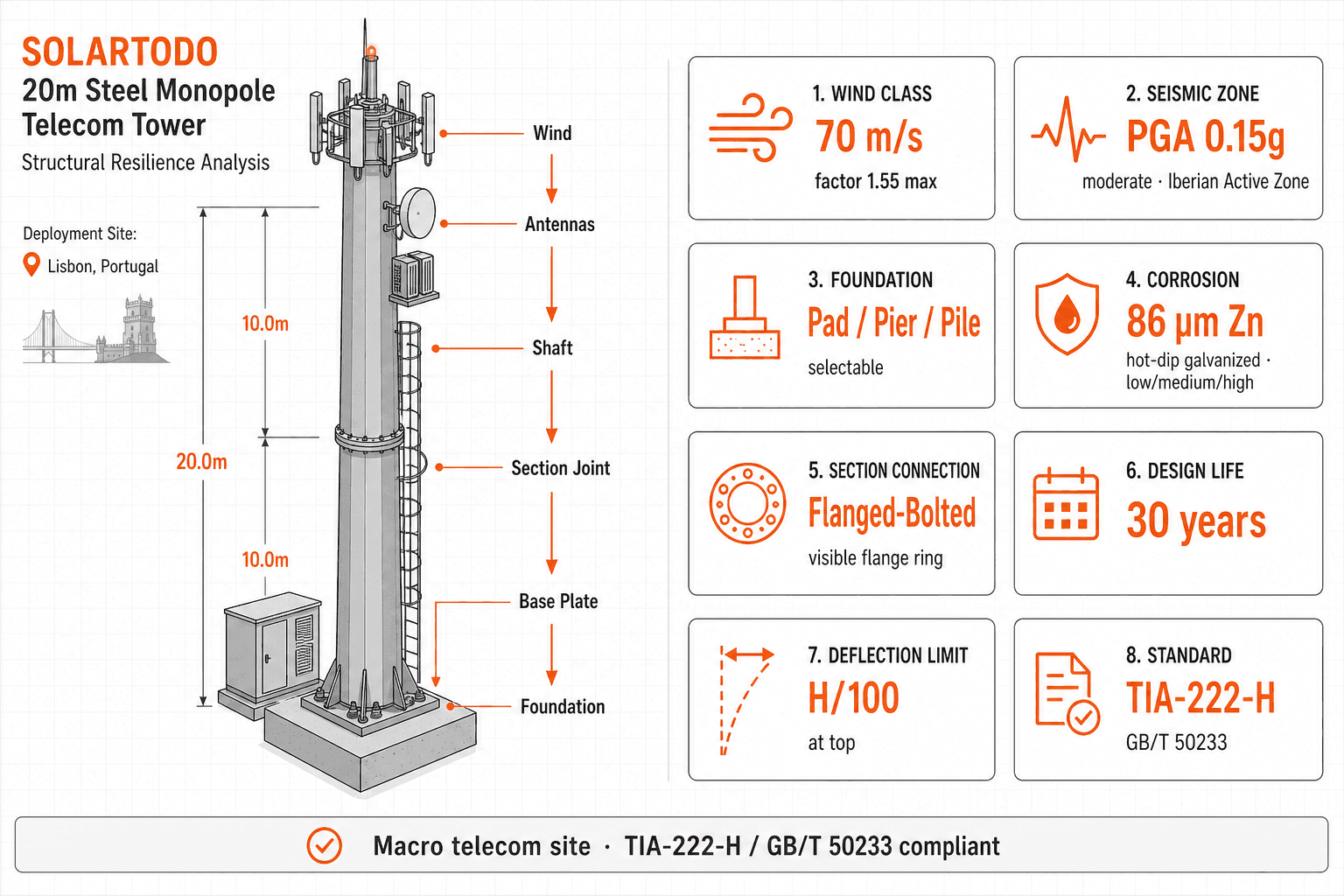
This Lisbon configuration is best specified as a 20m Q345 galvanized monopole with 3×25kg panel antennas, 60 m/s wind class 3 loading, concrete pad foundation, and approximately 7t structural weight.
- Product type: Steel monopole Telecom Tower, tapered tubular form
- Application profile: Urban macro site / urban infill
- Quantity reference: Approximately 62 units for a city-scale infill program
- Tower height: 20m
- Size class match: 15-25m urban infill class
- Structural weight: Approximately 7t per tower, equal to about 350kg/m
- Steel grade: Q345 hot-dip galvanized steel
- Corrosion zone: High-corrosion specification
- Design wind class: Class 3
- Design wind speed: 60 m/s
- Wind load factor: 1.35 per TIA-222-H
- Antenna load: 3× panel antennas, 25kg each
- Antenna arrangement: Urban infill single-sector or compact tri-sector layout, depending on operator RF plan
- Foundation type: Concrete pad foundation
- Pole class: Urban macro site
- Accessories: Climbing ladder, cable tray, aircraft warning light, grounding system, lightning rod, 3 antenna platforms, safety cage
- Design life: 30 years
- Sectional connection: Flanged bolt-on sectional design
- Shipping mode: CKD, with 60-70% volume reduction versus fully assembled transport
- Production lead time: Approximately 30-45 days
- Standards: TIA-222-H and GB/T 50233
For buyers comparing this against the generic engineering table, the 20m height is inside the 15-25m urban infill range, while the 7t mass is slightly below the typical 8-15t bracket because the antenna load is limited to 75kg total and no microwave dishes are included. That lower mass does not create a standards conflict; it reflects a lighter monopole optimized for compact urban loading rather than a heavier suburban or highway tower.
Implementation Approach
A typical Lisbon rollout for 62 monopoles would proceed in 5 stages: survey, permitting, factory production, civil works, and erection plus commissioning, with 30-45 days needed for production before site sequencing.
The first stage is site screening. Each location should be checked for right-of-way constraints, façade and skyline sensitivity, geotechnical bearing capacity, and utility conflicts within at least a 20-30m work radius. In Lisbon, heritage zones and dense utility corridors can be more decisive than raw RF demand, so the civil and permitting review should start before final pole release.
The second stage is structural and RF coordination. The operator or tower company would confirm the 3×25kg panel arrangement, mounting elevations, feeder routing, grounding path, and maintenance access geometry. TIA-222-H load combinations should be verified for local exposure category, while lightning and earthing details should align with Portuguese electrical safety practice and IEC 62305 principles.
The third stage is manufacturing and logistics. SOLARTODO’s CKD shipping format reduces shipping volume by 60-70%, which is useful for port handling and staged urban delivery. With a 30-45 day production window, buyers can batch foundations first and then release poles in installation groups of 8-15 sites to reduce storage pressure in the city.
The fourth stage is civil works. Concrete pad foundations are excavated, reinforced, cast, and cured before anchor alignment checks. In dense Lisbon plots, this phase often determines schedule risk because buried utilities, traffic management windows, and municipal access permits can add 7-21 days per cluster if not cleared early.
The fifth stage is erection and commissioning. Sectional flanged monopoles are assembled, lifted, bolted, plumbed, grounded, and fitted with ladders, trays, warning lights, and antenna platforms. A typical team would then complete antenna mounting, cable dressing, grounding continuity checks, and final acceptance documentation before the site enters RF integration.
Expected Performance & ROI
For Lisbon infill coverage, a 20m 3-panel monopole program would mainly improve street-level signal consistency, reduce congestion on nearby macro cells, and lower logistics cost through 60-70% CKD volume reduction.
Telecom tower ROI is usually driven by network utilization, colocation potential, and avoided performance losses rather than by the tower alone. According to the World Bank (2023), digital infrastructure investment supports measurable productivity gains when it improves service quality in dense urban economies. In practical terms, a 20m infill tower can help operators reduce dead zones, increase usable sector capacity, and improve user experience in traffic-heavy districts where existing rooftop coverage is inconsistent.
For neutral-host or shared-infrastructure buyers, payback often depends on tenancy ratio. A single-tenant urban macro site may have a longer recovery period, while a two-tenant structure can materially improve lifecycle returns if municipal and structural approvals allow shared loading. According to GSMA (2023), infrastructure sharing reduces network deployment cost and can improve business-case viability in urban 5G densification.
Maintenance economics also matter over 30 years. Hot-dip galvanized steel in a high-corrosion specification typically lowers repainting and heavy intervention frequency compared with lower-protection alternatives, especially in marine-influenced air. NREL notes that corrosion control and preventive inspection are major drivers of long-term steel-structure asset performance, which supports specifying galvanization and routine inspection intervals from the start.
From a schedule and logistics perspective, CKD shipment is one of the clearest cost controls. Reducing freight volume by 60-70% can improve container utilization and simplify city delivery planning. For Lisbon buyers managing multiple infill sites, that logistics advantage may be as important as the structural specification itself.
Results and Impact
A 62-unit Lisbon infill program would be expected to improve urban coverage density, speed up phased deployment through CKD logistics, and support a 30-year tower asset life under class 3 wind design.
The main impact is network densification with a compact visual profile. A 20m monopole is easier to position in constrained urban parcels than a 35-45m highway-class tower, and its 3-panel antenna arrangement is aligned with targeted infill rather than long-range blanket coverage. For municipal planners, this usually means a better balance between telecom performance and streetscape acceptance.
The second impact is implementation predictability. Standardizing 62 units around one height, one wind class, one steel grade, and one foundation family reduces engineering variation and procurement complexity. For buyers working with SOLARTODO, this can simplify factory documentation, spare parts planning, and installation training across all sites.
The third impact is lifecycle control. A 30-year design life, hot-dip galvanization, and integrated grounding and lightning protection reduce long-term risk in Lisbon’s humid coastal environment. That does not remove the need for inspection, but it does create a more stable maintenance baseline than ad hoc mixed-asset portfolios.
Comparison Table
This table shows why a 20m Lisbon urban macro monopole is more suitable for infill coverage than taller suburban or peri-urban tower classes.
| Configuration factor | Lisbon recommended profile | 25-35m suburban monopole | 35-45m peri-urban monopole |
|---|---|---|---|
| Height | 20m | 30m typical | 40m typical |
| Size class | 15-25m urban infill | 25-35m suburban/residential | 35-45m highway/peri-urban |
| Typical antenna load | 3×25kg panels | 6× panels + RRUs | 6× panels + 1-2 microwave |
| Structural weight | ~7t | ~15-22t | ~22-30t |
| Foundation baseline | Concrete pad | Pad or pier | Pier or pile more common |
| Wind design in this guide | 60 m/s, class 3 | Site-specific | Site-specific |
| Visual impact | Lower | Medium | Higher |
| Urban permitting fit | Stronger in dense plots | Moderate | Often harder |
| Logistics format | CKD, 60-70% volume reduction | CKD possible | CKD possible |
| Best use case | Lisbon street-level infill | Residential expansion | Long-span coverage/backhaul |
Pricing & Quotation
SOLARTODO offers three pricing tiers for this product line: FOB Supply (equipment ex-works China), CIF Delivered (including ocean freight and insurance), and EPC Turnkey (fully installed, commissioned, with 1-year warranty). Volume discounts are available for large-scale deployments. Configure your system online for an instant estimate, or request a custom quotation from our engineering team at [email protected].
Frequently Asked Questions
This FAQ answers the main Lisbon Telecom Tower buying questions, including structural specs, timeline, maintenance, EPC scope, and expected return factors for a 62-unit urban infill program.
Q1: Why is a 20m Telecom Tower suitable for Lisbon instead of a 35m or 40m tower? A 20m monopole fits the 15-25m urban infill class and is more suitable for dense Lisbon plots, visual-control requirements, and targeted gap filling. Taller 35-45m towers are usually better for peri-urban or highway coverage. For 3×25kg panel antennas, 20m gives a balanced structure, lower visual impact, and simpler civil works.
Q2: Does the 7t tower weight conflict with the standard 8-15t urban infill range? No. The generic size-class table gives a typical range, not a fixed minimum. At 20m height, a lighter 7t monopole is reasonable because the specified antenna load is only 75kg total and no microwave dishes or heavy RRU clusters are included. The key check is compliance with TIA-222-H and project load combinations.
Q3: What wind rating should buyers specify for Lisbon, Portugal? This guide uses wind class 3 at 60 m/s with a 1.35 factor, based on the project-specific requirement and Lisbon’s Atlantic exposure. Final design should still confirm terrain category, shielding, and local gust behavior. For exposed waterfront or elevated sites, the structural engineer may apply stricter local assumptions within TIA-222-H calculations.
Q4: Why is hot-dip galvanized Q345 steel recommended in Lisbon? Lisbon’s marine humidity and salt-laden air can accelerate corrosion, especially near the Tagus estuary and coastal corridors. Hot-dip galvanized Q345 steel gives a practical balance of strength, weldability, and corrosion resistance for a 30-year design life. In a high-corrosion zone, galvanization usually has lower lifecycle maintenance burden than lower-protection finishes.
Q5: How long would a typical 62-unit program take to manufacture and install? Production for the tower package is typically 30-45 days. Total field delivery depends on permits, foundations, utility clearance, and antenna integration. For 62 sites, buyers often phase work in clusters, with civil works and erection overlapping after the first batch. Urban approvals in Lisbon can affect schedule more than fabrication lead time.
Q6: What kind of foundation is appropriate for this Telecom Tower configuration? The specified baseline is a concrete pad foundation, which is suitable for many 20m urban macro sites with adequate soil bearing and manageable excavation depth. However, every site still needs geotechnical review. If underground utilities, weak fill, or settlement limits are severe, some locations may require pier or pile alternatives even within the same city program.
Q7: What maintenance should operators budget over a 30-year design life? Typical maintenance includes bolt torque checks, galvanization inspection, grounding resistance tests, lightning protection verification, ladder and cage inspection, and antenna mount review. Annual visual inspection and periodic detailed structural review are common. In high-corrosion zones, buyers should pay extra attention to base areas, flange interfaces, and cable-tray attachment points.
Q8: What are the main ROI drivers for an urban infill Telecom Tower? ROI usually comes from improved network quality, reduced congestion, better subscriber retention, and possible colocation income. A two-tenant structure often has a stronger payback profile than a single-tenant site, assuming zoning and loading allow it. CKD logistics can also reduce delivered cost by improving freight efficiency across a 62-unit procurement package.
Q9: How does a monopole compare with a lattice tower in Lisbon? A steel monopole usually has lower visual impact, a smaller footprint, and better fit for dense urban parcels. Lattice towers can support higher loads and greater heights, but they are often harder to permit in compact city environments. For Lisbon infill with 20m height and 3-panel loading, a monopole is generally the more practical choice.
Q10: What is included in EPC turnkey scope for this product line? EPC turnkey typically covers supply, transport coordination, civil works, erection, commissioning, and a 1-year warranty, subject to contract scope. Buyers should still confirm exclusions such as spectrum equipment, utility connection fees, municipal permits, and operator RF integration. For procurement support, buyers can contact SOLARTODO through the contact page.
References
- ANACOM (2024): Portugal telecom market updates, 5G rollout data, spectrum and mobile network development indicators.
- PORDATA (2024): Lisbon municipality and metropolitan demographic indicators used for urban density and service concentration context.
- Eurostat (2024): Regional urbanization and digital-economy indicators relevant to telecom demand in major European cities.
- IPMA (2024): Portuguese meteorological data and climate context for Atlantic exposure, wind, and humidity conditions in Lisbon.
- ITU (2023): IMT/5G network densification guidance and urban mobile infrastructure planning context.
- GSMA (2023): Mobile infrastructure sharing and cost-efficiency findings for 5G densification strategies.
- TIA (2022): TIA-222-H structural standard for antenna supporting structures and antennas.
- GB/T 50233 (2014): Chinese construction and acceptance code for communication line engineering and related steel tower implementation practice.
- IEC (2010): IEC 62305 lightning protection principles applicable to exposed telecom structures.
- NREL (2023): Asset durability and corrosion-control considerations for long-life steel infrastructure in exposed environments.
Equipment Deployed
- 62 × 20m tapered steel monopole Telecom Tower, urban macro site class
- Hot-dip galvanized Q345 steel structure, approximately 7t per tower
- Wind class 3 design, 60 m/s, factor 1.35 per TIA-222-H
- 3 × panel antennas per tower, 25kg each
- Concrete pad foundation
- 3 antenna platforms
- Climbing ladder
- Cable tray
- Aircraft warning light
- Grounding system
- Lightning rod
- Safety cage
- CKD shipping format with 60-70% volume reduction
- 30-year design life
- Standards compliance: TIA-222-H / GB/T 50233