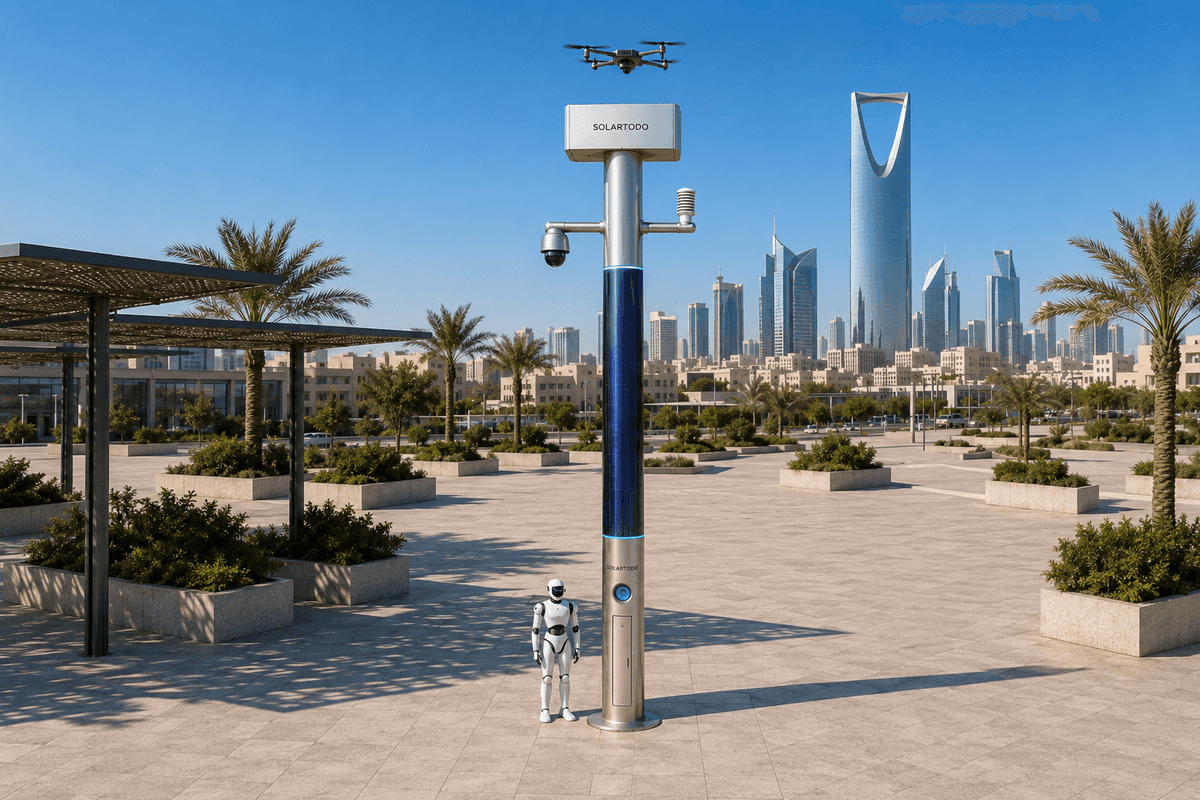
A City AI Pole is a non-lighting physical-AI urban edge node that combines off-grid energy, local sensing, edge compute, drone operations, robot operations and command workflows in one pole-form station. In this Mexico City case, SOLARTODO Sentinel Sky Hub is configured for temporary-event perimeter security at a power-utility industrial campus with blind-spot reduction and response-time evaluation.
Procurement Context
For a Mexico City power utility preparing a temporary event inside an industrial-park environment, the security problem is not general surveillance coverage; it is the set of short-lived blind spots created when the event perimeter expands beyond the fixed campus security layout. Access gates, contractor parking, staging yards, transformer service lanes and temporary logistics corridors can shift for several weeks. Existing fixed cameras may still cover the main entrances, but they often leave oblique fence-line views, dark service alleys, storage areas and emergency access routes without continuous operational awareness. During tropical-cyclone season, storms affecting the Gulf and Pacific coasts can disrupt regional logistics, create sudden contractor movements and increase the need for reliable autonomous field inspection, even when Mexico City itself is inland. This procurement case therefore frames Sentinel Sky Hub as a temporary-event security layer for an industrial campus perimeter, subject to final engineering confirmation. The proposed deployment does not assume a citywide rollout, named public program or achieved performance result. It describes how a buyer could evaluate a set of off-grid physical-AI edge-node poles against response-time targets, patrol substitution assumptions and blind-spot closure priorities during a defined event window.
Deployment Design
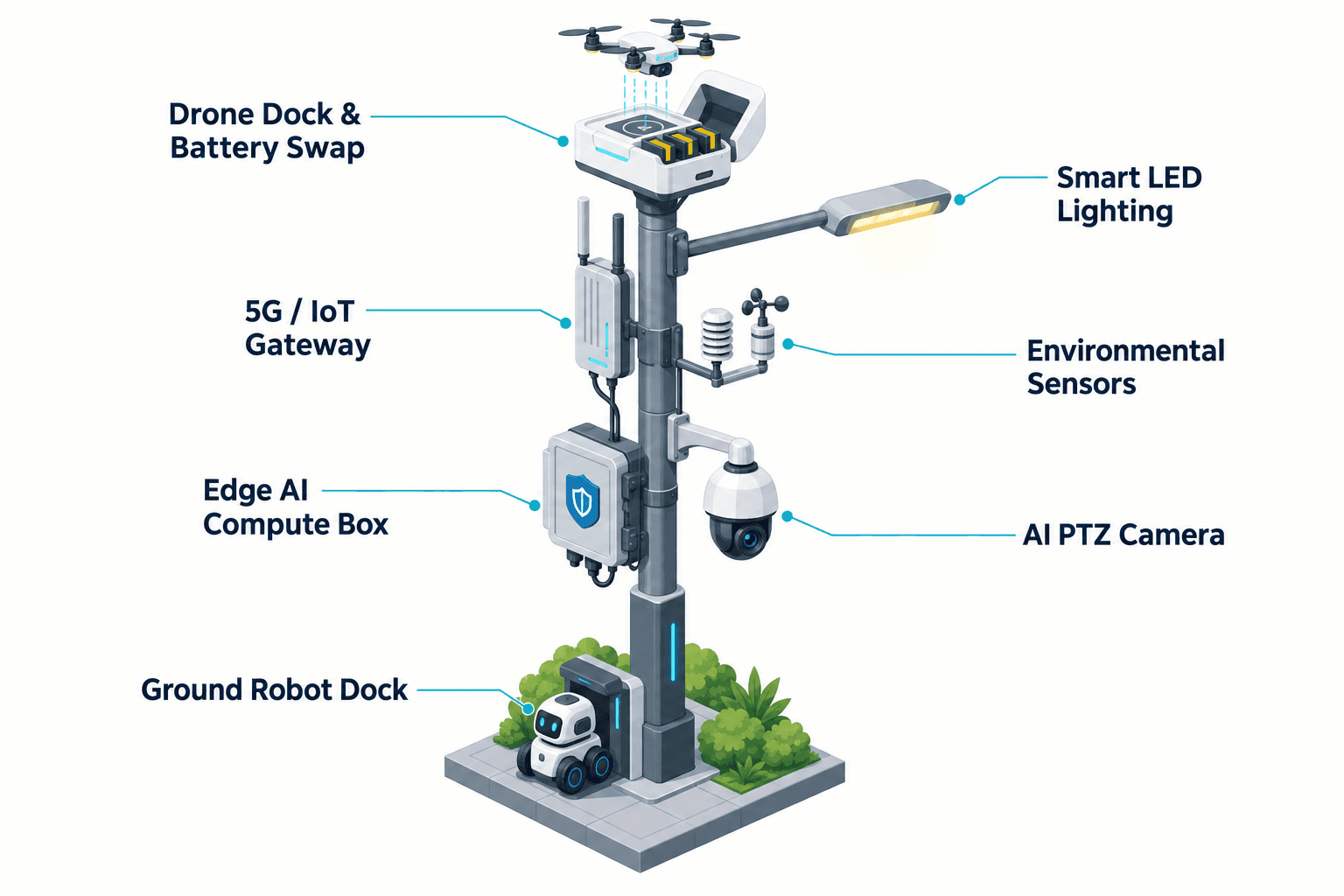
The proposed configuration uses SOLARTODO Sentinel Sky Hub as a pure smart pole with no lighting system. Each pole is a fully off-grid micro-station combining battery storage, 360-degree wrapped flexible CIGS thin-film solar replenishment, edge AI compute, PTZ security sensing, environmental monitoring, drone operations and ground robot operations. The pole does not require grid, city or site power. Its vertical cylindrical body carries about 15 square meters of flexible CIGS over an approximately 8 meter tall, 0.6 meter wide form, with roughly 2.4 to 2.7 kWp nameplate. Because only the sun-facing projection collects direct sun at any moment, planning should treat the wrap as supplemental replenishment rather than unlimited solar self-sufficiency. In a high-irradiance region, realistic clear-sky output is about 0.8 to 1.1 kW DC peak and about 6 to 9 kWh per day; Mexico City event planning should further derate by local weather, shade, air quality and site geometry. High-power drone and robot tasks are therefore buffered by 5 to 20 kWh-class storage and scheduled by duty cycle. For the campus perimeter, procurement would typically position nodes at temporary gates, fence-line bends, equipment laydown areas and areas where fixed cameras cannot see behind vehicles or structures. The goal is not to replace the security control room, but to give it a movable common-operating-picture layer at the perimeter without trenching, generator fuel, or grid-permit dependency.
Battery-Swap Operations
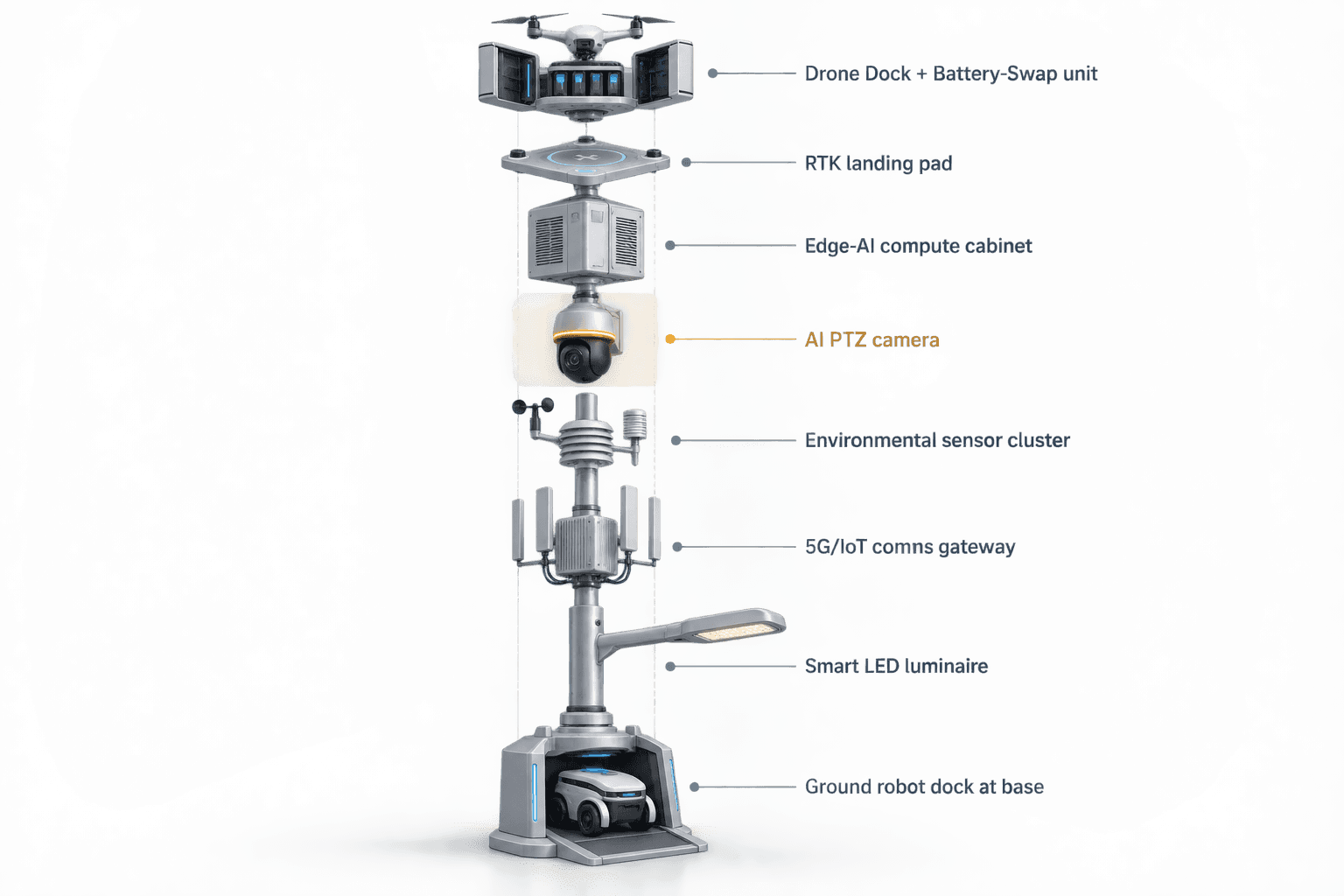
The module focus for this case is drone battery hot-swap, because response time is most affected when a drone can land, exchange a depleted pack through a multi-bay rear-service battery magazine, and relaunch without an operator on site. In a temporary-event perimeter, the first sortie may inspect a fence alarm, the second may follow a suspicious vehicle route inside a service lane, and the third may check an equipment yard after wind or rain. A manual battery process would force the security team to dispatch a person to the landing area, handle batteries, log the mission and clear the drone for the next task. Sky Hub instead manages the charge and swap state machine on the pole: landed drone recognized, pack exchanged, charged bay assigned, mission status updated and next route released when human authorization is in place. Multiple bays allow several consecutive sorties within the event security plan, subject to storage state, weather limits and site rules. The same node can coordinate a ground robot for closer inspection at the fence or service road, where aerial video alone is insufficient. The robot returns to the pole base for wireless charging, while the drone handles overhead inspection and rapid route verification. For unauthorized drone awareness, Sky Hub may detect and track an object using local sensing and optional partner-sensor inputs; radar is not built into the pole. Any mitigation remains non-lethal and human-authorized, such as commanding the node's friendly drone for soft aerial net-capture or close-approach deterrence. The workflow expressly excludes shoot-down, jamming, denial effects, weapons or autonomous attack.
Data And COP
The operating loop follows sensing, authorized assessment and response, edge-compute scheduling, field operations and maintenance, all presented through a common-operating-picture command view. The PTZ camera and local perception are used for anonymous vehicle count, crowd density, intrusion and perimeter awareness; this configuration does not claim face recognition or licence-plate recognition as an active deployed capability. Environmental monitoring adds wind speed, wind direction, temperature, humidity, atmospheric pressure, noise, PM10, PM2.5 and illuminance, helping operators understand whether wind, dust, rain or visibility conditions should change the drone route or dispatch a ground robot instead. Edge AI compute runs local inference and schedules workloads on the pole. Raw video and sensor data stay on the pole and are processed locally; only de-identified event and status metadata may leave the pole. This is PDPL-LGPD-oriented design language for local processing and privacy-aware operations, not a claim of certification or already compliant status. In procurement terms, the buyer should ask vendors and integrators to document data retention settings, audit logs, role-based approvals, metadata schemas, human authorization points and evidence export policies before final acceptance.
Evaluation Metrics
Because this is a proposed temporary-event configuration, the KPI framing should use target and evaluation metrics rather than claimed results. The primary KPI is response time: how quickly the security team can move from a perimeter anomaly to an authorized aerial or ground response, and then to a recorded event package in the COP. Secondary metrics include blind-spot inspection frequency, autonomous patrol substitution, drone turnaround time after landing, number of consecutive sorties available under a defined duty cycle, and percentage of alarms resolved without sending a guard into low-visibility perimeter areas. During Mexico City's tropical-cyclone-season planning window, the utility should also test degraded-weather rules, including wind thresholds, rain pauses, solar derating, battery reserve policies and manual override procedures. The procurement case should request a site survey, electromagnetic and aviation review, perimeter risk map, emergency access review and final energy model before installation. Acceptance should be based on documented workflows, human-in-the-loop approvals, raw-data-local processing, off-grid power behavior and event-window reliability. The strongest business case is not a generic smart-city pitch; it is a measurable reduction in perimeter blind spots and a shorter, more repeatable detect-to-response cycle for a power-utility industrial campus when the security layout is temporary.
System Configuration
| Parameter | Configuration |
|---|---|
| Pole form | Pure non-lighting Sky Hub physical-AI edge-node pole for temporary-event campus-perimeter security |
| Power system | Fully off-grid battery-backed micro-station with 360-degree wrapped flexible CIGS replenishment and duty-cycle scheduling |
| Drone battery swap | Rear-service multi-bay battery magazine for automated pack exchange and consecutive authorized sorties |
| Edge AI compute | Jetson-class on-pole inference cabinet for local perception, workload scheduling and mission-state logic |
| Security sensing | AI PTZ camera for anonymous vehicle count, crowd density, intrusion and perimeter awareness |
| Environmental package | Wind speed, wind direction, temperature, humidity, atmospheric pressure, noise, PM10, PM2.5 and illuminance |
| Robot operations | Ground service robot patrol coordination with pole-base wireless charging and air-ground task handoff |
How It Works
- On-pole PTZ sensing flags a perimeter anomaly in a mapped blind-spot zone.
- Edge AI classifies the event locally and sends de-identified status metadata to the COP.
- A human operator reviews context, authorizes response and selects drone, robot or combined tasking.
- Sky Hub schedules the sortie, battery-swap state and route while preserving reserve-energy rules.
- Drone or ground robot inspects the area, returns to the pole and records mission status.
- The COP stores event metadata, operator action, asset health and maintenance follow-up.
Planning Assumptions (Indicative)
Illustrative planning inputs a buyer can recompute — target metrics, not achieved results. Subject to final engineering confirmation.
| Metric | Planning assumption | Indicative value |
|---|---|---|
| Response-time target | Anomaly-to-authorized sortie is evaluated against current guard-dispatch workflow | ~5 minute target for launch decision after verified alert |
| Inspection labor | Drone patrol replaces repeat manual perimeter checks during the event window | ~20 routine patrol segments per week automated |
| Drone turnaround | Battery hot-swap avoids manual pack handling between consecutive sorties | ~3 to 5 minute target ground interval after landing |
| Blind-spot coverage | Temporary poles are positioned at mapped fence-line bends, service lanes and staging-yard gaps | ~6 to 10 priority blind spots assigned patrol routes |
| Energy reserve | High-power tasks are scheduled against battery state and weather derating | 5 to 20 kWh-class storage planning band per node |
Deployed Equipment
- SOLARTODO Sentinel Sky Hub pure smart pole body
- Flexible 360-degree CIGS solar wrap
- 5 to 20 kWh-class battery storage cabinet
- Multi-bay drone battery hot-swap magazine
- Autonomous patrol drone interface and landing service module
- Ground service robot wireless charging base
- AI PTZ security camera
- Nine-parameter environmental monitoring package
Frequently Asked Questions
Is Sky Hub a smart streetlight?
No. In this procurement case, Sky Hub is specified as a pure smart pole and physical-AI edge node with no lighting system. Its role is perimeter sensing, local compute, drone operations, robot operations, off-grid power management and command workflow support, not street illumination or roadway lighting replacement.
How is the system powered during a temporary event?
The node is designed as a fully off-grid, battery-backed micro-station. The flexible CIGS solar wrap replenishes energy, but it is not treated as unlimited pure solar self-sufficiency. Drone and robot workloads are scheduled against battery state, weather derating, reserve rules and the event's response-time priorities.
Why focus on drone battery hot-swap for a power-utility campus?
Battery hot-swap directly affects response-time planning. A landed drone can receive a charged pack through the pole's multi-bay magazine and relaunch for the next authorized task, reducing dependence on on-site battery handling. That matters when temporary-event blind spots create several inspection demands in quick sequence.
What data leaves the pole?
The intended operating model keeps raw video and sensor data on the pole for local processing. Only de-identified event and status metadata may leave the node for the common-operating-picture view. This is PDPL-LGPD-oriented architecture language and should be validated through final legal, security and data-governance review.
Does the configuration include face or licence-plate recognition?
No active deployed capability is claimed for face recognition or licence-plate recognition in this case. The security-sensing scope is anonymous vehicle count, crowd density, intrusion and perimeter awareness. Procurement teams should keep these limits explicit in acceptance criteria and operator training materials.
How does Counter-UAS coordination work in this case?
The pole may detect and track an unauthorized drone using its local sensing and optional partner-sensor inputs, while radar is not built into the pole. Any mitigation is non-lethal and human-authorized only, such as soft aerial net-capture or close-approach deterrence by the node's friendly drone.
What should be verified before procurement approval?
The buyer should require a site survey, final energy model, aviation and safety review, communications assessment, data-retention design, human-authorization workflow and event-specific patrol map. Acceptance should measure target response time, drone turnaround, blind-spot task coverage and reliability during the defined temporary-event window.
Explore Further
- City AI Pole / smart streetlight product line
- More smart-city deployment cases
- Talk to our engineering team
Planning a similar physical-AI deployment for streets, campuses or public spaces? Request an engineering consultation