Milan Flood-Risk Streets and EV Kerbs: Smart Streetlight Hybrid Configuration Guide
Summary
Milan's 1.4M-city and 3.25M metro population, 0-30°C climate band, and 7kW Type 2 kerb charging needs favor a 43-unit, 11m hybrid SOLARTODO Smart Streetlight configuration at 30m spacing.
Key Takeaways
- A typical 43-unit Milan deployment would cover about 1.29km of urban corridor at 30m spacing, within the 30-50 poles/km density used for city streets.
- The recommended pole class is 11m octagonal tapered steel, not highway-scale 12m+ traffic poles and not 6-8m garden lighting.
- Each unit integrates 2×80W LED luminaires at 4000K and 150lm/W, giving 24,000lm per pole before adaptive dimming controls.
- Milan's inland continental climate ranges roughly from 0/+5°C in January to +20/+30°C in July, so LFP thermal management and sealed cabinets matter.
- Italy's public low-voltage supply commonly uses 230V single-phase and 400V three-phase, matching a 7kW AC Type 2 kerbside charging profile.
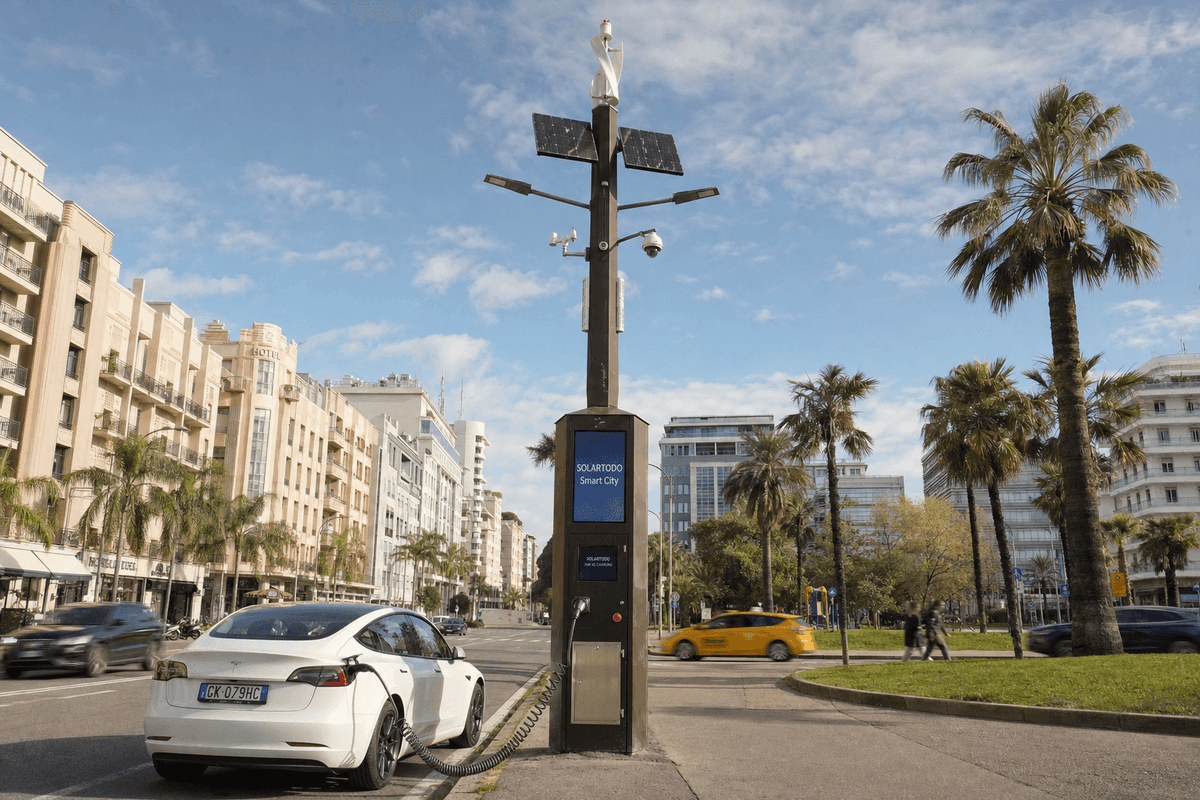
- The lower 2.2m of the SOLARTODO pole is the EV charging cabinet itself, welded as one continuous structure rather than installed as a separate pillar.
- A 5G NR n78 small-cell module at 8.7m with 4T4R MIMO can support dense Milan corridors where cabinets and roofline sites are constrained.
- The configuration follows IEC 60598 for luminaires, IEC 62196-2 for AC EV charging interfaces, and GB/T 37024 for smart lighting system functions.
Market Context for Milan
Milan needs smart streetlight planning that respects 3.25M metropolitan users, narrow historic streets, low-emission mobility policy, and flood-alert infrastructure around Seveso and Lambro corridors.
Milan is not a coastal salt-air market; it is an inland Po Valley city at about 45.46°N, 9.19°E with dense stone streets, tram corridors, limited-traffic zones, and high pedestrian demand. According to the Metropolitan City of Milan (2024), the metropolitan area had 3,245,459 residents on 1 January 2024, while Comune di Milano publishes resident-population statistics for the municipality through 31 December 2024. That density changes the pole brief: a Smart Streetlight must combine lighting, sensing, public address, charging, and telecom in one vertical asset instead of multiplying separate sidewalk cabinets.
Climate is a real design input. According to YesMilano, Milan has a continental climate with January temperatures around 0/+5°C and July temperatures around +20/+30°C, with rainfall distributed through the year and peaks in October-November. This favors hot-dip galvanized steel, sealed access doors, battery protection, corrosion control from urban pollution rather than marine salt, and drainage-aware foundations. Milan's civil-protection materials also identify flood risk on the Lambro and Seveso rivers, so base cabinets should avoid low-mounted cable penetrations and should use elevated gaskets and service loops.
The mobility context is unusually important. According to Comune di Milano (2018), the PUMS was approved by City Council Resolution 38 on 12 November 2018 and defines long-term mobility strategy. According to Comune di Milano (2026), Area C operates Monday-Friday from 07:30 to 19:30, while municipal open-data pages describe Area B as covering much of the city with environmental access restrictions. For streetlight procurement, that means installation windows, CKD deliveries, and crane access must be coordinated around ZTL gates, tram wires, loading restrictions, and dense old-town curb space.
Italy also has a clear public-lighting data-governance context. According to ENEA and AgID (2018), the PELL public-lighting specifications define a national data model for technical, maintenance, and consumption characteristics. ENEA states, "PELL is a monitoring system for public energy infrastructures". For SOLARTODO, this means the cloud controller should export pole IDs, POD linkage, dimming schedules, energy data, maintenance tickets, and sensor status in a structured format compatible with Italian public-administration expectations.
Recommended Technical Configuration
A typical 43-unit Milan corridor would use 11m hybrid octagonal poles at 30m spacing to combine lighting, charging, sensing, and telecom without extra kerbside pillars.
The recommended SOLARTODO Smart Streetlight variant for Milan is the hybrid 12m family, adjusted to the project-specific 11m height. This is a city-street class, not a highway mast and not a park luminaire. The configuration fits avenues, interchange streets near transit nodes, logistics entrances, and municipal boulevards where Milan needs lighting plus EV top-up, air-quality sensing, public alerts, and small-cell readiness.
A typical 43-unit deployment of this scale would cover approximately 1.29km using 30m pole spacing. Each pole would use an antique bronze RAL8011 finish to reduce visual conflict with Milan's historic and mixed-use streetscapes. The lower 2.2m of the pole is the EV charging cabinet itself: it is a seamlessly welded, continuous steel structure, not a separate charging pillar bolted beside the pole.
The power architecture should be hybrid, not solar-only. Milan has winter cloud, urban canyon shading, and high service expectations for emergency audio and telecom, so the pole should combine a 400W Gorlov-type helical VAWT, 2×200W monocrystalline panels, a 15kWh LFP battery, MPPT control, and backup grid tie. According to E-Distribuzione (2025), Italian low-voltage systems are typically 230V single-phase or 400V three-phase, which aligns with the integrated 7kW AC charger profile.
Technical Specifications
The Milan recommendation is a 43-unit SOLARTODO Smart Streetlight package with 11m hybrid poles, 15kWh LFP storage, 7kW Type 2 charging, and 5G-ready communications.
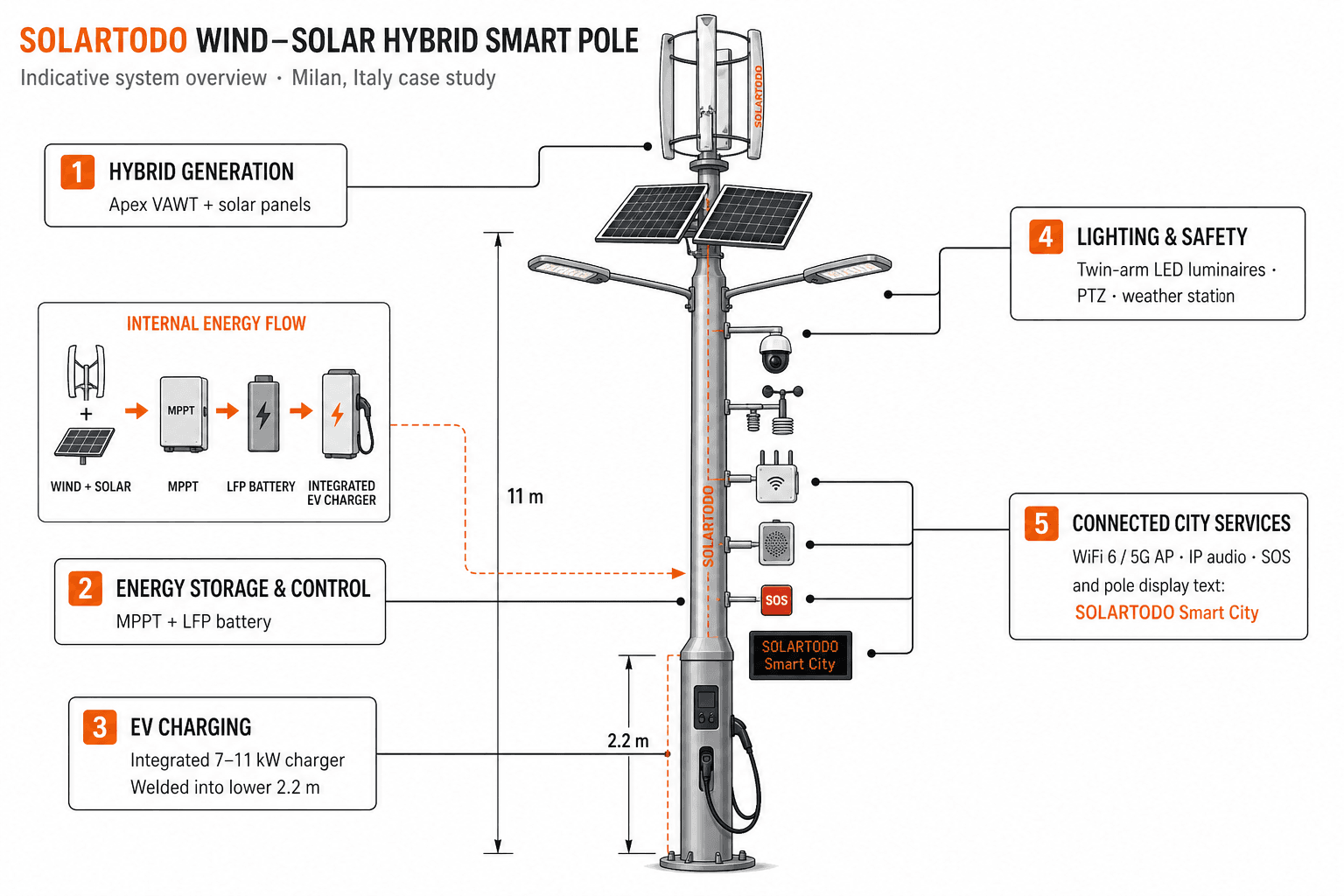
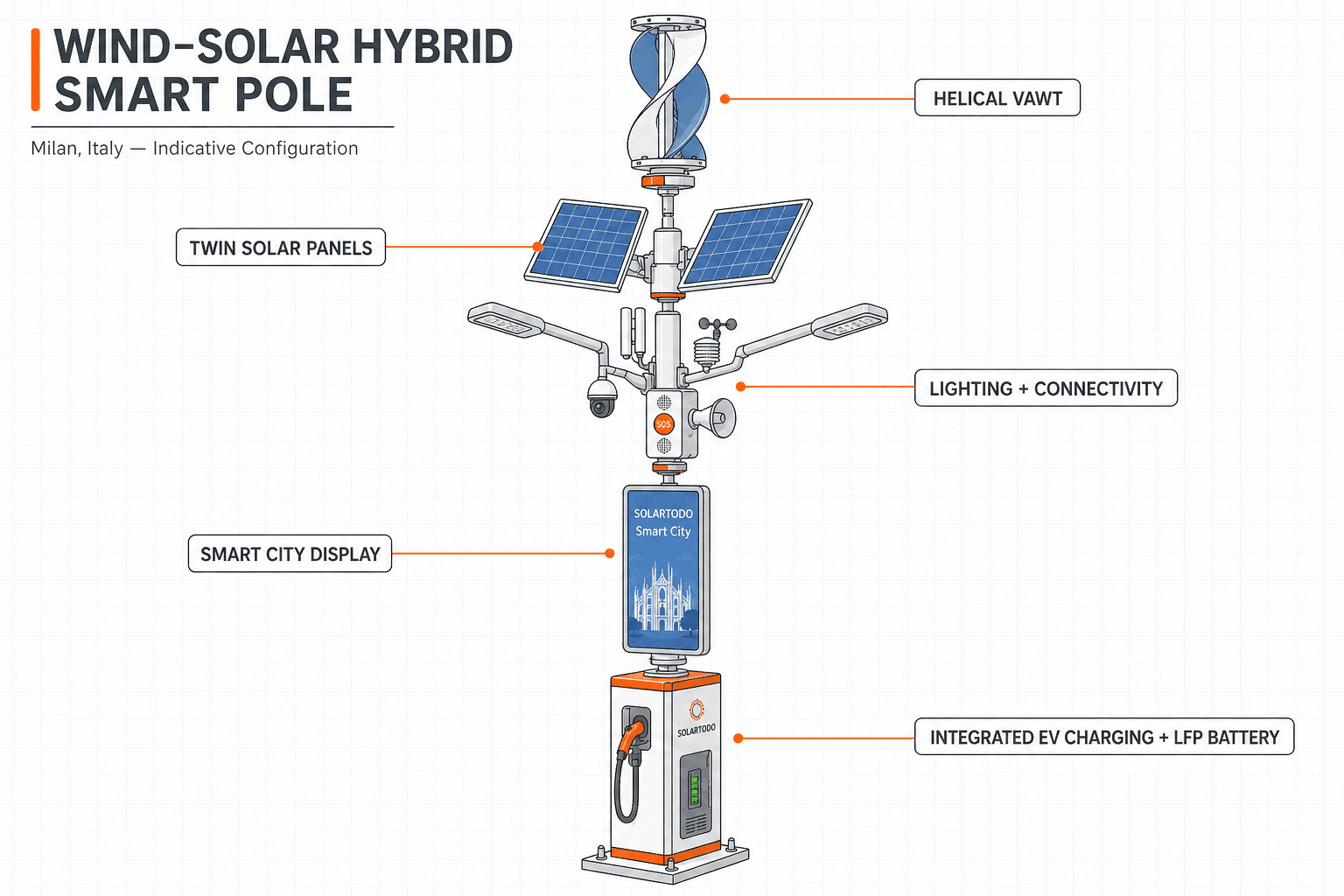
- Pole body: 11m octagonal tapered steel smart pole, base Ø45cm to top Ø15cm, antique bronze RAL8011.
- Integrated EV design: lower 2.2m of pole is the charging cabinet, welded as one continuous steel structure, not a separate pillar.
- Wind generator: Gorlov-type helical VAWT, 3 twisted white aluminum blades, Ø70×100cm, 400W, red aviation LED.
- Solar generation: 2×200W monocrystalline deep-black panels on symmetric east-west A-frame brackets at 15° tilt.
- Battery and power electronics: 15kWh LFP battery inside pole base with MPPT controller and backup grid tie.
- Lighting: twin symmetric 1.5m arms with +8° upward tilt, 2×80W LED, 150lm/W efficacy, 4000K neutral white.
- Video: 15cm mini white PTZ dome camera, 360° pan, 20× zoom, IR range up to 100m, mounted on 40cm L-bracket.
- Environmental sensing: 12-parameter top sensor covering meteorology, air quality, rain, CO, NO2, and O3.
- Public address: 1× IP audio column, Ø10×50cm, 30W/93dB, TCP/IP networked, slim perforated aluminum tube flush against the flat pole face.
- Emergency system: one-press SOS button, two-way audio intercom, and visual LED indicator.
- EV charging: integrated 7kW dual-gun AC charger, 2× Type 2 connectors, OCPP 1.6J, 5m coiled cable, touchscreen, E-stop, and maintenance door.
- LED display: P3 portrait display, 1000×2000mm, >6000cd/m², content strictly reading "SOLARTODO Smart City" in white sans-serif on deep blue.
- Communications: 5G NR n78 small cell, 4T4R MIMO, approximately 200m coverage, flush-integrated at 8.7m with color-matched housing.
- Auxiliary power: USB-C PD 30W and USB-A charging points.
- Control layer: LoRaWAN/4G smart controller with cloud platform integration.
- Standards alignment: IEC 60598, GB/T 37024, and IEC 62196-2.
According to IEC (2025), IEC 62196-2 covers dimensional compatibility and interchangeability for AC EV plugs, socket-outlets, connectors, and vehicle inlets. IEC states, "Type 2 is now available with optional shutter" in the IEC 62196-2 publication history. For Milan procurement, Type 2 is the correct connector family for public AC charging expectations in Europe.
Implementation Approach
A 43-unit Milan rollout would typically proceed in 5 phases: survey, permitting, CKD logistics, foundations, and commissioning with lighting and charging tests.
The first phase is corridor selection and survey. Engineering teams should map existing lighting points, utility ducts, tram overhead constraints, CCTV coverage gaps, flood-prone kerbs, and Area C or Area B gate restrictions. The survey should identify where a pole-as-charger reduces sidewalk clutter compared with a separate EV pillar plus lighting pole plus telecom bracket.
The second phase is municipal and utility coordination. Milan installations would normally require public-space authorization, traffic management, local distributor connection requests where grid tie is used, and telecom coordination for the n78 small-cell radio. According to ARERA, distribution companies must connect users to their networks subject to technical rules and continuity obligations. That makes early point-of-delivery planning important even when the hybrid system can self-power lighting and sensors.
The third phase is CKD shipping and staging. Poles, VAWT modules, A-frame solar brackets, batteries, LED heads, screens, and charger assemblies should be packed as matched kits by pole ID. For dense Milan streets, small-lot deliveries are usually preferable to large laydown yards because historic blocks, tram corridors, and loading restrictions constrain storage.
The fourth phase is civil installation. Foundations should use drainage-aware details and base sealing because Milan's Seveso and Lambro flood alerts are a known municipal operating condition. Crews should verify anchor bolt templates, earthing continuity, door clearances, cable bend radius, and accessible E-stop placement before raising the pole.
The fifth phase is commissioning. Tests should include 2×80W LED photometry, dimming profiles, OCPP 1.6J charger sessions, Type 2 connector checks, PTZ video, SOS intercom, 93dB audio column output, 5G small-cell integration, LoRaWAN/4G telemetry, and display content lock to the approved "SOLARTODO Smart City" message.
Expected Performance & ROI
Expected value comes from replacing 4-6 separate street assets with 1 pole while reducing lighting energy demand through 160W LED output and smart controls.
A standard Milan pole position can otherwise accumulate a lighting mast, CCTV pole, EV charger cabinet, air-quality station, public address speaker, WiFi device, and telecom small-cell bracket. The SOLARTODO configuration compresses those functions into one 11m structure. This is especially relevant in the Cerchia dei Bastioni, transit-adjacent streets, and redeveloped corridors such as Farini-Bovisa where sidewalk capacity is a design constraint.
Lighting savings should be modeled against the existing luminaire baseline, not claimed as a universal result. According to ENEA (2022), LED bulbs with integrated motion detectors can more than halve lighting consumption in public-building contexts, while outdoor street results depend on photometry, dimming policy, and baseline technology. For this configuration, the technical target is 24,000lm per pole from 160W installed LED load, with adaptive schedules reducing overnight consumption where permitted.
EV revenue and payback depend on utilization, tariff structure, grid connection cost, and parking policy. A 7kW dual-gun AC charger is a destination and dwell-time charger, not a DC fast charger. In Milan, that profile fits residential streets, mixed-use commercial kerbs, municipal parking, and last-mile delivery dwell periods better than high-turnover motorway charging.
Maintenance ROI should be assessed as avoided truck rolls and fewer separate assets. A single cloud-managed pole can report lighting faults, battery state, charger availability, sensor health, PTZ status, and display status. According to ENEA and AgID (2021), PELL data models were updated to support monitoring and evaluation of public-lighting consumption and performance, which supports a lifecycle-cost procurement approach rather than a lowest-device-cost approach.
Results and Impact
A typical 43-unit Milan configuration would create approximately 86 Type 2 charging outlets, 6.88kW of LED lighting load, and 1.29km of smart corridor coverage.
The expected impact is operational consolidation, not a fabricated installation result. Approximately 43 poles would provide 86 AC charging connectors, 43 PTZ camera points, 43 environmental monitoring points, 43 SOS intercom points, and 43 public-audio nodes. At 30m spacing, this would create a continuous smart corridor suitable for dense urban streets rather than highway edges.
For Milan, the most defensible procurement argument is resilience plus asset reduction. The hybrid power stack supports critical functions during grid interruptions, while grid tie supports charging and winter reliability. The flush 5G module and integrated charger reduce visual clutter, which matters in historic districts and public-realm design reviews.
Comparison Table
The 11m hybrid Smart Streetlight is strongest where Milan needs 7kW AC charging, sensors, and 5G readiness in one constrained 30m-spaced corridor.
| Configuration option | Milan fit | Height/form | Power architecture | Kerb impact | Best use |
|---|---|---|---|---|---|
| SOLARTODO hybrid 11m recommended | High | 11m octagonal tapered steel | 400W VAWT + 400W solar + 15kWh LFP + grid backup | 1 integrated pole-as-charger | Dense mixed-use streets, ZTL edges, transit corridors |
| Grid-only smart pole | Medium | 12m octagonal steel | Grid-powered AC | May need more grid work | Streets with strong utility access and limited renewable brief |
| Cylindrical CIGS premium pole | Medium-high | Ø180-400mm seamless cylinder | 360° CIGS wrap + embedded modules | Very low visual clutter | Premium piazza-edge or design-sensitive corridors |
| Standard modular smart pole | Medium | 6-12m galvanized pole | Grid or simple solar options | Accessories may add brackets | Lower-complexity municipal lighting upgrades |
| Separate light + EV pillar + CCTV | Low-medium | Multiple assets | Separate grid feeds | Highest sidewalk occupation | Sites with existing cabinets and no visual constraint |
Pricing & Quotation
SOLARTODO offers 3 commercial pathways for Milan buyers: FOB Supply, CIF Delivered, and EPC Turnkey, with quotation scope driven by volume and installation responsibility.
SOLARTODO offers three pricing tiers for this product line: FOB Supply (equipment ex-works China), CIF Delivered (including ocean freight and insurance), and EPC Turnkey (fully installed, commissioned, with 1-year warranty). Volume discounts are available for large-scale deployments. Configure your system online for an instant estimate, or request a custom quotation from our engineering team at [email protected].
For technical scoping, Milan buyers should provide corridor length, existing pole spacing, available grid points, foundation constraints, ZTL delivery limitations, OCPP backend requirements, telecom operator requirements, and whether the LED display is permitted in the selected streetscape. Product details can be reviewed at SOLARTODO Smart Streetlight, and engineering questions can be sent through contact us.
Frequently Asked Questions
A Milan Smart Streetlight procurement should specify 11m pole geometry, 7kW Type 2 charging, 15kWh LFP storage, 30m spacing, and Italian public-lighting data requirements.
Q1: Why is an 11m hybrid pole recommended for Milan instead of a smaller garden-light pole? An 11m pole supports twin 80W street luminaires, PTZ camera height, 5G n78 placement at 8.7m, and a 1000×2000mm LED display while maintaining city-street proportions. A 6-8m garden pole is better for parks and pedestrian paths, but Milan mixed-use streets need lighting, charging, sensing, and communications from one structural asset.
Q2: How many units would a typical Milan corridor require? At 30m spacing, approximately 43 units cover about 1.29km of corridor. The exact count depends on intersections, tram stops, heritage setbacks, existing foundations, tree canopies, and driveway conflicts. SOLARTODO would normally validate spacing through photometric design and a utility survey before finalizing pole locations.
Q3: What EV charging standard should be specified for Italy? For Milan public AC charging, the recommended interface is Type 2 under IEC 62196-2, with OCPP 1.6J for backend communication. The specified configuration uses a 7kW dual-gun AC charger with two Type 2 connectors, 5m coiled cable, touchscreen, E-stop, and maintenance door integrated into the pole base.
Q4: How long would implementation usually take? A realistic program should allow time for corridor survey, municipal authorization, distributor coordination, CKD manufacturing, shipping, foundations, pole erection, and commissioning. For a 43-unit corridor, installation itself can be staged by blocks, but approvals and utility interfaces often drive the schedule more than pole assembly speed.
Q5: What maintenance model fits this configuration? Maintenance should combine annual structural inspection, battery health checks, charger connector inspection, display brightness verification, camera cleaning, sensor calibration, and remote controller monitoring. Because one pole contains lighting, EV charging, audio, SOS, sensing, and telecom, the service plan should assign clear responsibility for each subsystem and maintain spare modules by pole ID.
Q6: What ROI factors matter most in Milan? ROI depends on avoided separate assets, LED energy savings, EV charging utilization, reduced maintenance visits, small-cell tenancy potential, and avoided sidewalk reconstruction. Milan's dense streets make space consolidation valuable, but payback should be modeled with local energy tariffs, parking policy, existing luminaire wattage, and expected charger dwell-time behavior.
Q7: How does this compare with installing separate EV chargers beside existing lights? Separate EV pillars are simpler when a site already has spare cabinet space and grid capacity. In Milan streets with narrow footways, heritage controls, ZTL access, or multiple smart-city functions, the integrated SOLARTODO pole can reduce clutter by combining lighting, Type 2 charging, sensing, SOS, display, and communications in one structure.
Q8: What should EPC pricing include? EPC scope should include foundation design, pole supply, CKD logistics, installation labor, grid connection coordination, OCPP setup, lighting commissioning, charger testing, sensor validation, and warranty administration. Numeric pricing should not be assumed from configuration alone because Milan traffic management, excavation, distributor fees, and permit conditions can materially change delivered cost.
Q9: What warranty should buyers request? For an EPC Turnkey scope, the article-specified commercial baseline includes a 1-year warranty. Buyers should separately define warranty treatment for LEDs, LFP battery, charger electronics, VAWT, display modules, and control platform subscriptions. Warranty value improves when commissioning records include electrical tests, pole IDs, firmware versions, and photo evidence.
Q10: Can the pole operate during grid interruptions? The hybrid design includes a 400W VAWT, 400W solar array, 15kWh LFP battery, MPPT controller, and grid backup. During an outage, priority loads such as LED lighting, SOS intercom, public audio, and telemetry can be maintained according to the configured load-shedding policy. EV charging should normally be limited or disabled during battery-only operation.
References
- Comune di Milano (2025): Resident population statistics for Milan as of 31 December 2024, published by the municipal Statistical Services Unit. https://www2.comune.milano.it/en/aree-tematiche/dati-statistici/pubblicazioni/popolazione-residente
- Città Metropolitana di Milano (2024): Metropolitan population of 3,245,459 residents on 1 January 2024. https://opencms10.cittametropolitana.mi.it/statistica/osservatorio_metropolitano/statistiche_demografiche/popolazione_residente.html
- YesMilano (2026): Milan climate profile with continental climate, January 0/+5°C and July +20/+30°C temperature ranges. https://www.yesmilano.it/en/climate-and-temperature
- Comune di Milano (2018): Urban Sustainable Mobility Plan approved by City Council Resolution 38 on 12 November 2018. https://www.comune.milano.it/en/aree-tematiche/mobilita/pianificazione-mobilita/piano-urbano-della-mobilita
- ENEA and AgID (2018): PELL public-lighting technical specifications for data models covering construction, maintenance, and consumption. https://www.agid.gov.it/it/agenzia/stampa-e-comunicazione/notizie/2018/07/27/progetto-pell-pubblicate-specifiche-tecniche-sullilluminazione-pubblica
- E-Distribuzione (2025): Italian low-voltage systems are below 1,000V AC and typically operate at 230V single-phase or 400V three-phase. https://www.e-distribuzione.it/supporto/guide-casa-aziende/differenze-impianti-bassa-media-tensione.html
- IEC (2025): IEC 62196-2 standard for AC EV plugs, socket-outlets, vehicle connectors, and inlets. https://webstore.iec.ch/en/publication/24204
Equipment Deployed
- 43 units × 11m octagonal tapered steel Smart Streetlight, base Ø45cm to top Ø15cm, antique bronze RAL8011
- Integrated lower 2.2m pole-as-EV-charging cabinet, welded as one continuous steel structure
- Gorlov-type helical VAWT, 3 twisted white aluminum blades, Ø70×100cm, 400W, red aviation LED
- 2×200W monocrystalline deep-black solar panels on symmetric east-west A-frame brackets at 15° tilt
- 15kWh LFP battery inside pole base with MPPT controller and backup grid tie
- Twin symmetric 1.5m arms with +8° upward tilt, 2×80W LED, 150lm/W, 4000K
- 15cm mini white PTZ dome camera, 360°, 20× zoom, IR 100m, 40cm L-bracket
- 12-parameter environmental sensor for meteorology, air quality, rain, CO, NO2, and O3
- IP audio column Ø10×50cm, 30W/93dB, TCP/IP, flush color-matched pole integration
- One-press SOS button with two-way audio intercom and visual LED indicator
- Integrated 7kW dual-gun AC charger, 2× Type 2, OCPP 1.6J, 5m coiled cable, touchscreen, E-stop
- P3 vertical LED screen 1000×2000mm, >6000cd/m², content restricted to SOLARTODO Smart City
- 5G NR n78 small cell, 4T4R MIMO, 200m coverage, flush at 8.7m
- USB-C PD 30W plus USB-A auxiliary charging
- LoRaWAN/4G smart controller and cloud platform