Nairobi Solar PV System Market Analysis: 1.8MW Industrial Rooftop Configuration Guide
Summary
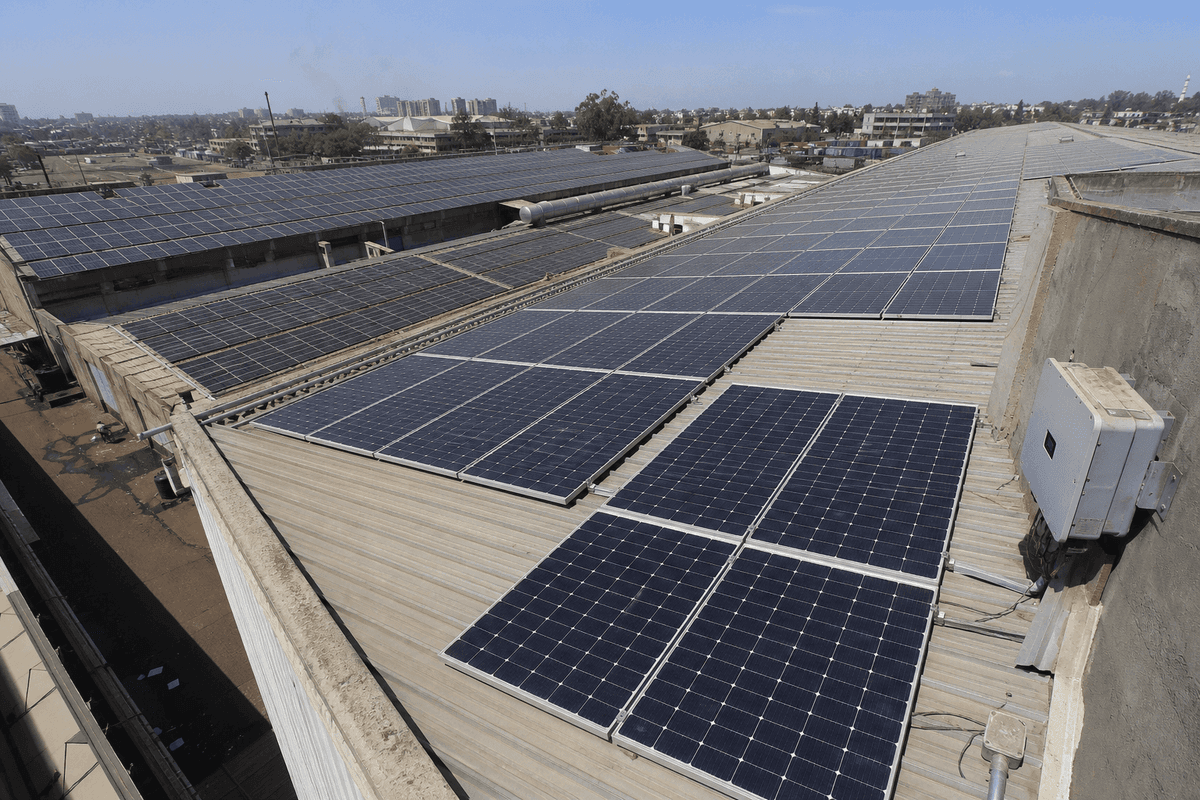
Nairobi's 705 km2 urban market and 4.9 million projected 2025 population support a 1.8MW industrial rooftop Solar PV System using 3,288 x 540W PERC panels, 10 degree fixed tilt, and about 1,950,104 kWh annual yield.
Key Takeaways
A 1.8MW Nairobi industrial rooftop Solar PV System fits the 500kW-5MW C&I class, with LV-to-11/33kV integration considered during utility review.
- A recommended SOLARTODO configuration uses approximately 3,288 monocrystalline PERC modules rated 540W each, giving about 1.776MW DC nameplate capacity.
- The design uses a DC/AC ratio of 1.15, a central inverter with 98% CEC efficiency, and a 5-year inverter warranty.
- The array is modeled at 10 degree fixed tilt, with 3.5 kWh/m2/day irradiance and approximately 14% total system losses.
- Expected first-year generation is approximately 1,950,104 kWh, equal to about 1,098 kWh per installed kW DC.
- Estimated CO2 reduction is approximately 819 tons per year, equivalent to about 36,855 trees using the project-specific conversion basis.
- Nairobi's 2025 population projection is about 4,906,355 people across 705 km2, creating dense commercial electricity demand.
- According to the IEA (2025), Kenya reached 79% electricity access in 2023 and nearly 90% renewable electricity generation.
- The recommended lifecycle basis is 30 years, with 25-year panel warranty coverage and 0.6% annual module degradation.
Market Context for Nairobi
Nairobi's dense 705 km2 urban economy makes a 1.8MW rooftop Solar PV System most relevant for factories, logistics centers, malls, warehouses, and institutional campuses.
Nairobi is Kenya's main commercial and administrative load center, so industrial rooftops can be valuable grid-adjacent generation sites where land is constrained. According to Nairobi City County CIDP (2023), the county's 2019 population was 4,397,073 and the 2025 projection is 4,906,355 across 705 km2. That equals a projected 2025 density of about 6,959 people per km2, which favors rooftop solar over open-land PV inside the city boundary.
According to Kenya Law (2022), KPLC primary substations in the Nairobi region include multiple 66/11kV nodes, including Industrial 66/11kV on Enterprise Road Industrial Area. For a 1.8MW Solar PV System, that local grid context supports a C&I architecture with low-voltage collection, transformer step-up where required, protection relay coordination, and utility-approved export or self-consumption controls. SOLARTODO should frame Nairobi recommendations as grid-tied industrial rooftop systems, not residential mini-systems or utility-scale greenfield plants.
According to the IEA (2025), Kenya's electricity access rose from 37% in 2013 to 79% in 2023, while urban electrification reached 100%. The same IEA review reports that Kenya's 2023 power generation was nearly 90% renewable, with geothermal at 47%, hydro at 21%, wind at 16%, and solar at 4%. IEA states, "Kenya is well-positioned to maintain its role as a regional leader" in renewable power generation. That makes Nairobi a fit for corporate decarbonization and tariff-risk reduction, rather than a market that needs basic electrification framing.
According to the World Bank Global Solar Atlas (2023), PVOUT datasets are provided at 1 km nominal resolution and solar resource layers at about 250 m nominal resolution. For this guide, the design basis uses the project-specific Nairobi irradiance input of 3.5 kWh/m2/day. That level is technically suitable for fixed-tilt industrial rooftop PV when roof loading, fire access paths, cable routing, and interconnection capacity are validated during detailed engineering.
Recommended Technical Configuration
A typical 1.8MW Nairobi industrial rooftop deployment would use the 500kW-5MW C&I architecture: multiple PV strings, central conversion, and utility-coordinated interconnection.
The recommended SOLARTODO Solar PV System profile is a 1.8MW industrial rooftop plant using approximately 3,288 mono PERC modules at 540W per panel. The DC nameplate is approximately 1,775,520W, commonly rounded to 1.8MW for commercial communication. With a DC/AC ratio of 1.15, the AC-side inverter block would be sized to keep inverter loading high during Nairobi's normal irradiance hours without excessive clipping.
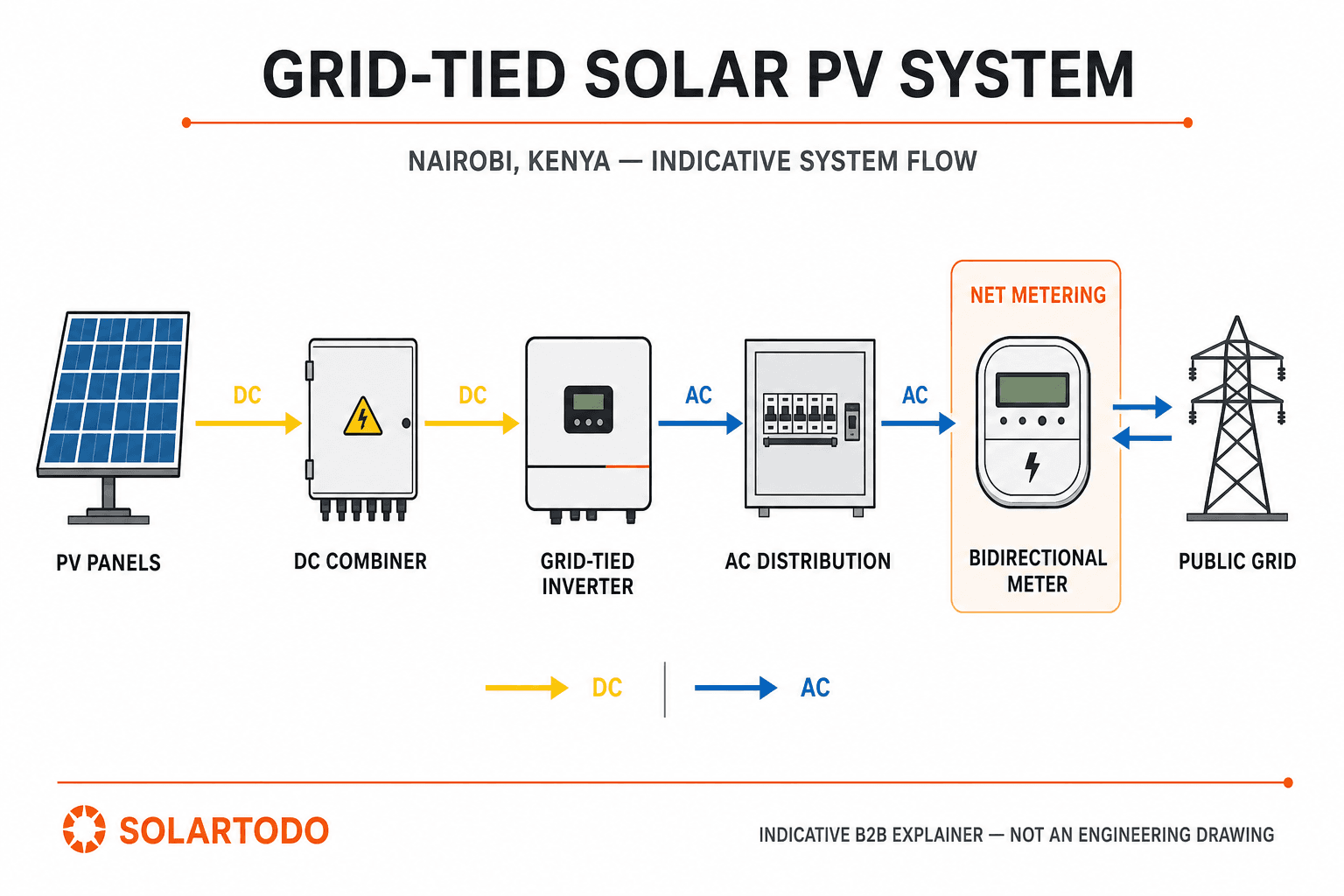
This system belongs to the 500kW-5MW C&I / industrial variant in the SOLARTODO architecture table. The appropriate form factor is a large rooftop array with a central inverter, DC combiner infrastructure, AC distribution, and a step-up transformer when the facility interconnection requires MV export at 11kV or 33kV. It should not be configured like a 5kW residential system, because a single small string inverter would be technically undersized and commercially irrelevant for a Nairobi industrial roof.
A typical engineering package would include panel layout, roof structural verification, string design, DC voltage window checks, inverter loading ratio analysis, protection settings, earthing design, lightning protection review, and utility interconnection documentation. The SOLARTODO Solar PV System page should position this design for factory roofs, logistics parks, shopping centers, and institutional campuses. For buyer qualification, contact us with roof dimensions, load profile, transformer rating, and monthly utility consumption.
Technical Specifications
The proposed 1.8MW technical configuration uses 3,288 x 540W PERC modules, 10 degree fixed tilt, 14% losses, and 1,950,104 kWh annual yield.
- Product line: SOLARTODO Solar PV System for industrial rooftop grid-tied generation.
- Capacity class: 500kW-5MW C&I / industrial rooftop PV.
- Module quantity: approximately 3,288 units.
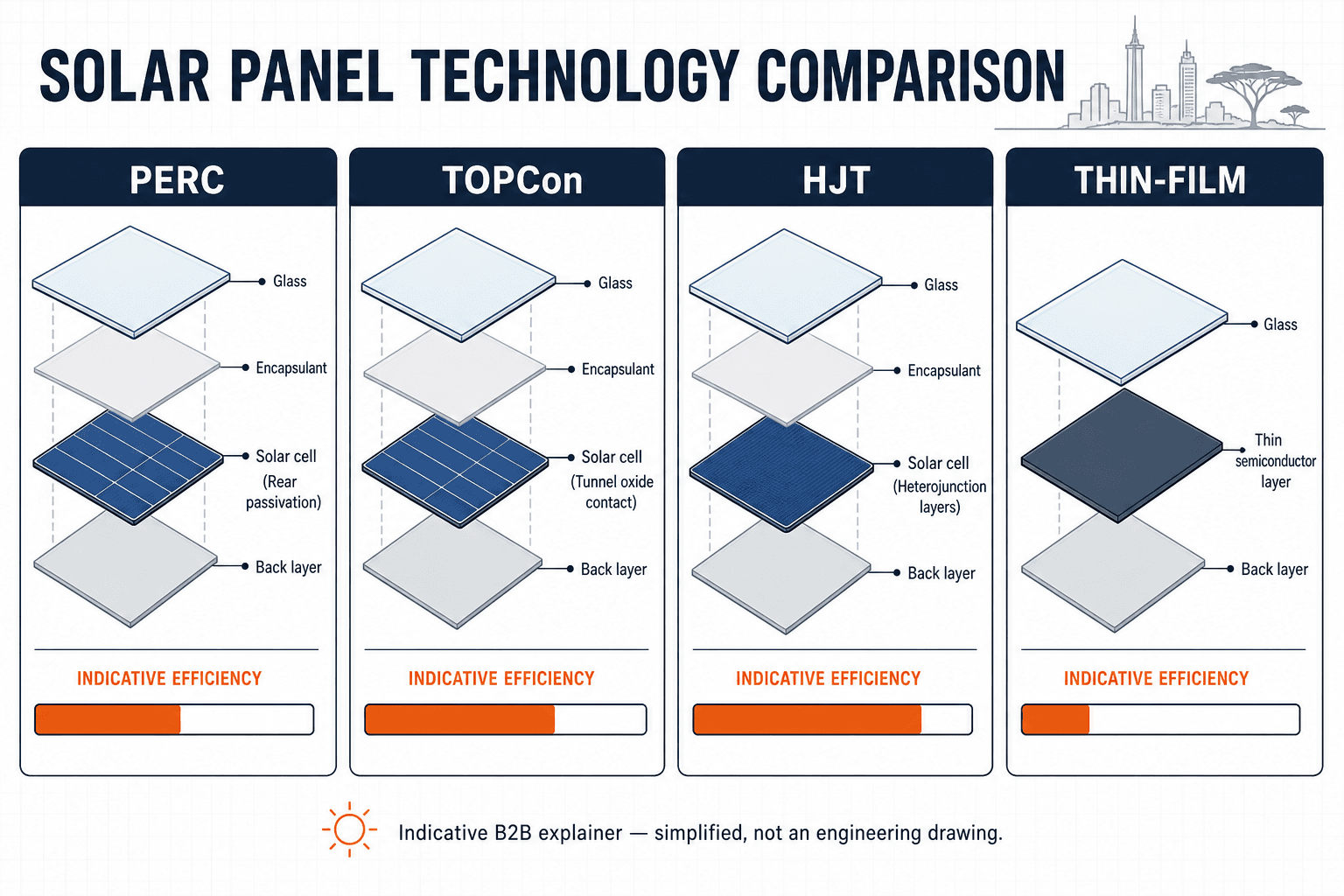
- Module type: monocrystalline PERC panel, 540W, 22% efficiency.
- DC nameplate: approximately 1.776MW DC, marketed as 1.8MW class.
- DC/AC ratio: 1.15.
- Inverter: central inverter, 98% CEC efficiency, 5-year inverter warranty.
- Mounting: aluminum fixed-tilt rooftop racks at 10 degrees.
- System losses: approximately 14%, including soiling 2%, shading 3%, mismatch 2%, wiring 3%, and availability 3%.
- Irradiance design input: 3.5 kWh/m2/day.
- Annual yield estimate: approximately 1,950,104 kWh in year 1.
- CO2 reduction estimate: approximately 819 tons per year, equivalent to about 36,855 trees.
- Lifetime planning basis: 30 years.
- Panel warranty: 25 years.
- Module degradation: 0.6% per year.
- Standards: IEC 61215 and IEC 61730.
According to IEC (2021), IEC 61215 covers design qualification and type approval for terrestrial photovoltaic modules. According to IEC (2023), IEC 61730 addresses PV module safety qualification, including construction and testing requirements. NREL states, "PVWatts estimates the energy production of grid-connected photovoltaic energy systems," which is why Nairobi yield estimates should be treated as pre-design modeling until detailed roof and utility data are confirmed.
Implementation Approach
A typical Nairobi 1.8MW rooftop PV program would progress through 6 engineering phases from site survey to grid commissioning and performance monitoring.
The first phase is technical due diligence. Engineers would verify roof dimensions, roof membrane condition, structural reserve capacity, available electrical rooms, transformer capacity, utility metering configuration, shading sources, fire setbacks, and equipment crane access. A realistic schedule should reserve time for Nairobi-specific site access, utility interface review, and commercial building operating constraints.
The second phase is detailed design and procurement. SOLARTODO would normally define module strings, combiner boxes, inverter location, DC cable routes, AC switchgear, earthing, surge protection, monitoring, and net-metering or self-consumption controls. CKD or containerized shipment planning should protect glass modules, aluminum racks, inverter cabinets, and DC components against moisture and handling damage during ocean freight and inland delivery.
The third phase is installation. A typical sequence is rack setting, module placement, DC string wiring, combiner installation, inverter mounting, AC distribution works, transformer integration where required, and SCADA or data logger commissioning. Nairobi industrial buildings may need staged work windows to avoid disrupting production, cold-chain operations, retail tenants, or logistics yard movement.
The final phase is testing and handover. Commissioning should include insulation resistance tests, polarity checks, string IV curve sampling, inverter anti-islanding verification, protection relay checks, meter validation, monitoring portal setup, and owner training. The handover package should include as-built drawings, warranty documents, serial number records, O&M manual, emergency shutdown procedure, and a performance baseline.
Expected Performance & ROI
The 1.8MW Nairobi configuration is expected to generate about 1.95GWh in year 1, with ROI driven by daytime self-consumption and avoided grid purchases.
The project-specific performance model estimates approximately 1,950,104 kWh of first-year generation. On a 1.776MW DC basis, that equals roughly 1,098 kWh/kW DC per year. With 0.6% annual module degradation, year-10 output would be lower than year-1 output, but the system remains commercially meaningful across a 30-year planning life.
ROI for Nairobi buyers should be modeled from actual tariff categories, demand charges, export rules, diesel generator displacement, and operating schedule. A factory with high daytime baseload can capture more PV value than a facility with low weekend consumption and limited export approval. Because the brief prohibits price disclosure, this guide treats payback as a project-specific calculation rather than a published claim.
According to IEA (2024), 96% of newly installed utility-scale solar PV and onshore wind capacity in 2023 had lower generation costs than new coal and gas plants. According to IRENA (2024), utility-scale solar PV remains one of the lowest-cost new power generation sources in many markets. These benchmarks support the economic logic of Nairobi C&I PV, but final ROI should be calculated only after roof survey, tariff review, and interconnection confirmation.
Results and Impact
A correctly specified 1.8MW Nairobi Solar PV System could offset about 819 tons of CO2 per year while improving industrial energy cost predictability.
The expected impact is not a claim of completed deployment. It is a modeled technical outcome for a recommended configuration using the exact project inputs: 3,288 panels, 3.5 kWh/m2/day irradiance, 14% system losses, 1.15 DC/AC ratio, and 30-year lifetime. The result is a bankable pre-design narrative for Nairobi buyers that separates engineering assumptions from installed evidence.
Operationally, the most important outcome is daytime load offset. Warehouses, manufacturing plants, malls, and campuses with predictable daytime consumption can use rooftop PV to reduce exposure to grid tariff escalation and diesel backup runtime. Carbon accounting teams can also use the 819 tons/year CO2 reduction estimate as a planning figure, subject to confirmation against the buyer's selected grid emissions factor methodology.
Comparison Table
This 1.8MW Nairobi configuration differs from residential and small-commercial PV by using central conversion, C&I protection design, and possible MV integration.
| Metric | Recommended Nairobi C&I System | Small Commercial Alternative | Residential Alternative |
|---|---|---|---|
| Capacity class | 1.8MW, within 500kW-5MW | 15-100kW | 3-15kW |
| Module count | Approx. 3,288 x 540W | Approx. 28-185 x 540W | Approx. 6-28 x 540W |
| Inverter architecture | Central inverter, 98% CEC efficiency | 1-2 string inverters | 1 residential string inverter |
| Mounting format | Large industrial rooftop, 10 degree fixed tilt | Rooftop or carport | House roof tilt rack |
| Grid interface | LV with possible 11/33kV step-up | LV commercial board | Single-phase or small three-phase LV |
| Annual yield basis | Approx. 1,950,104 kWh | Site-specific, lower absolute output | Site-specific residential output |
| Warranty basis | 25-year panels, 5-year inverter | Typically 25-year panels | Typically 25-year panels |
| Best-fit buyer | Factory, logistics, mall, campus | SME office or retail site | Individual household |
Pricing & Quotation
SOLARTODO offers three pricing tiers for this product line: FOB Supply (equipment ex-works China), CIF Delivered (including ocean freight and insurance), and EPC Turnkey (fully installed, commissioned, with 1-year warranty). Volume discounts are available for large-scale deployments. Configure your system online for an instant estimate, or request a custom quotation from our engineering team at [email protected].
Frequently Asked Questions
These 10 FAQs cover the 1.8MW Nairobi Solar PV System's specifications, timeline, ROI method, maintenance, warranty, installation, comparison, and quotation process.
Q1: What is the recommended Solar PV System size for an industrial rooftop in Nairobi? A typical industrial rooftop recommendation is the 1.8MW class, using approximately 3,288 x 540W mono PERC modules. The DC nameplate is about 1.776MW, with a 1.15 DC/AC ratio. This belongs to the 500kW-5MW C&I architecture class, not the residential or small commercial class.
Q2: Why does this Nairobi design use a central inverter instead of residential string inverters? At 1.8MW scale, a central inverter simplifies AC collection, monitoring, and maintenance compared with many small residential units. The specified inverter has 98% CEC efficiency and a 5-year warranty. String inverters can still be considered during detailed design, but the project-specific configuration calls for central inversion.
Q3: What annual energy output should buyers use for early feasibility modeling? The project-specific yield estimate is approximately 1,950,104 kWh in year 1, based on 3.5 kWh/m2/day irradiance and about 14% system losses. This is suitable for feasibility screening. Final production should be recalculated after roof survey, shading analysis, module orientation, utility constraints, and actual equipment layout are confirmed.
Q4: How long would deployment typically take in Nairobi? A 1.8MW rooftop PV project would typically move through survey, engineering, procurement, shipment, installation, grid review, commissioning, and handover. Timeline depends on roof readiness, utility approvals, transformer interface, site access, and import logistics. A realistic schedule should include contingency for electrical shutdown windows and industrial operating constraints.
Q5: How should ROI and payback be calculated without publishing prices? ROI should be calculated from the buyer's tariff category, daytime load profile, self-consumption percentage, export permission, diesel offset, financing cost, and maintenance plan. This guide does not mention prices. SOLARTODO can model payback after receiving 12 months of bills, roof dimensions, transformer rating, and operating schedule.
Q6: What maintenance is required for a 1.8MW rooftop Solar PV System? Maintenance should include periodic module cleaning, thermographic inspection, inverter log review, torque checks, combiner inspection, insulation testing, vegetation or debris control, and monitoring alarm response. Nairobi dust, roof access limits, and drainage conditions can affect cleaning frequency. Annual preventive maintenance should compare actual output against the 1,950,104 kWh baseline.
Q7: What warranties apply to the recommended configuration? The project-specific warranty basis is 25 years for panels and 5 years for the central inverter. The panels use a 30-year lifetime planning assumption and 0.6% annual degradation. Warranty review should confirm serial numbers, warranty start date, exclusions, claim procedure, and whether local EPC labor is included beyond equipment coverage.
Q8: Is this system suitable for net metering or export to the Nairobi grid? The configuration includes bi-directional net-metering capability in the broader SOLARTODO grid-tied PV architecture. Actual export approval depends on Kenyan regulations, utility interconnection studies, transformer capacity, protection settings, and the facility's load profile. For many industrial buyers, high daytime self-consumption may be more valuable than maximizing export.
Q9: How does this 1.8MW system compare with a 100kW small commercial system? A 100kW system may use 2-4 strings and 1-2 string inverters, while the 1.8MW Nairobi configuration uses thousands of modules, central conversion, larger AC distribution, and possible 11/33kV interface. The 1.8MW design is better suited to factories, logistics roofs, malls, and campuses with high daytime demand.
Q10: What information is needed for an EPC quotation? An EPC quotation needs roof drawings, structural data, monthly electricity bills, transformer rating, load profile, preferred export strategy, site photos, access constraints, and target commissioning window. For Nairobi projects, interconnection voltage and shutdown requirements are also important. SOLARTODO can then prepare FOB Supply, CIF Delivered, or EPC Turnkey options.
References
These 7 references support Nairobi demographics, Kenya grid context, PV modeling, renewable benchmarks, and IEC module qualification for the 1.8MW recommendation.
- Nairobi City County (2023): County Integrated Development Plan 2023-2027 reports 4,397,073 people in 2019, 4,906,355 projected in 2025, 705 km2 area, and 6,959 people/km2 projected 2025 density.
- Kenya Law (2022): Protected Areas Energy Sector Order lists KPLC Nairobi-region primary substations including multiple 66/11kV substations and Industrial 66/11kV on Enterprise Road.
- IEA (2025): Kenya 2024 Energy Policy Review reports 79% electricity access in 2023, urban electrification at 100%, and nearly 90% renewable electricity generation.
- World Bank / Global Solar Atlas (2023): PVOUT data uses 1 km nominal resolution and solar resource layers use about 250 m nominal resolution for solar geospatial analysis.
- NREL (2022): PVWatts Version 8 estimates energy production of grid-connected PV systems and uses updated weather and modeling inputs for feasibility analysis.
- IEC (2021): IEC 61215 defines terrestrial photovoltaic module design qualification and type approval requirements.
- IEC (2023): IEC 61730 defines photovoltaic module safety qualification requirements for construction and testing.
Equipment Deployed
- 3,288 x 540W monocrystalline PERC PV panels, 22% efficiency, 0.6%/yr degradation
- Central inverter, 98% CEC efficiency, 5-year warranty
- Aluminum fixed-tilt rooftop mounting racks, 10 degree tilt
- DC combiner boxes and string protection equipment
- AC distribution cabinet and grid-tied protection interface
- Bi-directional net metering compatible metering architecture
- Optional LV-to-11/33kV step-up transformer subject to utility interconnection review
- Monitoring, data logger, earthing, surge protection, and commissioning test package