Nassau Telecom Tower Market Analysis: 20m Urban Macro Monopole Configuration Guide
Summary
Nassau’s 296,521-person New Providence market supports an approximately 80-unit, 20m steel Telecom Tower plan using 40m/s wind design, 7t Q345 monopoles, and CKD shipping for 60-70% volume reduction.
Key Takeaways
- A typical 80-unit Nassau urban macro program would use 20m tapered steel monopoles, not lattice, FRP, or joint-use structures.
- Each tower would weigh approximately 7t, equal to 350kg/m for the specified 20m urban infill configuration.
- The specified antenna loading is 3 x 25kg panel antennas per tower, or 75kg nominal antenna payload before brackets and feeder allowances.
- Wind Class 1 at 40m/s with factor 1.0 is the baseline design input under the TIA-222-H method for this configuration.
- New Providence’s 2022 population was 296,521, concentrated across 24 supervisory districts that create dense urban coverage needs.
- CKD sectional shipping can reduce tower transport volume by 60-70%, which is material for island logistics into Nassau.
- Recommended accessories include 2 antenna platforms, ladder, cable tray, aircraft warning light, grounding system, lightning rod, and safety cage.
- Production lead time would typically be 30-45 days before freight, customs clearance, pier drilling, erection, and commissioning.
Market Context for Nassau
Nassau’s mobile infrastructure demand is shaped by a 296,521-person island population, coastal corrosion exposure, tourism peaks, and compact urban districts. According to the Commonwealth of The Bahamas Census of Population and Housing (2022), New Providence recorded 296,521 residents out of a national population of 398,916, placing roughly three quarters of the country on the island that contains Nassau. This concentration supports urban macro cells and infill structures rather than very tall rural coverage towers.
According to Government of The Bahamas district data (2022), New Providence includes 24 supervisory districts, with district populations commonly ranging from about 9,000 to 17,700 residents. That pattern favors repeatable 20m to 25m monopole assets that can be inserted into constrained urban and suburban parcels. For SOLARTODO, the relevant product fit is a hot-dip galvanized steel Telecom Tower that balances low visual impact, corrosion resistance, and standardized antenna mounting.
According to CIA World Factbook communications data (2012), The Bahamas had modern telecom facilities, a highly developed automatic domestic system, and domestic submarine cable connectivity linking 14 islands. Although the cited data is older, it still indicates why Nassau functions as the national traffic hub: international backhaul, government activity, financial services, ports, and hotels concentrate demand on New Providence. ITU states, "universal and meaningful connectivity" is the policy objective for digital access, and Nassau’s site planning should therefore prioritize resilient urban coverage, not only headline peak speed.
Nassau also requires coastal durability. According to World Bank climate risk guidance for The Bahamas (2021), the country faces hurricane, sea-level, and coastal flooding exposure, making corrosion control and wind verification important for telecom assets. A high-corrosion-zone classification is appropriate for galvanized steel close to salt air, especially where maintenance access may be interrupted during storm seasons.
Recommended Technical Configuration
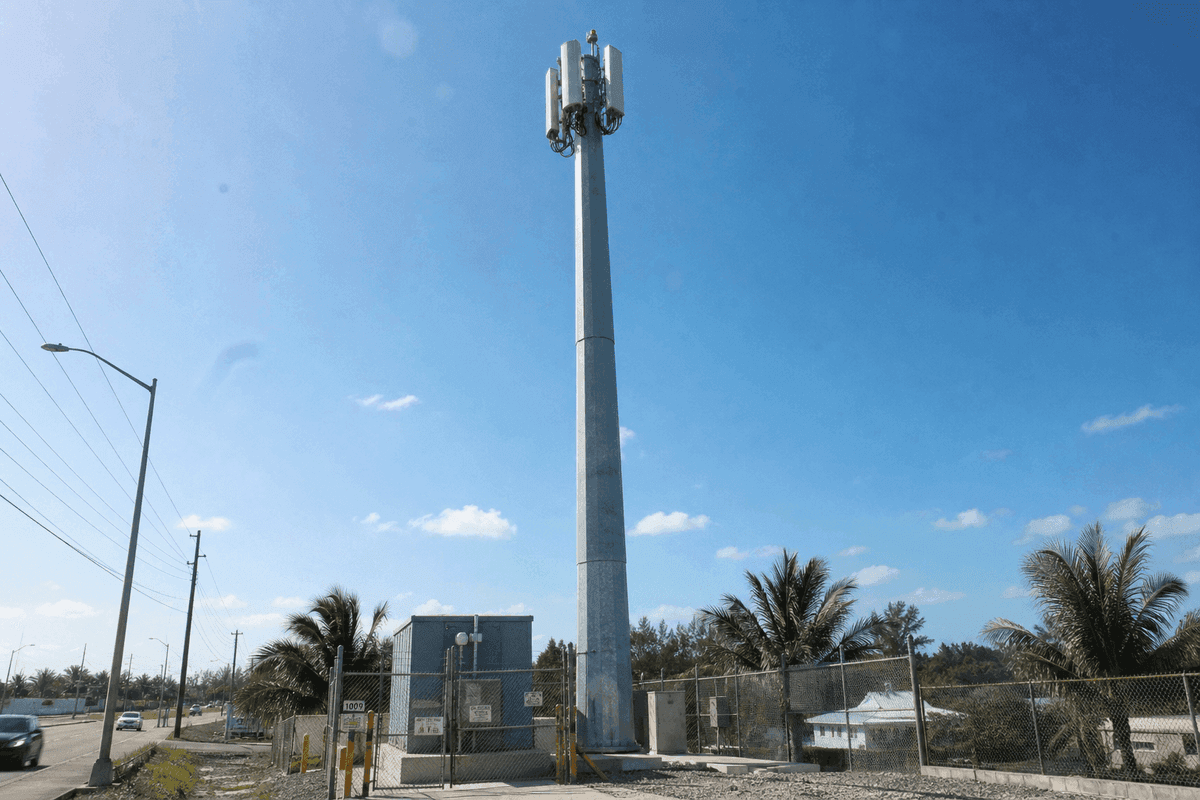
A recommended Nassau configuration is an approximately 80-unit, 20m steel Telecom Tower program for urban macro and urban infill coverage. The correct size class is the 15-25m rooftop and urban infill category because the specified height is 20m and the antenna load is 3 panel antennas. The product should remain a tapered round or octagonal steel monopole, not a lattice tower, FRP pole, or joint-use utility structure.
A typical 80-unit deployment of this scale would consist of 20m hot-dip galvanized Q345 steel monopoles with concrete drilled pier foundations. The specified tower weight is approximately 7t per tower, equal to 350kg/m, which is lighter than the general 8-15t urban infill reference band but acceptable as a project-specific 20m telecom monopole profile when verified by detailed structural calculations. SOLARTODO should treat the 7t value as a controlled design input tied to Wind Class 1, 3-panel loading, and a 30-year design life.
The antenna profile is deliberately conservative: 3 x panel antennas at 25kg each, configured for urban infill rather than a dense 5G hotspot. That avoids over-stating capacity and keeps the tower class aligned with Nassau’s parcel constraints, zoning visibility, and salt-air maintenance needs. Where operators later require additional RRUs, microwave dishes, or small cells, the structure should be rechecked under TIA-222-H before loading changes are approved.
SOLARTODO’s recommended form is a flanged bolt-on sectional monopole shipped CKD. CKD shipping is commercially important for Nassau because port and last-mile logistics are more constrained than mainland projects; a 60-70% volume reduction can reduce container count, handling complexity, and laydown area at the receiving yard. The configuration should include climbing ladder, cable tray, aircraft warning light, grounding system, lightning rod, two antenna platforms, and safety cage.
Technical Specifications
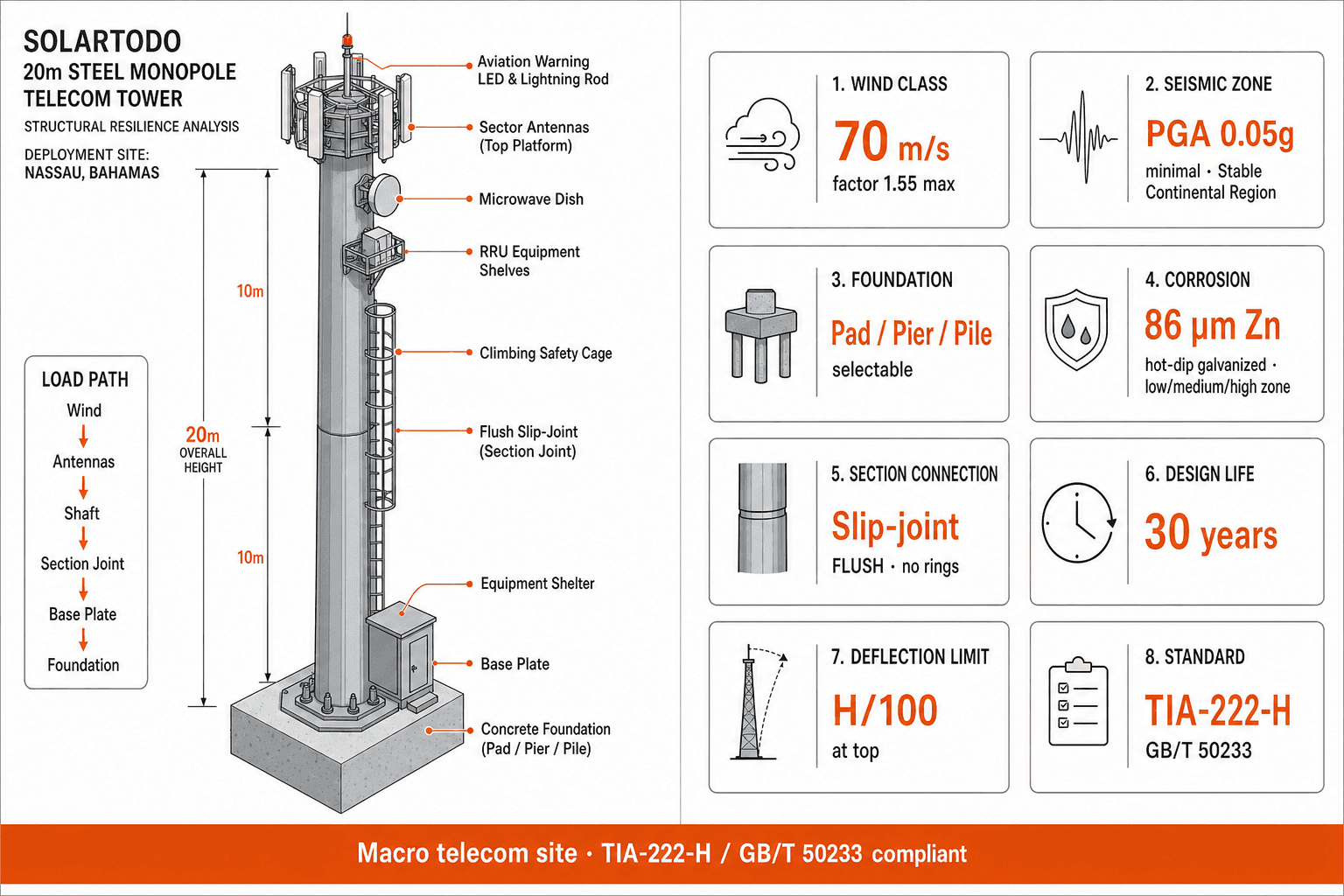
The Nassau Telecom Tower specification uses 20m Q345 galvanized steel monopoles, 3 x 25kg panel antennas, 40m/s wind design, and drilled pier foundations.
- Product type: Steel Telecom Tower, tapered round or octagonal monopole form only.
- Quantity basis: approximately 80 units for a typical Nassau urban macro program.
- Height: 20m, within the 15-25m urban infill size class.
- Pole class: urban macro site, suitable for compact New Providence coverage zones.
- Material: Q345 hot-dip galvanized steel for high corrosion exposure.
- Approximate weight: 7t per tower, equal to about 350kg/m for this specific 20m design.
- Antenna load: 3 x panel antennas at 25kg each, totaling 75kg nominal antenna mass.
- Wind class: Class 1, 40m/s, factor 1.0 under the TIA-222-H design framework.
- Foundation: concrete pier, normally drilled pier foundation after geotechnical confirmation.
- Connection method: flanged bolt-on sectional design for CKD transport and site assembly.
- Accessories: climbing ladder, cable tray, aircraft warning light, grounding system, lightning rod, 2 antenna platforms, and safety cage.
- Design life: 30 years with planned inspection and corrosion maintenance.
- Production lead time: 30-45 days before shipping and site works.
- Standards basis: TIA-222-H and GB/T 50233.
TIA states, "Structural Standard for Antenna Supporting Structures and Antennas," which is the core reference category for tower wind, ice, loading, and serviceability checks. GB/T 50233 provides a Chinese engineering reference for overhead line construction and steel structure workmanship; for export telecom towers, it should be paired with project-specific drawings, foundation calculations, galvanizing certificates, and bolt material traceability.
Implementation Approach
A Nassau rollout would typically move through 5 controlled phases: survey, manufacturing, CKD logistics, foundation works, and tower commissioning. The first phase is a radio and civil survey that maps coverage objectives against available parcels, airport lighting constraints, setback limits, underground utilities, and coastal exposure. Soil investigation should confirm whether drilled pier foundations are adequate at each location or whether localized rock, fill, or water-table conditions require adjustment.
The second phase is engineering submittal and factory production. SOLARTODO would prepare structural drawings, material lists, bolt schedules, galvanizing requirements, and packing plans for the 20m Q345 monopole sections. The stated production window is 30-45 days, but project scheduling should add time for drawing approval, third-party inspection, export documentation, and freight booking.
The third phase is CKD transport. Because the tower is sectional and flanged, the shafts, platforms, ladders, cable trays, grounding components, and lighting kits can be packed for reduced volume. The specified 60-70% volume reduction is especially relevant for island delivery because container utilization, port demurrage, and storage congestion can affect total installed schedule even when tower fabrication is complete.
The fourth phase is civil installation. A drilled pier foundation would normally be excavated or drilled, reinforced, poured, cured, and surveyed before tower erection. Anchor bolt templates, grout thickness, base-plate leveling, and grounding continuity should be checked before lifting any steel sections.
The final phase is erection and commissioning. Crews would assemble the flanged sections, torque bolts to specification, install ladder and safety cage, mount antenna platforms, bond the grounding system, install the lightning rod, and verify aircraft warning light operation. Telecom equipment integration should include antenna azimuth, tilt, sweep testing, grounding resistance, and as-built documentation.
Expected Performance & ROI
Expected performance is based on faster urban infill coverage, 30-year structural life, reduced shipping volume, and lower civil complexity versus taller macro towers. A 20m urban macro monopole is not designed to replace every rooftop or high-mast site; it is a repeatable structure for targeted coverage gaps, roadside corridors, hotel zones, port approaches, and residential districts where a 35m to 45m tower would be visually or spatially excessive.
According to GSMA (2024), mobile networks carry the majority of consumer connectivity demand in many island and emerging markets, making tower uptime and backhaul readiness central to economic resilience. In Nassau, the practical return comes from faster site acquisition, standardized foundations, and simplified repeat procurement rather than from a single spectacular coverage radius. For operators, a 20m monopole can support incremental 4G/5G sector densification where traffic congestion matters more than long-distance propagation.
ROI should be evaluated through avoided churn, new tenant revenue, reduced truck rolls, and lifecycle maintenance. A 30-year design life allows capex to be assessed over a long structural period, while hot-dip galvanizing reduces repainting frequency in high-corrosion zones. A reasonable financial model would include tower supply, ocean freight, customs, civil works, craneage, antenna integration, annual inspections, lightning protection testing, and corrosion touch-up allowances.
Results and Impact
The expected impact of a typical 80-unit Nassau configuration is improved urban coverage density without claiming any completed SOLARTODO deployment. With 80 units at 20m each, the program would represent about 1,600m of installed monopole height and approximately 560t of galvanized steel tower mass before accessories and foundations. This scale is large enough to standardize procurement while still allowing site-by-site engineering review.
Compared with taller 35m to 45m towers, the 20m design lowers visual impact and can simplify approvals in dense districts. Compared with rooftop-only deployments, it gives operators more control over antenna height, grounding, access, and maintenance windows. The main operational risk is future overloading: adding RRUs, microwave dishes, or additional sectors without structural review could invalidate the original 40m/s Wind Class 1 assumptions.
Comparison Table
The 20m Nassau configuration fits urban infill better than taller suburban or highway monopoles because it uses 7t towers, 3 panels, and drilled piers.
| Configuration factor | Nassau recommended Telecom Tower | Taller suburban macro alternative | Dense hotspot alternative |
|---|---|---|---|
| Height class | 20m, 15-25m urban infill | 30-35m suburban/residential | 25-30m dense urban |
| Typical tower weight | ~7t specified | 15-22t reference band | 15-22t reference band |
| Antenna loading | 3 x 25kg panels | 6-9 panels | 9 panels + 6 RRUs + 3 small cells |
| Foundation | Concrete drilled pier | Pier or pile by soil | Pier with stricter vibration/access review |
| Wind class basis | 40m/s, factor 1.0 | 40-70m/s by site | 40-70m/s by site |
| Best fit in Nassau | Urban macro and infill | Wider residential coverage | High-traffic hotspot only |
| Shipping method | CKD, 60-70% volume reduction | CKD, higher steel tonnage | CKD, more accessory packages |
| Structural review trigger | Any extra RRU/dish load | Height or tenant increase | Every tenant/load change |
Pricing & Quotation
SOLARTODO pricing for Nassau should be quoted by supply scope, delivery term, and EPC responsibility, not by unsupported generic unit prices. SOLARTODO offers three pricing tiers for this product line: FOB Supply (equipment ex-works China), CIF Delivered (including ocean freight and insurance), and EPC Turnkey (fully installed, commissioned, with 1-year warranty). Volume discounts are available for large-scale deployments. Configure your system online for an instant estimate, or request a custom quotation from our engineering team at [email protected].
For technical review, start from the SOLARTODO Telecom Tower product page and provide coordinates, antenna schedule, wind requirement, corrosion class, site access limits, and foundation data. Buyers can also contact us for a formal engineering review before committing to tower quantities or EPC scope.
Frequently Asked Questions
Q1: What Telecom Tower specification is recommended for Nassau? A typical Nassau configuration would use approximately 80 units of 20m tapered steel monopole towers made from hot-dip galvanized Q345 steel. Each tower would weigh about 7t and support 3 x 25kg panel antennas. The configuration is intended for urban macro and infill coverage, not rural wide-area coverage.
Q2: Why is a 20m monopole preferred instead of a 35m or 45m tower? A 20m tower fits the 15-25m urban infill class and is better suited to Nassau’s dense New Providence districts. Taller 35m to 45m monopoles are more appropriate for highway, peri-urban, or wider coverage sites. The specified 3-panel antenna load does not require a taller heavy macro structure.
Q3: What is the expected deployment timeline? Factory production is typically 30-45 days after drawing approval and material confirmation. The full schedule should also include site survey, geotechnical review, CKD packing, ocean freight, customs clearance, drilled pier foundation curing, tower erection, and commissioning. For an 80-unit program, phased rollout planning is more realistic than a single installation window.
Q4: What ROI factors should buyers model? ROI should include coverage improvement, tenant revenue potential, reduced churn, avoided rooftop lease complexity, shipping efficiency, and lifecycle maintenance. The tower has a 30-year design life, so financial models should not focus only on initial supply cost. Salt-air corrosion maintenance and annual structural inspections should be included.
Q5: How does this compare with a lattice tower? A steel monopole has a smaller visual and land footprint than a lattice tower and is usually easier to place in urban infill locations. Lattice towers can carry heavier multi-tenant loads, but they are less suitable where parcel size, aesthetics, and compact civil works matter. The Nassau recommendation is explicitly not lattice.
Q6: What foundation is recommended for Nassau sites? The recommended baseline is a concrete drilled pier foundation. Final diameter, depth, reinforcement, and anchor bolt design must be confirmed by soil conditions, water table, overturning load, and site access. Coastal or filled sites may require additional geotechnical checks before assuming a standard pier design.
Q7: What maintenance is required in a high-corrosion zone? Maintenance should include annual visual inspection, bolt torque sampling, grounding continuity tests, aircraft warning light checks, ladder and safety cage inspection, and corrosion review. Hot-dip galvanizing improves durability, but salt air can still affect exposed edges, fasteners, and damaged coating areas. Touch-up repairs should follow approved galvanizing repair procedures.
Q8: Does SOLARTODO provide EPC pricing? SOLARTODO can quote FOB Supply, CIF Delivered, or EPC Turnkey scopes for the Telecom Tower product line. The article does not list prices because freight, foundations, access, craneage, customs, and installation responsibility change the total cost. Buyers should request a project-specific quotation with coordinates and antenna schedules.
Q9: What warranty should be expected? The quoted EPC Turnkey scope includes a 1-year warranty, while the structural design life is 30 years under the stated loading and maintenance assumptions. Warranty terms should be separated from design life: warranty covers defined defects and scope obligations, while design life depends on correct use, inspection, and corrosion control.
Q10: Can extra RRUs or microwave dishes be added later? Additional equipment should not be added without structural review. The Nassau configuration is based on 3 x 25kg panel antennas and Wind Class 1 at 40m/s. Adding RRUs, microwave dishes, small cells, or extra platforms changes wind area, mass, and overturning moment, so TIA-222-H checks should be repeated.
References
- Commonwealth of The Bahamas (2022): Census of Population and Housing reports New Providence at 296,521 residents and The Bahamas at 398,916 residents.
- Government of The Bahamas (2022): New Providence district data identifies 24 supervisory districts with district populations commonly near 9,000-17,700 residents.
- CIA World Factbook (2012): Bahamas communications profile describes modern telecom facilities, automatic domestic systems, and domestic submarine cable links across 14 islands.
- ITU (2024): Digital development policy uses universal and meaningful connectivity as a benchmark for resilient broadband access.
- World Bank (2021): Climate risk guidance for The Bahamas identifies hurricane, coastal flooding, sea-level, and storm exposure as infrastructure planning risks.
- TIA (2017): ANSI/TIA-222-H, Structural Standard for Antenna Supporting Structures and Antennas, defines tower loading and structural design practice.
- GB/T 50233 (2014): Chinese construction standard for overhead transmission line engineering, relevant to steel structure fabrication, erection discipline, and quality documentation.
Equipment Deployed
- 80 units x 20m tapered steel monopole Telecom Tower
- Hot-dip galvanized Q345 steel, high-corrosion-zone finish
- Approx. 7t per tower, about 350kg/m
- Wind Class 1, 40m/s, factor 1.0 per TIA-222-H basis
- 3 x 25kg panel antenna load per tower
- Concrete drilled pier foundation
- Flanged bolt-on sectional CKD design with 60-70% volume reduction
- Climbing ladder, cable tray, aircraft warning light, grounding system, lightning rod, 2 antenna platforms, safety cage
- 30-year design life, 30-45 day production window
- Standards basis: TIA-222-H / GB/T 50233