Panama City Solar PV System Market Analysis: 10.9MW Utility Configuration Guide for High-Irradiance Grid Connection
Summary
Panama City’s utility-scale solar profile supports a recommended 10.9MW ground-mount Solar PV System using 20,245×540W Mono PERC modules, single-axis tracking, and a 1.15 DC/AC ratio, with modeled annual generation of about 25.74GWh under 6kWh/m²/day irradiance.
Key Takeaways
- A utility-scale Panama City configuration would fit the 5-50MW small utility class, with 10.9MW DC capacity and 20,245 Mono PERC 540W panels.
- Based on the provided design inputs, the recommended array uses single-axis tracking with 30° tilt, improving energy yield by about 25% versus fixed-tilt layouts.
- The proposed system uses central inverters at 98% CEC efficiency and a DC/AC ratio of 1.15, which is typical for high-irradiance utility plants.
- With 6kWh/m²/day irradiance and ~14% total system losses, expected annual generation is approximately 25,736,661kWh.
- Estimated environmental impact is about 10,809 tons of CO₂ avoided per year, roughly equivalent to 486,405 trees on a common equivalency basis.
- The module package includes a 25-year panel warranty, 0.6%/year degradation, and a modeled 30-year project life; inverter warranty is 5 years.
- According to IRENA (2024), solar PV remains one of the lowest-cost new-build generation technologies globally, which supports utility procurement interest in Panama’s urban load centers.
- SOLARTODO would typically recommend utility interconnection through 35kV collection and substation architecture for a project in this size band, subject to utility study and local permitting.
Market Context for Panama City
Panama City combines high electricity demand, strong solar resource, and a grid structure that can support utility-scale PV in the 10MW class when land, interconnection, and permitting align. According to the World Bank (2024), Panama’s urbanization rate exceeds 68%, and the Panama metropolitan area remains the country’s largest load center, which increases the value of daytime generation close to demand.
According to Global Solar Atlas (2024), the Panama City area near 8.98, -79.52 has favorable solar resource conditions, and the design basis used here assumes 6kWh/m²/day irradiance. That resource level is suitable for utility-scale tracking systems because a 25% yield uplift from single-axis tracking can materially improve annual MWh output in tropical conditions with strong daytime insolation.
Panama’s electricity market also benefits from an established transmission and distribution framework. According to the International Trade Administration (2023), Panama continues to invest in grid infrastructure and generation diversification, with renewables forming a strategic part of the national power mix. For a 10.9MW plant, a utility-scale interconnection study would typically examine feeder loading, substation capacity, and protection coordination at medium-voltage collection and substation step-up levels.
The climate profile matters for design. According to the World Bank Climate Change Knowledge Portal (2024), Panama has a tropical climate with high humidity, seasonal rainfall, and temperatures commonly above 30°C in lowland urban areas. Those conditions increase attention to module soiling, drainage, corrosion protection, inverter thermal management, and maintenance access roads, especially for a ground-mount site operating over a 30-year life.
Two standards issues are central in this market. First, PV modules should comply with IEC 61215 and IEC 61730, the exact standards specified for this product configuration. Second, interconnection equipment, grounding, and protection settings would normally be reviewed against local utility requirements and internationally recognized practices used across Latin American utility solar projects.
SOLARTODO’s role in this context is best framed as a technical supplier and configuration advisor for utility buyers evaluating a Panama City Solar PV System. Rather than treating the city as a generic tropical site, the correct approach is to match the 10.9MW utility class, the 6kWh/m²/day resource assumption, and the likely 35kV collection architecture to local grid and land constraints. For product details, buyers can review the Solar PV System product page or contact us for project-specific engineering input.
Recommended Technical Configuration
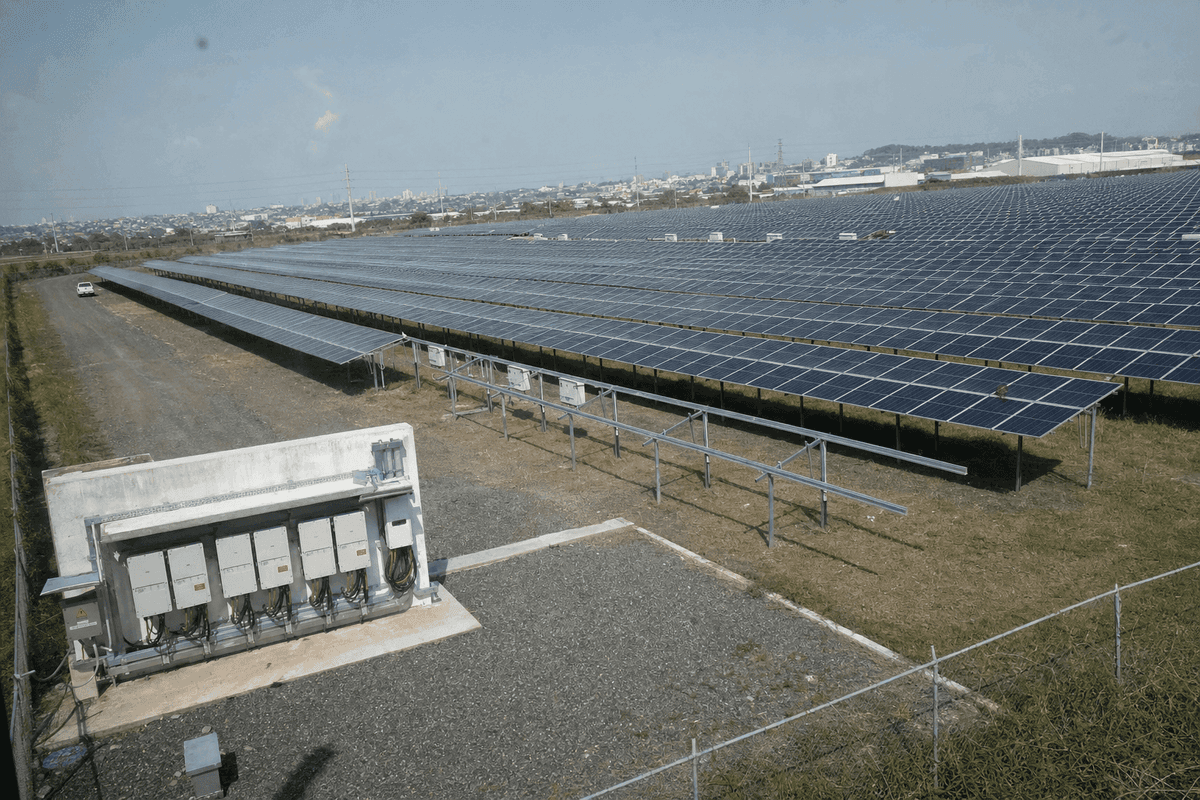
A Panama City utility solar project in this profile would typically use a 10.9MW ground-mount configuration with 20,245 modules, central inverter architecture, single-axis tracking, and medium-voltage collection for grid export.
Based on the provided configuration and Panama City’s irradiation profile, the correct size class is 5-50MW utility small from the SOLARTODO product architecture matrix. That class fits a 10.9MW plant because it calls for utility-scale inverter blocks, 35kV step-up, and substation-level grid connection rather than rooftop or low-voltage commercial topology.
A typical deployment of this scale would consist of approximately 20,245 monocrystalline PERC modules rated at 540W each, producing 10.9323MW DC nameplate capacity. With a DC/AC ratio of 1.15, the corresponding AC export capacity would be approximately 9.5MW AC, which is consistent with utility oversizing practice used to improve inverter loading through more hours of the day.
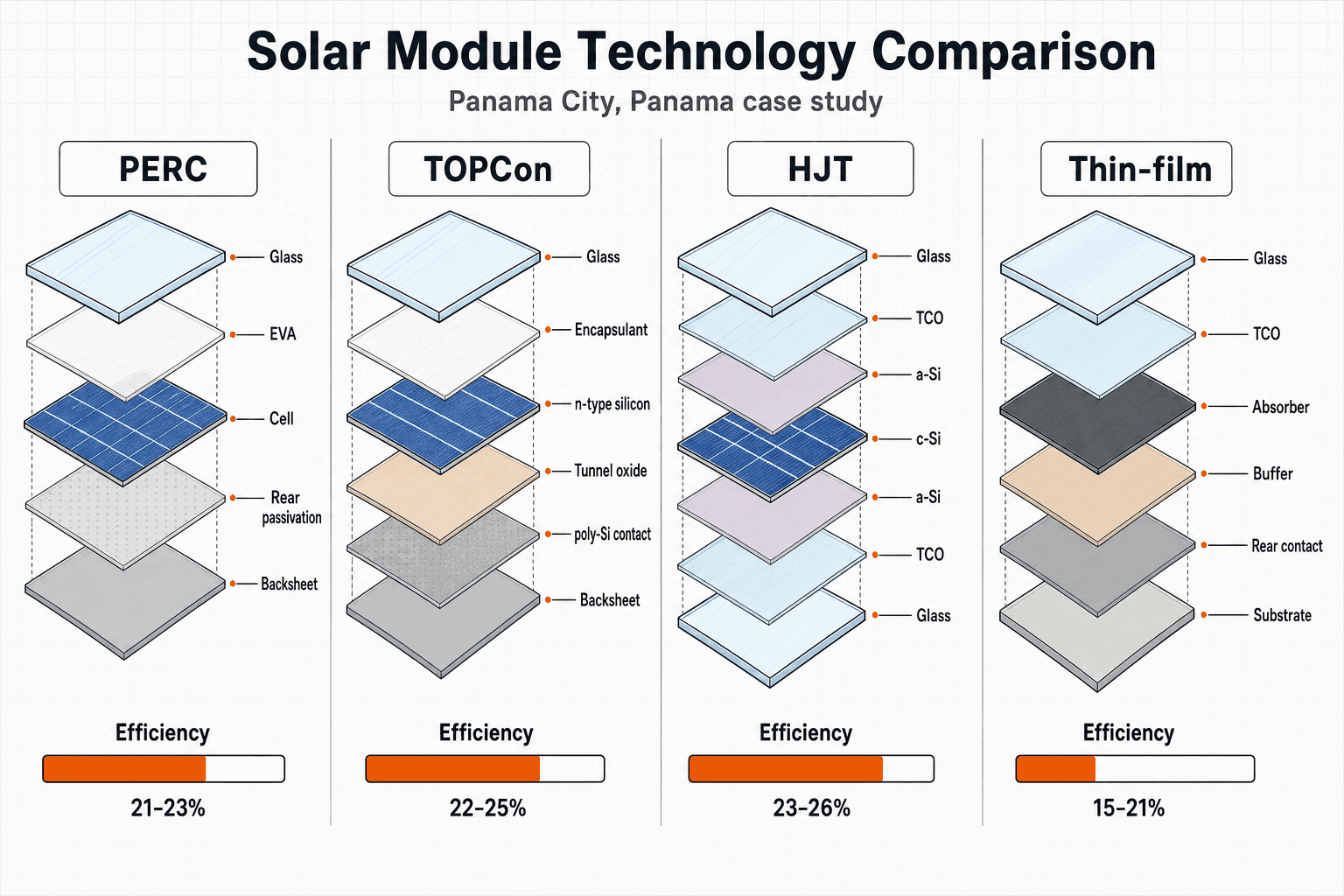
The module selection is important for climate fit. Mono PERC at 22% efficiency offers a practical balance between land use and procurement availability, while the specified 0.6%/year degradation supports long-term energy modeling over a 30-year life. In Panama’s humid conditions, buyers should also review frame anodization, junction box sealing, and tracker fastener corrosion class during technical due diligence.
The inverter recommendation in this exact configuration is central inverter technology with 98% CEC efficiency and a 5-year warranty. For a plant above 10MW, central inverters can reduce balance-of-system complexity compared with a high count of dispersed string inverters, although the final choice should still consider spare strategy, maintenance logistics, and partial-load behavior.
Single-axis tracking is justified in this market analysis because the provided design basis states +25% yield versus a non-tracking baseline. In a high-irradiance location near Panama City, that yield gain can materially improve annual output from the same 10.9MW DC field, provided the site has acceptable topography, row spacing, and geotechnical conditions for tracker foundations.
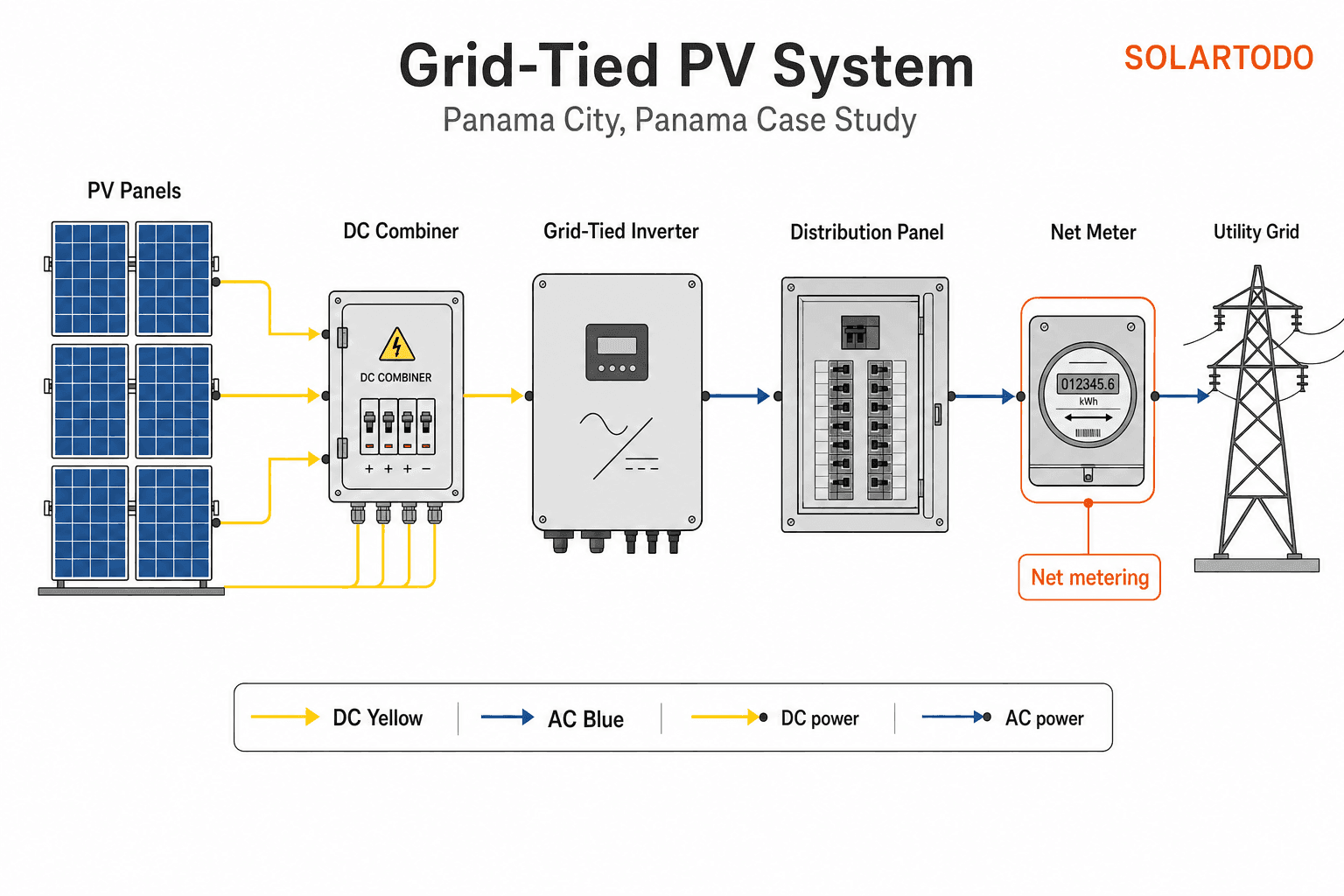
A typical interconnection concept would include inverter output aggregation at low voltage, step-up transformation to 35kV, and export to the nearest suitable substation or utility feeder after power-flow and fault-level review. According to IEA (2024), grid integration planning becomes more important as variable renewable penetration rises, particularly for projects above 5MW where curtailment risk, voltage regulation, and dispatch rules can affect realized revenue.
Technical Specifications
This Panama City recommendation uses the exact provided utility-scale specification: 10.9MW DC, 20,245×540W Mono PERC modules, central inverter blocks, single-axis tracking, and IEC 61215/61730 compliant modules.
- System type: Grid-tied ground-mount utility Solar PV System
- Location basis: Panama City, Panama; coordinates 8.98, -79.52
- Capacity class: 5-50MW utility small architecture band
- Installed DC capacity: 10.9MW
- Module quantity: 20,245 panels
- Module type: Monocrystalline PERC
- Module rating: 540W each
- Module efficiency: 22%
- Module degradation: 0.6%/year
- Panel warranty: 25 years
- Inverter type: Central inverter
- Inverter efficiency: 98% CEC
- Inverter warranty: 5 years
- Tracker type: Single-axis tracking
- Tracking yield uplift: approximately +25%
- Array tilt: 30°
- DC/AC ratio: 1.15
- Irradiance basis: 6kWh/m²/day
- System losses: ~14% total
- Soiling loss: 2%
- Shading loss: 3%
- Mismatch loss: 2%
- Wiring loss: 3%
- Availability loss: 3%
- Annual energy yield: ~25,736,661kWh
- Estimated CO₂ reduction: ~10,809 tons/year
- Tree equivalency: ~486,405 trees
- Design life: 30 years
- Applicable standards: IEC 61215, IEC 61730
Implementation Approach
A 10.9MW Panama City utility solar project would typically move through 5 phases: site due diligence, detailed engineering, procurement and logistics, construction, and grid commissioning over roughly 8-14 months.
Phase 1 is site and interconnection screening. For a plant of 10.9MW, this usually includes topographic survey, geotechnical borings, flood review, and utility interconnection application. In Panama’s rainy climate, drainage design and access-road stability are not minor details; they directly affect availability assumptions such as the specified 3% availability loss.
Phase 2 is detailed engineering. This includes tracker row layout, pile or ground-screw selection, cable routing, inverter pad design, SCADA architecture, and the medium-voltage collection system. Because the design basis uses 30° tilt and single-axis tracking, row spacing and backtracking logic should be modeled to control the stated 3% shading loss.
Phase 3 is procurement and shipping. A utility buyer would typically order approximately 20,245 modules, tracker steel, central inverter blocks, combiner equipment, transformers, and protection panels in coordinated lots. For imported equipment, lead times often depend on vessel schedules, customs clearance, and whether the project uses supply-only, delivered, or turnkey scope.
Phase 4 is field construction. Typical work packages include civil grading, foundation installation, tracker assembly, module mounting, inverter station placement, MV cabling, grounding, and perimeter security. According to NREL (2024), construction quality in cable terminations, torque control, and commissioning tests can materially affect long-term performance ratios in utility PV plants.
Phase 5 is testing and energization. This stage usually includes insulation resistance testing, inverter functional checks, tracker calibration, relay testing, utility witness testing, and performance verification against the production model. SOLARTODO would normally advise buyers to align acceptance testing with the loss assumptions of ~14% and the annual yield target of 25,736,661kWh so that contractual expectations remain clear.
Expected Performance & ROI
For the specified 10.9MW configuration in Panama City, modeled annual output is about 25.74GWh, with economics driven by irradiance, capacity factor, interconnection terms, and final EPC scope rather than a single universal payback number.
Using the provided design basis, the system generates ~25,736,661kWh/year. Relative to 10.9MW DC, that is a strong utility-scale yield profile and reflects the combined impact of 6kWh/m²/day irradiance and +25% tracking gain, offset by the stated ~14% losses. According to IRENA (2024), tracking systems often improve output in high-resource markets when land and maintenance conditions support the added mechanical complexity.
The environmental case is also quantifiable. The provided estimate indicates ~10,809 tons of CO₂ reduction per year, equivalent to roughly 486,405 trees. According to the IEA (2024), emissions reduction from solar generation depends on the displaced grid mix, so buyers should treat this figure as a planning estimate and align final reporting with local utility or regulatory carbon accounting methods.
Payback and ROI require project-specific assumptions, especially tariff structure, wheeling rules, financing cost, land lease, and curtailment risk. According to NREL (2024), utility PV financial performance is usually modeled through LCOE, net present value, and debt-service coverage rather than a simple headline payback. In Panama City, a procurement team should test at least 3 scenarios: merchant sale, utility PPA, and self-consumption with export credit where regulation allows.
Two authority statements are worth noting here. IEA states, "Solar PV is expected to account for most of the increase in renewable electricity capacity worldwide," underscoring the technology’s central role in new generation planning. IEC states, "International Standards and conformity assessment underpin international trade in electrical and electronic equipment," which is directly relevant when specifying IEC 61215 and IEC 61730 compliance for imported PV modules.
Results and Impact
A Panama City project built to this 10.9MW specification would be expected to deliver approximately 25.74GWh annually, avoid about 10,809 tons of CO₂ each year, and provide utility-scale daytime generation close to Panama’s largest urban load center.
From a grid-planning perspective, the main impact is daytime energy injection in a market where urban demand concentration supports locally connected renewable supply. For corporate offtakers or utilities, 25,736,661kWh/year can offset a substantial share of daytime commercial consumption, especially in cooling-heavy profiles where tropical temperatures often exceed 30°C.
From an asset-life perspective, the combination of 25-year module warranty, 30-year design life, and 0.6%/year degradation gives a clear basis for long-term production modeling. The main operational variables in Panama City are likely to be soiling control, vegetation management, drainage, and spare-parts planning for the 5-year inverter warranty window.
For buyers comparing suppliers, SOLARTODO’s value is strongest when the discussion stays technical: exact module count, inverter topology, tracking gain, loss budget, and standards compliance. That is the right level of detail for utility procurement teams evaluating a Solar PV System package or preparing a formal request for technical consultation.
Comparison Table
This table compares the recommended 10.9MW tracking configuration with a simplified fixed-tilt alternative to show why the specified Panama City design favors single-axis tracking.
| Metric | Recommended Panama City Utility Config | Fixed-Tilt Utility Alternative |
|---|---|---|
| DC capacity | 10.9MW | 10.9MW |
| Module count | 20,245 × 540W | 20,245 × 540W |
| Module type | Mono PERC, 22% | Mono PERC, 22% |
| Inverter type | Central inverter | Central inverter |
| Inverter efficiency | 98% CEC | 98% CEC |
| Array structure | Single-axis tracking | Fixed-tilt |
| Tilt | 30° | 30° equivalent design basis |
| Tracking gain | +25% | 0% |
| DC/AC ratio | 1.15 | 1.15 |
| System losses | ~14% | ~14% |
| Annual yield | ~25,736,661kWh | Lower, depending on site model |
| CO₂ reduction | ~10,809 tons/year | Lower, proportional to output |
| Design life | 30 years | 30 years |
| Module warranty | 25 years | 25 years |
| Inverter warranty | 5 years | 5 years |
Pricing & Quotation
SOLARTODO offers three pricing tiers for this product line: FOB Supply (equipment ex-works China), CIF Delivered (including ocean freight and insurance), and EPC Turnkey (fully installed, commissioned, with 1-year warranty). Volume discounts are available for large-scale deployments. Configure your system online for an instant estimate, or request a custom quotation from our engineering team at [email protected].
Frequently Asked Questions
A Panama City buyer usually asks about 10 issues first: capacity sizing, grid connection, timeline, ROI, maintenance, warranties, tracker value, and whether a 10.9MW design fits local utility conditions.
Q1: Why is 10.9MW the right size class for this Panama City analysis?
Because 10.9MW sits clearly in the 5-50MW utility small category, it requires utility-scale architecture rather than commercial rooftop design. That means ground-mount arrays, central inverter blocks, medium-voltage collection, and likely 35kV step-up for export, subject to the local utility interconnection study.
Q2: How many solar panels does this configuration use?
The specified configuration uses 20,245 monocrystalline PERC panels, each rated at 540W. That gives about 10.93MW DC total installed module capacity. For procurement, buyers should also verify spare module percentage, palletization, and replacement availability over the plant’s 30-year operating life.
Q3: Why use single-axis tracking instead of fixed-tilt mounting?
The provided design basis assigns about 25% higher yield to single-axis tracking. In a location with 6kWh/m²/day irradiance, that gain can materially increase annual MWh output. Tracking adds mechanical scope, but on utility sites with suitable land and O&M planning, the energy uplift often justifies the choice.
Q4: What annual generation can be expected in Panama City?
Using the exact assumptions provided, expected annual generation is approximately 25,736,661kWh. That estimate includes ~14% total system losses, broken into 2% soiling, 3% shading, 2% mismatch, 3% wiring, and 3% availability. Final yield should still be validated with a site-specific energy model.
Q5: How long would a 10.9MW project typically take to deploy?
A utility-scale project of this size commonly takes 8-14 months from site validation to energization, depending on permitting, interconnection approval, shipping, and rainy-season constraints. Civil works, tracker installation, inverter station setup, and utility witness testing usually control the schedule more than module mounting alone.
Q6: What is the likely ROI or payback period?
There is no single accurate payback number without tariff, financing, and curtailment assumptions. A proper model should test at least 3 cases: utility PPA, merchant sale, and self-consumption with export credit if allowed. Most utility buyers rely on LCOE, NPV, and DSCR rather than a simplified payback headline.
Q7: What maintenance does this Solar PV System require?
Routine O&M typically includes module cleaning, vegetation control, thermal inspection, torque checks, inverter preventive maintenance, tracker calibration, and spare-parts management. In Panama’s humid climate, soiling and drainage matter because the loss budget already assumes 2% soiling and 3% availability, leaving limited room for poor maintenance practice.
Q8: What warranties apply to this configuration?
The specified package includes a 25-year panel warranty and a 5-year inverter warranty. The modules are modeled at 0.6% annual degradation, which supports long-term production forecasting. Buyers should also review warranty terms for tracker drives, corrosion protection, transformers, SCADA hardware, and any optional extended inverter coverage.
Q9: Is central inverter architecture suitable for Panama City conditions?
Yes, for a 10.9MW utility plant, central inverters are a reasonable fit because they reduce inverter count and can simplify MV aggregation. The tradeoff is that maintenance events affect larger power blocks, so spare strategy, service response time, and environmental enclosure protection are important in high-humidity tropical operation.
Q10: Does this article describe a completed project in Panama City?
No. This is a market analysis and technical configuration guide, not a past deployment claim. The quantities and performance figures describe a recommended or typical utility-scale configuration using the exact provided specifications for a 10.9MW Solar PV System in Panama City conditions.
References
- World Bank (2024): Panama country data and urbanization indicators relevant to electricity demand concentration in Panama City.
- Global Solar Atlas (2024): Solar resource data for Panama, including irradiance conditions applicable to coordinates near 8.98, -79.52.
- International Trade Administration (2023): Panama energy sector overview and infrastructure investment context.
- World Bank Climate Change Knowledge Portal (2024): Panama climate profile, including tropical rainfall and temperature conditions affecting PV design and O&M.
- IRENA (2024): Renewable Power Generation Costs in 2023; solar PV cost and utility-scale competitiveness benchmarks.
- IEA (2024): Renewables market analysis and solar PV deployment outlook; grid integration relevance for utility-scale projects.
- IEC (2021): IEC 61215 and IEC 61730 standards for terrestrial photovoltaic modules, performance qualification, and safety requirements.
- NREL (2024): Utility-scale PV performance, commissioning, and financial modeling practices relevant to yield and ROI assessment.
Equipment Deployed
- 20,245 × Monocrystalline PERC solar panels, 540W each, 22% efficiency, 0.6%/year degradation
- Ground-mount utility support structure with single-axis tracking and 30° tilt design basis
- Central inverter system, 98% CEC efficiency, 5-year warranty
- Medium-voltage collection system with step-up transformer for typical 35kV utility interconnection
- DC combiner and balance-of-system cabling sized for 10.9MW utility array
- AC distribution and protection equipment for grid-tied export
- Bi-directional metering and monitoring/SCADA interface for utility performance tracking
- Grounding, surge protection, and IEC 61215 / IEC 61730 compliant module package